At the end of his life, Moses makes two requests of God concerning leadership in the Land of Israel: one, in this week’s parsha, that he be allowed “to cross over and see the Good Land beyond the Jordan River,” where he presumably can continue to lead [Deuteronomy 3:23-25]. God’s response: “You must command Joshua, strengthen him and give him resolve, for he shall cross before this nation and shall bring them to inherit the Land” [Deut. 3:28].
The second request came in Pinchas, “Let (God) appoint a leader over the witness assembly” [Numbers 27:15-16], a request coming after the Torah informs us that the daughters of Tzelafhad can inherit their father’s share [Num. 27:11].
Listen to the words of the Midrash: “What caused Moses to request his replacement, after [the story of] the daughters? Since these daughters inherited their father, Moses declared, ‘This is the right moment for me to claim my need. After all, if these women can inherit [their father] my sons should certainly inherit my glory.’ The Holy One, blessed be He, said to him: ‘… Your sons sat idly by themselves and were not occupied in the study of Torah. Joshua, on the other hand, served you well and extended to you much honor. He would arrive at your courthouse early in the morning and leave late at night. … Appoint Joshua the son of Nun as your successor, to fulfill the verse, ‘the guardian of the fig tree shall eat of its fruit’” [Proverbs 27:18].
Both requests by Moses are denied. That his children be his successors is denied because his sons are found wanting. Perhaps Moses understands that he himself bears some guilt for the flaws in his children. After all, he is so consumed with his relationship with the Divine that he doesn’t seem to have the time or the patience for family.
Moses apparently is more comfortable requesting that he be allowed to enter the Promised Land. Does he not deserve to reach his life’s goal, enter the Land of Israel, and begin this new era of Jewish history with himself as leader? And yet, that request, too, is denied: “And the Lord was angry at me because of you, and He did not accept my plea … saying that I may not speak of this anymore” [Deut. 3:26].
Perhaps both rejections emanate from the same source, and Moses is really blaming himself. Remember that when God had originally asked Moses to assume the leadership of the Israelites, Moses demurred, claiming to be kevad peh, “heavy of speech” [Ex. 4:10]. And then the Bible testifies that “the [Israelites] did not listen to Moses [about leaving Egypt] because of impatience and difficult work” [Ex. 6:9]. Most commentators explain that the Hebrews had no energy to resist their slavery; the hard work of servitude sapped their inner strength and prevented them from even dreaming about freedom. But Ralbag [1288-1344] explains this to mean that it was because of Moses’ impatience with his people [the Hebrews], because of his difficult work in making himself intellectually and spiritually close to the Divine.
Moses was into the “heavy talk” of communicating with God and receiving the Divine words. He did not have the interest or patience to get into the small talk, the necessary public relations of establishing personal ties and convincing one Hebrew after another that it was worthwhile to rebel against Egypt and conquer the Land of Israel. He was a God-person, not a people-person, or even a family-person. He’s not blaming them; he is ultimately blaming himself. He spent his time communicating with God, receiving God’s words for the generations; as a result, Moses sacrificed his ability to move his own generation to accept God’s command to enter the Promised Land.
A leader must share the destiny of his people. If they could not enter the Land, even if it was because of their own backsliding, he may not enter the Land, because he did not succeed in inspiring them.
The very source of Moses’ greatness — his lofty spirit and closeness to God — was what prevented him from getting down to the level of his congregation and family to lift them up. Moses succeeded like no one else, before or after him, in communicating God’s word for all future generations; but he did not do as well with his own generation. Hence his words are honest and very much to the point: “The Lord was angry at me because of you” — because I did not have sufficient time to deal with you on a personal level, to nurture and empower you until you were ready to accept God’s teachings and conquer the Promised Land.
Perhaps Moses’ requests were denied in order to teach us that no mortal, not even Moses, leaves this world without desires unfulfilled. And perhaps he was refused merely to teach us that no matter how worthy our prayer, sometimes God answers “No,” and we must accept a negative answer.
Faith, first and foremost, implies our faithfulness to God, even though at the end of the day He may refuse our request.
Entendiendo el uso positivo y negativo de las etiquetas.
“Las etiquetas son para la ropa, no para las personas”, suelen decir. Una versión más honesta sería esta: “Las etiquetas son para la ropa y para otras personas, ¡pero no te atrevas a tratar de etiquetarme a mí!”.
La mayoría de las personas detestan que les pongan rótulos, pero les encanta etiquetar a los demás. Como seres humanos complejos, nos resistimos a ser reducidos a un prolijo y pequeño paquete. Nuestras almas anhelan ser libres, sin ataduras y auténticas, por lo que nos irrita que nos encierren y nos limiten dentro de las diversas categorías sociales.
Pero las etiquetas también tienen un propósito (aparte del que tienen en las prendas), y un mundo que se resiste en exceso a las etiquetas quizás sea también un mundo que no está cómodo con los límites y las definiciones. Sin duda el deseo de no limitarse a uno mismo es positivo, pero si nunca te limitas ni te defines… ¿entonces quién eres realmente? Una palabra es significativa porque significa algo, pero sólo significa algo porque no significa otra cosa.
Tomemos por ejemplo la etiqueta “judío”. Si la palabra judío significa cualquier cosa que uno desee, entonces la palabra pierde su significado. Esto no significa que la definición de ciertos términos y etiquetas no vayan a ser polémicos y debatibles, pero el punto de partida debe ser que, es necesaria una definición y esto no es intrínsecamente ofensivo. En un mundo en el que cada vez hay más definiciones subjetivas, se vuelve cada vez más difícil discutir ideas. Al final de cuentas, si cada uno tiene su propia definición de las palabras, ¿cómo podemos usar esas palabras para discutir sobre ideas y mantener una comunicación significativa?
Las etiquetas son constructivas cuando proveen claridad y ayudan a promover el diálogo y el entendimiento. Pero a menudo se las usa para impedir la comunicación.
Esta es la distinción básica entre un uso positivo o negativo de las etiquetas. Las etiquetas son constructivas cuando proveen claridad y ayudan a promover el diálogo y el entendimiento. Pero a menudo se las usa exactamente con el propósito contrario: para descartar a alguien e impedir la comunicación. Conversaciones importantes se interrumpen porque una o ambas partes se niegan a ver más allá de la identidad o de la etiqueta de la persona con la que están conversando para llegar realmente a discutir el contenido.
¿Cuántas veces vimos que alguien intenta aclarar un punto significativo en una discusión política y se lo descarta simplemente diciendo: “¡izquierdista!” o “oligarca!”. El deseo de etiquetar a los demás en este contexto es claro. Si puedo demostrar que alguien es del “otro equipo”, entonces simple y convenientemente puedo rechazarlo en base a su identidad, sin llegar a relacionarme con la sustancia misma de lo que dice. El pensamiento introspectivo o la conversación matizada es mucho más complicada que permanecer en una cámara de eco. La misma dinámica entra en juego cuando se discute sobre religión.
Hace poco completamos el período de las tres semanas y Tishá BeAv, donde guardamos duelo por la destrucción del Templo. Dado que el Templo fue destruido a causa del odio infundado, la manera en que podemos contrarrestarlo es con abundante amor. Superar nuestros egos y nuestras parcialidades, nuestros juicios y nuestra estrechez mental y en cambio abrir nuestros brazos, nuestras mentes y nuestros corazones. Hoy más que nunca esto puede parecer algo imposible, pero siempre fuimos un pueblo que acepta lo imposible.
Causa más daño lo que se siente internamente, que el rechazo causado por los demás.
El rechazo es un sentimiento conocido por todos, cada quien lo ha sentido a su manera y en algún momento de su vida. Éste, causa heridas emocionales que a pesar de no se verse, lastiman al alma y aumentan el sentimiento de soledad, desconexión y desamor.
El rechazo duele porque lastima directamente la autoestima. La persona rechazada siente que es inadecuada, diferente o que simplemente no es aceptada. El rechazo cuestiona el valor propio y hace dudar a la persona.
Sentir rechazo paraliza y genera pena interna que cuesta trabajo superar, porque la persona siente como si le clavaran un puñal directo en su alma, el cual deja una cicatriz silenciosa y un vacío emocional.
Cuando una persona es rechazada, se siente juzgada y excluida del grupo, la familia o hasta de su propia pareja. Cuando esto sucede, se pierde la seguridad personal y aumenta la vulnerabilidad y desprotección.
El rechazo afecta a las emociones y al humor, ya que el daño que se siente, se registra en la mente, justo en el mismo lugar donde se localiza la sensación cuando hay dolor físico. Así, las reacciones son similares. El dolor es dolor, no importa si es físico o emocional.
Desafortunadamente, el daño generado por una causa mental no se ve y solo lo siente la persona que ha sido rechazada, por lo tanto, nadie le da la importancia más que la persona que ha sido rechazada.
Cuando la tristeza y la soledad causadas por el rechazo no se cuidan, se convierten en depresión. Cuando esta depresión se agudiza, la recuperación de la persona se complica y no siempre se puede sanar.
Desde luego que hay diferentes tipos de rechazos, no es lo mismo el rechazo en las redes sociales, que sentir rechazo familiar, de la pareja, de un trabajo o de amigos cercanos. No es lo mismo un raspón leve, que una fractura de un hueso. El tiempo y el cuidado para sanar son muy distintos en cada caso.
El problema más grave del rechazo es que cuando sucede, no importa la razón, ni la explicación, la persona rechazada se atormenta y ella misma se juzga con más crueldad, sufre porque no es aceptado y se sufre aún más por las ideas que el alimenta en su mente.
El rechazo se convierte en una tortura que se revive continuamente y dirige la atención sólo a los aspectos negativos, destructivos y tóxicos de la persona, perdiendo de vista todo lo bueno y positivo que también es.
El mejor antídoto para el rechazo, es hacer “higiene mental” continua, por medio de la claridad de los pensamientos, validando la convicción propia, y no tomando tan personalmente la opinion de los otros.
Hay que ser noble con uno mismo y aceptar que no siempre la gente nos va a aceptar.
La receta: Protegiéndose del rechazo
Ingredientes:
Claridad de pensamientos – ser objetivo y realista con el pensamiento
Fortaleza – valor para defender los valores y las ideas personales sin crear lucha de poder
Determinación – disciplina para seguir, luchar y continuar el camino
Convicción – validarse a uno mismo para no depender de la aceptación de los demás
Actitud positiva – no darse por vencido, buscar la conexión por todos los medios necesarios
Afirmación Positiva para protegerse del rechazo:
Tengo y valoro mi opinion propia. Me gusta compartir mis ideas, pero si no son aceptadas, no me voy a sentir rechazado. Respeto la forma de pensar de los demás y me gusta que me respeten a mí. Tengo claridad en mis pensamientos, fortaleza para defender mi valor propio, convicción en mis ideas y valor para conquistar el miedo al rechazo. Me enfoco en lo bueno, lo positivo y lo que me ayuda a ser mejor.
Como superar el rechazo:
Busca a quien te quiere y te respeta por lo que eres y dices. NO te aferres a las personas que no te respetan y te tratan mal. Hay muchas personas en este mundo, rodéate con gente que te entienda y te valore.
La opinion y la persona más importante para tomar en cuenta eres tú mismo. No debes tratar de complacer a los demás, porque por hacerlo, puedes comprometer tus valores, tu tranquilidad y al final igual nunca vas a quedar bien con todos.
Aplica primeros auxilios emocionales constantemente. Valídate, trátate con gentileza, enfócate en todos los aspectos positivos de tu personalidad. Nutre tu amor propio. Recuerda que si tú no te quieres, difícilmente otros lo harán por ti.
“No puedes controlar a quien te rechaza, pero tienes absoluto control de tus reacciones hacia el rechazo y la forma como te tratas a ti mismo”.
En la parashá de esta semana se esconde discreta una frase breve con un potencial explosivo que nos lleva a pensar de nuevo acerca de la naturaleza de la historia judía y acerca de la tarea que tiene hoy en día el judaísmo.
Moshé le recordaba a la nueva generación, a los hijos de aquellos que habían abandonado Egipto, la extraordinaria historia de la que eran herederos:
Ciertamente, pregunta ahora acerca de los tiempos pasados que fueron antes de ti, desde el día en que Di-s creó al hombre sobre la tierra; inquiere desde un extremo de los cielos hasta el otro. ¿Se ha hecho cosa tan grande como ésta, o se ha oído algo como esto? ¿Ha oído pueblo alguno la voz de Di-s, hablando de en medio del fuego, como tú la has oído, y ha sobrevivido? ¿O ha intentado dios alguno tomar para sí una nación de en medio de otra nación, con pruebas, con señales y maravillas, con guerra y mano fuerte y con brazo extendido y hechos aterradores, como Hashem tu Di-s hizo por ti en Egipto delante de tus ojos?1
Los israelitas no habían cruzado todavía el Iardén. No habían comenzado aún su vida como pueblo soberano en su propia tierra. Pero aun así Moshé estaba seguro, con una certidumbre que sólo podía ser profética, de que eran un pueblo como ningún otro. Lo que les había sucedido era extraordinario. Habían sido y eran un pueblo destinado a la grandeza.
Moshé les recuerda de la gran revelación en el monte Sinaí. Recuerda los Diez Mandamientos. Da el discurso más famoso de toda la fe judía: “Escucha, Israel: Hashem es nuestro Di-s, Hashem es uno”. Da la más majestuosa de todas las órdenes: “Ama a Hashem tu Di-s con todo tu corazón y con toda tu alma y con toda tu fuerza”. Dos veces les dice a las personas que le enseñen estas cosas a sus hijos. Les da su misión eterna como pueblo: “Porque tú eres pueblo santo para Hashem tu Di-s; Hashem tu Dios te ha escogido para ser pueblo suyo de entre todos los pueblos que están sobre la faz de la tierra”.2
Luego dice:
Hashem no puso su amor en vosotros ni os escogió por ser vosotros más numerosos que otro pueblo, pues erais el más pequeño de todos los pueblos.3
¿El más pequeño de todos los pueblos?¿Qué había pasado con todas las promesas de Bereshit, de que los hijos de Abraham serían muchos, incontables, tantos como las estrellas que hay en el cielo, como el polvo de la tierra, como los granos de arena que hay en la playa? ¿Qué hay con la declaración de Moshé mismo al comienzo de Devarim: “Hashem vuestro Di-s os ha multiplicado y he aquí que hoy sois como las estrellas del cielo en multitud”?4
La respuesta es sencilla. Los israelitas eran en efecto numerosos en comparación con lo que habían sido. Moshé mismo así lo dice en la parashá de la semana próxima: “Cuando tus padres descendieron a Egipto eran setenta personas, y ahora Hashem tu Di-s te ha hecho tan numeroso como las estrellas del cielo”.5 Habían sido una pequeña y única familia: Abraham, Sara y sus descendientes, y ahora se convertían en un pueblo de doce tribus.
Pero (y este es el punto de Moshé) en comparación con otros pueblos, aún eran pocos. “Cuando Hashem tu Di-s te haya introducido en la tierra donde vas a entrar para poseerla y haya echado de delante de ti a muchas naciones: los hititas, los gergeseos, los amorreos, los cananeos, los ferezeos, los heveos y los jebuseos, siete naciones más grandes y más poderosas que tú…”.6 En otras palabras, los israelitas no sólo eran menos que la gente de los grandes imperios del mundo antiguo. Eran incluso menos que la gente de los otros pueblos de la región. En relación a sus orígenes, habían crecido, pero en comparación con sus vecinos aún eran pocos.
Luego Moshé les dice lo que esto significa:
Si dijeras en tu corazón: “Estas naciones son más poderosas que nosotros, ¿cómo podremos desposeerlas?”, no tengas temor de ellas; recuerda bien lo que Hashem tu Di-s hizo al Faraón y a todo Egipto”.7
Israel sería el más pequeño de los pueblos por una razón que tiene que ver con el corazón mismo de su existencia. Para mostrarle al mundo que un pueblo no necesita ser grande para ser grandioso. No tiene que ser numeroso para vencer a sus enemigos. La extraordinaria historia de Israel comprobará que, en las palabras del profeta Zejariá (4:6): “‘No por el poder ni por la fuerza, sino por mi Espíritu’ dice Hashem Todopoderoso”.
En sí mismo, Israel sería testigo de algo más grande que sí mismo. Como lo expresó el filósofo exmarxista Nicolái Berdiáyev:
Recuerdo cómo la interpretación materialista de la historia, cuando en mi juventud intenté verificarla al aplicarla a los destinos de los pueblos, no funcionó en el caso de los judíos, en el que el destino parecía inexplicable desde el punto de vista materialista […]. Su supervivencia es un fenómeno misterioso y maravilloso que demuestra que la vida de este pueblo es gobernada por una predeterminación especial, que trasciende los procesos de adaptación que explica la interpretación materialista de la historia. La supervivencia de los judíos, su resistencia a la destrucción, su capacidad de soportar las condiciones más difíciles y el papel fundamental que jugaron en la historia: todo esto apunta a los fundamentos, tan particulares y misteriosos, de su destino.8
La declaración de Moshé tiene enormes implicancias para la identidad judía. La proposición implícita a lo largo del Covenant and Conversation de este año es que los judíos han tenido una influencia sin proporción con su número porque todos somos llamados a ser líderes, a tomar la responsabilidad, a contribuir, a marcar una diferencia en la vida de los demás, a traer al mundo la presencia Divina. Como somos pocos, estamos todos y cada uno destinados a la grandeza.
S. Y. Agnon, el gran escritor en lengua hebrea, compuso un rezo para acompañar el Kadish de Duelo. Se dio cuenta de que los niños de Israel siempre han sido pocos en comparación con los de otras naciones. Luego dijo que cuando un rey gobierna a una población numerosa, no se da cuenta cuando una persona muere, porque hay otras personas que ocupan su lugar. “Pero nuestro Rey, el Rey de Reyes, el Sagrado, santificado sea… Nos eligió, y no porque seamos un pueblo numeroso, porque somos uno de los más pequeños. Somos pocos, y a causa del amor con que él nos ama, cada uno de nosotros es para él una legión entera. No tiene muchos reemplazos para nosotros. Si uno de nosotros falta, que el Cielo lo prohíba, entonces las fuerzas del Rey se ven disminuidas y su reino se debilita, como ha sucedido. Una de sus legiones se va y su grandeza se reduce. Por esta razón, es nuestra costumbre recitar el Kadish cuando un judío fallece”.9
Margaret Mead dijo una vez: “Nunca dudes de que un pequeño grupo de personas atentas y comprometidas pueda cambiar el mundo. De hecho, es lo único que alguna vez lo ha cambiado”. Gandhi dijo: “Un pequeño cuerpo de espíritus determinados, motivados por una fe infranqueable en su misión, puede cambiar el curso de la historia”. Esa debe ser nuestra fe como judíos. Podremos ser el más pequeño de todos los pueblos, pero cuando prestamos atención al llamado de Di-s, tenemos la capacidad, como lo prueba numerosas veces nuestro pasado, de enmendar y transformar el mundo.
Notas al Pie
1. Devarim 4:32-34.
2.Devarim 7:6.
3.Devarim 7:7.
4.Devarim 1:10.
5.Devarim 10:22.
6.Devarim 7:1.
7.Devarim 7:17-18.
8.Nicolái Berdiáyev, The Meaning of History, Transaction Publishers, 2005, 86 (hay edición castellana: El sentido de la historia, Encuentro, Madrid, 1979).
Rabbi Azariah and Rabbi Acha said in the name of Rabbi Yochanan: When, at Mount Sinai, the Israelites heard the word “Anochi” (“I” — the first word of “The Ten Words”), their souls left them, as it says:[1] “If we hear the voice of God any more, we will die.” It is also written:[2] “My soul departed when He spoke.” Then the Word went back to the Holy One blessed be He and said: ”Lord of the Universe, You live eternally and Your Torah lives eternally, but You have sent me to the dead. They are all dead!” Thereupon, the Holy One blessed be He sweetened the Word for them… Rabbi Shimon bar Yochai taught: The Torah that God gave to Israel restored their souls to them, as it says:[3] “The Torah of the Lord is perfect, it restores the soul.”[4]
It may perhaps be argued that this Midrash, like no other text, encapsulates the essence of Judaism and its dialectic nature. The tension between Jewish Law and the near hopelessness of man to live by it, survive it and simultaneously obey it with great fervor is at the very core of Judaism’s complexity.
The Divine Word is deadly and causes paralysis. The Word, wrought by fire in the upper world, is unmanageable and wreaks havoc once it descends. Its demands are not of this world; they belong to the angels. The Word therefore comes to naught once it enters the human sphere, since there is no one to receive it. All have died before the Word is able to pronounce its second word. How then can it delight the living soul?
The answer is: sweetness. It has to have grace and therefore must be put to music. The problem with the Word is that it carries the possibility of literal-mindedness[5] and takes the word for what it is, robbing it of its inner spiritual meaning. The language of faith employs only a few words in its own spirit. Most of its terms are borrowed from the world in which the Word creates physical images in the mind of man. But the Divine Word needs to be heard, not seen. To hear is to perceive what is beyond the utterance of the mouth. To live with the Word is to discover the ineffable and act on it through the direction of the Law. The mitzvot are founded on the appreciation of the unimaginable, but they become poison when performed only for the sake of the deed.
Rabbi Shefatia said in the name of Rabbi Yochanan: If one reads the Torah without a melody, or repeats the Mishnah without a tune, of him Scripture says:[6] “So, too, I gave them statutes that were not good and laws by which they could not live.” [7]
When one learns Torah without spiritual sweetness symbolized in a melody, which takes the words far beyond their literary meaning, the biblical text turns into a deadly poison. Similarly, to observe a commandment without sweetness is like consuming a medicine in which the healing components have gone bad. They are not only neutralized but have become mortally dangerous.
The function of music is to connect the Word with Heaven. It is not so much the music that man plays on an instrument or sings, but the music of his soul, which is externalized through the use of an instrument or song. It leads man to the edge of the infinite and allows him to gaze, just for a few moments, into the Other. Music is the art of word exegesis. While a word on its own is dead, it is resurrected when touched by music. Music is the refutation of human finality. As such, it is the sweetness that God added to His Word when the Word alone was wreaking havoc. It is able to revive man when he dies as he is confronted with the bare Word at Sinai. Life without music is death—poignantly bitter when one realizes that one has never really lived.
There is little meaning in living by Halacha if one does not hear its grace. It is not a life of Halachic observance that we need, but a life of experiencing Halacha as a daily living music recital. Observance alone does not propel man to a level of existence where he realizes that there is more to life than the mind can grasp.
Jewish education has often been founded on the Word before it turned to God to be sweetened. As a result, there are many casualties and a large part of our nation has been paralyzed.
It is the great task of Jewish educators and thinkers to send the Word back to God and ask Him to teach them how to sweeten it.
Unlike the first four books of the Pentateuch, the Book of Deuteronomy is, for the most part, the Word of G‑d given in the language and style of Moses. Five weeks before his death, Moses assembled the people of Israel in Moab and gave them a parting speech, which formed the core of this book. One of the first things Moses did was reiterate the Ten Commandments, along with other tenets of Judaism.
In a strange twist, there are some significant differences between the original text in Exodus1 and the repeat recorded in Deuteronomy.2
Some of the More Significant Differences
Fourth Commandment:
Exodus
Deuteronomy
Remember the Sabbath day . . . you shall perform no labor, neither you, your son, your daughter, your manservant, your maidservant, your beast, nor your stranger who is in your cities. For [in] six days the L-rd made the heaven and the earth, the sea and all that is in them, and He rested on the seventh day. Therefore, the L-rd blessed the Sabbath day and sanctified it.3
Keep the Sabbath day . . . you shall perform no labor, neither you, your son, your daughter, your manservant, your maidservant, your ox, your donkey, any of your livestock, nor the stranger who is within your cities, in order that your manservant and your maidservant may rest like you. And you shall remember that you were a slave in the land of Egypt, and that the L-rd your G-d took you out from there with a strong hand and with an outstretched arm; therefore, the L-rd, your G-d, commanded you to observe the Sabbath day.4
Sixth Commandment:
Exodus
Deuteronomy
Honor your father and your mother, in order that your days be lengthened on the land that the L-rd, your G-d, is giving you.5
Honor your father and your mother as the L-rd your G-d commanded you, in order that your days be lengthened, and that it may go well with you on the land that the L-rd, your G-d, is giving you.6
Tenth Commandment:
Exodus
Deuteronomy
You shall not covet your neighbor’s house. You shall not covet your neighbor’s wife, his manservant, his maidservant, his ox, his donkey, or anything that belongs to your neighbor.7
And you shall not covet your neighbor’s wife, nor shall you desire your neighbor’s house, his field, his manservant, his maidservant, his ox, his donkey, or anything that belongs to your neighbor.8
Why the Differences Matter
It should be stressed that this isn’t just an issue of semantics. Some of these differences have practical ramifications. For example, the commandment to “remember” the Shabbat (Exodus) tells us to verbally sanctify the Shabbat through reciting kiddush, etc., while the commandment to “keep” the Shabbat (Deuteronomy) is about refraining from doing forbidden work.
Another example is that in the last commandment, the Exodus version only warns not to “covet” something that belongs to someone else. Conversely, the Deuteronomy version seems to have a new commandment: “You shall not desire.” The difference is substantial. “You shall not covet” tells us not to act toward obtaining the object of our desire. “You shall not desire,” on the other hand, means that we may not even actively think about it. (More on that in this essay: Do Not Covet.)
This raises the question, if Moses was faithfully repeating what G‑d had said 40 years earlier, then why the difference between the version in Exodus and Deuteronomy?
To be sure, we find specific explanations for some of the differences. For example, the Talmud and Midrash relate that the parallel commands to “remember” and “keep” Shabbat were actually both said by G‑d and miraculously heard simultaneously.9 For whatever reason, “remember” was recorded in Exodus and “keep” was recorded in Deuteronomy.
But what are we to make of all the other differences? Is there an overarching explanation for all them?
Two Tablets
According to one tradition in the Midrash, the two versions correspond to the two sets of Tablets. The version in Exodus was what was written on the first set of Tablets, which were ultimately broken after the Jews sinned with the Golden Calf. The Deuteronomy repeat records what was written on the second Tablets that G‑d gave Moses.10
However, on a literal level, it seems that the verses in both Exodus and Deuteronomy recount what G‑d said at Sinai. So how could both versions be true?
Nations of the World
Rabbi Shlomo Ephraim Luntschitz offers a novel explanation based on the Midrashic tradition that before the giving of the Torah, G‑d first offered the Torah to all the nations of the world, but they rejected it. Thus, the version in Exodus is what the Torah would have looked like had all the nations wished to accept it, and the version in Deuteronomy is for the Jews alone. Thus, the first version only speaks about sanctifying the Shabbat, but not about the prohibitions. This also explains why the creation of the world is given as the reason for Shabbat in the first version, but the Exodus (a uniquely Jewish experience) is recorded in the second version, in Deuteronomy. Also, since the first version is more universal, it only prohibits acting toward obtaining another’s belongings, but doesn’t require the higher standard of not even desiring it, as does the Deuteronomy version.11
Ultimately, among other difficulties, this explanation has the same issue as the Midrash’s explanation: both versions seem to be referring to the same event at Sinai.
G‑d’s Words and Moses’ Words
Commentaries explain that the difference can be understood by taking into account the most obvious difference between the first four books of the Torah and Deuteronomy. As we explained above, Deuteronomy is Moses’ own narrative of what had occurred. Thus, the Exodus version is how G‑d himself said it, while Deuteronomy tells how Moses recounted it.12
(This explains why the second version has additions like this one in the Sixth Commandment: “as the L‑rd your G‑d commanded you.” Obviously, G‑d didn’t say those words when he spoke at Sinai, but when Moses retold the story, such insertions were natural.)
Of course, like the rest of the Torah, Moses communicated Deuteronomy as a prophet of G‑d. It contains not his own ideas, but the faithful, prophetic transmission of G‑d’s message. But in this case, the message is expressed through the mind and words of Moses, making it more readily understood to our minds as well.
Why The Need for Two Versions
The Lubavitcher Rebbe explains that the reason for this difference goes to the very heart of what happened when G‑d gave the Torah at Mount Sinai.13
There are two aspects of the Torah. On the one hand, it is G‑d’s beloved treasure, His intimate wisdom, and ultimately it is “one with Him.” But then G‑d takes that wisdom and applies it to matters of our world, thereby investing something of His very self into a way of thinking that is accessible to human beings. This is the Torah as G‑d gave it to us here in this physical world, where we must study and delve into the Torah with our own understanding, assimilating its approach and using its wisdom and laws to transform the world into a sacred space.
So G‑d didn’t simply present us with a set of instructions. G‑d chose to invest His wisdom and will in the Torah and to entrust the human mind with the task of deducing and comprehending the divine teachings and commandments it contains. This way, we aren’t just receiving His wisdom in the abstract. Rather, the Torah itself becomes part of our own intellect, our very selves. In studying this divine wisdom, then, we are paradoxically connecting and integrating the infinite with the finite.
So, on the one hand, the student of Torah must ask all the questions that come to mind and not fear any of them—no matter how uncomfortable they make him or others feel. He can never allow himself to be satisfied with easy answers, and must even seek out apparent contradictions in an attempt to resolve them. This is how Torah is studied and acquired.
Yet when it comes to fulfilling the Torah in practical terms, the same student must follow the Torah’s instructions with utter confidence that this is G‑d’s absolute will. Indeed, even in his learning of Torah, he must understand that this is a divine wisdom that he can never entirely comprehend, and that the main thing is to bring it into this world of action.
This very crucial and seemingly paradoxical idea—that on the one hand it is divine wisdom and on the other we are tasked to comprehend and understand it with our own limited intellects—is something that we all need to keep in mind when studying the Torah. If we forget that it is divine wisdom, we may decide not to keep those parts we do not understand. If we forget that we are tasked to understand it with our own minds, we will never come to acquire Torah as our own. Therefore it was important that this idea be expressed at the very giving of the Torah with the different versions of the Ten Commandments—one version expressing how G‑d said it, and one how the divine will and wisdom was expressed through the intellect of His faithful prophet Moses, all the while remaining G‑dly and transcendent.
“Hashem your God delivers them to you and you defeat them, you must doom them to destruction: grant them no terms and give them no quarter.” Deuteronomy 7:2 (The Israel Bible™)
“The Extermination of the Canaanites”, F. Phil
At a speech in Ramallah on Saturday, Palestinian President Mahmoud Abbas perpetuated a myth that is one of the main Palestinian talking points.
“We are the Canaanites,” Abbas was quoted in Asharq Al-Awsat as saying. “We will remain in our homeland, and the outsiders on this land has no right in this country. The land is for its inhabitants, this land is for the Canaanites who were here 5,000 years ago, and we are the Canaanites.”
This claim has been made frequently by Palestinian leaders despite its blatant lack of historical veracity. Dr. Mordechai Kedar, a senior lecturer in the Department of Arabic at Bar-Ilan University, stated that all Arab peoples first arrived in the land of Judea with the Muslim invasion from the Arab Peninsula in 637 CE.
“This includes the Palestinians who are proudly Arab,” Dr. Kedar told Breaking Israel News. “Since we Jews claim we came back to our forefathers’ land, the Palestinians needed to create an entirely new version of history.”
Dr. Kedar explained that this rewriting of history, or what he called “the earliest form of fake news”, was inherent to Bedouin and nomadic culture and has been a part of the Middle East for thousands of years.
“The culture of the Middle East is based on the Thousand and One Nights,” Dr. Kedar said, referring to a Persian classic collection of fables in which a newly-married queen named Scheherazade put off execution by telling her husband, King Shahryar, a new story every night.
Dr. Kedar explained that tall-tales, or constructive fibbing, was an inherent part of the culture.
“Imagine a Bedouin tribe whose water has dried up,” Dr. Kedar explained. “They move at night to a place where there are trees and water. They settle in and pitch their tents. In the morning, when the residents show up and ask what they are doing there, the Bedouins answer that they have lived there for thousands of years and they are indigenous.”
“They do it because they have to live because if they admit that they are not from this place, they must go away and they will die. They create history just as any culture creates something they need to survive. And they don’t even blink when they say it. Whether they believe it themselves or not is irrelevant.”
Rabbi Yosef Dayan, a member of the Sanhedrin and a descendant of King David, reacted to Abbas’ claim with humor. The rabbi related that the last time Prime Minister Netanyahu met with Abbas, he told him that he was willing to make concessions but first, he wanted to settle an old and outstanding debt between the Palestinians and the Jews.
“When Moses came down from Sinai, a Palestinian stole the stone tablets. We want them back. They are precious artifacts worth millions of dollars.”
“No,” Abbas retorted. “We don’t have them and we don’t keep those laws. We weren’t there.”
“Exactly,” Netanyahu countered. “Now let’s talk about whose land it really is.”
Not only is the Palestinian claim to be descended from Canaan inconsistent with the history and archaeological evidence but it is also problematic from the Jewish side. If we accept Abbas’ claims, the Torah requires the Jews to annihilate the Canaanites that live inside Israel.
When Hashem your God brings you to the land that you are about to enter and possess, and He dislodges many nations before you—the Hittites, Girgashites, Amorites, Canaanites, Perizzites, Hivites, and Jebusites, seven nations much larger than you. And Hashem your God delivers them to you and you defeat them, you must doom them to destruction: grant them no terms and give them no quarter. Deuteronomy 7:1-2
Rabbi Dayan emphasized that since the Palestines were certainly not the Canaanites, this commandment does not apply to them.
“But even if they are not Canaanites, there is no place in the land of Israel for the Palestinians,” Rabbi Dayan said. “This is not racism against them. It is specifically because of their actions. They have made it clear that they will never change their goals or their actions even if we come to an agreement.”
Rabbi Dayan noted the Bible commanded the Israelites to first kill the Canaanites and then to destroy their idols.
“If you destroy their idols and leave the people, they will just make new idols,” Rabbi Dayan noted. The same is true of any evil they do. With the Palestinians, it is terrorism. Terrorism comes from terrorists and people who support it. If you want to stop terrorism, you need to relate to the source, which is the people.”
The rabbi noted that allowing evil people to dwell in Israel went counter to the Bible.
“We are commanded to hate evil,” Rabbi Dayan said, citing a verse in Psalms.
O you who love Hashem, hate evil! He guards the lives of His loyal ones, saving them from the hand of the wicked. Psalms 97:10
“Trying to be smarter, or more holy, or more merciful than God always leads to trouble,” Rabbi Dayan said. “That is how the world comes to grief. If you do what God tells you to do, the whole world will benefit from it.”
Abbas claim would be no less problematic to Christians in light of the Palestinian claim that Jesus was a Palestinian. This would necessarily mean that Jesus was a Canaanite which contradicts explicit references to Jesus’ Judean origins in the New Testament.
Abbas’ claim also contradicts scientific findings. A 2017 study sequenced the Canaanite genome from the remains of five individuals buried around 3,700 years ago in the ancient port city of Sidon, Lebanon. The results were compared against the DNA of 99 modern-day Lebanese residents. The study determined that more than 90 percent of the genetic ancestry of modern Lebanese is derived from ancient Canaanites
The claim that Palestinians have direct ancestral connections to the ancient Canaanites without an intermediate Israelite link is an ideology that is contentious even among Palestinians since it concedes that the conflict with the Jews predates European Zionism.
The claim is also inaccurate, conflating disparate historical and Biblical timelines. It appears that Abbas is claiming the Palestinian presence in Israel predated Biblical Abraham. The Bible names the pre-Abrahamic residents of Israel as the Philistines.
And Avraham sojourned in the land of the Philistines many days. Genesis 21:34
In historical reality, the Philistines were a Biblical people of Greek origin who settled on ancient Israel’s coastal plain around the 12th century BCE. Approximately 600 years later, both the Philistine and Israelite nations were exiled by King Nebuchadnezzar of Babylon, the Philistines in 604 BCE and the Kingdom of Judah in 586 BCE.
The Philistine nation and identity were subsumed into the conquering Greek culture and the Philistines disappeared as a people soon after. The Israelites returned to Israel 70 years later and rebuilt the Temple. The true Philistines, now non-existent, have no ancestral or historical connection to today’s Palestinians. The Arabs arrived in the region a full thousand years after the disappearance of the Biblical Philistines.
Imagine the following scenario. You are 119 years and 11 months old. The end of your life is in sight. Your hopes have received devastating blows. You have been told by God that you will not enter the land to which you have been leading your people for forty years. You have been repeatedly criticised by the people you have led. Your sister and brother, with whom you shared the burdens of leadership, have predeceased you. And you know that neither of your children, Gershom and Eliezer, will succeed you. Your life seems to be coming to a tragic end, your destination unreached, your aspirations unfulfilled. What do you do?
We can imagine a range of responses. You could sink into sadness, reflecting on the might-have-beens had the past taken a different direction. You could continue to plead with God to change His mind and let you cross the Jordan. You could retreat into memories of the good times: when the people sang a song at the Red Sea, when they gave their assent to the covenant at Sinai, when they built the Tabernacle. These would be the normal human reactions. Moses did none of these things – and what he did instead helped change the course of Jewish history.
For a month Moses convened the people on the far side of the Jordan and addressed them. Those addresses form the substance of the book of Deuteronomy. They are extraordinarily wide-ranging, covering a history of the past, a set of prophecies and warnings about the future, laws, narratives, a song, and a set of blessings. Together they constitute the most comprehensive, profound vision of what it is to be a holy people, dedicated to God, constructing a society that would stand as a role model for humanity in how to combine freedom and order, justice and compassion, individual dignity and collective responsibility.
Over and above what Moses said in the last month of his life, though, is what Moses did. He changed careers. He shifted his relationship with the people. No longer Moses the liberator, the lawgiver, the worker of miracles, the intermediary between the Israelites and God, he became the figure known to Jewish memory: Moshe Rabbeinu, “Moses, our teacher.” That is how Deuteronomy begins – “Moses began to expound this Law” (Deut. 1:5) – using a verb, be’er, that we have not encountered in this sense in the Torah and which appears only one more time towards the end of the book: “And you shall write very clearly [ba’er hetev] all the words of this law on these stones” (27:8). He wanted to explain, expound, make clear. He wanted the people to understand that Judaism is not a religion of mysteries intelligible only to the few. It is – as he would say in his very last speech – an “inheritance of the [entire] congregation of Jacob” (33:4).
Moses became, in the last month of his life, the master educator. In these addresses, he does more than tell the people what the law is. He explains to them why the law is. There is nothing arbitrary about it. The law is as it is because of the people’s experience of slavery and persecution in Egypt, which was their tutorial in why we need freedom and law-governed liberty. Time and again he says: You shall do this because you were once slaves in Egypt. They must remember and never forget – two verbs that appear repeatedly in the book – where they came from and what it felt like to be exiled, persecuted, and powerless. In Lin-Manuel Miranda’s musical Hamilton, George Washington tells the young, hot-headed Alexander Hamilton: “Dying is easy, young man; living is harder.” In Deuteronomy, Moses keeps telling the Israelites, in effect: Slavery is easy; freedom is harder.
Throughout Deuteronomy, Moses reaches a new level of authority and wisdom. For the first time we hear him speak extensively in his own voice, rather than merely as the transmitter of God’s words to him. His grasp of vision and detail is faultless. He wants the people to understand that the laws God has commanded them are for their good, not just God’s.
All ancient peoples had gods. All ancient peoples had laws. But their laws were not from a god; they were from the king, pharaoh, or ruler – as in the famous law code of Hammurabi. The gods of the ancient world were seen as a source of power, not justice. Laws were man-made rules for the maintenance of social order. The Israelites were different. Their laws were not made by their kings – monarchy in ancient Israel was unique in endowing the king with no legislative powers. Their laws came directly from God Himself, creator of the universe and liberator of His people. Hence Moses’ ringing declaration: “Observe [these laws] carefully, for this will show your wisdom and understanding to the nations, who will hear about all these decrees and say, ‘Surely this great nation is a wise and understanding people’” (Deut. 4:6).
At this defining moment of his life, Moses understood that, though he would not be physically with the people when they entered the Promised Land, he could still be with them intellectually and emotionally if he gave them the teachings to take with them into the future. Moses became the pioneer of perhaps the single greatest contribution of Judaism to the concept of leadership: the idea of the teacher as hero.
Heroes are people who demonstrate courage in the field of battle. What Moses knew was that the most important battles are not military. They are spiritual, moral, cultural. A military victory shifts the pieces on the chessboard of history. A spiritual victory changes lives. A military victory is almost always short-lived. Either the enemy attacks again or a new and more dangerous opponent appears. But spiritual victories can – if their lesson is not forgotten – last forever. Even quite ordinary people, Yiftah, for example (Book of Judges, Chapters 11–12), or Samson (Chapters 13–16), can be military heroes. But those who teach people to see, feel, and act differently, who enlarge the moral horizons of humankind, are rare indeed. Of these, Moses was the greatest.
Not only does he become the teacher in Deuteronomy. In words engraved on Jewish hearts ever since, he tells the entire people that they must become a nation of educators:
Make known to your children and your children’s children, how you once stood before the Lord your God at Horeb. (Deut. 4:9–10)
In the future, when your child asks you, “What is the meaning of the testimonies, decrees, and laws that the Lord our God has commanded you?” tell them, “We were slaves to Pharaoh in Egypt, but the Lord brought us out of Egypt with a mighty hand.…” (Deut. 6:20–21)
Teach [these words] to your children, speaking of them when you sit at home and when you travel on the way, when you lie down and when you rise. (Deut. 11:19)
Indeed, the last two commands Moses ever gave the Israelites were explicitly educational in nature: to gather the entire people together in the seventh year to hear the Torah being read, to remind them of their covenant with God (Deut. 31:12–13), and, “Write down for yourselves this song and teach it to the people of Israel” (31:19), understood as the command that each person must write for himself a scroll of the law.
In Deuteronomy, a new word enters the biblical vocabulary: the verb l-m-d, meaning to learn or teach. The verb does not appear even once in Genesis, Exodus, Leviticus, or Numbers. In Deuteronomy it appears seventeen times.
There was nothing like this concern for universal education elsewhere in the ancient world. Jews became the people whose heroes were teachers, whose citadels were schools, and whose passion was study and the life of the mind.
Moses’ end-of-life transformation is one of the most inspiring in all of religious history. In that one act, he liberated his career from tragedy. He became a leader not for his time only but for all time. His body did not accompany his people as they entered the land, but his teachings did. His sons did not succeed him, but his disciples did. He may have felt that he had not changed his people in his lifetime, but in the full perspective of history, he changed them more than any leader has ever changed any people, turning them into the people of the book and the nation who built not ziggurats or pyramids but schools and houses of study.
The poet Shelley famously said, “Poets are the unacknowledged legislators of the world.”[1] In truth, though, it is not poets but teachers who shape society, handing on the legacy of the past to those who build the future. That insight sustained Judaism for longer than any other civilisation, and it began with Moses in the last month of his life.
NOTES
[1] Percy Bysshe Shelley, “A Defence of Poetry,” in The Selected Poetry and Prose of Shelley, ed. Harold Bloom (Toronto: New American Library, 1996), 448.
An extraordinary statement in the Talmud offers us a glimpse into the frame of mind of the Sages immediately following the destruction of the Temple, the murder of hundreds of thousands Jews, and the complete breakdown of Jewish life in the ancient land of Israel:
By right, we [the sages] should really decree upon ourselves to refrain from marrying and bringing children into the world, thus passively allowing for the seed of Avraham to disappear. (Baba Batra 60b).
Nothing can better describe the total despair of the rabbis than these very words. Once they realized that the remaining small remnant of the people of Israel was exiled and forced to live in violent anti-Semitic societies, they concluded that there was no longer any hope for a better future. So why continue to suffer, if fading into oblivion could be their salvation?
Still, relates the Talmud, against their initial instincts, the Sages did not issue such a decree. They realized that the Jews of those days would not give in to that state of mind. Instead, they would oppose their leaders’ arguments and decide to rebuild Jewish life wherever possible and whatever the circumstances. And, indeed, so it was! The ordinary Jew did not subscribe to the rabbis’ despair. In this they showed unprecedented courage. With no country, army or finances, and surrounded by millions whose hatred towards Jews was well known, these people found the strength to marry and raise families. Despite the total collapse of Jewish life, they opted for the impossible. Yes, it was these ordinary Jews who decided not to listen to their leaders but to continue building the nation of Israel, as they had previously been taught by the very sages who now despaired. Sometimes, the simple man has more faith in the Jewish future than the greatest Talmudic scholar.
In a similar vein, the book of Yirmiyahu tells the story of Yerushalayim under heavy siege by the Babylonian army. Famine and plagues had already caused the deaths of hundreds of thousands. Yirmiyahu, known as “the prophet of doom,” was thrown into jail by King Tzidkiyahu after having predicted that the city would soon fall and the king himself would be captured (Yirmiyahu 32: 1-5).
To Yirmiyahu’s utter surprise, God appears to him in jail and reveals to him that his cousin Hanamel will come and offer to sell him his field in Anatot, near Yerushalayim. Soon after, Hanamel indeed appears making the offer, and Yirmiyahu, realizing that this is God’s will, buys the piece of land, signs a contract with his cousin and buries this document in the ground so as to preserve it. Thereafter, he announces: “For this is what the Lord Almighty, the God of Israel says: “Houses, fields and vineyards will again be bought in the land” (ibid, verse 15).
It is utterly astonishing that at that time, when Jews lived under disastrous conditions, one simple Jew approached Yirmiyahu—the very prophet who had persistently prophesied that a terrible calamity would befall the people of Israel—and dared to challenge him and suggest that he buy a piece of land in Israel! No doubt this field was surrounded by dead corpses and situated in a war zone that would not allow the new owner to even come and have a look for himself. Who would ever think of selling, let alone buying?
Indeed, it is not Yirmiyahu who is the hero of this story; it is his unknown cousin Hanamel. After all, Yirmiyahu was told by no less than God Himself to buy the land, how could he refuse? But Hanamel had heard no word of God telling him to sell. From where did he have the courage to even suggest such a transaction?
Absolutely nothing would stop Hanamel from continuing with his life, buying and selling, with the absolute knowledge that one day everything would fall into place and a beautiful Jewish life would be restored in the land of our forefathers. Today may be a disaster, but tomorrow will be full of joy. This is the unprecedented faith of Hanamel to which even the prophet of doom had to yield.
And so it is today. After the Holocaust, in which six million Jews died, and as the threat of violence in Israel and beyond continues to plague the Jewish people, young Jews, instead of falling victim to despair, are marrying and building new families, establishing careers, and learning Torah as never before. They are the Hanamels of today.
Sometimes, rabbis would do well to listen more closely to their flock. Sometimes, there is wisdom beyond the written word and all logic. Sometimes, the rabbis are drowning in too much knowledge, and the simple folk may be able to rescue them.
The Death of Cain, ca. 1872-1875 George Frederic Watts
Does the one who brings death into the world deserve protection from God?
How did Cain die?
We don’t know for sure. The Bible doesn’t tell us. But the sages of the Midrash had something to say about the matter. Working with various clues from the Biblical text, they patched together an account of how the man who committed the first murder met his own demise.
The story they tell is bizarre and haunting. At face value, it borders on the absurd. But Midrashic stories are not necessarily meant to be interpreted at face value. They often use the language of allegory to point to deeper, underlying currents in a story. For all its improbability, then, the story the Midrash tells about Cain’s death may be quite “truthful” indeed.
Let’s begin our look at the Midrashic elaboration with an eye towards the Biblical clues that it is based upon. As near as I can figure it, these are some of the issues that nudged the sages towards their view of how Cain died:
An Unexplained Fear
The Torah records that after Cain killed Abel, the Lord imposed a number of punishments upon Cain. In response, Cain turned to God and expressed his concern that his own demise will not be long in coming:
And Cain said to God, “My sin is greater than I can bear… anyone who finds me will kill me.” God replied to him, “Therefore — anyone who kills Cain will be avenged seven-fold,” and God placed a mark upon Cain, so that all who find him would not kill him. (Genesis 4:13-15)
The Lord has not posted any “Cain: Wanted, Dead or Alive” signs around the neighborhood. So why is Cain so worried?
We might ask: Why, exactly, does Cain feel so vulnerable? It is true that God has imposed a number of punishments on him, from difficulty farming to exile, but He has not decreed that Cain deserves to be killed. The Lord has not posted any “Cain: Wanted, Dead or Alive” signs around the local neighborhood. Why, then, is Cain so worried? Moreover, who exactly are these other people that Cain fears will do him in? The world’s aggregate population was pretty tiny at the time. Besides his parents and Mrs. Cain, there weren’t too many others around. Who, really, is Cain afraid of?
Rashi, grandfather of the medieval commentators, is bothered by this question. His answer, which originates in the Midrash, is that the killers Cain feared were not men but animals. That is, Cain was worried that, in the wake of his act of murder, a beast might devour him.
Does Rashi solve the problem? Well, perhaps he explains who might kill him, but he doesn’t seem to explain why. Why would Cain all of a sudden worry that animals would kill him? God didn’t command animals to avenge Abel’s blood. What’s more, if Cain had the means to defend himself adequately against the animal world before he killed Abel, he presumably had these same capabilities afterwards, too. Why, all of a sudden, does he become afraid?
The Mystery of “Seven-Fold Vengeance”
So Cain’s fear of death is one oddity — but it is not the only one. Another strange thing is God’s response to this fear, his promise to Cain that whoever kills him will suffer sevenfold vengeance. Why, for starters, would God want to promise such a thing to Cain? It is one thing to soothe Cain by telling him that he will be protected from would-be-killers — but why extend to Cain, a murderer, the assurance that one who kills him will be punished seven times more severely than the crime warrants? God didn’t extend this courtesy to Abel, the innocent victim of murder. Why extend it to Cain, Abel’s killer?
And there’s another problem, too: What exactly does “seven-fold vengeance” really mean? Presumably, the worst thing God could do to a killer of Cain, by way of vengeance, would be to kill that person himself. But that’s not sevenfold vengeance — that’s just plain vanilla vengeance — a simple tit-for-tat. Where does the “seven” part fit in?
A New Theory
A strange verse, tucked away at the end of the story of Cain and Abel, may hold the key to answering these questions.
Just after the Torah tells us of Cain’s punishments, it goes on to give a long list of genealogical tables. We hear all about Cain’s descendants — who gave birth to who, and how long they lived. Many might wonder why the Bible felt it necessary to include all this apparently trivial information. But if you stop and actually read these genealogical tables, you will find something curious: The Torah goes into a great amount of detail about one particular family, a family which appears at the very end of the chain of descendants. We are told the names and professions of each child, and then, strangely enough, the text quotes, verbatim, a short and cryptic declaration made by the father of these children.
In that speech, the father speaks about having killed a man. And he also speaks of the “sevenfold vengeance” of Cain, as well as vengeance that will be exacted against him, this latter-day killer. And what’s more, if we bother to count all the “who-begat-who’s” in between, we will find that this mysterious mention of murder occurs precisely at — wouldn’t you know it — the seventh generation removed from Cain.
An interesting possibility begins to unfold. Maybe these verses are describing, somehow, the carrying out of the mysterious vengeance of Cain. Maybe the phrase “sevenfold” didn’t refer to the severity of the vengeance (that someone would be killed seven times over) but to the time at which it occurs. Maybe the promised vengeance would take place after a seven-fold lapse in generations, and maybe this is precisely what we are reading about at the very end of Cain’s genealogical table.
Such a possibility bears, at least, further exploration. So let’s take a closer look at these strange events that occur seven generations removed from Cain. What, in fact, happened at that promised “seventh generation?”
The Lemech Connection
Only a few details are clear. We are introduced to a man named Lemech, and we are told that he has two wives and four children — three boys and a girl. We know their names. The three boys are Yaval, Yuval and Tuval-Kayin, and the girl is named Na’ama. Yaval becomes “the father of all shepherds and tent-dwellers.” Yuval becomes the “father of harps and cymbals” — i.e. the inventor of the first musical instruments. And Tuval-Kayin is the inventor of ironworks, the first to fashion metal weaponry.
The Torah then tells us that one day, Lemech convened his two wives, and made a strange speech to them:
Listen to my voice; wives of Lemech, hearken to my words: For I have killed a man to my injury, and a child to my wound. Yes, sevenfold was the vengeance of Cain; and Lemech, seventy-seven. (4:23-24)
Lemech’s declaration is difficult to decipher, to say the least. He talks about having killed a man and a child, and refers, strangely, to the promise of his ancestor’s sevenfold vengeance. What does he mean to say?
The Sages Parable
The sages of the Midrash gathered the various puzzle pieces of this story, and constructed a parable that seeks, I think, to give meaning to it all. And it is here that the Midrash tells us how it thinks Cain died. According to the Midrash, here is what happened:
Lemech was a seventh generation descendant of Cain. He was blind, and he would go out hunting with his son, [Tuval-Kayin]. [His son] would lead him by the hand, and when he would see an animal, he would inform his father, [who would proceed to hunt it]. One day, [Tuval Kayin] cried out to his father: “I see something like an animal over there.” Lemech pulled back on his bow and shot. … The child peered from afar at the dead body… and said to Lemech: “What we killed bears the figure of a man, but it has a horn protruding from its forehead.” Lemech then exclaimed in anguish: “Woe unto me! It is my ancestor, Cain!” and he clapped his hands together in grief. In doing so, though, he unintentionally struck Tuval-Kayin and killed him, too. (Tanchuma to Genesis, 11)
What exactly was Cain doing parading around the forest in a unicorn costume?
What a strange story. We hear of a hunt gone awry, with a blind Lemech shooting arrows at the beck and call of his over-eager son, little Tuval-Kayin. We hear of an elderly Cain being mistaken for an animal, walking around with a strange horn protruding from his head. What exactly was Cain doing parading around the forest in a unicorn costume?
One thing seems clear, though. According to the sages, the “man” Lemech killed “to [his] injury” was none other than Cain, and the “child” he struck “to his wound” was his own son, Tuval-Kayin. If we put two and two together, the Midrash seems to be saying that when God talked about “sevenfold vengeance” for Cain, He wasn’t talking about punishing Cain’s murderer. Instead, God was talking about punishing Cain himself. He was promising that Cain himself would be killed in vengeance for Abel’s murder — but that this would occur only after a sevenfold lapse in generations.1
The Advent of the Unicorn
So where did Cain get that unicorn costume from? Why did he have a horn, of all things, sticking out of his forehead?
It is time to revisit, one last time, the story of Adam and Eve in Eden — the story where the cascade leading to Cain and Abel first begins.
We noticed a while back that the Cain and Abel narrative is speckled with connections between it and the story of Adam and Eve in the Garden. A triad of consequences — exile, difficulty farming, hiding from God — beset mankind after they eat from the Tree, and these same consequences reappear, only more intensely, after Cain kills Abel. The Torah, as we noted, seems to be saying that the Cain and Abel episode is a further chapter in the story of the Tree of Knowledge; that Cain’s act of murder was fundamentally similar to Adam and Eve’s eating from the Tree. It was just another chapter in the same saga.
If we had to boil down that saga to just a single, simple sentence — what would we say that these two, linked stories, are about?
They are about, we might say, what it really means to be a human being and not an animal.
In Eden, humanity was accosted by the primal serpent — an animal that walked, talked and was apparently an intelligent being. The snake was very nearly human, and earlier, we argued that the challenge the snake proffers to humanity touches on how we define ourselves in relation to him — that is, “what makes us human and him a snake.” The snake begins his words with: Even if God said don’t eat from the tree, [so what?]. God may have told you not to eat of the tree, but those words are belied by your desires. Do you want to eat? If so, God is talking to you through that desire. He put those instincts inside you, and you obey God by following them.
Animals follow God’s will by obeying their passions, their instincts — the “voice of God inside of them.”
In making this argument, the snake was faithfully representing the perspective of the animal world. The dividing line between man and animal, we argued, lies in how one perceives that God “speaks” to him. Does God speak to you in the form of commands, or in the form of desire? Animals, such as snakes, follow God’s will not by listening to God’s words, His verbal commands, but by obeying their passions, their instincts — the “voice of God inside of them.” The snake, quite innocently, holds out the possibility that perhaps man should adopt the same approach. The voice of desire, for an animal, always reigns supreme.
In the act of reaching for the forbidden fruit, Adam and Eve succumbed to the snake’s argument. In buying the argument that, for man too, one’s internal desire could be the final arbiter of God’s Will, mankind lost a little bit of who he was, and became a little more snake-like.
In the wake of that failure, God punishes all the relevant parties. The snake’s “punishment,” though, is particularly interesting. He is told that from then on, he will eat dust, will crawl on his belly, and that hatred and strife will henceforth reign in the relationship between his progeny and the children of Eve. The common denominator in these three punishments of the snake seems evident: The snake will become more obviously different — a being that crawls rather than walks, a being that subsists on food that men would never touch; and a being whose sight and presence registers instinctive alarm and enmity in the collective psyche of humanity. The snake will become more obviously animal-like, more clearly removed from the realm of man. Having failed once to distinguish himself from the animal world, mankind will no longer be faced with as subtle and dangerous a temptation.
But man’s struggle to define himself in relation to the animal world is not yet over. The story of Cain and Abel was a further battle in the same war — a war centered on how man is meant to relate to the passions, the creative will, that surges inside of him. Cain became enamored with his ability to create in partnership with God, and became entranced by the products of that enterprise. In the end, he sacrificed everything — his relationship with God, and the life of his own brother — on that altar. As the verse suggests, he had in effect used Abel’s blood as fertilizer for the ground. The life of a brother had become a regrettable but acceptable casualty of Cain’s continuing, intoxicating quest to bring forth life from the ground. Blind desire had once again had its way.
In the wake of that basic failure, Cain intuited a self-evident truth: He would now fear the world of beasts. Not because beasts would be interested in avenging Abel. But simply because they would perceive that Cain really was not all that different from them. The days of comfortable distance from the world of the jungle were now behind him.
Cain pleads to the Almighty for protection from these newfound threats. And the Lord accedes to the request, giving to Cain a mark that will protect him from those that would molest him. We wondered earlier why it is “fair” that Cain, a murderer, would merit special protection from death at the hands of others. But that mark, the Midrash is saying, was not some “supernatural” sign promising heavenly retribution to anyone who would harm Cain, nor was it some artificial device that would convince the animals that Cain really was a human to be feared after all. Instead, the sign, as the Midrash tells it, was a simple animal’s horn. Having become vulnerable to his new compatriots in the world of the jungle, it is only fair that Cain be given a horn, the same means of defense available to any other beast.
In a savage twist of irony, it is precisely the horn given to Cain for protection that does him in.
In a savage twist of irony, though, in the end it is precisely the horn given to Cain for protection that does him in. Little Tuval-Kayin sees Cain’s horn and immediately assumes that he has sighted a beast. Upon closer examination, though, the boy isn’t so sure. The body of the figure is man-like and he can’t figure out whether the being he killed is man or beast. He can’t tell, perhaps, not because he can’t see well — that’s his father’s problem, not his — but because the identity of his prey really is uncertain: Cain has crossed into the no-man’s land between man and animal. Cain, the person who feared he would be killed by an animal, is killed because a person couldn’t tell whether he was, in fact, man or animal.
The Child and the Blind Hunter
The story the Midrash tells is interesting not only for the way it portrays Cain, but for its view of Cain’s killer as well. The image of Tuval Kayin and Lemech, the child and the blind hunter, is a memorable one. To fully understand its significance, I propose we take a quick look at the larger, extended family.
Tuval Kayin, the child weapon-maker, has two brothers — men by the names Yuval and Yaval. If you replay the names of these three siblings over in your mind, they should sound vaguely familiar. Yuval, Yaval, and Tuval Kayin. What do they remind you of?
Well, to tell the truth, if you are used to reading the Bible in English, they may not remind you of much. But if you switch to Hebrew, the resonance in these names is unmistakable. The Hebrew original for the word “Cain” is Kayin — a word that reappears in the appellation given his descendant, Tuval-Kayin. Likewise, the Hebrew name for “Abel” is Hevel or Haval, which sounds suspiciously similar to “Yaval,” the brother of Tuval-Kayin.
The resemblance goes beyond names, too. Just as we are told the professions of Cain and Abel, we are told the professions of Tuval-Kayin and Yaval, too. And wouldn’t you know it — the professions adopted by these seventh-generation descendants bear an eerie similarity to the arts practiced by their forebears. Cain/Kayin was the word’s first killer — and Tuval-Kayin, his namesake-descendant, makes weaponry. Abel/Haval is the first shepherd in history, and his namesake-descendant in the seventh generation, Yaval, is the “father” of traveling herdsmen.
These connections did not go unnoticed by the sages of the Midrash. The rabbis commented about Tuval-Kayin, for example, that his name signifies that “he perfected [metavel (1)] the arts of Kayin.” Cain killed without benefit of tools; Tuval-Kayin comes along and, by forging weaponry, gives the art of killing a technological boost. One can argue that Yaval, the seventh-generation heir to Haval/Abel, does likewise: He “perfects” the art of Abel. Abel, the ancestor, grazed his flocks, but Yaval pushed the envelope further. As Rashi puts it, he — the “father of herdsmen” — constantly moved his tents, transporting flocks from pasture to pasture, to ensure a virtually never ending supply of grassland. (2)
These “great leaps forward” all take place in the seventh generation from Cain and Abel. Seven, in the Torah, is a number laden with symbolic significance. It often signifies completion — the bringing of a process to its culmination. God finished Creation in “seven” days, bringing the Universe to its finished state of being. After forty nine years — seven times seven — we celebrate Yovel, the Jubilee year, in which “freedom is proclaimed throughout the land.” Everything attains a new homeostasis, everything achieves a new balance: Debts are forgiven and slaves are released from servitude. Here too, at the end of seven generations, the lines of Cain and Abel reach their “perfection,” their final fruition.
In the case of Cain, that destiny bears ominous overtones. His seventh-generation descendant, Tuval-Kayin, the metalworker, takes the art of killing to new and more powerful levels — levels that would have been unimaginable to Cain himself, the ancestor of it all. But such is the way of things. We don’t always have control over forces we put in motion.
Cain is powerless to stem the lethal forces he has begun to unleash — forces that culminate in the personage of Tuval Kayin. But ironically, Tuval Kayin and Lemech — the new killers — are, in their own ways, just as powerless as well…
The image of a child weapon-maker leading around his blind father on hunting expeditions is comedic but chilling.
When you get right down to thinking about it, the partnership of Tuval-Kayin and Lemech has to be the craziest hunting duo one can possibly imagine. Tuval-Kayin spots a leopard at a hundred paces, and calls out the coordinates to his father. Lemech, who can’t see a blasted thing, wheels around sixty degrees to his left, takes a moment to calculate range and trajectory, then lets his arrows fly. The image of a child weapon-maker leading around his blind father on hunting expeditions is comedic but chilling. Neither the father nor the child is in control. Neither is quite aware at the awesome power they so irresponsibly wield. Both are powerful engines — but nothing of consequence guides either of them.
Three Blind Men
A quick survey of blind men in the Bible turns up an interesting pattern. Lemech, according to the Sages, was blind. Isaac, towards the end of his life, suffered from failing eyesight. And so did Eli, the high priest mentioned at the beginning of I Samuel. Sensing a commonality here, the sages of the Midrash commented:
Anyone who raises a wicked son or trains a wicked disciple, is destined to eventually lose his eyesight…
The sages are not doctors, and the observation they are making, arguably, is not medical in nature, but spiritual. Why would a father who raises wicked children eventually become blind? Perhaps the sages are not talking about the physical inability to see, but an emotional blindness — a deep-seated unwillingness to see. Isaac can’t bring himself to face the true nature of Esau, and Eli can’t bear to face the sins his sons commit. These otherwise prescient fathers are blind to what is obvious to all others around them. When reality is too cruel to see, the best among us can easily make ourselves blind to its horror.
In the view of the Midrash, Lemech — like Isaac and Eli — is blind. It is not so much that his son is evil — after all, Tuval-Kayin is but a child — but the dangers of his craft are entirely lost on the oblivious father. There is a kid out there making sawed-off shotguns, and instead of restraining him, Lemech invites little Tuval out for hunting parties. Lemech can easily rationalize the deadly arts of his son — after all, it is not guns that kill people, but people that kill people — and if all my kid does is make the swords that others use… well, that’s a good, clean living, isn’t it? The mandate of parents is to guide their children, but in this case, it is little Tuval-Kayin who is the leader, guiding — with devastating inaccuracy — the arrows of his blind father.
The seventh generation is the apogee — and the generations of Cain are slowly spinning out of control. Tuval-Kayin really is, “Cain Perfected.” Cain failed to rule over the raging passions that beset his soul, and Lemech failed to rule over the raging power of his young son’s killing machines. Seven generations from Cain, nothing has changed; it is just the stakes that have gotten higher. The legacy of the forbidden fruit is alive and well. Mankind becomes ever more snake-like, as raw power, left to its own devices, consistently overwhelms its bearer.
The Second Lemech and the Wife of Noah
The children of Lemech are the last descendants of Cain that the world will ever know. The great flood — the ultimate destruction of humanity — is right around the corner. A glimmer of hope, though, beckons to humanity.
Right after the Torah finishes telling us of Cain’s seven generations of descendants — indeed, immediately after Lemech’s disastrous pronouncement of “seventy-seven times vengeance” — the Torah tells us something fascinating. We hear of a second chain of generations, which begins with the birth of a child named Shet (see Genesis 4:25). Shet was a third son born to Eve, a son born after Cain killed Abel, and the text tells us that Shet, in Eve’s mind, constituted a replacement of sorts for her murdered son, Abel (see 4:25). Interestingly, the list of Shet’s descendants is introduced with the words: These are the generations of Adam — as if to say, somehow, that these are the real generations of Adam. And they really are. After all, Abel was murdered and had no children. Cain’s children are wiped out after seven generations in the great flood. It is really only this last child, Shet, who allows the generations of Adam to continue in perpetuity. For, as the verses go on to tell us, Noah — the saving remnant of humanity — is a descendant of Shet.
Strangely, as you begin to go through them, the descendants of Shet sound a lot like the descendants of Cain. For example, Cain has a descendant named Metushael, and Shet has a descendant named Metushelech. Cain has a child by the name of Chanoch; and Shet has a descendant by the same name. Curiously, Shet’s immediate offspring is a child named “Enosh,” a word which has come to mean “man,” and the child of Enosh is Keinan — a word which seems a variation on Kayin/Cain. It is as if Shet’s own line of heirs contains a mirror of Adam himself, and a mirror of Adam’s son, Cain.
Well, it can’t come as too much of a surprise that, seven generations after Enosh, this second Adam — we are greeted with the birth of a child named… you guessed it, Lemech. (3) In case you missed the point, this second Lemech just happens to live to the ripe old age of — seven hundred and seventy-seven years. So, when all is said and done, at seven generations, each line — the line of Adam I and Adam II — come to their apex. But whereas the first Lemech gives birth to Tuval Kayin, a son who becomes a partner in the destruction of life, the second Lemech gives birth to a son who will allow for the perpetuation of life. The child of Lemech II is a man by the name of Noah.
While the three sons of Lemech I die in a flood, the child of Lemech II builds an ark. And yet, while the children of Lemech I perish in that flood, the legacy of Lemech I is not erased entirely. One of his children, according to the sages, survives. According to the Midrash, Na’amah — the sister of Tuval-Kayin — becomes the wife of Noah.
So a daughter of Lemech I survives by marrying the son of Lemech II. In that union, humanity comes full circle. The doomed line of Cain merges with a spark of life from Shet — the man who, according to Eve, was a replacement for Abel. At long last, the legacies of Cain and “replacement Abel” have come together, as a father from one line and a mother from the other unite to create Noah.
When we look back on Cain and his legacy, it is easy to disregard him; to feel that mankind is better off without having to deal with the wickedness he manifests. But evidently, Abel — or his replacement — is not enough of a foundation upon which to build a New World. Cain, for all the danger he brings to the table, is a necessary partner. Somehow, mankind needs the energies of both Cain and Abel — ground, coupled with nothingness; possession, bound together with breath — to move on, to build itself in perpetuity. And so it is that — in the personhood of Noah and Naama — under the life-saving roof of an ark, a fragmented humanity finally gains a semblance of unity, just as the storm-clouds of apocalypse gather on the horizon.
NOTES
(1) In Hebrew, “metavel,” or “one who perfects,” is the verb form of the word “Tuval.” (2)The middle brother, Yuval, seemingly has no analogue in the Cain and Abel saga, in which there were only two brothers. We might speculate, though, that his name — Yuval — seems to be a cross between Tuval-Kayin and Yaval. Indeed, his craft — the making of musical instruments, might be seen as a cross between the pastoral profession of shepherding, and the technological innovations of metallurgy and practical tool-making. (3)In elaborating this point, Rashi notes a grammatical oddity in the verse in question and suggests that the phrase “whoever kills Cain / sevenfold he will be avenged” should actually be read as two entirely separate statements, one referring to avenging Cain — the other, to avenging Abel. First, God states “whoever kills Cain…,” and the rest of the thought is left unsaid, implying an unspoken threat: “Whoever kills Cain … well, we won’t even talk about what happens to him.” As for the rest of the phrase, “sevenfold will he be avenged,” Rashi suggests that this refers to the way Abel’s killer will be avenged. That is, the verse is telling us that Cain will eventually have to pay with his life for killing Abel — but that he has a seven-generation grace period before vengeance will do its ugly work.
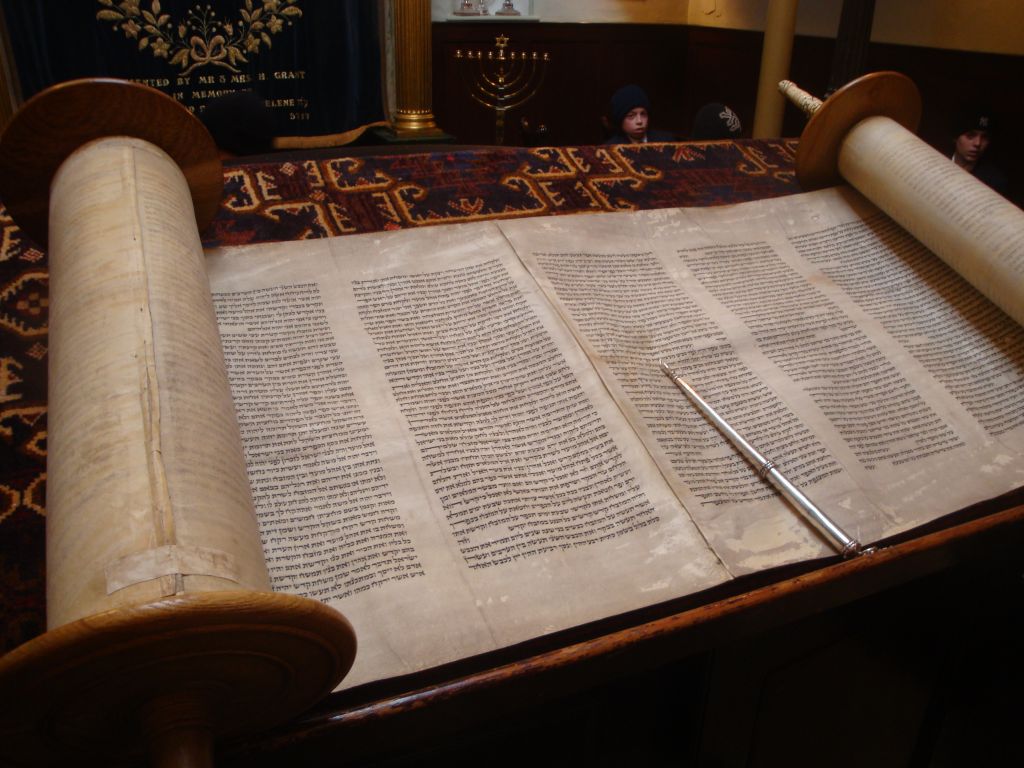


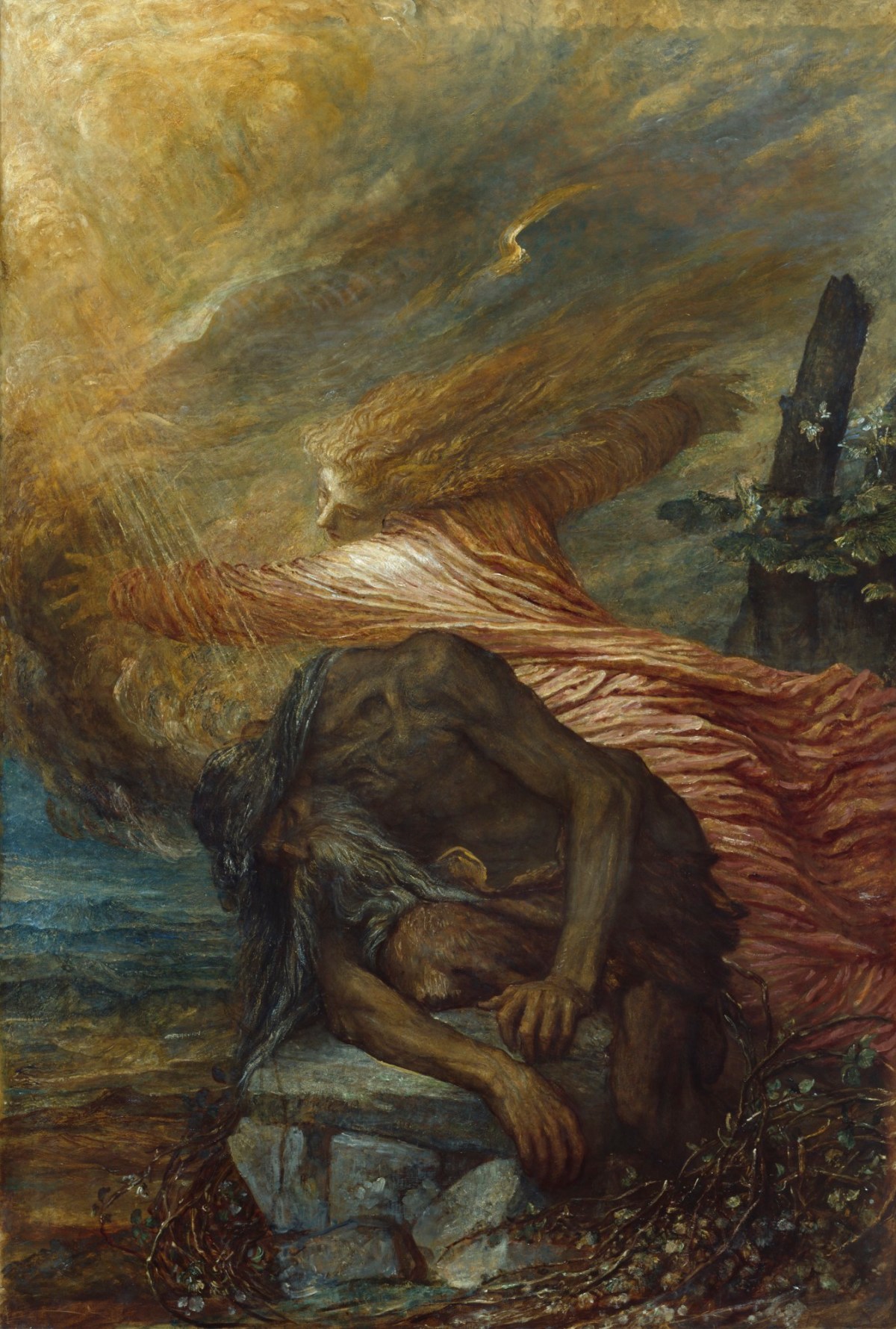


 Centro Estudios Judaicos del Sur de PR