RSS

Monthly Archives: September 2019

Los Diez Mandamientos

Los Diez Mandamientos
por Rav Zave Rudman

Explorando los monumentales eventos del Monte Sinaí.


Lectura requerida: Éxodo, capítulos 19-20.

Introducción

Probablemente la parte más fundamental de la Torá es la entrega de los Diez Mandamientos. Ningún otro evento define con tanta claridad la relación entre Dios y la humanidad. Para lograr un entendimiento profundo de lo ocurrido debemos ir más allá de la película y analizar el texto. Comencemos repasando los eventos que llevaron al Monte Sinaí (1).

Los judíos dejaron Egipto y, una semana después, cruzaron el Mar de los Juncos. Luego viajaron por el desierto hacia el Monte Sinaí. Durante este período comenzó a caer el maná, Moshé transmitió varias leyes (como el Shabat) y los judíos repelieron un ataque de Amalek. Seis semanas después del Éxodo, llegaron al Monte Sinaí, en donde toda la nación pasó una semana preparándose para recibir la Torá, lo cual ocurrió 50 días después del Éxodo, en sexto día del mes de siván.

Cuando se les ofreció la Torá a los judíos, su respuesta fue naasé venishmá, “haremos y escucharemos”. Luego la montaña se elevó en el aire y fue suspendida sobre el pueblo (2). Seguido a eso, Dios proclamó los Diez Mandamientos, por medio de lo cual toda la nación judía (hombres, mujeres y niños) participó junto a Moshé en esta experiencia profética única.

Al día siguiente, Moshé subió a la montaña y estudió el resto de la Torá junto a Dios durante 40 días y 40 noches. Cuando Moshé descendió, encontró a los judíos adorando el Becerro de Oro (3).

El objetivo del Éxodo era que los judíos recibieran la Torá, como le fue dicho a Moshé en su primera conversación con Dios en el episodio de la zarza ardiente (4). Todo lo que ocurrió hasta entonces había sido en preparación para aquel evento. Para apreciar por completo aquel monumental evento, debemos responder lo siguiente:

  • ¿Cuál fue la función de la semana de preparativos?
  • ¿Qué ocurrió realmente en el Monte Sinaí?
  • ¿Qué hay de especial sobre estos Diez Mandamientos?
  • ¿Por qué Dios suspendió la montaña sobre el pueblo?

Los preparativos

El primer prerrequisito para recibir la Torá era la unidad del pueblo judío. En el primer día de siván, los judíos llegaron a la montaña. El versículo (5) utiliza una inusual conjugación para describir su campamento. En lugar de utilizar la forma plural, el campo completo es descrito en singular, lo cual enfatiza la necesidad de unión en la entrega de la Torá (6).

Esto no es sólo un hermoso sentimiento, sino que es un punto crucial para el entendimiento de los eventos. En el Zóhar se nos enseña que hay 600.000 letras en la Torá, que equivalen a la cantidad de almas raíz de los judíos que aceptaron la Torá (7). La conclusión obvia es que cada judío tiene una letra que le corresponde en la Torá.

Pero hay un significado más profundo aún. Un rollo de Torá al que le falta una letra es inválido, sin importar cuán poco importante parezca esa letra. Esto se debe a que la Torá es más grande que la suma de sus partes. De la misma forma, si al pueblo judío le falta una persona es inválido. Cada judío tiene una función única en la composición de la nación. El pueblo judío y la Torá se reflejan mutuamente; sin unidad judía, la Torá no podría comenzar.

Los preparativos continuaron en el segundo día de siván. Moshé subió a la montaña y Dios le ordenó que le hable a la casa de Yaakov y le instruya a los hijos de Israel (8). El Midrash señala el uso doble de la idea de casa e hijos: casa se refiere a las mujeres, mientras que hijos se refiere a los hombres (9). Esto resalta otro aspecto importante de la unidad judía: si algún miembro de la nación —ya fuese hombre, mujer o niño— hubiera estado ausente en el Monte Sinaí, la Torá no hubiera sido entregada (10).

La montaña humilde

Dios le ordenó a Moshé que santificara el Monte Sinaí y que prohibiera tocar la montaña. A partir de esto podríamos asumir que el Monte Sinaí es uno de los sitios más sagrados del judaísmo. Sin embargo, a Moshé le fue dicho que después de la entrega de la Torá, esta prohibición sería anulada y la montaña podría ser utilizada incluso para pastorear ganado (11). Eso es bastante curioso, pero hay una pregunta aún más profunda sobre la ubicación que fue elegida: ¿Por qué la Torá fue dada en el desierto y no en la tierra de Israel?

La respuesta para ambas preguntas es la misma: la Torá es eterna y relevante en cualquier lugar del mundo. Además, la relación entre Dios e Israel es inherente y no está limitada a ninguna ubicación geográfica en particular. Entonces, una vez que la montaña haya servido su función, vuelve a su estado anterior (12).

A pesar de que la montaña no tiene una santidad eterna, hay un hermoso Midrash que explica por qué fue elegido el Monte Sinaí. Todas las montañas deseaban cumplir con el propósito de Dios y ser usadas para la entrega de la Torá. Todas excepto el Monte Sinaí, que sintió que no era lo suficientemente bueno para aquella elevada tarea. Cuando Dios percibió la humildad del Monte Sinaí, lo eligió como el medio para este evento, para enfatizar la importancia de dicha cualidad (13).

¿Por qué esto era tan crucial para recibir la Torá?

Podemos responder a esta pregunta postulando otra pregunta. La Torá dice: Y Dios le habló a Moshé en el desierto de Sinaí (14). ¿Por qué la Torá fue entregada en un desierto? Porque un desierto está vacío (15). Esto nos enseña que para adquirir Torá, para recibir la sabiduría de Dios, primero debemos estar dispuestos a dejar de lado la confianza en nosotros mismos, a darnos cuenta que aún tenemos mucho por aprender y a abrir un lugar en nuestro interior. Un desierto, yermo y vacío, simboliza este proceso.

Naasé Venishmá

Un aspecto clave de lo ocurrido en el Monte Sinaí fue la estridente declaración de los judíos: haremos y escucharemos. Esta declaración de aceptación absoluta de la voluntad de Dios es el paradigma de la visión judía sobre las mitzvot.

Hay dos enfoques posibles para la relación entre Dios y el hombre. Uno es que la voluntad de Dios está tan fuera del alcance de la razón humana que no hay posibilidad de entenderla y, por lo tanto, seguimos Sus mandamientos sin hacer ningún intento para entenderlos. El otro es que si Dios nos ordenó cumplir con los mandamientos, entonces nuestro intelecto debe ser suficiente para entender qué es lo que nos fue comandado; por lo tanto, si no entendemos, no estamos obligados.

Ambos enfoques son correctos, pero cada uno por sí solo no lo es.

Dios le dio al hombre el poder del intelecto, el cual le posibilita entender parte de la voluntad de Dios. Sin embargo, para que la arrogancia del hombre no le hiciera creer que su entendimiento de Dios es completo, Dios también espera que sigamos Sus mandamientos incluso sin entenderlos. Esa es la particularidad de naasé venishmá. La parte de “escucharemos” dice que debemos intentar comprender la voluntad de Dios. Sin embargo, esto viene precedido por “haremos”; es decir, nuestra primera obligación es someternos ante la voluntad de Dios, incluso cuando no la comprendamos.

Este es el fino balance: reconocer el grandioso intelecto que Dios le dio al hombre, pero al mismo tiempo entender que es limitado en lo que refiere a su percepción de Dios.

El día de la entrega de la Torá

Moshé reunió al pueblo al pie del Monte Sinaí. Se veía un gran pilar de fuego y humo emanando de la nube que estaba sobre la montaña. Entonces Moshé ascendió hacia la nube y toda la nación esperó la palabra de Dios. En ese momento, la voz y la presencia de Dios llenaron el mundo; toda la naturaleza se quedó quieta y toda la nación judía oyó y vio la voz de Dios proclamando los Diez Mandamientos. A continuación, Moshé le informó al pueblo que ascendería a la montaña por 40 días y 40 noches para recibir el resto de la Torá y para bajar con las Tablas de la Ley inscritas con los Diez Mandamientos (16).

Cada uno de los detalles de ese día tiene una gran importancia. Analizaremos unos pocos aspectos.

Maimónides escribe (17):

Los judíos no creyeron en Moshé por los milagros que realizó. Toda creencia que es meramente un resultado de milagros permanece sujeta a la duda, dado que quizás los milagros fueron hechos con magia. En el Monte Sinaí, el pueblo judío oyó a Dios llamar a Moshé y participó con él en su experiencia profética. Desde ese momento en adelante, nuestra creencia en Moshé fue establecida.

Parecería que el objetivo principal de la entrega de la Torá, más allá de los mandamientos específicos, era concretizar el saber de que Dios realmente le había hablado a Moshé y que el pueblo estuviese seguro de que el resto de la Torá había sido fielmente transmitida de Dios a Moshé. De hecho, ninguna otra religión está fundada sobre la base de una profecía colectiva nacional (18). Esto crea una relación única con Dios y con la Torá que está basada en conocimiento en lugar de fe.

Esto comienza a explicar el acertijo que postulamos sobre los Diez Mandamientos. En total, la Torá contiene 613 mandamientos, los cuales fueron transmitidos en el curso de muchos años:

  • Los primeros mandamientos fueron dados en Egipto (19).
  • Más fueron dados durante el período de 49 días entre el Éxodo y el Monte Sinaí (20).
  • La mayoría fue dada durante los 40 años en el desierto.
  • El mandamiento final fue dado a sólo días del fallecimiento de Moshé (21).

Entonces, ¿por qué fueron esos 10 mandamientos elegidos específicamente para ser dados en el Monte Sinaí? ¿Son en algún sentido más importantes que los otros 603?

En realidad no hay diferencia entre uno de los Diez Mandamientos y cualquier otra ley de la Torá. La obligación de observarlos es igual. Pero esto no hace más que fortalecer nuestra pregunta: ¿Por qué esos 10?

Los Diez Mandamientos son los principios fundamentales de las 613 mitzvot. Rav Saadia Gaón, un erudito del siglo X, delineó todos los mandamientos en 10 familias, basado en los Diez Mandamientos (22). Tratar ese tema en detalle va más allá del alcance de este artículo, pero un análisis rápido mostrará los principios de esa idea:

Como es bien sabido, los mandamientos fueron dados en dos tablas. En el cuadro vemos que los mandamientos parecieran estar claramente divididos en dos grupos: los que aplican entre el hombre y Dios, y los que aplican entre el hombre y el hombre.

Mira de cerca. Hay uno de los mandamientos que pareciera estar mal ubicado: el quinto mandamiento, Honrarás a tus padres. La explicación común de esto es que la relación entre un padre y su hijo es una metáfora de la relación entre el hombre y Dios. Desde el momento de la infancia en adelante, la forma en que un padre actúa con su hijo forma en la consciencia del niño un paradigma de la manera en que Dios se relaciona con nosotros.

Pero también podemos utilizar esto como un medio para ilustrar la forma en que cada uno de los mandamientos se expande para incluir grandes porciones de la Torá. El principio de honrar a los padres es para enseñarnos gratitud. Esto pareciera ser un acto simple, pero es tremendamente difícil. Para ser agradecido, uno debe reconocer que tiene carencias, que necesita de los demás. Quien cree que no necesita a los demás, incluso cuando reciba accidentalmente ayuda de otra persona, no sentirá gratitud. Este reconocimiento de nuestra deficiencia humana, de que vengo de algún lugar (mis padres) y de que soy dependiente, es el comienzo de aceptar a Dios.

Por lo tanto, honrar a los padres es la base de todas las mitzvot que exigen nuestra sumisión a una autoridad superior, razón por la que es parte de la primera tabla. Esta es sólo una ilustración de la forma de abordar cada uno de los Diez Mandamientos como un fundamento para el resto de la Torá.

Montaña suspendida

Antes enunciar los Diez Mandamientos, Dios suspendió la montaña sobre la cabeza de los judíos y dijo: “Si aceptan la Torá, bien. Si no, la montaña los enterrará” (23).

Como fue descrito anteriormente, el pueblo judío aceptó la Torá voluntariamente, declarando haremos y escucharemos. ¿Por qué fue necesario entonces este chantaje?

La respuesta simple es que si bien el pueblo aceptó voluntariamente cumplir la Torá, Dios quiso asegurarse que entendieran que es realmente una obligación (24).

En un sentido más profundo, la montaña suspendida sobre la nación era para reforzar la inevitabilidad de la Torá. La Torá tiene dos niveles. En un nivel, Torá es la decisión individual de cada persona y hay libre albedrío para su observancia. Sin embargo, hay otra realidad: el mundo necesita de la Torá. Un mundo sin la revelación de Dios, sin un estándar absoluto de moralidad para guiar a la humanidad, es un mundo devoto de su objetivo supremo. Entonces, una vez que la Torá fue aceptada de buena gana, Dios enfatizó la verdad ineludible de que sin la existencia de la Torá el mundo no puede existir. Sin la guía de la luz de la Torá, el mundo terminaría volviendo a su estado previo a la creación, de vacío y nada (25).


Notas:

  1. Esta es la cronología de acuerdo a como aparece en la lectura simple del texto, sin los agregados midráshicos.
  2. Talmud – Shabat 88a.
  3. El tema de nuestro próximo ensayo.
  4. Rashi (Éxodo 3:12).
  5. Éxodo 19:2.
  6. Rashi (Éxodo 19:2).
  7. Zóhar Jadash; BaMidbar Kedemot del Jidá (10:6); ver Jatam Sofer (Kóvetz Teshuvot 52).
  8. Éxodo 19:3.
  9. Midrash Rabá (Éxodo 28:2).
  10. Brisker Rav.
  11. Rashi (Éxodo 19:13) citando la Mejilta.
  12. Rashi (Éxodo 19:13) citando la Mejilta.
  13. Midrash Rabá (Números 13:3).
  14. Números 1:1.
  15. Talmud – Eruvín 54a.
  16. Éxodo 24:1 con Rashi y Rambán.
  17. Cimientos de la Torá 8:1.
  18. Ver Kuzari 1:87.
  19. Éxodo capítulo 12.
  20. Talmud – Sanedrín 56b; Rashi – Éxodo 15:25.
  21. Deuteronomio 31:19.
  22. “Azarot” por Rav Saadia Gaón; ver Rashi (Éxodo 24:12).
  23. Talmud – Shabat 88a.
  24. Tosafot (Shabat 88a, s.v. “Kafa”).
  25. Génesis 1:2; Talmud – Shabat 88a; Midrash Rabá (Éxodo 47:4).

Segun tomado de, https://www.aishlatino.com/judaismo/la-tora/temas-principales/Los-Diez-Mandamientos.html?s=mpw

 
Leave a comment

Posted by on September 7, 2019 in Uncategorized


¿Por qué los palestinos se oponen a la construcción de un hospital en Gaza?

¿Por qué los palestinos se oponen a la construcción de un hospital en Gaza?
por Bassam Tawil

Los líderes palestinos han alcanzado un nuevo nivel de obsesión, ahora están tratando de impedir la creación de un nuevo hospital en Gaza.


Apenas se puede considerar noticia que los líderes de la Autoridad Palestina estén obsesionados con el presidente de EEUU, Donald J. Trump, y su Administración. Sin embargo, lo cierto es que han alcanzado un nuevo nivel de obsesión: ahora están tratando de impedir la creación de un nuevo hospital para su población en la Franja de Gaza.

Se prevé que el nuevo hospital, que consiste en 16 departamentos, se construya cerca de la frontera de Erez que cruza entre la Franja de Gaza e Israel. El nuevo hospital fue aprobado por Israel como parte de los acuerdos de alto el fuego alcanzados en las últimas semanas con los dirigentes de Hamás de la Franja de Gaza bajo los auspicios de Naciones Unidas, Qatar y Egipto.

El hospital, de 13.000 metros cuadrados, se valdrá de la infraestructura, la experiencia y los recursos de una ONG internacional llamada Friendship, con el objetivo de mejorar considerablemente los servicios médicos a los palestinos de la Franja de Gaza.

Extrañamente, aunque Israel ha aprobado el proyecto, los funcionarios de la Autoridad Palestina siguen intentando arruinarlo. Mai Kaila, ministra de Sanidad de la Autoridad Palestina, en una reunión en su oficina en la Margen Occidental en Ramala, le dijo al coordinador adjunto de la ONU para el Proceso de Paz en Oriente Medio, Jimmy McGoldrick, el 31 de julio, que el hospital de campaña era parte de un plan para separar la Margen Occidental de la Franja de Gaza y que el Gobierno de la Autoridad Palestina considera que el plan de construir el hospital se enmarca en el “Acuerdo del Siglo”.

“Si el objetivo para crear este hospital es humano, habría sido mejor financiar y desarrollar los hospitales que ya existen en la Franja de Gaza”, dijo la ministra palestina al funcionario de la ONU. “Este proyecto se disfraza de humanidad mientras esconde un peligro aspecto político”.

Kaila le pidió al funcionario de la ONU que transmitiera un mensaje a todas las partes concernidas: en efecto, el Gobierno de la Autoridad Palestina se ha lavado las manos en lo relativo al nuevo hospital.

Uno esperaría que los líderes palestinos se hubiesen alegrado de contar con un nuevo hospital que daría servicio a los dos millones de habitantes de la Franja de Gaza. Sin embargo, estos gobernantes no tienen ningún problema en sacrificar la vida de los pacientes palestinos en el altar de su odio hacia el plan de paz.

Los funcionarios de la Autoridad Palestina han justificado su oposición a la construcción del hospital diciendo que está concebido para “separar la Margen Occidental de la Franja de Gaza”.

“El hospital que Israel y EEUU están intentando crear en la frontera norte de la Franja de Gaza es parte de los actuales intentos de separar la Franja de Gaza y la Margen Occidental bajo pretextos humanitarios”, había aseverado ya el Gobierno palestino el 8 de julio.

Esta afirmación carece totalmente de base, hasta el punto de ser surrealista.

¿Qué tiene que ver la construcción de un hospital moderno con la “separación de la Margen Occidental de la Franja de Gaza? En realidad, las dos entidades han estado políticamente separadas la una de la otra desde que Hamás derrocó con violencia el régimen de la Autoridad Palestina en la Franja de Gaza en el verano de 2007. Desde entonces, los palestinos han tenido dos mini Estados diferenciados que, de hecho, siempre han estado culturalmente separados: uno en la Margen Occidental, que antes era parte de Jordania y ahora está bajo el control del presidente Mahmud Abás y su Autoridad Palestina; y el otro, en la Franja de Gaza, antes parte de Egipto, y ahora bajo el control de Hamás y la Yihad Islámica.

A lo largo de los dos últimos años, Abás y otros líderes de la Autoridad Palestina han cogido la costumbre de culpar de todo lo que no les gusta a la Administración Trump y su “Acuerdo del Siglo”.

En lo que respecta a la Autoridad Palestina, incluso la parte económica del plan de Trump, que les ofrece miles de millones de dólares para impulsar la economía palestina y mejorar sus condiciones de vida, es una “conspiración” relacionada con el “Acuerdo del Siglo”.

La última pirueta de la Autoridad Palestina es afirmar —falsamente— que la construcción del nuevo hospital es también parte del “Acuerdo del Siglo” de Trump.

El Gobierno de la Autoridad Palestina —con Mohamed Shtayeh a la cabeza, al que Abás nombró primer ministro el mes pasado—, e ignorando por completo las necesidades de su población en la Franja de Gaza, se apresuró a rechazar el proyecto de hospital. Shtayeh y su gobierno no toman ninguna decisión salvo que haya sido aprobada por Abás. Esas decisiones son después apoyadas por los líderes de la Autoridad Palestina (incluidos Abás y sus funcionarios de la OLP y Fatah), que después las publican en sus medios oficiales.

En la campaña de la Autoridad Palestina contra el nuevo hospital, se puede ver otra prueba más de una mentalidad conspirativa que sigue siendo una epidemia entre los dirigentes palestinos. Por ejemplo, en los últimos dos años, los líderes palestinos han estado advirtiendo de una “conspiración” de EEUU e Israel para liquidar la causa palestina. Lo que parecen querer decir con esto es que cualquier propuesta de paz que no satisfaga las aspiraciones nacionales palestinas, como la de un Estado independiente con el este de Jerusalén como capital u obligar a Israel a absorber a millones de descendientes de los refugiados palestinos de una guerra que los árabes (Egipto, el Líbano, Siria, las fuerzas saudíes e Irak) iniciaron en 1948.

Aunque hasta ahora no ha salido a la luz ninguna “conspiración”, los líderes palestinos consideran simplemente que los israelíes o los estadounidenses les ofrecen una “conspiración”.

Cuando, en febrero, EEUU convocó una cumbre sobre Oriente Medio en Varsovia para intentar frustrar la invasión iraní, los líderes palestinos volvieron a afirmar que la reunión era una “conspiración” contra los árabes. De nuevo, no se causó ningún daño a los palestinos a consecuencia de la cumbre. Que los palestinos hablen de “conspiración” parecía absurdo, si no ridículo.

Algunos palestinos han llegado incluso a afirmar que la continua rivalidad entre Fatah, la facción gobernante de Abás y Hamás es fruto de una “conspiración” entre EEUU e Israel. La acusación se basa en la suposición de que Israel y EEUU no quieren la unión de los palestinos. Esta afirmación, por supuesto, tampoco tiene ninguna base: ni Israel ni EEUU tienen nada que ver con la disputa entre Fatah y Hamás. Recurrir a los intentos de algunos estados árabes para poner fin a la disputa no ha servido de nada por la falta de voluntad de Fatah y Hamás de aceptar concesiones mutuas.

La aversión de los líderes palestinos a Trump y la Administración estadounidense ha llegado al paroxismo, especialmente cuando los estadounidenses están yendo adelante con su plan de paz a pesar de la fuerte oposición palestina. Los líderes palestinos ven como la Administración Trump avanza con su plan en cooperación con algunos estados árabes, lo que para los líderes palestinos es darles la espalda a sus hermanos palestinos.

En los últimos años, los habitantes de la Franja de Gaza se han estado quejando de falta de medicinas y equipos médicos.

Si no se construye el hospital, a la población palestina de la Franja de Gaza se les habrá negado —por sus propios líderes— un recurso de incalculable valor.

Además, unos meses atrás, el Gobierno de la Autoridad Palestina anunció que iba a dejar de enviar a los palestinos a los hospitales israelíes. Esa decisión catastrófica sólo perjudicó al pueblo palestino.

El Gobierno de la Autoridad Palestina trató ilógicamente de justificar su decisión diciendo que la había tomado en respuesta a las cantidades que Israel deduce de los impuestos recaudados. Israel declara abiertamente que lo hace por los pagos que el Gobierno palestino hace a las familias de los terroristas palestinos, “presos de seguridad” y terroristas suicidas que creen que entrarán en el Paraíso como mártires o shahids, o que murieron en el transcurso de cometer un atentado contra Israel.

La Autoridad Palestina, al parar las derivaciones a los hospitales israelíes y privar a su población del acceso a un excelente tratamiento médico en Israel, ha puesto la vida de miles de sus ciudadanos en peligro. Varios palestinos han condenado la decisión por ser “equivocada”, “precipitada” y “no calculada”.

Los líderes de la Autoridad Palestina tienen razón en una cosa: una de las partes en este conflicto sí está utilizando la disputa para sus propios fines, pero no es la Administración Trump. La única parte que merece la culpa son Abás y sus socios. Están rechazando un centro médico que necesitan desesperadamente para poder seguir echando la culpa del sufrimiento de los palestinos de la Franja de Gaza a los pies de Israel. Abás parece temer que un nuevo hospital —que ha recibido la aprobación israelí— pueda quitarle el argumento de que Israel es responsable de la miseria palestina.

Abás responsabiliza a Israel de la crisis económica y humanitaria en la Franja de Gaza, mientras oculta el hecho de que en los últimos dos años ha estado imponiendo duras sanciones a los habitantes de la Franja. Una de las sanciones fue suspender el sueldo de miles de sus propios empleados y las ayudas sociales a muchas familias palestinas necesitadas.

Además, al parecer, Abás no quiere que mejoren las condiciones de vida de su gente si viven bajo el régimen de Hamás. Parece estar esperando que, si la situación en la Franja de Gaza empeora, los palestinos acabarán rebelándose contra los rivales de Abás en Hamás y los expulsen del poder. Sin embargo, mientras Hamás siga con el control absoluto de Gaza, esa esperanza parece poco realista. No hay señales de que se vaya a producir ningún desafío importante para su régimen, salvo, quizá, el de Irán. Como era de esperar, los mulás de Irán han estado utilizando a Hamás como otro de sus satélites regionales, que ahora incluye a los huzis en el Yemen y a Hezbolá en el Líbano.

Por último, la Autoridad Palestina ha rechazado el nuevo hospital por una triste y vieja razón: al parecer quiere que todos los proyectos internacionales se canalicen exclusivamente bajo sus auspicios, lo que sin duda le facilita echarles la mano a buenas cantidades de dinero y transferirlo a las arcas personales de sus líderes.

La Autoridad Palestina es probablemente el único gobierno del mundo que considera la creación de un nuevo hospital una “conspiración”. Queda por ver si la comunidad internacional cederá a la campaña de Abás y abandonará el proyecto de hospital, o si decidirá ayudar al pueblo palestino, cuyos líderes sólo saben ayudarse a sí mismos.

Segun tomado de, https://www.aishlatino.com/iymj/mo/Por-que-los-palestinos-se-oponen-a-la-construccion-de-un-hospital-en-Gaza.html?s=hp2

 
Leave a comment

Posted by on September 7, 2019 in Uncategorized


The Problem With Astrology

by Menachem Feldman

The Torah’s position is clear: Although it was common for the nations of ancient Canaan to seek counsel from astrologers, for a Jew, astrology is off limits.

For these nations that you are possessing – they hearken to astrologers and diviners; but as for you – not so has Hashem your G‑d given for you.1

The Jews may wonder, how will we survive with this disadvantage? While the other nations could look to their astrologers to guide them in everything from planning war to picking stocks, we will be in the dark! But Moses puts them at ease, reassuring them that they will have a different source of information:

A prophet from your midst, from your brethren, like me, shall Hashem, your G‑d establish for you—to him shall you hearken.2

The question, of course, is what is the difference between a prophet and an astrologer? If listening to an astrologer is so terrible, why are we not only permitted, but in fact commanded, to listen to the prophet? The question intensifies when one realizes that while astrologers are not always accurate predictors of the future, prophets have a far from perfect track record too. Perhaps the most famous prediction gone wrong was the prophecy of Jonah, which warned that the great city of Nineveh would be destroyed 40 days henceforth, when in fact no such thing happened. The people of Nineveh repented and G‑d averted the terrible decree.

Why wasn’t the prophecy realized? Only a good prediction must materialize; G‑d is compassionate and may avert a negative event up until the very last moment.

The astrologers, by contrast, claim to be straightforward and leave no room for their predictions to change.

Why then would we want to listen to a prophet, whose prophecy may or may not come to fruition?

Although it may not seem so on the surface, the prophet and the astrologer are not actually in the same line of business. Their mission statements could not be further apart.

The astrologer predicts a person’s destiny based on his or her personality, nature, or spiritual make-up. In some ways, the information is very useful. Why should a person spend a lifetime trying to discover which things he will succeed or fail at, when he can presumably take a shortcut and get the information directly from an astrologer? But implied in the message of the astrologer is that a person cannot change; his nature is his nature, and that determines his future.

The prophet, however, is not in the business of predicting the future. The prophet’s role is to inspire a person to break out of his or her nature, to break free of his destiny, and to understand that there is no barrier to spiritual growth that cannot be shattered. The astrologer limits a person, while the prophet liberates him.

When Nineveh was spared, Jonah was terribly angry. Initially, he had tried to escape his mission precisely because he was afraid that G‑d would not ultimately destroy the city, putting his reputation as a professional predictor of the future into severe jeopardy. No one would ever trust his predictions again. G‑d was upset at Jonah’s anger, precisely because Jonah had entirely missed the point of prophecy. He did not realize that had his prediction succeeded, his mission would have failed, for the prophet’s mission is not to define a person’s destiny, but to tell him that he can change and become a new person anytime he so desires.

Although we are no longer in the era of the prophets, we must take the message to heart, ignore our inner astrologer and listen to our inner prophet. The greatest impediment to growth, both spiritual and material, is the voice inside us which tells us that after all these years we know who we are, we know our strengths and weaknesses, we know where we will succeed and where we will fail, what we can hope for, and what we shouldn’t even dream about. We have it all figured out.

The commandment to heed the prophet, in the portion of Shoftim, is read during the month of Elul, the month of introspection and repentance leading up to the New Year. And we read the book of Jonah on Yom Kippur, the Day of Atonement, because as we prepare for the New Year, we must listen to the voice of prophecy. We must understand that whatever our nature is, we cannot and must not allow it to limit us. We must understand that G‑d gives us the power to break out of our limitations, to change, and to become the person we know we should be.

Footnotes

1.Deuteronomy 18:14.

2.Ibid. 18:15.

As taken from, https://www.chabad.org/parshah/article_cdo/aid/4460800/jewish/The-Problem-With-Astrology.htm

 
Leave a comment

Posted by on September 6, 2019 in Uncategorized


Darwinism, Judaism and the clash between science and religion

by Melanie Phillips

The West’s concept of reason actually comes from the Hebrew Bible. Ideas such as an orderly and rational universe structured on a linear concept of time were revolutionary concepts introduced in the book of Genesis.

Yale University professor of computer science David Gelernter has renounced his previous belief in Darwinian evolution.

Writing that he was sad to give up on “a brilliant and beautiful scientific theory,” he said he had concluded that it couldn’t explain the big picture – not the fine-tuning of existing species, but the emergence of new ones.

Whether or not his argument is well-founded is a discussion for another time. The point here is that it’s unsayable by anyone who isn’t prepared to risk professional and social suicide.

Darwinism, said Gelernter, had passed beyond a scientific argument. Although his Yale colleagues had treated him in a courteous and collegiate manner, people took their life in their hands to question Darwinian evolution.

“They will destroy you if you challenge it,” he said. There was nothing approaching free speech on this topic. “It’s a sort of bitter, fundamental, angry, outraged, violent rejection, which comes nowhere near scientific or intellectual discussion.”

Gelernter’s conclusions about Darwinism have derived principally from his analysis of the statistical probability of the evolution of new species. Yet anyone who queries Darwinism is immediately labeled “anti-science” and accused of being a religious nut.

Indeed, the pushback against Gelernter’s apostasy has included the observation that he is a religious Jew. Apparently, the only reason he could possibly have come to this “denialist” conclusion, says one pro-evolution website, is that he views science through “Old Testament goggles.”

In fact, a belief that’s unchallengeable has the characteristic of religious faith. That’s why Gelernter calls Darwinism a religion.

There are plenty of other unsayables in our thought-policed society. Human-made global warming, for example, is considered beyond challenge because the science of that theory is said to be “settled.” This is, in fact, anti-science dogma because nothing is ever settled in science, which is always open to fresh challenges.

So how come our scientific age promotes anti-science ideas more akin to religious doctrine and calls them science?

Our era is supposedly devoted to promoting individual freedom, tolerance and an end to prejudice. So why are so many views being silenced? Why has debate been so widely replaced by hateful insults? And how come this has been accompanied by an upsurge in anti-Semitism, often among precisely the same subscribers to the liberal anti-racist “woke” agenda?

There may be a connection here that is generally overlooked. And it involves the Jews.

At the core of all this moral and intellectual confusion lies an onslaught against the core principles of Western civilization on the grounds that these are innately exclusive, prejudicial and oppressive.

That’s because they are rooted in biblical values that are held to be cruel, obscurantist and inimical to reason, enlightenment, and generosity of spirit.

By contrast, the secular agenda is believed to stand for all good things associated with modernity, such as kindness, rationality, and progress.

The West tells itself that modernity sprang from a repudiation of religion in the 17th-century Enlightenment.

In fact, as a new book points out, Christianity remains at the core of contemporary Western thinking even among those who disdain it. “Dominion,” by the British historian Tom Holland, is a magisterial analysis of the way in which Christian values have shaped the West and still do so even in the most unlikely places.

His book is not merely a fascinating account of the extraordinary reach and persistence of Christianity, which has evolved and adapted down through the generations and across societies. He also argues that Christian values, which have sometimes led to slavery, empire, and war, nevertheless lie at the core of what makes the West civilized and good.

This has startled people for whom it is axiomatic that only secularism produces goodness while religion produces only bad stuff. But Holland points out that even attacks by secular liberals on Christian thinking are motivated by Christian values of tolerance and fairness.

Of course, there’s an elephant in this particular room. For although these core Western principles were introduced and spread by Christianity, their origin lay in the Hebrew Bible.

Holland pays due regard to the Jewish foundations of Christianity and also to the terrible way that Christianity has behaved in the past towards the Jews.

But what so many overlook is that moral principles assumed to have been invented by Christianity, such as compassion, fairness, looking after the poor or putting others first, were all introduced to the world by the Hebrew Bible.

It is Judaism’s Mosaic code that gave the West its conscience and the roots of its civilization by putting chains on people’s selfish appetites. And strikingly, every contemporary ideology that aims to undermine or transform the West is based on opposition to Jewish religious beliefs, Jewish moral codes or the Jewish homeland in Israel.

Deep green environmentalism, for example, wants to knock human beings off their pedestal in Genesis as the pinnacle of creation; sexual lifestyle choice negates Judaism’s moral codes; scientific materialism repudiates belief in the Divine creator of the world; anti-Zionism denies the Jews’ right to their own homeland; and liberal universalism is an innate challenge to Judaism which, as a stubbornly and uniquely distinct set of beliefs, always stands in the way of any universalizing ideology.

Much of this secular onslaught goes back to the central Enlightenment idea of a world based on reason, which French Enlightenment thinkers in particular perceived to be in opposition to religion.

But the West’s concept of reason actually comes from the Hebrew Bible. Ideas such as an orderly and rational universe structured on a linear concept of time were revolutionary concepts introduced in the book of Genesis.

These ideas were essential to the development of Western science. Early scientists believed that natural laws necessarily presupposed a law-giver. As Galileo Galilei said: “The laws of nature are written by the hand of God in the language of mathematics.”

The opposition between religion and science that is assumed to be fundamental by secular liberals is, in fact, foreign to Judaism. With so much of the Hebrew Bible interpreted over the centuries as allegory or metaphor, Judaism has never seen science as a threat.

The 12th-century Jewish sage Maimonides was the great exemplar of the belief that science and religion were complementary. He wrote that conflict between science and the Bible arose from either a lack of scientific knowledge or a defective understanding of the Bible.

Without the Hebrew Bible, there would have been no Western rationality or principles such as justice or compassion. But secularism holds that the rule of reason divorced from biblical religion would banish bad things like prejudice or war from the world and the human heart.

Impossible utopianism like this invariably results in oppression. So it proved with medieval apocalyptic Christianity, the French Revolution, communism and fascism; and so it is proving today with the cultural totalitarianism of the Left.

Like all utopians, the Left believes that their ideas are unchallengeable because they supposedly stand for virtue itself. All who oppose them are therefore not just wrong, but evil. So heretics like Gelernter must be stamped out because no quarter can ever be given to any challenge to secularism.

What secular liberals don’t understand is that in attacking the Jewish concepts at the core of the Christian West, they are not merely repudiating their own supposed ideals of tolerance and rationality, but are sawing off the branch on which they themselves are sitting.

As taken from, https://www.israelhayom.com/opinions/darwinism-judaism-and-the-clash-between-science-and-religion/

 
Leave a comment

Posted by on September 6, 2019 in Uncategorized


Palestinian Professor: Bible Lied About Jewish Temple on Temple Mount, No Archaeological Proof

“At that time, they shall call Yerushalayim “Throne of Hashem,” and all nations shall assemble there, in the name of Hashem, at Yerushalayim. They shall no longer follow the willfulness of their evil hearts.” Jeremiah 3:17 (The Israel Bible™)

A view of the Temple Mount from the Davidson Archaeological gardens. (Credit: Seth Aronstam/Shutterstock.com)

The head of the Department of History and Archaeology at the Islamic University of Gaza, Dr. Ghassan Weshah told Felesteena Gazan news service, in an interview this week that there was no archaeological evidence of a Jewish Temple on the Temple Mount.

“One of the biggest lies of the Zionists with regard to the Al-Aqsa Mosque is that it was built on the ruins of the Temple, which was destroyed on August 21, 586 BCE,” Prof. Weshah said in the interview. “This is a false statement. There is no other building under the Al-Aqsa Mosque.”

“Engineering scientists said that what is under the Al-Aqsa Mosque are sedimentary stones from the Canaanite period and they never talked about any rubble,” Pro. Weshah said. He emphasized that the “Zionists” could not find anything under the Al-Aqsa Mosque despite the excavations they do. He also noted that the excavations performed in the construction of the Marwani Mosque confirmed this.

The Waqf began built the Marwani Mosque in what was formerly called Solomon’s Stables in 1996, without a permit and in gross violation of the status quo agreement signed two years earlier in which Israel granted custodianship to Jordan. It is the largest mosque in Israel with space for 10,000 worshippers. The builders used heavy equipment to clear the site, destroying artifacts of immense archaeological importance and damaging the structural integrity of the southern wall of the Temple Mount. The construction resulted in over 400 truckloads of material containing artifacts being removed from the Temple Mount and dumped in landfills.  Much of the material was lost but the Sifting Project directed by Dr. Gabriel Barkay has succeeded in recovering countless remnants from the Jewish Temples.  His results  include a reconstruction of the tile floor from a section of the Temple. The underground mosque is always open to Muslims but prayers are only held there on Muslim holidays when rain or heat makes outdoor prayer uncomfortable. In many of the available photos, Muslims are seen using the site as a place to sleep or socialize.

It is important to note that the Waqf does not permit any archaeological studies to take place on the Temple Mount and reject any efforts to preserve artifacts, even those with significance to Islam. In 1929, a massive earthquake caused the roof of the silver-domed Aqsa Mosque to collapse. The roof was repaired using new beams but the original beams were studied by Robert W. Hamilton, director of antiquities for the British Mandate. He described most of the beams and wooden panels as being from the early Islamic Ummayad Dynasty from the Eighth Century. The best examples were taken to be displayed at the Rockefeller Museum near Jerusalem where they are on display to this day. Many of the beams were left outside on the Temple Mount. Some of the beams were sold to an Armenian wood merchant and even more disappeared.

In the 1970’s, the beams were checked by a team of Israeli botanists who determined that most of them were cedars from Lebanon and some are Cyprus trees. They carried out Carbon-14 tests on several of the timbers.  Some were determined to have been felled about 1,340 years ago which is approximately when al Aqsa Mosque was originally built. One cypress beam was determined to be was found to be 2,600 years, or around 630 BCE, around 50 years before the destruction of the First Temple.

Shockingly, one of the oak beams was determined to be 2,860 years old, cut down around 880 BCE, early in the First Temple period.

About a decade ago, the Israeli Antiquities Authority wanted to preserve the beams but the Waqf insisted the beams are their property. There have been unconfirmed sightings of some of the beams stored next to the Golden Gate being burned.

Professor Weshah claimed that museums have confirmed that artifacts that seem to indicate a historic Jewish presence in the land are, in fact, fake.

“He pointed out that no matter how the Zionists tried to falsify some of the artifacts and claim that they prove their presence in Palestine, the largest and most famous museums in the world discovered the falsification by the occupation of these pieces and refused to exhibit any artifact coming from the occupation state to display in international museums because they are forged.”

The professor went on to say that “Facts refute all the promises mentioned in the Torah are prove that they are lies. It affirms that Palestine is Arab land and is part of the Arabian Peninsula, where the [Palestinians] settled thousands of years before the Jews.”

The professor did not address the description of the Jewish Temples that appear at least twice in the Koran.

As taken from, https://www.breakingisraelnews.com/136689/palestinian-professor-bible-lied-about-jewish-temple-on-temple-mount/?mc_cid=5f8add1102&mc_eid=3dced499f3

 
Leave a comment

Posted by on September 6, 2019 in Uncategorized


¿Se puede sanar el alma cuando uno ha actuado equivocadamente?

¿Se puede sanar el alma cuando uno ha actuado equivocadamente?
por Becky Krinsky

Todo lo que se daña, se puede reparar, si se tiene la intención y conciencia del daño causado.


No creo conocer a alguna persona que en su sano estado mental diga “yo soy mala y busco lastimar a todos los que me rodean”, de hecho, muchas personas que están en la cárcel, insisten que son inocentes y que tenían una “buena razón” para actuar.

Es difícil y quizá injusto categorizar a una persona como ‘buena’ o ‘mala’. Cada persona tiene su historia y es imposible juzgar sin conocer lo que esta persona ha vivido, aprendido y entiende que es la manera correcta de actuar.

A pesar de que sería interesante entender los motivos y los temas morales que motivan a las personas a actuar de determinada manera, este ensayo tiene el propósito de ver cómo se puede sanar cuando se actúa equivocadamente, cómo dejar de sentirse mal con uno mismo y cómo se puede recuperar el sentimiento de bondad y paz emocional.

Ser y actuar como una buena persona, es sin duda un trabajo que requiere disciplina, esfuerzo, conciencia y sobre todo, es una acción que se tiene que nutrir a diario. Cada quien tiene el poder y la oportunidad de elegir en cada momento cómo quiere actuar. Siempre se puede cambiar de parecer de un momento a otro.

El alma desea vivir bien, busca su paz, necesita armonía y balance para poder desarrollar sus potencialidades y vivir en plenitud. Es terrible cargar la culpabilidad y el malestar por sentirse malvado o haber actuado erróneamente.

A pesar de que uno puede tener buenas intenciones y hacer “buenas” acciones, hay ocasiones en que las cosas no se dan como uno espera y sin querer o por una intensión mal encaminada, uno puede lastimar, echar a perder, herir y causar mucho más daño de lo que esperaba.

Hay ocasiones que uno cree que se está actuando con buenas intenciones y en realidad está causando mucho dolor y actuando equivocadamente. Por ejemplo:

Esteban insiste que él es el hijo bueno de su familia. Toda acción que hace, cada palabra que dice cada pensamiento los tiene premeditados, a toda costa insiste en demostrar su bondad… pero NO le importa si sus acciones confrontan, dañan las relaciones entre sus hermanos o si ofende cuando habla. Su necesidad por ser el mejor lo ha cegado del dolor y los problemas que ha causado. ¿El daño y el dolor que causa justifican sus principios por ser el mejor hijo?

El problema de estar convencido de que uno es bueno y tiene las mejores intenciones radica en que su convicción le impide ver la realidad y el daño colateral que causa es imposible de sanar si no lo puede reconocer.

Uno tiene que actuar en armonía con el universo y debe de buscar el bien para todos y no sólo para sus necesidades, la bondad no se justifica, se ve y se siente claramente y sin explicaciones.

La receta: Para ser una buena persona

Ingredientes

  • Honestidad – reconocer y diferenciar las intenciones de los intereses personales
  • Conciencia – responsabilidad personal y de las consecuencias que causan las acciones
  • Humildad – perspectiva de cada quien en el entorno del universo
  • Consideración – sensibilidad hacia los demás y respeto a la armonía global
  • Fortaleza – para reconocer cuando uno ha lastimado y tener el valor para repararlo

Afirmación positiva

Soy una persona buena. Busco armonía y paz en mis relaciones con las personas y con el mundo. Tengo la sensibilidad para reconocer que hay veces que me equivoco y creo que hago las cosas con buenas intenciones pero puedo lastimar sin darme cuenta. Logro ver el dolor que le causo a los demás y asumo mi responsabilidad para reparar mis acciones.

Como se puede ser una persona buena:

  1. Ser bueno es una acción que se aprende y se perfecciona diariamente. El ser una persona buena es el resultado de nutrir la conciencia con pensamientos positivos y con acciones responsables y armoniosas.
  2. Toda oportunidad que surge es una posibilidad que ofrece el mundo para ser mejor persona. La vida está llena de momentos que si se aprovechan se pueden convertir en las mejores ocasiones para fortalecer la personalidad y transformar un simple momento en un acto extraordinario, creando paz y fortaleciendo las relaciones.
  3. La bondad proviene del corazón. Se hace el bien porque es lo correcto para todos, nunca para satisfacer necesidades personales y egoístas. No se busca impresionar, ni se trata de imponer, sólo se busca hacer el bien y sentirse en paz y armonía con uno mismo y con el mundo.

“Uno es tan sano y bueno como la calidad de sus relaciones personales”.

Segun tomado de, https://www.aishlatino.com/fm/recetas-para-la-vida/Se-puede-sanar-el-alma-cuando-uno-ha-actuado-equivocadamente.html?s=mm

 
Leave a comment

Posted by on September 6, 2019 in Uncategorized


The Ecological Imperative

Image result for rain drop in a leaf

by Rabbi Jonathan Sacks

In the course of setting out the laws of war, the Torah adds a seemingly minor detail that became the basis of a much wider field of human responsibility, and is of major consequence today. The passage concerns a military campaign that involves laying siege to a city:

When you lay siege to a city for a long time, fighting against it to capture it, do not destroy its trees by putting an axe to them, because you can eat their fruit. Do not cut them down. Are the trees people, that you should besiege them? However, you may cut down trees that you know are not fruit trees and use them to build siege works until the city at war with you falls. (Deut. 20:19–20)

War is, the Torah implies, inevitably destructive. That is why Judaism’s highest value is peace. Nonetheless, there is a difference between necessary and needless destruction. Trees are a source of wood for siege works. But some trees, those that bear fruit, are also a source of food. Therefore, do not destroy them. Do not needlessly deprive yourself and others of a productive resource. Do not engage in a “scorched earth” tactic in the course of war.

The Sages, though, saw in this command something more than a detail in the laws of war. They saw it as a binyan av, a specific example of a more general principle. They called this the rule of baltashchit, the prohibition against needless destruction of any kind. This is how Maimonides summarises it: “Not only does this apply to trees, but also whoever breaks vessels or tears garments, destroys a building, blocks a wellspring of water, or destructively wastes food, transgresses the command of bal tashchit.”[1] This is the halachic basis of an ethic of ecological responsibility.

What determines whether a biblical command is to be taken restrictively or expansively? Why did the Sages take this seemingly minor law to build out a wide halachic field? What led the Sages in the direction they took?

The simplest answer lies in the word “Torah”. It means law. But it also means: teaching, instruction, direction, guidance. The Torah is a lawbook like no other, because it includes not only laws but also narratives, genealogies, history, and song. Law as the Torah conceives it is embedded in a larger universe of meanings. Those meanings help us understand the context and purpose of any given law.

So it is here. First and foremost is the fact that the earth is not ours. It belongs to its Creator, to God Himself. That is the point of the first chapter of the Torah: “In the beginning, God created…” He made it; therefore He is entitled to lay down the conditions within which we live in it as His guests.

The logic of this is immediately played out in the story of the very first humans. In Genesis 1 God commands humanity: “Fill the earth and subdue it. Rule over the fish in the sea and the birds in the sky and over every living creature that moves on the ground” (1:28). “Subdue” and “rule” are verbs of dominance. In Genesis 2, however, the text uses two quite different verbs. God placed the first man in the Garden “to serve it [le’ovdah] and guard it [leshomrah]” (2:15). These belong to the language of responsibility. The first term, le’ovdah, tells us that humanity is not just the master but also the servant of nature. The second, leshomrah, is the term used in later biblical legislation to specify the responsibilities of one who undertakes to guard something that is not their own.

How are we to understand this tension between the two opening chapters? Quite simply: Genesis 1 tells us about creation and nature, the reality mapped by the natural sciences. It speaks about humanity as the biological species, Homo sapiens. What is distinctive about humans as a species is precisely our godlike powers of dominating nature and exercising control of the forces that shape the physical world. This is a matter of fact, not value, and it has increased exponentially throughout the relatively short period of human civilisation. As John F. Kennedy put it in his inaugural presidential address: “Man holds in his mortal hands the power to abolish all forms of human poverty and all forms of human life.”[2] Power is morally neutral. It can be used to heal or wound, build or destroy.

Genesis 2, by contrast, is about morality and responsibility. It tells us about the moral limits of power. Not everything we can do may we do. We have the power but not the permission; we have the ability but not the right. The earth is not ours. It belongs to God who made it. Therefore we are not the owners of nature but its custodians. We are here to serve it and care for it.

This explains the story that immediately follows, about Adam, Eve, the serpent, and the forbidden fruit. What the fruit was, why the serpent spoke, and what was the nature of the first sin – all these are secondary. The primary point the Torah is making is that, even in paradise, there are limits. There is forbidden fruit. Not everything we can do may we do.

Few moral principles have been forgotten more often and more disastrously. The record of human intervention in the natural order is marked by devastation on a massive scale.[3] Within a thousand years, the first human inhabitants of America had travelled from the Arctic north to the southernmost tip of Patagonia, making their way through two continents and, on the way, destroying most of the large mammal species then extant, among them mammoths, mastodons, tapirs, camels, horses, lions, cheetahs, and bears.

When the first British colonists arrived in New Zealand in the early nineteenth century, bats were the only native land mammals they found. They discovered, however, traces of a large, ostrich-like bird the Maoris called “moa.” Eventually skeletons of a dozen species of this animal came to light, ranging from three to ten feet high. The remains of some twenty-eight other species have been found, among them flightless ducks, coots, and geese together with pelicans, swans, ravens, and eagles. Animals that have not had to face human predators before are easy game, and the Maoris must have found them a relatively effortless source of food.

A similar pattern can be traced almost everywhere human beings have set foot. They have consistently been more mindful of the ability to “subdue” and “rule” than of the responsibility to “serve” and “guard.” An ancient Midrash sums this up, in a way that deeply resonates with contemporary ecological awareness: When God made Adam, He showed him the panoply of creation and said to him: “See all My works, how beautiful they are. All I have made, I have made for you. Take care, therefore, that you do not destroy My world, for if you do, there will be no one left to mend what you have destroyed.”[4]

Environmental responsibility seems to be one of the principles underlying the three great commands of periodic rest: Shabbat, the Sabbatical year, and the Jubilee year. On Shabbat all agricultural work is forbidden, “so that your ox and your donkey may rest” (Ex. 23:12). It sets a limit to our intervention in nature and the pursuit of economic growth. We remind ourselves that we are creations, not just creators. For six days the earth is handed over to us and our labours, but on the seventh we may perform no “work,” namely, any act that alters the state of something for human purposes. Shabbat is thus a weekly reminder of the integrity of nature and the limits of human striving.

What Shabbat does for humans and animals, the Sabbatical and Jubilee years do for the land. The earth too is entitled to its periodic rest. The Torah warns that if the Israelites do not respect this, they will suffer exile: “Then shall the land make up for its Sabbatical years throughout the time that it is desolate and you are in the land of your enemies; then shall the land rest and make up for its Sabbath years” (Lev. 26:34). Behind this are two concerns. One is environmental. As Maimonides points out, land which is overexploited eventually erodes and loses its fertility. The Israelites were therefore commanded to conserve the soil by giving it periodic fallow years, not pursuing short-term gain at the cost of long-term desolation.[5] The second, no less significant, is theological: “The land,” says God, “is Mine; you are but strangers and temporary residents with Me” (Lev. 25:23). We are guests on earth.

Another set of commands is directed against over-interference with nature. The Torah forbids crossbreeding livestock, planting a field with mixed seeds, and wearing a garment of mixed wool and linen. These rules are called chukim or “statutes.” Samson Raphael Hirsch (Germany, 1808–1888) in the nineteenth century, like Nachmanides six centuries earlier, understood chukim to be laws that respect the integrity of nature. They represent the principle that “the same regard which you show to man you must also demonstrate to every lower creature, to the earth which bears and sustains all, and to the world of plants and animals.” They are a kind of social justice applied to the natural world: “They ask you to regard all living things as God’s property. Destroy none; abuse none; waste nothing; employ all things wisely…. Look upon all creatures as servants in the household of creation.”[6]

So it was no accident that Jewish law interpreted the prohibition against cutting down fruit-bearing trees in the course of war as an instance of a more general prohibition against needless destruction, and more generally still, against acts that deplete earth’s non-renewable resources, or damage the ecosystem, or lead to the extinction of species.

Václav Havel made a fundamental point in The Art of the Impossible: “I believe that we have little chance of averting an environmental catastrophe unless we recognise that we are not the masters of Being, but only a part of Being.”[7] That is why a religious vision is so important, reminding us that we are not owners of our resources. They belong not to us but to the Eternal and eternity. Hence we may not needlessly destroy. If that applies even in war, how much more so in times of peace. “The earth is the Lord’s and all that is in it” (Ps. 24:1). We are its guardians, on behalf of its Creator, for the sake of future generations.

Shabbat Shalom

NOTES

[1]  Maimonides, Mishneh Torah, Hilchot Melachim 6:10.

[2] Washington, DC, January 20, 1961.

[3] Jared Diamond’s Guns, Germs, and Steel (New York: W. W. Norton, 1997) and Collapse: How Societies Choose to Fail or Succeed (New York: Viking Penguin, 2005) are classic texts on the subject.

[4] Ecclesiastes Rabbah 7:13.

[5] Maimonides, Guide for the Perplexed, III:39.

[6] Samson Raphael Hirsch, The Nineteen Letters, letter 11.

[7] Václav Havel, The Art of the Impossible (New York: Knopf, 1997), 79.

As taken from, https://mailchi.mp/rabbisacks/shoftim-5779-244311?e=97ac870b13

 
Leave a comment

Posted by on September 4, 2019 in Uncategorized


Why is the chief rabbi acting like the pope?

by Susan Weiss

Get-refusal is a heinous, vengeful act that must be eradicated – but not without due process, and the other protections of a democracy separated from religion

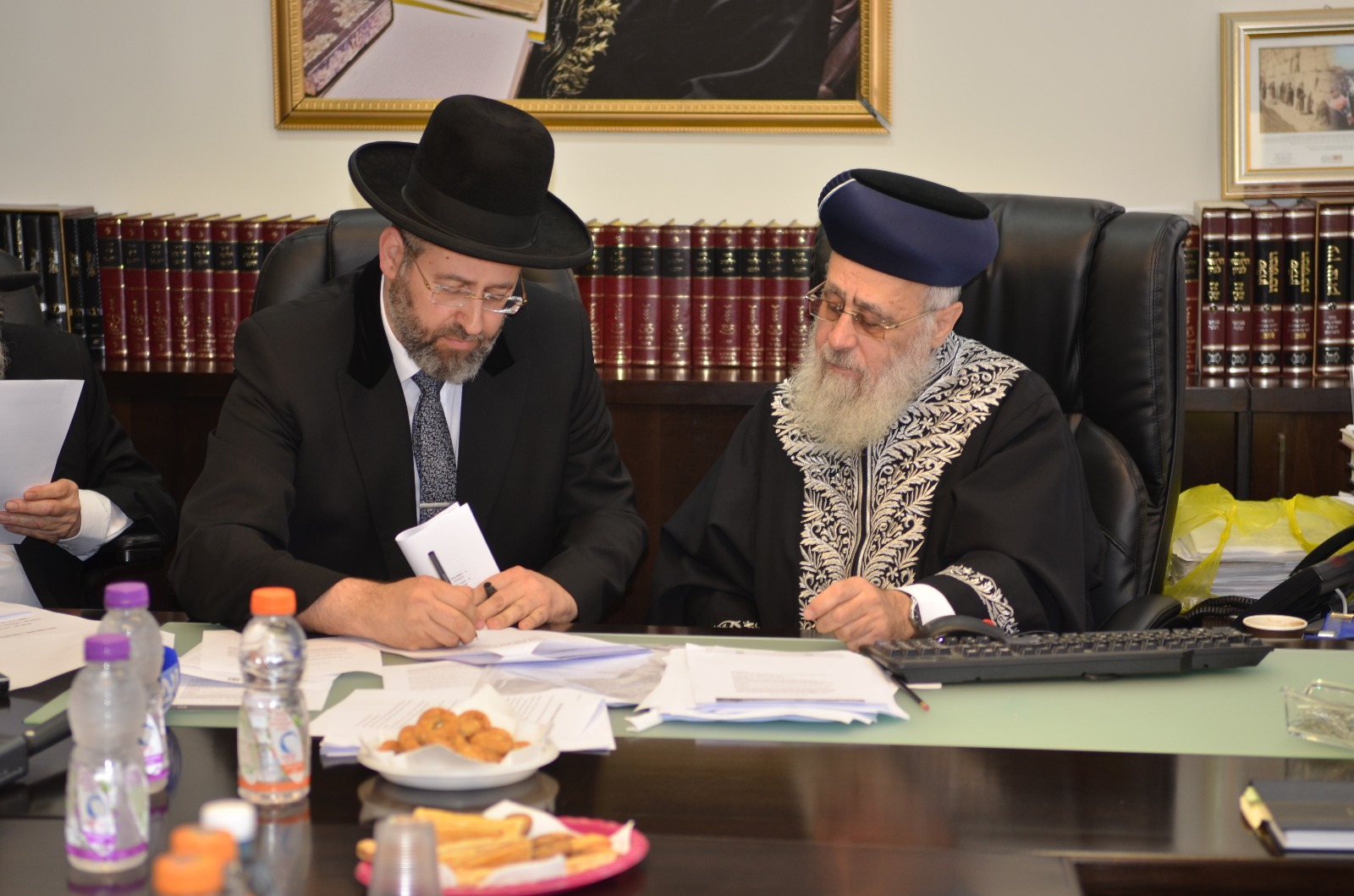
Illustrative. Ashkenazi Chief Rabbi David Lau (L) and Sephardi Chief Rabbi Yitzhak Yosef convene an emergency meeting against a new proposal to overhaul the conversion to Judaism system in the country on June 3, 2018. (courtesy, the Chief Rabbinate spokesperson)

Illustrative. Ashkenazi Chief Rabbi David Lau (L) and Sephardi Chief Rabbi Yitzhak Yosef convene an emergency meeting against a new proposal to overhaul the conversion to Judaism system in the country on June 3, 2018. (courtesy, the Chief Rabbinate spokesperson)

A few years back, a colleague informed me that she thought the New York Get Laws were unconstitutional, dangerously entangling the state in religious affairs. Passed in 1983 and 1992, the laws encourage Jewish husbands to deliver religious divorces (“gets”) to their wives. The laws preclude judges from entertaining a civil divorce suit filed by husbands who fail to “remove all barriers to remarriage”; and, they also allow judges to take the failure to give a get into account when making equitable distribution of marital property. A long-standing activist for Jewish women, I retorted flippantly that “Maybe my colleague was right, but I didn’t care.” 

I should have. Theocracies — states who answer to clerics speaking for God and are oblivious  to the Rule of Law and basic civil liberties — are dangerous. A recent case is illustrative. Two weeks ago, Israeli Chief Rabbi Meir Lau ordered Jerusalem undertakers to halt a burial. At the request of the Union of Orthodox Rabbis of America, Lau was trying to force the hand of the deceased’s son. Lau claimed that the man, an American citizen and resident, had been withholding a get for the past 15 years from a woman from whom he had been civilly divorced. After the man’s family agreed to post a bond to guarantee the get, the burial commenced. Immediately afterwards, however, the man announced that he had had no intention of delivering the get. He said that he had already deposited one with an American rabbinic court. Responding, his divorcee, who is also an American citizen and resident, claimed that the man’s designated court was not reputable. She also was not satisfied with the  decree of annulment that had been issued at her request by the International Beth Din, located in New York City. She wanted a “more” kosher get, one recognized by the Israeli Rabbinate. Lau agreed. 

Much criticism has been levelled at the above events, most aimed at Lau, at Jewish law, and obviously at the get-refuser. Some criticism was even directed at the divorcee. However, no one criticized the elephant in the room: the fact that the democratic state of Israel has entangled itself with religion to such an extent that it has constructed a partial theocracy which violates the civil liberties of its citizens — as well as foreign citizens — without it, or them, even noticing. 

Theocracies violate due process. 

In the case at hand, the chief rabbi, a state actor who is the apparent head of Israel’s theocratic arm, violated the rights of the deceased and her family to a fair trial. Not only was no trial or investigation conducted before the chief rabbi took action, he did not even summon a response from ANY of the parties involved — not even the woman in whose benefit he claimed to be acting. Not to mention the fact that no law or regulation on the books of the state gives him authority to make any order to allow or deny a burial.

Theocracies do not respect privacy. 

Here, the chief rabbi violated the privacy and dignity of the deceased, with impunity, because he could. By disrespecting the body of the deceased, he abused the state’s obligation to preserve the dignity of persons, and abused its limited privilege to exercise violence within its geographic boundaries.

Theocracies confiscate  properties.  

In the matter under discussion, the chief rabbi interfered with the private contract entered into between the deceased and the Jerusalem Burial Society. Aside from this being a tortious interference with a contract by a third party that would entitle the family to sue the chief rabbi personally for damages, it is tantamount to a state violation of the core civil liberties  of persons to own property and contract with other persons and entities.

Theocracies coerce religious behavior. 

In this instance, the chief rabbi attempted to coerce the religious activity of a man in a manner that he deemed religiously inappropriate. Though the man argued that he had already done the religious act, and although the woman had already found relief in a private, religious court of her choice, the chief rabbi imposed his religious conscience on all parties involved. 

Theocracies do not respect their limited geographical jurisdiction. 

Perhaps most appallingly, the chief rabbi did not think that his theocratic realm had any geographic boundaries. He abused his powers as a state actor to infringe on the privacy, property, and religious freedoms of persons who were in no way subject to the state’s jurisdiction. None of the parties are, or were, citizens or residents of the state, nor were they present in the state. Through the abused body of the deceased, the long-arm of the chief rabbi reached across the oceans to coerce their behavior. Such overreaching of state power violates all principles of international law. 

Theocracies can also become Vaticans. 

By transgressing the boundaries of the state, the chief rabbi has turned himself into the pope of the Jewish religion. As pope, he decides what God’s word is. He gets to decide who is in and who is out of the Jewish people all over the world. This is not a power which the State of Israel has given him.

I still think that the NY Get Laws are constitutional and a legitimate tool of the State of New York to do justice (at the risk of oversimplification, I believe the laws meet the state’s secular goals of marriage and fair allocation of resources). But I know that my support for those laws cannot be justified simply because I think get-refusal is a heinous, vengeful act that needs to be eradicated. There are certain values even greater than eradication of heinous acts — like due process, a fair trial, freedom of religion, privacy, autonomy, dignity, and protection of the individual from a violent state. Today, the chief rabbi as Head of the State Theocracy  “merely” violated the dignity of a cadaver. Tomorrow, he could violate the civil liberties of you and me. Unless those values are protected, first and foremost, we have nothing, except perhaps a new Vatican with a new pope. 

As taken from, https://blogs.timesofisrael.com/why-is-the-chief-rabbi-acting-like-the-pope/?utm_source=The+Daily+Edition&utm_campaign=daily-edition-2019-09-04&utm_medium=email

 
Leave a comment

Posted by on September 4, 2019 in Uncategorized


DNA Testing to ‘Prove’ Jewishness Is Spine-chilling

The division that handles Judaism inquiries at the district rabbinical court in Jerusalem, November 2018.

The division that handles Judaism inquiries at the district rabbinical court in Jerusalem, November 2018. Olivier Fitoussi

The Chief Rabbinate’s interest in genetic testing as a tool to establish Jewishness should set off a historical warning light for everyone, but particularly for Jews.

Over the past year the rabbinical courts began proposing that individuals in the process of “clarifying their Jewish states” undergo genetic testing: specifically of mitochondrial DNA, which is inherited from the mother. Dozens of Israelis have undergone the test in the past year, and it has helped about two-thirds of those whose Judaism had been in doubt.

Every year, more than 4,000 Israelis are required to prove whether they are Jewish. In most cases they are the children of immigrants from the former Soviet Union who want to register for marriage. Until recently, the process involved presenting documents, such as birth and death certificates. Now, as if Judaism is a matter of race, not religion, rabbinical courts are inviting people whose documents did not satisfy them to undergo a DNA test.

This is a test that can make things easier for people the rabbinical courts did not recognize as Jews. But we must not be misled into thinking it is a sign of improved service by the rabbinate. It is inconceivable that an Israeli who wants to marry should have to take a DNA test to prove that they are Jewish. Although the test is voluntary at present, and is used only to prove a person’s Jewishness, it could open the door to negating the Jewish status of a person who was previously recognized as Jewish.

A few months ago Yisrael Beiteinu Chairman Avigdor Lieberman slammed the Interior Ministry, and rightly so, for asking immigrants from the former Soviet Union to take a DNA test. Lieberman accused the ministry of discrimination and said the voluntary nature of the test was meaningless if refusing to undergo it results in not being recognized as Jewish and therefore being disqualified from marrying in Israel. The way to cut the red tape is not to make verification methods more sophisticated, but rather to do away with them, among other ways by introducing civil marriage.

In Israel, which grants citizenship according to bloodlines only; where a person’s Jewishness has legal significance that affects the right to immigrate and to obtain citizenship, as well as affecting personal status and even the right to buy property, the thought of making DNA testing part of the process of determining Jewishness according to religious law is spine-chilling. While there is no overlap between determining Jewishness according to Jewish religious law and determining Jewishness for the purposes of the Law of Return, the complex relationship between state and religion in Israel demands extreme caution.

No door should be opened for Israel to become a country where entry and citizenship will someday depend on a genetic test. This is a slippery slope, at the bottom of which Israel is liable to define itself not only as the nation-state of the Jewish people, but as the state of the Jewish race.

As taken from, https://www.haaretz.com/opinion/editorial/dna-testing-to-prove-jewishness-is-spine-chilling-1.7772897?utm_source=smartfocus&utm_medium=email&utm_campaign=daily-brief&utm_content=https://www.haaretz.com/opinion/editorial/dna-testing-to-prove-jewishness-is-spine-chilling-1.7772897

 
Leave a comment

Posted by on September 1, 2019 in Uncategorized


Secular people need a way to become Jewish

by Yegór Avraham Osipov-Gipsh

Baby Conversion to Judaism at the Mikveh- Mayyim Hayyim (YouTube screenshot )

Baby Conversion to Judaism at the Mikveh- Mayyim Hayyim (YouTube screenshot )

Four years ago, I wrote an article about how I acquired my Jewish identity. After the Tablet piece got published, I was lucky: My parents, friends, and partners — some halakhic Jews among them — accepted me as a Jew. Thanks to their acceptance, I was able to negotiate and construct my Jewishness in public spaces without having to turn to synagogues, rabbinates, or the State of Israel for approval. Today, while living in the Diaspora and not being a member of any congregation, I feel Jewish, know a little bit of Hebrew, celebrate holidays through the lens of their secular interpretation, and consider the Jewish culture to be part of my heritage. I am also seen as a fellow Jew by those Jews whose opinion matters to me. Frankly, I don’t think it could have gone any better.

Yet I am aware that my case is an exception. Today, we are still stuck in a situation when a non-Jew can “formally” join the Jewish people strictly through religious conversion. This means that a secular person cannot, at least honestly, become a Jew by choice. The giyur (Hebrew for conversion) itself is not the main problem here. It is understandable that the procedure, which emerged when it was impossible to imagine the Jewish community of faith and the Jewish nation as two separate phenomena, remained insensitive to the distinction that appeared later on. The real problem is that we still haven’t created an institution of secular giyur — neither in the Diaspora, where Jewish life is concentrated around synagogues and doesn’t exist in a purely secular fashion, nor in the State of Israel, where the Orthodox Rabbinate holds an absolute monopoly on deciding ‘who is a Jew.’

Creating mechanisms of secular giyur is necessary because this would bring us closer to accepting the reality, which we all know is there. Today, millions of Jews live non-religious lives and hundreds of thousands are married to non-Jewish (whatever that means) spouses. yet at the same time, the right of welcoming Jews by choice remains a privilege reserved to religious Jews only. The introduction of secular giyur would be a gesture of respect to secular Jews and secular converts — it would be just, from the social point of view. From the religious point of view, it can be seen as a return to the Biblical tradition. Thus, when Ruth spoke to Naomi — “thy people shall be my people, and thy God my God” — she, in the interpretation of Israeli Reform Rabbi Gregory Kotlyar, first became part of the Jewish people and only then, by virtue of this accession, had to follow the laws of the Torah. This order was reversed in the times of galut, the exile, when religion became the only foundation of the Jewish people, and remained such up until nowadays. Today, a convert first accepts the religious laws of Judaism and only then joins the Jewish people and acquires the right to join the Jewish nation by making aliyah. Secular giyur would make it possible for converts to join the Jewish people without subscribing to the laws of Judaism, which many Jews by birth are not following.

Secular conversion shouldn’t be a procedure administered by a single institution. Rather, it should be a set of cultural and political mechanisms that would allow secular Jews by choice to be treated equally. In Israel, those mechanisms can be created by implementing a complete separation of “church” and state. Dismantling the Orthodox Rabbinate’s control over the private lives of the Israeli Jews will leave the ‘who is a Jew?’ question up to the Israelis themselves. In such a situation, every new shabbat dinner, every new date, and every new friendship will produce a different and equally legitimate answer to this question, and plurality could become the norm. In addition, the current Law of Return should be replaced with an immigration law that would allow naturalisation. Opening up the Israeli nationality in such a manner would make it possible for secular Jews by choice to move to the country and settle there freely. It would also open the country to non-Jews, something that should happen if we want Israel to survive as a truly democratic society.

Imagining mechanisms of secular giyur in the Diaspora, where synagogue remains the only Jewish institution, is somewhat harder. In 2010, Jewish philosopher Michael Walzer wrote that outside of Israel, “secular Jewishness isn’t sufficiently institutionalized to sustain itself by itself” due to the lack of Jewish life outside of the network of congregations. Yet my story is a reminder that this is not always the case: I know that with the support and acceptance of other Jews one can live a full and sufficient secular Jewish life outside of synagogue. Turning my case from an exception into a rule isn’t impossible: In the end, it’s up to each of us to accept and welcome people who feel Jewish and identify as Jewish, no matter how they developed those feelings. Institutions will follow.

As taken from, https://blogs.timesofisrael.com/in-favour-of-secular-conversion/?utm_source=The+Weekend+Edition&utm_campaign=weekend-edition-2019-09-01&utm_medium=email

 
Leave a comment

Posted by on September 1, 2019 in Uncategorized