RSS

Author Archives: yishmaelgunzhard

The Survivors’ Talmud: When the US Army Printed the Talmud

The "Survivors' Talmud" and the Obligation to Remember - Jewish Action
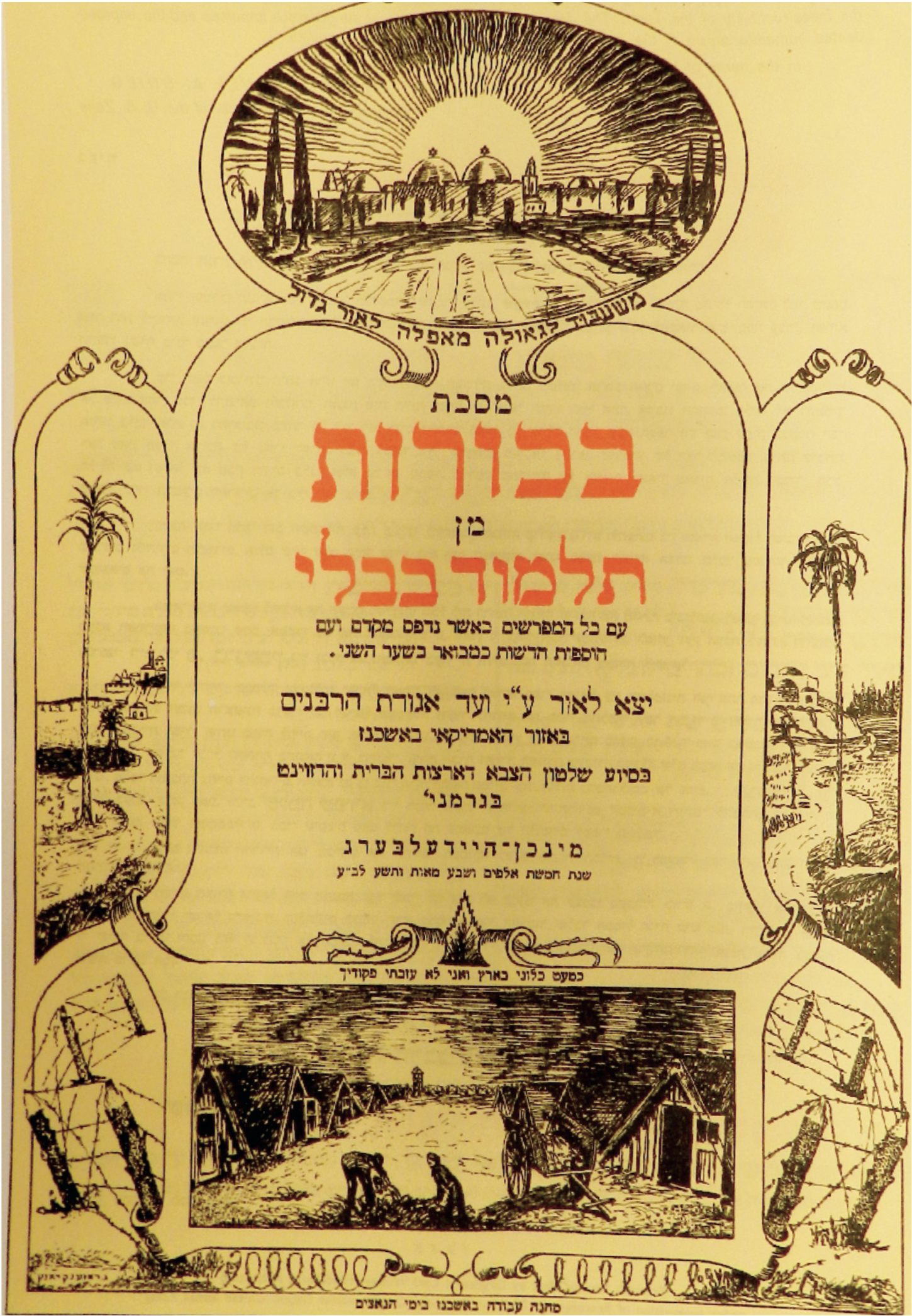
The title page of Masechet Bechorot from the “Survivors’ Talmud.”

by Dr. Yvette Alt Miller

With the help of the US Army, Jewish Holocaust survivors printed copies of the Talmud.

As World War II drew to a close in 1945, survivors of the Nazi death camps tried to rebuild their shattered lives in Displaced Person (DP) camps, many of which were housed in the very concentration camps in which Nazis had recently tortured and murdered Jews and others.

On September 29, over three months after the end of the war in Europe, US President Harry S. Truman wrote a scathing letter to Gen. Dwight D. Eisenhower, who was in charge of American troops in occupied Germany, describing the horrific conditions that Jews were still living in. Pres. Truman quoted from a report on the conditions in the DP camps that he’d commissioned: “As matters now stand, we appear to be treating the Jews as the Nazis treated them except that we do not exterminate them. They are in concentration camps in large numbers under our military guard instead of S.S. troops. One is led to wonder whether the German people, seeing this, are not supposing that we are following or at least condoning Nazi policy.”

Truman argued that “we have a particular responsibility toward these victims of persecution and tyranny who are in our zone. We must make clear to the German people that we thoroughly abhor the Nazi policies of hatred and persecution. We have no better opportunity to demonstrate this than by the manner in which we ourselves actually treat the survivors remaining in Germany.”

With American support, Jewish life slowly began to return to the camps. The American Jewish Joint Distribution Committee moved into many DP camps and helped distribute food and medical supplies. They also helped set up Jewish schools in the camps, aided at times by the American army and also by some remarkable rabbis who’d survived the Holocaust and were determined now to rebuild Jewish life.

One huge problem prevented the resumption of Jewish education and religious services: while the Nazis murdered as many Jews as possible and tried to wipe out Jewish existence, they also destroyed countless Jewish books, Torah scrolls and other ritual objects. Allied officials were able to find some Jewish prayer books in Nazi warehouses, but the ragged Jewish survivors in DP camps still lacked many basic Jewish books and supplies.

One leader who stepped in to help was Rabbi Avrohom Kalmanowitz. Born in Russia, Rabbi Kalmanowitz was head of the renowned Mir Yeshiva, one of the greatest yeshivas in the world. In 1939, with war looming, Rabbi Kalmanowitz decided to relocate his famous school from Lithuania to Kobe, in Japan.He set out to bring 575 members of the school, but soon found himself leading nearly 3,000 Jews who were desperate to escape Nazi Europe. He led this group, which included many sick and elderly Jews, across Russia and Siberia and onto Japan. For much of the journey, stronger members of the group would carry those who couldn’t walk on their backs.

After Japan attacked the United States, Rabbi Kalmanowitz moved his yeshiva once more, to Shanghai. There he improvised printing presses using stones and managed to publish 38,000 Jewish books. “While Hitler was burning books and bodies,” Rabbi Kalmanowitz later recalled, “the men of Mirrer (the Mir Yeshiva) who had traveled 16,000 miles from Lithuania to Shanghai were using stones for printing presses to keep the light of learning alive.” After the end of the war, Rabbi Kalmanowitz returned to Europe, and once more championed the printing of Jewish books and preservation of Jewish life.

Mirrer Yeshiva in Shanghai

Rabbi Kalmanowitz was a leading figure in the Agudat Harabbanim and the Vaad Hatzalah. He cultivated contacts with American military officials and oversaw the printing of Jewish prayer books, Passover Haggadahs, copies of the Megillah of Esther for Purim, and even some volumes of the Talmud. “Rabbi Kalmanowitz is a patient and appreciative old patriarch,” Gen. John Hilldring, the US Assistant Secretary of State for Occupied Areas, wrote to a colleague. “I can think of no assistance I gave anyone in Washington…that gave me more satisfaction than the very little help I gave the old rabbi.” Rabbi Kalmanowitz requested resources to print even more Jewish books but was told that with the acute shortage of paper in Germany, more ambitious plans to print Jewish books was impossible.

Seeing Rabbi Kalmanowitz’s success in printing some Jewish books and even some volumes of the Talmud, another Jewish leader in Europe at the time began to dream of an even more ambitious project. The chief rabbi of the US Zone in Europe was Rabbi Samuel Abba Snieg. He was a commanding figure. Before he was captured by the Nazis he was a chaplain in the Lithuanian army. He was sent to the Jewish Ghetto in Slabodka, a town near Kovno in Lithuania which was renowned as a center of Jewish intellectual life. From there, Rabbi Snieg was sent to the notorious Dachau concentration camp. He survived, and after being liberated dedicated his life to rebuilding Jewish life. He was assisted by Rabbi Samuel Jakob Rose, a young man who’d studied at the famous Slabodka Yeshiva before the Holocaust. They resolved to approach the US military for help in printing copies of the Talmud – the first volumes of the Talmud to be printed in Europe since the Holocaust.

Rabbi Samuel Jakob Rose, a survivor of Dachau, examines the galleys of the first postwar edition of the Talmud to be printed in Germany. Photo taken ca. 1947. Courtesy of the United States Holocaust Memorial Museum via the National Archives and Records Administration, College Park

A set of Talmud – called “Shas” – is made up of 63 tractates, comprising 2711 double-sided pages. For millennia, its many volumes have been studied day and night by Jews around the world. Printing a complete set of the Talmud would send a powerful message that Jewish life was possible once again.

Whom to ask for help? General Joseph McNarney was the commander of American forces in Europe. The rabbis wondered if there might be a way to reach him with their request, and decided to approach his advisor for Jewish affairs, an American Reform rabbi from New York named Philip S. Bernstein.

Rabbi Bernstein came from a very different background from the black-hatted Orthodox rabbis laboring in the DP camps. On the surface, perhaps, the men looked very different. But Rabbi Bernstein’s mother had come from Lithuania and he had a deep attachment to Jewish life and was open to requests for help in rebuilding Jewish education in the DP camps. Rabbi Snieg and Rabbi Rose explained their proposal to print whole sets of the Talmud on German soil, and Rabbi Bernstein became an enthusiastic supporter of the plan.

Title page of Masechet Nedarim

They arranged a meeting with Gen. McNarney in Frankfurt where they asked if the US army would lend “the tools for the perpetuation of religion, for the students who crave these texts…” Gen McNarney realized that printing sets of the Talmud would be a powerful symbol of the triumph of Jewish life – supported by American forces – in the lands where it had so nearly been wiped out. On September 11, 1946, he signed an agreement with the American Joint Distribution Committee and Rabbinical Council of the US Zone in Germany to print fifty copies of the Talmud, packaged into 16 volume sets. It would be the first time in history that an army agreed to print copies of this core Jewish text. The project became known as the Survivors’ Talmud.

The team immediately ran into obstacles. First, it was impossible to find a set of Shas (the entire Talmud) anywhere in the US Zone of former Nazi lands. “Every Jew in Poland was ordered, upon pain of death, to carry to the Nazi bonfires and personally consign to the flames his copy of the Talmud,” one testimony recorded. In the end, a member of the American Joint Distribution Committee brought two complete sets of the Talmud from New York.

The title page of Masechet Bechorot from the “Survivors’ Talmud.” Courtesy of Yeshiva University, Mendel Gottesman Library

Even though the US Army had agreed to print the volumes, some officials objected to the expense. The timeframe and scope of the project kept changing. Then there was the sheer labor involved in printing what eventually became nineteen-volume sets of the Talmud: each copy needed 1,800 zinc plates which had to be painstakingly set and proofread. The project began in 1947 and was finally completed in late 1950. “…we are Gott sie Dank (Thank God) packing the Talmud” an American Joint Distribution Committee employee wrote in November, when they began distributing the Talmud. The Joint paid for additional sets of the Talmud to be printed; in the end, about 3,000 volumes were made. These were then shipped all over the world wherever Holocaust survivors from the the DP camps were settling. The Survivor’s Talmud made its way to New York, Antwerp, Paris, Algeria, Italy, Hungary, Morocco, Tunisia, South Africa, Greece, Yugoslavia, Norway, Sweden, and Israel.

From the outside, these sets of the Survivors’ Talmud looked like any other set of Shas. Their special origin is only visible on the title page, which shows a picture of the Land of Israel as well as a concentration camp surrounded by a barbed wire fence, with the words “From bondage to freedom, from darkness to a great light.” Below is this touching dedication:

“This edition of the Talmud is dedicated to the United States Army. The Army played a major role in the rescue of the Jewish people from total annihilation, and their defeat of Hitler bore the major burden of sustaining the DPs of the Jewish faith. This special edition of the Talmud, published in the very land where, but a short time ago, everything Jewish and of Jewish inspiration was anathema, will remain a symbol of the indestructibility of the Torah. The Jewish DPs will never forget the generous impulses and the unprecedented humanitarianism of the American Forces, to whom they owe so much.”

Some individual owners of this remarkable set of Talmud wrote their own dedications as well. One rabbi of a small town in Israel near Jerusalem recalled how he lost his wife and children when they were murdered in the Holocaust. Living in Israel, he spent his days studying from his Survivors’ Talmud. On the first page he hand-wrote his own dedication as well, which surely was the hope of many other survivors who studied this remarkable Survivors’ Talmud as well:

“May it be Thy will that I be privileged to dwell quietly in the land; to study the holy Torah amid contentment of mind, peace, and security for the rest of my days; that I may learn, teach, heed, do and fulfill in love all the words of Thy Love. May I yet be remembered for salvation for the sake of my parents who sanctified Thy name when living and when led to their martyr’s eath. May their blood be avenged! May I merit to witness soon the final redemption of Israel. Amen.”

This was the prayer of so many of the Jews who helped print and then studied the Survivor’s Talmud. This remarkable undertaking was a way of declaring that no matter how terrible circumstances became, Jews would always find a way to return to the Jewish texts that have always sustained us.

As taken from, https://www.aish.com/jw/s/The-Survivors-Talmud-When-the-US-Army-Printed-the-Talmud.html?s=ss1

 
Leave a comment

Posted by on April 20, 2020 in Uncategorized


The Ancient Origin of anti-Semitic Conspiracy Theories Blaming Jews for Plagues

by Ofri Ilany

Ancient Egypt may have had its own version of the Exodus story. It begins with a plague.

Spain's coronavirus deaths leap; Prince Charles now infected ...
Municipal workers disinfecting the area around the pyramids in Giza, last month.

About 3,350 years ago, an epidemic swept through pharaonic Egypt. From southern Syria, the outbreak spread rapidly southward into the land of Canaan, ravaging Megiddo and other towns in the land. At the same time, it pushed eastward and northward from Syria. It was probably tularemia (rabbit fever), a contagious disease that can cause skin ulcers, deformities, high fever and, ultimately, in some cases, deadly pneumonia.

For a few years, the Kingdom of Egypt, the most powerful empire in the region in the 14th century B.C.E., protected itself against the epidemic by closing its borders. Testimony to this is found in a missive sent by the governor of an Egyptian city: “The people of Sumur cannot come into my city; there is a plague in Sumur.”

Trade between Egypt and the kingdoms to the north was halted for more than two decades. Because the epidemic arrived from the north, the Egyptians called it the “Canaanite disease,” or the “Asian disease.” It decimated the Hittite Empire and claimed the lives of two of its kings, in succession. But finally it penetrated Egypt as well and wrought havoc in the kingdom.

The German Egyptologist Jan Assmann believes that the epidemic – the most devastating one, he says, to hit the ancient world – constituted an unprecedented trauma for the Egyptians. In their collective memory, the shock it caused fused with political and religious developments of the period and spawned legends that have persisted for millennia. At the center of one of those legends was a story that’s familiar to us: the Exodus of the Israelites from Egypt.

The connection between Jews and plagues has continuously preoccupied European culture, through the Middle Ages and into modernity. Even now, as Israel’s Foreign Ministry warned recently, there is concern about a possible wave of anti-Semitism arising in the United States, in which Jews will be accused of being responsible for the outbreak of the coronavirus. It emerges, however, that the roots of that association likely date to the dawn of history.

Assmann, in his 1998 book “Moses the Egyptian,” theorizes that ancient Egypt had its own version of the Exodus story. It is difficult to reconstruct, but has left an imprint on certain Egyptian traditions. Moreover, it may also be instructive regarding the emergence of the biblical narrative.

The earliest known account of the Egyptian Exodus from a nonbiblical source was recorded by the historian Hecataeus of Abdera, who lived in Egypt in the fourth century B.C.E. His version of the story contains elements that recall the biblical account, which dates to several hundred years before that, but also some that are not familiar to us. One of them is the fact – in his version – that the whole narrative begins with a plague.

According to Hecataeus, in ancient times, a lethal plague struck Egypt, and the ordinary folk blamed it on foreigners living in their midst, who had ostensibly angered the local gods. Accordingly, they decided that the foreigners must be expelled from Egypt. One group of foreigners ended up in Greece, while a larger number arrived in a land then known as Judah. That group was led by a person named Moses, who, after he and his people seized control of the land, founded a number of cities – among them Jerusalem.

Hectaeus is not alone in associating the Israelites’ Exodus from Egypt with a plague. Other evidence, more hostile to the Hebrews, appears in the writings of the Egyptian priest Manetho, who lived in the third century B.C.E. It is his account of the Exodus that is cited by Jewish historian Josephus Flavius. Manetho tells of Pharaoh Amenhotep, who, under the influence of a peculiar prophet, decided to purify Egypt of lepers and individuals with deformities.

Amenhotep sent the lepers to the stone quarries in eastern Egypt, where he brutally enslaved them. The lepers decided to rise up against the pharaoh and chose as their leader a leprous Egyptian priest named Osarsiph from the city of Heliopolis. Osarsiph gave them laws that required them to desist from idol worship and ordered them to burn down the Egyptian temples and slaughter their sacred animals. Finally, Manetho notes that Osarsiph changed his name when he became the lepers’ leader – choosing for himself the moniker of Moses.

Few modern historians accept Manetho’s account at face value. However, the recurrence of the plague motif is noteworthy, and it appears that he did not totally invent it. For one, Assmann points out that the biblical account of the 10 Plagues inflicted on Egypt include a medical affliction, and also an apparent physical separation of the Israelites and the Egyptians at the time of the plague, which is the source of the name “Pesah” (“Passover”). In both narratives there is a component of separation of the pure from the sick. According to Assmann, the Hebrews’ story might be a different version of these events as remembered in the tradition of Canaan – namely a mirror image of the Egyptian tale.

Can we infer from this that a connection exists between the historical epidemic and a certain event in antiquity that morphed into the story of the Exodus from Egypt? Hecataeus and Manetho, it should be noted, lived about 1,000 years after the actual tularemia epidemic and in a completely different political reality. Nevertheless, Assmann observes, it can be surmised that they were drawing upon an ancient Egyptian tradition originating in an epidemic and related events. For the fact is that a religious revolution did take place around the same time as the epidemic raged.

Pharaoh Akhenaten, who ruled in the 14th century B.C.E., banned idol worship and introduced something akin to monotheistic worship. Akhenaten is credited with fomenting the first monotheistic revolution in history, but what is less well known is that this occurred against the background of an epidemic. Akhenaten is known to have moved the capital of Egypt, from Thebes to Amarna, in the western desert, but Egyptologist Hans Goedicke suggests that the reason for this was not religious ideology, but simply an attempt to create a quarantine zone that would offer protection from infection.

From the dawn of history to the present day, plagues have been perceived as divine punishment for human sins. Some Egyptologists think that the phenomenon was interpreted in ancient Egypt as punishment imposed by the gods because Akhenaten closed the temples and prohibited the worship of those gods. In Assmann’s view, the Israelites were associated after the fact in the Egyptian collective memory with the banning of the traditional religion. The repressed memory of the disorder that occurred in Akhenaten’s time was linked to the Hebrews.

Unlike Assmann, other historians are skeptical about the possibility that the events of Akhenaten’s revolution were preserved in the collective memory for such a lengthy period and then reemerged. Historian David Nirenberg maintains, in his book “Anti-Judaism,” that Manetho the priest mixed together different motifs from Egyptian history and fused them into a single narrative about the origins of the Israelites. In any event, this was the origin of a potentially dangerous connection: between Jews, monotheism and the spread of diseases.

The concept of the Jews carrying plagues gained currency across the ancient world. In the Roman world, for example, they were depicted as enemies of the gods, haters of humanity and carriers of diseases. So effective did these allegations turn out to be, according to Nirenberg, that they continue to underlie anti-Jewish ideologies until today.

As taken from, https://www.haaretz.com/israel-news/.premium-the-ancient-origin-of-anti-semitic-conspiracy-theories-blaming-jews-for-plagues-1.8776563?=&utm_source=smartfocus&utm_medium=email&utm_campaign=weekend&utm_content=https%3A%2F%2Fwww.haaretz.com%2Fisrael-news%2F.premium-the-ancient-origin-of-anti-semitic-conspiracy-theories-blaming-jews-for-plagues-1.8776563&ts=_1587230304707

 
Leave a comment

Posted by on April 18, 2020 in Uncategorized


Limits

by Rabbi Lord Jonathan Sacks

There is an order to the universe and we must respect it.

The story of Nadav and Avihu, Aaron’s two eldest sons who died on the day the Sanctuary was dedicated, is one of the most tragic in the Torah. It is referred to on no less than four separate occasions. It turned a day that should have been a national celebration into one of deep grief. Aaron, bereaved, could not speak. A sense of mourning fell over the camp and the people. God had told Moshe that it was dangerous to have the Divine Presence within the camp (Ex. 33:3), but even Moshe could not have guessed that something as serious as this could happen. What did Nadav and Avihu do wrong?

An exceptionally broad range of interpretations have been given by the Sages. Some say that they aspired to lead the people and were impatiently waiting for Moses and Aaron to die. Others say that their sin was that they never married, considering all women to be unworthy of them. Others attribute their sin to intoxication. Others again say that they did not seek guidance as to what they should do and what they were not permitted to do on this day. Yet another explanation is that they entered the Holy of Holies, which only the High Priest was permitted to do.

The simplest explanation, though, is the one given explicitly in the text. They offered “strange fire that was not commanded.” Why should they have done such a thing? And why was it so serious an error?

The explanation that makes most sense psychologically is that they were carried away by the mood of the moment. They acted in a kind of ecstasy. They were caught up by the sheer excitement of the inauguration of the first collective house of worship in the history of Avraham’s children. Their behaviour was spontaneous. They wanted to do something extra, uncommanded, to express their religious fervour.

The difference was that Moshe was a prophet. David was a king. But Nadav and Avihu were priests. Prophets and kings sometimes act spontaneously, because they both inhabit the world of time. To fulfill their functions, they need a sense of history. They develop an intuitive grasp of time. They understand the mood of the moment, and what it calls for. For them, today is not yesterday, and tomorrow will be different again. That leads them, from time to time, to act spontaneously because that is what the moment requires.

Moshe knew that only something as dramatic as shattering the tablets would bring the people to their senses and convey to them how grave was their sin. David knew that dancing alongside the Ark would express to the people a sense of the significance of what was happening, that Jerusalem was about to become not just the political capital but also the spiritual centre of the nation. These acts of precisely judged spontaneity were essential in shaping the destiny of the people.

But priests have a different role altogether. They inhabit a world that is timeless, ahistorical, in which nothing significant changes. The daily, weekly and yearly sacrifices were always the same. Every element of the service of the Tabernacle was bounded by its own detailed rules, and nothing of significance was left to the discretion of the priest.

The priest was the guardian of order. It was his job to maintain boundaries, between sacred and secular, pure and impure, perfect and blemished, permitted and forbidden. His domain was that of the holy, the points at which the infinite and eternal enter the world of the finite and mortal. As God tells Aaron in our parsha: “You must distinguish between the sacred and the profane, and between the unclean and the clean; and you must teach the Israelites all the laws which the Lord has imparted to them through Moses.” The key verbs for the cohen were lehavdil, to distinguish, and lehorot, to teach. The cohen made distinctions and taught the people to do likewise.

The priestly vocation was to remind the people that there are limits. There is an order to the universe and we must respect it. Spontaneity has no place in the life of the priest or the service of the Sanctuary. That is what Nadav and Avihu failed to honour. It might have seemed like a minor transgression but it was in fact a negation of everything the Tabernacle and the priesthood stood for.

There are limits. That is what the story of Adam and Eve in the Garden of Eden is about. Why would God go to the trouble of creating two trees, the Tree of Life and the Tree of Knowledge, from which human beings are forbidden to eat? Why tell the humans what the trees were and what their fruit could do? Why expose them to temptation? Who would not wish to have knowledge and eternal life if they could acquire them by merely eating a fruit? Why plant these trees in a garden where the humans could not but help see them? Why put Adam and Eve to a test they were unlikely to pass?

To teach them, and us, that even in Eden, Utopia, Paradise, there are limits. There are certain things we can do, and would like to do, that we must not do.

The classic example is the environment. As Jared Diamond has documented in his books, Guns, Germs and Steel, and Collapse, almost wherever human beings have set foot, they have left a trail of destruction in their wake. They have farmed lands to exhaustion and hunted animals to extinction. They have done so because they have not had, embedded in their minds and habits, the notion of limits. Hence the concept, key to environmental ethics, of sustainability, meaning limiting your exploitation of the Earth’s resources to the point where they can renew themselves. A failure to observe those limits causes human beings to be exiled from their own garden of Eden.

We have been aware of threats to the environment and the dangers of climate change for a long time, certainly since the 1970s. Yet the measures humanity has taken to establish limits to consumption, pollution, the destruction of habitats and the like have, for the most part, been too little, too late. A 2019 BBC survey of moral attitudes in Britain showed that despite the fact that a majority of people felt responsibility for the future of the planet, that did not translate into action. 71 percent of people thought that it is acceptable to drive when it would be just as easy to walk. 65 percent of people thought it acceptable to use disposable cutlery and plates.1

In The True and Only Heaven, Christopher Lasch argued that the scientific revolution and the Enlightenment endowed us with the belief that there are no limits, that science and technology will solve every problem they create and the earth will continue indefinitely to yield its bounty. “Progressive optimism rests, at bottom, on a denial of the natural limits on human power and freedom, and it cannot survive for very long in a world in which an awareness of those limits has become inescapable.”2 Forget limits and eventually we lose paradise. That is what the story of Adam and Eve warns.

In a remarkable passage in his 1976 book on inflation, The Reigning Error, William Rees-Mogg waxed eloquent about the role of Jewish law in securing Jewish survival. It did so by containing the energies of the people – Jews are, he said, “a people of an electric energy, both of personality and of mind.” Nuclear energy, he says, is immensely powerful but at the same time needs to be contained. He then says this:

In the same way, the energy of the Jewish people has been enclosed in a different type of container, the law. That has acted as a bottle inside which the spiritual and intellectual energy could be held; only because it could be held has it been possible to make use of it. It has not merely exploded or been dispersed; it has been harnessed as a continuous power … Contained energy can be a driving force over an indefinite period; uncontrolled energy is merely a big and usually destructive bang. In human nature only disciplined energy is effective.3

That was the role of the cohen, and it is the continuing role of halachah. Both are expressions of limits: rules, laws and distinctions. Without limits, civilisations can be as thrilling and short-lived as fireworks. To survive they need to find a way of containing energy so that it lasts, undiminished. That was the priest’s role and what Nadav and Avihu betrayed by introducing spontaneity where it does not belong. As Rees-Mogg said, “uncontrolled energy is merely a big and usually destructive bang.”

I believe that we need to recover a sense of limits because, in our uncontrolled search for ever greater affluence, we are endangering the future of the planet and betraying our responsibility to generations not yet born. There are such things as fruit we should not eat and fire we should not bring.

NOTES

1. https://www.bbc.co.uk/mediacentre/latestnews/2019/year-of-beliefs-morality-ethics-survey-2019.
2. Christopher Lasch, The True and Only Heaven: Progress and its Critics, WW Norton, 1991, 530.
3. William Rees-Mogg, The Reigning Error: The Crisis of World Inflation, Hamish Hamilton, 1974, 12.

As taken from, https://www.aish.com/tp/i/sacks/Limits.html?s=mm

 
Leave a comment

Posted by on April 16, 2020 in Uncategorized


Azazel: What the Hell Does It Mean?

Muflon evropský (With images) | North american animals, Animals ...

By Elon Gilad

Israelis use this word all the time but have no idea that it’s a name of an ancient desert goat-demon worshiped by their ancestors.

It appears in phrases like le’azazel eem zeh which translates to “the hell with it” and lekh le’azazel which translates as to “go to hell” – but azazel doesn’t actually mean hell. There’s also sa’ir le’azazel, which means scapegoat, but azazel doesn’t mean scape either. It is a very mysterious word indeed.

It first appears in Hebrew texts in the Book of Leviticus as a part of the Temple worship on Yom Kippur. Among the many rituals the High Priest had to officiate on this holy day was a lottery among two goats. One was designated to God and the other to Azazel. The goat designated to God was immediately taken to the altar and slaughtered, and its blood splattered in the Holy of Holies.

The goat designated to “Azazel” had a different destiny.

A specially-appointed man, usually a priest, would take the hapless beast on a 12-km walk east to the Judean Desert, accompanied by the city’s dignitaries. En route they would stop at 10 specially erected booths, in which food and drink was offered and rejected.

The last leg of the journey was made by just the priest and the goat, until they reached the edge of a cliff. The priest would turn his back to the valley below, hoist the goat and toss it down. The goat would tumble down the hill, smashing on the sharp rocks as it fell, and dying by the time it reached the bottom.

The meaning of the name Azazel puzzled the ancients. The Talmud said it was the place from which the goat was hurled, while the Greek translators of the Septuagint avoided the issue, translating it as the “the goat set free.”

Rabbi Abraham Ibn Ezra (1089-1164) saw past this, but didn’t explain its meaning explicitly, only giving a hint: “And if you could understand the secret of the word Azazel you will know its secret and its secret and the secret of its name as it has friends in the Bible, and I will reveal to you a bit of the secret with a hint: When you turn 33 you will know it.”

If you are bewildered by this, you aren’t alone. Luckily, Nahmanides (1194-1270) provided the answer: If you count 33 verses from the verse in Leviticus where Azazel is first mentioned (16:8), you reach a verse that reads “And they shall no more offer their sacrifices unto devils, after whom they have gone a whoring. This shall be a statute for ever unto them throughout their generations.” (17:7) Nahmanides explains: “And this is the secret of the issue, that they worshipped other gods, they the messengers sacrificed to them.”

Mount Azazel in the Judean Desert, from which the goat was pushed to its death.Wikimedia Commons

The rabbi went on to explain that this wasn’t idolatry, since “the scapegoat wasn’t a sacrifice from us to him, God forbid, but rather we did what our God commanded us to do, like when holding a banquet and the master orders that the person holding the meal serve his slave.”

So who is this demon worshiped by the ancient Israelites? Well, originally he was named Azaz’el, with the letters alef and zain swapped in order to hide the ending “el,” which means god. The original non-obfuscated name appears in the Samaritan Bible and also in the Dead Sea Scrolls.

We learn more about Azazel from the Book of Jubilees and the Book of Enoch, where it says :“And Azazel taught men to make swords and knives and shields and breastplates; and made known to them the metals [of the earth] and the art of working them; and bracelets and ornaments; and the use of antimony and the beautifying of the eyelids; and all kinds of costly stones and all colouring tinctures. And there arose much godlessness, and they committed fornication, and they were led astray and became corrupt in all their ways.” (8:1-3)

The first reference to the use of the phrase Lekh le’azazel is in the book Khavat Yair by Rabbi Yair Chayim Bacharach (1701-1638). Bacharach writes of a mother who hit her son and said “Go to Azazel in the desert!” The phrase gained popularity among the users of Hebrew. It appears twice in the novel Ayit Tzavua (1858) by Abraham Mapu, the first Hebrew novelist.

The phrase reached the apex of its popularity in the early 20th century. One day in 1927, the poet Haim Nahman Bialik and his friend the publisher Yehoshua Hana Ravnitzky were walking on a Tel Aviv street talking in Yiddish with one another. Aharon Nachmani, a young and zealous member of the Battalion for the Defense of the Language, a group dedicated to policing the exclusive use of Hebrew among Palestine Jews, approached Bialik and shouted “Bialik, speak Hebrew!” to which the annoyed Bialik responded, “Lekh le’azazel!”

This could have been the end of the story, but Nachmani went to court and sued Bialik for insulting him.

In his defense, Bialik wrote: “It is possible that the word is a bit harsh according to its regular use in the marketplace, but according to its accurate and real meaning, it is a name of a mountain in the desert, not far from Jerusalem a two-three hour walk in the Judean Desert. And this place, in my opinion, is pretty dignified place for that man to take a walk in.” Nachmani withdrew his lawsuit and was charged 180 prutot in court fees.

 
Leave a comment

Posted by on April 10, 2020 in Uncategorized


Antonio Piñero: «Los judíos tuvieron poco que ver con la muerte de Jesús»

Antonio Piñero: «Los judíos tuvieron poco que ver con la muerte de ...
Expulsión de los judíos del Templo, por Carl Heinrich Bloch

Antonio Piñero (Chipiona, 1941) es uno de los mayores expertos en la figura de Jesús de Nazaret y el Nuevo Testamento a nivel mundial en su aspecto estrictamente histórico. En ABC Historia recuperamos una entrevista realizada a este catedrático emérito de filología griega de la Universidad Complutense de Madrid, capaz de recitar sin pestañear pasajes enteros del Nuevo Testamento, donde responde a cuestiones fundamentales para comprender quién fue Jesús de Nazaret.

¿Cómo se puede definir a Jesús de Nazaret y su vida desde un punto de vista estrictamente histórico?

Jesús es un artesano de la clase media-baja de Galilea, maestro de la ley, exorcista, sanador, proclamador de la venida del Reino de Dios, profeta y, al final de su vida, probablemente él mismo se proclamó Mesías. Fue un maestro de la ley fracasado porque no consiguió convencer de su mensaje a sus contemporáneos, ni en Galilea ni en Jerusalén.

¿En qué se desvió de las doctrinas judías de la época?

No quería romper con el Judaísmo. Se desvía como lo hicieron los antiguos profetas de la sociedad de la época, porque Jesús era un elemento supercrítico con su sociedad. Pero no se desvía ni en lo religioso ni siquiera en lo político del pueblo judío, que aspiraba a que los romanos fueran derrotados por las legiones de ángeles encabezadas por Dios. Ellos sabían que estaban en inferioridad militar, pero esperaban que, si alguien iniciaba la lucha contra los romanos, Dios les apoyaría.

¿Era un nuevo Moisés?

Hasta cierto punto sí, pero algo más pequeño. La idea de Jesús como un nuevo Moisés es algo que luego predican los evangelistas. Y, puestos a hablar del Antiguo Testamento, yo trazaría un paralelismo con la figura del juez bíblico Gedeón, el cual significa «Guerrero poderoso», que encabezó una lucha armada contra amalecitas y madianitas con la ayuda de Dios. El Reino de Dios que debe traer el Mesías es el final de la opresión romana. Jesús estaba convencido de que este Reino de Dios no iba a venir por manos humanas, sino por la intervención divina.

Cuadro que recoge el episodio de Jesús en casa de Anás, sumo sacerdote judío junto con Caifás
Cuadro que recoge el episodio de Jesús en casa de Anás, sumo sacerdote judío junto con Caifás – Museo del Prado

También hay quien ha querido ver la importancia de la influencia clásica en la doctrina de Jesucristo. ¿Conocía el griego o estuvo expuesto a la cultura helenística?

Los propios judíos llamaban Galilea de los gentiles porque estaba llena de griegos. Él no era inmune a esta influencia, aunque su formación era profundamente judía. Como artesano de la madera que era, capaz de construir casas y no solamente muebles, es muy probable que aprendiera griego para expandir su negocio. En el Evangelio de San Juan, se insinúa dos ocasiones que Jesús sabía griego. Lo cual no significa que estuviera influenciado en su concepto religioso por la mentalidad helenística. Su religión era completamente judía, sin influencias externas.

De la infancia y de la juventud de Jesús no tenemos apenas datos históricos. De su salto a predicar, el Evangelio de Marcos afirma que su familia pensaba que Jesús estaba «fuera de sí», que estaba enajenado.

Jesús se lanza a predicar de una forma autónoma después de la muerte de El Bautista. De alguna manera recibió la antorcha de su mentor (o maestro) Juan Bautista, solo hay que observar que el marco mental de sus discursos es el mismo. No obstante, la familia de Jesús pensó originalmente que estaba enajenado, el Evangelio de San Marcos en concreto lo describe como «fuera de sí» (de la misma raíz que da en castellano «éxtasis»). Los familiares no creían en Jesús, pero era algo natural porque probablemente tuvo que abandonar un negocio que era próspero. Su madre debió quedar muy sorprendida. ¿Y cómo una mujer, María, a la que el Arcángel Gabriel le ha contado un embarazo maravilloso luego va a decir que su hijo estaba fuera de sí? Es evidente que hay historias teológicas que se han pegado posteriormente, sobre todo en relación a la infancia de Jesús, y que el estudio detallado de los Evangelios desprende datos de esta biografía oculta.

A Juan Bautista usted lo ha definido en sus trabajos como el mentor de Jesucristo. ¿Cree que él reconocía a Jesús como el Mesías?

Aunque el Evangelio de Lucas lo indica claramente, no podemos demostrar que Juan Bautista fuera familiar de Jesús desde un punto de vista histórico, posiblemente es un añadido teológico. Él pudo pensar que era hijo de Dios en un sentido judío, como un profeta intensamente relacionado con Dios. Por eso hay que matizar que, si un personaje de la época de Jesús llama a alguien hijo de Dios, no lo hace cómo lo puedan pensar los griegos, de una forma física. Un hijo de Dios en Israel es alguien que tiene un especial contacto con la divinidad. Por ejemplo, un profeta, un sumo sacerdote o un rey. En el tiempo de Jesús ya no había rey, así que el Mesías era una mezcla de todos estos.«Como historiador no puede asegurar cuál era su condición civil, pero puedo exponer que en su vida pública nunca fue acompañado de una fémina»

Es un tema del que escribió largo y tendido en «Jesús y las mujeres» (Editorial Trotta, 2014): ¿Por qué no tiene ninguna base histórica que hubiera alguna relación entre Jesús y María Magdalena?

Toda la información que ha llegado a nuestros días sobre Jesús y María Magdalena antes de la Crucifixión son dos breves versículos del capítulo ocho del Evangelio de Lucas que dice: «Había muchas mujeres que desde Galilea seguía a Jesús y le ayudaban con sus dineros. Entre ellas estaba María Magdalena, de la que Jesús había expulsado siete demonios…» ¿Qué puede sacar un historiador de ahí? Era una de un montón de mujeres, que, además, estaba gravemente enferma. Una enfermedad corriente está causada por un demonio; una de muchos demonios debía ser una epilepsia por lo menos.

Quizás lo que mantenga vivo el asunto sea lo extraño a ojos actuales de que Jesús, a diferencia de alguno de sus apóstoles, no se casara ni tuviera descendientes. ¿Era algo habitual?

¿Qué les hubiera importado a los evangelistas, que hablan con toda tranquilidad de los hermanos de Jesús y las esposas de algunos apóstoles, mencionar el asunto si fuera cierto? Hubiera sido más fácil para el relato decir que, como Pedro que había dejado todo por el Reino de Dios, Jesús había dejado su familia para predicar. Como historiador no puede asegurar cuál era su condición civil, pero puedo exponer que en su vida pública nunca fue acompañado de una fémina. El profeta Jeremías, el ídolo de los reformistas, era soltero, y los esenios, tenidos por hombres muy piadosos, la mayoría eran solteros. Es algo que se dice por total desconocimiento del Israel del siglo I.Portada del libro «Aproximación al Jesús histórico»

¿Caló en la sociedad judía la reforma de Jesús?

Tuvo cierta relevancia. Pongamos que captó al 10 o 15% de la población, pero desde luego en Jerusalén no era un personaje popular. En las expulsión de los mercaderes del Templo de Jerusalén es fácil entender que no cosechara muchas simpatías en algunos sectores. Jesús alcanzó su mayor índice de violencia en ese episodio y fue una acción que le pudo costar la vida. Desplegó un tipo de violencia profética, donde anunció la purificación del templo: la destrucción y reconstrucción de la edificación a manos de Dios. Los artesanos, mercaderes y comerciantes que vivían en torno al templo no tenían ninguna disposición a un cambio de estatus como el profetizado.

Jesús de Nazaret terminó siendo condenado a la cruz por sedición contra Roma, pero previamente es juzgado por los sacerdotes hebreos. ¿Qué le hizo tan peligroso respecto a otros profetas y predicadores?

Hay una discusión histórica a propósito de eso. Es muy probable que los judíos tuvieran poco que ver con la muerte de Jesús. Un proceso judío como el narrado en los Evangelios no sigue para nada las normas legales habituales en un juicio de este tipo. Así y todo, los evangelistas nunca inventan nada porque sí. El Evangelio de Juan, poco después de la resurrección de Lázaro, narra una reunión en casa de Caifás con todo el Sanedrín. Caifás alerta en este relato de la cantidad de gente que concentra Jesús y de la posibilidad de que su movimiento derive en una revolución contra los romanos que acabaría costando miles de muertos a las filas judías. «Es bueno que uno muera por el pueblo, y no que mueran tantos de la nación», afirma en la frase más recordada del Sumo Sacerdote judío. Si hubo un juicio contra Jesús es más posible que respondiera a las características de este relato y no a un proceso legal en firme.

Para quienes no conocen ese contexto, la pregunta más habitual suele ser: ¿Por qué mataron a un personaje que predicaba el amor?

Jesús no es un personaje blandito. Es un personaje duro, que se juega la vida, que tiene que huir continuamente de la «policía», que tiene que alimentar a un pequeño grupo de seguidores, los cuales viven de la caridad pública, y que se juega el pellejo. Luego los Evangelios, sobre todo los de Mateo y Lucas, pintan a un Jesús manso de corazón, pero eso es una reinterpretación posterior.

¿Y en qué momento llama la atención de los romanos?

La gente no sabe que, aunque en Judea eran más de manga ancha, en Roma « la Lex Julia de collegiis» impedía que más de diez personas se juntaran sin permiso de las autoridades. Imagínate cuando Jesús empieza a concentrar a grandes grupos de gente. La preocupación de los romanos demuestra que el movimiento estaba teniendo cierta repercusión.

Judas es uno de los malos de esta historia y, sin embargo, su traición a Jesús parece más teatral que efectiva. Se dice que era el tesorero del grupo y que había robado anteriormente dinero, pero no se conocen muchos más datos previos a la traición.

Judas es posiblemente una figura mítica. Hubo algún traidor en el grupo, pero la figura pudo ser pintada con trazos más gruesos. La prueba está en que la muerte de Judas está representada de forma contradictoria en los Evangelios: Mateo dice que fue por ahorcamiento y San Lucas escribe que se arrojó a un acantilado. Estudiando el Antiguo Testamento, el relato de San Mateo está casi copiado de la historia del consejero real Ajitófel, que traicionó al Rey David y luego se ahorcó. Por su parte, San Lucas, que es posiblemente un griego convertido al Judaísmo, narra en Judas la muerte de Antíoco IV de Epífanes, el gran perseguidor de los hebreos que quiso eliminar la religión judía en el siglo II antes de Cristo. De todas formas, tampoco hay suficientes argumentos para negar su historicidad.«Jesús no es un personaje blandito. Es un personaje duro, que se juega la vida, que tiene que huir continuamente de la “policía”»

El suicidio de Judas Iscariote es hoy en día interpretado como un acto de cobardía, pero ha recordado usted alguna vez en sus trabajos que en la Antigüedad el suicidio era considerado como una forma de purificación. ¿Debe considerarse un personaje redimido dentro del relato bíblico?

Es lo que se llama la muerte noble en la cultura clásica, pero ahí se nota que los autores de los Evangelios son judíos. Ellos no aceptan esa doctrina helenística: se suicida y se condena, mientras que para los griegos era aceptar su error y pagarlo con la vida para liberarse. En la Antigüedad, hay 127 casos de suicidios mencionados en la literatura grecorromana, y prácticamente todos son muertes nobles.

Un personaje del Nuevo Testamento que llama poderosamente la atención por su aire enigmático, pese a su breve aparición, es el de Barrabás, al que el pueblo prefiere antes que a Jesús cuando los romanos preguntan a qué preso quieren libre. ¿Quién era este personaje que contaba con la simpatía del pueblo y que Pilatos accedió a liberar?

Su nombre significa «el hijo del padre» en arameo, puede ser desde un personaje de algún grupo precursor de los zelotes de 30 años más tarde o de los sicarios que iban liquidando romanos en secreto. Se ha especulado incluso que fuera uno de los discípulos de Jesús. Es muy difícil de probar su existencia histórica.

Menciona usted a los zelotes y a los sicarios. Ellos sí se inclinaron por una solución armada contra Roma décadas después de la muerte de Jesús.

Los zelotes fueron unos fanáticos como ahora es el Estado Islámico. Cuando alguien está seguro de su contacto con la divinidad y piensa que su opinión teológica es verdadera, el asesinato es una vía aceptada. Jesús no tenía nada que ver con los zelotes. Aunque es cierto que no hay ninguna frase en los Evangelios donde Jesús condene la violencia. Todo lo contrario. Es una persona que dice «el que no tiene espada, venda su capa y compre una». No se puede probar que fuera un pacifista estricto con una lectura sencilla, no sesgada, como tampoco se puede probar que fuera el primer feminista.

¿No le cabe duda de que murió en la cruz y no años después en Cachemira como han sostenido algunas teorías pseudohistóricas?

Totalmente, esas teorías son absurdas. Los romanos sabían matar muy bien y no iban a dejarle escapar. La cruz fue el primer problema teológico grave del grupo de seguidores de Jesús: fundamentar por qué el Mesías había muerto en la cruz. Nadie lanza una piedra contra su propio tejado. La respuesta de los apóstoles es que es un designio de Dios, que, dado que la situación de pecado de la humanidad era terrible y cómo no había más remedio, permitió la muerte de su hijo.En el mundo Antiguo, y ahí Pablo de Tarso demuestra tener una mentalidad muy griega, ningún problema se arregla si no es con sangre y sacrificio.

Fotografía del profesor Dr. Antonio Piñero

Junto a Jesús murieron dos ladrones crucificados, que usted ha cuestionado que fueran delincuentes comunes.

Los llamados ladrones que acompañaron a Jesús en la Cruz probablemente eran miembros de su grupo. San Lucas cambia la palabra bandoleros, la manera despectiva con la que los romanos llamaban a los secuaces de los movimientos antirromanos de la época, y la sustituye por malhechores, que tiene un significado vinculado a delincuentes comunes. Hay que pensar en la persecución inmediata que sufrió el grupo tras el apresamiento de Jesús. Los apóstoles en torno a la cruz es una visión simbólica de San Juan, un mito. Para San Marcos todos estaban a distancia salvo las mujeres. En una sociedad semítica, las mujeres no representaban una amenaza y no tenían nada que temer.

¿Se puede considerar a Jesús como uno de los fundadores del Cristianismo desde un punto de vista histórico?

Si un individuo proclama de una forma directa o indirecta por su vida y por el conjunto de información que de él se conserva que nunca quiere fundar una religión, como en el caso de Jesús, que buscaba entender profundamente y reformar el Judaísmo, o el de Pablo de Tarso, que quería vivir el Judaísmo según el Mesías, no se le puede considerar un fundador del Cristianismo, a no ser que digas que es un fundador inconsciente. El Cristianismo tarda en consolidarse como mínimo 400 años después de la muerte de Jesús y tiene muchos fundadores. De Pablo de Tarso se puede decir que fue el primero que reinterpreta a Jesús y pone los máximos fundamentos, pero los fundadores empiezan a su muerte a través de sus discípulos. Uno de ellos probablemente fue el evangelista Marcos, que es muy paulino.

Segun tomado de, https://www.abc.es/historia/abci-antonio-pinero-judios-tuvieron-poco-muerte-jesus-201812110328_noticia.html

 
Leave a comment

Posted by on April 9, 2020 in Uncategorized


Pesah and the Coronavirus: Where is God

Pesach: The Mystery of Karpas – Centro Estudios Judaicos del Sur de PR
Dr. Nathan Lopes Cardozo

Therefore it is important to strengthen our recognition that there is nothing to be afraid of. All images of fear are merely scattered colors of the big picture which needs to be finalized. Once the picture is complete the segregated images will emerge together and elicit a robust, forceful and tremendous trust that fills the soul with determination and courage.

—Rav Avraham Yitzchak Kook, Middot HaRe’iyah, Fearfulness, Section Four.

The Coronavirus has once more confronted us with the absence of God in modern times. This absence is often seen as the cause for much secularism. Since the days of the Renaissance man has become more and more skeptical of the occurrences of divine intervention. No longer, it is argued, are there enough indications for God’s interference in the national and private affairs of mankind. This viewpoint ultimately leads to the collapse of much of religious authority and in many ways undermined the role of religion in man’s life.

When the Israelites left Egypt, divine intervention was most visible. The ten plagues, the splitting of the Reed Sea and the many other smaller and larger miracles gave full evidence for God’s intervention in man’s affairs. Consequently our general reading of those years makes us believe that anyone living under such miraculous conditions would not have had any other option but to be a deeply religious person.

Rashi in his commentary on the Torah gives us however a totally different version of the events:

As the result of the sin of the spies in which they spoke evil about the land of Israel, the speech of God did no longer seclude itself with Moshe for 38 years. (Vayikra 1.1)

Whatever the deeper meaning of these mysterious words may be, it can’t be denied that this is a most remarkable and a far-reaching observation. What we are told is that most of the time in which the Israelites traveled through the desert, there was no special divine providence. God did not speak to Moshe or to the Israelites in His usual way and consequently the Israelites had to deal with the question of God’s interference not much different from the way in which the modern human being does. Although the miraculous bread, manna, fell and other smaller miracles did take place, it becomes clear that these events did no longer have any real effect on the religious condition of the Israelites. Not for nothing did they say that this manna was lechem hakelokel, repulsive bread (Bamidbar 21.5). They saw these miracles as common events not much different than the way we view the laws of nature. (We are reminded of Rabbi Dessler’s famous observation that the laws of nature are nothing more but the frequency of miracles,[1] something which famous philosophers of science such as Karl Popper have fully endorsed from a secular point of view.[2]) Indeed on several occasions the Israelites asked whether God still lived among them.

It is perhaps this fact which makes Pesach so relevant for our own times: The realization that even at the time of the greatest of miracles, many years passed by without God making Himself known in any revealed form or way!

Sitting at the Seder table we often feel that we are reading a story which has little in common with our days and lives. We complain that God has become silent and that His spoken word is no longer available. How then can we believe in His existence and why should we listen to His words of many thousands of years ago? We are today confronted with a Deus Absconditus, an absent God, and no story about God’s open intervention in history is able to reach us any longer. God’s silence has made us deaf. So we complain.

And even when we admit that God did not speak with Moshe and the Israelites for 38 years, we still would make the powerful point that we have not heard from Him for more than two thousand years! So why asking us to deliberate on an event of thousands of years ago with which we have nearly nothing in common?

But with hindsight we may have to radically change our view. We need to realize that the silence of these 38 years must have been much more frightening than all the Divine silence of our last two thousand years. While we are, to a great extent, able to take care of ourselves, and much more independent, this was not the case for our forefathers in the desert. They encountered the emptiness of desert land. There were no natural resources, food, water, or any other basic items without which even the most elementary forms of life are impossible. True, we are told that they miraculously had water and food, but once God stopped speaking with them in the middle of the desert and with the realization that this thundering silence of God went on day after day, accompanied by the frightening awareness that they had nothing to fall back on in case God would possibly also decide to stop providing them with water and food, this Godly silence must have been more dreadful than anything we can imagine. Being used to open miracles and then suddenly overnight finding oneself in an icy absence of any divine voice, right in the middle of a desert, must have been too much to bear. God’s “indifference”, no doubt, created a devastating traumatic experience without precedence.[3]

On the other side, the generation of our parents or grandparents experienced the Holocaust. This was far more calamitous than the forty years in the desert of our forefathers. So why not arguing that we are, after all, much worse off than those Israelites who had to undergo God’s absence in the desert? Would this not make the Exodus story completely irrelevant and meaningless to us?

However, it was our generation which, despite the absence of God in the Holocaust, clearly saw the return of the hand of God in the establishment of the State of Israel three years after the destruction of most of European Jewry. Without falling victim to the idea that all this is for sure the beginning of the messianic age, a highly dangerous idea, it is impossible to deny that God’s miraculous interference in the establishment of the Jewish State and the successes of its inhabitants which are nothing less but sui generis and touching on the impossible, remind us that despite the Divine silence in the Holocaust, God had re-entered history which make the story of the Passover exodus very relevant. It was Ben Gurion who used to say that if one does not believe in miracles, one is not a realist.

When we realize that the story of the exodus was mainly a story of divine silence and that only occasionally a word of God entered the human condition, we also become conscious of the fact that the story which we read on the Seder night is most relevant. While the words of the Hagada relate the miracles, the “empty spaces” between the words tell us of the frightening divine silence of these very 38 years. And just as our forefathers must often have wondered what happened to God’s presence, in all these years, so do we. But just as they came through, so must we.

For reasons unknown to us, God disappears and suddenly emerges in this great drama called the history of mankind making the Jewish people the ultimate symbol of this queer spectacle.

The art is to hear God in His silence and to see His miracles in His paradoxical “hide and seek” with mankind. It is in the balance of these two facts that religious life takes place.

Notes:

[1] Rabbi Eliyahu Eliezer Dessler. Michtav Me-Eliyahu, volume 1.

[2] Karl Popper: The Logic of Scientific Discovery, 1934, Conjectures and Reflections, 1963.

[3] The absence of God’s word for all these 38 years throws a radical different light on much of the Israelites’ upheavals and complaints in the desert as mentioned in the Torah.

As taken from, https://us11.campaign-archive.com/?e=ea5f46c325&u=001429d2ea98064eb844c6bf8&id=0108a0a92c

 
Leave a comment

Posted by on April 3, 2020 in Uncategorized


‘Blood Libel Never a Church Teaching,’ Says Prominent US Catholic Academic, as Defenders of Antisemitic Italian Painting Come Forward

Italian Artist Giovanni Gasparro Revives Antisemitic Blood Libel ...
by Ben Cohen

The Italian Catholic painter whose artistic rendering of a medieval blood libel caused a storm of protest in the Jewish community last week is winning over some supporters notwithstanding.

An editorial published on Wednesday in the Italian newspaper L’Quotidiano Italiano praised artist Giovanni Gasparro’s creation — titled “The Martyrdom of St. Simon of Trento By Jewish Ritual Murder” — as “objectively a masterpiece.”

The paper, which serves the Adriatic port city of Bari where Gasparro resides, described the painter as an “internationally-renowned artist,” noting as well that “ecclesiastical bodies” of the Catholic Church were among those who had purchased Gasparro’s works in the past.

Critically, the editorial defended the historical veracity of the blood libel episode depicted in Gasparro’s painting — which features stereotypically-lurid Jewish characters crowding around a terrified infant as they drain his blood.

In March 1475, the discovery of the body of a missing child named Simon in the Italian city of Trento, supposedly in the cellar of a local Jew, led to the entire Jewish community being charged with the “blood libel” — the false accusation that Jews used the blood of Christian children for religious rituals. The result was an anti-Jewish frenzy in which Jewish men, women and children alike were tortured and beaten, and the leaders of the community burned at the stake following a show trial.

But as one leading American Catholic academic pointed out in an extensive interview on Wednesday, unlike the long-ago spurned charge of “deicide” — collective Jewish responsibility for the execution of Jesus by the Roman authorities — historically the 900-year-old blood libel was never endorsed by Catholic teachings.

“This particular accusation of Jews killing Christian children was never a church teaching or doctrine, and was rejected even by Popes during the medieval period,” Prof. Philip Cunningham — director of the Institute for Jewish-Catholic relations at Saint Joseph’s University in Philadelphia — told The Algemeiner.

One of the several pontiffs to have rejected any theological basis for believing the blood libel was Gregory X (1271-76), who asserted, “Most falsely do these Christians claim that the Jews have secretly and furtively carried away these children and killed them, and that the Jews offer sacrifice from the heart and blood of these children, since their law in this matter precisely and expressly forbids Jews to sacrifice, eat, or drink the blood, or to eat the flesh of animals having claws. This has been demonstrated many times at our court by Jews converted to the Christian faith: nevertheless very many Jews are often seized and detained unjustly because of this.”

In the case of Simon of Trento, however, this doctrinal rejection of the blood libel did not prevent the 15th-century Pope Sixtus IV from declaring that the Trento Jewish community had deserved its punishment. Nor did it prevent Pope Gregory XIII from canonizing Simon as a “martyr” during the 16th Century. It was not until 1965 — the year that the Second Vatican Council issued its historic “Nostra Aetate” Declaration disavowing antisemitism — that Simon’s canonized status was formally revoked by Pope Paul VI.

Yet more than fifty years after the Catholic Church recognized the “Jewish covenant with God” through Nostra Aetate, Prof. Cunningham said, there were still some “outliers” who espoused antisemitic views and continued to believe that “this is a zero-sum game, and if the Catholics are right, then the Jews have to be wrong.”

And while Wednesday’s newspaper editorial in Italy defending Gasparro lauded the painter as a part of the “traditional Catholic world who celebrates Mass according to the ancient Roman rite,” Cunningham cautioned against the misuse of such labels.

“‘Traditionalism’ is absolutely not the same thing as tradition,” he explained. “The deicide charge was taught by lots of Christian theologians for centuries, so you can call it part of the Christian tradition, but not the blood libel — that was outlandish even by the standards of the time.”

Instead, the spread of the blood libel around Europe was a reflection of local superstitions derived from certain religious practices such as the eucharist, in which the bread and wine consumed by believers is held to be the body of Jesus.

During the period that the blood libel surfaced, said Cunningham, there was a “deeply physical understanding of the eucharist,” encouraging the folk belief that the Jews would continue shedding the blood of Christians just as they had allegedly done with Jesus himself.

These popular legends were frequently accompanied by baser economic motives for demonizing Jews, Cunningham said. Debts owed to Jews could be voided by persecuting the local community through such libels, while towns and cities whose inhabitants were canonized could look forward to lucrative annual pilgrimages drawing outside visitors.

Asked about his own reaction to Gasparro’s painting, Cunningham said he had been “appalled by it.”

“It clearly revives all of the old tropes and visual stereotypes and caricatures in the context of an incident that historically-speaking is very murky,” he said.

The task of countering those with Gasparro’s views was not equivalent to a battle between “left” and “right,” Cunningham emphasized.

“I don’t want to to give the impression that the historic changes in relations with Jews are what you might call ‘liberal’ or ‘left-wing’ phenomena,” he said. “It encompasses the entire mainstream community. There are bishops who might be labeled ‘right of center’ who strongly condemn antisemitic actions on the part of Catholics, and who promote positive relations with Jews.”

Cunningham stressed that those who opposed the “living” Catholic tradition established by Nostra Aetate had distanced themselves from their faith “by their own choice.”

“They are no longer simply ‘right-of-center,’ so to speak,” Cunningham remarked. “They are outside the community.”

As taken from, https://www.algemeiner.com/2020/04/01/blood-libel-never-a-church-teaching-says-prominent-us-catholic-academic-as-defenders-of-antisemitic-italian-painting-come-forward/?utm_content=news1&utm_medium=daily_email&utm_campaign=email&utm_source=internal/

 
Leave a comment

Posted by on April 1, 2020 in Uncategorized


Cómo lograr tu éxodo personal

Pair of shoes standing on a tarmac road with yellow arrow ...
por Rev Dov Heller

Libera tu voluntad al aceptar el poder de lo pequeño.


Pésaj es la fiesta de la libertad, la oportunidad de expandirse y crecer más allá de lo que percibimos como nuestras limitaciones. En hebreo, la palabra Egipto tiene relación con la palabra “estrecho”. Egipto era un lugar que limitaba el potencial humano y esclavizaba la voluntad. La liberación de nuestro “Egipto personal” es la experiencia de expandirse e ir más allá de nuestras limitaciones personales aprovechando y liberando nuestra voluntad.

Nuestro “Egipto personal” es el dolor de esperar mejorar en una forma específica, pero sentirnos impotentes de lograr ese cambio. En vez de crecimiento sentimos estancamiento y desesperanza.

Desde que tiene memoria, Gaby se esforzó por amar a las personas y sentirse conectado. Él probó muchas técnicas, con la esperanza de que alguna de ellas le permitiera alcanzar el progreso que tanto ansiaba. Tenía un patrón repetitivo en el que aprendía sobre una nueva herramienta para llegar a amar a los demás, se emocionaba de la novedad y dos semanas más tarde abandonaba todo al comprender que para él no funcionaba. Hace poco leyó sobre una técnica llamada “el juego del amor”: la sugerencia es estudiar de cerca a una persona y hacer una lista de cinco virtudes que ella posee. En este contexto, el amor se define como el placer de llegar a identificar a alguien con sus virtudes y perdonar sus defectos. Una vez más Gaby se emocionó, porque la idea parecía tener sentido. Lamentablemente, dos semanas más tarde todo perdió su brillo. Gaby se sintió un perdedor y se resignó a una vida de desconexión.

Me parece que todos nos podemos identificar con la frustración de Gaby. Hay algunos aspectos de nosotros mismos que deseamos cambiar, pero nos rendimos, nos resignamos a vivir con nuestras limitaciones.

Nuestro verdadero punto de libre albedrío es ese pequeño paso que podemos dar de forma consistente sin realizar un esfuerzo sobrehumano.

Nuestros Sabios enseñan que “nada se interpone ante la voluntad”. Tenemos la fuerza para mejorar de cualquier forma que realmente deseemos hacerlo. Rav Eliahu Dessler enseñó que el secreto de liberar nuestra voluntad es identificar dónde se encuentra nuestro punto de libre albedrío, o lo que yo llamaría “nuestros puntos personales de posibilidad real”. Nuestro verdadero punto de libre albedrío es ese pequeño paso que podemos dar de forma consistente sin realizar un esfuerzo sobrehumano.

Siempre existe algún cambio significativo que podemos hacer, algún paso para ser mejores. Ese cambio puede ser tan pequeño que tendemos a descartarlo por pensar que no es un gran logro. Este es un gran error. Cualquier cambio, sin importar cuán pequeño sea, es significativo y profundamente satisfactorio. Esta es la “fuerza de lo pequeño”, y es la clave para liberar la voluntad y lograr un auténtico crecimiento y transformación.

Una razón habitual por la que no logramos mejorar es porque fijamos un objetivo muy elevado, demasiado difícil de alcanzar. El Talmud nos enseña que “el que trata de abarcar demasiado, termina sin nada”. La mejor manera de evitar lo que yo llamo el desgaste y la desesperanza respecto al desarrollo personal, es apuntar a un crecimiento realista con una perspectiva honesta de nuestro punto de libre albedrío. No te dejes seducir por los logros dramáticos que alientan los coaches y mentores. Para muchas personas, esta es una fórmula para la frustración crónica y la depresión.

Conócete a ti mismo y acepta tus limitaciones. No te compares con los demás. Competir con otros nos distrae y no nos permite ser honestos con nosotros mismos. Tienes que estar seguro respecto a lo que eres: una persona imperfecta que se esfuerza por crecer. Evita la grandiosidad y el perfeccionismo. En cambio, celebra cada pequeño paso de crecimiento.

El verdadero problema de Gaby era que siempre fijaba el objetivo demasiado lejos de su punto de libre albedrío. Las herramientas que intentó aplicar estaban fuera de su rango real de posibilidades. Si Gaby hubiera sido capaz de ser honesto consigo mismo, habría descubierto que su punto de libre albedrío era un cambio muy pequeño. Afortunadamente, con un poco de ayuda, Gaby descubrió dónde estaba su punto de libre albedrío: una vez al día se propuso saludar a una persona con una sonrisa sincera y genuina. Cuando recibía en respuesta una agradable sonrisa, se sentía conectado y más positivo respecto a esa persona.

Después de un mes, Gaby se sorprendió del cambio en la forma que se sentía consigo mismo y con los demás. Se sentía con más fuerza y estaba convencido de que podría mantener ese cambio sin esforzarse demasiado. Una vez que Gaby sintió que había dominado este cambio, estuvo listo para elevar un poco el objetivo. Incluso sintió que el siguiente paso podía ser: buscar las virtudes de los demás.

Este enfoque sobre el crecimiento da mucha fuerza. El poder de lo pequeño en definitiva es la posibilidad de vivir en la realidad y esforzarse por lograr una transformación genuina. Cada éxodo de nuestro “Egipto personal” comienza con pasos pequeños que se encuentran en nuestros puntos de libre albedrío. Con la fuerza de lo pequeño, podemos entender por qué nuestros sabios dijeron que nada se interpone a la voluntad.

Segun tomado de, https://www.aishlatino.com/h/pes/a/Como-lograr-tu-exodo-personal.html?s=mm

 
Leave a comment

Posted by on April 1, 2020 in Uncategorized


Jerusalem Rabbi Uses Ancient Wall to Solve Mystery in Book of Isaiah

Old Jerusalem Cityscape Stock Photo, Picture And Royalty Free ...
Old Jerusalem

For those visiting Israel, exploring archaeology is a must. 

But how many people can honestly say that an ancient ruin was actually the missing piece to a complex puzzle that baffled Bible scholars for years?  

This is one of the facets of the teachings of Rabbi Chaim Eisen,founder of Zion Bible Studies. As a prominent Bible scholar who isn’t afraid to teach Christians the Scriptures in its original language (Hebrew) and from a Jewish perspective, Rabbi Eisen also takes his pupils on Biblical tours of the Old City of Jerusalem.

Speaking candidly to Breaking Israel News, Rabbi Eisen explained that there is a big mystery in the Book of Isaiah that was only solved after excavations following the Six-Day-War in Jerusalem. 

When that happened, a wall was uncovered in the Jewish Quarter of Jerusalem’s Old City. 

So what’s the big deal?

As Rabbi Eisen explains, it was this wall that Isaiah spoke about when he blasted King Hezekiah:

and you constructed a basin between the two walls for the water of the old pool. But you gave no thought to Him who planned it, You took no note of Him who designed it long before. (Isaiah 22:11)

In Hebrew, the word for ‘two walls’ is חֹמֹתַיִם (chomotayim) which appears nowhere else in the Bible. And until this wall was discovered in the aftermath of the ‘Six-Day War, no one knew what ‘walls’ Isaiah was referring to.

But as it turns out, that wall was actually an additional wall that was built by King Hezekiah to protect the city against the imminent Syrian onslaught. 

The houses

This incredible find settled another unsolved mystery Rabbi Eisen explains. That’s because in the previous passage in Isaiah, the prophet mentions demolished houses:

and you counted the houses of Yerushalayim and pulled houses down to fortify the wall (Isaiah 22:10)

What’s interesting to note is that at the base of King Hezekiah’s recently discovered wall are neighborhoods of demolished houses. As Rabbi Eisen explains, it was these very houses that had to be ruined in order to erect an additional wall to protect Judea against Sancherib’s assault. 

This outer wall was discussed in the Book of Chronicles:

He acted with vigor, rebuilding the whole breached wall, raising towers on it, and building another wall outside it. He fortified the Millo of the City of David, and made a great quantity of arms and shields. (Chronicles 2 32:5)

As Rabbi Eisen explains, these homes belonged to the ten lost tribes who fled from Samaria to Jerusalem when Sancherib ransacked the northern region. 

There was just one problem

As Rabbi Eisen notes, “Jerusalem was surrounded by mountains. So you can’t just build a wall wherever you want.” He added that Hezekiah’s wall had to coincide with the ridges of the mountains which meant that some houses would have to be destroyed in the process. 

In Isaiah 22:10, the prophet indicts King Hezekiah for destroying the homes of the ten lost tribes on the outskirts of the city saying:

and you counted the houses of Yerushalayim and pulled houses down to fortify the wall (Isaiah 22:10)

Hezekiah’s tunnel

In the following verse, Isaiah speaks of a water basin between the two walls.

and you constructed a basin between the two walls for the water of the old pool. But you gave no thought to Him who planned it, You took no note of Him who designed it long before. (Isaiah 22:11)

But the location of this water basin is something that only made sense after Hezekiah’s wall was discovered in Jerusalem. That’s because there was no basin between the eastern and western walls of David’s village. But there is one between the two inner and outer walls (built by Hezekiah) on the western side of David’s Village. 

This basin was in reference to Hezekiah’s water tunnel that was discovered in the 19th century. The only two walls that this basin lies between is the outer wall and the inner wall on the western side of David’s Village. 

Rabbi Eisen also points out that the Bible isn’t just a history book. Rather, the words of the prophets like Isaiah are meant to teach us how to live. He emphasizes the importance of understanding that “the words of the prophet come from a historical context.” The rabbi added that it helps to “be able to understand what he’s saying in context before he’s saying it to us.”

And although many might say that there’s no better way to tour Jerusalem than the Bible, Rabbi Eisen says that “there’s no better way to tour the Bible than Jerusalem.”

As taken from, https://www.breakingisraelnews.com/148015/jerusalem-rabbi-uses-ancient-wall-to-solve-mystery-in-book-of-isaiah/?utm_source=ActiveCampaign&utm_medium=email&utm_content=How+a+New+U+S++Silver+Quarter+with+a+Bat+on+it+was+Foretold+in+the+Book+of+Isaiah&utm_campaign=BIN+-+PM+-+APRIL+1%2C+2020

 
Leave a comment

Posted by on April 1, 2020 in Uncategorized


31 de Marzo: Fecha Funesta

SYNAGOGUES IN TOLEDO, SPAIN בתי כנסת יהודיים בטולדו, ספרד
Sinagoga en Toledo, España

Analisemos una de las fechas más siniestras en la historia del Pueblo Judío.

La España medieval no existía: era una sucesión de reinos como Castilla, León, Navarra, Aragón y otros, independientes entre sí. En 1469 se casan Fernando de Aragón y Isabel de Castilla, lo que iniciará la formación de España como país.

Isabel era profundamente católica y tenía al fraile Tomás de Torquemada como su confesor. España tenía el mayor contingente de conversos judíos en el mundo, llamados Cristianos Nuevos, vistos con profunda sospecha por la iglesia y por los “Cristianos Viejos”. Torquemada nutria un odio profundo hacia los Judíos e incita a la corona a perseguirlos, bajo el argumento de “sangre limpia”, la eliminación de los no cristianos del reino.

El reino atravesaba una grave crisis financiera y un renacimiento de la fe cristiana. Los Judíos ya eran una poderosa burguesía urbana. Prohibidos de poseer tierras, se dedican al comercio y las finanzas. Fernando de Aragón ve esta combinación de hechos como una buena razón para respaldar las ideas de Torquemada y, en 1478, autorizó la persecución de judíos y conversos acusados de prácticas judaizantes. La persecución comienza exactamente confiscando los bienes de los judíos y los nuevos cristianos y cancelando las deudas de la Corona con los financistas Judíos, lo que alivia las finanzas del estado y le da a Fernando de Aragón mayores razones para aumentar la libertad de acción de Torquemada. . Siendo Dominicano, usa el derecho de crear Tribunales del Santo Oficio y comienza a publicar instrucciones que lleven a delacciones. Algunas de sus instrucciones:

  • “Si notas que tus vecinos visten ropa limpia y colorida el sábado, son judíos”.
  • Si limpian sus casas los viernes y encienden velas antes de lo habitual esa noche, son judíos.
  • Si comen pan azimo y comienzan su comida con apio y lechuga durante la Semana Santa, son judíos.
  • Si dicen sus oraciones frente a una pared, inclinándose hacia adelante y hacia atrás, son judíos “.

Lo más intrigante fue la orden de observar si sus vecinos se bañaban y denunciar a cualquiera que usara toallas limpias en la víspera del sábado, mientras la Iglesia condenaba el baño por considerarlo un lujo innecesario y pecaminoso, ampliamente practicado por los Judíos. Los Padres, por ejemplo, se bañan solo dos veces al año y los más entusiasmados con la limpieza se bañan, como máximo, dos veces al año. El rey mismo lo hacia solo con prescripción medica y con las debidas precauciones.

Sin embargo, los Judíos estaban obligados a limpiarse, ya que la religión obliga al Judío a lavarse las manos al despertar, antes de tocar su cuerpo. También tres veces al día, antes de las oraciones y nuevamente antes de cada comida. Finalmente, el mandamiento de Mikve, el baño ritual obligatorio generalmente los viernes y, para las mujeres, después de la menstruación. Esta limpieza ayudó a las delaciones.

Torquemada realizó un notorio juicio en 1490, durante el cual acusó a los Judíos de rituales satánicos y de crucificar a niños Cristianos. Su predicación aumentó el odio a los judíos y en 1492 convenció a Fernando e Isabel de expulsar a los Judíos del territorio español. La ley se firma el 31/03/1492 y recibe el nombre de Edicto de Granada o Decreto de la Alhambra. La ley se hace pública el 29 de abril de 1492 y los judíos tienen un período máximo de 90 días para “convertirse al catolicismo o abandonar España para nunca volver al Reino”, dejando lógicamente sus propiedades al Reino. Cualquier Judío que quedara sería asesinado.

Miles se convierten y decenas de miles se exilian, una gran parte en Portugal. Dom Manuel I les da la bienvenida y en un período relativamente corto los Judíos crean una economía próspera y un centro intelectual en Portugal. Fernando de Aragão ve esto como una amenaza. Se le propone casarse con la hija de Fernando e Isabel, también llamada Isabel, que albergaba un profundo odio hacia los Judíos. ¡Isabel, la hija, le escribió a D. Manuel que no cruzaría la frontera mientras hubiera un solo Judío en el reino!

Las condiciones establecidas en el pacto nupcial fueron:

  1. Portugal no se uniría a Francia y lucharía junto con España contra los Turcos.
  2. Judios y moros serían expulsados de Portugal

Diario Judío México – La inquisición Española llevó a 300,000 judíos a prisión, tortura y muerte en la hoguera o colgandos, en los llamados auto da fe.

La Inquisición continuó en España hasta 1834, durante 356 años. En Portugal se extinguió después de 324 años, en 1821, casualmente el mismo día del 31 de marzo.

Según tomado de, https://diariojudio.com/opinion/31-de-marzo-fecha-funesta/327535/

 
Leave a comment

Posted by on March 31, 2020 in Uncategorized