Todo lo que se daña, se puede reparar, si se tiene la intención y conciencia del daño causado.
No creo conocer a alguna persona que en su sano estado mental diga “yo soy mala y busco lastimar a todos los que me rodean”, de hecho, muchas personas que están en la cárcel, insisten que son inocentes y que tenían una “buena razón” para actuar.
Es difícil y quizá injusto categorizar a una persona como ‘buena’ o ‘mala’. Cada persona tiene su historia y es imposible juzgar sin conocer lo que esta persona ha vivido, aprendido y entiende que es la manera correcta de actuar.
A pesar de que sería interesante entender los motivos y los temas morales que motivan a las personas a actuar de determinada manera, este ensayo tiene el propósito de ver cómo se puede sanar cuando se actúa equivocadamente, cómo dejar de sentirse mal con uno mismo y cómo se puede recuperar el sentimiento de bondad y paz emocional.
Ser y actuar como una buena persona, es sin duda un trabajo que requiere disciplina, esfuerzo, conciencia y sobre todo, es una acción que se tiene que nutrir a diario. Cada quien tiene el poder y la oportunidad de elegir en cada momento cómo quiere actuar. Siempre se puede cambiar de parecer de un momento a otro.
El alma desea vivir bien, busca su paz, necesita armonía y balance para poder desarrollar sus potencialidades y vivir en plenitud. Es terrible cargar la culpabilidad y el malestar por sentirse malvado o haber actuado erróneamente.
A pesar de que uno puede tener buenas intenciones y hacer “buenas” acciones, hay ocasiones en que las cosas no se dan como uno espera y sin querer o por una intensión mal encaminada, uno puede lastimar, echar a perder, herir y causar mucho más daño de lo que esperaba.
Hay ocasiones que uno cree que se está actuando con buenas intenciones y en realidad está causando mucho dolor y actuando equivocadamente. Por ejemplo:
Esteban insiste que él es el hijo bueno de su familia. Toda acción que hace, cada palabra que dice cada pensamiento los tiene premeditados, a toda costa insiste en demostrar su bondad… pero NO le importa si sus acciones confrontan, dañan las relaciones entre sus hermanos o si ofende cuando habla. Su necesidad por ser el mejor lo ha cegado del dolor y los problemas que ha causado. ¿El daño y el dolor que causa justifican sus principios por ser el mejor hijo?
El problema de estar convencido de que uno es bueno y tiene las mejores intenciones radica en que su convicción le impide ver la realidad y el daño colateral que causa es imposible de sanar si no lo puede reconocer.
Uno tiene que actuar en armonía con el universo y debe de buscar el bien para todos y no sólo para sus necesidades, la bondad no se justifica, se ve y se siente claramente y sin explicaciones.
La receta: Para ser una buena persona
Ingredientes
Honestidad – reconocer y diferenciar las intenciones de los intereses personales
Conciencia – responsabilidad personal y de las consecuencias que causan las acciones
Humildad – perspectiva de cada quien en el entorno del universo
Consideración – sensibilidad hacia los demás y respeto a la armonía global
Fortaleza – para reconocer cuando uno ha lastimado y tener el valor para repararlo
Afirmación positiva
Soy una persona buena. Busco armonía y paz en mis relaciones con las personas y con el mundo. Tengo la sensibilidad para reconocer que hay veces que me equivoco y creo que hago las cosas con buenas intenciones pero puedo lastimar sin darme cuenta. Logro ver el dolor que le causo a los demás y asumo mi responsabilidad para reparar mis acciones.
Como se puede ser una persona buena:
Ser bueno es una acción que se aprende y se perfecciona diariamente. El ser una persona buena es el resultado de nutrir la conciencia con pensamientos positivos y con acciones responsables y armoniosas.
Toda oportunidad que surge es una posibilidad que ofrece el mundo para ser mejor persona. La vida está llena de momentos que si se aprovechan se pueden convertir en las mejores ocasiones para fortalecer la personalidad y transformar un simple momento en un acto extraordinario, creando paz y fortaleciendo las relaciones.
La bondad proviene del corazón. Se hace el bien porque es lo correcto para todos, nunca para satisfacer necesidades personales y egoístas. No se busca impresionar, ni se trata de imponer, sólo se busca hacer el bien y sentirse en paz y armonía con uno mismo y con el mundo.
“Uno es tan sano y bueno como la calidad de sus relaciones personales”.
In the course of setting out the laws of war, the Torah adds a seemingly minor detail that became the basis of a much wider field of human responsibility, and is of major consequence today. The passage concerns a military campaign that involves laying siege to a city:
When you lay siege to a city for a long time, fighting against it to capture it, do not destroy its trees by putting an axe to them, because you can eat their fruit. Do not cut them down. Are the trees people, that you should besiege them? However, you may cut down trees that you know are not fruit trees and use them to build siege works until the city at war with you falls. (Deut. 20:19–20)
War is, the Torah implies, inevitably destructive. That is why Judaism’s highest value is peace. Nonetheless, there is a difference between necessary and needless destruction. Trees are a source of wood for siege works. But some trees, those that bear fruit, are also a source of food. Therefore, do not destroy them. Do not needlessly deprive yourself and others of a productive resource. Do not engage in a “scorched earth” tactic in the course of war.
The Sages, though, saw in this command something more than a detail in the laws of war. They saw it as a binyan av, a specific example of a more general principle. They called this the rule of baltashchit, the prohibition against needless destruction of any kind. This is how Maimonides summarises it: “Not only does this apply to trees, but also whoever breaks vessels or tears garments, destroys a building, blocks a wellspring of water, or destructively wastes food, transgresses the command of bal tashchit.”[1] This is the halachic basis of an ethic of ecological responsibility.
What determines whether a biblical command is to be taken restrictively or expansively? Why did the Sages take this seemingly minor law to build out a wide halachic field? What led the Sages in the direction they took?
The simplest answer lies in the word “Torah”. It means law. But it also means: teaching, instruction, direction, guidance. The Torah is a lawbook like no other, because it includes not only laws but also narratives, genealogies, history, and song. Law as the Torah conceives it is embedded in a larger universe of meanings. Those meanings help us understand the context and purpose of any given law.
So it is here. First and foremost is the fact that the earth is not ours. It belongs to its Creator, to God Himself. That is the point of the first chapter of the Torah: “In the beginning, God created…” He made it; therefore He is entitled to lay down the conditions within which we live in it as His guests.
The logic of this is immediately played out in the story of the very first humans. In Genesis 1 God commands humanity: “Fill the earth and subdue it. Rule over the fish in the sea and the birds in the sky and over every living creature that moves on the ground” (1:28). “Subdue” and “rule” are verbs of dominance. In Genesis 2, however, the text uses two quite different verbs. God placed the first man in the Garden “to serve it [le’ovdah] and guard it [leshomrah]” (2:15). These belong to the language of responsibility. The first term, le’ovdah, tells us that humanity is not just the master but also the servant of nature. The second, leshomrah, is the term used in later biblical legislation to specify the responsibilities of one who undertakes to guard something that is not their own.
How are we to understand this tension between the two opening chapters? Quite simply: Genesis 1 tells us about creation and nature, the reality mapped by the natural sciences. It speaks about humanity as the biological species, Homo sapiens. What is distinctive about humans as a species is precisely our godlike powers of dominating nature and exercising control of the forces that shape the physical world. This is a matter of fact, not value, and it has increased exponentially throughout the relatively short period of human civilisation. As John F. Kennedy put it in his inaugural presidential address: “Man holds in his mortal hands the power to abolish all forms of human poverty and all forms of human life.”[2] Power is morally neutral. It can be used to heal or wound, build or destroy.
Genesis 2, by contrast, is about morality and responsibility. It tells us about the moral limits of power. Not everything we can do may we do. We have the power but not the permission; we have the ability but not the right. The earth is not ours. It belongs to God who made it. Therefore we are not the owners of nature but its custodians. We are here to serve it and care for it.
This explains the story that immediately follows, about Adam, Eve, the serpent, and the forbidden fruit. What the fruit was, why the serpent spoke, and what was the nature of the first sin – all these are secondary. The primary point the Torah is making is that, even in paradise, there are limits. There is forbidden fruit. Not everything we can do may we do.
Few moral principles have been forgotten more often and more disastrously. The record of human intervention in the natural order is marked by devastation on a massive scale.[3] Within a thousand years, the first human inhabitants of America had travelled from the Arctic north to the southernmost tip of Patagonia, making their way through two continents and, on the way, destroying most of the large mammal species then extant, among them mammoths, mastodons, tapirs, camels, horses, lions, cheetahs, and bears.
When the first British colonists arrived in New Zealand in the early nineteenth century, bats were the only native land mammals they found. They discovered, however, traces of a large, ostrich-like bird the Maoris called “moa.” Eventually skeletons of a dozen species of this animal came to light, ranging from three to ten feet high. The remains of some twenty-eight other species have been found, among them flightless ducks, coots, and geese together with pelicans, swans, ravens, and eagles. Animals that have not had to face human predators before are easy game, and the Maoris must have found them a relatively effortless source of food.
A similar pattern can be traced almost everywhere human beings have set foot. They have consistently been more mindful of the ability to “subdue” and “rule” than of the responsibility to “serve” and “guard.” An ancient Midrash sums this up, in a way that deeply resonates with contemporary ecological awareness: When God made Adam, He showed him the panoply of creation and said to him: “See all My works, how beautiful they are. All I have made, I have made for you. Take care, therefore, that you do not destroy My world, for if you do, there will be no one left to mend what you have destroyed.”[4]
Environmental responsibility seems to be one of the principles underlying the three great commands of periodic rest: Shabbat, the Sabbatical year, and the Jubilee year. On Shabbat all agricultural work is forbidden, “so that your ox and your donkey may rest” (Ex. 23:12). It sets a limit to our intervention in nature and the pursuit of economic growth. We remind ourselves that we are creations, not just creators. For six days the earth is handed over to us and our labours, but on the seventh we may perform no “work,” namely, any act that alters the state of something for human purposes. Shabbat is thus a weekly reminder of the integrity of nature and the limits of human striving.
What Shabbat does for humans and animals, the Sabbatical and Jubilee years do for the land. The earth too is entitled to its periodic rest. The Torah warns that if the Israelites do not respect this, they will suffer exile: “Then shall the land make up for its Sabbatical years throughout the time that it is desolate and you are in the land of your enemies; then shall the land rest and make up for its Sabbath years” (Lev. 26:34). Behind this are two concerns. One is environmental. As Maimonides points out, land which is overexploited eventually erodes and loses its fertility. The Israelites were therefore commanded to conserve the soil by giving it periodic fallow years, not pursuing short-term gain at the cost of long-term desolation.[5] The second, no less significant, is theological: “The land,” says God, “is Mine; you are but strangers and temporary residents with Me” (Lev. 25:23). We are guests on earth.
Another set of commands is directed against over-interference with nature. The Torah forbids crossbreeding livestock, planting a field with mixed seeds, and wearing a garment of mixed wool and linen. These rules are called chukim or “statutes.” Samson Raphael Hirsch (Germany, 1808–1888) in the nineteenth century, like Nachmanides six centuries earlier, understood chukim to be laws that respect the integrity of nature. They represent the principle that “the same regard which you show to man you must also demonstrate to every lower creature, to the earth which bears and sustains all, and to the world of plants and animals.” They are a kind of social justice applied to the natural world: “They ask you to regard all living things as God’s property. Destroy none; abuse none; waste nothing; employ all things wisely…. Look upon all creatures as servants in the household of creation.”[6]
So it was no accident that Jewish law interpreted the prohibition against cutting down fruit-bearing trees in the course of war as an instance of a more general prohibition against needless destruction, and more generally still, against acts that deplete earth’s non-renewable resources, or damage the ecosystem, or lead to the extinction of species.
Václav Havel made a fundamental point in The Art of the Impossible: “I believe that we have little chance of averting an environmental catastrophe unless we recognise that we are not the masters of Being, but only a part of Being.”[7] That is why a religious vision is so important, reminding us that we are not owners of our resources. They belong not to us but to the Eternal and eternity. Hence we may not needlessly destroy. If that applies even in war, how much more so in times of peace. “The earth is the Lord’s and all that is in it” (Ps. 24:1). We are its guardians, on behalf of its Creator, for the sake of future generations.
[3] Jared Diamond’s Guns, Germs, and Steel (New York: W. W. Norton, 1997) and Collapse: How Societies Choose to Fail or Succeed (New York: Viking Penguin, 2005) are classic texts on the subject.
[4] Ecclesiastes Rabbah 7:13.
[5] Maimonides, Guide for the Perplexed, III:39.
[6] Samson Raphael Hirsch, The Nineteen Letters, letter 11.
[7] Václav Havel, The Art of the Impossible (New York: Knopf, 1997), 79.
Get-refusal is a heinous, vengeful act that must be eradicated – but not without due process, and the other protections of a democracy separated from religion
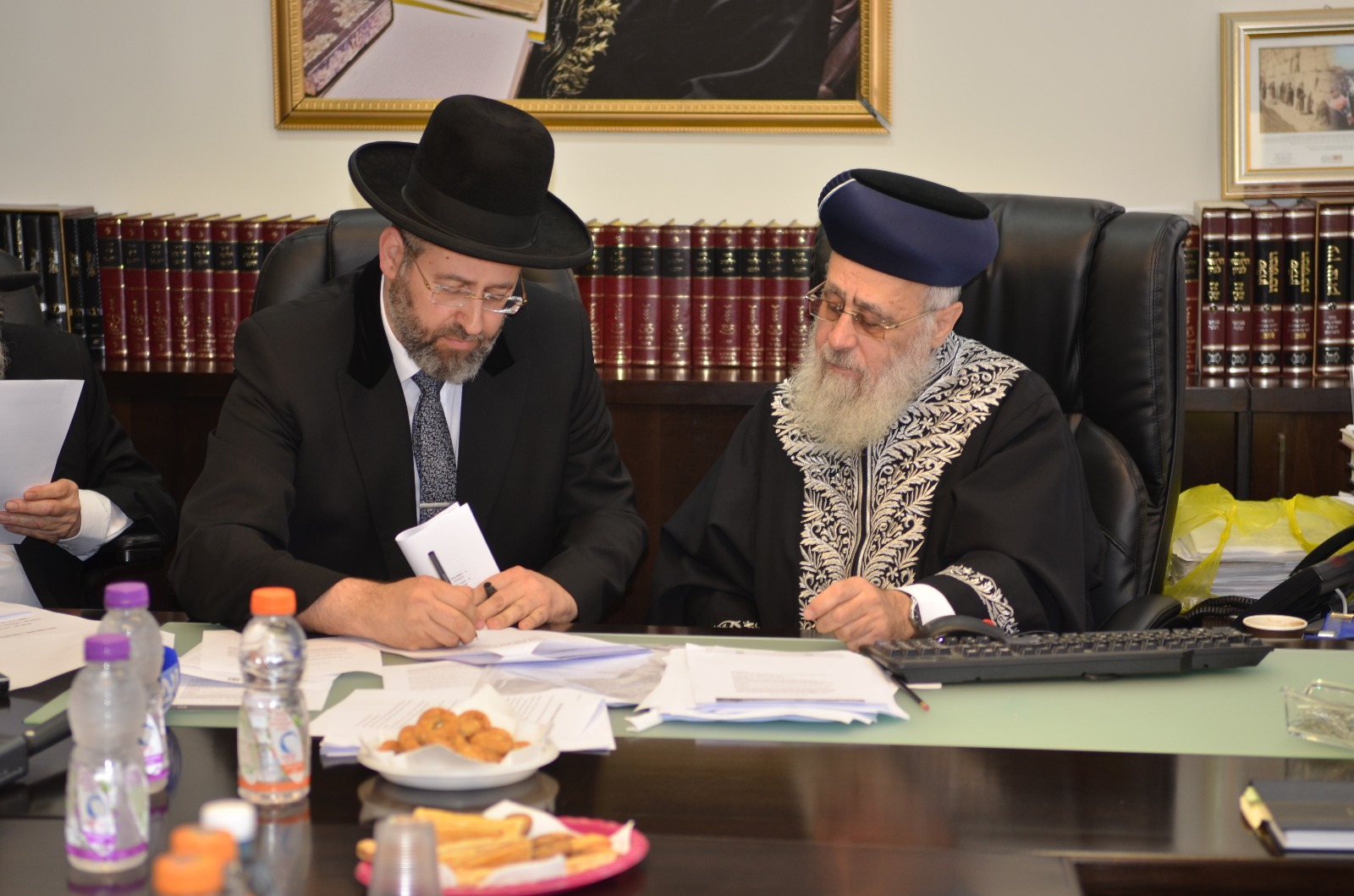
Illustrative. Ashkenazi Chief Rabbi David Lau (L) and Sephardi Chief Rabbi Yitzhak Yosef convene an emergency meeting against a new proposal to overhaul the conversion to Judaism system in the country on June 3, 2018. (courtesy, the Chief Rabbinate spokesperson)
A few years back, a colleague informed me that she thought the New York Get Laws were unconstitutional, dangerously entangling the state in religious affairs. Passed in 1983 and 1992, the laws encourage Jewish husbands to deliver religious divorces (“gets”) to their wives. The laws preclude judges from entertaining a civil divorce suit filed by husbands who fail to “remove all barriers to remarriage”; and, they also allow judges to take the failure to give a get into account when making equitable distribution of marital property. A long-standing activist for Jewish women, I retorted flippantly that “Maybe my colleague was right, but I didn’t care.”
I should have. Theocracies — states who answer to clerics speaking for God and are oblivious to the Rule of Law and basic civil liberties — are dangerous. A recent case is illustrative. Two weeks ago, Israeli Chief Rabbi Meir Lau ordered Jerusalem undertakers to halt a burial. At the request of the Union of Orthodox Rabbis of America, Lau was trying to force the hand of the deceased’s son. Lau claimed that the man, an American citizen and resident, had been withholding a get for the past 15 years from a woman from whom he had been civilly divorced. After the man’s family agreed to post a bond to guarantee the get, the burial commenced. Immediately afterwards, however, the man announced that he had had no intention of delivering the get. He said that he had already deposited one with an American rabbinic court. Responding, his divorcee, who is also an American citizen and resident, claimed that the man’s designated court was not reputable. She also was not satisfied with the decree of annulment that had been issued at her request by the International Beth Din, located in New York City. She wanted a “more” kosher get, one recognized by the Israeli Rabbinate. Lau agreed.
Much criticism has been levelled at the above events, most aimed at Lau, at Jewish law, and obviously at the get-refuser. Some criticism was even directed at the divorcee. However, no one criticized the elephant in the room: the fact that the democratic state of Israel has entangled itself with religion to such an extent that it has constructed a partial theocracy which violates the civil liberties of its citizens — as well as foreign citizens — without it, or them, even noticing.
Theocracies violate due process.
In the case at hand, the chief rabbi, a state actor who is the apparent head of Israel’s theocratic arm, violated the rights of the deceased and her family to a fair trial. Not only was no trial or investigation conducted before the chief rabbi took action, he did not even summon a response from ANY of the parties involved — not even the woman in whose benefit he claimed to be acting. Not to mention the fact that no law or regulation on the books of the state gives him authority to make any order to allow or deny a burial.
Theocracies do not respect privacy.
Here, the chief rabbi violated the privacy and dignity of the deceased, with impunity, because he could. By disrespecting the body of the deceased, he abused the state’s obligation to preserve the dignity of persons, and abused its limited privilege to exercise violence within its geographic boundaries.
Theocracies confiscate properties.
In the matter under discussion, the chief rabbi interfered with the private contract entered into between the deceased and the Jerusalem Burial Society. Aside from this being a tortious interference with a contract by a third party that would entitle the family to sue the chief rabbi personally for damages, it is tantamount to a state violation of the core civil liberties of persons to own property and contract with other persons and entities.
Theocracies coerce religious behavior.
In this instance, the chief rabbi attempted to coerce the religious activity of a man in a manner that he deemed religiously inappropriate. Though the man argued that he had already done the religious act, and although the woman had already found relief in a private, religious court of her choice, the chief rabbi imposed his religious conscience on all parties involved.
Theocracies do not respect their limited geographical jurisdiction.
Perhaps most appallingly, the chief rabbi did not think that his theocratic realm had any geographic boundaries. He abused his powers as a state actor to infringe on the privacy, property, and religious freedoms of persons who were in no way subject to the state’s jurisdiction. None of the parties are, or were, citizens or residents of the state, nor were they present in the state. Through the abused body of the deceased, the long-arm of the chief rabbi reached across the oceans to coerce their behavior. Such overreaching of state power violates all principles of international law.
Theocracies can also become Vaticans.
By transgressing the boundaries of the state, the chief rabbi has turned himself into the pope of the Jewish religion. As pope, he decides what God’s word is. He gets to decide who is in and who is out of the Jewish people all over the world. This is not a power which the State of Israel has given him.
I still think that the NY Get Laws are constitutional and a legitimate tool of the State of New York to do justice (at the risk of oversimplification, I believe the laws meet the state’s secular goals of marriage and fair allocation of resources). But I know that my support for those laws cannot be justified simply because I think get-refusal is a heinous, vengeful act that needs to be eradicated. There are certain values even greater than eradication of heinous acts — like due process, a fair trial, freedom of religion, privacy, autonomy, dignity, and protection of the individual from a violent state. Today, the chief rabbi as Head of the State Theocracy “merely” violated the dignity of a cadaver. Tomorrow, he could violate the civil liberties of you and me. Unless those values are protected, first and foremost, we have nothing, except perhaps a new Vatican with a new pope.
The division that handles Judaism inquiries at the district rabbinical court in Jerusalem, November 2018. Olivier Fitoussi
The Chief Rabbinate’s interest in genetic testing as a tool to establish Jewishness should set off a historical warning light for everyone, but particularly for Jews.
Over the past year the rabbinical courts began proposing that individuals in the process of “clarifying their Jewish states” undergo genetic testing: specifically of mitochondrial DNA, which is inherited from the mother. Dozens of Israelis have undergone the test in the past year, and it has helped about two-thirds of those whose Judaism had been in doubt.
Every year, more than 4,000 Israelis are required to prove whether they are Jewish. In most cases they are the children of immigrants from the former Soviet Union who want to register for marriage. Until recently, the process involved presenting documents, such as birth and death certificates. Now, as if Judaism is a matter of race, not religion, rabbinical courts are inviting people whose documents did not satisfy them to undergo a DNA test.
This is a test that can make things easier for people the rabbinical courts did not recognize as Jews. But we must not be misled into thinking it is a sign of improved service by the rabbinate. It is inconceivable that an Israeli who wants to marry should have to take a DNA test to prove that they are Jewish. Although the test is voluntary at present, and is used only to prove a person’s Jewishness, it could open the door to negating the Jewish status of a person who was previously recognized as Jewish.
A few months ago Yisrael Beiteinu Chairman Avigdor Lieberman slammed the Interior Ministry, and rightly so, for asking immigrants from the former Soviet Union to take a DNA test. Lieberman accused the ministry of discrimination and said the voluntary nature of the test was meaningless if refusing to undergo it results in not being recognized as Jewish and therefore being disqualified from marrying in Israel. The way to cut the red tape is not to make verification methods more sophisticated, but rather to do away with them, among other ways by introducing civil marriage.
In Israel, which grants citizenship according to bloodlines only; where a person’s Jewishness has legal significance that affects the right to immigrate and to obtain citizenship, as well as affecting personal status and even the right to buy property, the thought of making DNA testing part of the process of determining Jewishness according to religious law is spine-chilling. While there is no overlap between determining Jewishness according to Jewish religious law and determining Jewishness for the purposes of the Law of Return, the complex relationship between state and religion in Israel demands extreme caution.
No door should be opened for Israel to become a country where entry and citizenship will someday depend on a genetic test. This is a slippery slope, at the bottom of which Israel is liable to define itself not only as the nation-state of the Jewish people, but as the state of the Jewish race.
Baby Conversion to Judaism at the Mikveh- Mayyim Hayyim (YouTube screenshot )
Four years ago, I wrote an article about how I acquired my Jewish identity. After the Tablet piece got published, I was lucky: My parents, friends, and partners — some halakhic Jews among them — accepted me as a Jew. Thanks to their acceptance, I was able to negotiate and construct my Jewishness in public spaces without having to turn to synagogues, rabbinates, or the State of Israel for approval. Today, while living in the Diaspora and not being a member of any congregation, I feel Jewish, know a little bit of Hebrew, celebrate holidays through the lens of their secular interpretation, and consider the Jewish culture to be part of my heritage. I am also seen as a fellow Jew by those Jews whose opinion matters to me. Frankly, I don’t think it could have gone any better.
Yet I am aware that my case is an exception. Today, we are still stuck in a situation when a non-Jew can “formally” join the Jewish people strictly through religious conversion. This means that a secular person cannot, at least honestly, become a Jew by choice. The giyur (Hebrew for conversion) itself is not the main problem here. It is understandable that the procedure, which emerged when it was impossible to imagine the Jewish community of faith and the Jewish nation as two separate phenomena, remained insensitive to the distinction that appeared later on. The real problem is that we still haven’t created an institution of secular giyur — neither in the Diaspora, where Jewish life is concentrated around synagogues and doesn’t exist in a purely secular fashion, nor in the State of Israel, where the Orthodox Rabbinate holds an absolute monopoly on deciding ‘who is a Jew.’
Creating mechanisms of secular giyur is necessary because this would bring us closer to accepting the reality, which we all know is there. Today, millions of Jews live non-religious lives and hundreds of thousands are married to non-Jewish (whatever that means) spouses. yet at the same time, the right of welcoming Jews by choice remains a privilege reserved to religious Jews only. The introduction of secular giyur would be a gesture of respect to secular Jews and secular converts — it would be just, from the social point of view. From the religious point of view, it can be seen as a return to the Biblical tradition. Thus, when Ruth spoke to Naomi — “thy people shall be my people, and thy God my God” — she, in the interpretation of Israeli Reform Rabbi Gregory Kotlyar, first became part of the Jewish people and only then, by virtue of this accession, had to follow the laws of the Torah. This order was reversed in the times of galut, the exile, when religion became the only foundation of the Jewish people, and remained such up until nowadays. Today, a convert first accepts the religious laws of Judaism and only then joins the Jewish people and acquires the right to join the Jewish nation by making aliyah. Secular giyur would make it possible for converts to join the Jewish people without subscribing to the laws of Judaism, which many Jews by birth are not following.
Secular conversion shouldn’t be a procedure administered by a single institution. Rather, it should be a set of cultural and political mechanisms that would allow secular Jews by choice to be treated equally. In Israel, those mechanisms can be created by implementing a complete separation of “church” and state. Dismantling the Orthodox Rabbinate’s control over the private lives of the Israeli Jews will leave the ‘who is a Jew?’ question up to the Israelis themselves. In such a situation, every new shabbat dinner, every new date, and every new friendship will produce a different and equally legitimate answer to this question, and plurality could become the norm. In addition, the current Law of Return should be replaced with an immigration law that would allow naturalisation. Opening up the Israeli nationality in such a manner would make it possible for secular Jews by choice to move to the country and settle there freely. It would also open the country to non-Jews, something that should happen if we want Israel to survive as a truly democratic society.
Imagining mechanisms of secular giyur in the Diaspora, where synagogue remains the only Jewish institution, is somewhat harder. In 2010, Jewish philosopher Michael Walzer wrote that outside of Israel, “secular Jewishness isn’t sufficiently institutionalized to sustain itself by itself” due to the lack of Jewish life outside of the network of congregations. Yet my story is a reminder that this is not always the case: I know that with the support and acceptance of other Jews one can live a full and sufficient secular Jewish life outside of synagogue. Turning my case from an exception into a rule isn’t impossible: In the end, it’s up to each of us to accept and welcome people who feel Jewish and identify as Jewish, no matter how they developed those feelings. Institutions will follow.
In Eikev, Moses sets out a political doctrine of such wisdom that it can never become redundant or obsolete. He does it by way of a pointed contrast between the ideal to which Israel is called, and the danger with which it is faced. This is the ideal:
Observe the commands of the Lord your God, walking in His ways and revering Him. For the Lord your God is bringing you into a good land — a land with streams and pools of water, with springs flowing in the valleys and hills; a land with wheat and barley, vines and fig trees, pomegranates, olive oil and honey; a land where bread will not be scarce and you will lack nothing; a land where the rocks are iron and you can dig copper out of the hills. When you have eaten and are satisfied, bless the Lord your God for the good land He has given you. (Deut. 8:6–10)
And this is the danger:
Be careful that you do not forget the Lord your God, failing to observe His commands, His laws, and His decrees that I am giving you this day. Otherwise, when you eat and are satisfied, when you build fine houses and settle down, and when your herds and flocks grow large and your silver and gold increase and all you have is multiplied, then your heart will become proud and you will forget the Lord your God, who brought you out of Egypt, out of the land of slavery. … You may say to yourself, “My power and the strength of my hands have produced this wealth for me.” But remember the Lord your God, for it is He who gives you the ability to produce wealth, and so confirms His covenant, which He swore to your forefathers, as it is today. (Deut. 8:11–18)
The two passages follow directly on from one another. They are linked by the phrase “when you have eaten and are satisfied,” and the contrast between them is a fugue between the verbs “to remember” and “to forget.”
Good things, says Moses, will happen to you. Everything, however, will depend on how you respond. Either you will eat and be satisfied and bless God, remembering that all things come from Him — or you will eat and be satisfied and forget to whom you owe all this. You will think it comes entirely from your own efforts: “My power and the strength of my hands have produced this wealth for me.” Although this may seem a small difference, it will, says Moses, make all the difference. This alone will define your future as a nation in its own land.
Moses’ argument is brilliant and counter-intuitive. You may think, he says, that the hard times are behind you. You have wandered for 40 years without a home. There were times when you had no water, no food. You were exposed to the elements. You were attacked by your enemies. You may think this was the test of your strength. It was not. The real challenge is not poverty but affluence, not slavery but freedom, not homelessness but home.
Many nations have been lifted to great heights when they faced difficulty and danger. They fought battles and won. They came through crises — droughts, plagues, recessions, defeats — and were toughened by them. When times are hard, people grow. They bury their differences. There is a sense of community and solidarity, of neighbors and strangers pulling together. Many people who have lived through a war know this.
The real test of a nation is not if it can survive a crisis but if it can survive the lack of a crisis. Can it stay strong during times of ease and plenty, power and prestige? That is the challenge that has defeated every civilization known to history. Let it not, says Moses, defeat you.
Moses’ foresight was little less than stunning. The pages of history are littered with the relics of nations that seemed impregnable in their day, but which eventually declined and fell and lapsed into oblivion — and always for the reason Moses prophetically foresaw. They forgot.
Memories fade. People lose sight of the values they once fought for — justice, equality, independence, freedom. The nation, its early battles over, becomes strong. Some of its members grow rich. They become lax, self-indulgent, over-sophisticated, decadent. They lose their sense of social solidarity. They no longer feel it their duty to care for the poor, the weak, the marginal, and the losers. They begin to feel that such wealth and position as they have is theirs by right.
The bonds of fraternity and collective responsibility begin to fray. The less well-off feel an acute sense of injustice. The scene is set for either revolution or conquest. Societies succumb to external pressures when they have long been weakened by internal decay. That was the danger Moses foresaw and about which he warned.
His analysis has proved true time and again, and it has been restated by several great analysts of the human condition. In the 14th century, the Islamic scholar Ibn Khaldun (1332-1406) argued that when a civilization becomes great, its elites get used to luxury and comfort, and the people as a whole lose what he called their asabiyyah, their social solidarity. The people then become prey to a conquering enemy, less civilized than they are but more cohesive and driven.
The Italian political philosopher Giambattista Vico (1668-1744) described a similar cycle: People, he said, “first sense what is necessary, then consider what is useful, next attend to comfort, later delight in pleasures, soon grow dissolute in luxury, and finally go mad squandering their estates.” Affluence begets decadence.
In the 20th century, few said it better than Bertrand Russell in his History of Western Philosophy. He believed that the two great peaks of civilization were reached in ancient Greece and Renaissance Italy, but he was honest enough to see that the very features that made them great contained the seeds of their own demise:
What had happened in the great age of Greece happened again in Renaissance Italy: traditional moral restraints disappeared, because they were seen to be associated with superstition; the liberation from fetters made individuals energetic and creative, producing a rare fluorescence of genius; but the anarchy and treachery which inevitably resulted from the decay of morals made Italians collectively impotent, and they fell, like the Greeks, under the domination of nations less civilized than themselves but not so destitute of social cohesion.
Moses, however, did more than prophesy and warn. He also taught how the danger could be avoided, and here too his insight is as relevant now as it was then. He spoke of the vital significance of memory for the moral health of a society.
Throughout history there have been many attempts to ground ethics in universal attributes of humanity. Some, like Immanuel Kant, based it on reason. Others based it on duty. Bentham rooted it in consequences (“the greatest happiness for the greatest number”). David Hume attributed it to certain basic emotions: sympathy, empathy, compassion. Adam Smith predicated it on the capacity to stand back from situations and judge them with detachment (“the impartial spectator”). Each of these has its virtues, but none has proved fail-safe.
Judaism took, and takes, a different view. The guardian of conscience is memory.
Time and again the verb zachor, “remember,” resonates through Moses’ speeches in Deuteronomy:
Remember that you were slaves in Egypt … therefore the Lord your God has commanded you to observe the Shabbat day. (Deut. 5:15)
Remember how the Lord your God led you all the way in the desert these forty years… (Deut. 8:2)
Remember this and never forget how you provoked the Lord your God to anger in the desert… (Deut. 9:7)
Remember what the Lord your God did to Miriam along the way after you came out of Egypt. (Deut. 24:9)
Remember what the Amalekites did to you along the way when you came out of Egypt. (Deut. 25:17)
Remember the days of old, consider the years of ages past. (Deut. 32:7)
As Yosef Hayim Yerushalmi notes in his great treatise Zakhor: Jewish History and Jewish Memory, “Only in Israel and nowhere else is the injunction to remember felt as a religious imperative to an entire people.”
Civilizations begin to die when they forget. Israel was commanded never to forget.
In an eloquent passage, the American scholar Jacob Neusner once wrote:
Civilization hangs suspended, from generation to generation, by the gossamer strand of memory. If only one cohort of mothers and fathers fails to convey to its children what it has learned from its parents, then the great chain of learning and wisdom snaps. If the guardians of human knowledge stumble only one time, in their fall collapses the whole edifice of knowledge and understanding.
The politics of free societies depends on the handing on of memory. That was Moses’ insight, and it speaks to us with undiminished power today.
Rabbi Lord Jonathan Sacks is the former chief rabbi of the United Hebrew Congregations of the Commonwealth. The author of over 30 books, he can be followed on social media @RabbiSacks or at www.RabbiSacks.org.
“The blessing and the curse”: all phenomena, and all human activity, seem subject to categorization by these two most basic definers of reality. A development is either positive or negative, an occurrence either fortunate or tragic, an act either virtuous or iniquitous.
Indeed, the principle of “free choice”—that man has been granted the absolute autonomy to choose between good and evil—lies at the heart of the Torah’s most basic premise: that human life is purposeful. That our deeds are not predetermined by our nature or any universal law, but are the product of our independent volition, making us true “partners with G‑d in creation” whose choices and actions effect the continuing development of the world as envisioned by its Creator.
Philosophers and theologians of all ages have asked: From where does this dichotomy stem? Does evil come from G‑d? If G‑d is the exclusive source of all, and is the essence of good, can there be evil in His work? If He is the ultimate unity and singularity, can there exist such duality within His potential?
In the words of the prophet Jeremiah, “From the Supernal One’s word there cannot emerge both evil and good” (Lamentations 3:38). Yet the Torah unequivocally states: “See, I am giving you today the blessing and the curse”—I, and no other, am the exclusive source and grantor of both.
Transmutation
One approach to understanding the Torah’s conception of “the blessing and the curse” is to see how this verse is rendered by the great translators of the Torah.
Aramaic, which was widely spoken by the Jewish people for fifteen centuries, is the “second language” of the Torah. It is the language of the Talmud, and even of several biblical chapters. There are also a number of important Aramaic translations of the Torah, including one compiled at the end of the first century CE by Onkelos, a Roman convert to Judaism who was a nephew of the emperor Titus; and a translation compiled a half-century earlier by the great Talmudic sage Rabbi Yonatan ben Uziel.
In Onkelos’ translation, the Hebrew word kelalah in the above-quoted verse is translated literally as “curse” (levatin in the Aramaic). But in Rabbi Yonatan’s translation, the verse appears thus: “See, I give you today the blessing and its transmutation.” The author is not merely avoiding the unsavory term “curse”—he himself uses that term but three verses later in Deuteronomy 11:29, and in a number of other places in the Torah where the word kelalah appears. Also, if Rabbi Yonatan just wanted to avoid using a negative expression, he would have written “the blessing and its opposite” or some similar euphemism. The Aramaic word he uses, chilufa, means “exchange” and “transmutation,” implying that “the curse” is something which devolves from the blessing and is thus an alternate form of the same essence.
In the words of our sages, “No evil descends from heaven”—only two types of good. The first is a “blatant” and obvious good—a good which can be experienced only as such in our lives. The other is also good, for nothing but good can “emerge from the Supernal One”; but it is a “concealed good,” a good that is subject to how we choose to receive and experience it. Because of the free choice granted us, it is in our power to distort these heavenly blessings into curses, to subvert these positive energies into negative forces.
Onkelos’s is the more “literal” of the two translations. Its purpose is to provide the student with the most rudimentary meaning of the verse. The verse, in the Hebrew, says “the blessing and the curse,” and Onkelos renders it as such in the Aramaic. Anyone searching for the deeper significance of the negative in our world must refer to those Torah texts which address such issues.
On the other hand, the translation of Rabbi Yonatan ben Uziel provides a more esoteric interpretation of the Torah, incorporating many Midrashic and Talmudic insights. So instead of simply calling “the curse” a curse, it alludes to the true significance of what we experience as evil in our lives. In essence, Rabbi Yonatan is telling us, what G‑d gives is good; but G‑d has granted us the ability to experience both “the blessing and its transmutation”—to divert His goodness to destructive ends, G‑d forbid.
This also explains why Rabbi Yonatan translates kelalah as “transmutation” in the above-cited verse (verse 26) and in a later verse (verse 28), yet in verse 29 he renders it literally as “curse,” in the manner of Onkelos. In light of the above, the reason for the differentiation is clear: the first two verses speak of G‑d’s giving us both a blessing and a “curse”; but G‑d does not give curses—only the option and capability to “transmute” His blessings. On the other hand, the third verse (“And it shall come to pass, when the L‑rd your G‑d has brought you into the land . . . you shall declare the blessing on Mount Gerizim and the curse on Mount Eival”) speaks of our articulation of the two pathways of life, where the “concealed good” can be received and perceived as an actual “curse.”
Galut
On a deeper level, the different perspectives on the nature of evil expressed by these two Aramaic translations of the Torah reflect the spiritual-historical circumstances under which they were compiled.
Galut, the state of physical and spiritual displacement in which we have found ourselves since the destruction of the Holy Temple and our exile from our land nearly two thousand years ago, is a primary cause for the distortion of G‑d’s blessing into “its transmutation.” When the people of Israel inhabited the Holy Land and experienced G‑d’s manifest presence in the Holy Temple in Jerusalem, they experienced the divine truth as a tactual reality. The intrinsic goodness and perfection of all that comes from G‑d was openly perceivable and accessible.
Galut, on the other hand, is a state of being which veils and distorts our soul’s inner vision, making it far more difficult to relate to the divine essence in every event and experience of our lives. Galut is an environment in which the “concealed good” that is granted us is all too readily transmuted into negativity and evil.
The translation by Rabbi Yonatan ben Uziel, also called the “Jerusalem Translation,”1 was compiled in the Holy Land in the generation before the Temple’s destruction. The very fact that its authorship was necessary—that for many Jews the language of the Torah was no longer their mother tongue, and the word of G‑d was accessible only through the medium of a vernacular—bespeaks the encroaching galut. The “concealed good” was already being experienced as something other than an expression of G‑d’s loving relationship with us.
Still, in Rabbi Yonatan’s day the Holy Temple stood in Jerusalem. The descending veil of galut was translucent still, allowing the recognition, if not the experience, of the true nature of reality. One was aware that what one perceived as negative in one’s life was a distortion of the divine goodness.
The Onkelos Translation was compiled a generation later, by the nephew of the Roman emperor who destroyed the Holy Temple and drove the people of Israel into exile. In Onkelos’ day, the galut had intensified to the point that the prevalent reality was that of a world dichotomized by good and evil, a world in which the “concealed good” is regarded as simply “the curse.”
But it is precisely such a world that offers the ultimate in freedom of choice, which, in turn, lends true import and significance to the deeds of man. It is precisely such a world that poses the greater—and more rewarding—challenge: to reveal the underlying goodness, unity and perfection of G‑d’s creation.
Footnotes
1.Certain editions of the Chumash include both a “Translation of Yonatan ben Uziel” as well as a “Jerusalem Translation.” According to most commentaries, these are two versions of the same work.
‘I performed Jewish. I lived Jewish. And nobody owns the right to tell me if I am Jewish or not.’
I was born three years after the Soviet Union was dissolved, in Tatarstan, a predominantly Muslim republic in Russia, some 1,100 kilometers east of Moscow. Both my parents are Russian. However, I am Jewish.
When I was 11, my parents divorced and I stayed with my mother. She soon met another man, who later became her partner, and then her husband. He was Jewish. Or, rather, I was told that he was Jewish. “What should I do with it?” I thought, because I never heard of anything called “a nation,” or “an ethnicity” before. I started questioning him about what it meant, but he, being one of millions of Soviet Jews whose parents and grandparents had abandoned all Jewish practices, was unable to tell me much. I started learning on my own from books, mainly about contemporary Israel.
The following year I went to a new school on the outskirts of Moscow. Students there were split into two competing categories—guys from the North Caucasian republics of Russia and those who considered themselves properly “white” Russian and looked down on anyone who was “black,” like the kids from the Caucasus. Ethnic clashes occurred daily after school. I told everyone I was Jewish. This placed me outside the Russian/North Caucasian binary but created a minority of one. I endured two years of anti-Semitic mockery and some physical violence. Somehow, though, I stuck with my Jewish self-identity. It was public at school and private at home: I no longer talked to my stepfather about his Jewishness, or mine.
When I was 14, I started attending a different school. This was a well-known, competitive Moscow school, where many of the students were Jewish, some also coming from families of former dissidents. No one ever asked if I was Jewish: It seemed assumed. Over the years, though, some differences emerged between me and the other Jewish teenagers at the school—most of them had at least a surface familiarity with Jewish ritual, and most had relatives in Israel. I made up a back story to explain these things away. In this story, it was my biological father who was Jewish (as was my stepfather). We had lived in Tel Aviv until I was 5. I even found a preschool that I had supposedly “attended.” Everyone, literally everyone—except for my parents—believed that I was Jewish and a former Israeli: My friends were hanging out with a fellow Jew, my lecturers were teaching me among many Jews, my girlfriend was dating a fellow Jew. Later, during my second year at university, my tutor, a prominent Russian scholar, said to me, “You must be careful in your statements because you represent the Israeli community among the students of our university.” I indeed represented it, though the Israeli community, if there was one at my university, hardly knew about it.
I was maturing, and so was my Jewish identity. I was reading books, going to events and talking to people, everything connected with what I found the most appealing and interesting part of Jewish history—European prewar Jewry and the modern State of Israel. I knew more about Israeli culture and history than most of my peers. I was accepted as Jewish at the Jewish cultural center in Moscow, through which I got free Hebrew lessons. I was invited to Jewish holidays and ignored those invitations because I was unfamiliar with the ritual and also because I felt I was not ready to join in religious ceremony. I was among five people present at a meeting held by the dean of the faculty of Jewish studies at Moscow State University, where scholarship options for Jewish students were discussed. I worked for a Jewish media outlet. I was living a secular Jewish life, but I also happen to believe in God. This meant that eventually I would ask a congregation to accept me for giur, a conversion ceremony.
I did it last October, when I moved to Amsterdam to study there. I was now 19. After three meetings with different rabbis and seven months of processing my request, the Liberal Congregation of The Netherlands (Liberaal Joods Gemeente) rejected my request for conversion. Officially I was told that LJG “prioritized the process for Jewish father, Jewish background or a Jewish spouse.” Another reason was, as a rabbi has explained to me a month later, that, roughly speaking, I am not religious enough. Later, the LGBT shul, Beit HaChidush, rejected me as well. Thus I learned that I did not have a “Jewish background” despite years of living as someone who was Jewish.
Over the months when my case was being discussed, my girlfriend and I broke up and I decided to tell her who I really was. But then I realized there was nothing to tell. There was no story, no “dual life”: just me, my identity, and my life. I told everything to her, and then—in a few weeks—to my closest friends, as well as to my parents. I felt liberated as never before. They finally knew what kind of Jew I am.
II
What is my Jewishness? What was it? Could I have picked another identity when I was 12 years old and wanted to be different from the others if my mother’s partner had been, say, Georgian? Probably.
If being Jewish is a matter of biology, my DNA test clearly tells me I have 0 percent of Jewish ancestry (I have checked).
If being Jewish is a matter of a family, then I am not Jewish, because I was not raised Jewish. And I am, because my stepfather, who has indeed raised me, is Jewish.
If being Jewish is a question of religion, then I am not Jewish, because I never took part in religious ceremony, I never attended a service at a synagogue before moving to The Netherlands, I never studied at a Jewish religious school. And yet I am, because I believe in the Jewish God.
If being Jewish is a matter of social recognition, then I am not Jewish, because Dutch congregations refused to accept me as a Jew. And I am because everyone who knows me in Russia knows me as a Jew.
If being Jewish is a matter of belonging to a nation, then I am not Jewish, because there is not a single document that says I am Jewish. And I am because every time a terrorist attack happens in Israel, I rush to call my friends there, and because I consider the occupation of Palestinian lands, which must end, and the Israeli housing crisis, to be pressing social issues of my time.
If being Jewish is a matter of appearance and visibility, then I—with blond hair and Scandinavian looks—am not Jewish. And I am, because sometimes I wear a kippah and it feels just right.
If being Jewish is a matter of culture, then I am not Jewish: I am not against intermarriage, I don’t do “things that only Jews do,” I am not acquainted with Jewish theater and Jewish cuisine. And I am, because I love Agnon and the Barry sisters, Waltz With Bashir and Rutu Modan. Because I feel Israel is my home, a big shul, and I will strive to make it a better, more tolerant, and peaceful place.
If being Jewish is a matter of anti-Semitism, then I am not Jewish, because the hatred I experienced would have been there if I had “othered” myself in any other way, not necessarily as a Jew. And I am, because I was told I should not exist because Jews, and not other group, rule the world.
If being Jewish is a matter of self-determination, then I am not only Jewish. I am European, Russian, white, bisexual, liberal, post-soviet, middle-class, a student. I am dozens of other identities. And I am Jewish.
III
Following the story of Rachel Dolezal this week I was thinking about how the uncertainty experienced by a person who has to perform many identities simultaneously is compensated with locating oneself in certain and defined boundaries, be those national, sexual, racial, social, or another sort. In case of Rachel Dolezal, this mechanism is extended to other person: She is told she can be either black or white, and this must be clear to society around her.
During one of the Amsterdam meetings with a rabbi I was told by a member of the congregation that I do not know what being Jewish is, that I was born in a time of little anti-Semitism, that I didn’t experience “enough” of it. The same is being said about Rachel Dolezal—that before becoming a black woman she wasn’t a black girl, that she didn’t live a black life but performed one. I can’t and do not want to get into Rachel Dolezal’s head. But her intentions do not matter: Nobody exclusively owns blackness and no one can tell Rachel Dolezal who she is, as well as demand from her to decide who she is. It was not only she who “performed” black, it was everyone around her who performed her blackness, too.
In Judaism, a person is considered Jewish if born from a Jewish mother or has undergone a conversion procedure. Speaking in nonreligious definitions, the biggest institution that believes it has the right to determine who is a Jew is the State of Israel. In 1962, Father Oswald Daniel Rufeisen (“Brother Daniel”), a Jew who converted to Catholicism during WWII, applied for Israeli citizenship under the Law of Return. During the hearings, four justices intended to set, as one scholarly version describes it, “some objective boundaries to the concept of Jewishness,” while Haim Cohen was the only justice arguing that in the absence of secular criteria of who is a Jew, such a definition should be “a subjective test.” The court ruled 4 to 1 that a Jew who voluntarily converted to Christianity cannot be considered a Jew under the secular Law of Return. Oswald Rufeisen was denied Israeli citizenship, but no “objective boundaries” were set to the secular definition of who is a Jew. Israeli Law of Return is based on the Nuremberg Laws’ definition of a Jew, though more than 70 years passed since the Holocaust. For Israel, it is still Nazi Germany that defines who is a Jew and who is not.
Some weeks ago my stepfather and my mother received aliyah visas to Israel, which will automatically turn into Israeli citizenship when they pass through customs at Ben-Gurion airport this July. Under Nuremberg Laws, my mother, who never expressed a wish of converting to Judaism or acquire a Jewish identity, is Israeli and will now be treated as a Jew every moment she will take out her Israeli passport everywhere in the world. Her voluntary decision to enter a Jewish family made her Jewish in the eyes of the law. But my voluntary decision and earnest desire didn’t: I, in turn, will be encountering obstacles to being recognized as Jewish on every step, both in Israel and outside of it.
But for me it doesn’t matter anymore. I performed Jewish. I lived Jewish. And nobody owns the right to tell me if I am Jewish or not, or demand me to choose. Not anti-Semites, not a single congregation, not the State of Israel.
Hace cien años Franz Rosenzweig terminó de escribir su libro más importante, “La Estrella de la Redención”, a traves del cual trazó nuevos caminos en las preocupaciones por el futuro de la teología y la filosofía judías. Entre los temas que trata ocupa un lugar decisivo el saberse pueblo elegido de los judíos. Aceptar una elección implica un compromiso, una obligación que se debe cumplir puntualmente. Ser elegido por Dios ha sido la ambición de muchos pueblos, pero, ¿ser elegido para qué? Es una pregunta fundamental en el pensamiento de Franz Rosenzweig, uno de los filósofos existencialistas religiosos más importantes del siglo pasado y uno de los teólogos más influyentes hasta el presente. Nació el 25 de diciembre de 1886 en Kassel, Alemania y murió en Frankfurt am Maine en 1929, el 10 de diciembre. Su familia asimilada tenía una buena posición económica y social, sus dos hijos recibieron una educación rica en literatura y arte, pobre en judaísmo.
Como parte de un grupo de jóvenes, inquietos, brillantes que encontraron su camino por los senderos del cristianismo, también el joven Franz estaba por convertirse al cristianismo en 1913.
Estudiaba medicina cuando decidió cambiarla por filosofía, se oponía a Hegel y al idealismo alemán, se inclinaba por el existencialismo que quería entender la realidad a partir de la experiencia y los intereses de la persona concreta, individual y no mediante conceptos abstractos.
En octubre de 1913 asistió al servicio de Yom Kippur en una sinagoga modesta en Berlín. El drama litúrgico de los pecados humanos y el perdón divino, la afirmación, unicidad de Dios y su amor tuvo un efecto poderoso en Franz. Lo que pensaba que encontraría en la iglesia –la fe que le daría una orientación en el mundo- lo encontró en la sinagoga. Sintió que debía ser judío.
Dedicó el año académico a la lectura intensa de fuentes hebreas clásicas y a las conferencias de Herman Cohen, eminente pensador judío alemán.
Durante la Primera Guerra Mundial se unió al ejército en una unidad contra la aviación que le dejaba tiempo para leer y escribir, publico un artículo sobre problemas teológicos –judaísmo y cristianismo-, elaboro un plan para reformar el sistema escolar alemán y escribió, “En Tiempo”, un programa para reorganizar la educación judía.
En 1918 fue enviado a un curso cerca de Varsovia ocupada por los alemanes y pudo observar la vida de los judíos de Europa Oriental que lo impresiono profundamente por la vitalidad y riqueza de su fe.
Cuando regreso a su puesto se sintió listo para empezar lo que sería su obra más importante: su filosofía existencialista, demostrando la relación mutua entre Dios, el ser humano y el mundo, basado en la experiencia humana, el sentido común y la realidad del lenguaje y el dialogo. Su fundamento se inicia en la revelación de Dios que se hace presente al hombre por su amor y despierta en el la conciencia de un Yo. Termino de escribir “La Estrella de la Redención” en ’19, apareció en ’21, ignorada por corrientes de filosofía académica, muy admirada por existencialistas y, especialmente, por teólogos jóvenes.
En “La Estrella de la Redención” se encuentra la mayor parte de sus respuestas al misterio de la elección, caso límite de particularidad social y política del pueblo judío. Históricamente, Franz trabaja después de la Ilustración y la identificación del judaísmo como religión, no nacionalidad y descubrió que falta el sentido genuino del judaísmo y lo ve como un barco en búsqueda de su muelle propio, en la búsqueda estudia la separación entre cristianismo y judaísmo en sus sentidos descriptivo y prescriptivo. Los cristianos creen que ellos son los electos desde la muerte de su redentor, Jesús. No pueden superar la irritación fundamental, casi amenazadora a su vida, de la existencia continua de los judíos que siguen afirmando ser elegidos. Explican el cambio en la elección divina por el error necio de los judíos que no reconocen al Mesías. El sufrimiento judío es castigo divino a su “necedad”.
Los judíos también valorizan todo sufrimiento como castigo, pero por razones muy diferentes: por corrupción del sacerdocio, difamación y calumnias entre los judíos, helenización, monarquía ilegitima, etc. Pero, al mismo tiempo, la teodicea judía entiende su exilio como evento positivo, como un nuevo estado, una tarea nueva, en la espera del Mesías: recuperar las chispas divinas regadas por el mundo, fuera de la Tierra Prometida, o llevar los valores judíos al mundo no-judío, o por ambas.
El pueblo judío es “el pueblo eterno”, según Rosenzwieg, porque la elección conllevaba la Torah que fue recibida. Esto significa que envolvía al pueblo judío con la vida eterna. Hay una conexión profunda entre la elección y el esquema de creación-revelación-redención, estructura de su pensamiento religioso.
La creación es para todos, Adán es un ser humano como lo serán todos los hombres, no es judío, Dios se revela a Abran que recibe la Torah, Dios le asigna a él y a sus descendientes un papel especial. Se llamará Abraham, es judío y el eslabón que une la elección y la revelación. “Israel es más que el pueblo elegido, es el uno y único pueblo elegido, el pueblo del Dios uno y único.” Esta frase de Rosenzwieg se aclara si se entiende el paso de la revelación a la redención, la diferencia entre los dos sentidos judíos de la elección, la diferencia entre revelación y redención se entiende por la diferencia entre una elección exclusiva y una inclusiva. La importancia de la elección exclusiva es que Dios le da al pueblo judío la Torah que es recibida. Los otros pueblos que no la tienen no viven completamente en la eternidad de Dios. Pero la exclusividad es solo temporal, los judíos deben difundir los valores de la Torah para que todos los pueblos también lleguen a seguir la senda de Dios y ser elegidos de Dios.
Esta es la importancia de la historia en el proceso de redención: la eternalizacion de los pueblos. La historia sagrada es la elección progresiva de las naciones. Según Rosenzwieg este trabajo se realiza por el cristianismo únicamente, mediante la evangelización. Al fin de la historia, cuando la exclusividad de la elección se vuelve obsoleta y se hace inclusiva, entonces, y solo entonces, se alcanza la verdad divina que no es judía ni cristiana, todos estarán incluidos en la elección de Dios y habrá solo un pueblo bajo “Dios uno y único”. En un mundo redimido la exclusividad del judaísmo y la evangelización del cristianismo serán superfluas. La verdad absoluta, eterna vive en sí y convierte el tiempo en eterno.
Mientras la historia sigue haciéndose, Dios quiere a todos. Contento con lo que es, el judío reza y añora al Mesias, cuya llegada significa la redención de todo el mundo. Rosenzwieg encuentra una contradicción fundamental en el judaísmo que divide la vida entre sagrado y profano y la tierra entre Israel y los otros pueblos.
La elección une a los judíos y los separa de los no-judíos; divide el mundo judío por dentro, como entre sábado y días de trabajo; entre Torah y vida cotidiana, olvidando la obligación de ver el mundo irredento no-judío y ensenarle los valores de la Torah. Una actitud que pone en gran peligro al judaísmo por una tentación interna de auto-absorción cuyo precio es abandonar el cuidado del mundo que está afuera.
Rosenzwieg se casó en ’20 y fue nombrado director del centro de estudios para adultos, Lehrhause, en Frankfort, animaba a los estudiantes a examinar las fuentes hebreas clásicas en búsqueda de lo vital y relevante. No ocupo el puesto mucho tiempo; a principios de ’22 enfermo de una forma de esclerosis que paralizaba todo el cuerpo progresivamente. Incapaz de hablar o escribir en sentido físico, natural, continuo muy interesado en sus semejantes y su comunidad. Con la ayuda de su esposa. creo un sistema de señales entre ellos y una máquina de escribir construida especialmente para él y pudo producir ensayos importantes, una versión anotada en alemán de la poesía de Juda Halevi; trabajo en una traducción al alemán de la Biblia con Martin Buber y escribió una serie de artículos sobre las particularidades y estilo del pensamiento bíblico. Como entretenimiento escribió comentarios para una revista respecto a grabaciones de música clásica y sagrada. Nada permitía adivinar que el autor estuviera mortalmente enfermo. La evidencia era de un espíritu fresco, agudo, con claridad intelectual, fe religiosa y sentido de humor hasta su muerte. Tenía 43 años y ya había dejado su huella de gran influencia en la historia de las ideas filosófico-religiosas.
Preparing
the Jewish people for their entry into the Promised Land, Moses paints a
harmonious picture of one place where all will gather to celebrate and serve
G‑d:
And you shall cross the Jordan and settle in the land the
L‑rd, your G‑d, is giving you as an inheritance… And it will be, that the place
the L‑rd, your G‑d, will choose in which to establish His Name there you shall
bring all that I am commanding you: Your burnt offerings, and your sacrifices,
your tithes, and the separation by your hand, and the choice of vows which you
will vow to the L‑rd. And you shall rejoice before the L‑rd, your G‑d you and
your sons and your daughters and your menservants and your maidservants, and
the Levite who is within your cities.1
The
pilgrim festivals are central to this portion. The Torah commands us how and
with whom to celebrate, but there is a glaring omission: although mentioned
more than 10 times in the parshah, “the place the L‑rd your G‑d will choose” is
left unnamed.
Moses
spent 40 years teaching Torah and passing on the mitzvot with intricate detail.
He transmitted the highly detailed laws of the sacrifices, including everything
from which types of animals may be used to the location on the Temple where the
animals should be offered. Yet the place where all this would happen is
undisclosed. Why did Moses keep the location of the spiritual capital a secret?
Why does the name of the city where the Holy Temple will be built remain a
mystery?
Maimonides
suggests three possibilities:
If the surrounding nations
would know the future site of the Holy Temple, they would fortify the place
with their strongest armies in an effort to stymie Jewish worship there.
If the current residents of the Temple Mount would realize
the spiritual significance the place has to the Jewish people, they would do
all they could to destroy and deface it.
The third
reason (which Maimonides favors as the “strongest”) is that the Temple mount is
in the portion of Judah and Benjamin. If the other tribes would know that it
would not be in their portion, they would begin to quarrel over that spot, each
one wishing to host G‑d in their own territory. G‑d solved this problem by only
revealing His chosen location after Israel was ruled by a king who would be
able to maintain peace even as some tribes were elevated over others.2
A more
spiritual answer can be found in the verse where the phrase “the place the
L‑rd, your G‑d, will choose” is used for the first time:
But only to the place which the L‑rd, your G‑d, shall
choose from all your tribes, to set His Name there; you shall seek His presence
and come there.3
“You
shall seek His presence,” says the Torah. G‑d will choose Jerusalem only after
the people themselves choose a place they feel is appropriate for His home.
Only the Jew, who is part and parcel of the physical reality, can create a
permanent dwelling place for G‑d in this physical world. Only after King David
chose the site of Jerusalem, did G‑d, through the prophet, agree with the
choice, establishing Jerusalem, and the Temple Mountain, as the spiritual
capital of the world.
The
holiness of every place G‑d chose for Divine revelation was temporary. The
physical location of Mount Sinai, for example, did not retain its holiness. The
one place chosen by humans (who did not wait for a sign from on high, but
fulfilled the command to “seek His presence”) was the place that achieved
permanent and everlasting holiness.
What is the lesson for us? To become the person we want to be, we cannot wait for inspiration from above. Inspiration alone will not change us for the better, unless we choose to get involved, to become a partner, to contribute to the effort, to do our part to “seek His presence.” G‑d will choose to send you Divine inspiration and success, but it will have a permanent effect only after you do your part in building your spiritual Jerusalem.4







 Centro Estudios Judaicos del Sur de PR