RSS

Author Archives: yishmaelgunzhard

Detenerse Antes de Tiempo: la tragedia de la corredora Israelí

Detenerse demasiado pronto: la tragedia de la corredora Israelí

Un mensaje apropiado para el mes de Elul.

por Rav Benjamín Blech

La semana pasada, la carrera de 5000 metros de mujeres en el campeonato de atletismo europeo en Berlín terminó de forma catastrófica para la competidora israelí. Fue una carrera que se recordará por mucho tiempo, no por la forma en que la ganaron sino por cómo la perdieron. La pasmosa derrota de la campeona mundial israelí nacida en Kenia, Lonah Salpeter, es un poderoso recordatorio de una idea profunda y central en elul, el mes previo a Rosh Hashaná.

Salpeter, quien ya había ganado la medalla de oro en la carrera de 10.000 metros, parecía estar camino a lograr otra notable victoria. Ella iba casi a la par con la holandesa Sifan Hassan y cuando faltaba una vuelta parecía tener asegurada si no la medalla de oro, por lo menos la de plata. Hasta que ocurrió lo inexplicable. Salpeter se detuvo antes de que sonara la campana que anuncia la última vuelta, pensando que la carrera había terminado… Ella cruzó los andariveles para celebrar prematuramente su medalla.

Los espectadores se horrorizaron. Los comentaristas no podían creer lo que veían. Las otras corredoras se sorprendieron. Lonah comprendió su error demasiado tarde y desesperadamente trató de regresar a la carrera, pero ya era demasiado tarde. Llegó cuarta y, remarcablemente, de todos modos quebró el record israelí.

El incidente nos recuerda las inmortales palabras de Yogi Berra: “No terminó hasta que termina”.

Las lágrimas de desesperación, miseria y angustia no pueden cambiar para Lonah Salpeter la realidad de haberse detenido demasiado pronto. Por supuesto que no fue intencional, pero la consecuencia es la misma.

La vida está repleta de momentos que nos presentan desafíos similares.

Napoleón Hill en su inspirador libro: Piense y hágase rico, cuenta la historia del casi multimillonario a quién él llama: El hombre que abandonó demasiado pronto. Es la historia de un tío de R.U. Darby que atrapado por la fiebre del oro se fue al oeste a cavar y volverse rico. Él clavó una estaca y comenzó a trabajar con pico y pala. Después de varias semanas de esfuerzos, fue recompensado con el descubrimiento del brillante mineral. Necesitaba máquinas para poder sacar el oro a la superficie. Sin decir nada, cubrió la mina y regresó a su hogar en Williamsburg, Maryland, donde les contó a sus parientes y a unos pocos vecinos sobre su descubrimiento. Entre todos reunieron el dinero para las máquinas necesarias y lo enviaron a una fundición. Los resultados probaron que tenían una de las minas más ricas en Colorado. A medida que bajaba el taladro subían sus esperanzas.

Pero entonces pasó algo. ¡La veta de oro desapareció! Habían llegado al final del arcoíris y la olla con oro ya no estaba allí. Siguieron taladrando, tratando desesperados de volver a encontrar la veta, pero fue en vano. Finalmente decidieron dejar todo.

Le vendieron los equipos por unos pocos cientos de dólares a un chatarrero y subieron al tren para regresar a casa. El chatarrero llamó a un ingeniero en minas para analizar la mina y efectuar algunos cálculos. El ingeniero consideró que el proyecto había fracasado porque los propietarios desconocían las líneas de falla del terreno. ¡Sus cálculos mostraron que la veta se encontraba a menos de un metro de distancia del lugar donde la familia Darby había dejado de cavar!

No cometas el error de pensar que ya llegaste a donde necesitabas ir. Puedes ir más lejos.

Y exactamente allí la encontraron. El chatarrero se volvió increíblemente rico porque supo no abandonar demasiado pronto.

Este es un mensaje importante para el mes de elul, cuando nos preparamos para las Altas Fiestas. El último mes del calendario antes del año nuevo nos somete a grandes demandas: no cometas el error de pensar que ya llegaste a donde necesitabas ir. Puedes ir más lejos. No abandones la carrera antes de haber logrado todo lo que eres capaz de hacer.

Para muchos, la tragedia es detenerse demasiado pronto, como le ocurrió a Lonah Salpeter. Queda más tiempo en la carrera de nuestras vidas, tiempo para merecer los premios que Dios puede tener para nosotros como eventuales ganadores. Qué triste sería que ignoremos las profundas palabras de Thomas Edison: “Muchos de los fracasos de la vida se deben a que las personas no se dan cuenta qué cerca estaban del éxito cuando se dieron por vencidas”.

Según tomado de, http://www.aishlatino.com/e/cp/Detenerse-demasiado-pronto-la-tragedia-de-la-corredora-Israeli.html?s=show

 
Leave a comment

Posted by on August 16, 2018 in Uncategorized


To Lead is to Serve

by Rabbi Jonathan Sacks

Our parsha talks about monarchy: “When you enter the land that the Lord your God is giving you, and have taken possession of it and settled in it, and you say, “I will set a king over me, like all the surrounding nations,” set over you a king whom the Lord your God chooses.” (Deut. 17:14-15). So it should be relatively easy to answer the question: From a Jewish perspective, is having a king a good thing or a bad thing? It turns out, however, to be almost unanswerable.

On the one hand, the parsha does say, “set over you a king.” This is a positive command. Maimonides counts it among the 613. On the other hand, of no other command anywhere does it say that that it is to be acted on when the people say that they want to be “like all the surrounding nations.” The Torah doesn’t tell us to be like everyone else. The word kadosh, “holy”, means, roughly, to be set apart, singular, distinctive, unique. Jews are supposed to have the courage to be different, to be in but not entirely of the surrounding world.

Matters are made no clearer when we turn to the famous episode in which the Israelites did actually ask for a king, in the days of Samuel (1 Samuel 8). Samuel is upset. He thinks the people are rejecting him. Not so, says God, the people are rejecting Me (1 Sam. 8:7). Yet God does not command Samuel to resist the request. To the contrary, He says, in effect, tell them what monarchy will cost, what the people stand to lose. Then, if they still want a king, give them a king.

So the ambivalence remains. If having a king is a good thing, why does God say that it means that the people are rejecting Him? If it is a bad thing, why does God tell Samuel to give the people what they want even if it is not what God would wish them to want?

Nor does the historical record resolve the issue. There were many bad kings in Jewish history. Of many, perhaps most, Tanakh says “He did evil in the eyes of God.” But then there were also good kings: David who united the nation, Solomon who built the Temple, Hezekiah and Josiah who led religious revivals. It would be easy to say that, on the whole, monarchy was a bad thing because there were more bad kings than good ones. But one could equally argue that without David and Solomon, Jewish history would never have risen to the heights.

Even within individual lives, the picture is fraught with ambivalence. David was a military hero, a political genius and a religious poet without equal in history. But this is also the man who committed a grievous sin with another man’s wife. With Solomon the record is even more chequered. He was the man whose name was synonymous with wisdom, author of Song of Songs, Proverbs and Kohelet. At the same time he was the king who broke all three of the Torah’s caveats about monarchy, mentioned in this week’s parsha, namely he should not have too many wives, or too many horses, or too much money (Deut. 17:16-17). Solomon – as the Talmud says[1] – thought he could break all the rules and stay uncorrupted. Despite all his wisdom, he was wrong.

Even stepping back and seeing matters on the basis of abstract principle, we have as close as Judaism comes to a contradiction. On the one hand, “We have no king but You,” as we say in Avinu Malkeinu.[2] On the other hand, the closing sentence of the book of Judges (21:25) reads: “In those days, there was no king in Israel. Everyone did what was right in his own eyes.” In short: without monarchy, anarchy.

So, in answer to the question: Is having a king a good thing or a bad one, the answer is an unequivocal yes-and-no. And as we would expect, the great commentators run the entire spectrum of interpretation. For Maimonides, having a king was a good thing and a positive command. For Ibn Ezra it was a permission, not an obligation. For Abarbanel it was a concession to human weakness. For Rabbenu Bachya, it was its own punishment. Why then is the Torah so ambivalent about this central element of its political programme?

The simplest answer was given by the outsider who saw most clearly that the Hebrew Bible was the world’s first tutorial in freedom: Lord Acton. He is the man who wrote: “Thus the example of the Hebrew nation laid down the parallel lines on which all freedom has been won … the principle that all political authorities must be tested and reformed according to a code which was not made by man.”[3] But he is also the originator of the classic statement: “All power tends to corrupt, and absolute power corrupts absolutely.”

Almost without exception, history has been about what Hobbes described as “a general inclination of all mankind: a perpetual and restless desire of power after power, that ceaseth only in death.”[4] Power is dangerous. It corrupts. It also diminishes. If I have power over you, then I stand as a limit to your freedom. I can force you to do what you don’t want to do. Or as the Athenians said to the Melians: The strong do what they want, and the weak suffer what they must.

The Torah is a sustained exploration of the question: to what extent can a society be organised not on the basis of power? Individuals are different. Michelangelo, Shakespeare and Rembrandt needed no power to achieve creative genius. But can a society? We all have desires. Those desires conflict. Conflict eventually leads to violence. The result is the world before the flood, when God regretted that He had made man on earth. Hence there is a need for a central power to ensure the rule of law and the defence of the realm.

Judaism is not an argument for powerlessness. The briefest glance at two thousand years of Jewish history in the Diaspora tells us that there is nothing dignified in powerlessness, and after the Holocaust it is unthinkable. Daily we should thank God, and all His helpers down here on earth, for the existence of the State of Israel and the restoration to the Jewish people of the power of self-defence, itself a necessary condition of the collective right to life.

Instead, Judaism is an argument for the limitation, secularisation and transformation of power.

Limitation: Israel’s kings were the only rulers in the ancient world without the power to legislate.[5] For us, the laws that matter come from God, not from human beings. To be sure, in Jewish law, kings may issue temporary regulations for the better ordering of society, but so may rabbis, courts, or local councils (the shiva tuvei ha-ir).

Secularisation: in Judaism, kings were not high priests and high priests were not kings. Jews were the first people to create a “separation of powers,” a doctrine normally attributed to Montesquieu in the eighteenth century. When some of the Hasmonean rulers sought to combine the two offices, the Talmud records the objection of the sages: “Let the royal crown be sufficient for you; leave the priestly crown to the descendants of Aaron.”[6]

Transformation: fundamental to Judaism is the idea of servant leadership. There is a wonderful statement of it in our parsha. The king must have his own sefer Torah, “and he shall read from it all the days of his life … not considering himself superior to his kinsfolk, or straying from the commandments to the right or to the left” (Dt. 17:19-20). Humility is the essence of royalty, because to lead is to serve.

Failure to remember this caused what, in retrospect, can be seen as the single most disastrous political decision in Jewish history. After the death of Solomon, the people came to Rehoboam, his son, asking him to lighten the load that Solomon’s projects had imposed on the people. The king asked his father’s advisers what he should do. They told him to accede to their request: “If today you will be a servant to these people and serve them and give them a favourable answer, they will always be your servants’(1 Kings 12:7). Note the threefold appearance of the word “serve” in this verse. Rehoboam ignored their advice. The kingdom split and the nation never fully recovered.

The radical nature of this transformation can be seen by recalling the two great architectural symbols of the world’s first empires: the Mesoptamians built ziggurats, the Egyptians built pyramids. Both are monumental statements in stone of a hierarchical society, broad at the base, narrow at the top. The people are there to support the leader. The great Jewish symbol, the menorah, inverts the triangle. It is broad at the top, narrow at the base. The leader is there to support the people.

In contemporary terms, Jim Collins in his book From Good to Great[7] tells us on the basis of extensive research that the great organisations are those with what he calls ‘Level 5 leaders,’ people who are personally modest but fiercely ambitious for the team. They seek, not their own success, but the success of those they lead.

This is counterintuitive. We think of leaders as people hungry for power. Many are. But power corrupts. That is why most political careers end in failure. Even Solomon’s wisdom could not save him from temptation.

Hence the life-changing idea: To lead is to serve. The greater your success, the harder you have to work to remember that you are there to serve others; they are not there to serve you.

NOTES

[1] Sanhedrin 21b.

[2] The source is Rabbi Akiva in Taanit 25b.

[3] Lord Acton, Essays on the History of Liberty, Indianapolis, LibertyClassics 1985, 8.

[4] Hobbes, The Leviathan, Book 1, Ch. 11.

[5] See, e.g., Michael Walzer, In God’s Shadow: Politics in the Hebrew Bible, Yale University Press, 2012.

[6] Kiddushin 66a.

[7] James Collins, From Good to Great, Harper Business, 2001.

As taken from, http://rabbisacks.org/lead-serve-shoftim-5778/

 
Leave a comment

Posted by on August 16, 2018 in Uncategorized


Surround Yourself with Cleanliness

Image result for jonathan lopes cardozo

by Rabbi Jonathan Lopes Cardozo

כי תצור אל עיר ימים רבים להלחם עליה לתפשה לא תשחית את עצה לנדח עליו גרזן כי ממנו תאכל ואתו לא תכרת כי האדם עץ השדה לבא מפניך במצור

When you besiege a city for many days to wage war against it to capture it, you shall not destroy its trees by wielding an ax against them, for you may eat from them, but you shall not cut them down. Is the tree of the field a man, to go into the siege before you?

Devarim 20:19

“Cleanliness is not next to Godliness nowadays,
for cleanliness is made an essential,
and Godliness is regarded as an offence.”

– G.K.  Chesterton[1]

Throughout most of history, religious Jews’ hygiene standards were far more advanced than those of most other people. Indeed, Jewish law dating back thousands of years contains a far-reaching codex for personal and environmental cleanliness that would seem novel and forward-thinking to many twenty-first century lawyers, environmentalists, and public health-care workers.

Besides numerous laws that prohibit needless destruction of the natural environment and its resources, as well as pollution in its various forms, Jewish Law also seeks to preserve animal life and maintain clean and pleasant conditions both in the home and in the public domain.

The Torah of the Bathroom

In a fascinating narrative, the Talmud tells of the great Rabbi Huna who asked his son why he was not attending the lectures of Rabbi Chisda, a brilliant, younger colleague. Rabbi Huna’s son, in his innocence, answered that he wanted “to hear words of Torah and not about worldly matters.” Taken aback by this response, Rabbi Huna asked his son which “worldly matters” Rabbi Chisda actually discussed. The son responded that the sage lectured about cleanliness and appropriate behavior in the bathroom. After hearing this, Rabbi Huna exclaimed in wonderment, “Here are matters of health [and thus of Torah], and you call them worldly matters!?!”[2]

On another occasion, the Mishna[3] states that “it is not permitted to soak clay in the public highway…. During building operations, stones [and other building materials] must be deposited immediately on the building site [and not left on the road].” The Talmud also forbids other forms of litter, such leaving shards of glass in the public domain.[4] The purpose of these laws is to protect the public against injury, and also to ensure a minimum standard of cleanliness in society.

With their keen insight into human nature, the Jewish sages understood the direct impact of these laws on the society’s psychological well-being. The Talmud quotes a source that states that if a spring serves as the water supply for two towns, but does not provide sufficient water for both, the town closer to the source takes precedence.[5] The other town, in such a case, would need to find other ways to get sufficient water. However, when it is a choice between the farther town’s drinking water and the nearer town’s laundry water supply, the farther town’s drinking water should come first.[6]

The Cause of Depression

To our surprise, Rabbi Yossi objects to this ruling and states that the closer town’s laundry water will take priority over the farther town’s drinking water! The Talmud, explaining Rabbi Yossi’s reasoning, refers to a statement of the famous authority, Shmuel, who says that constantly wearing dirty clothes causes depression and mental instability![7]

In other words, clean garments are not a luxury. Jewish law considers cleanliness a necessity. The great Halachic authority, Rabbi Ahai Gaon (8th century), ruled that the law is decided according to Rabbi Yossi’s opinion.[8] A wealth of similar laws and observations are to be found throughout traditional Jewish literature.

Unfortunately, these laws do not seem to be of great concern within many orthodox communities today. Though litter does not pollute the streets of orthodox communities any more so than in some secular communities, one still wonders why rabbis and religious leaders who are so genuinely committed to the Torah and Tradition do not speak out on these issues to ensure that the relevant laws receive the attention they deserve. Indeed, given the spirit of Jewish Law, we would expect that the streets in orthodox neighborhoods would look remarkably cleaner than anywhere else.

By implementing the Torah’s laws in this realm – which should really not be too difficult, for after all, we’re only talking about throwing garbage in bins rather than in the streets – orthodox communities will take away much of the ammunition in their secular detractors’ arsenals, and in so doing, will make a tremendous kiddush Hashem, which is in fact the purpose of being a Jew.[9]

NOTES

[1] G.K.  Chesterton, Tremendous Trifles (New York: Dodd Mead, 1917), 67.

[2] Shabbat 82a.

[3] Bava Metzia 10:5.

[4] See Bava Kama 29b.

[5] Nedarim 80a.

[6] For full understanding of this statement see the commentaries on Nedarim 80b.

[7] Nedarim 80b.

[8] She’eltot, Re’eh, no. 147.

[9] For further reading on this subject, see the excellent essay by Dr. Manfred Gerstenfeld and Dr. Avraham Wyler: “The Ultra Orthodox Community and Environmental Issues,” Jerusalem Letter/Viewpoints, no. 415, 21 Tishrei 5760, (October 1999): 1-7.

As taken from, https://mailchi.mp/cardozoacademy/ttp-1352685?e=ea5f46c325

 
Leave a comment

Posted by on August 16, 2018 in Uncategorized


We have to rethink Elul

The Jewish New Year is a time of praying for all of humanity, not asking for divine pardon for one’s sins

Elul — The Common View

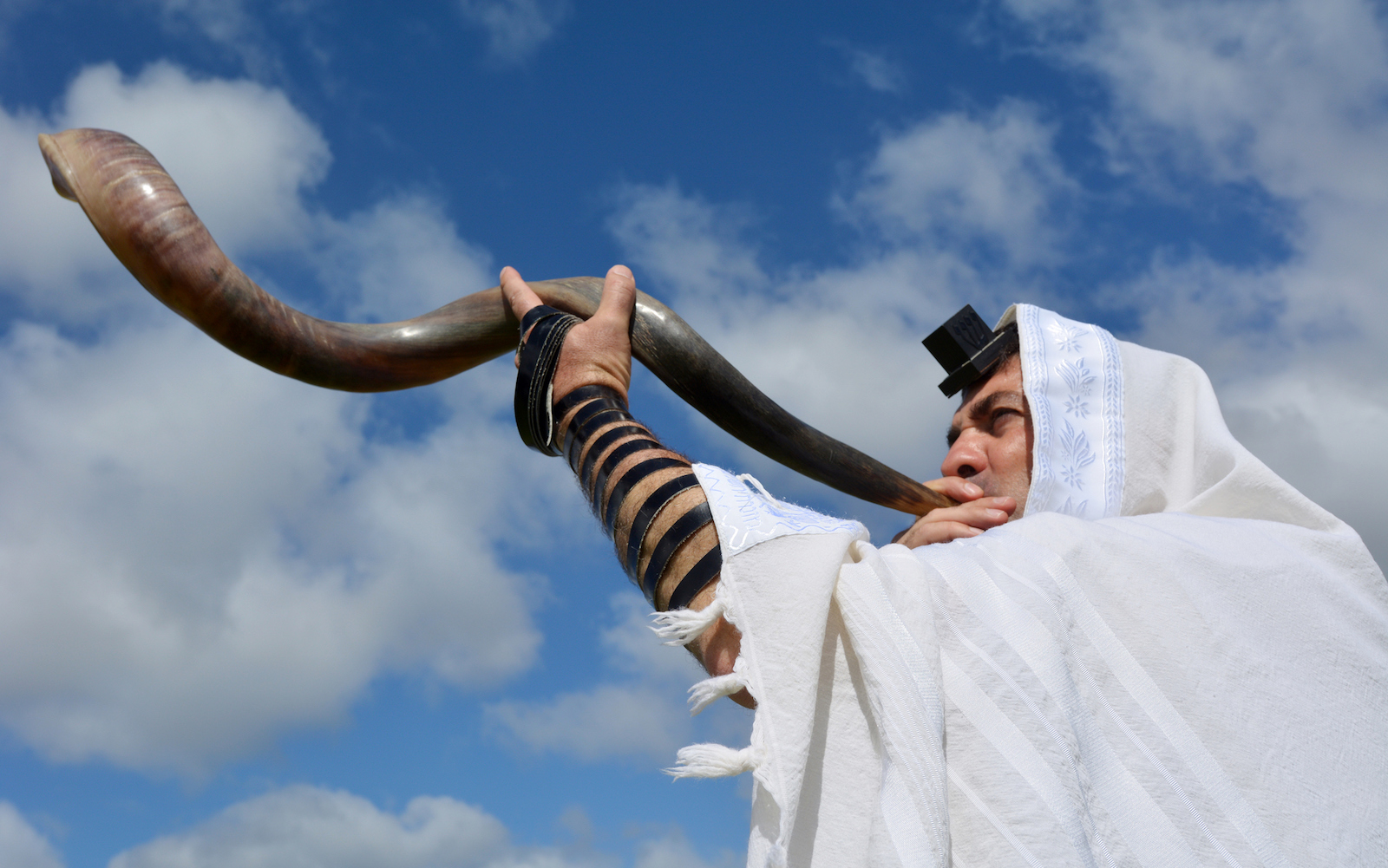
Elul is upon us. That means daily shofar blowing, special psalms and for Mizrahi Jews – waking up half an hour earlier to recite selichot. The name of the game is repentance and preparing ourselves for Rosh Hashanah and Yom Kippur. A month-long period of repentance and preparation should allow us to get safely through the days of judgement and ensure ourselves another safe and healthy year.

This, I suspect, is how most observant Jews see the period.

On the eve of Elul I found myself in conversation with a Hasidic friend/teacher, telling him how little I relate to Elul. As described above, it doesn’t work for me. And I have serious doubts about the real efficacy of the practice even for those who engage in it sincerely. 40 days (Elul +the 10 days of repentance between Rosh Hashanah and Kippur) is a very long time to keep a focus on repentance. It is so long that it loses its efficacy. If one is sincere in one’s repentance, God forgives one on the spot (the point is made beautifully in Sefer Hatanya, Igeret Hateshuva, Chapter 11). Holding the same note, and repeating the very same prayers day after day for 30 days, in addition to an already too-long and too-verbose liturgy, is a recipe for not succeeding in cultivating genuine repentance.

We’ve Also Lost Rosh Hashanah

Actually, the problem with Elul is more fundamental. It goes to the core of our understanding of Rosh Hashanah. We need Elul to prepare for Rosh Hashanah because we consider Rosh Hashanah a day of judgement. Our fear of judgement leads us to advance the process of repentance and seeking Divine forgiveness by a month.  But this is a very mistaken, or at least partial, understanding of Rosh Hashanah. A look at the core liturgy, instituted by the Rabbis, for Rosh Hashanah teaches us that the theme of the day is completely different. It is a day of enthroning God, of proclaiming his Kingdom, of thinking of the entire world as subject to God’s kingdom. It is a day of praying for the world, not for our own safety in face of a terrible judgement. Later generations added another layer of meaning, based on later Talmudic statements representing Rosh Hashanah as a day of judgement (Bavli Rosh Hashanah 16b), and this meaning has eclipsed the fundamental meaning of the day. Concern for God’s kingdom has been replaced by concern for making it safely through divine judgement and this has, in turn, shaped our Elul. Can we imagine a different Elul, as preparation for the deeper and truer meaning of Rosh Hashanah?

Celebrating Elul — A Suggestion

If Rosh Hashanah is about praying for God’s kingdom and God’s will in the world, we can prepare for that very message during Elul. We can cultivate that perspective, decentering attention from ourselves, and thinking of God and the world, as we prepare our minds and hearts for Rosh Hashanah. Here is a suggestion. We spend much of our time thinking of Israel and the world. We consume news of the world, especially of politics, in huge doses, exceeding anything prior generations could have dreamt about. We have, in short, a global consciousness, yet the scope of our religious life is narrow and centered on our wellbeing and survival. Elul could be a time to change that. Imagine every day of Elul could be a day to pray for another world leader or state, asking that the given world leader be in alignment with God’s will, an instrument for fulfilling God’s kingdom. We need not decide anything about local or global politics. We need not align ourselves with any political camp. We simply need to translate the broad mandate of praying for humanity, as formulated in our Rosh Hashanah liturgy, into small prayer-size units, that could be applied on a daily basis to leaders and nations in turn. For all the time we spend talking of Putin, Trump, Merkel, Macron, Urban, Duterte etc., we could spend a few moments each day, praying for one of them, in turn,  asking for them to be guided by God and preparing our own hearts to raise the entire world to God during Rosh Hashanah. It seems to me that selfless prayer for others, in the framework of realizing God’s will for humanity, will go at least as far, probably farther, than repeating one more time the request for divine pardon for our sins. It will be selfless. It will open our hearts to think of others. It will focus our mind on God, and not on ourselves. And, perhaps more than anything, it will allow us a return to a mission we have lost sight of, repentance in the truest sense.

A Kingdom of Priests

Exodus 19:6 states, right before the giving of the Torah, that we are to become a kingdom of priests. This is a vision that we have mostly lost sight of. What does it mean for Israel to be a kingdom of priests? One important strand of interpretation considers that the priest has the duty to bless and to pray for others, and so Israel is the priest among the nations, caring for their welfare. The earliest witness to this view is Philo of Alexandria:

A priest has the same relation to a city that the nation of the Jews has to the entire inhabited world. For it serves as a priest…through the use of all purificatory offerings and the guidance both for body and soul of divine laws… For this reason it is astounding that some dare to charge the nation with an anti-social stance, a nation which has made such an extensive use of fellowship and goodwill toward all people everywhere that they offer up prayers and feasts and first fruits on behalf of the common race of human beings and serve the really self-existent God both on behalf of themselves and of others (on the special laws 163; 167)

If we think of return and repentance, we should consider return to our core vocation, one that is all too often eclipsed by our concern for survival. If our vocation includes caring for and praying for others, what better time to fulfill this than as preparation for the days when we affirm God’s sovereignty over the entire world? Surely, God will take great pleasure in our concern for His Kingdom and raising humanity to it. If we rise to being good instruments for His purpose, He will surely, I believe, also forgive our sins.

About the Author
Alon Goshen-Gottstein is the founder and director of the Elijah Interfaith Institute. He is acknowledged as one of the world’s leading figures in interreligious dialogue, specializing in bridging the theological and academic dimension with a variety of practical initiatives, especially involving world religious leadership.
 
Leave a comment

Posted by on August 14, 2018 in Uncategorized


Israel, This Is Not Who We Are

Orthodoxy should be respected, but we cannot allow the politics of a radical minority to alienate millions of Jews worldwide.

By Ronald S. Lauder

Mr. Lauder is president of the World Jewish Congress.

CreditRuth Gwily

For many Israelis, Jews and supporters of Israel, the last year has been a challenging one. In the summer of 2017, Israel’s government withdrew from an agreement that would have created an egalitarian prayer area at the Western Wall and proposed a strict conversion law that impinges on the rights of non-Orthodox Jews. This summer the Knesset passed a law that denies equal rights to same-sex couples. A day later came the nation-state law, which correctly reaffirms that Israel is a Jewish state, but also damages the sense of equality and belonging of Israel’s Druze, Christian and Muslim citizens.

Last month, a Conservative rabbi was detained for the alleged crime of performing a non-Orthodox wedding ceremony in Israel. In several municipalities, attempts were made to disrupt secular life by closing convenience stores on the Sabbath.

These events are creating the impression that the democratic and egalitarian dimensions of the Jewish democratic state are being tested.

Israel is a miracle. The Jews of the diaspora look up to Israel, admire its astonishing achievements and view it as their second home. However, today some wonder if the nation they cherish is losing its way.

For 4,000 years, the Jewish people were seen as the world’s moral compass.

The Zionist movement has been unwaveringly democratic from its very start. Writ large upon its flag were liberty, equality and human rights for all. It was also one of the very first national movements to guarantee full equality and voting rights for women. And when Israel was founded, it immediately became the first and only democracy in the Middle East. Its Declaration of Independence guarantees “complete equality of social and political rights to all its inhabitants irrespective of religion, race or sex,” as well as a guarantee of freedom of religion, conscience, language, education and culture.

Theodor Herzl, Chaim Weizmann, Zeev Jabotinsky, David Ben Gurion and Golda Meir always emphasized the need to combine Jewish nationalism with universal humanism. So now, when Israel’s government appears to be tarnishing the sacred value of equality, many supporters feel it is turning its back on Jewish heritage, the Zionist ethos and the Israeli spirit.

The issue at hand is first and foremost a moral one, but the new nation-state legislation may also have severe national and international repercussions. In Israel, it will heighten the sense of polarization and discord. Abroad, Israel may find itself associated with a broken values system and questionable friends. As a result, future leaders of the West may become hostile or indifferent to the Jewish state.

Tragically, the new policies will not strengthen Israel but weaken it, and in the long run they may endanger Israel’s social cohesiveness, economic success and international standing.

But the greatest threat is to the future of the Jewish people. For over 200 years, modern Judaism has aligned itself with enlightenment. The Jews of the new era have fused our national pride and religious affiliation with a dedication to human progress, worldly culture and morality. Conservatives and liberals, we all believe in a just Zionism and a pluralistic Judaism that respects every human being. So when members of Israel’s current government unintentionally undermine the covenant between Judaism and enlightenment, they crush the core of contemporary Jewish existence.

As taken from, https://www.nytimes.com/2018/08/13/opinion/israel-ronald-lauder-nation-state-law.html?emc=edit_th_180814&nl=todaysheadlines&nlid=851744250814

 
Leave a comment

Posted by on August 14, 2018 in Uncategorized


The Human Tree

For man is a tree of the field

Deuteronomy 20:19

The tree’s primary components are: the roots, which anchor it to the ground and supply it with water and other nutrients; the trunk, branches and leaves which comprise its body; and the fruit which contain the seeds by which the tree reproduces itself.

The spiritual life of man also includes roots, a body, and fruit. The roots represent faith, our source of nurture and perseverance. The trunk, branches and leaves are the body of our spiritual lives — our intellectual, emotional and practical achievements. The fruit is our power of spiritual procreation — the power to influence others, to plant a seed in a fellow human being and see it sprout, grow and bear fruit.

Roots and Body

The roots are the least glamorous of the trees parts, and the most crucial. Buried underground, virtually invisible, they possess neither the majesty of the tree’s body, the colorfulness of its leaves nor the tastiness of its fruit. But without roots, a tree cannot survive.

Furthermore, the roots must keep pace with the body: if the trunk and leaves of a tree grow and spread without a proportional increase in its roots, the tree will collapse under its own weight. On the other hand, a profusion of roots makes for a healthier, stronger tree, even if it has a meager trunk and few branches, leaves and fruit. And if the roots are sound, the tree will rejuvenate itself if its body is damaged or its branches cut off.

Faith is the least glamorous of our spiritual faculties. Characterized by a simple conviction and commitment to one’s Source, it lacks the sophistication of the intellect, the vivid color of the emotions, or the sense of satisfaction that comes from deed. And faith is buried underground, its true extent concealed from others and even from ourselves.

Yet our faith, our supra-rational commitment to G‑d, is the foundation of our entire tree. From it stems the trunk of our understanding, from which branch out our feelings, motivations and deeds. And while the body of the tree also provides some of its spiritual nurture, the bulk of our spiritual sustenance derives from its roots, from our faith in and commitment to our Creator.

A soul might grow a majestic trunk, numerous and wide-spreading branches, beautiful leaves and lush fruit. But these must be equaled, indeed surpassed, by its roots. Above the surface, there might be much wisdom, profundity of feeling, abundant experience, copious achievement and many disciples; but if these are not grounded and vitalized by an even greater faith and commitment, it is a tree without foundation, a tree doomed to collapse under its own weight.

On the other hand, a life might be blessed with only sparse knowledge, meager feeling and experience, scant achievement and little fruit. But if its roots are extensive and deep, it is a healthy tree: a tree fully in possession of what it does have; a tree with the capacity to recover from the setbacks of life; a tree with the potential to eventually grow and develop into a loftier, more beautiful and fruitful tree.

Fruit and Seed

The tree desires to reproduce, to spread its seeds far and wide so that they take root in diverse and distant places. But the tree’s reach is limited to the extent of its own branches. It must therefore seek out other, more mobile couriers to transport its seeds.

So the tree produces fruit, in which its seeds are enveloped by tasty, colorful, sweet-smelling fibers and juices. The seeds themselves would not rouse the interest of animals and men; but with their attractive packaging, they have no shortage of customers who, after consuming the external fruit, deposit the seeds in those diverse and distant places where the tree wants to plant its seeds.

When we communicate with others, we employ many devices to make our message attractive. We buttress it with intellectual sophistication, steep it in emotional sauce, dress it in colorful words and images. But we should bear in mind that this is only the packaging — the fruit that contains the seed. The seed itself is essentially tasteless — the only way that we can truly impact others is by conveying our own simple faith in what we are telling them, our own simple commitment to what we are espousing.

If the seed is there, our message will take root in their minds and hearts, and our own vision will be grafted into theirs. But if there is no seed, there will be no progeny to our effort, however tasty our fruit might be.

As taken from, https://www.chabad.org/parshah/article_cdo/aid/55500/jewish/The-Human-Tree.htm

 
Leave a comment

Posted by on August 13, 2018 in Uncategorized


Moses on Addiction

It takes courage and strength to change the course of generations.


We all have our addictions. Alcohol or anger, power or pornography, self-absorption or spending—any compulsive, Researchers now believe that about 60% of addiction is epigenetic. self-destructive behavior is a legitimate candidate for addiction.

The nastiest addictions are those passed along through the generations—perhaps epigenetically. Epigenetics is about how environment and experience leaves an imprint on your DNA. Researchers now believe that about 60% of addiction is epigenetic. That’s right—you can inherit the repercussions of traumatic experiences of your ancestors and their adaptive responses in your genes.

Sometimes adaptive, often maladaptive. One generation suffers through famine, for example, and two generations later researchers find the grandchildren are obese.

Small wonder some people can hardly imagine overcoming their worst vices. It’s not easy when a behavioral response is in your blood.

Like the next generation after the Exodus—the children of those who had left Egypt behind and died over the forty years of wandering. With them, it was literally a blood addiction—animal blood. That’s how Torah works: It’s called mashal hakadmoni1 —”the primal metaphor”—because it contains the essential paradigm of everything in our universe.Torah is filled with paradigms for everything. Including addictions. Including addictions.

Seven times2 the Torah warns the Jews who have left Egypt, “Quit it with the animal blood already!” Finally, the seventh time around, to this second generation, Moses says, “Be strong, and don’t consume blood. Spill it on the ground like water.”3

And in fact, Jews have taken that admonition very seriously ever since. We salt our meat while still raw with coarse salt to draw out as much blood as possible.4 If so much as a drop of blood is found in a chicken’s egg, we throw out the whole thing.

The Origins of Blood Addiction

But the question remains: Why, now, after 40 years, must Moses tell these people to be strong?

That’s a matter of debate. You’ll find that debate in the Sifre,5 a collection of halachic commentary contemporaneous to the Mishnah.

There, Rabbi Yehuda remarks that the very fact that Moses had to tell these people to be strong tells us that they were addicted to blood. As Nachmanides explains, 40 years had passed and they were still drinking raw, animal blood as their parents had done in the magical rites of Egypt. There they would make sacrifices to demons, and then fill bowls with blood and invite the demons to take part in a meal with them. They would drink the blood themselves, and experience visions and hallucinations, even foretelling the future.

But Rabbi Shimon ben Zoma appears to disagree—to the extreme. “Blood is disgusting to a normal human being,” he says. “The Torah is repeating this to tell you that you must be strong with every mitzvah. After all, if we are told to be strong with something so easy to avoid,That’s the strange thing about addictions: We come to love that which is destructive and repulsive. all the more so we have to be strong with every mitzvah.”

On which the Rebbe, Rabbi Menachem M. Schneerson, makes a fascinating remark: The two rabbis are not really in disagreement. Drinking an animal’s blood is repulsive to a normal human being. But these people, even in the next generation, were addicted.6

The Strength to Surrender

That’s the thing about addictions. We become addicted to those things that are the most destructive to the life of a healthy human being. Although at first the addict loves his chosen substance or behavior, eventually he comes to loathe the substance, loathe his addiction, and loathe himself for being an addict. But he can’t stop.

So Moses must tell them, “Be strong. No matter how intense your desire for blood is, listen to what G‑d is telling you to do—because that is the only way you can truly become a master over your own desires: Take that blood and spill it on the ground like water.”

That is the first step to escaping that boiling fury, that blood that curdles in your veins, that beast has you between its teeth and won’t let go, that rules your life as a slave ruling over its master: Be strong, and with G‑d’s help, pour that bloody beast inside you like water upon the lowly earth. Put down the drink. Don’t buy that next fix. Put a block on your computer. Then you can begin a program of recovery.

There are other crazy addictions that are passed from generation to generation that have nothing to do with substances, devices or even pleasure. The society in which you live brings its own maladaptations, behaviors that would seem bizarre to any outside observer, but to which most of us have sold our very souls. Crazy working hours. Slavery to fashions, fads and vogues. Fear of “what will they say at work if I suddenly start keeping Shabbos (or wearing a kippah, or no longer eating the same food everyone eats)?”

Be strong and dump all those fears on the earth like water. You will be released from your chains. You will be free to grow, to have your own life.

It takes strength to face up to your addictions.It takes strength to face up to your addictions. It takes courage to humble yourself. It takes courage to humble yourself, to admit you need help, and to surrender to a power greater than yourself. But it takes the most strength of all to ask for the courage to change your behavior, today.

With that strength, which flows from an innermost humility, you can change not only your own life, but the course of a river that has flowed for generations. You can open up a new future, for yourself and for your children, and for your children’s children.

Footnotes
1. Samuel 1 24:3. See Ramban, preface to commentary on Genesis.
2. Maimonides, in Sefer HaMitzvot, counts seven warnings against consumption of blood, as does Rabenu Bachye ad loc. In Talmud, Kritot 4b, however, only five are counted.
3. Deuteronomy 12:33.
4. Learn the process of salting meat prior to cooking.
5. Ad loc, quoted by Rashi ad loc with slight alterations.
6. Likutei Sichot vol. 14, p. 47 (Re’eh 1, 3).
 
Leave a comment

Posted by on August 13, 2018 in Uncategorized


¿Por que ser Judíos?

Pregunta:

Soy profesor de secundaria, y estoy enseñando sobre las amenazas al judaísmo en el mundo moderno. ¿Qué cree usted que es mayor amenaza para la supervivencia judía: la asimilación o el antisemitismo?

Respuesta:

La amenaza más grande para la supervivencia judía es la identidad judía confusa. Lamentablemente, hoy en muchas escuelas y familias judías, la identidad judía se construye con la enseñanza del conocimiento del Holocausto y el miedo al matrimonio mixto. La preocupación de la comunidad judía con la asimilación y el antisemitismo no son la solución, son el problema.

Una presentación pesimista y negativa sobre ser judío rechaza a los jóvenes judíos más que cualquier otra cosa. Cuando nos obsesionamos con el antisemitismo nos pintamos como víctimas perpetuas. Cuando acentuamos demasiado la amenaza de la asimilación, nos da la sensación de especie en extinción. Los judíos están junto a la ballena austral y al panda gigante en la lista de grupos desamparados y lamentables que desaparecen del planeta. ¿Está sorprendiendo tanto que los judíos jóvenes opten por escapar al judaísmo? ¿Quién desea ser una víctima?

Tenemos que dejar de definirnos de la forma que otros nos perciben. La asimilación ocurre cuando los no judíos nos aman tanto que desean casarse con nosotros. El antisemitismo ocurre cuando los no judíos nos odian tanto que desean matarnos. Ambas nos suceden; ¿pero qué pensamos nosotros de nosotros mismos?

Necesitamos una razón clara y positiva de permanecer judíos. De no existir tal razón, ¿por qué debe el judaísmo sobrevivir? ¿Hay un buen motivo para no asimilarnos en las sociedades que nos rodean? ¿Hay alguna razón que obligue a permanecer orgulloso como judío frente al antisemitismo?

Creo que la hay.

El judaísmo es la idea de mayor alcance que el mundo ha visto. Los judíos deben sobrevivir porque tenemos un mensaje que el mundo necesita oír.

La manera de la vida judía es una fuerza revolucionaria que puede transformar vidas ordinarias en vidas con significado. Una familia que guarda Shabat siempre recuerda lo que es realmente importante — que la vida es algo más que acumular riquezas. Las leyes de kashrut nos enseñan que no somos meros animales que alimentan cada impulso y deseo, y comer puede ser santo. La Mezuzá en la puerta dice al mundo que este hogar está construido para un propósito más profundo.

El judaísmo enseña lecciones que el mundo urge de aprender. Que somos creados a imagen de Di-s, y por lo tanto cada persona es única y valorada; que la moral no es relativa sino absoluta; que los seres humanos son socios con Di-s en la creación, con la misión de crear el cielo en la tierra.

Estas ideas judías son más relevantes ahora que nunca. Pero las ideas judías revolucionarias necesitan a un pueblo judío con coraje para perpetuarlas. El mundo puede ser elevado solamente si los individuos primero se elevan. Podemos hacer solamente del mundo un hogar divino si comenzamos con nuestro propio hogar. Ésta es la fórmula del judaísmo para cambiar el mundo. Ésta es la razón por la cual debemos permanecer judíos.

La amenaza más grande para el judaísmo no es la presión externa sino la confusión interna. Cuando perdemos de vista nuestra misión, perdemos la fuerza y energía para sobrevivir. El sentimiento judío que debemos desarrollar en nosotros y en nuestros niños no son el miedo al antisemitismo, o la culpa por la asimilación. Es un orgullo humilde en la grandeza de la misión judía y de la resolución confidente para satisfacerla. Cuando estamos claros sobre nuestra identidad, ninguna amenaza en el mundo puede sacudirnos.

Según tomado de, https://es.chabad.org/library/article_cdo/aid/562643/jewish/Por-que-ser-Judos.htm

 
Leave a comment

Posted by on August 13, 2018 in Uncategorized


Night of the Murdered Poets

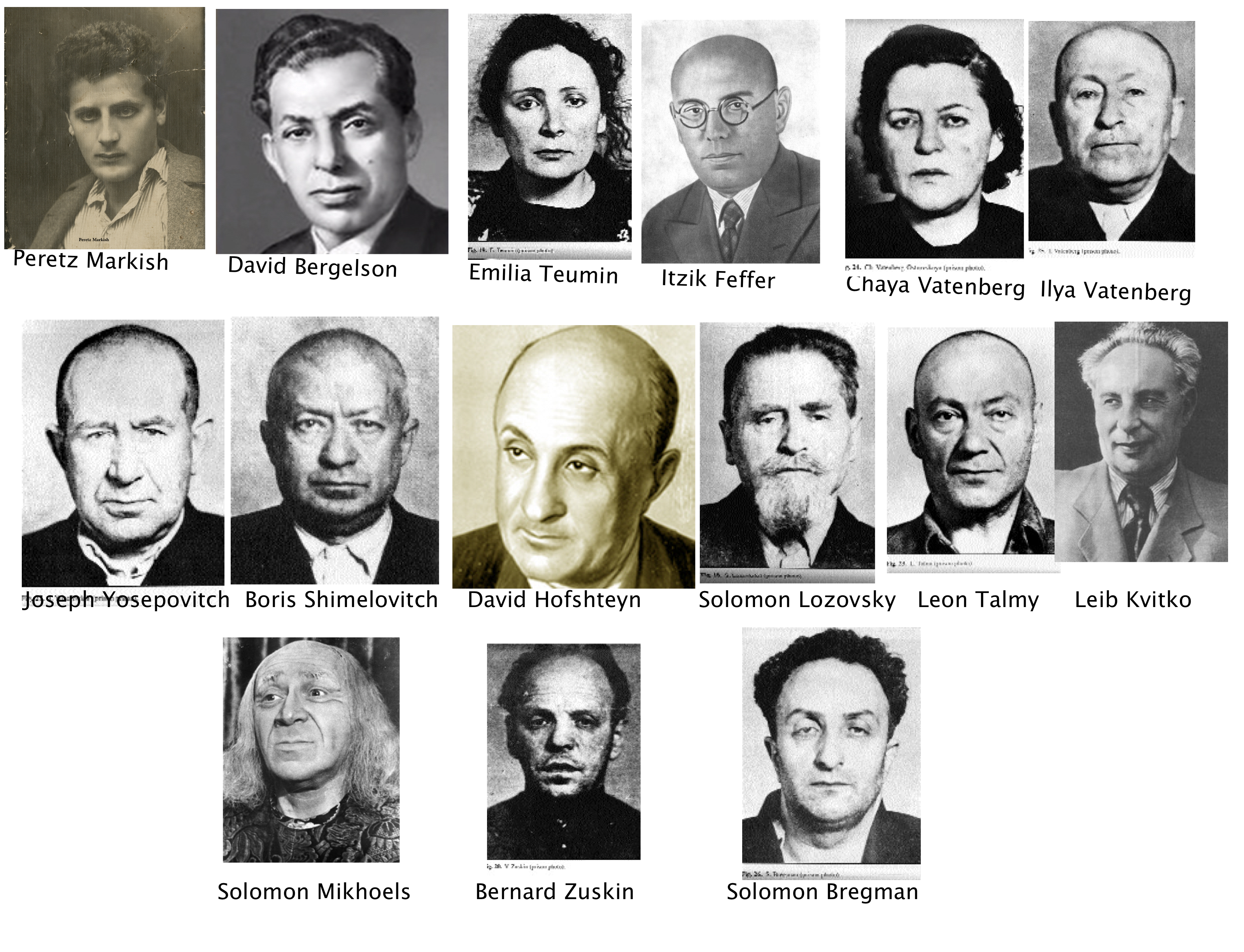
Diario Judío México – In the pre-dawn darkness of August 12, 1952, thirteen Yiddish poets, actors, critics, and editors were shot by a firing squad in the notorious Lubyanka prison, victims of the psychopathic autocrat Joseph Stalin. They were not the first Yiddish artists to be murdered at his hands, nor were they the last.

The arrests were first made in September 1948 and June 1949. All defendants were accused of espionage and treason as well as many other crimes. After their arrests, they were tortured, beaten, and isolated for three years before being formally charged. There were five Yiddish writers among these defendants, all of whom were a part of the Jewish Anti-Fascist Committee.

Peretz Markish (1895–1952), Yiddish poet, co-founder the School of Writers, a Yiddish literary school in Soviet Russia
David Hofstein (1889–1952), Yiddish poet
Itzik Feffer (1900–1952), Yiddish poet, informer for the Ministry of Internal Affairs
Leib Kvitko (1890–1952), Yiddish poet and children’s writer
David Bergelson (1884–1952), distinguished novelist
Solomon Lozovsky (1878–1952), Director of Soviet Information Bureau, Deputy Commissar of Foreign Affairs, vigorously denounced accusations against himself and others
Boris Shimeliovich (1892–1952), Medical Director of the Botkin Clinical Hospital, Moscow
Benjamin Zuskin (1899–1952), assistant to and successor of Solomon Mikhoels as director of the Moscow State Jewish Theater
Joseph Yuzefovich (1890–1952), researcher at the Institute of History, Soviet Academy of Sciences, trade union leader
Leon Talmy (1893–1952), translator, journalist, former member of the Communist Party USA
Ilya Vatenberg (1887–1952), translator and editor of Eynikeyt, newspaper of the JAC; Labor Zionist leader in Austria and U.S. before returning to the USSR in 1933
Chaika Vatenburg-Ostrovskaya (1901–1952), wife of Ilya Vatenburg, translator at JAC.
Emilia Teumin (1905–1952), deputy editor of the Diplomatic Dictionary; editor, International Division, Soviet Information Bureau
Solomon Bregman (1895–1953), Deputy Commissar of Foreign Affairs. Fell into a coma after denouncing the trial and died in prison five months after the executions.
Lina Stern (or Shtern) (1875–1968), a biochemist, physiologist and humanist and the first female academician in the Russian Academy of Sciences and is best known for her pioneering work on blood–brain barrier. She was the only survivor out of the fifteen defendants.

As taken from, https://diariojudio.com/opinion/night-of-the-murdered-poets/276447/

 
Leave a comment

Posted by on August 13, 2018 in Uncategorized


The real message of Mount Gerizim and Mount Ebal

The ceremony that receives more Torah coverage than Creation, the Exodus, or the revelation at Mount Sinai (Re’eh)

The view of Tel Aviv from Mount Ebal. (Wikipedia)

The view of Tel Aviv from Mount Ebal. (Wikipedia)

Hodge-podge. That precise, academic term is the first that used to come to my mind when thinking of the Book of Deuteronomy. And it didn’t bother me that this was so; in fact, it seemed most fitting. After all, this was Moses’s goodbye speech to the people to whom he had been utterly devoted for the last 40 years. Of course, it’s a jumble of reminiscences of their most memorable times, veiled reprimands, concerned cautions not to fall prey to the idol worship of their soon-to-be-neighbors, and insistent reminders to punctiliously observe the divine commandments that he had bequeathed to them — just as a parent’s last goodbye as they drop their child off at college is often a hodge-podge of recollections of fond memories, advice and admonishments about everything ranging from laundry to finances, cautions against the influences of the campus culture, and pleas to maintain committed to the values they’ve imparted the last 20 years, all in no particular order.

However, years ago, a teacher (I wish I could remember who so I could give him or her credit) recommended an awesome exercise: to read through an entire book of the Torah cover-to-cover, in one sitting. I did so with the Book of Deuteronomy and was stunned by what jumped out from the pages. This seeming hodge-podge of a book is actually all about one singular event! And that event doesn’t even seem all that significant in the grand scheme of Jewish history; I would venture to guess it wouldn’t make it on anyone’s Top Ten list of the Jewish People’s Greatest Moments. That event is the covenant of Mounts Gerizim and Ebal that God commands the Jewish people to enact there, upon entry to the Promised Land.

First, let’s examine the textual evidence that leads to this startling conclusion that the entire book is actually all about this singular event.

At first glance, this covenant does not seem exceedingly significant. It is mentioned only twice, once for a mere seven verses in our parsha (Deuteronomy 11:26-32), and the second time, 16 chapters later, in Parshat Ki Tavo (27:1-26). Between these two descriptions are 15 chapters of seemingly random, detailed, practical laws, which seem unrelated to the ceremony to be enacted on these two mountains. However, when reading it all in one fell swoop, one notices that the description of the covenant in our parsha begins, “See I am placing before you today a blessing and a curse. The blessing [you will receive] if you follow the commandments of God that I am commanding you TODAY, and the curse if you do not observe the commandments of God and turn astray from the path that I am commanding you TODAY (11:26-28; see also 11:32-12:1).” Thus, what emerges is that the 15 chapters of seemingly random laws found in chapters 12-26 do not serve as a barrier between the two descriptions of this ceremony, but rather as a bridge between them — because they themselves are an integral part of the covenant. These are the laws whose observance or violation will lead to the blessings or curses promised on Mounts Gerizim and Ebal!

In fact, the Torah highlights that the main bulk of this book is all one long description of the covenenant — Brit Har G’rizim V’Har Eival — by beginning and concluding the description of it using virtually identical language, creating a kind of envelope or bookends. The final description of the covenant in 30:15-19 concludes with the phrase: “See I have placed before you today… the blessing and the curse,” which points us back to the opening phrase or bookend in 11:26: “See I am placing before you today a blessing and a curse.” Thus, all of what comes in between these two bookends, namely chapters 11-30 (20 of the book’s 34 chapters!) are all part of one grand narrative of the ceremony to be enacted on these two mountains upon entry to the Land.

The obvious question is: What is the significance of this ceremony that earns it the lion’s share of an entire book of the Torah, far more coverage than that received by Creation, the Exodus, or even the giving of the Torah on Mount Sinai?

The key lies, I believe, in noticing the striking similarities between the covenant enacted on Mount Sinai and that enacted on Mounts Gerizim and Ebal. First and foremost, Mount Sinai has the identical structure of one description of the awe-inspiring event (Exodus, chapters 19-20), followed by seemingly random, detailed laws (Exodus Chapters 21-23 of Parshat Mishpatim), finally followed by another description of the ritual ceremony (Exodus, chapter 24). Clearly, what strikes us as bizarre — namely, the insertion of halachic minutia in the midst of majestic, awe-inspiring Divine — human covenants — is the Torah’s norm. The message seems to be that in the Torah’s conception, there is no such thing as an inspirational interaction with God that does not find expression through halacha, and no such thing as halacha not infused by a meaningful relationship with God.

The similarities between the covenant of Sinai and that of Mounts Grizim and Eival do not end with their shared structure. Both covenants involve virtually the identical procedures. In both covenants, Moses first has to TELL the people all of God’s commands, then WRITE them down, then BUILD an ALTAR, then set up 12 STONES as a monument, and finally sacrifice OLOT and SHLAMIM (compare Exodus 24:3-5 and Deuteronomy 37:1-7 to see the obvious parallels.) In addition, there’s the conspicuous fact that both covenants transpire on the tops of mountains.

The clear message, I believe, is that the covenant to be enacted on Mounts Gerizim and Ebal upon entry to the Land is the second generation’s Matan Torah, the concretizing of their unique relationship with God. THAT is in fact something worthy of virtually an entire book of the Torah.

Significantly, each generation’s covenant with God is tailor-made to uniquely suit its particular needs. Consider the differences between the two covenants. At Mount Sinai, the people are warned repeatedly not to touch the mountain, and they cower in the background, daring to speak only so as to express the request that God stop communicating with them directly, lest they perish. In contrast, at Mounts Gerizim and Ebal, the people stand at the very tops of the mountains, and verse after verse repeatedly informs us that the entire nation declares, “Amen,” after each and every utterance.

Gone is the passive experience of the generation that leaves Egypt through God’s miraculous intervention and then lives by God’s protection and sustenance in the wilderness. Enter the new generation that will conquer the Land utilizing military ingenuity, and that will then invest herculean efforts to farm that Land. Similarly, the focus at Gerizim and Ebal is no longer on the laws themselves as it is at Mount Sinai. Instead, the emphasis has shifted to the CONSEQUENCES for observing or violating the laws, since this generation will proactively forge their own destinies, rendering the link between their success and their observance of God’s commands less obvious.

The powerful message that God and Moses are conveying to the Israelites — and us — is this: Matan Torah — the revelation of the Torah — is not an event frozen in time to be pulled off the shelf of our collective memory every so often, dusted off, and remembered wistfully as something that occurred long ago for our ancestors. Matan Torah is ALIVE. Our relationship with God — both individually and communally — is dynamic, personal, and ever-evolving.

And I would suggest that this is the message not only of the final book of the Five Books of Moses, but through many laws and at critical junctures throughout Jewish history. The commandment of Hakhel to gather the entire nation every seven years for a mass reading of the Torah expresses the message that EVERY generation should renew its covenant and relationship with God (Deuteronomy 31:10-13), as does our reenactment of Matan Torah every week through communal Torah reading (see Shulchan Aruch Orach Chayim 141:4 with Mishnah Berurah).

Furthermore, Tractate Shabbat 88a informs us that during the Purim story, the Jews re-accept the Torah (“kiymu mah she-kiblu kvar” — they upheld that which they had already accepted). I would suggest that this occurs precisely at that time because the Purim story takes place during the first exile of the Jewish people, following the destruction of the First Temple. Perhaps it is precisely then, as the nation is reeling from the devastating calamity and seeming betrayal of exile, that God miraculously saves them, embracing them with the message that He has not in fact deserted them. (And here too, God conveys the message in a way uniquely suited to that generation — hester panim, through hidden means; God’s name is absent from the megilla).

And perhaps, we can suggest that in our own times, the extraordinary miracle of the reestablishment of the State of Israel so closely on the heels of the staggering devastation of the Holocaust is God’s message that though we may never understand His ways, He has not abandoned us.

And so, it seems to me that there could not possibly be a more perfect message for the final book of the Torah than that this is not the end; it is merely the beginning of what will be a new era in our nation’s infinite, dynamic, ever-developing relationship with the Divine.

Dena Freundlich
About the Author
Dena Freundlich teaches Gemara and Halachah at Midreshet Lindenbaum in Jerusalem. She also teaches Halachah at Midreshet Torah v’Avodah, and has lectured in many schools and institutions on topics related to Tanach, Halacha, and Gemara. Prior to making aliyah in 2010, she served as Talmud Department Chair at Ma’ayanot Yeshiva High School in Teaneck, NJ. She holds a BA in Biology and Jewish Studies from Yeshiva University’s Stern College for Women, an MA in Bible from the Bernard Revel Graduate School, and was a member of the first graduating class of YU’s Graduate Program for Advanced Talmudic Studies (GPATS). She lives in Efrat with her 3 children.
 
Leave a comment

Posted by on August 11, 2018 in Uncategorized