If you are not a Jew you have never felt yourself be hunted.
You have never faced a whole world that judges your deeds, asking you to adhere to the highest standards while it simultaneously closes both its eyes to others’ deeds, justifying their injustice and immorality.
If you are not a Jew, please do not go on reading. Because you would never be able to relate with this feeling of anger and impotence towards a whole humanity that is lying and making up fake accusations for thousands of years.
If you are not a Jew, you cannot understand how it feels to send your children around with their kipà on their heads, knowing others view it as the uniform of an enemy. Or to walk in the streets and hear people yelling ‘murderer of children!’ to you, you, who would never harm a fly.
You cannot imagine the state of mind of a Jew who reads the news and finds a series of factious lines based on the distorted and biased filters of the major press agencies.
Whole pages that kindle the fantasy of society and paint us again with an aquiline nose and claw fingers.
News that transform us into blood drinkers, thirsty for power and land.
A people who are insensitive to others pain. These Jews, transformed from victims to cruel slaughterers…
If you are not a Jew, don’t even try to understand. Because there is no logic in this hate against Jews, in antisemitism. Nothing can explain the judgment of people who have never met you and yet think they know you so well.
Only a Jew’s skin can feel the painful comments made by people who are accepting everyone… except Jews. People who give everyone a chance…except Jews.
We are alone, dear brothers and sisters, we are alone among 70 hungry wolves.
Friends come and go, but history was very careful to provide enemies in every generation. We are alone as we have always been.
Maybe because our habits are really annoying.
We have the habit on insisting on creating light in the darkest places, we have that unique Jewish habit to try and enlighten not only our rooms, but to direct our flames towards others’ too.
Yes, what can we do if we are taught since childhood to think of our fellows and not only of ourselves?
We are affected by that feeling that makes us cry for Ronen Lubarsky, a soldier killed by an ‘innocuous marble slab’ as if we had known him since he was born; a feeling that makes us perceive, in the deep of our hearts, the cry of a mother who has just lost her soldier son.
We are affected by that fear that grips our soul when missiles are thrown at thousands of kilometers distance from our homes and makes us think: my home is there in that desert, in that history where I can be who I am and not in these four walls where I live everyday under scrutinizing looks.
If you are not a Jew you cannot truly understand Golda Meir’s words when she said that the worst punishment for an Israeli soldier is to be forced to kill his enemy.
If you are not a Jew and you’ve read until here, please take a minute of your time to examine the objectivity of your morality and to try to understand how you let factious news make you forget all the other tragedies of the world and concentrate only on the Jewish nation and its impelling need to defend itself from those who wish to send us back to gas chambers, we, the children of survivors.
If you are aware of all this and have chosen to speak on our behalf too, just a word: thank you.
And if you are a Jew, please remember.
If G-d wanted you to survive until now, if He helped you outlive those who wished to wipe you away, it’s because you have a mission to accomplish.
Go on to be the lone voice, the faith where there is no hope, the conscience that fights against the inurement to the normality of evil.
First-of-its-kind research initiative will use lens of gender in order to examine the experiences of communities often glossed over in favor of European Jewry
By Josefin Dolsten, 8 June 2018
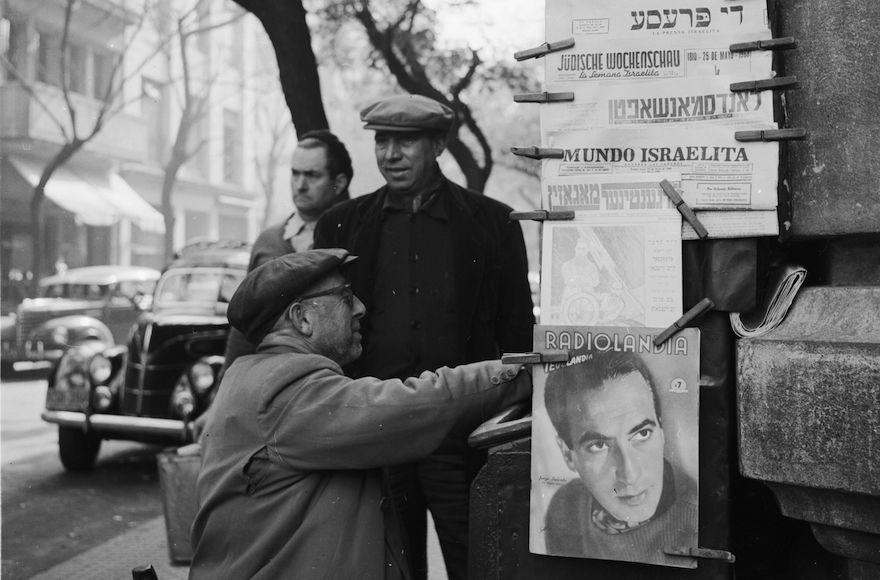
A man buying Jewish newspapers from a stall in Buenos Aires, circa 1956. (Evans/Three Lions/Getty Images)
JTA — Growing up in Venezuela, Menachem Bandel was deeply aware of the unique culture and history of Latin American Jews, including the experiences of his Holocaust survivor grandparents who settled there.
Thus it came as a surprise to him when he started his studies at Brandeis University and discovered that most of his fellow students did not even know Jews lived in Latin America.
“The Latin Jews were kind of forgotten. No one knew about them,” said Bandel, who graduated in the spring. “People didn’t even know you could speak Spanish and be Jewish at the same time. That to me was pretty mind-blowing.”
A new project seeks to change that. Developed by Dalia Wassner, a Jewish studies scholar who was raised in the United States and Mexico, the Brandeis initiative aims to shine a light on the Latin American Jewish experience.
During his senior year Bandel worked with Wassner to develop the program, which is being launched in November at the Hadassah-Brandeis Institute, a research institute on women and gender.
The project aims to be a corrective to Jewish studies departments that gloss over the region in favor of focusing on the experience of Jews in Europe, Israel and the United States. It also will use the lens of gender in order to examine the experiences of Latin American Jews, making it the first academic initiative in the world to do so, Wassner told JTA.
“Our mandate is to explore fresh ideas about Jews and gender, and the full range of Jewish women’s experiences in particular,” said Lisa Fishbayn Joffe, director of the Hadassah-Brandeis Institute. “Part of what I want to do is expand understanding of who Jewish women are and where these experiences take place and the complexity of their experiences.”
A woman walks across Israel square in Guatemala City, Dec. 27, 2017. (Orlando Estrada/AFP/Getty Images)
The project will explore the topic of immigration. Latin America’s Jewish population has declined in recent years as many Jews have left for Israel and the United States, motivated by economic reasons and Zionism, Wassner said. An estimated 300,000 to 400,000 Jews live in the region today, compared to more than 500,000 in the 1970s.
Still, Jewish communities continue to thrive in countries like Mexico, Brazil and Argentina, and immigrants who settle elsewhere bring their culture with them, creating a second Diaspora with Latin America as its center.
Wassner herself is one such immigrant. She grew up in a Mexican Jewish family in San Diego, but when she was 12, her parents decided to return to their native country. They wanted Wassner and her siblings to “know and connect to our Latin American Jewish identity in our own skin,” she said.
Mexico City’s Jewish culture had a different flavor than the one she had known in San Diego. Her family moved back to the US five years later, but the experience had a deep impact on Wassner that she says enriches her field of study.
“I think I understand these questions in a very personal way,” she said.
The idea for the project grew out of a course Wassner taught at Brandeis in 2015. The class focused on the Latin American Jewish experience and identities, how they have shaped the region’s history and gender issues.
The Hadassah-Brandeis Institute provided seed money, and additional funding came from private donors and Targum Shlishi, a foundation promoting Jewish culture, education and women’s issues.
In addition to promoting academic study and research, Wassner wants to foster community for Latin American Jews and others interested in their culture.
Entrance to Havana’s El Patronato, the largest of Cuba’s five functioning synagogues. (Larry Luxner/Times of Israel)
To that end, in addition to its offering courses, hosting a conference and publishing articles, the initiative will host cultural events, such as film screenings and talks at synagogues.
Though it has yet to officially launch, the initiative held events in the past academic year. Fishbayn Joffe said the turnout showed a need and desire among Latin American Jews living in the US for community.
At a film screening of “Cuba’s Forgotten Jewels,” a documentary about European Jews who fled to Cuba during World War II, attendees spoke of how happy they were to attend an event that spoke to their Jewish identities.
“The people in the audience were saying, ‘This is my story, Latin America is part of my Jewish identity, my family sought shelter there, my family lived there,’” Fishbayn Joffe recalled. “‘This narrative of the Jewish community as just being Ashkenazi or Sephardic doesn’t capture the complexity of our identities.’”
As long as Gazans are defined as refugees from Palestine, there’s no real chance to rebuild the Strip
By Einat Wilf and Adi Schwartz
It’s the same old tune – renewed discussion about “reconstructing and redeveloping” the Gaza Strip. Again people are talking about some kind of “arrangement” for managing Gaza’s reconstruction, whether under Egyptian, Qatari or American auspices. There’s more talk of huge investments in a port and in water and power infrastructures, and about creating jobs.
Wasted efforts, all. They’re doomed to fail, the same as all the other reconstruction attempts in recent years. As long as the political land mine at the heart of the matter – the perpetuation of the status of Gaza’s residents as refugees from “Palestine” – is not defused, there’s no real possibility for rebuilding and developing the Gaza Strip.
The problem is that Gaza’s inhabitants do not view that piece of land as their home, but rather as a transit camp they will inhabit until the day they can return to what they believe is their home. Because of this, they will far prefer to invest their efforts and resources in returning to their “true” home – by force if necessary – than in cultivating the temporary one where they currently reside.
Of the 1.8 million people living in Gaza, 1.3 million are registered as refugees with the United Nations Relief and Works Agency for Palestine Refugees (UNRWA). In other words, three-quarters of the people in the Strip possess a status that is by definition temporary in character – one granted to someone who is between permanent residence in one locale and permanent habitation in a second place.
When UNRWA was established, in the wake of the 1947-1949 war, it spent its first few years in an earnest effort to assist the Arab refugees from the war (the Jewish ones were taken care of by the newly established State of Israel) in rebuilding their lives in their new locations, whether in the West Bank and Gaza, Jordan, Lebanon or Syria. But within a few short years, it became painfully clear that neither the Palestinians themselves, nor the Arab host countries were willing to let this process take place, as it would legitimize the outcome of the war in the form of the establishment of the State of Israel.
Having failed to prevent the vote on partition in the UN General Assembly, or prevent partition itself and the birth of Israel through war and military invasions, the Palestinians and the Arab host states mobilized to turn the demand for “return” to Israel into one of the central means by which the outcome of the war, in the form of a sovereign state for the Jewish people, could be undone. To that end, UNRWA then was taken over by the Palestinians, becoming an organization that would grant them the official status of “refugees” until that day of “return.”
These 1.3 million refugees, some of whom are the fifth generation of Palestinian families who arrived in the Strip in 1948, long for the moment when they will be able to return to their ancestral homes (most of which do not exist anymore) in Ashdod, Ashkelon and Be’er Sheva, and believe that this moment is possible and close at hand. Their dream – and that of their brethren in the West Bank, Jordan, Lebanon and Syria – has coalesced into a collective demand whose import was and continues to be a continuing war on Israel by other means. Clinging to the dream of return makes it possible for the Palestinians not to accept the consequences of their defeat, and to believe that even if they lost a few battles, the overall war against Zionism still isn’t over.
Still, there’s a tangible difference between dreams and the demands that are nurtured by international support under UN sanction. The State of Israel cannot exert a direct influence on the Palestinian dream of return, but it can definitely act to deny the dream the fuel that sustains it, and that fuel comes from the West.
A Palestinian man rides his horse past the UNRWA office in Gaza City on January 8, 2018. MOHAMMED ABED/AFP
Under the influence of various interests in the Arab world, the international community became complicit in the process of leaving so many Palestinians in a legal, social and economic limbo, awaiting “return.” The West in particular, providing the bulk of the funds for UNRWA’s operations, unwittingly became the central source of sustenance for the Palestinian idea that it is better to continue to struggle for “return” rather than come to terms with the legitimacy of Israel and build a new life of prosperity in the West Bank and Gaza.
This has to change. Israel can and should intervene with UNRWA’s donor countries – the United States, Australia, Britain and the European Union – and insist that they cease and desist from supporting the Palestinian demand to annihilate Israel, by way of their support for UNRWA. Countries that officially support the two-state solution cannot underwrite an organization whose aim is to ensure that the Jewish people, as a people, will not have a sovereign state.
UNRWA’s essence involves making it clear to the more than 70 percent of Gaza inhabitants registered as refugees, that Gaza is not their true home. It does so by providing the political infrastructure that grants Palestinians the status of “refugees,” which they would not otherwise merit if international standards were applied to them; by passing this status on to their descendants automatically and in perpetuity, while opposing any effort to find solutions for those registered as “refugees,” other than in the context of the collective demand for “return.” It is this that UNRWA often refers to by the code words “just solution” and “legitimate rights,” of which it calls itself the protector. UNRWA makes it clear to the “refugees” in Gaza (and in all of its other areas of operations) that their “true home,” wrested from them by force, lies across the border. People who grow up with that belief will assuredly use cement, when given it, not to build permanent homes, but to dig tunnels to the place which, as far as they are concerned, is their real home.
It is not only parents and grandparents who cultivate this dream. Every day, residents go into the streets of Gaza and see UNRWA signs on the schools and clinics that the organization operates. They read those signs to mean that the UN – that is, the world community – recognizes them as refugees and encourages their “return” to Israel.
The chances of reconstructing and developing the Gaza Strip will be greater without UNRWA, and even if some benefit accrues to cooperation with the UN organization in Gaza, it is far outweighed by the damage the agency has wrought. Ever since 1967, when Israel’s security establishment chose to cooperate with UNRWA and enable its ongoing operations in the West Bank and Gaza, it has argued that UNRWA is a moderating force, without whose education and healthcare services greater violence would prevail. But given that in Gaza and Lebanon, where UNRWA’s operations are most extensive, and the ratio of Palestinians served by UNRWA who still live in refugee camps is the greatest (50 percent as compared to 25 percent in the West Bank, and 18 percent in Jordan) – the time has come to ask how many Israeli soldiers and civilians have been killed in the rounds of fighting in Gaza and Lebanon because of the extreme terrorist elements that the refugee-camp culture there has spawned.
Israel has declared preventing aggravation of the situation in Gaza as a security interest, and it still operates on the assumption that it is not possible to aid the Strip without UNRWA, which is helping to prevent a humanitarian disaster there. Indeed, because UNRWA has succeeded in concealing its political raison d’etre of sustaining the Palestinian demand for “return” designed to undo Israel, and it has done so under a humanitarian guise – it enjoys cooperation from Israel as well as international funding. In Gaza the organization has also become, in good part thanks to Israel, the principal conduit for the international aid that is supposed to be used to rebuild the Gaza Strip.
That is a mistake: UNRWA cannot be a true and sincere partner in Gaza’s reconstruction. On the contrary: The fact that UNRWA is a major actor in the attempts to rebuild Gaza plays a decisive part in the repeated failure of those efforts.
Perhaps Israel cannot take away the Palestinians’ dream to return to Ashkelon, Ashdod and Be’er Sheva, but at the very least it can and should take action to terminate international support for the agency that stokes that dream. As such, it is necessary first and foremost to recognize the fact that the damage caused to Israel by UNRWA’s continued existence dwarfs any tactical advantage it may offer.
Refugee school girls fly kites during the “Kites of Dignity” event at the UNRWA Rimal Girls Preparatory school in Gaza City, March 12, 2018. Adel Hana/AP
No place for cooperation
It is possible, however, to preserve Israel’s security interests while aiding in the development of Gaza and preventing further deterioration of living conditions and growing extremism.
First, Israel must demand that every international move to rebuild and develop the Gaza Strip be accompanied by clear declarations on the part of the donor countries, certainly the Western ones, that they do not recognize the claim that the residents of Gaza are refugees from Palestine. On the contrary, Israel must demand that the donor countries assert that, because Gaza is part of Palestine, and because Israel has no territorial claims on it – all residents of Gaza are Palestinian Gazans and they have no right to make claims to the sovereign territory of the State of Israel, or demand “return” by virtue of their being registered as “refugees” from Palestine. They already live in Palestine.
It is time to tell the Palestinians loud and clear: There is no “right” of “return” and there never will be. The future of the Gazans is in Gaza. There will be no Arab Palestine from the sea to the river. There can be an Arab Palestine in Gaza and the West Bank, but certainly not one that supersedes Israel. In fact, the price of a Palestinian state in the West Bank and Gaza is forgoing any claims to an Arab Palestine in the rest of the territory where Israel exists.
Second, Israel itself must announce the termination of its voluntary cooperation with UNRWA in the Gaza Strip. The fact that Israel did cooperate for so long stems from decades of shortsightedness, during which such cooperation seemed to be providing quiet. But that “quiet” was ultimately bought at a bloody cost, due to the conflict’s prolongation and exacerbation.
If an arrangement becomes possible in which the Palestinian Authority is once more the main administrative factor in Gaza, it can become the principal channel for aid. The countries that donate to UNRWA will be able to transfer the hundreds of millions of dollars they now give to UNRWA annually directly to the PA to benefit UNRWA hospitals and schools. Nothing will change in terms of the actual provision of services – only the sign outside the buildings. The UNRWA school will become the school of the PA, but students, teachers and curriculum will remain the same. Likewise for the hospitals. The Palestinians are likely to continue teaching in those schools that all of Palestine is exclusively theirs, but they would no longer do so under the aegis of the UN.
Such steps will show that Israel does not object to the services being provided in a manner that helps build an infrastructure for a functioning Palestinian state, but does object to their provision through an organization that is actively preserving the dream of Israel’s destruction.
If the PA is unable to operate in Gaza, aid should be transferred through a new and apolitical umbrella organization whose only purpose would be the reconstruction and development of the Strip. Israel would declare its willingness to take far-reaching actions on behalf of this effort, but make them conditional on the establishment of the new organization and transfer of all of UNRWA’s activity to this organization, whose operations would not involve granting refugee status to its clients.
If the United Nations is capable of acting instantaneously to dispatch rescue operations to disaster areas around the world, and to assist earthquake victims in Haiti or tsunami victims in Southeast Asia without necessarily classifying them as refugees, it is also capable of doing so in Gaza.
Another possibility is for the Western donor countries to act in conjunction with other humanitarian organizations already operating in Gaza, such as USAID, UNICEF and others. Every one of these groups is preferable to UNRWA, because UNRWA links the humanitarian aid that Gaza needs to its own political support for the idea of “return,” and this only precludes the possibility of any future conciliation between the peoples.
The rebuilding process must be based on the simple insight that those who live in the Gaza Strip will themselves invest their efforts and resources in the Strip only if they believe that their future lies there. Therefore, it is out of the question to entrust rebuilding efforts to those who are subverting that message. It’s not by chance that over time, significantly larger sums per capita have been funneled into the efforts to develop Gaza and into UNRWA than went into the Marshall Plan. As long as the ostensible reconstruction efforts are implemented by those who do not truly wish to build a new future for the residents in question, this will be a bottomless pit.
Only a decision to stop fueling the idea of return completely will create a true chance to rehabilitate Gaza so that its inhabitants will transform it into a worthy place, and in the long run perhaps achieve something else: coming to terms with the legitimacy of the State of Israel as the sovereign state of the Jewish people, on the path to peace.
Adi Schwartz and Einat Wilf are co-authors of the book “The War for Return,” recently published by Kinneret Zmora-Bitan (in Hebrew).
So a guy finds a bottle on the beach, rubs it, and a genie comes out. “I’ll grant you anything you want,” says the genie. “Great,” says the guy. “I have relatives in England, but I hate flying. Build me a bridge from here to England. “Are you crazy?” says the genie. “That’s impossible. There’s not enough concrete on the planet to do something like that. Please be more realistic.” “Okay,” says the guy. “Figure out what to do about Gaza.”
The genie thinks for a few minutes and says, “Did you want two lanes or four?”
This joke came to mind when one of my congregants responded to my last blog post, about the legitimacy of Israel’s self-defense during the recent Gaza riots. He agreed with the general principle, but pointed out correctly that Israel, rightly or wrongly, has policies that make the life of Gazans miserable. Was there nothing that could be done?
This is my response.
There has been a lot of talk about what to do for Gaza, but every choice involves a dizzying array of unintended consequences. It’s a geo-political tea party that would drive the Mad Hatter crazy.
Look at the options:
There are those who aren’t concerned about Israel’s “security concerns,” who suggest simply ending the Israeli blockade because “it’s the right thing to do.”
Go directly to war, do not pass go, do not collect anything but body bags.
This would enormously strengthen Hamas, which is explicitly genocidal. That alone makes it anything but “the right thing to do.” And if that weren’t enough, the Palestinian Authority (PA) would be fatally weakened in the West Bank. Simply put, anybody who talks about Israel’s “security concerns” with scare quotes, as if those concerns aren’t real, isn’t worth listening to. For sure, Israel won’t be listening to them, and we shouldn’t either.
A variant on the theme is to loosen the blockade, but not end it altogether. The idea here is that since Israel knows how to handle the Hamas tunnels and the Hamas rockets, we should let the cement and pipes through in order to ease the suffering of the civilian population.
Only two problems: First, it won’t ease the suffering of the civilian population, because Hamas needs the civilian population to suffer. Second, it is an open invitation to a truly right-wingnut government taking over in Israel. All you need is one rocket to hit one kindergarten with kids in it (not an empty one, as happened just last week, in spite of Iron Dome, etc.), and the government of “appeasers” falls. And if you think Netanyahu is really right-wing, just wait.
On the other end of the spectrum are those that say Israel should go back into Gaza, reoccupy every inch, go through every house, every tunnel, arrest or kill every terrorist, and “clean up the mess.”
What could possibly go wrong?
This plan should go about as well as Afghanistan. Thousands of dead Israeli soldiers, tens of thousands of dead Palestinians, mostly civilians.
And the world will sit by passively, without any negative consequences for Israel.
Not.
But what of the massive civilian suffering, the “strangulation,” the “open air prison”? Get real. After Operation Protective Edge in 2014, the Palestinians were offered $5.4 billion (“billion” with a b) for reconstruction. 90,000 homes have been rebuilt, along with hospitals, schools, etc.
Sure, Israel could do things like expand Gaza’s fishing zone, or loosen up on Gaza exports, or allow more areas to be cultivated for agriculture (you, know, areas near the border fence next to the Israeli fields burned by those ever-innovative Palestinian youth with their flaming kites. Gee, those kids…).
I doubt, though, that people who claim they are ready to die because they have nothing to live for will change their minds because they can catch a few more fish. When you say you have “nothing to lose,” it implies that if you did have something to lose, it would change your mind. But no economic relief is really going to matter when you are led by people whose idea of victory is standing on a pile of rubble and flashing a “v”-sign. If unemployment is approaching 50% in Gaza, it’s because Hamas wants employment to approach 50% in Gaza. (In the meantime, another Israeli tech-whiz will sell his after- school garage project to Google for a billion dollars)
There have been calls to bring in the PA, which could then spearhead a massive reconstruction with the backing of the Arab world and leapfrog into an independent Palestinian state. All that would need to happen would be for Hamas to disarm.
Wait, what?
Disarm Hamas?! Weapons are to Hamas what blood is to the circulatory system. Proof that G-d has a sense of humor is the ironic fact that the Hebrew word for violence is…“hamas.” That anyone would seriously raise this (non)possibility is a mark of the desperation of well-meaning people to find a solution — any solution — to the problem of Gaza. Even one that doesn’t work.
An option already proposed by Israel would be to take five billion dollars, build an island with an airport and a seaport, linked to Gaza by a bridge. Israel would be responsible for security, but other than that it would be the Arab states, or the international community, that would have to carry the ball. Which is vaguely like asking someone if they would like cancer. Egypt, for one, wants absolutely nothing to do with Gaza. Neither do the Europeans, who would be in constant confrontations with Hamas. The only ones that would fall all over themselves to make a mark in Gaza are the Iranians, who see Gaza as a bridgehead in their drive to the Mediterranean.
That won’t help.
An alternative to all of these political machinations is simply for Israel to use the same five billion dollars to pay Gazans to leave. It’s a lot cheaper than tanks, and the fact is that almost all the water in Gaza is (and will remain) undrinkable, so Gazan society is already on the verge of collapse — and that doesn’t take into account global warming and sea-level rise, which in a few decades will put much of Gaza under water, and make agriculture impossible. But, of course, anyone who even suggests such a thing would be accused of ethnic cleansing. Better to let the Palestinians suffer nobly.
Sure.
So what’s to do? As long as Hamas is in power, and wants misery, there’s going to be misery. So how do we a) alleviate the misery while simultaneously b) diminishing the power of Hamas?
Here’s my two-part suggestion: 1. Israel should offer to let a select number of Gazan workers (say, 5,000 to start) into Israel. They should get paid exactly the same wages as Israelis doing the same job. The security procedures that will be put in place should be as streamlined and gentle (albeit necessarily thorough) as possible. Over time, the numbers could increase. 2. UNWRA funds should be systematically decreased in rough proportion to the wages being brought in by the workers.
Why is this a good idea?
Part one doesn’t involve an intricate minuet among international players. Israel can just do it. Part two, which does, would get broad backing for purely economic reasons. Why should the international community pay welfare money when people are actually getting jobs that pay them far more?
Beside putting more money into the Gazan economy, and doing it on the individual level, it will remove the well-documented negative consequences of UNWRA welfare payments. These keep the Palestinians detached from the reality that real economics involve something other than endless declarations of hate for Israel.
If Hamas goes along with this, suddenly people really will have “something to live for.” In fact, on an Israeli salary, they can live like kings in Gaza. A janitor in Israel earns $1,500/month. Average wage in Gaza is about a quarter of that ($419), if you are in the lucky half of the population that has a job at all.
If Hamas, true to form, prefers to keep everyone miserable, and refuses to let people participate on grounds of “anti-normalization of the Zionist entity,” then two things happen. First, Gazans will look at Hamas and say “Are you meshuga?” (not exactly, but you get the idea). “You’re making us turn down a dream job so we can all starve in solidarity?” That’s not going to make Hamas any more popular, and the overthrow of Hamas can’t come soon enough (for Gazans themselves, not to mention the rest of us). Second, Israel will be able to look to the EU, the UN, and the rogues’ gallery of NGO’s and say, “What do you want from us? We offered to build a bridge, they offered to burn it down.”
This is not a big step forward. No illusions there. But it is a small step, which, as regards Gaza, is a minor miracle. It could shake up the situation, creating more options for the future.
Alan Dershowitz likes to say that in Israel, the pessimist says “It can’t possibly get worse,” and the optimist cheerily answers, “Oh yes it can!” As bad as it is in Gaza — and it’s bad — it could easily get worse. Much worse. War, of course, is worse. But even in the absence of war, Hamas can continue to retard the growth of Gaza for its propagandistic purposes—the political equivalent of a childhood temper tantrum.
And every parent knows that when you give in to tantrums, you create a monster.
Enojo es una palabra amplia para describir una básica —a menudo saludable —respuesta humana.
Pero me refiero al tipo no saludable. Todos lo conocemos: el irracional, agresivo —’descontrolado’ —enojo.
Así que, ¿alguna vez estuvo enojado?
¿A veces está consumido por la furia?
Por un momento retroceda a ese estado mental. ¿Cómo se siente? ¿Controla usted su vida?
¿O ha perdido el control? En lugar de guiar su respuesta emocional, ¿realmente el enojo lo controla?
Y si ha perdido el control, ¿con quién lo ha perdido? ¿Quién se sienta en el lugar del conductor en su vida?
No es usted.
“Usted” es su “mejor usted”, y éste no lo es.
Como es explicado en algunas obras clásicas de espiritualidad judía: Cuando usted sucumbe al enojo desencadena su infierno interior. Es su peor yo. Es tóxico.
Aunque parezca mentira, también puede ser seductor. Esa fuerza, que destruye la calidad de su vida, puede convertirse en una droga emocional; se presenta como su amigo, justificadamente presentándose como “en su apoyo”.
Piense nuevamente. En las palabras de Job (5:2): El enojo mata a los tontos.
Debemos conocernos. Debemos sentir cuando este enemigo ha entrado a nuestra psiquis. Cuando sentimos enojo necesitamos ver una bandera roja con los ojos de nuestra mente y entonces necesitamos inmediatamente comenzar a trabajar imaginándonos como controlarnos, como evitar la espiral descendente de resentimiento y enojo.
Pero para crear un sistema de respuesta interna adecuado, necesitamos cultivar una sensibilidad hacia el peligro. Necesitamos un genuino reconocimiento de que el enojo es un veneno para el sistema humano y un impedimento para vivir una vida significativa.
Si ve al enojo de esa manera, lo más probable es que controle su psiquis —reencuadrando su perspectiva para canalizar sus emociones de una manera más productiva.
Por milenios la tradición judía ha enseñado que el enojo también refleja una carencia de fe.
La ecuación es bastante simple: Nos enojamos cuando nos sentimos vulnerables a una amenaza o problema. Cuando creo en Di-s no me puedo sentir vulnerable. Cuando siento mi fe en Di-s, mi visión del mundo se concentra en mi Divinamente otorgada jornada, mi destino —no mi percepción de vulnerabilidad.
El enojo compite con mi sentido de destino. No le puedo permitir vencer.
Entre un estímulo que potencialmente puede provocar enojo y mi respuesta hay una brecha: Es ahí donde entra mi elección. Necesito reconocer que algunos problemas pueden ser resueltos, y algunos sólo pueden ser manejados, pero de todos modos necesito elegir una respuesta que sea adecuada para mi viaje por la vida —no una que lo niegue, y niegue la realidad de que los desafíos también son parte de ese viaje.
Por lo tanto, preste atención a su cociente de enojo.
At various times in history, including now, people have thought that there was a conflict between religion and science. At the time of Galileo, when religion was the stronger of the two, religious belief was used to reject science. Today, when science is stronger, it is sometimes used to reject religion. In fact, though, this whole idea is mistaken.
Watch Rabbi Sacks’ new whiteboard animation below on ‘The Great Partnership’. You can read more about this subject in Rabbi Sacks’ book called ‘The Great Partnership’ – details here.
For those interested, the YouTube version of this video contains subtitles in Chinese, French, German, Hebrew, Italian, Portuguese, Russian and Spanish. Please click here to watch.
TRANSCRIPT
At various times in history, including now, people have thought that there was a conflict between religion and science. At the time of Galileo, when religion was the stronger of the two, religious belief was used to reject science. Today, when science is stronger, it sometimes used to reject religion.
In fact, though, this whole idea is mistaken. Religion and science are completely different things, and neither negates the other. They are as unlike as poetry and prose, or song and speech, or a portrait of a person and an MRI scan.
The human mind is capable of doing two quite different things. One is the ability to break things down into their constituent parts and see how they mesh and interact. This is often called “left brain” thinking, and the best example is science. The other, often called “right brain thinking,” is the ability to join events together so that they tell a story, or to join people together so that they form relationships. The best example of this is religion.
To put it at its simplest: science takes things apart to see how they work. Religion puts things together to see what they mean. And we need them both, the way we need the two hemispheres of the brain.
Science is about explanation, religion is about interpretation. Science analyses, religion integrates. Science breaks things down to their component parts; religion binds people together in relationships of trust. Science tells us what is, religion tells us what ought to be. Science describes; religion inspires, beckons, calls.
Science practices detachment; religion is the art of attachment, self to self, soul to soul. Science sees the underlying order of the physical world. Religion hears the music beneath the noise. Science is the conquest of ignorance. Religion is the redemption of solitude.
One way of seeing the difference is to think about their relationship with time. Science looks for causes of events, and a cause always comes before its effect. How did the window break? Because I threw a stone at it. First came the throwing of the stone, then came the breaking of the window. Science looks back from effect to cause.
However, human action is always looking forward. Why did I throw the stone? Because I wanted to wake someone who was asleep to warn them that the building next door is on fire. An action always seeks to bring about something in the future.
And that’s where religion comes in as our deepest guide to the future: the promised land, the messianic age, the vision of the prophets we travel toward when we work for a world in which people finally recognize the image of God in the people not like them, and so bring an end to violence and war. Or sometimes it’s about eternal life and the destiny of the soul after death. Either way, religion isn’t about causes but about purposes.
Why then do we need science? Because we need to understand the world, if we are to honour God’s purposes within it. We need to understand disease if we are to cure it. We need to understand the causes of poverty if we are to alleviate it. We need to understand our destructive drives if we are to rise above them.
And why do we need religion? Because what gives human life its meaning and purpose. The universe is more than the result of an accidental fluctuation in the quantum field at the dawn of time. Human life is more than the unintended consequence of random genetic mutations blindly sifted by natural selection.
Just as there is something within us that is beyond the purely physical, so there is something within the universe – we call it the Divine presence – that is beyond the merely material. And just as God created the universe in love, justice and compassion, so He calls on us to create relationships of love, justice and compassion.
Or to put it another way: the difference between religion and science is the difference between the impersonal and the personal.
When you treat impersonal phenomena as if they were persons, the result is myth: light is from the sun god, rain from the sky god, natural disasters from battles between the gods, and so on. Science was born when people stopped telling stories about nature and instead observed it; in other words, when they relinquished myth.
And when you treat persons impersonally, as if they were objects, the result is dehumanisation: people categorised by colour, class or creed and treated differently as a result. The religion of the Bible was born when people stopped seeing people as useful or useless objects and began to see each individual as unique, sacrosanct, the image of God.
So we need both religion and science. Albert Einstein said it most famously: “Science without religion is lame. Religion without science is blind.”
We need both: science to understand the universe, and religion to guide our way within it, from the world as it is to the world as it ought to be: a world of peace, justice, compassion and love, when we, God’s creations, honour God, our Creator.
¿Por qué pasamos el 25% al 30% de nuestras vidas sin hacer nada?
Por Yanki Tauber
Diariamente, miles de millones de horas humanas son desperdiciadas por el sueño. Si hay más de 6.000.000.000 de seres humanos en el mundo, y cada uno duerme un promedio de 7.2 horas por noche, bien, hagamos los cálculos. El resultado es que el tiempo de sueño es probablemente el principal recurso humano desperdiciado.
¿Por qué pasamos el 25% al 30% de nuestras vidas sin hacer nada? ¿Por qué dormimos?
Quizás esto parezca una pregunta insustancial. ¿Por qué dormimos? Porque nuestro cuerpo lo exige. Porque es la forma en que estamos diseñados fisiológicamente –requerimos tantas horas de descanso diarias para poder funcionar. Pero para el judío, no hay preguntas insustanciales. Si Di-s nos creó de cierta manera, es por una razón. Si nuestras horas activas deben ser siempre precedidas por lo que el Talmud llama la “muerte menor” del sueño, aquí hay una lección, una verdad que es fundamental para el progreso del ser humano.
El Rebe de Lubavitch explica: Si no durmiéramos, no habría mañana. La vida sería un solo y eterno hoy. Cada pensamiento y acción serían una consecuencia de todos nuestros pensamientos y acciones anteriores. No habría nuevos principios en nuestras vidas, el concepto mismo de un nuevo principio sería extraño a nosotros.
El sueño significa que tenemos la capacidad, no sólo de mejorar sino también de superarnos. De abrir un nuevo capítulo en la vida que ni previmos ni creímos posible hasta ahora. De liberarnos de los problemas de ayer y construir un nuevo y recreado yo.
El Baal Shem Tov enseñó que Di-s crea el mundo nuevamente a cada milisegundo. Si somos sus “socios en la creación” (el Talmud dice que lo somos), debemos poder hacer eso también —por lo menos una vez al día.
Los adultos confían en la manera de hacer las cosas que ya conocen
Años atrás entraba en pánico cada vez que tenía una reunión en línea. Como no tenía mucha inclinación por la tecnología, me preocupaba cometer algún error muy tonto. Trataba de programar la reunión para después de las 4:15 pm, para que pudiera ayudarme mi asistente técnico: mi hijo de diez años, que para ese momento ya habría vuelto de la escuela.
Hoy mi hijo pasa su tiempo estudiando en una ieshivá, pero aún me ayuda a la distancia. Mi nueva asistente personal es mi hija de 12 años. Para ella, y para las generaciones más jóvenes, la tecnología es intuitiva.
¿Por qué los niños son tanto mejores con las aplicaciones, los juguetes electrónicos y las computadoras que los adultos?
Investigadores de la Universidad de California se propusieron averiguarlo.
Descubrieron que los niños pequeños, incluso los que tienen 4 años y todavía no saben atarse los cordones, son mejores con estos dispositivos que los adultos.
La psicóloga Alison Gopnik, quien estuvo a cargo del estudio, piensa que se debe a que el enfoque de los niños para resolver problemas es diferente: intentan con una serie de ideas innovadoras y estrategias inusuales. “El aprendizaje a partir de la exploración está en la naturaleza de los niños pequeños. Los adultos, por su parte, buscar la solución más obvia, la más fácil, e insisten en aferrarse a ella incluso cuando no funciona”, dice Gopnik.
Cuando buscan una solución, los adultos confían en la manera de hacer las cosas que ya conocen, haya resultado exitosa o no en el pasado. Los niños, por otra parte, tienen un pensamiento mucho más flexible y fluido, y están mucho más dispuestos a explorar una hipótesis poco probable. De hecho, cuanto más pequeño es el niño, más flexible es su pensamiento.
A menudo nos quedamos atascados en lo que conocemos, por miedo a hacer los cambios necesarios y salir de nuestra zona de confort. Encaramos nuestras relaciones ejecutando siempre la misma danza y reaccionamos por instinto, incluso si eso ha intensificado el conflicto en el pasado. Resolvemos los problemas mediante los mismos métodos ya ensayados, aunque nos hayan generado problemas. Podemos tener miedo de dejar un trabajo o una circunstancia que no nos hace felices sólo porque eso es todo lo que conocemos.
En la parashá de esta semana, en la que los espías vuelven de investigar la Tierra de Israel, todos menos dos dan un falso informe negativo. Dice una de sus afirmaciones:
“Es una tierra que se devora a sus habitantes” (Bamidbar 13:32).
La palabra que usan para “sus habitantes”, ioshvehá, significa literalmente “quienes están asentados (en ella)”.
El maestro jasídico rabí Itzjak de Vorka extrapola de estas palabras: “La Tierra Prometida no tolera (sino que ‘consume’) a aquellos que están asentados en ella, conformes con sus logros…”
La santidad implica no dejar de saltar para llegar cada vez más alto. No podemos permitir que nuestras vidas se “asienten” en el estancamiento; en cada etapa necesitamos explorar nuevas oportunidades para crecer.
A través de su experiencia técnica y su desprejuiciada curiosidad constante, los niños nos recuerdan que nuestros patrones cotidianos no deberían dejarnos atrapados en la rutina. Para prosperar, tenemos que abrir la mente a nuevas posibilidades y seguir apuntando alto.
In Philadelphia there lives a gentle, gracious, grey-haired man, by now in his late-90s, whom Elaine and I have had the pleasure of meeting several times and who is one of the most lovely people we have ever known. Many people have reason to be thankful to him, because his work has transformed many lives, rescuing people from depression and other debilitating psychological states.
His name is Aaron T. Beck and he is the founder of one of the most effective forms of psychotherapy yet devised: Cognitive Behavioural Therapy. He discovered it through his work at the depression research clinic he founded in the University of Pennsylvania. He began to detect a pattern among his patients. It had to do with the way they interpreted events. They did so in negative ways that were damaging to their self-respect, and fatalistic. It was as if they had thought themselves into a condition that one of Beck’s most brilliant disciples, Martin Seligman, was later to call “learned helplessness.” Essentially they kept telling themselves, “I am a failure. Nothing I try ever succeeds. I am useless. Things will never change.”
They had these thoughts automatically. They were their default reaction to anything that went wrong in their lives. But Beck found that if they became conscious of these thoughts, saw how unjustified they were, and developed different and more realistic thought patterns, they could, in effect, cure themselves. This also turns out to be a revelatory way of understanding the key episode of our parsha, namely the story of the spies.
Recall what happened. Moses sent twelve men to spy out the land. The men were leaders, princes of their tribes, people of distinction. Yet ten of them came back with a demoralising report. The land, they said, is indeed good. It does flow with milk and honey. But the people are strong. The cities are large and well fortified. Caleb tried to calm the people. “We can do it.” But the ten said that it could not be done. The people are stronger than we are. They are giants. We are grasshoppers.
And so the terrible event happened. The people lost heart. “If only,” they said, “we had died in Egypt. Let us choose a leader and go back.” God became angry. Moses pleaded for mercy. God relented, but insisted that none of that generation, with the sole exceptions of the two dissenting spies, Caleb and Joshua, would live to enter the land. The people would stay in the wilderness for forty years, and there they would die. Their children would eventually inherit what might have been theirs had they only had faith.
Essential to understanding this passage is the fact that the report of the ten spies was utterly unfounded. Only much later, in the book of Joshua, when Joshua himself sent spies, did they learn from the woman who sheltered them, Rahab, what actually happened when the inhabitants of the land heard that the Israelites were coming:
“I know that the Lord has given you the land, and that dread of you has fallen on us, and that all the inhabitants of the land melt in fear before you … As soon as we heard it, our hearts melted, and there was no courage left in any of us because of you.” (Josh. 2:9-11)
The spies were terrified of the Canaanites, and entirely failed to realise that the Canaanites were terrified of them. How could they make such a profound mistake? For this we turn to Cognitive Behavioural Therapy, and to some of the types of distorted thinking identified by Beck’s student, David Burns.
One is all-or-nothing thinking. Everything is either black or white, good or bad, easy or impossible. That was the spies’ verdict on the possibility of conquest. It couldn’t be done. There was no room for shading, nuance, complexity. They could have said, “It will be difficult, we will need courage and skill, but with God’s help we will prevail.” But they did not. Their thinking was a polarised either/or.
Another is negative filtering. We discount the positives as being insignificant, and focus almost exclusively on the negatives. The spies began by noting the positives: “The land is good. Look at its fruit.” Then came the “but”: the long string of negatives, drowning out the good news and leaving an overwhelmingly negative impression.
A third is catastrophising, expecting disaster to strike, no matter what. That is what the people did when they said, “Why is the Lord bringing us to this land only to let us die by the sword? Our wives and children will be taken as plunder.”
A fourth is mind-reading. We assume we know what other people are thinking, when usually we are completely wrong because we are jumping to conclusions about them based on our own feelings, not theirs. That is what the spies did when they said, “We seemed like grasshoppers in our own eyes, and so we seemed to them.” They had no way of knowing how they appeared to the people of the land, but they attributed to them, mistakenly, a sentiment based on their own subjective fears.
A fifth is inability to disconfirm. You reject any evidence or argument that might contradict your negative thoughts. The spies heard the counter-argument of Caleb but dismissed it. They had decided that any attempt to conquer the land would fail, and they were simply not open to any other interpretation of the facts.
A sixth is emotional reasoning: letting your feelings, rather than careful deliberation, dictate your thinking. A key example is the interpretation the spies placed on the fact that the cities were “fortified and very large” (Num. 13:28), or “with walls up to the sky” (Deut. 1:28). They did not stop to think that people who need high city walls to protect them are in fact fearful. Had they stopped to think, they might have realised that the Canaanites were not confident, not giants, not invulnerable. But they let their emotions substitute for thought.
A seventh is blame. We accuse someone else of being responsible for our predicament instead of accepting responsibility ourselves. This is what the people did in the wake of the spies’ report. “They grumbled against Moses and Aaron” (Num. 14:1), as if to say, “It is all your fault. If only you had let us stay in Egypt!” People who blame others have already begun down the road to “learned helplessness.” They see themselves as powerless to change. They are the passive victims of forces beyond their control.
Applying cognitive behavioural therapy to the story of the spies lets us see how that ancient event might be relevant to us, here, now. It is very easy to fall into these and other forms of cognitive distortion, and the result can be depression and despair –dangerous states of mind that need immediate medical or therapeutic attention.
What I find profoundly moving is the therapy the Torah itself prescribes. I have pointed out elsewhere that the end of the parsha – the paragraph dealing with tzitzit – is connected to the episode of the spies by two keywords, ure-item, “you shall see” (Num. 13:18; 15:39), and the verb latur, (Num. 13:2, 16, 17, 25, 32; 15:39). The key sentence is the one that says about the thread of blue in the tzitzit, that “when you see it, you will remember all the commandments of the Lord and do them, and not follow after your own heart and your own eyes” (Num. 15:39).
Note the strange order of the parts of the body. Normally we would expect it to be the other way around: as Rashi says in his commentary to the verse, “The eye sees and the heart desires.” First we see, then we feel. But in fact the Torah reverses the order, thus anticipating the very point Cognitive Behavioural Therapy makes, which is that often our feelings distort our perception. We see what we fear – and often what we think we see is not there at all. Hence Roosevelt’s famous words in his first Inaugural Address – stunningly relevant to the story of the spies: “the only thing we have to fear is…fear itself — nameless, unreasoning, unjustified terror which paralyses needed efforts to convert retreat into advance.”
The blue thread in the tzitzit, says the Talmud (Sotah 17a), is there to remind us of the sea, the sky, and God’s throne of glory. Techelet, the blue itself, was in the ancient world the mark of royalty. Thus the tzitzit as itself a form of cognitive behavioural therapy, saying: “Do not be afraid. God is with you. And do not give way to your emotions, because you are royalty: you are children of the King.”
Hence the life-changing idea: never let negative emotions distort your perceptions. You are not a grasshopper. Those who oppose you are not giants. To see the world as it is, not as you are afraid it might be, let faith banish fear.
Renowned British Philosopher Sir Isaiah Berlin (1909–1997), a proud secular Jew, warns us that our need for ideal solutions is often beyond our reach and in fact dangerous.
I believe . . . that some of the ultimate values by which men live cannot be reconciled or combined, not just for practical reasons, but in principle, conceptually. . . . You cannot combine full liberty with full equality – full liberty for the wolves cannot be combined with full liberty for the sheep. Justice and mercy, knowledge and happiness can collide . . . the idea of a perfect solution of human problems – of how to live – cannot be coherently conceived . . . there is no avoiding compromises; they are bound to be made: the very worst can be averted by trade-offs. So much for this, so much for that. . . . How much justice, how much mercy? How much kindness, how much truth? The idea of some ultimate solution of all our problems is incoherent. . . . All fanatical belief in the possibility of a final solution, reached no matter how, cannot but lead to suffering, misery, blood, terrible oppression. (R. Jahanbegloo, Conversations with Isaiah Berlin)
Anybody who deals with the crisis of conversion in the State of Israel had better take these words to heart.
If we do not act quickly, growing assimilation will not only overwhelm the Jewish character of the State of Israel, but actually undermine its very existence and security. Nearly 400,000 Russian legal residents of Jewish descent, but who are halachically not Jewish, could unwittingly bring an end to the Jewish State within the next fifty to a hundred years, once their non-Jewish children marry into Jewish families. While it is true that if their sons marry Jewish women their children will be Jewish, this is far from a healthy option. The conversion issue is not just a halachic problem, but also a sociological one. It is highly undesirable for so many people of Jewish descent to ultimately remain non-Jews, especially in Israel. It will create serious social difficulties, including discrimination and feelings of rejection, which can easily undermine a society that is already dealing with enough problems.
Unresolved issues accumulate and inevitably create catastrophes. Many people see them coming, but like sleepers in the midst of a nightmare, they do nothing because the nightmare paralyzes them.
While much more must be done to inspire people to become Jewish and observe Halacha—through a welcoming atmosphere, exciting and convincing seminars, invitations to our homes, and other means, demanding of people to observe all of the commandments is too much for many of them.
Here is where we need to take notice of Sir Isaiah Berlin’s warning. There are no perfect solutions. A far-reaching compromise and an ideological trade-off will be necessary. We must choose between a priori halachic standards—only converting people who are prepared to live according to Halacha, consequently causing a flood of assimilation in the State of Israel and endangering its existence as well as the security of millions of Jews—or using every lenient halachic view, expressed by major halachic authorities of the past and present, to prevent that. (See my book: Jewish Law as Rebellion, chapters 41 and 46.)
It will be necessary to establish a halachic ruling and to admit that the survival of the State of Israel overrules the need for such a halachic commitment on an individual level. However painful, we are not permitted to apply the conventional strict standards of conversion, without using many lenient rabbinical opinions as stated in our traditional sources. The strict opinions never imagined a modern Jewish State that would absorb nearly 400,000 non-Jews of Jewish descent.
It would be a colossal mistake to apply the strict halachic ruling, constituting a transgression of the very Halacha to which we are committed. The halachic need to convert these people, no matter what, is not the lenient ruling, but in fact the stricter one.
Instead of waiting until the candidates are ready to take on Jewish Law and only then converting them, we should first convert them, make them feel comfortable, invite them to our homes and synagogues, and slowly introduce them to Jewish religious values and Halacha. This should be done by way of gentle persuasion and love, with no coercion whatsoever. We must give them the option of making their own choices, introducing them to a “ladder of observance” that they can climb at their own pace and within their own abilities. This will be much more effective than making all sorts of preconditions, which for the most part are counterproductive.
Let’s tell them that it would be great if they would start observing some biblical laws and that there’s no need (yet) for them to observe all rabbinical laws. Let it be optional. We can inform them about the many minority opinions in the Talmud that may be more applicable to them and will speak more to their hearts. When they are ready for it, they may introduce alternative laws and practices and decide how to observe Shabbat while making use of tradition. Let us suggest that saying Shema Yisrael in the morning and evening is a major accomplishment; putting on tefillin once in a while is a most meaningful undertaking; and wearing a kippa all the time is not even a halacha, but can be a beautiful and pious act. (See: Biur ha-Gra, Orach Chaim 8:2) Let them make their own berachot if they want, or just say “Wow” before they eat and “Thanks” after they are satisfied. (See: Berachot 40b) Let them use their creative imagination and feel that they are gradually building their own Judaism and seeing its wonders. Slowly, some of them will discern the wisdom of the sages and introduce more of rabbinical law into their lives. They will do it willingly, out of a sincere desire to be part of this great tradition.
It is high time the rabbis realize that the very standing of Halacha is at stake. If it cannot find a realistic solution to the conversion problem, it will become less and less significant in the eyes of Jews the world over. In fact, it will prove that contemporary Halacha has run its course. Ultimately, it will lose its influence on our young people. It is not only the survival of Jews that is at stake, but also the survival of Halacha itself.
Most important to remember is that kabbalat mitzvot is not the only issue as far as conversion is concerned. Judaism is much more than just Halacha. The first convert and Jew, Avraham, was only asked to observe a few of the commandments, such as circumcision. An incubation period was required to allow for an embryonic form of Judaism which was to develop slowly and be solidified at Sinai with the giving of the Torah. In this time frame, the great moral-religious foundations of Judaism and the conditions for creating the Jewish nation were shaped. Only afterward was it possible to introduce the world of mitzvot and Halacha. We should allow potential converts this option to slowly work their way up to Sinai. And if they will not arrive at this destination, we should be pleased that they have cast their fate with our people. Every mitzva the convert does is done as a Jew, and that in itself is a great accomplishment. (See: R. BenZion Uziel, Mishpatei Uziel Yore De’eah: 2:58) We can then hope that the convert’s child will observe many more commandments.
At the same time, we should not forget that strict adherence to the law only can actually do great harm. Every legal system works in categories of right and wrong, lawful and unlawful. But life itself is much more than any law can ever sustain or cover—even divine law. There is a narrative that slips through the net of the law and rises above it. A nation with a mission must be constantly aware that sometimes it has to break the strict law so as to allow the spirit of the law and its ultimate goal to have the upper hand.
While far from ideal from a religious or conventional halachic point of view, it may be necessary to introduce mass conversion as the only option to overcome the impending danger of countless mixed marriages in Israel, which will otherwise break the backbone of the Jewish State. Inclusiveness is now the order of the day. (See: R.Yoel ben Nun, Eretz Acheret, 17)
We must remind ourselves that since the State of Israel was established, our future is in our own hands. Never have we had such freedom to do whatever we wanted when it comes to our own destiny. No one can stop us from doing what needs to be done. This is unprecedented in the last two thousand years of Jewish history. All that is required is courage.
This is true about Halacha as well. It is up to the leading Orthodox rabbis to realize this and show us the way. Whether they like it or not, ultimately they will be forced to take drastic steps and change their attitude toward the issue of conversion in the State of Israel. The only question is how many casualties will there be before they come around. They should be most careful not to extend their imprimatur after the fact.
“The paradox of courage is that a man must be a little careless of his life even in order to keep it,” said English author G.K. Chesterton. (The Methuselahite).



 Centro Estudios Judaicos del Sur de PR