RSS

Monthly Archives: December 2018

The Universal and the Particular

The story of Joseph is one of those rare narratives in Tanach in which a Jew (Israelite/Hebrew) comes to play a prominent part in a gentile society – the others are, most notably, the books of Esther and Daniel. I want here to explore one facet of that scenario. How does a Jew speak to a non-Jew about God?

What is particular, and what is universal, in the religious life? In its approach to this, Judaism is unique. On the one hand, the God of Abraham is, we believe, the God of everyone. We are all – Jew and non-Jew alike – made in God’s image and likeness. On the other, the religion of Abraham is not the religion of everyone. It was born in the specific covenant God made with Abraham and his descendants. We say of God in our prayers that He “chose us from all the peoples.

How does this work out in practice? When Joseph, son of Jacob, meets Pharaoh, King of Egypt, what concepts do they share, and what remains untranslatable?

The Torah answers this question deftly and subtly. When Joseph is brought from prison to interpret Pharaoh’s dreams, both men refer to God, always using the word Elokim.  The word appears seven times in the scene,[1] always in biblical narrative a significant number. The first five are spoken by Joseph: “God will give Pharaoh the answer He desires … God has revealed to Pharaoh what He is about to do … God has shown Pharaoh what He is about to do … The matter has been firmly decided by God, and God will do it soon” (Gen. 41:16-32).

The last two are uttered by Pharaoh himself, after Joseph has interpreted the dreams, stated the problem (seven years of famine), provided the solution (store up grain in the years of plenty), and advised him to appoint a “wise and discerning man” (Gen. 41:33) to oversee the project:

The plan seemed good to Pharaoh and all his officials. So Pharaoh asked them, “Can we find anyone like this man, in whom is the spirit of God?” Then Pharaoh said to Joseph, “Since God has made all this known to you, there is no one so discerning and wise as you. You shall be in charge of my palace…” (Gen. 41:37–39)

This is surprising. The Egypt of the Pharaohs was not a monotheistic culture. It was a place of many gods and goddesses – the sun, the Nile, and so on. To be sure, there was a brief period under Ikhnaton (Amenhotep IV), when the official religion was reformed in the direction of monolatry (worship of one god without disputing the existence of others). But this was short-lived, and certainly not at the time of Joseph. The entire biblical portrayal of Egypt is predicated on their belief in many gods, against whom God “executed judgement” at the time of the plagues. Why then does Joseph take it for granted that Pharaoh will understand his reference to God – an assumption proved correct when Pharaoh twice uses the word himself? What is the significance of the word Elokim?

The Hebrew Bible has two primary ways of referring to God, the four-letter name we allude to as Hashem (“the name” par excellence) and the word Elokim.  The sages understood the difference in terms of the distinction between God-as-justice (Elokim) and God-as-mercy (Hashem). However, the philosopher-poet of the eleventh century, Judah HaLevi, proposed a quite different distinction, based not on ethical attributes but on modes of relationship[2] – a view revived in the twentieth century by Martin Buber in his distinction between I-It and I-Thou.

HaLevi’s view was this: the ancients worshipped forces of nature, which they personified as gods. Each was known as El, or Eloah. The word “El” therefore generically means “a force, a power, of nature.” The fundamental difference between those cultures and Judaism, was that Judaism believed that the forces of nature were not independent and autonomous. They represented a single totality, one creative will, the Author of being. The Torah therefore speaks of Elokim in the plural, meaning, “the sum of all forces, the totality of all powers.” In today’s language, we might say that Elokim is God as He is disclosed by science: the Big Bang, the various forces that give the universe its configuration, and the genetic code that shapes life from the simplest bacterium to Homo sapiens.

Hashem is a word of different kind. It is, according to HaLevi, God’s proper name. Just as “the first patriarch” (a generic description) was called Abraham (a name), and “the leader who led the Israelites out of Egypt” (another description) was called Moses, so “the Author of being” (Elokim) has a proper name, Hashem.

The difference between proper names and generic descriptions is fundamental. Things have descriptions, but only people have proper names. When we call someone by name we are engaged in a fundamental existential encounter. We are relating to them in their uniqueness and ours. We are opening up ourselves to them and inviting them to open themselves up to us. We are, in Kant’s famous distinction, regarding them as ends, not means, as centres of value in themselves, not potential tools to the satisfaction of our desires.

The word Hashem represents a revolution in the religious life of humankind. It means that we relate to the totality of being, not as does a scientist seeing it as something to be understood and controlled, but as does a poet standing before it in reverence and awe, addressing and being addressed by it.

Elokim is God as we encounter Him in nature. Hashem is God as we encounter Him in personal relationships, above all in speech, conversation, dialogue, words. Elokim is God as He is found in creation. Hashem is God as He is disclosed in revelation.

Hence the tension in Judaism between the universal and the particular. God as we encounter Him in creation is universal. God as we hear Him in revelation is particular. This is mirrored in the way the Genesis story develops. It begins with characters and events whose significance is that they are universal archetypes: Adam and Eve, Cain and Abel, Noah and the Flood, the builders of Babel. Their stories are about the human condition as such: obedience and rebellion, faith and fratricide, hubris and nemesis, technology and violence, the order God makes and the chaos we create. Not until the twelfth chapter of Genesis does the Torah turn to the particular, to one family, that of Abraham and Sarah, and the covenant God enters into with them and their descendants.

This duality is why Genesis speaks of two covenants, the first with Noah and all humanity after the Flood, the second with Abraham and his descendants, later given more detailed shape at Mount Sinai in the days of Moses. The Noahide covenant is universal, with its seven basic moral commands. These are the minimal requirements of humanity as such, the foundations of any decent society. The other is the richly detailed code of 613 commandments that form Israel’s unique constitution as “a kingdom of priests and a holy nation” (Exodus 19:6).

So there are the universals of Judaism – creation, humanity as God’s image, and the covenant with Noah. There are also its particularities – revelation, Israel as God’s “firstborn child,” and the covenants with Abraham and the Jewish people at Sinai. The first represents the face of God accessible to all humankind; the second, that special, intimate and personal relationship He has with the people He holds close, as disclosed in the Torah (revelation) and Jewish history (redemption). The word for the first is Elokim, and for the second, Hashem.

We can now understand that Genesis works on the assumption that one aspect of God, Elokim, is intelligible to all human beings, regardless of whether they belong to the family of Abraham or not. So, for example, Elokim comes in a vision to Avimelekh, King of Gerar, despite the fact that he is a pagan. The Hittites call Abraham “a prince of God [Elokim] in our midst.” Jacob, in his conversations with Laban and later with Esau uses the term Elokim. When he returns to the land of Canaan, the Torah says that “the terror of God [Elokim]” fell on the surrounding towns. All these cases refer to individuals or groups who are outside the Abrahamic covenant. Yet the Torah has no hesitation in ascribing to them the language of Elokim.

That is why Joseph is able to assume that Egyptians will understand the idea of Elokim, even though they are wholly unfamiliar with the idea of Hashem. This is made clear in two pointed contrasts. The first occurs in Genesis 39, Joseph’s experience in the house of Potiphar. The chapter consistently and repeatedly uses the word Hashem in relation to Joseph (“Hashem was with Joseph… Hashem gave him success in everything he did” [Gen. 39:2, 5]), but when Joseph speaks to Potiphar’s wife, who is attempting to seduce him, he says, “How then could I do such a wicked thing and sin against Elokim” (Gen. 30:9).

The second is in the contrast between the Pharaoh who speaks to Joseph and twice uses the word Elokim, and the Pharaoh of Moses’ day, who says, “Who is Hashem that I should obey Him and let Israel go? I do not know Hashem and I will not let Israel go” (Exodus 5:2). An Egyptian can understand Elokim, the God of nature. He cannot understand Hashem, the God of personal relationship.

Judaism was and remains unique in its combination of universalism and particularism. We believe that God is the God of all humanity. He created all. He is accessible to all. He cares for all. He has made a covenant with all.

Yet there is also a relationship with God that is unique to the Jewish people. It alone has placed its national life under His direct sovereignty. It alone has risked its very existence on a divine covenant. It testifies in its history to the presence within it of a Presence beyond history.

As we search in the twenty-first century for a way to avoid a “clash of civilisations,” humanity can learn much from this ancient and still compelling way of understanding the human condition. We are all “the image and likeness” of God. There are universal principles of human dignity. They are expressed in the Noahide covenant, in human wisdom (ĥokhma), and in that aspect of the One God we call Elokim. There is a global covenant of human solidarity.

But each civilisation is also unique. We do not presume to judge them, except insofar as they succeed or fail in honouring the basic, universal principles of human dignity and justice. We as Jews rest secure in our relationship with God, the God who has revealed Himself to us in the intimacy and particularity of love, whom we call Hashem.

The challenge of an era of conflicting civilisations is best met by following the example of Abraham, Sarah and their children, as exemplified in Joseph’s contribution to the economy and politics of Egypt, saving it and the region from famine. To be a Jew is to be true to our faith while being a blessing to others regardless of their faith. That is a formula for peace and graciousness in an age badly in need of both.

NOTES

1] The word appears nine times in Genesis 41, the last two in the later episode in which Joseph gives names to his two sons.
2] Judah HaLevi, Kuzari, book 1v, para. 1.

by Rabbi Lord Jonathan Sacks

As taken from, http://rabbisacks.org/universal-particular-mikketz-5779/


Leave a comment

Posted by on December 8, 2018 in Uncategorized


The Pain of Being a Tzaddik

ויוסף הוא השליט על הארץ הוא המשביר לכל עם הארץ…

Now Yosef was the ruler over the land; it was he who sold grain to the entire populace of the land…

Bereshit 42:6

When looking at the lives of the Avot, the three forefathers of the People of Israel, it is remarkable to note that not one of them was officially called a tzaddik (righteous man) by the Talmudic and midrashic Sages. Only Ya’akov’s son Yosef was granted that title.[1] This is rather strange, since it cannot be denied that Avraham, Yitzchak and Ya’akov were also outstandingly pious people.

It may be that the reason for this special honor is because, paradoxically, Yosef did not at all appear to be a tzaddik. If anything, the reverse might have been more accurate.

There can be little doubt that during Yosef’s reign in Egypt, he must have been seen as a ruthless person who didn’t hesitate to make the lives of his fellow people unbearable, particularly those of his brothers and father. We should not overlook the fact that the Torah and commentaries offer readers a huge advantage, telling them the whole story in just a few chapters, so they have no time to resent Yosef before discovering his righteousness at the end of the story! This privilege, however, was not granted to any of the people with whom Yosef actually spent a good part of his life.

Yosef’s life is the epitome of complicated human existence in the extreme. It is a life in which human conditions are far from ideal. There are no black-and-white choices in which it is easy to take a stand and where the good guys and bad guys are clearly identified. Every choice includes a complex mixture of good and bad. Even with the best intentions, people sometimes cannot help hurting those they really love the most and doing favors for those who are corrupt.

Population Transfer

Reading the story, one wonders what must have gone through Yosef’s mind and heart when he took a tough stand against the people of Egypt by buying up everything they owned until he left the entire population with no personal possessions and enslaved to Pharaoh. The text also clearly indicates that he uprooted everyone from their homes, and all of them became refugees in their own country.[2] This was nothing less than mass population transfer and dispersal, one of the worst human experiences. Commentators explain that this was the only way he was able to save the country from even greater disasters and, in fact, the only way to revive the economy.[3] Still, it must have greatly distressed him to bring about such upheaval in the nation. Few must have understood what he did, and millions must have cursed him for making their lives miserable.

Yosef’s behavior toward his father and brothers must have caused him sleepless nights, year after year. While ruling the Land of Egypt, he never told his father that he was still alive. His own life must have been unbearable every time he thought of his suffering father. How can I endure one more day knowing that my father is in constant anguish because of me?

His terribly strong stand against his brothers, when they came to Egypt to buy food, must have given him nightmares and caused him depression as well. What will my brothers and all the servants in the palace think of me? No doubt, in their eyes I must seem like a cruel despot looking for sadistic ways to hurt people whenever possible. What are they thinking of me as I am imprisoning Shimon and forcing my brothers to bring Binyamin to Egypt?

Still, as many commentators explain, he had no option but to do what he did. In fact, it was his deep devotion and his concern for them that motivated him.[4]

Revealing True Motivation?

Surely he must have dreamed of the day when he would be able to reveal to them the true motivation behind his harsh actions.

But, as the Torah clearly reveals, even this Yosef was not granted. His father never knew what his real motives were, and his brothers clearly showed after the death of their father that they suspected Yosef would take revenge on them.[5] How painful it must have been for Yosef when he realized that even in his old age he could not tell anybody why he did what he did without revealing what his brothers had in fact done to him. And that was not an option for him.

He was convinced that he would go to his grave considered by millions to have been a merciless leader. The fact that he saved the economy of the Egyptian people would make little difference in the eyes of all who would never comprehend why he needed to achieve that goal through the harsh measures he took. Their expression of gratitude[6] may well have been the kind of forced courtesy often given to a dictator.

What a relief it would have been for him had he known that hundreds of years later the Torah and its commentators would reveal the entire story and prove his righteous intentions! Still, one wonders whether he would have even agreed that God include this story in the Torah, giving his brothers a bad name!

The Tzaddik’s Tragedy

This, indeed, is the tragedy of practically every tzaddik. Tzaddikim are, for the most part, people who are unable to reveal their true intentions and righteousness. Often they must work under the most agonizing circumstances, sometimes hurting people when it is the only way to prevent an even greater tragedy. This is the reason why they cannot always be “nice guys” and “well-mannered people.”

Tzaddikim hold to a higher purpose; they cannot allow themselves to sway with the winds. The saying “When you stand for nothing you fall for everything” applies to them. But standing for something may very well give one a bad name, no matter how noble the intentions. One can only hope that perhaps someday people will discover what they were really all about and how painful it was to be a “hidden tzaddik.” Unfortunately, there is usually little chance of that happening. After all, who is as privileged as Yosef to have his or her real story written in an eternal book?

This is the reason why the title “tzaddik” was bestowed upon Yosef in particular. While it is true that his father, grandfather and great-grandfather were illustrious people, the sages realized that only Yosef had to do so much that he detested doing, so as to become a real tzaddik. In fact, the Midrash makes it abundantly clear that it was the tough measures he took that earned him the title “tzaddik.”[7]

To be righteous, with the full awareness that nobody will ever know the real story, and to have one’s deeds condemned, is one of the most painful human experiences and is a great tragedy. Only the knowledge that the One Above knows the real story, and the conviction that it is more important that others benefit from one’s deeds than to be assured of the recognition of one’s real intentions, gives the ultimate feeling of spiritual satisfaction for which the tzaddik strives.

Notes:[1] See Midrash Tanchuma, Buber ed., Noach 4.
[2] Bereshit 47.
[3] See Sigmund A. Wagner-Tsukamoto, “The Genesis of Economic Cooperation in the Stories of Joseph: A Constitutional and Institutional Economic Reconstruction,” Scandinavian Journal of the Old Testament 29, no. 1 (2015):  33-54.
[4] See, for example, the commentaries of Ramban and Rabbi Samson Raphael Hirsch on this chapter.
[5] Bereshit 50:15.
[6] Ibid., 47:25.
[7] See Midrash Tanchuma, Buber ed., Noach 4.

by Rabbi Nathan Lopes Cardozo
As taken from, https://www.cardozoacademy.org/thoughts-to-ponder/parashat-miketz-the-pain-of-being-a-tzaddik/?utm_source=Subscribers&utm_campaign=44b4aba753-Weekly_Thoughts_to_Ponder_campaign_TTP_548_COPY_01&utm_medium=email&utm_term=0_dd05790c6d-44b4aba753-242341409

 
Leave a comment

Posted by on December 8, 2018 in Uncategorized


The conventions of Biblical Gematria

Yesterday I called the biblical art of gematria ‘sophisticated’, and today I’d like to elaborate a little upon that theme.

You’ll all be familiar with the concept of written grammar, but have you ever paid mind to numerical grammar?  It is by convention to numerical grammar that we structure our mathematical calculations the way that we do.  For instance, understanding the sum [ 220 / 7 = 31.428571r ] requires us to know which elements of the sum are arranged where and for what reason.  And before we do any calculation we also need to be familiar with the signs for math functions (like +, -, *, /, $, %, !) .  Therefore, because we require knowledge of the conventions, we need some degree of formal education in order to do math, and the same is true for biblical gematria.  There are numerical conventions for biblical gematria; it has a type of numerical grammar.

A student who is learning biblical gematria needs to develop an eye for the text they are working with.  They should try to see the cues, the math functions, the indicators, the logic of the calculation, the results, and finally ~ the sum in context with the other gematria calculations in the text.

Most indicators have a logical relationship with their mathematical function, for instance:“et” = add, “not” = disregard, “on the head” = the first syllable of a word, “bruise” = put two words together, “the heel” = the end syllable of a word.  So we’re going to be taking you on a bit of a whirlwind tour around the Torah, to alight on some of the common conventions of biblical gematria.  As promised, today we’re going to look at an unusual bit of gematria in the story of Ephraim and Manasseh; Genesis 48:14.

This calculation has something of the feel of a cryptic crossword clue about it.  When we read it we should be looking for logical relationships between the words in the sentence:

וישלח ישראל את־ימינו וישת על־ראש אפרים והוא הצעיר ואת־שמאלו ‏על־ראש מנשה שכל את־ידיו כי מנשה הבכור

“But Israel stretched out his right hand and laid it on the head of Ephraim, who was the younger, and his left hand on Manasseh’s head, crossing his hands, although Manasseh was the firstborn.”

The value of the names are exactly the same, until just ‘the head’ of the names are considered;

מְנַשֶּׁ֖ה הַבְּכֽוֹר ‘Manasseh the firstborn’ = 331
 אֶפְרַ֙יִם֙ ‘Ephraim’ = 331

Israel is touching both Ephraim and Manasseh which indicates the sum of the three names are to be added, but the text specifies that he is only touching them  עַל רֹ֤אש “on the head” which by convention means we should add ‎‎‘the head’ or first parts from each name, therefore we take the Peh and Aleph from Ephraim and the Mem from Manasseh:

יִשְׂרָאֵ֨ל‎ ‘Israel’ (244) + (‎‏(81) אֶפְ‎ of  ‎‏(אֶפְרַ֙יִם֙‎ + (‎‏ (40) מְof ‎מְנַשֶּׁ֑ה‎) = 365 (days).

And now we may ask ourselves “Why is the number of days in a year relevant to the story of Manasseh and Ephraim?”   Much of the gematria in Genesis concerns the Solar and Lunar cycles, and we see the number 365 appearing many times in Genesis as the text discusses the cycles of the solar year.  It’s first seen in Genesis 1:2-3;

365 = פְּנֵ֣י תְה֑וֹם – וְחֹ֖שֶׁךְ + אֽוֹר
“The Face of the Deep” – “and darkness” + “light” = 365

We see 365 again in Genesis 3:3;

ומפרי העץ אשר בתוך ־ הגן
“And the fruit of the tree which in the middle of the garden.

[In my experience of the calculating art, typically the use of the words such as בְּתוֹךְ ‘middle’ or ‘’between’ denotes the function of division by 2 of the following noun, which in this case is הגן ‘garden’ 58. Therefore: 58 / 2 = 29 and when we add this to ומפרי ‘and the fruit’ 336 results in 365 (days in a year).]

365 is central to the story of Jacob and Esau [Genesis 25:27];

עֵשָׂ֗ו + צַ֖יִד + יַעֲקֹב֙

Esau 79 + hunter 104 + Jacob 182 = 365

This story in particular has strong typological similarities to the 3rd millennium BCE Sumerian text The Debate between Winter and Summer.

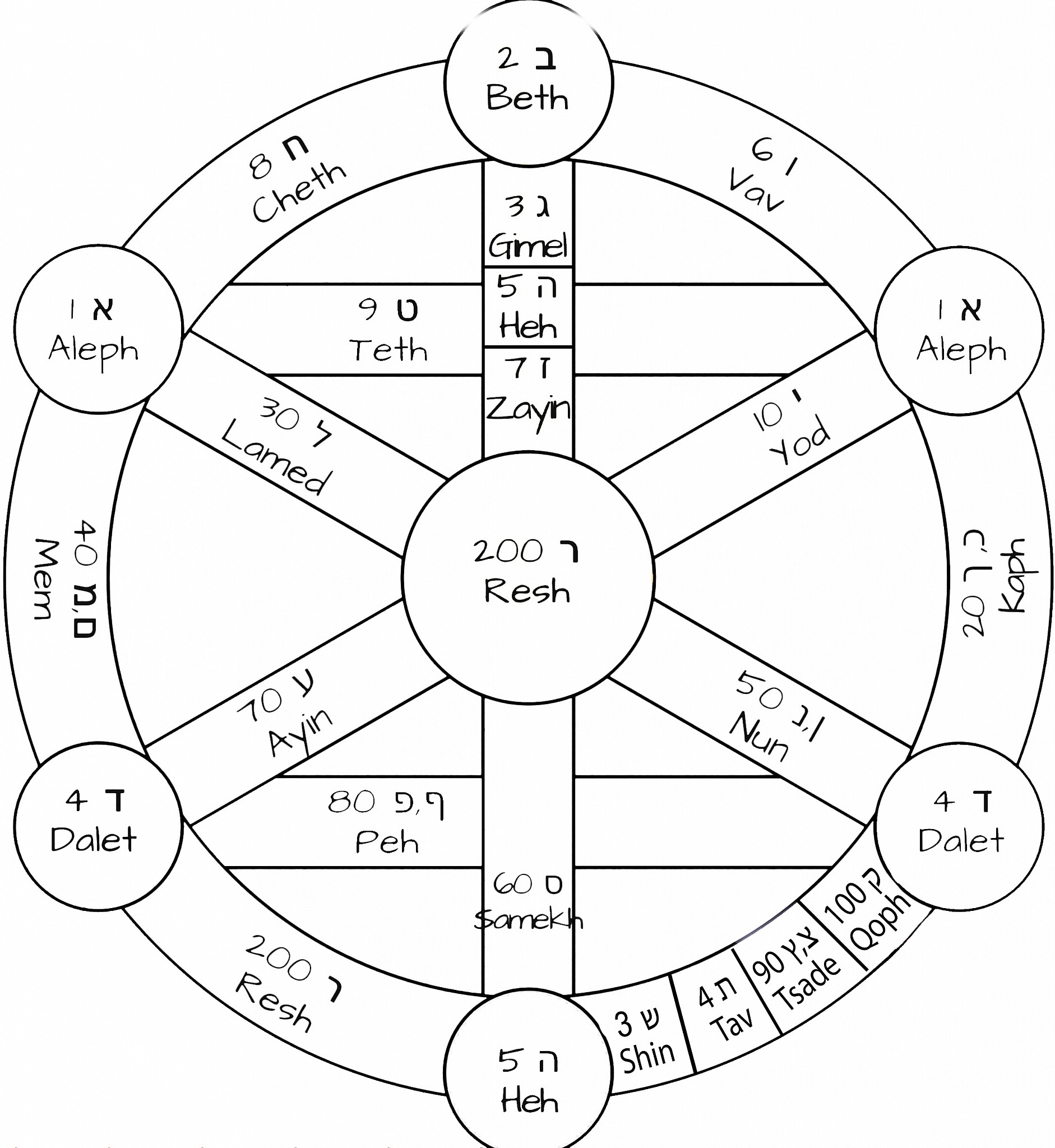
365 is a significant number to the Seven Palaces.  When the sum of the middle column is calculated (282 if we do not ‎use gates) and then removed from the total number (1012 ‎for the entire wheel) this leaves 730 and also splits the ‎wheel into two sections.

730 = 365 days + 365 nights.

When the letters Yod and Ayin are doubled on their paths we find the total sum from the Palace of the Aleph to the Palace of the Daleth is 365;

Aleph (1) + (Yod x 2 (20)) + Resh (200) + (Ayin x 2 (140) + Daleth (4) = 365.

And we also find the same calculation with the opposite diagonal;

Aleph (1) + (Lamed x 2 (60)) + Resh (200) + (Nun x 2 (100) + Daleth (4) = 365.

Lastly, the Talmud Yerushalmi Tractate Rosh Hashanah ‎‎2:5 says:

”The Holy One blessed be He created 365 windows that the world might use them:  182 in the east, and 182 in the west and one in the center of the firmament from which it came forth at the beginning of the Creation.”

That’s it for today.  Continuing on tomorrow I’ll be discussing how the ancients thought about light, as well looking into the story of the expulsion of Adam and Eve from the Garden of Eden.  So stay tuned for more numerical honey.

by
Bethsheba Ashe

As taken from, https://blogs.timesofisrael.com/the-conventions-of-biblical-gematria/

 
Leave a comment

Posted by on December 1, 2018 in Uncategorized