Every week, one section of the Torah, known as the Torah portion or “parsha ,” is designated as a focus of Jewish study and is read aloud in synagogue that Shabbat.
The first mention of a scheduled Torah-reading cycle appears in the Bible, in Deuteronomy, where Moses instructs the tribe of Levi and the elders of Israel to gather all the people for a public reading from portions of the Torah once every seven years. The need to read the Torah publicly intensified after the destruction of the Second Temple in 70 CE; Jews were dispersed into other parts of the Middle East, into North Africa, and into Europe; and their earlier religious and cultural world became decentralized. While most Jews in the Diaspora now follow one Torah-reading cycle, some communities are on a triennial cycle.
Because a reference in the Mishnah (the first effort to permanently record Jewish custom and law, compiled in the 3rd century C.E.) supported Deuteronomy’s prescription, we understand that Jews were continuing to read the Torah publicly; and we also know that there were Torah readings for festivals, special Shabbatot (plural of Shabbat) and fast days.
But it was not until the Talmudic era, about the 6th century C.E., that the Jews in the Land of Israel began to read the entire Torah in public and do so until all the Five Books of Moses were completed. At that time, the cycle took three years in a pattern called the Palestinian triennial, beginning the first year with the first book, Genesis, and finishing, at the end of the third year, with the fifth book, Deuteronomy.
The Jews of Babylon, however, followed a different custom, established by the beginning of the 7th century CE, and completed the entire cycle each year, which they did by dividing the Torah into 54 weekly portions. (Because the number of portions exceeds the number of weeks in a given year, more than one portion is read during certain weeks.) In Hebrew, the word for portion is parsha (plural, parshiyot).
In the 19th century, a reintroduction of the Palestinian triennial cycle was attempted at the West End Congregation in London, but was unsuccessful. In the middle of the 20th century, various congregations in the United States (primarily Conservative ones) were seeking ways to modernize the service and also to spend more time on Shabbat on Torah study. They too attempted to revive the Palestinian cycles with the argument that reading only a section of the weekly Torah portion would make Torah study more concentrated and thus enhanced.
The reintroduction failed for two reasons. First, in the pattern of the Palestinian triennial cycle, the weekly reading would have differed from what the rest of the Jewish world was reading. Second, Simchat Torah (the holiday in which Jews celebrate the conclusion of one Torah-reading cycle and the beginning of the next) celebrations would occur only one out of every three years, instead of annually.
Finally, in 1988, the Committee on Jewish Law and Standards of the Conservative Movement passed a legal responsum that put into practice a new American triennial cycle. This new triennial cycle, rather than dividing the entire Torah into thirds, as was done in the Palestinian cycle, divides each of the individual 54 portions into thirds. Therefore, a congregation can be reading within the same portion as those who follow the annual cycle, but will only read one-third of each portion per year. In addition, this pattern enables the congregation to read from Genesis through Deuteronomy each year, providing for an annual celebration of Simchat Torah.
There is an obvious drawback to this system: Only one-third of each conventional Torah portion is actually read per year; and the readings, because incomplete, do not flow smoothly into the portion of the following week. Nonetheless, the vast majority of American Conservative and Reform congregations prefer this new cycle. All Jews in Israel, however, and Orthodox Jews in America continue to follow the annual cycle with the full portion read each week.
Rejoicing with the Torah because it is an exceptional book that has made us exceptional.
Till now the best definition of chutzpah was probably that given by Leo Rosten in his classic work, The Joys of Yiddish: “Chutzpah is that quality enshrined in a man who, having killed his mother and father, throws himself on the mercy of the court because he is an orphan.”
In the aftermath of the by now infamous op-ed piece in the New York Times by Vladimir Putin, the Russian President might well be a serious contender for the title.
Speaking out strongly against a possible military response by the United States against his Syrian ally for the monstrous crime of using internationally forbidden chemical weapons, Putin dons the mantle of ethical advisor to offer us what he calls “A Plea for Caution from Russia.” Head of a regime known for its indifference to human life, its support of totalitarian dictatorships, and its history of hostility to religion, Putin has the gall to close his piece by reminding us that “when we ask for the Lord’s blessings, we must not forget that God created us equal.”
The man who has been providing heavy weaponry to Assad’s regime, the better for them to batter towns and villages filled with civilian women and children, and who has systematically blocked any UN Security Council action – even to reprimand Syria for its many wanton crimes – feels no shame as he offers hypocritical pieties. Sanctimoniously, Putin claims to stand variously with the Pope, those who honor international law and seek regional stability, human rights activists and peace-loving people throughout the world. Perhaps the only thing missing from his piece is a reminder to those who might publicly disagree with him that their fate might be the same as that meted out to the members of the feminist punk band who were imprisoned for being insufficiently respectful to the Russian leader.
Reaction to this highly unusual op-ed was almost unanimously negative. Vice President Biden spoke for many when he said it “made him want to vomit.” But one point Putin made did strike a chord. For those who live by the ideal of political correctness it served to open a widely disseminated discussion. Perhaps, comes the voice of the naïve swayed by beautiful sounding platitudes, Putin was correct when he criticized President Obama for putting forward the idea of American exceptionalism.
“It is extremely dangerous,” Putin wrote, “to encourage people to see themselves as exceptional, whatever the motivation.” Exceptional means better. And that idea – the idea that some people can rise above others by dint of hard work, uncompromising commitment to personal growth and steadfast adherence to sacred values – seems anathema not only to communism but to many who live by the creed of cultural relativism.
For them nobody is better than anybody else. No people have greater claim to moral superiority than any others. Exceptionalism is a dirty word.
Jews need to take pride in the fact that it has been our Torah that served to civilize the world.
As politically incorrect as it might be to say it, we need to remember that exceptionalism is the key to civilization, and we Jews need to take pride in the fact that it has been our Torah, our teaching of morality and ethics that served to civilize the world.
Emmanuel Kant did not hesitate in expressing the exceptionalism of the Jews and the Jewish Bible: “The existence of the Bible as a book for the people of the world is the greatest benefit which the human race has ever experienced. Every attempt to belittle it is a crime against society.”
The Catholic writer Thomas Cahill was so overwhelmed by his study of the Jewish contribution to world civilization that he authored what proved to become an international bestseller, The Gifts of the Jews. The Jews, he concluded, literally transformed the world.
The Jews not only discovered monotheism, but they then explained why that made God different from all the pagan gods worshiped until that time. The Jewish God is above nature; witchcraft and sorcery simply have no meaning for Jews. Such practices suggest that humans can manipulate God. A God who can be manipulated is made in man’s image. Jews believe the reverse, that man is created in God’s image.
Cahill believes that the ultimate breakthrough in humanity’s understanding of God came with the Jewish perception that God “is a real personality who has intervened in real history, changing its course and robbing it of predictability.” God is more than the Force of Star Wars; he is the “I” of the first commandment: “I am the Lord your God who took you out of the land of Egypt, the house of bondage.” God interacts with man and intercedes in history.
The Jews not only introduced the world to God but to his book as well. The Torah, transmitted from Moses to the Jewish people, has nurtured Christianity and Islam, Judaism’s two daughter religions. Its teachings provided the soil for democratic ideals and the seeds of Western civilization.
From the Torah, Cahill explains, the world learned the meaning of spirituality. Pagan gods, being physical, wanted physical things from their worshipers. Not so the God of the Jews. As Cahill puts it, “God wanted something other than blood and smoke, buildings and citadels. He wanted justice, mercy, humility. He wanted what was invisible… There is no way of exaggerating how strange a thought this was… The word that fall so easily from our lips – spiritual – had no real counterpart in the ancient world.”
That is why the Bible continues to be the world’s biggest best-seller. And that is why we have a special holiday dedicated to rejoicing with the Torah, Simchat Torah.
It is a holiday whose very theme is exceptionalism. It is the exceptionalism of our ancestors who stood at Sinai and responded yes to the challenge of accepting the Torah when the rest of the world was as yet unwilling or unready. It is the exceptionalism of our people who in spite of persecution – and oft times even martyrdom – held fast to those values which God proclaimed as the only reason for the world’s continued survival. It is the exceptionalism of Torah that stands above all other works written by man, whose divine truths illuminate our path and make life worth living.
We rejoice with the Torah on Simchat Torah because it is an exceptional book that has made us exceptional – and if that bothers President Putin, perhaps that gives us all the more reason for celebrating.
Shemini Atzeret is the holiday that follows immediately after the seventh day of Sukkot. Literally, Shemini Atzeret means “the eighth [day] of assembly.” The Torah designates this day as one of solemn assembly and prohibits labor.
Shemini Atzeret serves to conclude the holiday of Sukkot , although it technically stands as its own festival. In this way Sukkot begins with a yom tov (full holiday) and ends with a yom tov, while the days in between are the intermediate festival days (hol ha-mo’ed). Thus, the concluding holiday acts as a transitional day leading the worshipper out of the various levels of meaning inherent in Sukkot. The community assembles again to end the festival.
Jewish tradition has attributed various meanings to Shemini Atzeret, to which the Torah offers little justification. One example: The Rabbis say that the festival is God’s way to retain closeness with the Jewish people for a little while longer; Sukkot was a pilgrimage festival in which the nation gathered in Jerusalem during Temple times. The addition of Shemini Atzeret delayed their departure briefly.
It is customary to read the book of Ecclesiastes (Kohelet) on the Sabbath of the intermediate days of Sukkot. However, should there be no Sabbath on those days, Ecclesiastes is read on Shemini Atzeret. The theme of Ecclesiastes is very fitting for this holiday, as it emphasizes that all of nature is a closed system, and life itself can appear to be a futile journey.
The dynamic that fights off this sense of futility is the individual’s relationship with God. The nature themes and the spiritual musings found in Ecclesiastes mirror many of the themes of Sukkot, and we are reminded of them once again on Shemini Atzeret as we close the holiday. The prayer for rain recited on Shemini Atzeret provides a further thematic link with nature and perhaps hints at the ancient Sukkot water libation festival.
In Israel and in liberal congregations, Shemini Atzeret and Simchat Torah are celebrated on the same day. In all other congregations Simchat Torah is celebrated the day after Shemini Atzeeret, following the tradition of adding an additional day to festivals in the Diaspora.
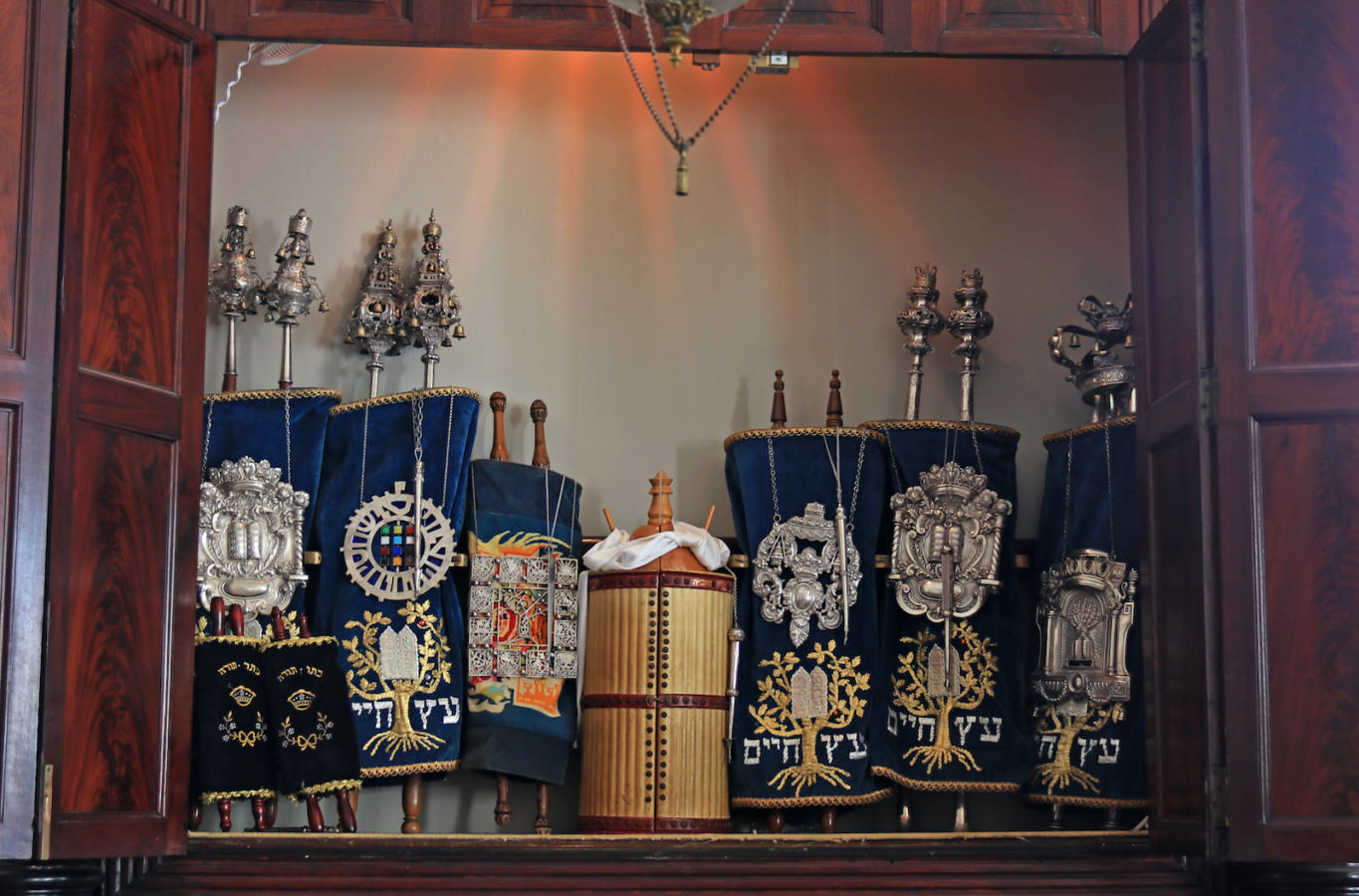
Simchat Torah–which roughly translates to, “rejoicing with the Torah”–is a holiday that occurs at the same time, but has an entirely different focal point. On this festival, the Jewish community ends its cycle of public Torah readings and immediately begins the next cycle of readings. All the Torah scrolls are removed from the ark in the synagogue, and the bimah or sanctuary is circled seven times in a festive procession known as a hakkafot. The congregation celebrates this completion and beginning by dancing and singing with the Torah scrolls.
On Simchat Torah the ending of the book of Deuteronomy is often read several times, since it is traditional to offer an aliyah –a blessing on the Torah–to all those who wish to participate. The term used for this aliyah is hatan Torah, the “bridegroom of the Torah.”
Immediately following this aliyah, the first part of Genesis is recited, and this aliyah is called hatan Bereshit “the bridegroom of Genesis.” [Egalitarian congregations may also offer a parallel aliyah for the kallah, the “bride of the Torah” or the “bride of Genesis.”] These terms speak of the perceived relationship the Jewish people have with Torah study. The commitment to the Torah is likened to that of a marriage in which two parties are singularly committed to each other.
It is an intimate relationship that challenges the individual and defines much of his/her identity. The marriage symbolism in the relationship between God and the people Israel is also found in seven processions around the synagogue, calling to mind the tradition of a bride circling the groom seven times.
The cycle of readings, moving from end to beginning, mirrors the cycle of the hakkafot, the circles walked around the ark. The entire image becomes symbolic of unending Torah learning. Unlike Shavuot, the holiday that celebrates the receiving of the Torah, Simchat Torah commemorates the community’s commitment to learning and its love of the Torah. Whereas Shavuot focuses on the burden of responsibility in receiving the Torah, Simchat Torah emphasizes the ecstatic joy of studying Torah. Simchat Torah reflects the rabbinic teaching that one studies Torah one’s entire lifetime and always finds new meanings within it.
The period of the High Holidays concludes with Shemini Atzeret and Simchat Torah. Beginning in the month of Elul and spanning Rosh Hashanah, Yom Kippur, Sukkot and finally Shemini Atzeret and Simchat Torah, the High Holiday period encompasses many of the themes that are central to Judaism. Accountability, spiritual awareness, harmony within nature, individual and community issues all find a place within this time period and set the tone for the coming year.
La alfabetización en el antiguo Reino de Judá (Judea) estaba extendida y “no era dominio exclusivo de escribas reales”, reveló un estudio israelí publicado en la revista PLOS ONE que identificó la escritura de una docena de autores en inscritos de cerámica de hace unos 2.600 años.
Expertos de la Universidad de Tel Aviv en disciplinas tan variadas como arqueología, algoritmos matemáticos, tecnologías modernas y una especialista en caligrafía forense analizaron dieciocho textos en hebreo antiguo, y concluyeron que la escritura en aquella época estaba más extendida de lo pensado.
La investigación parte de inscritos en tinta en fragmentos de cerámica hallados en la década de los sesenta en el yacimiento de Tel Arad, un antiguo puesto militar alrededor del sur de Judá en torno al 600 a.C., poco antes de que este reino desapareciera por la conquista de los babilonios.
El uso de tecnología avanzada de procesamiento de imágenes también ayudó a revelar que las inscripciones fueron escritas por al menos una docena de personas distintas.
Este hallazgo “contradice la creencia popular” y sugiere que una parte importante de la población de Judá “podía leer y escribir”, aseguran los investigadores.
El profesor de arqueología Israel Finkelstein considera que si en un lugar remoto como era Tel Arad -con unos veinte o treinta soldados -hubo “un mínimo de doce autores de dieciocho inscripciones” en poco tiempo, esto podría indicar que el nivel de alfabetización entre los alrededor de 120.000 habitantes de Judá era alto.
“No estaba reservado a un dominio exclusivo de los escribas reales”, valora Finkelstein, .
“Estudié las características de la escritura para analizar”, comparar y profundizar en “los detalles microscópicos” de las distintas inscripciones. Estas recogen “órdenes relativas al movimiento de soldados y el suministro de vino, aceite y harina”, explica Yana Berger, experta en escritura forense y exagente del departamento de documentación falsa de la Policía israelí.
Las escrituras también incluyen correspondencia con los enclaves fortificados vecinos y órdenes que llegaban a Tel Arad desde altos rangos del sistema militar de la era, agrega la especialista, que a través del análisis forenses de las inscripciones determinó que una docena de autores dejaron sus trazas de caligrafía en ellas.
Los investigadores remarcan que el estudio aporta detalles de la antigua sociedad de Judá, de la que aún se desconoce mucho.
Los hallazgos ayudaron a construir “un organigrama completo de la correspondencia” en torno al puesto de Tel Arad, y “quién escribía a quién”, lo que “refleja la cadena de mando dentro del Ejército judaíta”, destaca el doctor en matemáticas Arie Shaus, que integró el equipo de científicos que creó algoritmos para ayudar a comparar las inscripciones. EFE
When Jewish Boxers fought Nazis in the 1930s in America.
It all started with a birthday party.
Five years ago, Leslie Barry’s mother was turning 90. Leslie, an entertainment industry executive living in northern California, wanted to assemble a huge celebration for her mom, Esther Levine Kaplan. “She’s from Newark, from an immigrant Jewish family from Lithuania,” Leslie Barry recently explained in an Aish.com exclusive interview. Leslie’s family is close knit and enjoys celebrating Jewish holidays and events together. Leslie, her husband Doug and their four kids often enjoy Shabbat dinner together. Leslie was determined to mark her mom’s 90th birthday with a beautiful celebration.
Lots of relatives and family friends attended the party, and soon they started reminiscing about growing up in Newark in the 1930s, as Nazism rose in Europe and Jews all over the world watched its growth in fear. Leslie’s mom had an older brother – beloved Uncle Harry – and the relatives recalled that he’d been a boxer and even won the Golden Gloves amateur boxing tournament in Madison Square Garden in 1936. Then the conversation turned bizarre. “Yeah,” one relative remembered to Esther, “remember when your mom used to get so upset when your brother used to go out and beat up Nazis?”
Leslie didn’t know what the relative was talking about. When did American Jewish men have the chance to beat up Nazis? Some relatives explained that in the 1930s, Nazi ideology flourished in many American cities. Leslie started doing some research and what she found shocked her. Nazis did indeed recruit Americans to their hateful cause – and some young American Jewish men risked their lives to fight them.
In the 1930s, the German American Bund was a popular, openly pro-Nazi organization. About 25,000 American citizens were formal members, with others sympathizing and attending Bund events. Incredibly, in addition to the dues-paying members, the German American Bund also organized 8,000 uniformed members known as Sturmabeteiungen, or Storm Troopers, who would demonstrate and march in American cities. Their activities weren’t limited to marches. Leslie discovered that they joined the NRA, the National Rifle Association, who would give you a free gun and training. The German American Bund seemed to be planning for a violent confrontation on American soil.
Fritz Kuhn saluting marching Bund members at Camp Nordland in New Jersey.
The German American Bund brazenly called for hatred against American Jews. They put up posters urging Americans not to vote for Jewish candidates in local elections, published magazines and other literature, held rallies, and even ran Nazi youth camps for hundreds of American children to indoctrinate a new generation of American youth in their hateful ideology. Leslie found that there were 25 German American Nazi youth summer camps. At some of these camps children even dressed in Nazi uniforms where they were indoctrinated in hate. Girls were often abused at these camps, Leslie found. One goal of the camp organizers was for German American girls to have as many babies as possible to increase the number of “Aryan” Americans.
The United States Holocaust Memorial Museum notes that “(a)side from its admiration for Adolf Hitler and the achievements of Nazi Germany, the German American Bund program included anti-Semitism, strongly anti-Communist sentiments, and the demand that the United States remain neutral in the approaching European conflict,” World War II.
The largest Bund event was a “Pro America Rally” in New York’s Madison Square Garden on February 20, 1939, celebrating George Washington’s birthday – just three years after Leslie’s Uncle Harry won the Golden Gloves championship there. In those few intervening years, the world had become a much darker place for Jews.
Uncle Harry, the boxer
Over 20,000 Americans attended the 1939 Pro America Rally. Streaming into the Gardens, they saw a thirty-foot high picture of George Washington, flanked by massive swastikas. Speaker after speaker railed against “job-taking Jewish refugees” and the supposed “Jewish domination of Christian America.” Participants yelled “Heil Hitler” and booed President Franklin Delano Roosevelt, saying he was a puppet of Jews. One of the most popular speakers of the evening was Gerhard Wilhelm Kunze, the Bund’s public relations director, who told the jubilant crowd that Nazism was an American sentiment, imbued in the country’s racist Jim Crow laws and exclusion of non-white immigrants: “It has then always been very much American to protect the Aryan character of this nation,” he said to rapturous applause.
As the German American Bund’s leader, a racist and anti-Semite named Fritze Kuhne, launched into the main speech of the night, one Jew who’d snuck into the audience had finally had enough. Isadore Greenbaum was a 26-year-old Jewish plumber’s assistant from Brooklyn. Earlier that evening, he’d left his wife and young child, and come into Manhattan, where he’d snuck into the Bund rally. He went up to the stage, pulled out the cables of the microphone, and yelled “Down with Hitler!” Greenbaum was immediately set upon by the uniformed Nazi Storm Troopers. He might have been killed had New York City police officers – who’d been watching this odious rally without interference – stepped in to save Greenbaum’s life. (Click here to read full story about Isadore Greenbaum.)
This was far from the only time that an American Jew risked his life to openly defy American Nazis. Leslie discovered that young Jewish men flocked to fight American Nazis, her Uncle Harry among them.
Pro-Nazi rally at Madison Square Garden, New York City, in 1939
During the 1920s and 1930s, a Jewish mafia flourished in New York, New Jersey, Chicago, and some other American cities. These groups were active in smuggling liquor during prohibition. Though they could be violent and hardly represented the best in Jewish life, Jewish underworld criminals were horrified by the rise in Nazism and anti-Semitism, and wanted to do all they could to help their fellow Jews. Their propensity to violence, in this case, made them valuable in the fight against Nazi thugs.
In many cases, Jewish resistance to Nazi rallies was ad hoc, with individual Jews stepping up to fight Nazis. In 1937, however, New York State Judge Nathan Perlman reached out to the infamous New York City Jewish gangster Meyer Lansky, and asked him to formally organize groups of Jewish men to break up Bund rallies. Lansky obliged, and created a group he called the Minutemen, after the American Colonists who organized themselves into informal militias to resist British rule in the 1700s.
Like the Minutemen of old, these Jewish Minutemen would be ready at a minute’s notice, as their name implied. Judge Perlman offered Lansky payment for organizing the group, but Lansky turned him down, insisting he’d help fight Nazis for free. “I was a Jew and felt for those Jews in Europe who were suffering. They were my brothers,” Lansky later observed. (Quoted in But He Was Good to His Mothers: The Lives and Crimes of Jewish Gangsters by Robert Rockaway, Gefen Publishing House: 1993.)
Leslie’s mother, Esther Levine Kaplan, reading her book
As she researched, Leslie found that after some New York City Minutemen injured a Nazi, the New York City Minutemen were disbanded – Jewish leaders feared it would look bad for the Jewish community if Jews injured American Nazis. The Jews were being asked to disrupt Nazi events, but not to seriously harm anyone. Instead, a Jewish boxer named Nat Arno in nearby Newark stepped in to reconstitute the Minutemen there. Nat’s real name was Sidney Nathaniel Abramowitz. He’d grown up in a Jewish home and he turned the Newark Minutemen into one of the most effective anti-Nazi forces in the United States in the 1930s, recruiting local Jews.
One of the men who joined Arno’s group was Max “Puddy” Hines. He later described disrupting a Nazi meeting, along with other Newark Minutemen members: “The Nazi scumbags were meeting one night on the 2nd floor. Nat Arno and I went upstairs and threw stink bombs into the room where the creeps were. As they ran out, from the horrible odor, running down the steps to go into the street to escape, our boys were waiting… It was like running a gauntlet. Our boys were lined up on both sides… The Nazis were screaming blue murder.”
Newark was a prime location to counter the German American Bund. Out of a German-American population of about 45,000, approximately 5% of Newark German-Americans were Nazi sympathizers at the time. Newark also had a large Jewish community; often, Jews and Nazis or Nazi supporters lived side by side in the town. Leslie Barry also discovered that the FBI gave tacit support to the Newark Minutemen. The Jews of this informal militia were told not to punch any Nazis in the head so as not to cause serious injury, but would go and find Nazi rallies to break up, she explains.
“The goal was to thwart this Nazi party from rising,” Leslie learned. “Somebody would find out that the Bund was having a rally or a meeting at City Hall. They would get the word out to everybody: go out tonight, get ready to disrupt this ray that’s going on.” Sometimes the fighting became pitched – hence her Uncle Harry’s cuts and bruises that Leslie’s neighbors reminisced about at her mother’s birthday party.
The Newark Minuteman also went undercover to find out what the German American Bund was planning. One big project that Newark Minutemen worked to disrupt was the Bund’s efforts to map American infrastructure for possible use in wartime. Other groups fought Nazis across America, but it seems that the Newark Minutemen were the most active. “The Bund was most heavily concentrated in New York and New Jersey,” Leslie explains, “and the Newark Minutemen were the most organized of the resistance groups.”
Leslie notes that many of the Newark Minutemen never spoke about their anti-Nazi activities. She thinks that’s perhaps because many of these men were soon drafted and fought in World War II; they had even more dramatic stories to tell their kids and grandchildren.
She recalls that her Uncle Harry was a gentle man. “He was big, 6’4”, and a lot older than my mom,” Leslie explains. He was a “loveable teddy bear uncle.” Uncle Harry lived in Newark until he was drafted, then served in the American Army during World War II as a Military Policeman. After the war, he returned to Newark and became a policeman to support his wife and son. “He led a pretty simple life,” Leslie explains. He spoke very little about his days as a Newark Minuteman.
As Leslie delved more and more into this incredible story, she decided to write a book. Leslie’s first novel, Newark Minutemen: A True 1930s Legend About One Man’s Mission to Save a Nation’s Soul Without Losing His Own, is coming out October 6, and has already been optioned for a movie by a group of investors that includes the television host James Corden. The book tells the story of a Jewish man named Yael Newman who uses his boxing skill to fight Nazis as a member of the Newark Minutemen – and also rescues a German American girl who’s been abducted and forced to live in a Nazi summer camp.
After years of writing, she’s gratified that her forthcoming book is being extensively reviewed and anticipated. Writing Newark Minutemen has also deepened the pride she feels in her family. “To learn your legacy is empowering,” she notes: “you kind of start to learn about what you’re made up of.”
She also has advice for people today. “Don’t be complacent; stand up for what you believe in. I’ve internalized this while researching this book: if you see something that’s not right, do something.” It’s also crucial to write down people’s stories while you can. Particularly when writing about World War II, Nazism and the Holocaust, the chance to record history is fast slipping away. “Record these stories while these people are still here,” Leslie urges.
La energía es el impulso vital que motiva y mueve a los seres humanos. Cuando ésta es positiva, la gente vive mejor, cuando es negativa, todo se complica.
Hay personas que tienen una manera de ser ligera, son agradables y que además siempre ofrecen sonrisas y buenos consejos, son personas contentas con la vida. Viven en un mundo pacifico y se las reconoce porque parecen magnetos de la buena suerte y oportunidades. La energía que tienen y que dan es positiva y amena.
Desafortunadamente también hay personas que tienen una vibra pesada, que su energía es negativa, cargada de malestar, siempre viven culpando a todos por todo. Este tipo de personas es gente que no aporta nada bueno al mundo y cuando hablan son hirientes, están enojados y parece que todo les molesta o es un problema.
De igual forma están las personas que no pareciera que tienen energía ya que viven sin hacer ni ruido, no opinan y nunca tienen nada que ofrecer. Siempre están agotadas y prefieren dormir en lugar de interactuar con el mundo.
Así que la energía existe. Es como una fuerza invisible, pero se siente. No se puede tocar, pero se la reconoce. Puede ser medida en laboratorios y sus resultados son evidentes.
Una vez uno está consciente del poder de su propia energía, entonces puede aprender a dirigir y hasta transformarla para aprovechar los beneficios y enriquecerse de sus resultados.
Tener energía pulsante que se renueva y se incrementa es la llave del éxito, y esto se logra cuando uno puede visualizar claramente el tipo de vida, la calidad de relaciones que quiere tener y sobre todo, cuando tiene un propósito de vivir en armonía, paz y abundancia, sin limitarse o elegir con quién sí y a quien no.
Toda energía se invierte y cada persona elige si quiere cargar o prefiere fluir. Por este motivo uno tiene el poder propio para decidir si uno quiere ser positivo y vivir alrededor de gente linda y positiva o si prefiere el camino contrario, guardando su buen trato SÓLO para las personas que él elige, ya que no todos son merecedores de su respeto, ni su buena cara.
La energía negativa consume, agota y aísla a la persona de los demás, asimismo la energía positiva, se multiplica, nutre las relaciones personales, cultiva la armonía y mejora la calidad de vida.
Hay personas que eligen ser positivas en ciertas circunstancias y deciden ser negativas en otras, lamentablemente, el juego de las energías internamente consume y termina contaminando lo bueno con lo negativo.
Es una verdadera lástima saber lo mucho que se pierde cuando uno nutre su energía negativa. En realidad, cuesta lo mismo alimentar la energía positiva, sin embargo, la calidad de vida y el tipo de relaciones que se obtienen cuando uno fluye con paz y armonía es mucho mejor.
La receta: Tener energía positiva
Ingredientes:
Conciencia – reconocer que ser positivo es una virtud que se trabaja, no se nace.
Compromiso – elección sincera de la manera como quiere actuar, la energía se dirige.
Disciplina – rituales para actuar de la forma deseada con cuidado continuo.
Visualizaciones – declaraciones personales que eligen el tipo de actitudes a tomar.
Evaluaciones – revisiones continuas del sentir, actuar y pensar personal.
Afirmación positiva para tener energía efectiva:
Quiero ser una persona con energía positiva. Visualizo el lado amable, bueno y constructivo de lo que me sucede. Yo soy la única persona que puede trasformar mi energía para ser mejor. Atraigo a gente positiva, generosa y deseo con todo mi corazón vivir en plenitud. Nutro mi energía positiva, la renuevo y la comparto con el mundo.
Como nutrir la energía positiva:
Visualizar la vida con ‘retos’ es tener una actitud más positiva que visualizarla con ‘obstáculos’ o ‘dificultades’. La actitud con la que se percibe la vida nutre el tipo de energía que uno desarrolla.
La energía positiva promueve la felicidad y motiva a que cada uno se convierta en su mejor versión. Ser una persona positiva es una elección consciente, racional y absolutamente se puede aprender con un buen entrenamiento.
La energía negativa se nutre sola, la energía positiva se tiene que trabajar. El mecanismo que protege a las personas del peligro es una defensa nata para sobrevivir. Ser una persona positiva es una elección que se debe decidir y propiciar.
“La energía más poderosa es cuando se logra transformar la energía negativa en energía positiva. Ese debe de ser el motor que mueve todas las acciones”.
There is a mitzvah to rejoice on all of the holidays, yet there is special emphasis on being joyful during Sukkot. As the Midrash1 notes, the Torah highlights the command to rejoice on Sukkot three times (as opposed to Shavuot, when we are commanded once, and Passover, when we are not explicitly commanded to rejoice).2
Furthermore, in our holiday prayers, each holiday is given its own descriptive name: Passover is the “Season of Our Liberation,” Shavuot is the “Season of the Giving of Our Torah” and Sukkot is described simply as the “Season of Our Rejoicing!”
Why is Sukkot singled out?
Gathering the Produce From the Field
On the most basic level, the Torah itself gives the answer. We read: “You shall make yourself the festival of Sukkot for seven days, when you gather in [the produce] from your threshing floor and your wine pit. And you shall rejoice in your festival—you, and your son, and your daughter . . .”3 Apparently, this extra shot of joy is due to our stocked storehouses after the harvest.
Based on this, the Midrash4 explains why the Torah does not explicitly command us to rejoice on Passover, and only commands us one time regarding Sukkot. At Passover time, we are judged regarding the grain, but we don’t know yet what the crop will look like, since we only harvest it after Passover; on Shavuot we have gathered the grain and can now rejoice, but we didn’t yet gather the fruits from the trees so rejoicing is only mentioned once. But as the Midrash concludes, “On Sukkot, when the souls have received acquittal . . . and furthermore, we have already gathered not just the grain but the fruit as well, it mentions the imperative to rejoice three times.”
Look closely at the Midrash, and you’ll find that we’re not just happy because we have so much food in reserve—our souls have been acquitted. Viewed through this lens, the celebration of the harvest is much deeper than we originally thought.
Between Grain and Fruit
All that occurs in the natural order of the world is but a reflection of a deeper spiritual truth. Thus, by understanding the significance of the ingathering of the fruit, we can better understand the significance of the holiday of Sukkot.
The Rebbe teaches that we must first appreciate the difference between the gathering of the grain (which is celebrated by the holiday of Shavuot) and the ingathering of the fruit.5
For one, when it comes to grain, it doesn’t take that long—just a matter of weeks or months—from the time of planting until the crops ripen and you can enjoy the bounty. With fruit, however, it can sometimes take many years until you can finally enjoy the “fruits of your labor.” In addition, it takes much less labor to grow a stalk of wheat than it does to nurture a fruit tree to maturity.6
On the other hand, the amount of grain you harvest is commensurate with the number of seeds that were planted. A fruit tree, however, which was planted using a single seed, can produce an abundance of fruit for dozens of years. Thus, the fruit produced is incomparable to what was put into it.
Fruits From the Teshuvah Tree
The difference between grain and fruit can be compared to the difference between the divine service of the tzadik, the righteous individual, and that of the baal teshuvah, one who is repentant.
The righteous person travels on the straight and narrow path without too much concern or effort. Whenever he has a question of what to do, he turns to the Torah and follows it. He is therefore compared to grain, which can be harvested in a relatively short span of time with minimal effort.
The baal teshuvah, however, is compared to a fruit tree. It takes much effort and time, with many obstacles, twists and turns, to ultimately harvest the fruit. But it is precisely because of this that when he does finally harvest, he does so in abundance, and the yield is incomparable to the one single seed that was planted.
The divine service of the holidays of Passover and Shavuot is compared to the service of the righteous tzadik. He too celebrates, but it is with limitations, as whatever grows is only relative to what was planted.
However, shortly after the Giving of the Torah (on Shavuot), the Jews sinned with the Golden Calf, and it was not until the day of Yom Kippur that the Jews fully repented and G‑d forgave them for that sin. Thus, G‑d ordained that Yom Kippur be set aside as the Day of Atonement, a day dedicated to the Divine service of the baal teshuvah.
On Sukkot, which comes right after Yom Kippur, we celebrate the harvest of the baal teshuvah, which is compared to the fruit harvest. It takes lots of work, time and determination to get there, but the harvest of the delicious fruit is incomparable to what has been planted.
Thus, the Midrash tells us that we celebrate Sukkot because not only have “the souls received acquittal,” but we have gathered the fruits as well.
This is why the Torah uses the term “joy” three times. For according to Jewish law, when something is repeated three times, it is a chazakah, the halachic status of permanence. Thus, our job on Sukkot is to take this state of joy and happiness and carry it through the rest of the year!
For more on the Joy of Sukkot, as well as the joy of Simchat Beit Hashoeva, see here.
Parshat V’zot HaBerachah has two focuses: the blessing that Moses bestows on Israel before his death and the account of his death.
Moses’ blessing to Israel almost forces a comparison to the corresponding blessing in Genesis 49, the blessing that Jacob bestows on his sons before his death. These two blessings are not just a leader’s parting words before his death; they also contain an aspect of guidance and prophecy.
The main difference between the blessings is that Jacob’s blessing relates to all the tribes, whereas Moses’ blessing skips at least one tribe – the tribe of Simeon.
The reason for this is that Jacob’s blessing is primarily directed to his sons, and since he has twelve sons, each one merits attention. In Moses’ blessing, however, this is not the case. Although he relates to the existing units that are still based on the tribal division, he has before him another significant structure: the People of Israel. Indeed, a considerable part of Moses’ blessing – both its beginning and its end – relates not at all to individual tribes but to the People of Israel as a nation, in which the division into tribes, despite their significance, is becoming increasingly blurred.
Another difference between the blessings is their tone. Although Jacob’s blessing is a father’s parting blessing to his sons, Jacob tells his sons from the outset that he will not only relate to them as they are now, but will also prophesy future events. By contrast, in Moses’ blessing, although it, too, certainly contains allusions and references to future events, the main focus is on the tribes as they are in the present, not in the future. In short, Moses’ blessing is composed only of words of blessing, whereas Jacob’s blessing contains words of reproof and prophecy as well.
Jacob, alongside the prophecies for the future and the words of praise for some of his sons, does not spare his first three sons harsh words of reproof for their past mistakes and sins. By contrast, in Moses’ blessing, there are no words of condemnation at all.
The reason for this is that Moses is not the father of the tribes; he cannot act like Jacob, who, upon departing from this world, could address his sons’ sins. Hence, Moses does not mention the sins themselves at all.
Although it is reasonable to assume that his omission of the tribe of Simeon is not accidental but is a value judgment of the tribe, Moses does not spell this out. Additionally, although the Torah does not spell out the matter entirely, most of the sinners involved in Israel’s sin at Shittim were Simeonites. A hint of this can be detected in the killing of one of the tribe’s princes by Pinchas, and another hint emerges from the final census taken of Israel in the wilderness, in which the only tribe whose number has decreased drastically is Simeon.1 This numerical decrease corresponds more or less to the number of those who died or were killed after the sin at Shittim. Nevertheless, Moses does not censure the tribe, but merely ignores it, or, as several commentators suggest, subtly includes it within the tribe of Judah.
Moses and Joshua
Besides these contextual differences, whether in the nature of the one giving the blessing or in the purpose of the blessing, there are differences in the treatment of the tribes themselves.
Like Jacob’s blessing, Moses’ blessing features Judah and Joseph prominently. These two tribes serve important roles, not only in the present but also in the future of the Jewish people. However, whereas Jacob’s prophetic blessing, which relates both to the individual personality and the distant future, gives almost equal treatment to Judah and Joseph, Moses’ blessing of Joseph is greater and more detailed than that of Judah. Here, too, as in Jacob’s blessing, Joseph’s two sons, Ephraim and Menashe, are blessed independently.
Although the commentators have not discussed the matter comprehensively, the extraordinary emphasis on the tribes of Joseph in Moses’ blessing is not a vision for distant generations. In fact, over the generations, the position and significance of the tribe of Judah has been much more central than any other tribe, including the tribes of Joseph. Here, in Moses’ blessing, the focus is on the present and immediate future, and is probably connected with Joshua.
Joshua was not just a member of the tribe of Joseph; he had a direct familial connection to the tribe’s leadership.2 For this reason, Moses gives special attention to the tribe that is most closely connected to him, the tribe of his right-hand man Joshua.
Although in the blessing itself Joshua is not mentioned by name, in the final parashot his character grows in significance, for Joshua fulfills the complicated and difficult role of taking over the leadership of Israel after Moses.
Anyone who enters the shoes of a giant personality will inevitably suffer from the comparison, whether he is a disciple or a son. Indeed, in Jewish history throughout the generations, we see how people who, taken on their own merits, were supremely exalted individuals, yet did not attain the prominence they deserved because their predecessors were so great that no one could properly succeed them.
The Talmud’s characterization of Joshua demonstrates this clearly: “Moses’ countenance was like that of the sun; Joshua’s countenance was like that of the moon.”3 Although the moon is a great luminary as well, its light and intensity cannot be compared to those of the sun.
A less ancient historical example is the case of Rabbi Abraham the son of Maimonides, whose achievements were overshadowed by those of his great father. If Rabbi Abraham had lived in another context, he certainly would have received greater attention as one of the outstanding Torah leaders of the generation.
In addition to replacing Moses, Joshua is also given the responsibility of conquering the Land of Israel. An almost direct reference to this important task appears in Moses’ blessing to Joseph: “His firstling ox, majesty is his; and his horns are the horns of the wild ox. With them he will gore the peoples all of them, even the ends of the earth.”4
Many interpret that the special treatment accorded to the tribe of Gad, the length of whose blessing is disproportionate to the tribe’s historical importance, is because the blessing contains an allusion to Moses’ own personality. When Jacob blesses his sons, he is certainly aware that he is addressing the tribes of Israel, but his blessings still retain a personal aspect. Moses’ blessing, however, is addressed to the entire people, and thus there is no room for a personal element. Nevertheless, Moses seems to grant the tribe of Gad a special blessing because he knows that his burial site will be within their allotted territory. As he says, “for that is where the plot of the Lawgiver is hidden.”5
Simeon and Levi
The biggest difference between Jacob’s blessing and Moses’ blessing is how they relate to the tribe of Levi.
Levi the man, the son of Jacob, receives from his father both words of reproof and a dim prediction of his future as dispersed and scattered, without a hold in any specific point of settlement in the Land of Israel.6
By contrast, Moses’ blessing sets forth for the tribe of Levi the possibility of redefinition and rectification. By changing their ways, the Levites have the ability to gain a new awareness, which can not only rectify past faults but can also transform them from evil to good.
In addition, the tribe of Levi receives a lengthy and detailed blessing that relates to the tribe’s special status, which was granted to it not only by G‑d’s choice but also as a consequence of its deeds. During the wilderness years, the tribe of Levi distinguished itself as the tribe of loyalists, the personal guard of the Sanctuary and the sacred. In this regard, G‑d’s command and His choice of the tribe of Levi came as a result of the complete devotion and faithfulness of the tribe’s members to G‑d and His Torah.
The Midrash notes that Jacob’s blessing to Simeon and Levi, “I will disperse them in Jacob and scatter them in Israel,” took on different meanings over the generations.7 The tribe of Simeon, along with its territory, was absorbed almost entirely by the neighboring tribes over the course of its history, and it is mentioned sparingly throughout Tanach. Jacob’s prophecy was fulfilled also in regard to Levi, only that it assumed a different form: Although Levi was not given any portion or inheritance, “G‑d is his heritage.”8
The blessing here to Levi bears an important message, which becomes especially clear when compared to Jacob’s blessing. Apparently, the destiny of a person or of a whole community is predetermined and cannot be changed. Even after numerous efforts and changes in direction, life’s general outline remains unchanged. Nevertheless, there are ways in which inner changes, teshuvah, and good deeds can give a new aspect to one’s predetermined fate. Even though there is a certain outline that cannot be fundamentally changed, nevertheless, every person has the power to change the meaning of this outline.
Similarly, our sages say that every newborn infant already has, from the beginning of his existence, contours that determine his characteristics, his achievements, even the nature of his personal life, yet he nevertheless has the freedom to change all of these.9 This does not contradict what was preordained but, rather, changes its meaning.
Moses’ Departure
At end of the parshah, the Torah’s description of Moses’ death is quite obscure. On the one hand, G‑d fulfills His promise to Moses and shows him the Land of Israel. Our sages explain that He shows Moses not only the geography of the Land of Israel but also everything that is destined to take place in it.10 Moses gazes and sees not only the mountains and the sea but also the history, its rises and its majesty as well as its pains and its desolation.
Nevertheless, since Moses dies alone, his death is, in many respects, a mystery. From Israel’s point of view, Moses does not die; he returns to his own plane of existence. Moses is described as “a fish that leaves the sea and walks on dry land,”11 meaning that although he walked and lived his life within our reality, he belongs and exists in a different world entirely. For this reason, Maimonides, who was a great admirer of Moses, writes in the introduction to his Commentary on the Mishna, “This was his death for us, since he was lost to us, but [it was] life for him, in that he was elevated to Him. As [our sages], peace be upon them, said, ‘Moses our Master did not die; rather, he ascended and is serving on high.’12” Moses dies only from the standpoint of his absence from the world, the world of human beings, but not in the sense of coming to an end.
The Torah implies that Moses is buried by G‑d Himself; hence, Moses’ burial is itself a supernatural event. In addition, we read in Pirkei Avot that Moses’ burial is one of the physical creations that do not fully belong to the material world.13
We see, then, that Moses’ death was not a consequence of bodily deterioration and ruin, for “his eyes had not dimmed and his vigor had not departed.”14 Hence, Moses’ death was merely a “departure” – histalkut, in the lexicon of Kabbala: an uplift, an ascent.
The grand summary regarding Moses and his life’s work raises here what Maimonides counts among the major principles of our faith: that the prophecy of Moses is the highest prophecy of all; that there never was nor will there ever be anyone like Moses, whose prophecy is the last word, the final summation of G‑d’s word to the world.
It is certainly fitting to conclude the book with the following mysterious words, which we would not have believed had our sages not uttered them: “What is the meaning of ‘Moses, man of G‑d’15? From the middle of his [body] downward, [he was] a man; from the middle upward, [he was] of G‑d.”16
16. Deuteronomy Rabbah 11:4. By Adin Even-Israel (Steinsaltz) Rabbi Adin Even-Israel (Steinsaltz) (1937-2020) was internationally regarded as one of the leading rabbis of this century. The author of many books, he was best known for his monumental translation of and commentary on the Talmud. To learn more visit his website. Koren Publishers Jerusalem and Maggid Books have been publishing the works of Rav Even-Israel (Steinsaltz) zt”l for over a decade. To purchase the complete edition of Talks on the Parasha or any of Rav Even-Israel’s books, commentaries, or translations, visit www.korenpub.com.Art by Rivka Korf Studio, a Miami-based art design studio run by Rivka Korf, a coffee lover and mother. Rivka uses her expertise and creativity to run a team that creates masterful compositions and illustrations for corporate and large nonprofit organizations.
No celebres sólo las festividades judías típicas. Sucot y Simjat Torá nos muestran un lado feliz del judaísmo que sin duda deseas que tu familia experimente.
¿Acaso los padres judíos estamos celebrando las festividades judías erróneas? La mayoría de los padres judíos que conozco, incluso yo misma, quieren que sus hijos aprecien y amen nuestra religión. Queremos que nuestros hijos tengan un sentimiento de comunidad e historia. Queremos que amen ser judíos.
Muchos padres hacen todo lo posible para fomentar en sus familias un sentido de judaísmo durante las Altas Fiestas. Los llevamos a la sinagoga en Rosh HaShaná y Iom Kipur.
Pero al focalizarnos en Rosh HaShaná y Iom Kipur, perdemos de vista otras festividades judías alegres de esta estación y les damos a nuestros hijos una imagen engañosamente severa y cargada de culpas de lo que significa ser judío. Los niños necesitan experimentar la alegría del judaísmo para poder enamorarse de él.
Aquí hay cuatro razones por las cuales Sucot y Simjat Torá son celebraciones hechas “a medida” para las familias, y algunas formas en las que estas dos festividades pueden ayudar a que los niños amen ser judíos.
El tiempo de nuestra alegría
Sucot es llamado zman simjatenu, o el “tiempo de nuestra alegría”. Sentarse en una bella sucá, comer afuera, compartir las comidas festivas con amigos y familia… Muchas de las mitzvot de Sucot están diseñadas para despertar una sensación de bienestar y felicidad.
Construir una sucá es un gran emprendimiento y puede resultar abrumador. Pero la energía que los padres dedicamos a asegurar que nuestros hijos valoren Rosh HaShaná y Iom Kipur puede impulsarnos también en Sucot.
Si no tienes a mano una sucá, este año considera construir tu propia sucá. (Ahora hay disponibles en el mercado nuevas sucot listas para armar que pueden ser ensambladas por una sola persona).
Este puede ser un momento perfecto para disfrutar de una cena con la familia. Sentarse bajo las estrellas en una sucá bellamente decorada, compartir comida y canciones (otra parte integral de las comidas de Sucot) crea una sensación mágica tanto para los niños como para los adultos. Estoy segura que no querrás perdértelo.
Aprendizaje multisensorial
Sucot involucra a todos nuestros sentidos y provee una experiencia de aprendizaje multisensorial.
En Sucot nos sentamos en sucot bellamente decoradas, disfrutamos sentir el sol y la brisa en nuestros rostros. Sentimos la fragancia del etrog, sostenemos las cuatro especies de plantas que la Torá nos ordena reunir y sacudir en seis direcciones (lo que simboliza que Dios existe en todas partes, en todas las direcciones).
Como en tantas cosas del judaísmo, siempre hay nuevas capas para descubrir y bellos significados ocultos para explorar. Las cuatro especies que sacudimos en Sucot simbolizan las cuatro clases diferentes de judíos, desde los más justos y estudiosos hasta los más alejados. En Sucot unimos las cuatro especies para simbolizar que todos los judíos somos una sola familia. En la sucá, cada día se acostumbra a recordar a uno de nuestros ancestros de la Torá, a quien simbólicamente invitamos a nuestra comida. En Sucot hay canciones y plegarias especiales, todo esto ayuda a relacionarnos con la festividad de diferentes maneras.
La gratitud
Las sucot rememoran a las pequeñas chozas en las que vivieron nuestros ancestros tras el éxodo de Egipto, cuando vagaron durante 40 años por el desierto. Vivir en estas pequeñas cabañas, a la intemperie, nos recuerda de una forma visceral que dependemos de Dios. Durante el resto del año, cuando habitamos dentro de nuestros hogares con aire acondicionado, puede ser fácil caer en una falsa sensación de seguridad y sentir que somos responsables de nuestro propio bienestar.
La belleza de Sucot es que invierte esta idea. Durante ocho días (siete en Israel), pasamos el tiempo fuera de la casa, teniendo plena conciencia de las condiciones climáticas. Esto es un recordatorio de que en realidad cada aspecto de nuestras vidas depende de la Divinidad. En el mundo actual, donde es tan difícil inculcar un sentido de gratitud a nuestros hijos, Sucot puede ser una lección oportuna respecto a cuántas bendiciones recibimos diariamente. Experimentar este sentimiento al habitar la sucá nos ayuda a valorar de una manera completamente nueva la bendición de estar vivo.
Un sentido de la historia
Cuando le pregunto a los niños de la escuela donde enseño cuáles son las festividades judías más importantes, ellos nunca logran identificarlas correctamente. Además de Rosh HaShaná y Iom Kipur, y de la festividad semanal de Shabat, también hay tres grandes festividades: Sucot, Pésaj y Shavuot.
En la antigüedad, los judíos de toda la Tierra de Israel se congregaban en Jerusalem para estas tres festividades. Allí ofrecían sacrificios a Dios y compartían comidas festivas. Sucot era una festividad especialmente maravillosa: cada noche de Sucot, decenas de miles de personas celebraban en las calles de Jerusalem, entonaban cánticos de alabanza a Dios, bailaban y escuchaban música. Cuando despuntaba el alba, caminaban hacia un manantial en las afueras de la ciudad y regresaban al Templo trayendo agua como otra ofrenda a Dios, valorando el milagro de tener agua fresca para beber.
Incluso ahora, miles de años más tarde, los judíos acostumbran a tratar de hacer que la semana de Sucot sea un momento especialmente alegre y divertido. Al celebrar Sucot hoy en día, nos conectamos directamente con nuestros ancestros y aseguramos que nosotros y nuestros hijos seamos parte de una cadena inquebrantable que se remonta a muchas generaciones. Esta es una poderosa lección para nuestros hijos y los ayuda a comprender que ellos son el siguiente eslabón en la cadena del pueblo judío.
Simjat Torá
Sucot termina con otra maravillosa festividad, Simjat Torá, cuando completamos el ciclo anual de la lectura de la Torá e inmediatamente comenzamos un nuevo ciclo. Simjat Torá nos muestra cuánto podemos divertirnos dentro de la sinagoga. Es un momento de bailes energéticos y cánticos. Se corren las sillas y la gente baila con los Rollos de la Torá. También hay muchas golosinas tanto para los niños como para los adultos.
No es fácil prepararse para otra ronda de festividades judías justo después de Rosh HaShaná y Iom Kipur. Para muchos, faltar al trabajo y a la escuela es un verdadero desafío. Pero si queremos que nuestros hijos realmente amen ser judíos, Sucot y Simjat Torá son oportunidades increíbles.
Sukkot, the most aesthetic, welcoming and creative Jewish holiday, is my seven day antidote to Christmas envy.
Michael Ross | Dreamstime.com
I have a confession.
While most observant Jews spend this time every year shopping for the four species – carefully inspecting the etrog’s texture and building Sukkah walls – I do my own careful sifting…through online Christmas light listings. I order the most brilliant lights for the ultimate Sukkah ambience. Yes, I am a bit of a Christmas light connoisseur.
You see, as a Jewish kid living in suburban Maryland, around Christmas time each year I’d drive by houses decked in the warm glow of Christmas lights, shimmering on crisp winter nights. Something about those twinkling lights drew me, and I felt like an outsider looking in. I’d wonder who lived in those houses and what their holiday looked like.Illustrative: Spectators view an elaborately decorated home for the holidays in Brooklyn, New York. Dec. 4, 2012 (AP Photo/Seth Wenig)
The warm lights felt so… well… haimish. When I’d look at the melting candles of my humble Menorah, something about the understatement just didn’t do it for me. So began my very Jewish love of Christmas lights.
Naturally, being a proud Jewish family, we would never dream of having a Christmas tree or putting up blatantly Christian ornaments.
And so my Sukkot loophole came to be. Sukkot, in my view, is the most aesthetic, welcoming and creative Jewish holiday. It is the yearly pinnacle of my Jewish observance, and I take no shortcuts. For one week, you recreate an outdoor home, however you envision it. You can paint the walls, deck bamboo with multi-colored shiny decorations, cut out chains and pomegranates, sing kumbaya with neighbors…and relish in string lights. Lots of them. Of all shapes and sizes. We take holiday decor to a new level: we don’t just decorate a tree; we build incandescent shacks.
Sukkot is my seven day antidote to Christmas envy.
When I adorn that hut with string lights, I think back to those warm winter memories. I am no longer an outsider looking in, but an insider looking out, unbearably eager to welcome in guests and bask in the light. The Sukkah is built for hosting and sharing. As I sit back in a radiant bamboo shack on these warm summer nights I could burst with haimish holiday joy.
On a deeper level, every time I put up those lights, the act—from beginning to end—is filled with Jewish intent and pride. It is an act of taking a foreign object and elevating it to the center of a Mitzvah. It is, in fact, the ultimate Hiddur Mitzvah (beautification of the holiday) and fulfillment of Judaism’s fundamental tenets: elevating an object to its highest spiritual potential.
There is no doubt in my mind that our forefathers will be tripping over themselves to be this year’s ushpizin in my light-filled Sukkah.
And with that, amidst a crazy, upside-down world, I wish you a very merry (and leibedik) Sukkot.



 Fritz Kuhn saluting marching Bund members at Camp Nordland in New Jersey.
 Uncle Harry, the boxer
 Pro-Nazi rally at Madison Square Garden, New York City, in 1939
 Leslie’s mother, Esther Levine Kaplan, reading her book


 Centro Estudios Judaicos del Sur de PR