RSS

Author Archives: yishmaelgunzhard

Brujería y judaísmo

Brujería y judaísmo

por Rav Aarón Lopiansky

Si la magia y las artes ocultas existen, ¿Por qué son tan malas?


La mayoría de los niños se emociona con las historias de brujas y demonios, con Harry Potter y Lord Voldemort. En un mundo seco y racional, esas fuerzas misteriosas le agregan un toque de diversión y excitación a la vida, además de estimular la imaginación. Les permiten a los niños sentir que hay una forma de vencer a un despiadado e insensible sistema.

¿Naciste pobre y no tienes la culpa? No hay problema: un hada mágica vendrá a tu puerta y te dará la fortuna que tanto deseas. ¿Un matón te está atormentando sin piedad? Alguien hará un hechizo que lo convertirá en ardilla por el resto de su vida.

Las películas de terror les dan una inyección momentánea de excitación y terror a los adolescentes junto con una fatídica ilusión de que quizás hay algo de cierto en la trama.

Tres enfoques generales

Cuando una persona madura, comienzan a surgir tres enfoques generales respecto a lo oculto y otras fuerzas extrañas.

Primero están las mentes serias y racionales que se ríen de todo. Para ellas, el mundo es racional y cuantificable y todo lo demás es una absoluta basura.

El mundo tiene una dimensión espiritual con misterios que no podemos comprender.

Hay un segundo grupo de personas, que tienden a ser espirituales, artísticas, poéticas, etc., las cuales sienten que el mundo tiene una dimensión espiritual y que existen todo tipo de fuerzas y misterios que la razón no puede comprender. El mundo de esta gente incluye la lectura de las hojas de té, el tarot, las bolas de cristal y las predicciones psíquicas.

El tercer grupo corresponde a las personas profundamente religiosas, cuyo entendimiento es que hay una gran batalla en el mundo entre dos fuerzas: el bien y el mal. El capitán del equipo bueno es Dios, y es ayudado por una muchedumbre de ángeles, santos, mártires, etc. El capitán del equipo malo es el diablo, y es ayudado por demonios, espíritus malvados y políticos. Su mundo se ve particularmente amenazado por los libros como Harry Potter, principalmente por la severidad con que la Biblia trata a la hechicería.

La visión judía

Ninguna de esas tres formas de ver el mundo se alinea con el judaísmo. ¿Cuál es la opinión de la Torá respecto a la hechicería?

La Torá tiene una actitud muy negativa respecto a la hechicería en sus varias formas. Como está escrito:

“A una hechicera no dejarás vivir” (Éxodo 22:17).

“Cuando vengas a la Tierra que te da Hashem, tu Dios, no aprenderás a actuar de acuerdo con las abominaciones de esas naciones. No se hallará entre ustedes… ningún brujo, nadie que lea presagios, ningún hechicero… o que consulte a los muertos. Pues todo el que hace esto es una abominación para Dios, y a causa de estas abominaciones Dios expulsa a las naciones de ante ti” (Deuteronomio 18:9-12).

Pero, ¿por qué? ¿Qué tienen de malo estas cosas?

El enfoque denominado el “diablo vs. Dios” es aborrecido por el judaísmo por causa de su inherente dualismo. Dios es Uno, y sólo Uno. Actúa de diferentes maneras, pero no hay dos bandos.

El judaísmo sí habla del Satán/diablo, pero considera que el Satán es un emisario de Dios que pone a prueba la sinceridad de las acciones del hombre, la fortaleza de sus convicciones y el vigor de su moral. Si bien este diablo pareciera tentar al hombre para que haga lo equivocado, no es inherentemente un ser malvado, sino que realiza una operación encubierta en la que aparenta tentar hacia el mal, pero en realidad está trabajando para Dios. Una lectura rápida del comienzo de Job transmite este mensaje: Dios envía al Satán para poner a prueba la rectitud de Job.

Tal como un dentista o un doctor ponen a prueba la firmeza de un hueso o de la carne y como un ejército pone a prueba la integridad y fidelidad de sus agentes de inteligencia, de la misma manera Dios pone a prueba al hombre. Una prueba tiene el poder de revelar el valor real de las acciones de una persona, demostrando cuál es su verdadero nivel.

Entonces, si la magia y lo oculto existen, ¿por qué son tan malos?

Magia buena, magia mala

También encontramos la mención de muchos tipos de “magia buena” en las fuentes talmúdicas, como las bendiciones, los amuletos, etc. ¿Cómo podemos distinguir entre los dos tipos de fuerzas espirituales?

El enfoque más aceptado es el de Najmánides, el gran pensador del siglo XII. Trataremos de adaptar y explicar su enfoque.

Si bien Dios fue el único creador del universo, Él creó un sistema autónomo que llamamos ‘naturaleza’, el cual sirve de intermediario entre Dios y el hombre.

El sistema de la naturaleza es independiente y tiene sus leyes, sus causas y sus efectos. Dado que este sistema puede utilizarse sin la asistencia directa de Dios, permite una especie de ateísmo: es fácil pensar que el sistema funciona por sí mismo, independiente de Dios. La gravedad, la inercia, el electromagnetismo, etc., funcionan tanto si la persona es recta como si es pecadora. Una persona que se deja engañar por el fenómeno de la naturaleza sin preguntarse sobre su causa, es engañada por el sistema y termina creyendo que Dios no existe.

El mundo de lo casi espiritual puede quebrar las reglas de la naturaleza por medio de los milagros y la magia.

Entre Dios y este mundo de la naturaleza hay otro puente, al cual llamaremos lo ‘oculto’ o lo ‘casi espiritual’, el cual tiene la capacidad de cambiar y torcer las reglas de la naturaleza por medio de milagros, magia, etc. Si bien este mundo casi espiritual es más elevado que la naturaleza, sigue sin ser Divino. También tiene sus reglas y leyes operativas. Quizás sea más poderoso que el mundo físico, pero con certeza no es omnipotente.

¿Podemos utilizar este mundo de la misma manera que podemos hacer uso del mundo físico?

Najmánides dice que por lo general Dios no quiere que utilicemos este mundo. Dios quiso que tomemos conciencia de Su existencia dentro del mundo natural y por medio de sus fenómenos. Quien subvierte el sistema natural utilizando constantemente el mundo sobrenatural está yendo en contra de la voluntad de Dios.

En las ocasiones en que algunas personas santas han utilizado fuerzas sobrenaturales, siempre han enfatizado que los milagros sólo demuestran la omnipotencia de Dios para pasar por sobre los fenómenos naturales. Esto es similar (aunque ciertamente no lo mismo) a los milagros que hizo Dios para Israel en Egipto con el objetivo de establecer ciertas verdades Divinas. Cuando una persona justa utiliza ocasionalmente la intervención Divina, refuerza esas grandes verdades.

Peligro de equivocarse

Es en este punto que existe el peligro de las grandes equivocaciones. Quien se da cuenta que las leyes de la naturaleza son insuficientes por sí mismas para explicar el mundo, se encontrará con este mundo más espiritual y conocerá una variedad de ‘seres espirituales’. Si entiende que son agentes de Dios, entonces la experiencia se volverá verdaderamente espiritual. Pero si se equivoca y cree que son independientes de Dios, ¡entonces comenzará a hacer idolatría! Por lo tanto, esas fuerzas se convierten en una fuente para el mal cuando son vistas como un poder alternativo a Dios.

Quizás la mejor ilustración de este enfoque dual es inherente a la historia de la serpiente de cobre:

El pueblo habló en contra de Dios y de Moshé… y Dios envió a las temibles serpientes en contra del pueblo y éstas mordieron al pueblo. Una gran multitud de Israel murió… y Dios le dijo a Moshé: “Hazte una serpiente temible [de cobre] y ponla sobre un mástil, y ocurrirá que todo el que fue mordido la mirará y vivirá”. Moshé hizo una serpiente de cobre y la colocó sobre el mástil; y ocurría que si una serpiente había mordido a un hombre, éste miraba a la serpiente de cobre y vivía” (Números 21:5-9).

La Mishná (Rosh Hashaná 29a) pone esto en perspectiva:

¿La serpiente curaba o mataba? [La verdad es que] cuando Israel miraba hacia el Cielo y dirigía su corazón hacia su Padre Celestial [eran sanados]; cuando no, eran eliminados.

Aquí tenemos ambas facetas de lo sobrenatural: al principio, la naturaleza milagrosa de la serpiente hacía que las personas se dieran cuenta de que la plaga provenía de Dios y trataban de mejorarse a sí mismas. En ese caso, fue una experiencia espiritual positiva.

Posteriormente las cosas empeoraron y la serpiente, en lugar de ser un medio para el reconocimiento de Dios, se convirtió en un punto focal, es decir, en la maravillosa serpiente curadora independiente del poder de Dios. Eso es idolatría. Por esta razón, muchos cientos de años después, el Rey Ezequías hizo que esta serpiente de cobre fuera destruida: porque la gente la trataba como un ídolo.

Entendiendo la idolatría

La idolatría es la percepción de que hay muchas fuerzas con muchos poderes sobre la humanidad que podrían actuar incluso sobre Dios. El idólatra cree que puede llegar a utilizar estos poderes en contra de Dios si tan sólo supiera cómo arrebatárselos.

Es como si el poder de Dios yaciera en una pistola que Él tiene en Su mano. El idólatra cree que si pudiera sacarle a Dios la pistola de la mano, entonces tendría ese poder; equipara los hechizos de la brujería con la capacidad de doblegar a Dios.

El mejor ejemplo de este pensamiento es el malvado profeta Bilam, a quien la Torá denomina hechicero. Él era una persona muy sabia en esta área. Se la pasaba tramando usar el mundo de la magia en contra de Dios. Creyó que entendía la mente de Dios y que, con suficiente manipulación, ¡podría superarlo!

En un aspecto, esta es la peor forma posible de idolatría. Por un lado, la persona tiene algo real. No es una roca extraña que una mente primitiva fantaseó que era un dios, sino que es un poder que realmente funciona. Pero de todos modos es esencialmente falso, porque nada es independiente de Dios.

La prueba de fuego de la espiritualidad es la moralidad. Sin moralidad, toda espiritualidad es falsa o malvada.

Para nosotros, la prueba de fuego de la espiritualidades la moralidad. Toda forma de espiritualidad que no le presenta exigencias morales a la persona, que no busca acercarlo a Dios ni materializar el potencial Divino del hombre, es falsa o malvada.

Si una persona practica ritos ocultos cuyo contenido es un mascullo de palabras extrañas, costumbres bizarras o ritos insólitos, entonces estos ritos o bien son falsos o bien son malvados. Por lo general son falsos, pero en los casos en que ha aprovechado esos poderes, son malvados porque la persona los ha divorciado de Dios.

Los grandes rabinos que realizaron actos sobrenaturales los utilizaron para transmitir un mensaje sobre Dios. Les ordenaban a las personas reconocer al Creador, desarrollar su carácter, ser amables con los demás, ser honestos y fieles, gobernar sus instintos, etc. En el contexto amplio de Dios, la Torá y la moralidad, esos inusuales milagros fueron realmente revelaciones Divinas.

Según tomado de, https://www.aishlatino.com/e/f/Brujeria-y-judaismo.html?s=mm
 
Leave a comment

Posted by on March 25, 2019 in Uncategorized


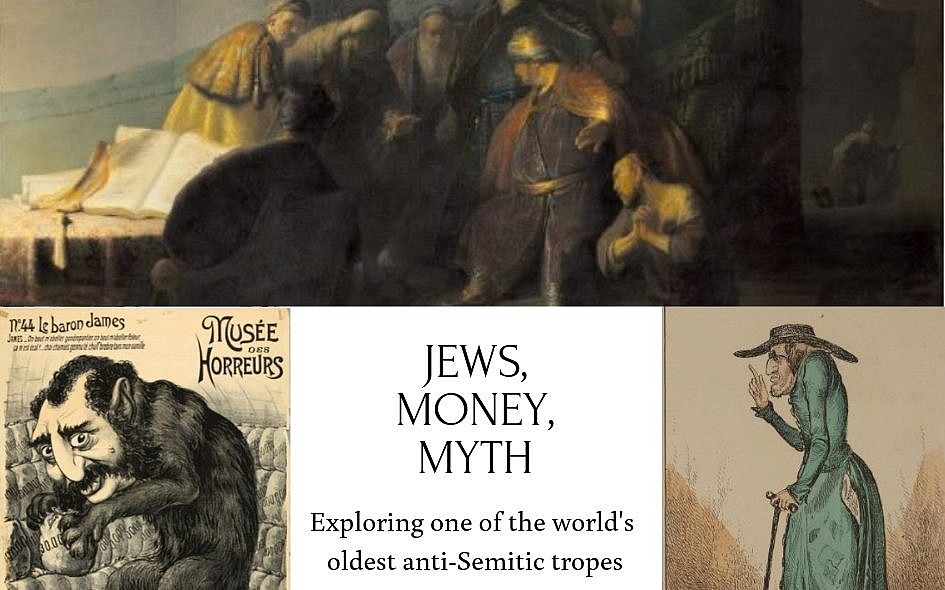
Jews, Money, Myth

Clockwise from lower left:'No. 44 Le baron James,' France, 1900 (Courtesy USHMM); Rembrandt, 'Judas Returning the Thirty Pieces of Silver,' 1629, (Courtesy National Gallery London); '11th Commandment: Get all you can, keep what you get, give away nothing,' England, 1830 (Courtesy Jewish Museum London)

Opened March 19, the show at London’s Jewish Museum doesn’t shy away from revealing to the public the extent of vicious anti-Semitic portrayals, past and present
By Jenni Frazer

Clockwise from lower left:’No. 44 Le baron James,’ France, 1900 (Courtesy USHMM); Rembrandt, ‘Judas Returning the Thirty Pieces of Silver,’ 1629, (Courtesy National Gallery London); ’11th Commandment: Get all you can, keep what you get, give away nothing,’ England, 1830 (Courtesy Jewish Museum London)

LONDON — If there were ever two words that sound toxic when put together, they would be “Jews” and “money.” But add the word “myth” into the mix, and you’ve got the daring exhibition. “Jews, Money, Myth” opened March 19 at London’s Jewish Museum and examines the tortured and tangled relationship between the words.

The timing couldn’t be more appropriate, with a trending rise of Jewish stereotyping by both the far right and far left in the United Kingdom.

Prof. David Feldman, director of the Pears Institute for the Study of Antisemitism at London University’s Birkbeck College, says the idea was “to examine the deeply entrenched anti-Semitic stereotypes and myths relating to Jews and money, and the malignity which has affected Jews in that context.”

The Pears Institute worked closely with the Jewish Museum to develop the narrative of the exhibition.

But as Abigail Morris, the Jewish Museum’s energetic director, explains, “Jews, Money, Myth” was an idea she had more than three years ago, following a cutting-edge exhibition the museum did about blood and its place in both uniting and dividing Jews.

“I think there’s something very exciting for a museum to tackle difficult subjects, but also to take the long view,” Morris says.

Abigail Morris, director of The Jewish Museum, London. (Courtesy JML)

“Exciting” barely describes the vicious anti-Semitic material that is on display in this exhibition, guaranteed to both draw crowds and shock them. British Jews, in particular, once used to the casual, easygoing tolerance of British society at large, are likely to be horrified at the entrenched anti-Semitism of 19th century Great Britain.

‘The New and Fashionable Game of the Jew,’ 1807. (Courtesy Jewish Museum of London)

Perhaps the most dramatic of the exhibits is “The New and Fashionable Game of the Jew,” a children’s dice game made in London in 1807. It features a stereotypical Jewish banker in the middle of the board, hoarding money. This game is from the Jewish Museum’s own collection, but the composer Steven Sondheim, who owns a copy, says “this is a game which taught kids to be anti-Semitic.”

The anti-Semitic tropes on display are not only confined to history, but are right up to date. One image on display famously triggered an uproar against Labour leader Jeremy Corbyn — a street art mural in which obviously Jewish bankers sit around a board game balanced on the backs of the oppressed poor.

The image, by the American artist Mear One (born Kalen Ockerman), was entitled “Freedom for Humanity,” and appeared in East London in 2012. As the Jewish Museum exhibition says, “The stereotypically Jewish features of the bankers recycled age-old tropes positioning Jews as exploitative and motivated by greed. The artist denied any antisemitic intent, saying the mural was a critique of ‘class and privilege.’”

But it was the initial response of Corbyn, who disagreed with the local council’s plan to remove the mural, which led to a recent upsurge in both claims of anti-Semitic abuse from the far left, as well as counterarguments that those accusations are unsubstantiated and motivated by politics. Jewish MP Luciana Berger, who raised the issue of the mural with Corbyn, quit the party last month, citing “a culture of bullying, bigotry and intimidation.”

Kalen Ockerman's mural 'The Enemy of Humanity' (photo credit: YouTube screen shot)

Kalen Ockerman’s mural ‘The Enemy of Humanity,’ which uses anti-Semitic imagery. (photo credit: YouTube screen shot)

Despite its impact on Britain’s contemporary politics, the Mear One image is situated in a section devoted to 19th century anti-Semitism. Also scattered through the gallery are some thought-provoking works by the British artist Ryan Gander, including a bronzed wallet and phone which are stuck to a bench, intended as a comment on the ties between morals and money.

Without doubt this is the Jewish Museum’s most ambitious show to date, and its importance can be judged by the quality of the loans on display.

There is a stunning Rembrandt, “Judas Returning the 30 Pieces of Silver,” painted when the artist was just 23. It has been loaned by a private collector and has not been on public show for 40 years. The lender, says Morris, is not Jewish but believed it was important to discuss the subject.

Rembrandt, ‘Judas Returning the Thirty Pieces of Silver,’ 1629, (Courtesy National Gallery London)

Or there is an extraordinary public treasury roll dating from 1233, an unprecedented loan from Britain’s National Archives.

“It’s one of the most iconic images of Christian-Jewish relations of medieval times. Someone has effectively doodled onto the roll a drawing of a three-headed demon Jew,” says Morris.

The sketch shows Isaac of Norwich, one of the wealthiest men in England, who appears at the top as a crowned, three-faced anti-Christ figure. A devil touches the noses of Isaac’s agent Mosse Mokke, who wears a spiked hat, and a Jewish woman called Avegaye. A figure on the left may be weighing coins on a pair of scales. Isaac and Mokke were both accused of charging excessive interest.

The writing on the document shows the sums that the Exchequer of the Jews, a tax institution set up by the Crown, received from individual Jews in each county.

Feldman, the historian who has worked closely with the museum on developing the narrative for the exhibition, says its twin aims were to “confront and debunk — and to explore the real historical relationship between Jews and money, and between wealth and poverty.”

Prof. David Feldman, director of the Pears Institute for the Study of Antisemitism at London University’s Birkbeck College. (Courtesy)

The central overarching myth, of course, is what has fed into the stereotype of the rich, grasping Jew — from medieval times all the way to George Soros — that all Jews have money and control the world.

But the truth, as the exhibition shows, is that there were uncountable numbers of Jewish poor, particularly in Britain, and that many made their living selling old clothes and rags, and, interestingly, as the main sellers of dried rhubarb — though nobody seems clear as to the reason for the latter.

Dr. Dave Rich, head of policy at Britain’s Community Security Trust (CST), who has run scores of education and training seminars about Jew-hatred, says that he has “definitely realized how little knowledge and recognition of anti-Semitism there is.”

Rich is the author of “The Left’s Jewish Problem, Jeremy Corbyn, Israel and Antisemitism.”

“I think that the exhibition can only be a good thing in talking about such things, because we need that education. So much of what is going on in the Labour Party at the moment is people using language they don’t understand,” he says.

Dave Rich, head of policy at Britain’s Community Security Trust. (Courtesy CST)

One of the repeated tropes of current-day anti-Semitism, says Rich, is the invocation of the Rothschild name as a sort of catch-all to represent the greedy Jew.

“I think the Rothschilds are a classic case,” he says. “They have no profile in public life. They are not an important bank, they are not involved in big public works — and yet the name Rothschild resonates over and over again. It is remarkable how the name still has a cultural meaning, completely detached from what the Rothschilds actually are.”

In research released by the CST in January this year, Rich says they found that Google searches for Rothschild were up by 39 percent in the last three years.

“It’s virtually all people looking for conspiracy theories and negative stereotypes that Jews are both rich and mean, and that they use their money to pull strings,” says Rich. The constant subtext, he says, is that Jews “will use their money for underhanded purposes.”

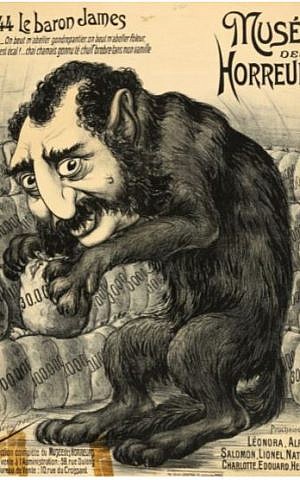
‘No. 44 Le baron James,’ France, 1900 (Courtesy USHMM)

Nowhere is this better illustrated than in some of the depictions of Nathan Mayer Rothschild, the legendary founder of the bank, who made his home in London in the early 19th century. What the Jewish Museum calls “probably the most obscenely antisemitic of all” is a repellent carved figurine dating from Paris in 1833, on loan from the French capital’s Musee Carnavalet. Rothschild is shown as a writhing, demonic figure, teeth bared and grasping at piles of cash.

Intriguingly, Morris and the show’s curator, Jo Rosenthal, have chosen to highlight what would normally be behind-the-scenes conversations about the design of the show, by putting those conversations on display.

For the Carnavalet Rothschild, there was intense discussion. The exchange is recorded:

Rosenthal: “I’m worried about the ethics of showing this much anti-Semitic material. The Rothschild sculpture is so gruesome I wonder if we should even show it.”

Morris: “I know what you mean. That sculpture is really upsetting. I wonder if we should find a different way to display it. How about using a mirror in the showcase and displaying the object with its back to us? That way it won’t be clearly on show, people will have to make a particular effort to look at it and will see themselves looking back as they look.”

Not everything in “Jews, Money, Myth” is related to anti-Semitism. There is fascinating material from the Jewish Museum’s own collection relating to positive relationships between Jews and money, from the special coins used at a Pidyon HaBen (redemption of the first-born) ceremony, to a section on the importance of charity in Jewish life.

’11th Commandment: Get all you can, keep what you get, give away nothing,’ England, 1830 (Courtesy Jewish Museum London)

But again and again the exhibition returns to difficult themes, from Judas to Shylock and Fagin, or to what Feldman calls the “utterly mainstream” conspiracy theories such as “a widespread belief that the Boer War was fought for Jewish financial interests through their alleged control of the press.”

Feldman, who was vice chair of the 2016 Chakrabarti inquiry into anti-Semitism in the Labour Party, says he hopes the exhibition has a message for Jews and non-Jews alike. But he acknowledges that there might be a particular message for the leadership of the Labour Party.

“The problem that part of the Labour leadership face is that of recognizing what is in front of them, and their expectation of the form that racism takes,” he says.

“For them, racism is about the poor, people of color and victims of colonialism. It is difficult for them to recognize people coded as white and possibly affluent [as victims of anti-Semitism]. This exhibition ought to help people understand how to recognize anti-Semitism,” says Feldman.

It is, agrees Morris, probably the first time such material has been assembled in one place by Jews, rather than by anti-Semites. She says a number of people have asked her whether the Jewish Museum should be staging such an exhibition.

“We have been incredibly careful. But [anti-Semitism] is not going away, and I feel it is incredibly important for us to build bridges, and not retreat into our echo-chamber silo,” she sighs.

As taken from, https://www.timesofisrael.com/this-shocking-exhibit-reexamines-age-old-anti-semitic-trope-of-jews-and-money/

 
Leave a comment

Posted by on March 24, 2019 in Uncategorized


The Romans tried to ban wild Purim parties

by Henry Abramson

If hanging Haman in effigy was a stand-in to mock Jesus’ crucifixion, it was in the Jews’ best interest to tone it down


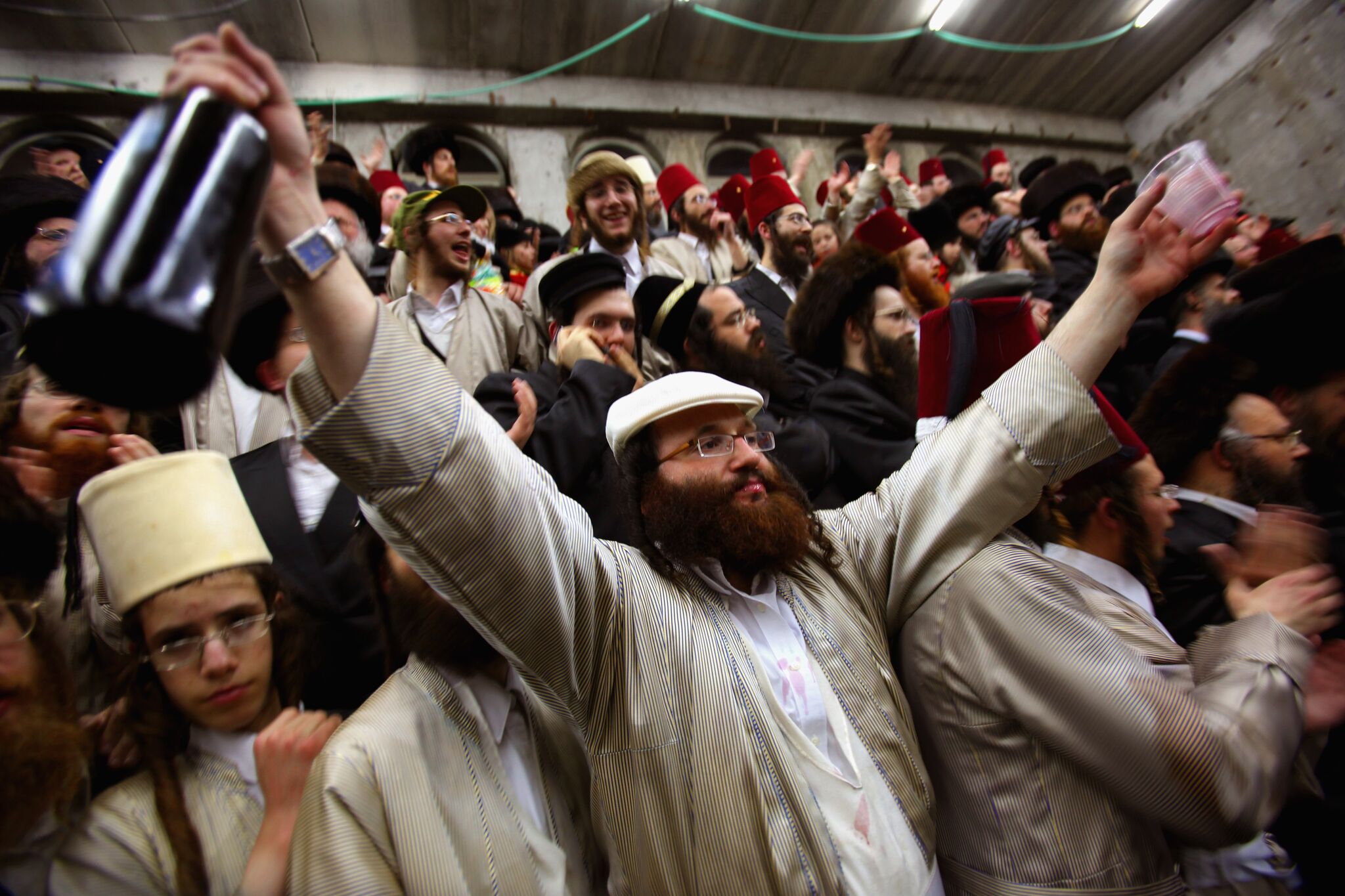
Haredi Jews revel in Purim at a synagogue in Beit Shemesh, Israel. (David Silverman/Getty Images)

Every year before Purim, my inbox and social media fill up with dire exhortations from rabbis and yeshivas warning against the dangers of celebratory excess – as if drunkenness on the holiday were something new.

In reality, the after-Purim regrets have been part of the discourse ever since Rabbah drunkenly attacked and inadvertently killed his dear friend Rabbi Zeira in the Talmud (don’t worry – he was revived in the end). Rabbis and communal leaders across the religious spectrum have condemned drunken revelry on a holiday dedicated to excess and carousing, noting it often leads to harming life and limb. Rabbi Menachem Mendel Schneerson, leader of the Hasidic Chabad movement, outlawed more than four drinks at a time for anyone younger than 40.

But even before all of that, it turns out that the ancient Romans — who weren’t exactly known for their sobriety — attempted to control wild Purim parties as early as the year 408.
An unusual bit of the Theodosian Code (16.8.18) is apparently the first non-Jewish source to document the phenomenon of Purim parties that get out of hand. Specifically, the law prohibited Jews from burning Haman in effigy. For Jews, the practice of symbolically destroying the notorious villain of the book of Esther, the paradigm of anti-Semitism, was considered an aspect of the Purim commandment to “erase the name of Amalek,” Haman’s Jew-hating ancestor.

The Romans weren’t especially discomfited by the idea of vicariously punishing enemies, or even maintaining fire safety. They were, however, concerned that drunken Jewish celebrants might use the opportunity to mock Christians by portraying Haman as a sacrilegious stand-in for Jesus. This is especially true because the favored method of representing Haman’s death in the ancient world wasn’t hanging by the neck – he was crucified on a wooden cross.
The biblical passage that literally describes Haman’s “hanging on a tree” (Esther 7:10) was rendered as “crucified” in the ancient works of the Jewish historian Josephus, the early translations of the book of Esther into Greek (Septuagint) and Latin (Vulgate), and all through the Middle Ages in literary classics like Dante’s “Purgatory.” Artistic representations also depicted Haman on the cross, such as the 15th-century Azor Masters and even by Michelangelo, who painted a muscular Haman on a cross on the Sistine Chapel.
It’s not hard to imagine how public Purim execrations of Haman, conducted by an inebriated crowd of Jews, could easily be misperceived by Christian observers, especially if the effigy of Haman is bound to a wooden cross. In fact, only a few years after the law in the Theodosian Code was promulgated, a Church historian named Socrates Scholasticus tendentiously described an event that sounded very much like a drunken Purim celebration gone horribly wrong: In Inmestar, Syria, a group allegedly seized a Christian child, bound him to a cross and scourged him until he died.

Socrates Scholasticus is not especially reliable as a source for Jewish history, but as the historian Elliot Horowitz has demonstrated in his masterful studies of Purim violence, it didn’t take much to convince Christian audiences that Jews were in fact bent on committing acts of horrific violence. From Inmestar to Norwich to Nazi Germany and beyond, the noxious lie of the blood libel continues to plague innocent Jewish communities. It’s too awful to think that it might in some way be connected to misunderstood, misapprehended, “harmless” Purim festivities.

The blood libels were just that. But because the Christian majority was so quick to feel threatened by Jewish revelry, violent or just intemperate, it was better for the Jews’ own sake that they tone it down.

Some might be tempted to argue that drunken revelry is essential to the celebration and that non-Jewish viewers should develop a sense of humor about the holiday. Yet isn’t that the same argument recently made by Bram De Baere, the designer of a carnival float in Aalst, Belgium, that depicted Jews in stereotypically ugly ways?  De Baere told a Belgian newspaper that “Carnival is a time when everyone and everything can be laughed at. If you were to forbid that, you would be attacking the DNA of Aalst at its core.”

Not everything is fair game for mockery, even on Purim. True, there’s a big difference between a tiny, relatively powerless community poking fun at the dominant people on one day of the year on the one hand, and the majority population using their position of power to demean a hapless minority on the other.

But I have to give this one to the Romans: The law of 408 wasn’t anti-Purim – it was anti-poor taste.

As taken from, https://blogs.timesofisrael.com/the-romans-tried-to-ban-wild-purim-parties/

 
Leave a comment

Posted by on March 15, 2019 in Uncategorized


Entre el destino y la suerte


Todos los mensajes que Di-s le transmitió a Moshé fueron precedidos por un llamado

Por el Rabino Jonathan Sacks

El tercer libro de la Torá recibe en español el nombre de Levítico, palabra que deriva del griego y del latín, cuyo significado es “Concerniente a los levitas”. Esto refleja el hecho de que, para el judaísmo, los sacerdotes –descendientes de Aarón– pertenecían a la tribu de Levi y de que el antiguo nombre rabínico para el libro era Torat Koanim, “La ley de los sacerdotes”. Este título resulta bastante apropiado. Mientras que Shemot y Bamidvar están repletos de narraciones, el libro que se encuentra entre ambos trata principalmente acerca de los sacrificios y de los rituales asociados, primero, con el tabernáculo y, después, con el templo de Jerusalén. Reflexiona acerca de los sacerdotes y de su rol como guardianes de la santidad, conforme lo indica su nombre, Torat Koanim.

El nombre tradicional vaikrá, “Y llamó”, parecería ser un mero accidente. Vaikrá es la primera palabra del libro, y no existe relación entre esta y la temática que se desarrolla. Sin embargo, me atrevo a decir que esto no es del todo así. Existe una conexión profunda entre la palabra vaikrá y el mensaje que subyace a todo este libro.

Para entenderlo, debemos percatarnos de que hay algo inusual acerca de la forma en la que la palabra aparece en el Sefer Torá. Su última letra, la alef, está escrita en un tamaño más pequeño, como si apenas existiera. Las letras de tamaño normal forman la palabra vaikar, que significa “Y encontró”. A diferencia devaikrá que se refiere a un llamado, una convocatoria, una reunión extraordinaria, vaikar sugiere un encuentro casual, una simple coincidencia en tiempo y espacio.

Haciendo uso de su sutileza para los matices, los sabios notaron la diferencia entre el llamado a Moshé, “Vaijkrá el Moshe”, con el que comienza el libro, y la aparición de Di-s ante el profeta pagano Balám, “Vaikar Elokim el Bilam”1 . Esto es lo que dice el midrash:

¿Qué diferencias existen entre los profetas de Israel y los profetas de las naciones paganas del mundo? R. Hama ben Hanina dijo: “El Santo, Bendito sea, se revela ante las naciones paganas de forma incompleta, como está dicho, ‘Y el Señor apareció (vaikar) ante Balám’, mientras que ante los profetas de Israel se revela completamente, como está dicho, ‘Y llamó (vaikrá) a Moshé’”.

Rashi es más explícito y dice:

“Todos los mensajes [que Di-s le transmitió a Moshé], ya sea mediante el uso de las palabras hablar, decir u ordenar fueron precedidos por un llamado, keriá,que es un término cariñoso utilizado por los ángeles cuando se refieren los unos a los otros, como está dicho, ‘Y se llamaban entre sí’, vekará ze el ze2 . Sin embargo, ante los profetas del resto de las naciones, Su aparición se describe como algo casual e impuro, como está dicho, ‘Y el Señor apareció ante Bilám’”.

Baal Ha Turim va un paso más allá en su comentario respecto de la alef pequeña y dice:

“Moshé era grande y humilde a la vez y solo quería escribir vaikar para referirse a un encuentro casual, como si el Santo, Bendito sea, hubiese aparecido ante él en un sueño, como en el caso de Balám [vaikar, sin la alef]. Sin embargo, Di-s le ordenó escribir la palabra con alef. Entonces, Moshé le dijo a Di-s, por su extrema humildad, que escribiría la alef más pequeña que todas las demás que existen en la Torá, y de hecho así lo hizo”.

Este suceso destaca un acontecimiento de gran importancia. Pero antes de desarrollarlo en profundidad, vayamos al final del libro en cuestión. Justo antes del final, en Bejucotái, se encuentra uno de los dos fragmentos más aterrorizantes de toda la Torá, conocido como tjejá3 . En él, se detalla el terrible destino que le espera al pueblo judío si no cumple con el pacto que hizo con Di-s:

“Y entre los que queden de vosotros en las tierras enemigas, enviaré debilidad en sus corazones de modo que se atemorizarán por el simple susurro de una hoja que se agita y huirán continuamente de la espada, aun cuando nadie los persiga… Y las tierras de vuestros enemigos os tragarán4 ”.

De todos modos, a pesar de lo aterrador del fragmento anterior, este termina con cierto grado de consuelo:

“Recordaré mi pacto con Iaacob, mi pacto con Itzjak y mi pacto con Abraham, y me acordaré también de la Tierra…, y aunque se encuentren en tierras ajenas, no los desecharé totalmente ni me dejaré llevar por mi ira para anular mi pacto con ellos. Yo soy su Di-s, el Eterno. Por ellos, me acordaré de mi pacto con sus ancestros, a quienes liberé de la tierra de Egipto ante los ojos de todos los pueblos para que Yo fuera su Di-s, el Eterno”5 .

La palabra clave del párrafo anterior es keri, que aparece exactamente siete veces a lo largo de la tojejá, hecho bastante significativo. A continuación, citamos solamente dos, a modo de ejemplo:

“Y si con todo continuaréis sin escucharme y desdeñándome, seguiré dando rienda suelta a mi ira e intensificaré mi castigo siete veces más”6 .

¿Qué significa la palabra keri? Aquí la hemos traducido como desdén e ira. Pero existen otras alternativas. El Targum lo expresa como “endurecerse”, Rashbam como “rehusarse”, Ibn Ezra como “sobreestimarse”, Saadia como “rebelarse”.

Pero Rambam sugiere una interpretación completamente diferente dentro del contexto halájico:

Existe un mandamiento que ordena rezar y hacer sonar las trompetas a modo de alarma cuando la comunidad se encuentra en problemas. Esto se infiere de cuando la Escritura dice: “Contra el adversario que los oprima, harán sonar la alarma con las trompetas”, que significa: Irrumpan en rezos y hagan sonar la alarma… Este es uno de los caminos hacia el arrepentimiento, ya que cuando la comunidad reza y hace sonar las alarmas por alguna amenaza o peligro, cada uno toma conciencia de que el mal ha caído sobre ellos a causa de sus errores… y que el arrepentimiento disipará los problemas.

Sin embargo, si el pueblo no reza ni hace sonar la alarma, sino simplemente acepta que ese es el modo en que se deben desarrollar los acontecimientos y que, por ende, sus problemas son pura coincidencia, entonces, ha elegido el camino equivocado que hará que siga cometiendo actos errados y, como consecuencia, habrá más desgracias. Ya que cuando la Escritura dice: “Si continúan siendo keri para conmigo, entonces, en mi ira yo seré keri con vosotros”, significa: Si cuando los problemas recaen sobre el pueblo para que este se arrepienta, lo que verdaderamente ocurre es que se cree que fue algo accidental, entonces, Di-s hará caer sobre el pueblo su ira por haber dejado las cosas libradas al azar”7 .

Rambam entiende que keri está relacionado con la palabra mikré, “azar”. Las maldiciones ‒conforme a esta interpretación‒ no son una retribución divina en sí mismas. No será Di-s quien haga sufrir a Israel, sino otros seres humanos. Lo que ocurrirá es que Di-s retirará su protección. Israel deberá enfrentar al mundo por sí solo, sin la presencia protectora de Di-s. Esto, para Rambam, es sencillamente medida-por-medida (midá kenegued midá). Si Israel confía en la Providencia divina, será bendecido con ella. Si ve la historia como puro azar –lo que Joseph Heller, autor de Catch-22, denominó “un conjunto de coincidencias azarosas traídas por el viendo”‒, entonces, sin duda, será librado al azar. Al tratarse de una nación pequeña y vulnerable, las probabilidades no les serán favorables.

Ahora sí podemos entender el mensaje que conecta el comienzo y el final de vaikrá, que es una de las verdades espirituales más profundas. La diferencia entre mikrá y mikré ‒entre la historia como un llamado de Di-s y la historia como una sucesión de eventos sin ningún significado o propósito subyacente‒ es en hebreo casi imperceptible. Las palabras suenan iguales. La única diferencia es que la primera tiene una alef, mientras que la segunda no. El significado de la alef es obvio: la primera letra del alfabeto, la primera letra de los diez mandamientos, la “I” de Di-s.

La letra alef es casi inaudible. Su aparición en el Sefer Torá al comienzo de vaikrá (la misma alef) es casi imperceptible. Por ende, la Torá nos está diciendo que no esperemos que la presencia de Di-s en la historia sea siempre tan clara y directa como lo fue durante el éxodo de Egipto y la división del Mar Rojo, ya que muchas veces, dependerá de nuestra sensibilidad que nos demos cuenta de su presencia. Para aquellos que sepan mirar, estará presente. Para aquellos que sepan escuchar, se hará oír. Pero primero, debemos ver y escuchar. Si elegimos no hacer ninguna de las dos, vaikrá se transformará en vaikar. El llamado será inaudible. La historia nos parecerá una mera sucesión de hechos azarosos. No hay nada de incoherente en dicha idea. Aquellos que creen en ella tendrán muchas herramientas para justificarla. De hecho, dice Di-s en la tojejá: “Si creen que la historia es puro azar, entonces, yo me convertiré en eso”.

Pero en realidad, no lo es. La historia del pueblo judío –incluso según la describen los no judíos, como Pascal, Rousseau y Tolstoi– da cuenta de la presencia de Di-s entre ellos. Solo así es posible entender cómo un pueblo tan pequeño, vulnerable y relativamente sin poder ha sobrevivido ‒y aún lo hace‒ luego del Holocausto. Am Israel Jai, el pueblo de Israel vive.

Y así como la historia del pueblo judío no es puro azar, tampoco es una mera casualidad que la primera palabra del libro central de la Torá sea vaikrá,“Y llamó”. Ser judío es creer que lo que nos pasa como pueblo es conforme al llamado de Di-s, quien nos insta a convertirnos en “un reino de sacerdotes y una nación santa”.

Notas al Pie

1. Números 23: 16.

2. Isaías 6: 3.

3. El otro aparece en Devarim 28.

4. Levítico 26: 36-38.

5. Levítico 26: 42-44.

6. Levítico 26: 27, 28.

7. Mishne Torá, Taaniot 1: 1-3.

Según tomado de, https://es.chabad.org/library/article_cdo/aid/2509024/jewish/Entre-el-destino-y-la-suerte.htm#utm_medium=email&utm_source=94_magazine_es&utm_campaign=es&utm_content=content

 
Leave a comment

Posted by on March 15, 2019 in Uncategorized


The Hardship and Privilege of Honest Teaching

Recently, I have been invited to respond to ten questions by Rav Ari Ze’ev Schwartz of Yerushalayim. I have agreed to answer them honestly and to the best of my ability.

For question 7, see here.

Question 8

It is a difficult career choice to become a teacher, rabbi, or Jewish educator. Can you explain why you think it is important, despite the hardships, to dedicate one’s life to Jewish education?


Nathan Lopes Cardozo:

For me it is a great privilege, and I wouldn’t exchange it for anything else. But I have to admit that it’s far from easy.

On a practical level, there is almost no money in it. There were times that I taught with no compensation, because the institutions where I lectured had no money, or could only pay meager salaries. Many of us continued to teach, since teaching Torah is a mission and not an occupation.

On several occasions I had to use my own private money, or take loans, or get help from our parents.

Even today, many of the projects—such as publishing my new books, translating my books and essays into Ivrit (for which there is a great demand) and other languages, and launching weekly podcasts—are hindered by the lack of funds. This is highly unfortunate.

But surely you are asking me concerning the very teaching itself. As with everything else, I feel that a Hand from Above, which I cannot escape, gives me no say in the matter. I have a strong awareness that I owe my unusual background and life to God who asks me to become a teacher with a very special mission. Sometimes I regret that I received Heter Hora’ah (rabbinical ordination) because today sadly enough it is no longer a title of absolute integrity; it carries a stigma and even closes doors.

I love teaching and sharing exciting concepts. This is closely related to my deep concern for the future of Judaism. I admit that Jewish education is much better today than it was in my younger days, but I am terribly worried that we will soon experience a backlash of huge proportions. Not much different from what happened in the days of the Aufklärung (The Enlightenment).

The reason is that we still don’t deal seriously with the real existential questions, the meaning and the experience of religiosity, and what Judaism really stands for. There’s a great amount of denial in religious circles about confronting serious questions. On top of that, since the establishment of the State of Israel, its enormous spiritual, moral and halachic challenges have not been dealt with on the level that is absolutely necessary. Often, religious communities and its leaders actually run away from them.

Many of the answers given are still embedded in a Galut (exile) mentality, as if we are still living under Galut conditions, and as if the establishment of the State of Israel has not created a radical change in the life of the Jewish people even though the Mashiach has not arrived. Ultimately, this will backfire and the price will be extremely high. One cannot fit “exile Judaism” into the modern State of Israel.

Only very few religious institutions really deal with these problems. In most places they are not taken seriously, and only lip service is offered. I taught in the introductory program of a ba’al teshuva yeshiva for many years, where “newcomers” would arrive. Some of my colleagues and I would discuss the great existential questions and the Jewish responses to them. Although I believe that the answers, including my own, were much too simplistic, at least we dealt with them in a serious way. This excited the students and they decided to stay and continue to learn more. But once they were out of the introductory program, these questions were not just ignored but actually looked down upon and sometimes even made fun of. All that counted was to fit in with the ultra-Orthodox community and to learn Talmud nearly all day long. Besides the fact that I believe it was taught the wrong way and nearly all matters of ideology were ignored, the biggest mistake was that these students never got the opportunity to give their own opinions, outside of the “yeshivisheh hashkofeh” (the ultra-Orthodox world view), which is often a complete re-writing of what authentic Judaism really is trying to convey. Instead of asking them to use their own talents, often learned at famous universities, they were told to keep silent and “just listen.” This talking down to the students (After all, what did they know?) was detrimental and robbed them of being themselves and making a contribution to Jewish learning. I think that even I was guilty of this, although less than some other teachers. I often had to deal with students who were totally put off by this and wanted to leave. Others were clever enough to see the fallacies and superficiality in the answers that some teachers gave, and just left, since they saw Judaism as a simplistic and outdated tradition. This still happens today, as I know from personal experience when I meet yeshiva students.

The mistake of the ba’al teshuva movement was that they demanded of the students to ignore their past, forget about their secular studies, and often suppress their creative talents. They had to fit into the existing ultra-Orthodox world. As such, they could not create a new spirit within Orthodoxy and were often treated as uninformed beginners who had nothing to offer and were considered failures if they didn’t become Talmudists. By making them feel inferior, Orthodoxy lost one of its great opportunities to re-create itself and bring in a new spirit, which was, and is, sorely needed, and to which these young people could have greatly contributed.

Another huge mistake was that Judaism was taught as if it had ready-made answers to all questions and nothing was left in doubt, still to be dealt with. This is completely untrue. Judaism still has many issues to deal with and to answer. In my opinion, it is still in the making. It’s an organic tradition that still has so much to discover. But it can only do so when it is prepared to change its mind and rethink its former teachings, and takes joy in the fact that it doesn’t have all the answers, but has powerful foundations and the courage to see new horizons.

Much money was wasted on the ba’al teshuva movement because it failed to live up to its potential and give Judaism a new spirit.

Rabbi Abraham Joshua Heschel once wrote:

It is customary to blame secular science and anti-religious philosophy for the eclipse of religion in modern society. It would be more honest to blame religion for its own defeats. Religion declined not because it was refuted, but because it became irrelevant, dull, oppressive, insipid. When faith is completely replaced by creed, worship by discipline, love by habit; when the crisis of today is ignored because of the splendor of the past; when faith becomes an heirloom rather than a living fountain; when religion speaks only in the name of authority rather than with the voice of compassion—its message becomes meaningless. (God in Search of Man, Farrar, Straus & Cudahy, NY, 1955, p.3.)

This is true to this very day. There is still too much of this malady, in which secularity is being blamed, while in truth it is commonplace Judaism that is at fault. This has done great damage. I feel, therefore, that it is my mission—probably because of my unusual background and my atypical studies—to try and turn the tide. This also explains why my teachings are unconventional and controversial. After all, I cannot fit into this kind of Judaism, which to me is obsolete and a misrepresentation. I am looking for ways to make Judaism exciting and novel.

Every generation has to do this in accordance with the times in which it lives. One cannot teach Judaism now as it was taught a few hundred years ago. When a new spirit has overtaken society and new ideas are promulgated, one needs to speak in that language. This is what Maimonides did in his days. Aristotle was the person who set the intellectual stage, and Maimonides wrote his masterpiece, the Guide for the Perplexed, accordingly. While its contents are still very powerful and worth studying, its style, use of language, and mode of argumentation are dated. And so it is true with all other great Jewish thinkers, from Saadia Gaon (882-942) to Rabbi Joseph Ber Soloveitchik (1903-1993). All of these works are dated—yes even Rabbi Soloveitchik’s!—and were written in accordance with the spirit of their times.

And so it will happen with my own ideas. And that’s the way it should be. God opens up new vistas that deepen our understanding, and we have to make full use of this, because it will give us more profound insight into what Judaism has to offer.

This is why I teach Judaism as a rebellion, because it is rebellion and autonomy that are now in the air. I strongly believe that when new ideas, ideologies and movements come about, these are God-given and have great religious meaning, even if most people see them as secular or downright atheistic. (I learned this from Rav Avraham Yitzchak Kook). This means that we are religiously obligated to incorporate them into Judaism—sometimes by just accepting them and other times by reworking them. The goal is to bring everything back to Judaism (or, for that matter, to other religions.)

It is important to remember not to fall victim to using just any argument as a means to ensure that people remain committed to Judaism or become religious, if these arguments are doubtful, cheap, and untrue. That would be dishonest. This is what some outreach programs often seem to do, especially with their often outdated so-called proofs for the existence of God or the divinity of the Torah. We must protest against that sort of dishonest approach.

But because there are truthful elements in each serious philosophy, which can help us understand and deepen our insights into Judaism, we must become familiar with them as long as we don’t treat them as axiomatic.

When Maimonides used Aristotle’s ideas to explain Judaism, he did so because he honestly believed it would enrich our understanding of Judaism. He clearly believed that Aristotle was sent from Heaven to give him ideas to explain Judaism. At the time, Aristotle’s ideas were seen as representing truth. As such, it was intellectually honest for Maimonides to use his ideas to explain Judaism. Maimonides would not have used these ideas had he known that they are actually untrue.

I have no doubt that if Maimonides were alive today he would be writing a very different Guide for the Perplexed, using the latest discoveries in science and recent insights into modern philosophy.

In some way we can argue that all philosophic and scientific insights are a kind of indirect explanation and elaboration on Torah and Judaism. And so it is with all literature, even if the authors were unaware of it or had none of that in mind.

When I claim that Judaism is rebellion, as I have done in my latest book Jewish Law as Rebellion, A Plea for Religious Authenticity and Halachic Courage (Urim Publications)  it is because I honestly believe it is really rebellious, and I emphasize that element within Judaism because it speaks to the generation in which I live. The next generation may see the need to use another truthful element that will speak for that generation.

For some people these ideas are sometimes considered to be fanciful, mind-boggling, implausible, and exaggerated. Occasionally, I am accused of wishful thinking and even of being superficial. There is a certain truth in this! After all, it is a thought in process! I know that I have touched on something much deeper, which I’m not yet able to verbalize on the level I would like.

Without comparing myself to Rav Kook, I have learned from him to let one’s thoughts run wild and just write down anything that comes to mind, which may not yet be at all sophisticated or properly thought through. But we know there are seeds that are planted, and we need to wait until they start growing and make a great contribution.

Sure, not everyone is able to do that. Only when people have enough knowledge and have been playing around with some of these ideas for a long time can they do that. “Smooth runs the water where the brook is deep,” said Shakespeare (Henry VI, Part 2, III, i, 53). So, I smile when people accuse me of superficiality. They’re right but they don’t understand the secret behind it. Superficial ideas are like straws that float on the surface, but the pearls are close by when one dives deeper. I risk expressing them at this moment in time, even if they are still immature, because others may develop them—as indeed sometimes happens. That I pay a certain price for that is the last thing I’m worried about. Rav Kook expressed ideas that were naive and underdeveloped, but some of these ideas were later expanded into major concepts, by him or by some of his students. I hope that the same will happen with my own ideas. Even naiveté, a kind of childish innocence, or crazy thought may one day become a major idea of great value.

I am reminded of the story about the famous scientist Wolfgang Pauli who gave a talk on elementary particle physics at Columbia University. Niels Bohr, one the greatest physicists of the twentieth century, was in the audience. After the lecture Pauli said to Bohr: You probably think that these ideas are crazyI do, replied Bohr. Unfortunately, they are not crazy enough.

This is the secret to successful teaching, and why it is one of the greatest and most exiting missions a human being can be privileged to take on.

As taken from, https://www.cardozoacademy.org/thoughts-to-ponder/the-hardship-and-privilege-of-honest-teaching-the-baal-teshuva-movement-impasse/?utm_source=Subscribers&utm_campaign=e09276d735-Weekly_Thoughts_to_Ponder_campaign_TTP_548_COPY_01&utm_medium=email&utm_term=0_dd05790c6d-e09276d735-242341409

 
Leave a comment

Posted by on March 15, 2019 in Uncategorized


My Controversy with the Mainstream Orthodox Community (Part 2)

Question 7 (Part 2)

You are known for your incredibly controversial articles about religion and ethics. In one article, you write about the spiritual danger involved if wearing a kippah becomes robotic and meaningless; you discuss the possibility of taking off one’s kippah from time to time in order to feel more spiritually connected to it. Even though you end up deciding against this possibility, the very raising of the question is highly thought provoking. In another article, you criticize Orthodox rabbis for being too afraid to speak at Limmud, a conference that includes Conservative and Reform rabbis. You write that if Orthodox rabbis were confident in their own beliefs, they wouldn’t be afraid of speaking alongside leaders of other religious denominations. Rav Kook, after the founding of the State of Israel, showed enormous courage in supporting the secular Zionists even when he was severely criticized and rejected by the Chareidi world for doing so. Where do you get your courage to write these controversial articles? Do you ever worry about the consequences? Or is this something that you have learned to ignore over time?


Nathan Lopes Cardozo:

Somebody once remarked that to study Talmud properly one needs to be an apikores (a Jewish heretic). I fully agree with this. After all, the idea is not just to accept what the Talmud states but to question it, challenge it, and see whether or not it is still true in our days. The big question is: Would the Sages have commented and ruled today the same as they did in the days of the Talmud? Although one cannot compare religious insights to scientific investigation such as astronomy, we should still take an example from people like Copernicus, Galileo and Einstein who gave us new insights into our universe.

Sure, the mitzvot are divine and cannot be abolished (although the Talmud teaches us that sometimes the Sages “uprooted” a commandment, but that’s a topic on its own, which I have discussed in my book Jewish Law as Rebellion: A Plea for Religious Authenticity and Halachic Courage). But much of what the Talmud discusses deals with rabbinical laws that made sense at the time and were essential. Today, however, they may just stand in the way of protecting the mitzvot and moving Judaism forward. A famous example is the observation of the great Rabbi Menachem Meiri, who was one of the most outstanding Talmudic scholars of the 13th-14th centuries in France. He stated on many occasions that most of the laws related to non-Jews no longer apply, because the non-Jewish world has drastically changed and is no longer involved in idol worship. So, many of the Talmudic prohibitions that relate to them are irrelevant.

It doesn’t make sense to argue, as a few poskim (decisors of Jewish law) have, that we shouldn’t take Rabbi Meiri’s insights into consideration, since his commentary on 36 tractates of the Talmud was unknown for so many generations. That’s also true about many other manuscripts we have found, which we do make use of. Yes, one needs to have a lot of knowledge and have the Talmud at one’s fingertips, but it’s also essential to have a keen understanding of other (non-Jewish) areas of human knowledge in order to decide what should go and what should stay. Our generation is blessed by God with the availability of almost infinite Jewish and secular knowledge, and we should surely make use of it!

Most important is to remember that great controversies are also great emancipators. They give us new and fresh insights. We are in dire need of them. We should not only allow them but encourage our students to advance them!

But it is also important to remember that courage is resistance to fear, not absence of fear. “Courage is a kind of salvation,” as Plato said in The Republic (CreateSpace Independent Publishing, 2019, p. 74).

There was a time when I was afraid of the repercussions of expressing my observations. But that was a long time ago. I have now thrown off this fear; although that may not be a good sign. After all, fear keeps us watchful. And there is a great advantage to achieving wisdom won through pain. I always keep this in mind when I speak or write. I hope it keeps me humble.

Much of the criticism I sometimes receive is nothing more than the result of people not reading carefully what I wrote. Sometimes I get the impression that people don’t even read the essay at all, for fear that they may become biased and convinced! I often use unusual (controversial) titles so as to catch the reader’s attention, but for some it seems to be enough of a reason to disapprove and not even read the article.

Personally, I read every serious article at least three or four times so that I (hopefully) understand entirely what the author is claiming. Often I realize that I got it wrong the first, second and third times!

It is symptomatic that through one small remark some of my critics make, I know immediately that they didn’t have the slightest idea what I was trying to convey. If I’m in a discussion with them, I try to spare them the embarrassment. So I attempt to raise their comments up to a higher level so that they feel like they made a major point.

Still others may indeed make compelling observations and criticize me with very valid arguments. They do this with great erudition and integrity. I learn a lot from them and will frequently change my mind and thank them for that. I have no monopoly on truth. All I want is that people think about my ideas, not necessarily agree with them.

On several occasions I showed my opponents – including great rabbis who call me a heretic – that certain statements by the famous Rav Avraham Yitzchak Kook are much graver, and more controversial, exceptionally daring, and “heretical” than what I wrote or said. They are totally dumbfounded and don’t know what to say. (See, for example, Rav Kook’s astonishing work titled L’Nevuchei HaDor, especially chapter 13.)

My wife and children also don’t always agree with me and even object to my ideas. I delight in that, because I see it comes from a place of love, deep religiosity and halachic commitment.

This is the reason that I’m not always able to live by my own teachings. While I suggest that I would love to take off my kippah because it would enhance my religiosity (See Link), I decided not to do so because my younger grandchildren and great-grandchildren are not yet able to understand my motivation and would surely see it as my lack of dedication to a rich halachic life. I would then set a bad example, God forbid.

The same is true for some of my friends who would love to use my thoughts concerning the kippah and other matters as a way to allow themselves to be less committed, so as not to look overly religious when with their non-religious friends. Sometimes this is clearly spineless. On the other hand, in certain specific Sephardic communities it is actually the custom not to wear kippot except when one prays or eats.

It’s what Jewish Russian-British philosopher Sir Isaiah Berlin said when dealing with moral problems: Often moral ideals clash. “…the idea of a perfect solution of human problems—of how to live—cannot be coherently conceived….there is no avoiding compromises; they are bound to be made: the very worst can be averted by trade-offs” (Ramin Jahanbegloo, Conversations with Isaiah Berlin, London: Halban, 2007, 142-143).

If I were living on my own, I would no doubt take off my kippah without any problem, because I believe that this is the correct halachic/spiritual approach for me, as I explained in my essay. To be honest, when I’m on my own I sometimes take it off so that I can put it on again with the right elevated sensation I so much long for. But I must admit that most of the time it doesn’t succeed and I don’t gain anything from it. I have become numb to this, which greatly pains me.

Claiming that I don’t dare to do so for religious reasons is really missing the point. It is educational reasons that motivate me. And so it is with many other suggestions I have made, some of which I actually implement. I drink kosher wine when it is touched by fine non-Jews, since I believe that the prohibition against drinking that wine when the non-Jews were idol worshippers no longer applies. It also doesn’t stop assimilation, which was in the past another reason for this proscription. Similarly, there are numerous other halachic prohibitions that I believe are no longer applicable. One day I will publish a full article with many examples.

I also believe that we have to make some new rabbinical suggestions to prevent certain acts that are not in the spirit of Judaism, even if they are now permitted. I mention only one: Reading secular newspapers on Shabbat. Although the actual Halacha does not consider them muktzeh (forbidden to be handled on Shabbat), and one can read or touch them , for me they are muktzeh and prohibited. It is a violation of the spirit of Shabbat. Even worse is when people start speaking about finances. I cannot understand how people who are often busy with finances the whole week continue to speak about it on Shabbat. Would they not prefer to take their minds off from their work and concentrate on something else entirely? As the prophet says:

“If you restrain your foot because of the Sabbath, from doing as you please on my holy day, and you call the Sabbath a delight and the LORD’s holy day honorable, and you honor it by not going your own way, by not pursuing your affairs or speaking idle words, then you shall delight with the Lord, and I will cause you to ride on the high places of the land, and I will feed you the heritage of Yaakov your forefather, for the mouth of the Lord has spoken” (Yeshayahu 58:13-14).

Those people also don’t seem to realize that they do great damage to their children who quickly realize that Shabbat is not their parents’ priority and that money is more important!

It is always interesting to note that those who don’t have the knowledge to criticize are the people who, out of frustration, sometimes use vulgar language and sporadically curse me. I laugh about it, because I’m blessed with a good sense of humor. But it’s obviously very, very sad.

I sometimes wonder if the reason I don’t get upset about it is nothing but arrogance. This is an old Portuguese-Jewish “malady,” which I probably inherited from my ancestors when they were dukes and lords of nobility in the days before the Spanish Inquisition. They were also often immensely rich. Today, the wealth is gone but the arrogance is alive and well in the Portuguese Jewish community in Amsterdam! I love that community dearly – not for its arrogance, but for its beautiful customs and “gravidade” (Portuguese dignity) with their top hats, style and allure. (It was this community that imposed a ban on Spinoza who, as anybody can read in his writings, possessed a great amount of superb arrogance!)

I also must admit that while I learn, work, read or write Torah, I sometimes listen to some former (political) humorists. Wim Kan (1911-1983) and Godfried Bomans (1913-1971), well known to all my Dutch readers, are superb examples. Wim Kan managed, as no one else did, on the last day of almost every December, in one hour, to ridicule and expose the entire Dutch government in such an unprecedented way that the minute he started his one-man show, there was nobody in the streets throughout the whole of Holland. Everyone was so glued to their televisions and radios that if the enemy would have come in with its infantry and heavy tanks, nobody would have noticed. All his masterly puns were clean and of high caliber satirically. While in those days other countries’ humorists would mercilessly target the government and politicians in small private gatherings, in Holland this was a national event in front of millions of viewers, and those ministers whose names were not dragged through the mud felt insulted! I know entire segments of these brilliant monologues by heart and still burst into laughter when I hear them again. Godfried Bomans was right when he observed that there was (and is) a psychological need among the Dutch for this. Holland is a flat country, without mountains and valleys, and this has a great influence on the characteristics of its inhabitants. The Dutch cannot live with people who stand out. So ministers and other governmental officials need to be equalized. Calling them by their first names and joking about them makes the Dutch feel better. The motto was that “Big” and “Important” people need to behave like anyone else. And anybody who lifts their head above the others needs to be taken down a notch. This is also the reason why most of the time Dutch Jewry couldn’t get along with their rabbis. The latter were (and still are) dealt with as employees who had to listen to their bosses, who often hadn’t the slightest idea what the task of a rabbi was, or couldn’t value a great sage among them. The rabbis’ lives were often made so unpleasant that they left. The most famous example is that of the great Rabbi Tzvi Ashkenazi, known worldwide as the Chacham Tzvi (1658-1718) who couldn’t stay in Amsterdam more than four years.

So I am often almost hysterically laughing while busy writing the most serious stuff. It helps very much to keep me in a good mood in my rather isolated life. This is besides my deep love for classical music and occasional jazz, or even the Beatles who were in my younger days seen as outrageous while today their music sounds antiquated.

Some of my readers may see this as sacrilege when I’m writing Torah at the same time, but for me these humorists were a gift from God to give so much joy and laughter to the people that I consider it a religious moment of great magnitude.

No doubt this fact has helped me immensely not to get upset, because when I hear or read some of these curses, I recall Wim Kan’s or Godfried Bomans’ puns that would make such fun of these curses that they then become hilarious.


Regarding the Limmud Conference in England, several powerful rabbis tried to stop me from going, since Reform and Conservative rabbis were also teaching there. Many years ago, when the Beth Din of the United Synagogue in England told me, as well as the famous Rabbi Dr. Norman Lamm, former president of Yeshiva University, that we were not allowed to go to Limmud, Rabbi Lamm and I wrote back that this “psak” (quasi halachic decision) did not make any sense. All it would do is deliver the entire Limmud conference into the hands of the Reform and Conservative movements. Nobody would hear an Orthodox point of view. This, we believed, would be a huge mistake – especially since nearly 3,000 people attended Limmud. We didn’t want to carry this black stain on our souls. In addition, such an attitude clearly indicates that Orthodoxy is afraid of the Reform and Conservative; and we would have no part in that. Rabbi Lamm and I went and even taught together, which was a great success.

I try to go as often as possible to these conferences and have been to Limmud in England, Australia, South Africa, Germany, Holland and Los Angeles. It is a marvelous experience, a real happening, although it’s true that there’s a lot of hot air and foolishness in what’s being taught there as well.

Many years ago, when Limmud invited an anti-Semitic British journalist to speak, I strongly disapproved and told them that I considered it completely unacceptable. In protest, I didn’t go that year. As far as I know, it never happened again. There are also some problems with lecturers who occasionally attack Israel in ways that are unacceptable. What I normally do is go to these lectures and then try to debunk them.

I always sit on panels with Reform and Conservative rabbis, and sometimes with atheists, which is great fun and a wonderful opportunity to show the profundity of Orthodox Judaism. Occasionally, however, I agree with my fellow panelists because their critique of Orthodoxy is right on target. It would be a good idea for Orthodox rabbis and teachers to listen to these critiques. There’s a lot to learn.

In any case, I have no problem with being controversial and although I’m an ignoramus compared to Rav Kook, I take an example from him. I just continue in my ways, as he did in his, despite the occasional outrage. Halevai (if only), may I be as religious as he was!

I am reminded of the famous quote by Franklin D. Roosevelt: “I ask you to judge me by the enemies I have made”!

As taken from, https://www.cardozoacademy.org/thoughts-to-ponder/critics-laughter-and-writing-serious-stuff-ten-questions-for-rabbi-cardozo-question-7-part-2/?utm_source=Subscribers&utm_campaign=fc05b3c41d-Weekly_Thoughts_to_Ponder_campaign_TTP_548_COPY_04&utm_medium=email&utm_term=0_dd05790c6d-fc05b3c41d-242341409

 
Leave a comment

Posted by on March 15, 2019 in Uncategorized


La Educación Infinita y el Juego del Miedo Educativo

por Diego Edelberg

En su libro publicado en 1986 titulado “Finite and Infinite Games”, James Carse explica que todos jugamos un juego en la vida. Lo más importante es entender qué clase de juego estamos jugando. Existen dos tipos de juegos posibles: juegos finitos y juegos infinitos.

En un juego finito los jugadores son conocidos, las reglas ya están fijadas de antemano y el objetivo final está acordado por todos los jugadores. El fútbol es un ejemplo de un juego finito. Hay reglas arbitrarias que han sido consensuadas y acordadas: dos equipos, una pelota, duración del juego y el que hace más goles gana. Al concluir un partido ningún equipo puede pedir jugar un ratito más, agregar otro jugador o traer una pelota extra al partido para demostrar que puede ganar. No sucede porque está planteado como un juego finito en el que hay ganadores y perdedores.

En un juego infinito algunos jugadores son conocidos pero también hay muchos jugadores desconocidos jugando, las reglas van cambiando y el objetivo final no es ganar sino seguir jugando. La educación es un ejemplo de un juego infinito. Como no hay una conclusión final para la educación en tanto nadie puede determinar una educación que no precisará renovarse continuamente y que satisface las necesidades de todas las comunidades del mundo por igual hasta el fin de los tiempos, no hay reglas fijas, no hay un solo objetivo final y lo que sucede es que con el paso del tiempo los jugadores (colegios, universidades, directores, ministerios de educación, profesores, etc.) abandonan cuando se acaba la voluntad o los recursos para continuar jugando, dando espacio para ser reemplazados por otros jugadores. El juego se perpetúa porque no dejará de existir la educación. Lo que cambiarán serán los jugadores porque irán cambiando las reglas y los objetivos de la educación.

¿Qué juego estamos jugando?

Cuando un jugador finito enfrenta a otro jugador finito el sistema de juego es estable. El fútbol es estable. Cuando dos jugadores infinitos se enfrentan el sistema también es estable hasta que uno deja de jugar (por ejemplo, el capitalismo versus el socialismo). Por supuesto que existen juegos finitos dentro de juegos infinitos. Pero los problemas surgen cuando un jugador finito se enfrenta a un jugador infinito. El jugador finito quiere ganar mientras que el jugador infinito quiere seguir jugando. Los objetivos y la misión serán totalmente diferentes. Esta situación hará que el jugador finito viva su vida entera frustrado intentando ganarle a un oponente que no es tal pues se encuentra jugando un juego diferente, el juego infinito, en el que a veces se gana y otras veces se pierde no siendo ese el objetivo del juego sino continuar jugando.

Como mencioné, la educación por definición es un juego infinito. La educación existe desde antes que aparezca cualquier institución educativa que hay hoy en el planeta y seguirá existiendo más allá que las instituciones educativas sigan existiendo o dejen de hacerlo. Continuamente se abren y se cierren colegios, universidades y otras instituciones educativas pero nunca se cerrará la educación como tal.

El verdadero desafío está en que si prestamos atención al lenguaje que utilizan los directivos, los ministerios de educación, los profesores, las instituciones educativas y el staff educativo descubrimos que en el fondo no saben realmente qué juego están jugando. Confunden el juego infinito con el juego finito. Esto es muy peligroso. Los colegios dicen que quieren ser “el mejor colegio”. La pregunta es, ¿ser el mejor colegio tomando qué métricas como referencia? ¿Todo el planeta?¿Durante el resto de la historia? ¿Ser el mejor en ganancias? ¿En asegurar la mayor cantidad de futuros empleos o salarios altos? ¿Cantidad de estudiantes? ¿Puntaje en la PSU (Prueba de Selección Universitaria)? ¿Metros cuadrados que la institución tiene? ¿Cantidad de profesores? ¿Y todo esto en referencia a qué ventana de tiempo (por año, por década, por siglo, por milenio)? En Chile particularmente, la respuesta que emerge rápidamente a estas preguntas es que ser el mejor colegio es ser “el número 1″ en el ranking de la PSU. Sin embargo hay una respuesta mucho más profunda que abordaremos en esta publicación y demuestra lo ridículo de jugar ese juego.

El Juego del Número es el Juego del Miedo

Como no todas las instituciones educativas del planeta e incluso aquellas que se encuentran en un mismo vecindario están de acuerdo con estas reglas aleatorias que cada colegio auto establece para evaluarse como institución, resulta absolutamente ridículo declarar que uno es “el mejor colegio” a menos que todos los demás colegios estén de acuerdo con las métricas elegidas. No todos los colegios acuerdan que el parámetro de referencia es el ranking en la PSU. Entonces ¿qué significa en la educación “ganarle al colegio de al lado”? Sabiendo lo absurdo del juego, los colegios igual se miran los unos a los otros para intentar “ganar” una competencia irreal. Pero no se pueden tomar decisiones estrategias de largo plazo en un juego infinito como es la educación analizando a la competencia del modo que haríamos en un juego finito. Se pueden tomar decisiones tácticas de corto plazo para “ganar” un partido. De todas maneras, todo el staff educativo e incluso los padres y estudiantes se frustran porque están jugando el juego equivocado. En cambio, las mejores instituciones entienden que juegan para seguir jugando y no para ganar.

En el juego finito entonces la obsesión es ganarle a la competencia. Por el contrario en el juego infinito la obsesión es mejorar uno mismo y ser mejor cada día. En el juego infinito quien juega con uno y no “en contra” de uno no es un contrincante. Es un rival digno que nos demuestra en aquello que hace bien las debilidades nuestras que debemos mejorar. El jugador infinito se pregunta, ¿cómo puedo hacer que mi institución educativa sea una mejor versión de sí misma hoy de lo que fue ayer sin evaluar en comparación con las demás instituciones? En la educación no se trata de ser “el número 1” ni ganarle a otros sino mejorarse a uno mismo en sus propios principios educativos que deberían ser infinitos. Uno mismo es la competencia en el juego infinito y eso es lo que asegura seguir jugando el juego. No sólo eso sino que jugar el juego infinito trae algo mejor que el jugador finito nunca conocerá: el goce y la alegría altruista de realmente sentir que lo que uno hace tiene un impacto transcendente. El goce y el sentimiento de realización se logra cuando uno deja de compararse y avanza sobre sus propios logros.

El problema es que amamos compararnos con otros porque es mucho más fácil. Amamos los rankings y sentir la ilusión y ficción que somos “el mejor colegio” o estamos entre los 10 de lo que sea. Pero cuando uno comprende el juego infinito que juega deja de tomar decisiones finitas que surgen por un solo factor: el miedo. El jugador finito es miedoso y ególatra. Así es, la diferencia cuando estamos jugando un juego finito es que lo que buscamos no es transcender por algo más grande sino que se recuerde nuestro propio nombre. Ese es el juego del ego, el poder y el control. Esto significa que en el juego finito vivimos con miedo a perder, desconfiamos de quienes nos rodean, creemos que nuestra misión es intentar ganarle al oponente (lo cual se traduce no solo ganarle al colegio de al lado sino a tus compañeros de clase en el promedio y a los otros profesores en status, dinero o reconocimiento, etc.) y no hay empatía ni ayuda grupal sino paranoia. En lugar de vivir un paradigma de abundancia educativa se establece un terror marcado por la escasez: no hay para todos, no todos pueden aprender y no todos pueden ingresar a la universidad y ganar dinero. La pregunta que surge entonces es, ¿qué juego está jugando el sistema educativo, los colegios, universidades, profesores, padres y estudiantes particularmente en Chile hoy? La respuesta, lamentablemente, es el juego finito. Aquí nadie es culpable. Todos somos responsables. Todos estamos eligiendo este juego. Debemos entender el juego para comenzar a cambiarlo. A eso nos enfocaremos a continuación.

Control, ego y poder…¿y la educación?

En Chile al igual que otras partes del mundo existe en el sistema educativo algo llamado PSU (Prueba de Selección Universitaria). Los estudiantes a partir de la educación media (secundaria) comienzan a recibir un promedio numérico que define sus carreras universitarias. Por otras razones sociológicas y particulares que superan esta publicación, el colegio no sólo influencia en la carrera universitaria sino también en la posibilidad de conseguir trabajo de acuerdo al número de la calle en la que uno nació y el nombre del colegio que uno asistió. En otras palabras, la sociedad entera está atrapada en un juego finito de control basado en números que expresan el puntaje académico y la dirección de la calle en la que nació el estudiante y el futuro empleado. Todo esto sirve para mantener en control el miedo latente de todos los jugadores (padres, instituciones, gobierno, empresas, país, etc.).

Los colegios publican en sus redes sociales con orgullo los estudiantes que obtienen números elevados dentro del ranking de la PSU como si estuvieran jugando un partido de fútbol contra los demás colegios en el que hay que ganar mientras otros pierden. El juego es claramente finito aún cuando ya sabemos que el juego educativo no se trata de ganar sino seguir jugando. El número promedio que los estudiantes van apilando en notas a lo largo de los años está basando en la capacidad que tienen de recibir información y devolvérsela al profesor de la manera más precisa que el profesor considera eficiente, dándoles a cambio a los estudiantes un número arbitrario en una escala de 1 a 7 basado en una definición numérica aleatoria preestablecida por el profesor y el staff educativo. Este número que los estudiantes van adoptando como identidad existencial en el fondo no expresa su inteligencia emocional ni su espiritualidad como totalidad sino una descripción fotográfica de la sabiduría externa cognitiva que poseen en ese instante de acuerdo a reglas arbitrarias que han sido consensuadas y acordadas entre los profesores, el staff educativo y los padres. Lo que esta nota produce al utilizarla como etiqueta sobre los estudiantes es condicionar una falsa autoestima como un número que mide su ser y no su emocionalidad o espiritualidad que es imposible de medir en números. Además, este juego disminuye la capacidad de ayuda colectiva y por el contrario otros estudiantes con mejor promedio son vistos como competidores a los que hay que ganarles porque no hay lugar para todos en el juego finito. No es casualidad que en este escenario la mayoría de los estudiantes (y muchos profesores) odian el colegio y si pudieran elegir estarían en cualquier otro lado donde el juego del aprendizaje sea creativo e infinito. En lugar de ser el espacio para desarrollar al máximo las capacidades cognitivas, emocionales y espirituales, el colegio se pierde la oportunidad de ser un lugar que motiva no solo el conocimiento exterior sino también la sabiduría interior.

¿Qué produce la necesidad de crear este sistema y sostenerlo aún cuando los propios jugadores no lo ven funcional? La respuesta, como vimos, es el miedo. En esta cultura del miedo los estudiantes tienen miedo de sus profesores que determinan su aparente valor numérico. Los estudiantes también temen al colegio mismo y su staff que trabaja desde el paradigma de control producido por el miedo. En efecto, los profesores y el staff del colegio tienen miedo que los estudiantes los conozcan como personas que también sufren y temen y por eso el staff evita compartir algo más profundo sobre quienes son emocional o espiritualmente prestándose solamente a mantener una distancia numérica abstracta entre ambos jugadores (los estudiantes y el staff) como si ambos fueran dos objetos en lugar de dos sujetos que se relacionan. Los números son necesarios para mantener la abstracción objetiva y distante entre los unos y los otros.

Los estudiantes confiesan no saber nada del profesor más que su nombre mientras que el profesor rara vez conoce algo más de sus estudiantes que aquello que le comunican las pruebas y exámenes que miden solamente la capa exterior del conocimiento de su alumno. Los profesores a su vez están asustados de los padres de los estudiantes, de la administración del colegio y del directorio por miedo a hacer algo que no sea parte del juego finito (¡no sea cosa que en lugar de centrarse en las notas numéricas decidan al igual que Robin Williams en la Sociedad de los Poetas Muertos o Merlí en la serie de Netflix cometer la atrocidad que los estudiantes lleguen a sentir entusiasmo o emoción por ir al colegio y descubrir la pasión de aprender!). La administración y el directorio del colegio están asustados de los padres que pagan las cuotas a razón de asegurarse que el colegio les promete rankings altos en la PSU y en consecuencia un retorno de su inversión monetaria que sus hijos e hijas podrán recuperar manteniéndose dentro del sistema del juego del trabajo. Y finalmente los padres están asustados que sus hijos no puedan ingresar a las universidades, conseguir un trabajo y no tener qué hacer el resto de sus vidas. Todos somos responsables de auto someternos a un juego finito porque tenemos miedos diferentes. En este juego que debería ser infinito se está jugando un juego finito en el que estamos todos asustados. Nadie está aprendiendo ni gozando. Solamente estamos evitando enfrentar nuestros temores y por eso todos pagamos el precio.

¿Hay una salida? ¡Siempre!

La necesidad de crear y sostener este forzado juego finito en lo que por naturaleza es un juego infinito produce además otras consecuencias. Los profesores y directores se sienten cómplices en lugar de estar entusiasmados con la vocación sagrada que eligieron de jugar el maravilloso juego infinito de la educación. Se sienten haciendo gestión organizativa de temas en lugar de maestros que forman parte del desarrollo espiritual de sus estudiantes y de la comunidad educativa. El clima en general es de paranoia y sospecha continua porque no sea cosa que se descubra quién comete un error terminando en el banco de suplentes o fuera del equipo dándole lugar a que entre otro jugador. En lugar de apoyarse, de entenderse mutuamente, de pedir ayuda si uno no sabe cómo manejar una determinada situación por miedo a ser despedido si es un miembro de staff o amonestado si es un estudiante, tanto el staff educativo como los estudiantes se preocupan por ellos mismos y no por el bien de algo más grande. En la paranoia hay miedo y la reacción primera es salvar el propio pellejo. Nadie se anima a arriesgarse. Como vimos, el juego finito posee una visión de escasez en lugar de abundancia. La escasez lleva al miedo, el miedo a la sospecha, la sospecha a la paranoia, la paranoia a la desconfianza y juntas la desconfianza, el miedo, la sospecha y la paranoia precisan control. El control lleva a un juego de poder y el poder alimenta al ego. Es ahí cuando se precisan números porque el número siempre tiene una narrativa de ego, poder, control y miedo. El juego finito tiene números (cantidad de goles, de ganadores y perdedores, etc.). Pero el juego infinito no posee números porque sabe que las cosas más trascendentales jamás podrán ser medidas. ¿Cuánto vale una lección bien dada por un maestro y aprendida por un estudiante? ¿Qué vale realmente un profesor que deja el alma para que sus estudiantes aprendan? ¿Qué número le pondríamos al placer de enseñar algo que amamos? ¿Cuánto vale los ojos brillantes de los estudiantes apasionados?

Soy una persona de fe y esperanza. No todo está perdido. El juego puede cambiar. Pero debe surgir desde quienes lideramos comunidades educativas porque las organizaciones serán de acuerdo a cómo somos sus líderes. Si los líderes tenemos miedo de cambiar seremos cómplices del juego pasando noches enteras sin dormir para descifrar ganarle a la competencia de un juego finito que no es tal. Los padres también tenemos responsabilidad si queremos realmente lo mejor para nuestros hijos. La primera salida de este enredo ya existe dentro del paradigma educativo. Se trata de abordar la educación desde una mentalidad flexible y no fija (Carol Dweck, la persona que acuñó el término lo describe en inglés como “growth mindset versus fix mindset”). Al final de esta publicación agregué un breve video que explica de forma extraordinaria esta filosofía educativa (se pueden elegir poner subtítulos en español).

Desde esa mentalidad flexible, el siguiente paso es comenzar a desarrollar iniciativas infinitas dentro de un sistema finito. Tenemos que sincerarnos en que no podemos cambiar el sistema entero de la noche a la mañana y debemos dar pequeños pasos que se convertirán en zancadas. Por eso esta publicación es al fin de cuentas una pregunta y no una respuesta. Opciones que propongo y que yo mismo he podido poner a prueba lidian con el campo de ESE (Educación Socio Emocional – también hay un video al final de esta publicación pero solamente en inglés). En esencia la ESE es un espacio dentro del currículum que ayuda a que los estudiantes se conecten con sus emociones más profundas y puedan reconocerlas, comprenderlas, influenciarlas e incluso comunicarlas. Luego de un año trabajando semanalmente a través de técnicas de meditación, estudio de textos con preguntas orientadas hacia ese desarrollo, salir a dar una clase al patio en lugar del aula y cientos de técnicas más no formales (incluyendo una presentación en la que les cuento sobre mi vida y lo que me gusta y me da miedo) se genera una comunidad de confianza que libera algo del ancho de banda de preocupaciones más allá de las notas de los estudiantes. No es casualidad que ya hay investigaciones realizadas que los colegios que poseen un espacio para ESE los estudiantes mejoran el rendimiento académico sin tener que sufrir porque han tenido un espacio para enfrentar los otros grandes temas -además del promedio escolar- que les preocupan en la vida. Uno de los proyectos que también ha estado empujando esta agenda con una visión infinita en la educación es la de Project Zero en Harvard http://www.pz.harvard.edu/

Heschel nos enseñó que el pensamiento sin raíces dará flores pero no frutos. Culpar al sistema es más fácil que asumir que el sistema somos nosotros. Los miedos son nuestros y la valentía tiene que surgir de nosotros. Si queremos un futuro mejor para la educación debemos comenzar por vivir un presente mejor en la educación.


Read more at http://www.judiosyjudaismo.com/2019/03/no-mandes-a-tus-hijos-a-ese-colegio-la-educacion-infinita-y-el-juego-del-miedo-educativo-en-chile/#tp3rRtYK9VsPD06k.99

 
Leave a comment

Posted by on March 15, 2019 in Uncategorized


What to Do with the Legacy of Trauma and Fear

By Tirzah Firestone

I. What is Patriarchy

What do we mean when we talk about the Patriarchy? Today more than ever, women around the world feel the meaning of this term in our very bones. We are talking about the control by men of a disproportionate share of power, and legal and social subordination of women and our bodies. And in a hierarchical structure that privileges transcendence over imminence, logos over eros, patriarchy becomes an arrogant dominion over our subjective sensual existence.

Even with all of the outward gains made in the West over the past century—women’s voting rights, four waves of feminism, Roe v. Wade, RBG, #MeToo, and a global environmental movement—it has become alarmingly clear that a rancorous counter-tide is building, attempting to redirect history away from what has been forward progress. Indeed we still have far, very far, to go before male dominance, with its extraordinary hubris, is brought into balance—not to mention the pernicious intergenerational effects of patriarchy.

Consider the sobering truth that today most of the world’s populations, governments, and religions are still governed by unrelenting patriarchal structures. Implicit within these structures is a worldview that would divide spirit and matter, heaven and earth, into un-nuanced binaries. The lives of men are unapologetically privileged, just as the world of ideas is favored over the physical body—and all that pertains to the “messy” earthly realms.   

The denigration and repression of the embodied, sensual side of life do of course come back to bite. We see the return of the repressed today in a multitude of forms—Catholic priests charged with pedophilia, rabbis and gurus exposed in seducing their students, sexual assaults occurring in every workplace, and of course, Mother Nature reeling from the imbalances that humankind has wrought upon her. With every whistle blow, we pray that finally the rules of the game may be changing. And then we witness the backlash: the indignant (self-righteous?) defense of Kavanaugh, #HimToo, and further denials of female voices. Nevertheless, women persist.

II. Understanding the Legacy of Fear

After decades of inquiry, I finally understand my own patriarchal upbringing in terms of the fear that fueled it. In those first decades after World War II, we Jews were far from knowing just how traumatized we were, and farther yet from understanding the far-reaching consequences of what we had gone through. At some fundamental level, we were still in shock, still running for our lives. Stopping to feel the pain of what had befallen us was out of the question; the pain was too great. It seemed that even the simplest conversation was breathless, the tenor and tempo of every interaction bristled with a frenzy that I now understand as hyperarousal, one of the residues of extreme trauma.

Perhaps that hyperarousal paid off. In the Midwest where I grew up, my Orthodox parents and their friends built an entire Jewish world in a matter of years—Hebrew schools, synagogues, yeshivas, Jewish community centers, free loan funds, hospitals, and old-folks homes, as we called them back then. Breakneck speed was normal. (Bodies? They were more like lampposts that supported and teleported our brains.) All that frenzied activity can be seen as a positive byproduct of our trauma.

But every coin has its flipside. The urgent productivity and do-or-die stance of post-Holocaust Jewry in both the diaspora and in Israel, evolved into a rigid, almost fanatic absorption into a Jewish identity that might best be understood as hyper-nationalism. Rough and uncompromising, tribal security became the uber ales value. And in such a trenchant mental space, messy feelings had no place. Empathy? That was for weaklings who would surely lose the ongoing war of our survival.

I now understand the loss of compassion for the other as another byproduct of trauma: emotional numbing, also called dissociation. The instinct to numb our feelings can be a shield from feelings that might otherwise shatter us. But it also demands a high price. What we split off will one day demand a way back into our consciousness. More to the point: when we shield ourselves from our feelings, we cut ourselves off not only from others but from our own selves. This schism is one of the greatest tolls of patriarchal trauma.

III. Healing the Legacy of Fear and Trauma

I fled my own Jewish patriarchal home early on, taking refuge in my physical body. There in my still uncolonized sensual self, I found endless secret pleasures. I discovered the many aromas of nature, the glistening eyes of animals, and a new kind of intelligence that was deliciously free of the cerebral orientation and frenetic pace to which I was accustomed.

By 25, I had left the Jewish world far behind, drawn to the newly emerging field of body-mind healing and the work of Wilhelm Reich, Alexander Lowen, Marion Woodman, and others who approached the body as a living map of the interior psyche. Studying the intricate wedding of mind and body, I found a miraculous form of wisdom revealing itself.

One rather shocking event stands out. Midway through my training in the healing arts, I volunteered to be a model in a deep tissue massage class. As the instructor demonstrated the technique on the intercostal tissue between my ribs, I felt a strangely evocative pain. Before I knew what was occurring, my breath took me on a journey. I was transported into a place of sheer agony, a darkened chamber where I experienced the screams and moans of masses of people; then the terror of suffocation, accompanied by clawing gestures and desperate pleas for help.

I seemed to have tapped a reservoir of pain that went far beyond anything I had personal knowledge of. It had its own life, its own origins, and it was far greater than mine alone. A powerful timeless field was constellated that day. By some unnamable osmosis, some twenty classmates watching the demonstration witnessed it too, later describing the scene of inescapable suffering in full detail.

This was the beginning of a profound unraveling that has continued to this day: the healing of a collective trauma that is also, simultaneously, my own personal wound. The intersection of collective and individual myths is a mystery of great relevance in our times. It underscores the importance of each of us doing our own personal healing work for the sake of the whole.

IV. Tapping Our Collective Wisdom

We each have reservoirs of pain like this, caches of collective wisdom hidden away in our cellular memory. This is because family patterns exert their influence in ways that are largely unconscious. So do the deep inscriptions of our tribal histories within our bodies.  

As a rabbi and depth psychologist, I have long been intrigued by the powers that lie beneath the surface of our lives. I have learned that our connection to our forebears and the Jewish concept of Dor l’Dor—from generation to generation—is more than just a sentimental idea. Whether our grandparents suffered from racial discrimination in the Middle East, scarcity in the Depression, or atrocities in the Holocaust, their extreme experiences can be stored and transmitted for generations.

Now new research in neuroscience and clinical psychology demonstrates that even when they are hidden, our ancestors’ traumas leave their evidence in the minds and bodies of future generations. The field of epigenetics provides growing evidence that traumatic events can create a kind of “biological memory” that emerges under stress. One landmark study carried out in Jerusalem found that the descendants of parents, grandparents, and even great grandparents who endured persecution, war, and other extreme stresses were prone to depression, anxiety, and other stress responses remarkably similar to those of their ancestors.

But the new research also intimates that our historical legacies can be transformed. First, we must reclaim our connection to our physical selves, this wise earth plane, and our instinctual sense of knowing. By reconnecting with the intelligence of our bodies, opening to the heartbreak all around us, and bringing awareness to the fact that we are connected across time, space, and generations, we can awaken a multi-dimensional perspective, one that balances the patriarchy’s ceaseless forward momentum with the wisdom of the ages. The wounds and the wounding of the fathers may have their indelible imprints, but they can and must be healed if we are to stand up to and transform the patriarchy.

Patriarchy is not just the subjugation of women and their bodies but an entire worldview that would deny the intricate fabric that connects our  primal body-knowing with cerebral understanding, our individual selves with the life of community, our personal memory with the guiding wisdom of our ancestors. Reclaiming and healing these connections spells the true end of the patriarchy and moves us decidedly beyond it.

About Tirzah Firestone

Rabbi Tirzah Firestone, PhD, is an author, Jungian psychotherapist, and founding rabbi of Congregation Nevei Kodesh in Boulder, Colorado. Ordained by Rabbi Zalman Schachter Shalomi in 1992, she is a leader in the international Jewish Renewal Movement and a renowned Jewish scholar and teacher.

As taken from, https://www.tikkun.org/newsite/what-to-do-with-the-legacy-of-trauma-and-fear

 
Leave a comment

Posted by on March 10, 2019 in Uncategorized


The Spiritual Challenge of AI, Trans-Humanism, and the Post-Human World

By Kabir Helminski

What compels me to write about the challenge of trans-humanism, artificial intelligence, and the post-human world is our culture’s lack of a metaphysical framework to understand what’s happening. With the disintegration of religious thought and its replacement with the dogma that only what is measurable is real, even those of us who are spiritual but not religious are a bit weak in the intellectual tools to consider questions of ontology and metaphysics. We have lost the idea of a human nature embedded in a divine order; it has been replaced by the idolization of human personality or ego, with its purely subjective and incoherent impulses.

Trans-humanism is not merely some geeky tech subculture, nor a futuristic daydream, but a pervasive phenomenon that is already impacting our humanness itself. We’re talking about the merging of human beings with technology, and not just at the physical level, but possibly a merging that encroaches upon the most intimate dimensions of the soul.

We live simultaneously in two distinctly different dimensions: one dimension is the world of matter and energy which science explores, measures, and explains. In its most advanced forms it reveals a world where energy and matter, wave and particle intermix, and even our conventional sense of reality is replaced by an indescribable unity of space time, reminiscent of the deepest formulations of the great mystics. But there is a second dimension, often overlooked in the scientific description of reality, a dimension that not only deserves our attention but is in fact the most valuable, and meaningful, aspect of our subjective experience as human beings. It is typically referred to as consciousness, but I wish to draw attention to the critical fact that this consciousness is not a mere mental experience, but includes our experience of values, qualities, and the sense of relationship, precisely those aspects which C.S. Lewis said “may not contribute to our survival but make life worth living.”

Yuval Harari in his book, Homo Deus, describes a trajectory of human development beginning with “religion” which explained reality in terms of gods and dogmas. Several centuries ago religion was superseded by humanism, a reliance upon the subjective feelings of human beings. Today, humanism is being replaced by artificial intelligence, and the ideology of “Dataism,” the belief that all entities and processes are fundamentally algorithms, and everything, from living creatures to political and material processes are forms of data processing which will soon be better understood and known by artificial intelligence.

In Harari’s analysis, religion amounts to no more than arbitrary beliefs and behaviors, which are mostly immature and unscientific attempts to deal with reality. In his analysis the quest for spiritual perception and transformation of the self is not mentioned. The next stage of human development, humanism, is no more than the reliance on subjective experience, such as desires and emotions, but with no reference to any criteria for refining, purifying, or elevating emotions, aspirations, ideals, and intuitions. And now, finally, in the age of artificial intelligence and “Dataism” the human being is conceived only in materialistic terms: our preferences in food, dress, politics, entertainment, sports, cars, and sex form our identity. When he says that artificial intelligence knows us better than we know ourselves, he means these preferences, tastes, and social identifications. Through this new dogma of “Dataism,” we are witnessing the erosion of our essential humanness, which is being replaced by the idolatry of mere information. In the new religion of Dataism subjective experience, qualitative consciousness, the perception of the heart, life’s most meaningful experiences are removed from the description of reality.

Trans-humanism is essentially the merging of human beings with technology, and Dataism collapses the human being into a mere algorithm. The concept of human identity put forward by the transhumanist technocrats is that we are merely databanks of memories and abilities, mere information processors. A Cybernetic Totalist philosopher like Daniel Dennett would state that humans are simply specialized computers that generate the illusion of being conscious; he would deny any fundamental ontological distinction between humans and computers. And Ray Kurzweil believes it is just a matter of time before intelligent machines will be conscious. To these technocrats death is merely the loss of information. If the information could be preserved and retrieved, we could rescue our identities from oblivion and “exist” indefinitely.

Our humanness consists in a spectrum of experience from the deeply personal to the cosmically transcendent. I am making certain assumptions in this talk, that I’m talking to people who are aware that we are more than mere computers transported by biological structures, that we are more than meat imbued with information; that we are essentially spiritual beings.

In contrast to the cybernetic conception of the human being, our true humanness is to be understood in the context of a greater spiritual reality. The phrase in the Hebrew Bible referencing human beings as “created in the image of God” suggests a relationship between individuality and Spirit. All of the spiritual traditions propose that the human being is sourced in, and has some relationship with, a greater spiritual reality. Hinduism, Judaism, Christianity, and Islam acknowledge that the human being is fundamentally a being with an inner life imbued with awareness, conscience, will, and love. Even Buddhism which is reluctant to assert metaphysical propositions like self, soul, and God, nevertheless makes wisdom and compassion the object of its practice, and attributes of its enlightenment.

Human beings are seekers and collectors of experience. The many ways we seek to fulfill this need include the quest for pleasure, control over the world, intellectual achievement, egoic satisfaction, and, for some, the experience of the transcendent, of the sacred, of ineffable beauty.

Not all inner experiences are equal, equally satisfying, or with equal consequences for our sense of identity. It may be true that some people find pleasure in cruelty, and others seem to journey through life content with the shallowest of experiences, the most banal thoughts, or even with the perpetual numbness of today’s depersonalized and busied life.

Is there a qualitative achievement of the soul that operates through a noble aspiration and leads to its realization? And does any of this matter? Some human beings profoundly feel the need to transcend their selfish desires and achieve coherence of soul. Some strive for beauty of character.

I’m going to offer a definition of spirituality from the perspective of the human’s craving for inner experience: spirituality is the process of developing our capacity for experience on ever more subtle levels of truth and beauty. Beauty is included here to suggest that our perceptions of “truth” impact us in a qualitative way. This concept is going to be central to my discussion of the challenge of the post-human world we are facing today: our capacity to experience truth and beauty.

Where is our technology taking us, for what purpose, and who is in charge?

Trans-humanism seeks to download the information of individuality into some vehicle or body, whether biological or not, to realize the goal of life extension. Individuality is reduced to mere biology and data storage. For them transcendence is merely a problem of engineering. Are we destined to be a set of memories captured in a box, or in a bio robot?

All of us are aware that smart phones, social media, and virtual reality have impacted our social life, capacities for communication and empathy, and have led to depersonalization and to dissociation. In other words, people are spending more time in the realm of virtual social relationships with the social identity managed and measured by tweets, Facebook likes, and Instagram posts. We only have to look around ourselves in public spaces to see that more people are relating to and seeking satisfaction from their iPhones than from the people they are with. More and more reports inform us that there’s something very different about the younger generation — here I mean early elementary school — which seems to be severely lacking in empathy and the capacity for relationship. But even this revolution in social relationships is only the beginning of the merging of human identity and artificial intelligence.

No one has so far asked our permission to establish a post-human world, a world in which countless ordinary tasks will be performed by AI algorithms. People will be surprised at how fast machine learning will displace jobs. Over the next 10 to 15 years 50% of jobs will be vulnerable, 60 to 85% in developing countries.

AI will gradually and almost unnoticeably outstrip us and leave us dependent on processes that may themselves be designed by artificial intelligence. Inevitably some of us humans will need to augment our biological intelligence to remain relevant and competitive in an economy and society dominated, perhaps controlled by artificial intelligence. What will human dignity mean in a post-human world, when there will be less need for our work and our main function will be as consumers, useless mouths that require a guaranteed income to perform a useful role in the economy?

What will be required of us in order to catch up with the robots? We will need to become cyborgs ourselves in order to become relevant in a future society. There is already the blueprint for innervated or cyborg tissue. Electronics can be injected into and intermingled with the brain. We will have to augment our biological intelligence with an intelligence nested in the cloud. It’s already possible to go into the brain with a tiny needle and implant a mesh that opens up and links you to the Internet.

As this takes off some of us will say we want nothing to do with it, but eventually we will have no choice.

A merger of biological and machine intelligence will be required in order to stay relevant, but what kind of intelligence will this be? Will it be more and more a calculating, analytical, impersonal intelligence? And what will happen to emotional intelligence, the intelligence of human relationships, let alone spiritual intelligence, the intelligence that opens us up to higher reality, higher emotions, universal intelligence?

We are already waste deep in the waters of AI, swayed by the flow of information coming at us which influences what appears on the screen of our awareness, what we choose to pay attention to, what narratives shape our reality, and what does not appear at all.

An example of this is the ability of Amazon to select books you might be interested in based on its knowledge of what you have read in the past, and what other people with similar interests are enjoying now. You are merely an algorithm in the system and the system can more efficiently offer the next books you might want to read, sparing you wasted time searching in bookstores or libraries.

If there were no limit to what Artificial Intelligence could know about you, it could not only supply you with reading materials, but with foods, medical suggestions, social events, interesting ideas, friends, and lovers. It could also begin to help you make decisions in your life much the same way as Google maps now sets the fastest route for travel, avoiding traffic congestion. Perhaps one day there will be an app called Google Life, which will know you better than you know yourself, or at least claim to, and guide you through life decisions.

What will be increasingly missing is human self-awareness, the inner life as the domain of aspiration, wisdom, conscience, and what will increasingly disappear are the possibilities of true individuality, creativity, moral striving, selfless sacrifice, and transcendent awareness.

Instead our focus will be adding more information to the glut of information, posting more self-conscious images of ourselves, authoring more self-preoccupied narratives of our lives, repeating formulaic opinions, floating on the surface of a never-ending river of external data.

And what does it mean when precisely these attributes of humanness, these values, these qualities that seem to arise beyond the human ego, are suppressed, numbed, or replaced by a virtual reality, a hive mind sourced in the cloud, creating and managing our thoughts, influencing what we will pay attention to, and providing a narrative to human life authored by technocrats rather than by world wisdom traditions that recognize the ontological reality of the human being?

Already a particular group of companies—you know their names already—occupy a commanding position as gatekeepers of our collective reality.  Could they conceivably become or may they already be the visible part of a rogue artificial intelligence collective, influencing, shaping, even threatening our very humanity? How can we make sure that these gatekeepers of our reality contribute to values derived from an understanding of our true humanness? This will be the responsibility of those who understand and value the mystery of being human.

Will we allow these companies to control our information so much that they become brainwashing hubs for those forces of profit and control that are in fact dehumanizing humanity and destroying life on earth? This is a conversation we must have at a time when the pace of change is outstripping the ability of government, education, religion, or psychology to adequately respond to artificial intelligence and the trans-humanist agenda.

The Three Gates

Dr. Graham Downing in England has proposed that there are three gates of human perception that are being impacted by artificial intelligence and this metaphysical ignorance of the realm of human values.

The first is the gate that takes us to the outer world. When replaced with virtual reality, actual reality is devalued, and a synthetic reality is substituted, a creation of commercial, political, egoistic forces enhanced by AI.

Second is the gate that takes us to the inner world. This gate will be closed when virtual reality becomes your inner world.

Finally, the gate that takes us to the spiritual world will get narrower than it ever has been. When we are increasingly enclosed in the synthetic and controlled environments of this technological age, when we are deprived of the natural world and our human response to it, when we are cut off from the living presence of authentic social relationships, we will also be insulated from the most direct impressions of the spiritual nature of reality.

In the end all three of these gates are being systematically and irreversibly damaged. Spiritual coherence is becoming harder to attain; humanity is becoming fractured and dissociated.

The wisdom traditions of mankind, at their best, have sought to awaken, sustain, mature, and beautify the inner life of the human being. While religious metaphors — heaven, hell, reward and punishment, sin and virtue — can sometimes be misused as tools of control, or cheapened into shallow clichés, nevertheless they point to a reality of something beyond time and space, an enduring dimension that we ignore at our own peril.

If I were to summarize the aim of spiritual development from the point of view of my own Sufi tradition, it is about reducing the tendencies of egoism that blind us to the spiritual nature of existence, that reality which the human being is inherently qualified to experience. Blatant forms of egoism like selfishness, arrogance, narcissism, prejudice, and aggression limit our capacities for knowing. The degree of our egoism determines the quality of consciousness we have, and whether that consciousness will include empathy for others, as well as a fair and balanced view of ourselves.

If our consciousness is limited primarily to thoughts based in quantitative analysis, if our consciousness is primarily occupied with outer things rather than with matters of the heart, if our minds are filled more with information than meaning, we are living at a superficial level of existence, a condition of reduced humanity, a humanity that has lost its consciousness of the full range of reality and enclosed itself in a mental box. No matter how great and extensive are the algorithms developed within that box, they are still applicable only within that box, and tell us nothing of what is outside the box.

True spirituality is and has always been the exploration of the wider field of reality; true spirituality cannot be other than true humanness.  True spirituality is a process of soul purification and development, the creation and accumulation of a qualitative spiritual “substance” that we can know and experience. Even if our material, mathematical sciences cannot confirm this substance (though it can sometimes read its effects in the human body, and especially the nervous system) the most important and valued experiences of human life happen in this domain.

The project of human spiritual development is the one thing that all material and social well-being depends on. For without this we are lost, awash in the currents of shallow human conjecture, relentless greed, and possibly a control system that is the enemy of the very humanness we cherish.

Rather than upgrading our biological intelligence by connecting individual human minds and bodies to a supposedly all-knowing network of knowledge produced by artificial intelligence, our task is to awaken our highest innate human faculties. Rather than attaining transcendence by downloading the data of memory into super-computing cyborg flesh, or merging our brains with the simulated reality of an oncoming singularity, our task may be quite the opposite: to benefit, learn from, and develop our humanness within this mortal existence, to align and harmonize ourselves with the cosmological order and through it attain greater coherence, and in the end to upload our souls into eternity.

As taken from, https://www.tikkun.org/newsite/the-spiritual-challenge-of-ai-trans-humanism-and-the-post-human-world

 
Leave a comment

Posted by on March 10, 2019 in Uncategorized


El sufrimiento es el origen de muchos trastornos mentales

por Maayán Hajaim

Related image

Diario Judío México – Una gran parte de los trastornos mentales se originan en el sufrimiento, concretamente en el significado que le otorgamos a este estado emocional. Hay una gran variedad de trastornos mentales, cada uno de ellos con manifestaciones distintas. En general, se caracterizan por una combinación de alteraciones del pensamiento, la percepción, las emociones, la conducta y las relaciones con los demás. Para la Organización Mundial de la Salud (OMS) los tratamientos eficaces contra los trastornos mentales son las medidas que permiten aliviar el sufrimiento que causan.

Por otro lado, cabe señalar que la prevalencia de los trastornos mentales continúa aumentando, causando efectos considerables en la salud de las personas y graves consecuencias a nivel socioeconómico y en el ámbito de los derechos humanos en todos los países.

¿Para quién es mayor el riesgo de padecer una enfermedad mental?

Una de cada cuatro personas podría sufrir a lo largo de su vida algún problema de salud mental. 

La salud mental es entendida como una forma armónica de relacionarse con uno mismo y con los demás, manteniendo una buena inserción social y una calidad de vida de acuerdo con la etapa y las expectativas de cada persona.

Puede ser alterada por múltiples motivos. Por otro lado, los conflictos vitales o las reacciones a situaciones dolorosas que el transcurso de la vida nos depara no deben entenderse como enfermedades, salvo que estas situaciones se prolonguen en el tiempo o su intensidad sea muy grande.

Los determinantes de la salud mental y de los trastornos mentales incluyen no solo características individuales, tales como la capacidad para gestionar nuestros pensamientos, emociones, comportamientos e interacciones con los demás. También incluyen factores sociales, culturales, económicos, políticos y ambientales, como las políticas nacionales, la protección social, el nivel de vida, las condiciones laborales o los apoyos sociales de la comunidad.

Otros factores que pueden causar trastornos mentales son el estrés, la herencia genética, la alimentación, las infecciones perinatales y la exposición a riesgos ambientales.

¿Cómo actúa el sufrimiento en los trastornos mentales?

Hay enfermedades que se presentan con la misma frecuencia en casi todas las culturas y países. Por el contrario, existen otras que están más ligadas a las condiciones sociales y familiares, cultuales, religiosas, socioeconómicas, etc. También hay factores genéticos que predisponen a determinadas enfermedades y también factores ligados al género.

Sin embargo, cuando el daño en la salud mental es muy significativo es debido a que se está produciendo mucho sufrimiento y éste sufrimiento está modificando la manera de vivir, de percibir y de entender en la persona. Además, es importante señalar que puede ser originada por diferentes motivos, biológicos, psicológicos o sociales.

Tenemos que tener presente que cualquier persona puede, en algún momento de su vida, y sometida a algunas circunstancias, sufrir una alteración emocional y un gran dolor que puede afectar directamente al curso de su vida. Pero, para que aparezca la enfermedad mental es usual que se necesite la presencia de otros factores que también influyan, de orden biológico, psicológico o social, actuales o pasados, en la que resulte que el sufrimiento es tan grande que se llegue a dar una enfermedad mental.

“El dolor mental es menos dramático que el dolor físico, pero es más común y también más difícil de soportar”

Según tomado de, https://diariojudio.com/opinion/salud/el-sufrimiento-es-el-origen-de-muchos-trastornos-mentales/291008/

 
Leave a comment

Posted by on March 8, 2019 in Uncategorized