RSS

Author Archives: yishmaelgunzhard

Blame Tamar, the killer-wife (or not)

Tamar and Judah, by Aert de Gelder, 1667. (Wikipedia)

Tamar and Judah, by Aert de Gelder, 1667. (Wikipedia)

Once upon a time, there was a world where illusions and delusions reigned. It was a world in which people believed that women could cause the deaths of their husbands, just by virtue of who they were.

Once upon a time, there was a world where women’s freedoms were stifled. It was a world in which a woman suspected of being unfaithful to her betrothed, could be dragged from her home and burned alive at the stake.

Once upon a time, women’s faces were hidden — by veils and by patriarchy.

But Tanakh tells us a story.

Once upon a time, the Tanakh tells us, there was a woman named Tamar. Tamar was married to Er, the son of Judah, but Er “did evil in the eyes of the Lord, and the Lord killed him.”  And so, as Canaanite custom would have it, Tamar was given to Er’s younger brother, Onan.  But Onan, knowing that any son borne of his marriage to Tamar would be named for his brother, made certain not to impregnate his new wife. His actions, like those of his brother before him, were “evil in the eyes of the Lord.” So, he too was slain.

Two deaths. Two reasons. Two subversive verses.

The “killer-wife” motif is one that, like many superstitions, somehow defied, or eluded the tests of time and rationale. Since the very origins of humanity, people have been searching for answers, for cause and effect, explanations for the inexplicable. The instinct to blame mysterious deaths on diabolical female forces, is as old as that search itself. Through its unequivocal contention that both men died for their own sins respectively, the Tanakh is propounding a subtle, yet unambiguous polemic against any such sentiments. Readers of the narrative are reminded that God, and God alone, retains dominion over life and death. The revolutionary voice of Tanakh leaves no room for the insinuation that a woman could be blamed for the untimely, even statistically anomalous deaths, of two husbands.

But Judah was not privy to that omniscient voice of the narrator. Judah, fearing for the life of his youngest son, defied the protocols of Levirate marriage that automated the engagement of Tamar to Shelah, and he sent Tamar away, “for he thought [Shelah] too might die like his brothers.”  Judah chose to keep Shelah safe even if it meant eradicating the names, and surrogate progeny, of Er and Onan. For years Tamar sat in widow’s garb, waiting to be summoned by her father-in-law to begin her life anew with Shelah. But the summons never came. She remained imprisoned in her loneliness, and in her anticipation, and in her hungering for a child of her own.

Our ancestors, like all human beings, made mistakes, and the Tanakh records many of those missteps. Our charge as students of Tanakh, is to read openly. For it is often the very mistakes that they made when bowing to convention that become the media through which the Tanakh communicates unconventional truths.

Judah made a mistake and became the victim of subterfuge.

Deception, phenomenologically speaking, is resorted to throughout history by individuals and groups rendered powerless by society. Resourcefulness, cunning, and creative rhetoric serve as counterbalances to the institutional constructs of hierarchy and biased legalities. Slaves deceive masters, laypeople deceive kings, foreigners deceive natives, women deceive men — and Tamar deceived Judah. When she learned that Judah would be passing through town, Tamar had a choice to make. She could remain exactly where she was and simply let Judah, and her childbearing years, pass before her eyes, or she could venture beyond the confines of her home and determine the course of her own fate. She chose the latter. Concealing her identity, Tamar posed as a prostitute and after charming Judah into her bed, kept his most personal possessions as collateral for the payment owed her. Within weeks, Tamar knew that she was pregnant with his child, and it was not long before word reached Judah that Tamar, his daughter in law, Shelah’s betrothed, had been with “another man.”  Tamar knew all too well the fate that awaited accused women of her world, but she held out patiently, strategically, for just the right moment in time. And in a remarkable maneuver, as she was being led to her execution, she sent Judah his belongings and declared “I am with child by the man to whom these belong.” She requested that he “please examine” the staff and personal seal before him, and then left the question of ownership, and of accountability, hanging in the air. Comprehending the scenario’s implications, Judah publicly, bravely, and contritely acknowledged paternity.  He professed: “She is more in the right than I, inasmuch as I did not give her to my son Shelah.” Her virtue re-established, Tamar went on to give birth to twin boys and become the ancestress of none other than King David himself.

Once upon a time, there was a world where women could not contend with the powers that be. It was a world where men’s errors were endured, at the price of women’s lives.

Once upon a time, women’s voices, and choices, were inconsequential.

And so Tanakh invites us to imagine an alternate world. A world that on the surface looks just like that world we abhor. But if we read closely, and listen carefully, we find a wholly different set of assumptions.

Tamar’s story does not begin with Er, and it does not end with the birth of her twins. Tamar stands at the center of a male-dominated drama about fathers and sons, brothers and viceroys. It is a drama that traces the elevation of Judah’s eminence among his brothers, and accounts for his tribe’s eventual leadership on the national scale. Tamar is the hinge on which that history hangs, but her actions, to be fully appreciated, need to be contextualized.

Years before Tamar steps on to the biblical stage, Judah had already made a calamitous decision. The brothers, jealous of Joseph’s favored position, hatched a plan to do away with the person that threatened their status. Judah had steered the sale of Joseph down to Egypt and then presented a misleadingly bloody cloak to his father. The brothers, hovering around their aging father asked Jacob to “please examine” the tattered garment, conjuring a nightmarish scene. Examine it he did, and with a broken heart he began mourning the imagined death of his favored son.

The brother’s disregard for the value of Joseph’s life, and the prioritizing of their ego and pride over and above the cohesion and welfare of their family, fractured the household.  So, we are not surprised when we are told, in the aftermath of the sale, that Judah “left his brothers.” Perhaps he was attempting to distance himself from the memories, and the grief, that in his father’s home must have been all-consuming. But suppressing trauma doesn’t make it disappear and disengaging from co-conspirators doesn’t undo damage wrought.

When Tamar asked Judah to “examine” his staff and seal, employing the identical words the brothers used when they handed their father the bloody cloak, she was doing more than just evoking a painful memory. Tamar was impelling him to realize that he was in the same position that he was all those years ago, and while it was too late for Joseph, it was not too late to do right by her. Tamar was asking Judah, this time, to prioritize the life of another over concern for his standing. With two hauntingly familiar words, she was imploring him, this time, to sacrifice his repute and save her life.

And that’s exactly what he did. Judah’s encounter with Tamar left him a changed person. And individuals who believe in the human ability to repent, and to change, and to grow from their mistakes, are those who are most ripe to lead.

Fast forward to a time when Judah’s twins are likely grown men themselves. Joseph, incognito, is ruling Egypt, and has sent the brothers home with the threat that if Benjamin does not join their next descent, Simeon will remain in prison. Reuben, the eldest, and default spokesperson, tries his hardest to persuade Jacob to part with his youngest son, but to no avail. Judah, like Tamar, waits for the perfect time to make his move. He waits months, until the sacks run out of food, the children’s bellies are empty, and their eyes are sad. He waits until the prospect of Jacob watching his grandchildren starve to death is a palpable reality, and then he speaks. He speaks words laden in experience and empathy, for only Judah could empathize with the desire to protect a son who is all that remains of a bygone life. When Judah speaks to Jacob, he speaks not as son to father, but as father to father. His words carry a depth of understanding that is both personal and profound. By trying to protect his youngest son, Judah explained, Jacob was ensuring the certain death of all his offspring. Jacob understood, because Judah understood, and eventually Jacob acquiesced. And we come to realize that the admission of guilt that Tamar extracted from Judah, set in motion a chain of events that culminated in the reunion of the budding nation of Israel.

Readers of Genesis are struck by the fact that Tamar’s impact continues to reverberate long after her name disappears from the page, but Tamar’s story is not unique in that sense. Tanakh’s influential women are exceptional, but they are not exceptions to Tanakh’s rules. While Tanakh reflects a concrete historical reality, it simultaneously challenges that backdrop. Its chapters take place in a time when women were outranked by men, but Tanakh consistently undermines the notion that subordination implies inferiority. In Tanakh, there are no uniquely-male attributes that account for their dominance, and no uniquely-female traits that could ever be used to justify their subservience. As Tikva Frymer-Kensky noted, contrasting the portrayal of biblical women from their Ancient Near Eastern literary counterparts, Tanakh does not resort to chauvinism to rationalize powerlessness. The Tanakh speaks matter-of-factly about female prophets, warriors and leaders, and their eligibility is always taken as a given. Tanakh’s protagonists are the products of a broader culture, but as Tamar’s story demonstrates on several levels, the Tanakh implicitly condemns the suppositions underlying that culture, and in doing so, ensures that women earn a prominent place in our people’s history.

Once upon a time, there was a world where people set aside prejudices and preconceived notions that had been cultivated over thousands of years.

Once upon a time, there was a world where people listened carefully, and honestly, to the words they believed to be divine…

…And they lived happily ever after.

As taken from, https://blogs.timesofisrael.com/when-wives-kill-or-dont/?utm_source=The+Blogs+Weekly+Highlights&utm_campaign=blogs-weekly-highlights-2018-12-13&utm_medium=email

 
Leave a comment

Posted by on December 14, 2018 in Uncategorized


¿Cómo sé que estoy perdonado?

¿Cómo me perdono a mí mismo?

Por Tzvi Freeman


La Torá enseña sobre el perdón de Di-s, pero no me siento perdonado y no puedo ni perdonarme a mí mismo. ¿Cómo venzo de una vez por todas a esta inclinación malvada? ¿Cómo que Di-s me ha perdonado? ¿Cómo me perdono a mí mismo?

Me deprimo y no quiero rezar, aprender ni hacer nada, porque estoy tan avergonzado y preocupado que no merezco presentarme ante Di-s. Agradezco cualquier ayuda que pueda ofrecerme.

—Gill T.

Hola, Gill:

Eva se metió en problemas por hacerle caso a una serpiente. Debería haberla ignorado, como si no existiera. Sin embargo, le dio el reconocimiento que la serpiente esperaba, y luego un poco más, y después… bueno, ya sabes lo que ocurrió. Luego de Eva, sus hijos volvieron a caer en la misma trampa, una y otra vez, de la misma manera: le dieron un crédito inmerecido al llamado de un reptil que de lo contrario hubiera permanecido impotente.

Luego de un tiempo, alguien lo entendió. Dijo: “Eh, si sólo ignoro a esta tonta serpiente, ¡es probable que se vaya!”.

Entonces lo intentó, y primero la serpiente gritó más fuerte y se volvió peor y más jutzpadik. Pero ignoró a la serpiente aún más, y con el tiempo se convirtió en un maestro puro e iluminado. Otras personas comenzaron a aprender de él, y pronto hubo más de estas almas puras. Entonces la serpiente se desesperó y trató de confabular, probó con más trucos astutos y engañosos para llamar la atención. La gente también los entendió.

Pero en un momento a la serpiente se le ocurrió un nuevo truco: se disfrazó de un ser muy piadoso y sagrado, justo lo que todas estas personas querían ser. Y funcionó. Pudo derrotar a miles de personas honradas en pocos días.

El disfraz funcionó tan bien que incluso le puso un nombre. Y aún lo usa hoy en día. Lo llama “culpa”.

Ahora sabes la verdad: la culpa no es más que veneno de serpiente. Y la misma estrategia que funciona con la serpiente funciona con la culpa: ignórala. Llévate bien con la vida. Haz el bien y dale la espalda al mal. Siente arrepentimiento, derrama algunas lágrimas, decide no volver a caer en la misma trampa, y luego vuelve a levantarte y no dejes de moverte. Si has hecho eso, Di-s te ha perdonado; ¿por qué entonces no te perdonarías tú mismo?

Y si en el camino te cruzas con una serpiente que levanta la cabeza y te llama pecador, ignórala. Eva ya cometió ese error. A esta altura, tenemos que haber aprendido algo.

Según tomado de, https://es.chabad.org/library/article_cdo/aid/3437028/jewish/Cmo-s-que-estoy-perdonado.htm

 
Leave a comment

Posted by on December 14, 2018 in Uncategorized


El día en que nació el perdón

El primer momento registrado en la historia en que un ser humano perdona a otro

Por Rabino Jonathan Sacks

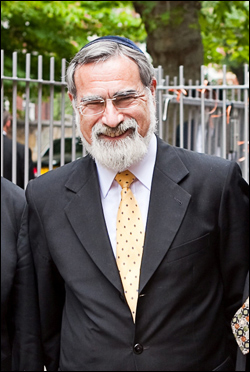
El gran Rabino Jonathan Sacks

El gran Rabino Jonathan Sacks

Hay momentos esporádicos y excepcionales en que el mundo cambia y nace una nueva posibilidad: cuando los hermanos Wright hicieron el primer vuelo humano en 1903 o cuando en 1969 Neil Armstrong se convirtió en el primer hombre en pisar la Luna, o cuando hace casi 6000 años alguien descubrió que unas marcas hechas con un palo en arcilla podían, al secarse, transformarse en signos permanentes, y así nacieron la escritura y la civilización.

Hay un momento así en esta porción semanal de la Torá, y se puede decir que ha tenido más influencia en el curso de la historia que ninguno de los hechos mencionados. Ocurre cuando Iosef finalmente revela su identidad a sus hermanos y cuando, mientras están en silencio y pasmados, dice lo siguiente:

Yo soy vuestro hermano Iosef, a quien vosotros vendisteis a Egipto. Ahora pues, no os entristezcáis ni os pese por haberme vendido aquí; pues para preservar vidas me envió Di-s delante de vosotros. Porque en estos dos años ha habido hambre en la tierra y todavía quedan otros cinco años en los cuales no habrá ni siembra ni siega. Y Di-s me envió delante de vosotros para preservaros un remanente en la tierra, y para guardaros con vida mediante una gran liberación. Ahora pues, no fuisteis vosotros los que me enviasteis aquí, sino Di-s.1

Este es el primer momento registrado en la historia en que un ser humano perdona a otro.2

Puede haber ocurrido que Di-s haya perdonado antes. Ciertamente, de acuerdo a algunas lecturas del Midrash sobre episodios anteriores, Di-s lo hizo. Pero en el sentido literal del texto, no fue así. ¿Perdonó Di-s a Adam y Javá? ¿Perdonó Di-s a Cain cuando asesinó a Ebel? Probablemente no. Puede haber atenuado el castigo. Adam y Javá no murieron inmediatamente. Di-s hace una marca en la frente de Cain para protegerlo de que otro lo mate. Pero la mitigación no es perdón.

Di-s no perdona a la generación del diluvio, o a los constructores de Babel, o a los pecadores de Sdom. Es significativo que cuando Abraham reza por el pueblo de Sdom, no le pide a Di-s que lo perdone. Su argumento es muy diferente. Dice: “quizás allí hay gente inocente”, quizás cincuenta, quizás no más de diez. Implica que su mérito debería salvar a los otros, pero eso es muy diferente de pedirle a Di-s que perdone a los demás.

Iosef perdona. Es la primera vez que eso sucede en la historia. Hay incluso un indicio en la Torá sobre la novedad de este acontecimiento. Muchos años más tarde, después de la muerte de su padre Iaacov, los hermanos se acercan a Iosef temiendo que ahora fuera a tomar venganza. Urden un cuento:

Entonces enviaron un mensaje a Iosef, que decía: «Tu padre mandó esto antes de morir: “Así diréis a Iosef: ‘Te ruego que perdones la maldad de tus hermanos y su pecado, porque ellos te trataron mal’”. Y ahora, te rogamos que perdones la maldad de los siervos del Di-s de tu padre». Y Iosef lloró cuando le hablaron.3

Los hermanos entienden la palabra “perdonar” –esta es la primera vez que aparece explícitamente en la Torá– pero aún no están seguros de ella. ¿Realmente Iosef quiso decir eso la primera vez? ¿Puede alguien realmente perdonar a otro que lo vendió a la esclavitud? Iosef llora porque sus hermanos no han entendido que de verdad lo sintió cuando lo dijo. Pero así fue, en ese momento y ahora.

¿Por qué digo que esta fue la primera vez en la historia? Por un libro fascinante escrito por un profesor estadounidense de literatura clásica, David Konstan. En Antes del Perdón: los orígenes de una idea moral (2010), sostiene que no existía el concepto de perdón en la literatura griega antigua. Hay algo diferente, que a menudo se confunde con el perdón. Hay un apaciguamiento de la ira.

Cuando alguien le hace mal a otro, la víctima se enoja y busca venganza. Esto es claramente peligroso para el perpetrador, quien puede intentar que la víctima se calme y siga adelante. Pueden tener excusas: no fui yo, fue otro. O fui yo pero no lo pude evitar. O fui yo pero fue un mal menor y te he hecho mucho bien en el pasado, así que a fin de cuentas, deberías dejarlo pasar.

Alternativamente, o junto a estas otras estrategias, el infractor puede rogar, suplicar y hacer algún ritual de degradación o humillación. Esta es una forma de decirle a la víctima: “Realmente no soy una amenaza”. La palabra griega sugnome, a veces traducida como perdón, en realidad significa exculpación o absolución, dice Konstan. No es que te perdono por lo que has hecho, sino que comprendo por qué lo has hecho –no lo pudiste evitar, estabas inmerso en circunstancias que no podías controlar– o si no, no necesito desquitarme porque por tu deferencia hacia mí ahora has demostrado que me respetas. Recobré mi dignidad.

Konstan propone que el perdón, al menos en su forma más temprana, aparece en la biblia hebrea y cita el caso de Iosef. Lo que no deja claro es por qué Iosef perdona. No hay nada accidental en su conducta. De hecho toda la secuencia de acontecimientos, desde el momento en que los hermanos aparecen frente a él en Egipto por primera vez hasta cuando anuncia su identidad y los perdona, es un relato muy detallado de lo que es ganarse el perdón.

Recuerden qué sucede. Primero los acusa de un crimen que no cometieron. Dice que son espías. Los encarcela por tres días. Luego, tomando a Shimeón como rehén, les dice que deben volver a casa y traer a su hermano menor Biniamín. Es decir, los fuerza a recrear la situación anterior cuando regresaron a lo de su padre sin uno de los hermanos, Iosef. Noten qué ocurre después.

Entonces se dijeron el uno al otro: “Verdaderamente merecemos un castigo [ashemim] en cuanto a nuestro hermano, porque vimos la angustia de su alma cuando nos rogaba, y no lo escuchamos, por eso ha venido sobre nosotros esta angustia” […] Ellos, sin embargo, no sabían que Iosef los entendía, porque había un intérprete entre él y ellos.4

Esta es la primera etapa del arrepentimiento. Admiten que han obrado mal.

Luego, después de la segunda reunión, Iosef hace poner su copa de plata especial en el saco de Biniamín. Se halla la copa y se trae de nuevo a los hermanos. Se les dice que Biniamín debe quedarse como esclavo.

“¿Qué podemos decir a mi señor? –respondió Iehudá–. ¿Qué podemos hablar y cómo nos justificaremos? Di-s ha descubierto la iniquidad de tus siervos; he aquí, somos esclavos de mi señor, tanto nosotros como aquel en cuyo poder fue encontrada la copa”.5

Esta es la segunda etapa del arrepentimiento. Confiesan. Más que eso: admiten la responsabilidad colectiva. Esto es importante. Cuando los hermanos vendieron a Iosef como esclavo fue Iehudá quien propuso el delito,6 pero todos (excepto Reubén) fueron cómplices.

Finalmente, en el clímax del relato Iehudá mismo dice “Ahora pues, te ruego que quede este tu siervo como esclavo de mi señor, en lugar del muchacho, y que el muchacho suba con sus hermanos.”7 Iehudá, quien vendió a Iosef como esclavo, ahora está dispuesto a convertirse en esclavo para que su hermano Biniamín pueda ser libre. Esto es lo que los sabios y el Rambam definen como arrepentimiento absoluto, concretamente cuando las circunstancias se repiten y uno tiene la oportunidad de cometer la misma falta otra vez pero se abstiene de hacerlo porque ha cambiado.

Ahora Iosef puede perdonar porque sus hermanos, encabezados por Iehudá, han atravesado todas las etapas del arrepentimiento: [1] admisión de culpa, [2] confesión y [3] cambio de conducta.

El perdón sólo existe en una cultura donde existe el arrepentimiento. El arrepentimiento presupone que somos agentes libres y moralmente responsables, capaces de cambiar; específicamente, el cambio que ocurre cuando reconocemos que algo que hicimos está mal y somos responsables por ello y no lo debemos hacer nunca más. La posibilidad de esa clase de transformación moral simplemente no existía en la Grecia antigua ni en ninguna otra cultura pagana. Para ponerlo en términos técnicos, Grecia era una cultura de vergüenza-y-honor. El judaísmo era una cultura de culpa-arrepentimiento-y-perdón, la primera de su clase en el mundo.

El perdón no es sólo una idea entre muchas. Transformó la situación humana. Por primera vez estableció la posibilidad de que no estamos condenados para siempre a repetir el pasado. Cuando me arrepiento demuestro que he cambiado. El futuro no está predestinado. Puedo hacer las cosas diferente de lo que podrían haber sido. Y cuando perdono muestro que mi acción no es una mera reacción, como lo sería una venganza. El perdón quiebra la irreversibilidad del pasado. Es deshacer lo que se ha hecho (como sostiene Hannah Arendt en La condición humana).

La humanidad cambió el día en que Iosef perdonó a sus hermanos. Cuando perdonamos y merecemos ser perdonados, ya no somos prisioneros de nuestro pasado.

NOTAS

1. Gén. 45: 4-8

2. N. del E.: Aunque Abraham también perdonó a Abimélej, pero eso no era el perdón que viene acompañado del verdadero arrepentimiento, como se desarrolla más adelante en este artículo.

3. Gén. 50: 16-18

4. Gén. 42: 21-23

5. Gén. 44: 16

6. Gén. 37: 26-27

7. Gén. 44: 33

Según tomado de, https://es.chabad.org/library/article_cdo/aid/3545586/jewish/El-da-en-que-naci-el-perdn.htm#utm_medium=email&utm_source=94_magazine_es&utm_campaign=es&utm_content=content

 
Leave a comment

Posted by on December 14, 2018 in Uncategorized


Judaism: Thinking Big

by Rabbi Dr. Nathan Lopes Cardozo

It is time to start thinking big about Judaism. Great opportunities are awaiting us and too much is at stake to let them pass by. For too long, Judaism has been jailed in compartmentalized and awkward boxes. It is time to liberate it.

Most religious Jews are not aware that Judaism has nearly become passé. They believe it is thriving. After all, we have more learning, more Jewish schools, yeshivot, women’s seminaries and outreach programs, and more books on this subject than ever before. Despite this, Judaism suffers from a serious malady. In truth, it is not only Judaism that suffers from this disease, but the whole world. We lack bold ideas. We have fallen in love with—and become overwhelmed by—an endless supply of all-encompassing but passive information, which does not get processed but only recycled. We can access trillions and trillions of sound bites, which expose us to every kind of information, providing us with all the knowledge we could ever dream of.

The retreat from creative thinking

The problem is that this easily accessible information has replaced creative thinking. It has expelled the possibility for big ideas; we have grown scared of them. We only tolerate and admire bold ideas when they provide us with profit-making inventions—when we feel our empty pockets—but not when they dare challenge our hollow souls. We do not discuss big ideas because they are too abstract and ethereal. Novelty is always seen as a threat. It carries with it a sense of violation; a kind of sacrilege. It asks us to think, to stretch our brains. This requires too much of an effort and doesn’t suit our most important concern: the need for instant satisfaction. We love the commonplace instead of the visionary and therefore do not produce people who have the capacity to deliver true innovation.

It is only among some very small, secular elite groups that we see staggering ideas emerging (Hawking and black holes, Aumann and game theory). In the department of Judaism, we rarely find anyone who even comes close to suggesting something new. This is all the more true within Orthodox Judaism. While in ages past, discussions within our faith could ignite fires of debate, incite revolutions and fundamentally change our views about Judaism and the world—as when the Baal Shem Tov founded Chasidism—we are now confronted with an increasingly post-idea Judaism. Provoking ideas that would boggle our minds are no longer “in.” If anything, they are condemned as heresy. Since they cannot easily be absorbed into our self-made religious boxes, and they don’t bring us the complacency we long for, we stick to the mainstream where we can dream our mediocre dreams and leave things as they are.

Most of our yeshivot have retreated from creative thinking. We encourage the narrowest specialization rather than push for daring ideas. We are producing a generation that believes its task is to tend potted plants rather than plant forests. We offer our young people prepared experiences in which we tell them what to think instead of teaching them how to think. We rob them of the capacity to learn what thinking is really all about. The plethora of halachic works, which educate them in the minutiae of the most intricate parts of Jewish law, hardly generate the inspiration of new ideas about these laws. In fact, they stand in the way. There is no time for anyone to process all the information even if they want to. But instead of seeing this as a problem, they and their teachers have turned it into a virtue.

And that is exactly the point. We are faced with two extremes: either our youth walk out on Judaism or maintain a lukewarm relationship with Jewish observance; or, they become so obsessed by its finest points that they are incapable of seeing the forest for the trees and they consequently turn into rigid religious extremists.

What we fail to realize is that this is the result of our own educational system. In both cases, young people have fallen victim to the disease of information for the sake of information.

The challenge of educating for creativity

Information is not simply to have. It is there to be converted into something much larger than itself; it is there to produce ideas that make sense of all the information gathered in order to move it forward to higher latitudes. Information is not there to be possessed but to be comprehended.

Jewish education today is, for the most part, producing a generation of religious Jews who know more and more about Jewish observance but think less and less about what it means. This is even truer of their teachers. Many of them are great Talmudic scholars, but these very scholars don’t realize that they have drowned in their vast knowledge. The more they know, the less they understand. Just as a young child may think it is an act of kindness to lift a fish out of an aquarium and “save” it, so these rabbis may be choking their students while thinking they are providing them with spiritual oxygen. Doing so, they rewrite Judaism in ways that are totally foreign to the very ideas that it truly stands for. They are embalming Judaism while claiming it is alive because it continues to maintain its external shape.

Fewer and fewer young religious people have proper knowledge of the great Jewish thinkers of the past and present. And even when they do, the ideas of these great thinkers are presented to them as information instead of as challenges to their own thinking, or as prompts to the development of their own creativity. This is a tragedy. Our current spiritual and intellectual challenges cannot be answered by simply looking backwards and giving answers that once worked but are now outdated.

Instead of new theories, hypotheses and great ideas, we get instant answers to questions of the utmost importance, offered via a wide variety of self-help books, the authors of which seem to claim that their philosophical information came directly from Sinai. Trivial, simplistic, and often incorrect information replaces significant ideas. The information is merely twittered—thus too brief and unsupported by proper arguments—yet still presented as “the answer.” By delivering “perfect” answers, which fit nicely into the often underdeveloped philosophies of their authors, everything is done to crush questioning. The quest for certainty paralyses the search for meaning. It is uncertainty that is the very stimulus impelling man to unfold his intellectual capacity.

The modern “Tower of Babel”

Outreach programs, although well intended, have become institutions that, like factories, focus on mass production and believe that the more people they can draw into Jewish observance, the more successful they are. That their methods crush the minds of many newcomers who might have made a major contribution to a new and vigorous Judaism is of no importance to them. The goal is to fit them into the existing system. That their outdated theories make other independent minds abhor Judaism is a thought they do not seem to even entertain. To them, only numbers count. How many people did we make observant?

Millions of dollars are spent to create more and more of the same type of religious Jew. Like the generation of the Tower of Babel, in which the whole world was “of one language and of one speech,” we are producing a religious Jewish community of artificial conformism in which independent thought and difference of opinion is not only condemned, but its absence is considered to be the ultimate ideal. We have created a generation of yes men. We desperately need to heed what Kierkegaard said about Christianity: “The greatest proof of Christianity’s decay is the prodigiously large number of [like-minded] Christians”.[i]

Insight has been replaced with clichés, flexibility with obstinacy, and spontaneity with habit. What was once one of the great pillars of Judaism—the esteemed value of spiritual, intellectual and moral dissent—has become anathema. Instead of teaching the art of audacity, we are now educating a generation of kowtowers. There is social ostracism of any kind of healthy rebellion against the conventional. Eliezer Berkovits was ignored when he argued that Halacha had become defensive; the master thinker Abraham Joshua Heschel is completely disregarded by Orthodoxy; Chareidi yeshivot pay no attention to Rav Kook.

Above all, we see dishonest attempts to portray fundamentalism as a genuinely open-minded intellectual position while in truth it is nothing of the sort. Great visions of the past are misused and abused. Today we are seeing many people taught that they must imitate so as to belong to the religious camp. Spiritual plagiarism has been adopted as the appropriate way of religious life and thought.

The need to be open to dissent

It is true that there are still dissidents in Judaism today—and they are growing in number. There are even some yeshivot and institutions that dissent, but the great tragedy is that these places speak in a small voice, which the religious establishment is unable to hear. Instead, the establishment puts its weight behind the insipid and the trivial, and has fallen in love with the uncompromised flatness of mainstream institutions, which yield large numbers and offer instant answers to people who find themselves in religious crisis.

Original Jewish thinkers today fall victim to the glut of conformists. While these thinkers challenge conventional views, they remain unsupported and live lonely lives because our culture writes them off. Rather than saying yes to new religious ideas, which we are in desperate need of, the conformists pander to the idol worship of intellectual and spiritual submission.

In fairness, it is not much different in the non-Jewish world. Were Socrates, Plato, Kant or Spinoza alive today, they would barely be mentioned in the media other than in some specialized philosophical journals that nobody reads. What our generation does not understand is that without these giants of the past we would still be living in a primitive world without science’s contribution of all the knowledge and luxuries that we enjoy today. Whether we agree or disagree with them, it was these thinkers who produced the great ideas that laid the foundations for much of what we have harvested through the centuries. Today they would be crowded out by massive quantities of trite sound bites that lead only to self-satisfaction.

And so it is with Judaism. Most Talmudic scholars don’t realize that the authors whose ideas they teach would turn in their graves if they knew their opinions were being taught as dogmas that cannot be challenged. They wanted their ideas tested, discussed, thought through, reformulated and even rejected, with the understanding that no final conclusions have ever been reached, could be reached or even should be reached. They realized that matters of faith should remain fluid, not static. Halacha is the practical upshot of living by unfinalized beliefs while remaining in theological suspense. Only in this way can Judaism avoid becoming paralyzed by its awe of a rigid tradition or, conversely, evaporate into a utopian reverie.

Parents today who are worried by their children’s lack of enthusiasm for Judaism do not realize that they themselves support a system that systematically makes such passion impossible.

Returning to the source of Judaism

What today’s Judaism desperately needs is verbal critics who could spread and energize its great message. It needs spiritual Einsteins, Freuds and Pasteurs who can demonstrate its untapped possibilities and undeveloped grandeur. Judaism should be challenged by new Spinozas and Nietzsches; by remorseless atheists who would scare the hell out of our rabbis, who would in turn be forced into thinking bold ideas.

The time has come to deal with the real issues and not hide behind excuses that ultimately will turn Judaism into a sham. Our thinking is behind the times, and that is something we can no longer afford. Judaism is about bold ideas. Its goal is not to find the truth, but to inspire us to honestly search for it. Torah study is not only the greatest undertaking there is, but also the most dangerous, since it can so easily lead to self-satisfaction and spiritual conceit. The leashing of our souls is easier than the building of our spirit.

What we need to do is search for Judaism as it was in its embryonic form, before it was solidified into the Halacha as we know it today. We must return to its great ideas with its many opinions, and develop them in ways that can answer the varied spiritual needs of modern man and inspire his soul.

We need to emulate Rembrandt, the great Dutch painter who, unlike all other painters of his generation, used the raw material of Holland’s landscape to perceive hidden connections—linking his preternatural sensibility to a reality that he was able to transform, with great passion, into a new creation. He found himself in a state of permanent antagonism from his society, and yet he spoke to his generation and continues to speak to us because he elevated himself to the point where he could see the full dimensions that art could address, which nobody else had discovered. Just like art, one cannot inherit faith and one cannot receive the Jewish tradition. One must fight for it and earn it. To be religious is to live in a state of warfare. The purpose of art is to disturb; not to produce finished works but to stop in the middle, from exhaustion, leaving it for others to continue. So it is with Judaism. It still has scaffolding, which I believe should remain while the building continues.

The solution: A return to classical Jewish education

Every idea within Judaism is multifaceted—filled with contradictions, opposing opinions, and unsolvable paradoxes. The greatness of the Talmudic sages was that they shared with their students their own struggles and doubts and their attempts at solving them, as when Beit Hillel and Beit Shammai debated the essential, existential question of whether man should have been created at all.[ii] Students were made privy to their teachers’ inner lives, and that made their discussions exciting. The teachers created tension in their classes, waged war with their own ideas and asked their students to fight them with knives between their teeth. They were not interested in teaching their students dogmas, but instead asked them to take them apart, to deconstruct them so as to rediscover the questions. These teachers realized that not all paradoxes can be solved, because life itself is full of paradoxes. They also realized that an answer is always a form of death, but a question opens the mind and inspires the heart.

It is true that this approach is not without risk, but there is no authentic life choice that is risk free. Nothing is worse than giving in to the indolence and callousness that stifles inquiry and leaves one drifting with the current. Such an approach shrinks Judaism’s universe to a self-centered and self-satisfying ideological ghetto, robbing it of its most essential component: the constant debate about the religious meaning of life and how to live in God’s presence and move to higher levels.

Conclusion: Building a new kind of yeshiva

I am not advocating revisionist reform-like positions, often presented just for the sake of being novel. History has shown that such approaches do not work and often lack the genuine religious experience. We should not be overanxious to encourage innovation in cases of doubtful improvement. But the time has come to rethink Jewish education as it is being taught in many traditional places. We are in need of a radically different kind of yeshiva: one in which students are challenged about their beliefs; where they are confronted with Jewish and non-Jewish thinkers’ critiques on Judaism and learn how to respond; where they become aware that it is not certainty, but doubt, that gets you an education; where it is not rabbinic authority that reigns supreme, but religious authenticity. A yeshiva where the teachers have the courage to share their doubts with their students and show them that Judaism teaches us how to live with uncertainty, and through that uncertainty to be deeply religious people. Students need to learn that Judaism, like life, is the art of drawing sufficient conclusions from insufficient premises. A reasonable probability is the only certainty we can have.

There is an urgent need to set up “Tents of Avraham” throughout the land of Israel, where religious and non-religious Jews can study, discuss and argue the great faith positions of earlier and later generations. Where they can engage in the wonder of Judaism, study its struggles, its worries, and its constant search for new understandings of itself. Where there can be honest discussion, even if it leads to considering the replacement of some components that are now seen as fundamental to Judaism. The need to break idols and slaughter sacred cows is itself a Jewish task, which none other than Avraham initiated. No doubt there will be fierce arguments, but we should never forget that great controversies are also great emancipators.

Broad change is not just window dressing, and it can be painful. It is liberating and refreshing but comes with a price. Without it, though, not only is there no future for Judaism; there is also no purpose.

We are in desperate need of bold ideas that will place the Torah in the center of our lives and make us receptive to God’s presence through a daring new encounter with Him. Let it be heroic. Not staid and comfortable, but painful and hard-won; a deep breath in the midst of the ongoing conflict ever-present in the heart of humankind.

NOTES

[i] M.M. Thulstrup’s “Kierkegaard’s Dialectic of Imitation,” in H.A. Johnson and N. Thulstrup (eds.), A Kierkegaard Critique (New York: Harper, 1962) p. 277.

[ii] Eruvin 13b.

As taken from, https://www.cardozoacademy.org/thoughts-to-ponder/judaism-thinking-big-2/?utm_source=Subscribers&utm_campaign=a8f50faea2-Weekly_Thoughts_to_Ponder_campaign_TTP_548_COPY_01&utm_medium=email&utm_term=0_dd05790c6d-a8f50faea2-242341409

 
Leave a comment

Posted by on December 13, 2018 in Uncategorized


Cristóbal Colón sí era judío confirman documentos secretos del Vaticano.

Cristóbal Colón sí era judío confirman  documentos secretos del Vaticano.

Seamos consecuentes con la historia: Colón se cambió al catolicismo por temor a la inquisición.

Por: FELIPE COIFFMAN

Según las últimas investigaciones, quedan muy pocas dudas sobre el origen judío del descubridor de las Américas. Así lo confirman documentos encontrados en la Biblioteca Real de España y que nunca antes habían estado al alcance de los historiadores. También lo confirman documentos que se conservan en los archivos secretos del Vaticano. Con ocasión del centenario del nacimiento de Einstein, también judío, el 10 de noviembre de 1979, el Papa Juan Pablo II abrió al público sus archivos. En esta memorable fecha el Papa pidió perdón al mundo por la condena que la inquisición, llamada el Santo Oficio, dio a Galileo Galilei. Su pecado fue sostener que era la tierra la que giraba alrededor del sol y no lo contrario como lo sostenía la iglesia.

La Fundación Samson Trust, sostenida por la familia que encabeza Elie Shalit, logró consultar documentos fundamentales sobre el tema. En ellos se demuestra que no fueron las joyas de la Reina Isabel de Castilla las que costearon la expedición, sino la comunidad judía. Antes de la expulsión de los judíos de España en 1492, decretada por los reyes Católicos Fernando de Aragón e Isabel de Castilla, más del 10% de la población española practicaba la religión judía. Creada la inquisición todo ser que no fuera católico solo tenía 3 caminos: o se convertía al catolicismo, o salía del país dejando todos sus bienes o moría en la hoguera. Emigraron entonces 120 mil judíos, especialmente a Portugal. Ante esta situación, Colón, que había nacido de una rica familia judía de Genova (Italia), se convirtió al catolicismo. Es sabido que influyentes judíos cristianizados abogaron ante los Reyes para que le dieran la bendición a Colón de zarpar del puerto de Palos de Moguer el 3 de Agosto de 1492. Tres naves partieron hacia el occidente con la intención de encontrar un camino más corto para llegar a la India.

Colón recibió en la Universidad de Coimbra, en Portugal, amplios conocimientos de cartografía, matemáticas y astronomía. Compartía con el sabio Toscanelli la idea de que la tierra era redonda y por tanto era factible llegar al oriente viajando al occidente. Desde antes de la era cristiana los judíos tenían alguna noción sobre la redondez de la tierra. Por esta razón, el yom kipur, el año nuevo judío, lo celebraban durante 2 días en vez de uno. Sabían que mientras a un lado de la tierra era de día, al otro lado era de noche. Curiosamente el día de la expulsión de los judíos de España, corresponde en el calendario judío, que ahora va en el año 5772, al 9 de Av, día de la destrucción del templo de Jerusalén por los romanos.

La mayoría de los 120 marineros que integraban la expedición, eran de origen judío. Huían de las persecuciones de la inquisición y buscaban otras tierras donde pudieran ejercer libremente su religión. En las anotaciones sobre el desembarco  en la isla de Guanahaní, que Colón bautizó como San Salvador, se lee que Colón habló a sus habitantes en hebreo, pensando que había encontrado una de las tribus perdidas de Israel.

Colón siempre ocultó los datos de su nacimiento y de su infancia. En las cartas que envió a los reyes de España mencionaba al rey David y a la expulsión de los judíos, asuntos que no tenían relación con su descubrimiento. Estas cartas, según estudios del departamento de grafología de la policía de Madrid, fueron escritas de derecha a izquierda tal como se escribe el hebreo. En las cartas que enviaba a su hijo siempre ponía en la parte superior de cada hoja las palabras hebreas bet hei que en hebreo significa “con la ayuda de Dios”.

El descubrimiento del nuevo mundo alentó a muchos criptojudíos a emigrar a él. En el cementerio hebreo de Curaçao, el más antiguo de América, se leen en numerosas tumbas nombres castellanizados pertenecientes a familias judías. Son comunes los terminados en guez, ez y los de nombres de santos tales como Rodríguez, Gutiérrez, González, López, Santodomingo, Santos, Sanjuán, Santamaría etc. -En un artículo que el profesor Luis López de Mesa escribió, encontró más de 300 apellidos castellanizados descendientes de familias judías españolas y portuguesas convertidas al cristianismo.

No sabemos cuántas sorpresas más nos deparará la historia sobre la infancia de Colón.

Felipe Coiffman

Prof. De Cirugía Plástica de la Universidad Nacional

Según tomado de, http://judios.org/cristobal-colon-si-era-judio-confirman-documentos-secretos-del-vaticano/

 
Leave a comment

Posted by on December 8, 2018 in Uncategorized


The Universal and the Particular

The story of Joseph is one of those rare narratives in Tanach in which a Jew (Israelite/Hebrew) comes to play a prominent part in a gentile society – the others are, most notably, the books of Esther and Daniel. I want here to explore one facet of that scenario. How does a Jew speak to a non-Jew about God?

What is particular, and what is universal, in the religious life? In its approach to this, Judaism is unique. On the one hand, the God of Abraham is, we believe, the God of everyone. We are all – Jew and non-Jew alike – made in God’s image and likeness. On the other, the religion of Abraham is not the religion of everyone. It was born in the specific covenant God made with Abraham and his descendants. We say of God in our prayers that He “chose us from all the peoples.

How does this work out in practice? When Joseph, son of Jacob, meets Pharaoh, King of Egypt, what concepts do they share, and what remains untranslatable?

The Torah answers this question deftly and subtly. When Joseph is brought from prison to interpret Pharaoh’s dreams, both men refer to God, always using the word Elokim.  The word appears seven times in the scene,[1] always in biblical narrative a significant number. The first five are spoken by Joseph: “God will give Pharaoh the answer He desires … God has revealed to Pharaoh what He is about to do … God has shown Pharaoh what He is about to do … The matter has been firmly decided by God, and God will do it soon” (Gen. 41:16-32).

The last two are uttered by Pharaoh himself, after Joseph has interpreted the dreams, stated the problem (seven years of famine), provided the solution (store up grain in the years of plenty), and advised him to appoint a “wise and discerning man” (Gen. 41:33) to oversee the project:

The plan seemed good to Pharaoh and all his officials. So Pharaoh asked them, “Can we find anyone like this man, in whom is the spirit of God?” Then Pharaoh said to Joseph, “Since God has made all this known to you, there is no one so discerning and wise as you. You shall be in charge of my palace…” (Gen. 41:37–39)

This is surprising. The Egypt of the Pharaohs was not a monotheistic culture. It was a place of many gods and goddesses – the sun, the Nile, and so on. To be sure, there was a brief period under Ikhnaton (Amenhotep IV), when the official religion was reformed in the direction of monolatry (worship of one god without disputing the existence of others). But this was short-lived, and certainly not at the time of Joseph. The entire biblical portrayal of Egypt is predicated on their belief in many gods, against whom God “executed judgement” at the time of the plagues. Why then does Joseph take it for granted that Pharaoh will understand his reference to God – an assumption proved correct when Pharaoh twice uses the word himself? What is the significance of the word Elokim?

The Hebrew Bible has two primary ways of referring to God, the four-letter name we allude to as Hashem (“the name” par excellence) and the word Elokim.  The sages understood the difference in terms of the distinction between God-as-justice (Elokim) and God-as-mercy (Hashem). However, the philosopher-poet of the eleventh century, Judah HaLevi, proposed a quite different distinction, based not on ethical attributes but on modes of relationship[2] – a view revived in the twentieth century by Martin Buber in his distinction between I-It and I-Thou.

HaLevi’s view was this: the ancients worshipped forces of nature, which they personified as gods. Each was known as El, or Eloah. The word “El” therefore generically means “a force, a power, of nature.” The fundamental difference between those cultures and Judaism, was that Judaism believed that the forces of nature were not independent and autonomous. They represented a single totality, one creative will, the Author of being. The Torah therefore speaks of Elokim in the plural, meaning, “the sum of all forces, the totality of all powers.” In today’s language, we might say that Elokim is God as He is disclosed by science: the Big Bang, the various forces that give the universe its configuration, and the genetic code that shapes life from the simplest bacterium to Homo sapiens.

Hashem is a word of different kind. It is, according to HaLevi, God’s proper name. Just as “the first patriarch” (a generic description) was called Abraham (a name), and “the leader who led the Israelites out of Egypt” (another description) was called Moses, so “the Author of being” (Elokim) has a proper name, Hashem.

The difference between proper names and generic descriptions is fundamental. Things have descriptions, but only people have proper names. When we call someone by name we are engaged in a fundamental existential encounter. We are relating to them in their uniqueness and ours. We are opening up ourselves to them and inviting them to open themselves up to us. We are, in Kant’s famous distinction, regarding them as ends, not means, as centres of value in themselves, not potential tools to the satisfaction of our desires.

The word Hashem represents a revolution in the religious life of humankind. It means that we relate to the totality of being, not as does a scientist seeing it as something to be understood and controlled, but as does a poet standing before it in reverence and awe, addressing and being addressed by it.

Elokim is God as we encounter Him in nature. Hashem is God as we encounter Him in personal relationships, above all in speech, conversation, dialogue, words. Elokim is God as He is found in creation. Hashem is God as He is disclosed in revelation.

Hence the tension in Judaism between the universal and the particular. God as we encounter Him in creation is universal. God as we hear Him in revelation is particular. This is mirrored in the way the Genesis story develops. It begins with characters and events whose significance is that they are universal archetypes: Adam and Eve, Cain and Abel, Noah and the Flood, the builders of Babel. Their stories are about the human condition as such: obedience and rebellion, faith and fratricide, hubris and nemesis, technology and violence, the order God makes and the chaos we create. Not until the twelfth chapter of Genesis does the Torah turn to the particular, to one family, that of Abraham and Sarah, and the covenant God enters into with them and their descendants.

This duality is why Genesis speaks of two covenants, the first with Noah and all humanity after the Flood, the second with Abraham and his descendants, later given more detailed shape at Mount Sinai in the days of Moses. The Noahide covenant is universal, with its seven basic moral commands. These are the minimal requirements of humanity as such, the foundations of any decent society. The other is the richly detailed code of 613 commandments that form Israel’s unique constitution as “a kingdom of priests and a holy nation” (Exodus 19:6).

So there are the universals of Judaism – creation, humanity as God’s image, and the covenant with Noah. There are also its particularities – revelation, Israel as God’s “firstborn child,” and the covenants with Abraham and the Jewish people at Sinai. The first represents the face of God accessible to all humankind; the second, that special, intimate and personal relationship He has with the people He holds close, as disclosed in the Torah (revelation) and Jewish history (redemption). The word for the first is Elokim, and for the second, Hashem.

We can now understand that Genesis works on the assumption that one aspect of God, Elokim, is intelligible to all human beings, regardless of whether they belong to the family of Abraham or not. So, for example, Elokim comes in a vision to Avimelekh, King of Gerar, despite the fact that he is a pagan. The Hittites call Abraham “a prince of God [Elokim] in our midst.” Jacob, in his conversations with Laban and later with Esau uses the term Elokim. When he returns to the land of Canaan, the Torah says that “the terror of God [Elokim]” fell on the surrounding towns. All these cases refer to individuals or groups who are outside the Abrahamic covenant. Yet the Torah has no hesitation in ascribing to them the language of Elokim.

That is why Joseph is able to assume that Egyptians will understand the idea of Elokim, even though they are wholly unfamiliar with the idea of Hashem. This is made clear in two pointed contrasts. The first occurs in Genesis 39, Joseph’s experience in the house of Potiphar. The chapter consistently and repeatedly uses the word Hashem in relation to Joseph (“Hashem was with Joseph… Hashem gave him success in everything he did” [Gen. 39:2, 5]), but when Joseph speaks to Potiphar’s wife, who is attempting to seduce him, he says, “How then could I do such a wicked thing and sin against Elokim” (Gen. 30:9).

The second is in the contrast between the Pharaoh who speaks to Joseph and twice uses the word Elokim, and the Pharaoh of Moses’ day, who says, “Who is Hashem that I should obey Him and let Israel go? I do not know Hashem and I will not let Israel go” (Exodus 5:2). An Egyptian can understand Elokim, the God of nature. He cannot understand Hashem, the God of personal relationship.

Judaism was and remains unique in its combination of universalism and particularism. We believe that God is the God of all humanity. He created all. He is accessible to all. He cares for all. He has made a covenant with all.

Yet there is also a relationship with God that is unique to the Jewish people. It alone has placed its national life under His direct sovereignty. It alone has risked its very existence on a divine covenant. It testifies in its history to the presence within it of a Presence beyond history.

As we search in the twenty-first century for a way to avoid a “clash of civilisations,” humanity can learn much from this ancient and still compelling way of understanding the human condition. We are all “the image and likeness” of God. There are universal principles of human dignity. They are expressed in the Noahide covenant, in human wisdom (ĥokhma), and in that aspect of the One God we call Elokim. There is a global covenant of human solidarity.

But each civilisation is also unique. We do not presume to judge them, except insofar as they succeed or fail in honouring the basic, universal principles of human dignity and justice. We as Jews rest secure in our relationship with God, the God who has revealed Himself to us in the intimacy and particularity of love, whom we call Hashem.

The challenge of an era of conflicting civilisations is best met by following the example of Abraham, Sarah and their children, as exemplified in Joseph’s contribution to the economy and politics of Egypt, saving it and the region from famine. To be a Jew is to be true to our faith while being a blessing to others regardless of their faith. That is a formula for peace and graciousness in an age badly in need of both.

NOTES

1] The word appears nine times in Genesis 41, the last two in the later episode in which Joseph gives names to his two sons.
2] Judah HaLevi, Kuzari, book 1v, para. 1.

by Rabbi Lord Jonathan Sacks

As taken from, http://rabbisacks.org/universal-particular-mikketz-5779/


Leave a comment

Posted by on December 8, 2018 in Uncategorized


The Pain of Being a Tzaddik

ויוסף הוא השליט על הארץ הוא המשביר לכל עם הארץ…

Now Yosef was the ruler over the land; it was he who sold grain to the entire populace of the land…

Bereshit 42:6

When looking at the lives of the Avot, the three forefathers of the People of Israel, it is remarkable to note that not one of them was officially called a tzaddik (righteous man) by the Talmudic and midrashic Sages. Only Ya’akov’s son Yosef was granted that title.[1] This is rather strange, since it cannot be denied that Avraham, Yitzchak and Ya’akov were also outstandingly pious people.

It may be that the reason for this special honor is because, paradoxically, Yosef did not at all appear to be a tzaddik. If anything, the reverse might have been more accurate.

There can be little doubt that during Yosef’s reign in Egypt, he must have been seen as a ruthless person who didn’t hesitate to make the lives of his fellow people unbearable, particularly those of his brothers and father. We should not overlook the fact that the Torah and commentaries offer readers a huge advantage, telling them the whole story in just a few chapters, so they have no time to resent Yosef before discovering his righteousness at the end of the story! This privilege, however, was not granted to any of the people with whom Yosef actually spent a good part of his life.

Yosef’s life is the epitome of complicated human existence in the extreme. It is a life in which human conditions are far from ideal. There are no black-and-white choices in which it is easy to take a stand and where the good guys and bad guys are clearly identified. Every choice includes a complex mixture of good and bad. Even with the best intentions, people sometimes cannot help hurting those they really love the most and doing favors for those who are corrupt.

Population Transfer

Reading the story, one wonders what must have gone through Yosef’s mind and heart when he took a tough stand against the people of Egypt by buying up everything they owned until he left the entire population with no personal possessions and enslaved to Pharaoh. The text also clearly indicates that he uprooted everyone from their homes, and all of them became refugees in their own country.[2] This was nothing less than mass population transfer and dispersal, one of the worst human experiences. Commentators explain that this was the only way he was able to save the country from even greater disasters and, in fact, the only way to revive the economy.[3] Still, it must have greatly distressed him to bring about such upheaval in the nation. Few must have understood what he did, and millions must have cursed him for making their lives miserable.

Yosef’s behavior toward his father and brothers must have caused him sleepless nights, year after year. While ruling the Land of Egypt, he never told his father that he was still alive. His own life must have been unbearable every time he thought of his suffering father. How can I endure one more day knowing that my father is in constant anguish because of me?

His terribly strong stand against his brothers, when they came to Egypt to buy food, must have given him nightmares and caused him depression as well. What will my brothers and all the servants in the palace think of me? No doubt, in their eyes I must seem like a cruel despot looking for sadistic ways to hurt people whenever possible. What are they thinking of me as I am imprisoning Shimon and forcing my brothers to bring Binyamin to Egypt?

Still, as many commentators explain, he had no option but to do what he did. In fact, it was his deep devotion and his concern for them that motivated him.[4]

Revealing True Motivation?

Surely he must have dreamed of the day when he would be able to reveal to them the true motivation behind his harsh actions.

But, as the Torah clearly reveals, even this Yosef was not granted. His father never knew what his real motives were, and his brothers clearly showed after the death of their father that they suspected Yosef would take revenge on them.[5] How painful it must have been for Yosef when he realized that even in his old age he could not tell anybody why he did what he did without revealing what his brothers had in fact done to him. And that was not an option for him.

He was convinced that he would go to his grave considered by millions to have been a merciless leader. The fact that he saved the economy of the Egyptian people would make little difference in the eyes of all who would never comprehend why he needed to achieve that goal through the harsh measures he took. Their expression of gratitude[6] may well have been the kind of forced courtesy often given to a dictator.

What a relief it would have been for him had he known that hundreds of years later the Torah and its commentators would reveal the entire story and prove his righteous intentions! Still, one wonders whether he would have even agreed that God include this story in the Torah, giving his brothers a bad name!

The Tzaddik’s Tragedy

This, indeed, is the tragedy of practically every tzaddik. Tzaddikim are, for the most part, people who are unable to reveal their true intentions and righteousness. Often they must work under the most agonizing circumstances, sometimes hurting people when it is the only way to prevent an even greater tragedy. This is the reason why they cannot always be “nice guys” and “well-mannered people.”

Tzaddikim hold to a higher purpose; they cannot allow themselves to sway with the winds. The saying “When you stand for nothing you fall for everything” applies to them. But standing for something may very well give one a bad name, no matter how noble the intentions. One can only hope that perhaps someday people will discover what they were really all about and how painful it was to be a “hidden tzaddik.” Unfortunately, there is usually little chance of that happening. After all, who is as privileged as Yosef to have his or her real story written in an eternal book?

This is the reason why the title “tzaddik” was bestowed upon Yosef in particular. While it is true that his father, grandfather and great-grandfather were illustrious people, the sages realized that only Yosef had to do so much that he detested doing, so as to become a real tzaddik. In fact, the Midrash makes it abundantly clear that it was the tough measures he took that earned him the title “tzaddik.”[7]

To be righteous, with the full awareness that nobody will ever know the real story, and to have one’s deeds condemned, is one of the most painful human experiences and is a great tragedy. Only the knowledge that the One Above knows the real story, and the conviction that it is more important that others benefit from one’s deeds than to be assured of the recognition of one’s real intentions, gives the ultimate feeling of spiritual satisfaction for which the tzaddik strives.

Notes:[1] See Midrash Tanchuma, Buber ed., Noach 4.
[2] Bereshit 47.
[3] See Sigmund A. Wagner-Tsukamoto, “The Genesis of Economic Cooperation in the Stories of Joseph: A Constitutional and Institutional Economic Reconstruction,” Scandinavian Journal of the Old Testament 29, no. 1 (2015):  33-54.
[4] See, for example, the commentaries of Ramban and Rabbi Samson Raphael Hirsch on this chapter.
[5] Bereshit 50:15.
[6] Ibid., 47:25.
[7] See Midrash Tanchuma, Buber ed., Noach 4.

by Rabbi Nathan Lopes Cardozo
As taken from, https://www.cardozoacademy.org/thoughts-to-ponder/parashat-miketz-the-pain-of-being-a-tzaddik/?utm_source=Subscribers&utm_campaign=44b4aba753-Weekly_Thoughts_to_Ponder_campaign_TTP_548_COPY_01&utm_medium=email&utm_term=0_dd05790c6d-44b4aba753-242341409

 
Leave a comment

Posted by on December 8, 2018 in Uncategorized


The conventions of Biblical Gematria

Yesterday I called the biblical art of gematria ‘sophisticated’, and today I’d like to elaborate a little upon that theme.

You’ll all be familiar with the concept of written grammar, but have you ever paid mind to numerical grammar?  It is by convention to numerical grammar that we structure our mathematical calculations the way that we do.  For instance, understanding the sum [ 220 / 7 = 31.428571r ] requires us to know which elements of the sum are arranged where and for what reason.  And before we do any calculation we also need to be familiar with the signs for math functions (like +, -, *, /, $, %, !) .  Therefore, because we require knowledge of the conventions, we need some degree of formal education in order to do math, and the same is true for biblical gematria.  There are numerical conventions for biblical gematria; it has a type of numerical grammar.

A student who is learning biblical gematria needs to develop an eye for the text they are working with.  They should try to see the cues, the math functions, the indicators, the logic of the calculation, the results, and finally ~ the sum in context with the other gematria calculations in the text.

Most indicators have a logical relationship with their mathematical function, for instance:“et” = add, “not” = disregard, “on the head” = the first syllable of a word, “bruise” = put two words together, “the heel” = the end syllable of a word.  So we’re going to be taking you on a bit of a whirlwind tour around the Torah, to alight on some of the common conventions of biblical gematria.  As promised, today we’re going to look at an unusual bit of gematria in the story of Ephraim and Manasseh; Genesis 48:14.

This calculation has something of the feel of a cryptic crossword clue about it.  When we read it we should be looking for logical relationships between the words in the sentence:

וישלח ישראל את־ימינו וישת על־ראש אפרים והוא הצעיר ואת־שמאלו ‏על־ראש מנשה שכל את־ידיו כי מנשה הבכור

“But Israel stretched out his right hand and laid it on the head of Ephraim, who was the younger, and his left hand on Manasseh’s head, crossing his hands, although Manasseh was the firstborn.”

The value of the names are exactly the same, until just ‘the head’ of the names are considered;

מְנַשֶּׁ֖ה הַבְּכֽוֹר ‘Manasseh the firstborn’ = 331
 אֶפְרַ֙יִם֙ ‘Ephraim’ = 331

Israel is touching both Ephraim and Manasseh which indicates the sum of the three names are to be added, but the text specifies that he is only touching them  עַל רֹ֤אש “on the head” which by convention means we should add ‎‎‘the head’ or first parts from each name, therefore we take the Peh and Aleph from Ephraim and the Mem from Manasseh:

יִשְׂרָאֵ֨ל‎ ‘Israel’ (244) + (‎‏(81) אֶפְ‎ of  ‎‏(אֶפְרַ֙יִם֙‎ + (‎‏ (40) מְof ‎מְנַשֶּׁ֑ה‎) = 365 (days).

And now we may ask ourselves “Why is the number of days in a year relevant to the story of Manasseh and Ephraim?”   Much of the gematria in Genesis concerns the Solar and Lunar cycles, and we see the number 365 appearing many times in Genesis as the text discusses the cycles of the solar year.  It’s first seen in Genesis 1:2-3;

365 = פְּנֵ֣י תְה֑וֹם – וְחֹ֖שֶׁךְ + אֽוֹר
“The Face of the Deep” – “and darkness” + “light” = 365

We see 365 again in Genesis 3:3;

ומפרי העץ אשר בתוך ־ הגן
“And the fruit of the tree which in the middle of the garden.

[In my experience of the calculating art, typically the use of the words such as בְּתוֹךְ ‘middle’ or ‘’between’ denotes the function of division by 2 of the following noun, which in this case is הגן ‘garden’ 58. Therefore: 58 / 2 = 29 and when we add this to ומפרי ‘and the fruit’ 336 results in 365 (days in a year).]

365 is central to the story of Jacob and Esau [Genesis 25:27];

עֵשָׂ֗ו + צַ֖יִד + יַעֲקֹב֙

Esau 79 + hunter 104 + Jacob 182 = 365

This story in particular has strong typological similarities to the 3rd millennium BCE Sumerian text The Debate between Winter and Summer.

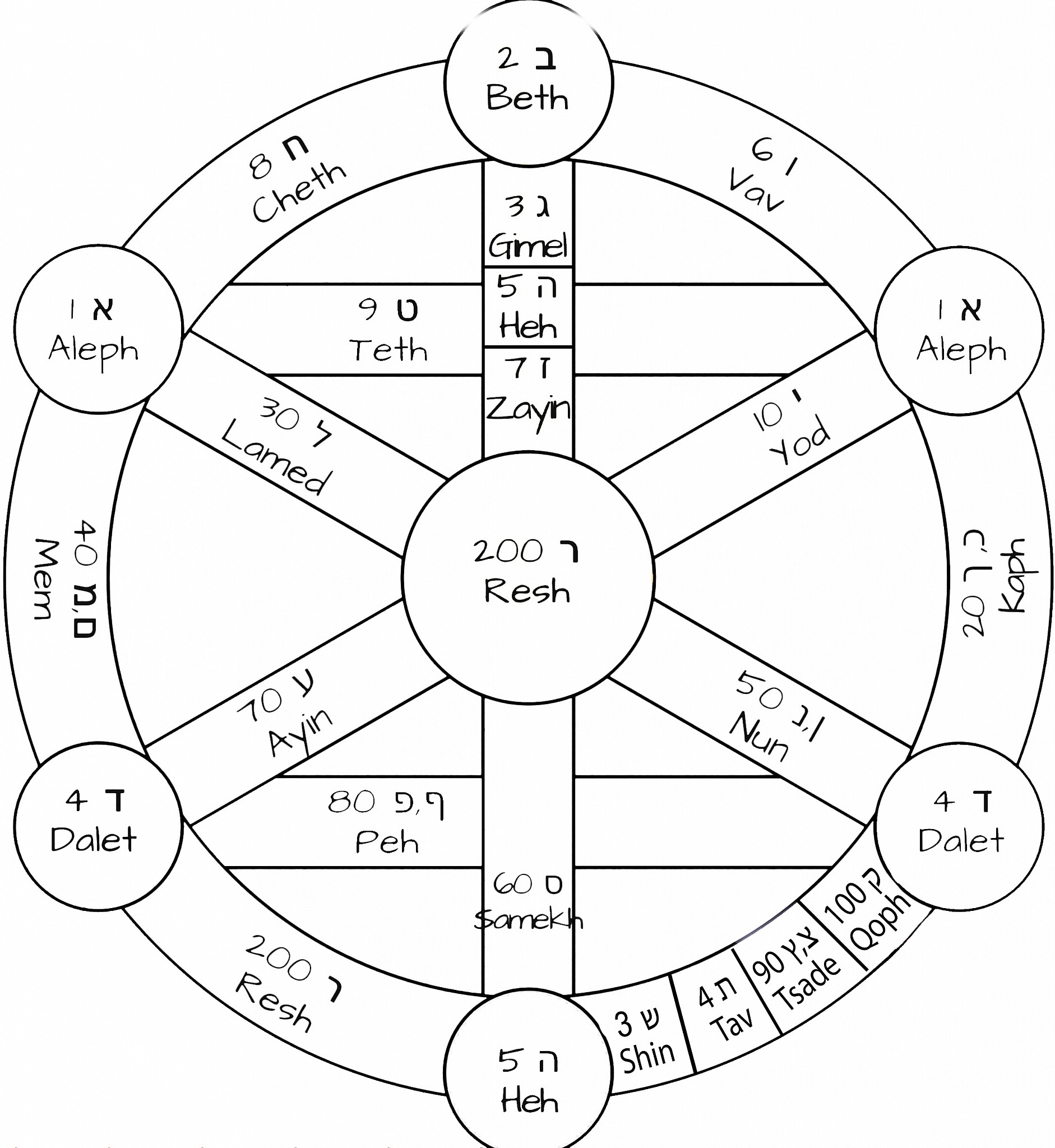
365 is a significant number to the Seven Palaces.  When the sum of the middle column is calculated (282 if we do not ‎use gates) and then removed from the total number (1012 ‎for the entire wheel) this leaves 730 and also splits the ‎wheel into two sections.

730 = 365 days + 365 nights.

When the letters Yod and Ayin are doubled on their paths we find the total sum from the Palace of the Aleph to the Palace of the Daleth is 365;

Aleph (1) + (Yod x 2 (20)) + Resh (200) + (Ayin x 2 (140) + Daleth (4) = 365.

And we also find the same calculation with the opposite diagonal;

Aleph (1) + (Lamed x 2 (60)) + Resh (200) + (Nun x 2 (100) + Daleth (4) = 365.

Lastly, the Talmud Yerushalmi Tractate Rosh Hashanah ‎‎2:5 says:

”The Holy One blessed be He created 365 windows that the world might use them:  182 in the east, and 182 in the west and one in the center of the firmament from which it came forth at the beginning of the Creation.”

That’s it for today.  Continuing on tomorrow I’ll be discussing how the ancients thought about light, as well looking into the story of the expulsion of Adam and Eve from the Garden of Eden.  So stay tuned for more numerical honey.

by
Bethsheba Ashe

As taken from, https://blogs.timesofisrael.com/the-conventions-of-biblical-gematria/

 
Leave a comment

Posted by on December 1, 2018 in Uncategorized


Divine Emanations, Chanuka and the Future of the State of Israel

by Rabbi Dr. Nathan Lopes Cardozo

History, the study of cause and effect in the annals of humankind, has been a serious challenge for honest historians. In many ways, interpreting history is conjecture. It is more what one would like to believe happened than what actually occurred which motivates many a historian (Benjamin Franklin).  After all, how can any historian ever know what really was the cause and effect in a specific instance? Sometimes, what we believe to be the cause is, rather, the effect.

Our sages draw our attention to this phenomenon when they deal with the sale of Joseph and his emancipation from prison. Referring to the words, “A definite period was set to the world to spend in darkness” (Iyov 28:3), the Midrash states: “A definite number of years was fixed for Joseph to spend in prison, in darkness. When the appointed time came: “And it came to pass at the end of two years and Pharaoh dreamed a dream…’” (Bereshit 41:1, Midrash Rabbah)

Rabbi Gedalyah Schorr, in his monumental work, Ohr Gedalyah, points out that this observation radically differs from the traditional, academic way of dealing with historical events.

Reading the story in the traditional way, we would no doubt conclude that because Pharaoh dreamed a dream which required an interpretation, Joseph, known to be a man with prophetic insights into dream interpretation, was asked to come and see Pharaoh. After having successfully solved the dreams, he was not only freed but elevated to the position of second-in-command of Egypt. This would mean that Pharaoh’s dream caused Joseph’s freedom.

A careful reading of our Midrash, however, suggests the reverse. It was because Joseph had to be freed and become the viceroy of Egypt that Pharaoh had to have a dream. The cause was, in fact, the effect.

As mentioned before, this approach opens a completely new way of understanding history. Judaism suggests that at certain times God sends emanations to this world so as to awaken human beings to act, just as Pharaoh received his dreams in order that Joseph’s imprisonment would come to an end.

A later example of this is the story of Chanukah. The Jews knew that logically there was no chance of a successful uprising against the Greeks, but God created a notion of revolt within the minds of the Maccabees. The greatness of these few Jews was manifest in their correct reaction to this heavenly directive. They realized what needed to be done, however preposterous.

Midrashic literature often compares the Greek empire to “darkness which blinded the eyes of the Jews” (“Choshech ze Yavan“,  “Darkness that is Greece”). The traditional interpretation is that Jews in the Maccabean period were blinded by the Greeks’ worship of the body and followed their example.

It may, however, have a much deeper meaning. The Greeks were also the inventors of historical interpretation. Greek thinkers were among the first to try and understand history in its more scientific form as reflected in the need to search for cause and effect. From the point of view of the Midrash, this approach blinded the Jews from sometimes reading history as divine emanations and the human response to them. It misconstrued the deeper meaning of history, reversed cause and effect, and darkened the clear insight of the Jews.

One of the most mysterious aspects of the human psyche is the dimension of motivation and taste. Human beings suddenly hear an inner voice or feel a mysterious pull to do something the source of which they do not understand. This is true not only regarding human actions but even taste and preference. History is replete with examples of human beings radically changing their taste in art and music. Melodies are considered to be superb and irreplaceable; then, half a century later, they lose favor. So it is with art, fashion and even the color of our wallpaper.

There are no rational explanations for these phenomena (notwithstanding various scientific suggestions). We would argue that all of them are the result of divine emanations communicated to our world. While it is difficult to explain why these divine messages come, perhaps their main purpose, particularly regarding music and art, is to offer man a feeling of renewal and an insight into the infinite possibilities of God’s creation. Some messages may be a divine response to human beings’ earlier deeds or moral condition. The sudden predilections for more aggressive forms of music or art may be a warning that man has abated his earlier dignity.

In the case of emanations, as with the Maccabees, the main challenge is in “hearing” the message, correctly interpreting it and subsequently knowing what it demands of us. This itself requires divine assistance and moral integrity and is not available to all. (In fact, it can be dangerous.)

Throughout history, Jews have experienced many divine emanations.  Several of them, cited in the latter part of Tanach, allude to the coming of the Mashiach at specific times. (See, for example, the book of Daniel.) Some of these dates are long behind us and Mashiach has not appeared.  This should not surprise us. Dates of Mashiach’s arrival, as cited in Jewish sources, were in no way final statements. They were divine signals that at these times the world would be more conducive to the coming of Mashiach, but they were not guarantees of his arrival. When humankind failed to respond in the appropriate religious and moral manner, the special moment passed with no outcome.

It is easy to recognize in this day and age that we, too, are confronted with new and powerful happenings which may be emanations from above. One cannot deny the unique events which have transpired in Israel over the last seventy years. Many of them, the good ones as well as the dire ones are difficult to explain by the conventional standards of historical interpretations.  Perhaps it may behoove us to view much what is happening today in Israel as a divine message that there is need for a radical change of heart regarding our identity, our Jewish connection, the moral quality of our society and Judaism at large. It may be worthwhile to contemplate this possibility and act accordingly.

Chanukah sameach!

As taken from, https://www.cardozoacademy.org/thoughts-to-ponder/parashat-vayeshev-divine-emanations-chanuka-and-the-future-of-the-state-of-israel/?utm_source=Subscribers&utm_campaign=0dfc7e6fca-Weekly_Thoughts_to_Ponder_campaign_TTP_548_COPY_01&utm_medium=email&utm_term=0_dd05790c6d-0dfc7e6fca-242341409

 
Leave a comment

Posted by on November 29, 2018 in Uncategorized


Refusing Comfort, Keeping Hope

by Rabbi Lord Jonathan Sacks

The deception has taken place. Joseph has been sold into slavery. His brothers dipped his coat in blood. They bring it back to their father, saying: “Look what we have found. Do you recognise it? Is this your son’s robe or not?” Jacob recognises it and replies, “It is my son’s robe. A wild beast has devoured him. Joseph has been torn to pieces.” We then read:

Jacob rent his clothes, put on sackcloth, and mourned his son for a long time. His sons and daughters tried to comfort him, but he refused to be comforted. He said, “I will go down to the grave mourning for my son.” (Gen. 37:34–35)

There are laws in Judaism about the limits of grief – shivasheloshim, a year. There is no such thing as a bereavement for which grief is endless. The Talmud says that God admonishes one who weeps beyond the appointed time, “You are not more compassionate than I.”1 And yet Jacob refuses to be comforted.

A Midrash gives a remarkable explanation. “One can be comforted for one who is dead, but not for one who is still living,” it says. In other words, Jacob refused to be comforted because he had not yet given up hope that Joseph was still alive. That, tragically, is the fate of those who have lost members of their family (the parents of soldiers missing in action, for example), but have as yet no proof that they are dead. They cannot go through the normal stages of mourning because they cannot abandon the possibility that the missing person is still capable of being rescued. Their continuing anguish is a form of loyalty; to give up, to mourn, to be reconciled to loss is a kind of betrayal. In such cases, grief lacks closure. To refuse to be comforted is to refuse to give up hope.

Yet on what basis did Jacob continue to hope? Surely he had recognised Joseph’s blood-stained coat – he said explicitly, “A wild beast has devoured him. Joseph has been torn to pieces.” Do these words not mean that he had accepted that Joseph was dead?

The late David Daube made a suggestion that I find convincing.2 The words the sons say to Jacob – haker na, literally “identify please” – have a quasi-legal connotation. Daube relates this passage to another, with which it has close linguistic parallels:

If a man gives a donkey, an ox, a sheep or any other animal to his neighbour for safekeeping and it dies or is injured or is taken away while no one is looking, the issue between them will be settled by the taking of an oath before the Lord that the neighbour did not lay hands on the other person’s property…If it [the animal] was torn to pieces by a wild animal, he shall bring the remains as evidence and he will not be required to pay for the torn animal. (Exodus 22:10–13)

The issue at stake is the extent of responsibility borne by a guardian (shomer). If the animal is lost through negligence, the guardian is at fault and must make good the loss. If there is no negligence, merely force majeure, an unavoidable, unforeseeable accident, the guardian is exempt from blame. One such case is where the loss has been caused by a wild animal. The wording in the law – tarof yitaref, “torn to pieces” – exactly parallels Jacob’s judgment in the case of Joseph: tarof toraf Yosef, “Joseph has been torn to pieces.”

We know that some such law existed prior to the giving of the Torah. Jacob himself says to Laban, whose flocks and herds had been placed in his charge, “I did not bring you animals torn by wild beasts; I bore the loss myself ” (Gen. 31:39). This implies that guardians even then were exempt from responsibility for the damage caused by wild animals. We also know that an elder brother carried a similar responsibility for the fate of a younger brother placed in his charge, as, for example, when the two were alone together. That is the significance of Cain’s denial when confronted by God as to the fate of Abel: “Am I my brother’s guardian [shomer]?” (Gen. 4:9).

We now understand a series of nuances in the encounter between Jacob and his sons upon their return without Joseph. Normally they would be held responsible for their younger brother’s disappearance. To avoid this, as in the case of later biblical law, they “bring the remains as evidence.” If those remains show signs of an attack by a wild animal, they must – by virtue of the law then operative – be held innocent. Their request to Jacob, haker na, must be construed as a legal request, meaning, “Examine the evidence.” Jacob has no alternative but to do so, and by virtue of what he has seen, to acquit them. A judge, however, may be forced to acquit someone accused of a crime because the evidence is insufficient to justify a conviction, while still retaining lingering private doubts. So Jacob was forced to find his sons innocent, without necessarily trusting what they said. In fact Jacob did not believe it, and his refusal to be comforted shows that he was unconvinced. He continued to hope that Joseph was still alive. That hope was eventually justified: Joseph was still alive, and father and son were ultimately reunited.

The refusal to be comforted sounded more than once in Jewish history. The prophet Jeremiah heard it in a later age:

This is what the Lord says:

“A voice is heard in Ramah,

Mourning and great weeping,

Rachel weeping for her children

Refusing to be comforted,

Because her children are no more.”

This is what the Lord says:

“Restrain your voice from weeping,

And your eyes from tears,

For your work will be rewarded,” says the Lord.

“They will return from the land of the enemy.

So there is hope for your future,” declares the Lord,

“Your children will return to their own land.”

(Jeremiah 31:15–17)

Why was Jeremiah sure that Jews would return? Because they refused to be comforted – meaning, they refused to give up hope.

So it was during the Babylonian exile, as articulated in one of the most paradigmatic expressions of the refusal to be comforted:

By the rivers of Babylon we sat and wept,

As we remembered Zion…

How can we sing the songs of the Lord in a strange land?

If I forget you, O Jerusalem,

May my right hand forget [its skill],

May my tongue cling to the roof of my mouth

If I do not remember you,

If I do not consider Jerusalem above my highest joy.

(Psalms 137:1–6)

It is said that Napoleon, passing a synagogue on the fast day of Tisha B’Av, heard the sounds of lamentation. “What are the Jews crying for?” he asked one of his officers. “For Jerusalem,” the soldier replied. “How long ago did they lose it?” “More than 1,700 hundred years.” “A people who can mourn for Jerusalem so long, will one day have it restored to them,” the Emperor is reputed to have replied.

Jews are the people who refused to be comforted because they never gave up hope. Jacob did eventually see Joseph again. Rachel’s children did return to the land. Jerusalem is once again the Jewish home. All the evidence may suggest otherwise: it may seem to signify irretrievable loss, a decree of history that cannot be overturned, a fate that must be accepted. Jews never believed the evidence because they had something else to set against it – a faith, a trust, an unbreakable hope that proved stronger than historical inevitability. It is not too much to say that Jewish survival was sustained in that hope. And that hope came from a simple – or perhaps not so simple – phrase in the life of Jacob. He refused to be comforted. And so – while we live in a world still scarred by violence, poverty and injustice – must we.

Shabbat shalom


1] Moed Katan 27b.

2] David Daube, Studies in Biblical Law (Cambridge: University Press, 1947).

As taken from, http://rabbisacks.org/refusing-comfort-keeping-hope-vayeshev-5779/

 
Leave a comment

Posted by on November 28, 2018 in Uncategorized