
RSS

Monthly Archives: October 2020

The Jewish Rainbow Connection

Rainbow Meaning: On Colors and Memes | Answers in Genesis

What’s the meaning behind the sign in the sky that God gives Noah?

BY RABBI NOAH ARNOW

One afternoon, a few years ago, I looked out my office window and saw a rainbow.  I told our synagogue’s education director, and at her wise suggestion we gathered the Hebrew school kids to see and recite the blessing over it. (Blessed are You, Lord our God, Ruler of the Universe, who remembers the covenant, and is faithful to God’s covenant, and keeps God’s promise.) It was one of those perfect spontaneous educational moments that I’ll always remember.

And remembering is really what a rainbow is about, at least for God. After the flood, God establishes a covenant with Noah and sets the rainbow as a sign of this covenant “between Me and the earth” (Gen. 9:13), says God:

When I bring clouds over the earth, and the bow appears in the clouds, I will remember my covenant between Me and you and every living creature among all flesh, so that the waters shall never again become a flood to destroy all flesh. (Gen. 9:14-15)

The rainbow, it seems, is a way for God to remember about the covenant not to destroy the earth. God, we suspect, will get angry at us humans, every so often, and perhaps desire to destroy the world again, but the rainbow is a reminder of God’s promise not to.

But why is a rainbow the symbol of this covenant? And what should it mean to us?

A rainbow is not just a rainbow, according to Rabbi Joseph Bechor Shor (12th-century France). Rather, it’s God showing God’s self. This is based on a verse from Ezekiel comparing God’s presence to a rainbow:

Like the appearance of the bow which shines in the clouds on a day of rain… was the appearance of the semblance of the Presence of the Lord. (Ezekiel 1:28)

We can assume God wouldn’t show God’s self if God intended to destroy the world, so us seeing a rainbow—the presence of God—is indeed a good sign!

Actually, some say the rainbow itself isn’t the symbol, but rather, it’s the fact that the rainbow is seen in the clouds. Originally, suggests Rabbi Isaac Caro (a 15th-16th-century Sephardic scholar and uncle of Shulchan Aruch author Joseph Caro), rainbows couldn’t be seen from earth because they were obscured by thick clouds —and it was these heavy, thick clouds that produced the flood rains. But after the flood, Caro posits, God thinned out the clouds, rendering them incapable of producing floods of this magnitude, and allowing rainbows to be seen. So, the symbol is not only the rainbow and our ability to see it, but the clouds too.

In another interpretation of the rainbow’s significance, Nahmanides (13th-century Spain) suggests it is a bow (as in a bow and arrow) that is no longer aimed at the earth. The flood was God taking aim at the earth, but the bow is now pointing away from earth, and it no longer has a string or  arrows. Displaying this disabled weapon, is sort of like a ceasefire — holding your weapon pointing towards yourself, away from your initial target. In this sense, a rainbow is about God setting aside God’s anger and making peace with us.

Other Jewish scholars have seen the rainbow as a different kind of peace symbol. One medieval commentator saw a rainbow as a combination of fire and water, coexisting in perfect peace in the natural world.

A more modern approach from Rabbi Samson Raphael Hirsch (19th-century Germany) suggests that each of the different colors of the rainbow represents a different kind of person. In this reading, red, the outermost ring of the rainbow, is closest to the heavens and related to Adam — the person who was created most directly and immediately in God’s image. (Adam and the Hebrew word for “red” [adom] share the same root: the letters alephdaled and mem.) The other colors represent people and other life forms that are further and further from God’s image, but the entire spectrum together is pure white light, representing God’s purity. Thus, the rainbow becomes a symbol of unity for all life.

Noticing that the rainbow is half of a circle, Rabbi Shlomo Riskin (a prominent American-born Orthodox rabbi in Israel) writes:

The rainbow is a half-picture, lacking a second half to complete the circle of wholeness. God can pledge not to destroy humanity, but since God created humanity with freedom of choice, God cannot guarantee that humanity will not destroy itself.

This is to say that God will take care of God’s part of the rainbow, but we have to do our part, to be God’s partners in caring for the world. I love this interpretation, because it gives us an important job, and computes with my own sense of reality, of us having freedom of choice with which God will not interfere.

For me though, the rainbow is about seeing. As Kermit the Frog sang in The Muppet Movie, “Rainbows are visions, but also illusions. And rainbows have nothing to hide.”

A rainbow is the refraction of light through water drops, breaking up the white light so that we can see the various colors in its visible spectrum. A rainbow allows us to see something that we cannot usually see. And we see a rainbow at the liminal moment when the rain has ended but the air is still damp with moisture, when we can sense both the rain and the sun, both danger and opportunity.

We’ve all had moments in our lives when suddenly we see more clearly—when the clouds in front of our eyes are lifted, and we can see not just black and white, but many shades of color, of nuance. Maybe moral vision in the world was in black and white—good and evil, life or death, right or wrong, early in Genesis, throughout the stories of Adam and Eve, Cain and Abel, Noah and his generation. Suddenly though, after the flood, the clouds lift and both God and people can see colors they had never before seen. Suddenly, they can see nuance, and people are no longer all good or all bad.

Maybe this is why there are so many songs about rainbows!

As taken from, https://www.myjewishlearning.com/article/the-rainbow-in-jewish-symbolism/?utm_source=mjl_maropost&utm_campaign=MJL&utm_medium=email

 
Leave a comment

Posted by on October 21, 2020 in Uncategorized


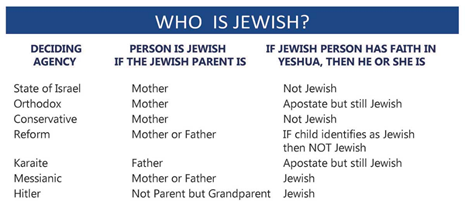
¿Quién es judío?

Quién es judío? | Ser judio, Judios, Religión

Siempre he asumido que ser judío significa ser de fe judía y/o ser de raza judía. Por favor, indíqueme si esto es correcto.

Las respuestas del rabino:

“Ser judío” es un STATUS TECNICO que requiere la ciudadanía en la nación judía, algo similar a ser ciudadano estadounidense. La ciudadanía se adquiere de dos formas:

(1) Judío de nacimiento: el judaísmo se transmite a través de la madre. Si la madre es judía, el niño es 100% judío. Si solo el padre es judío (pero no la madre), entonces el niño es 100% no judío. La identidad judía transmitida a través de la madre ha sido universalmente aceptada por los judíos durante 3300 años, y fue decidida por Dios, como se registra en los Cinco Libros de Moisés en Deut. 7: 3-4. El Talmud (Kidushin 68b) explica cómo esta ley es evidente en esos pasajes.

Según la ley judía, este seguirá siendo el estado de la persona para siempre. No hay forma de que uno pueda perder su condición de judío incluso si no practica formalmente el judaísmo, aun si ha llegado tan lejos como para convertirse a otra religión.

(2) Conversión: Si un no judío quiere convertirse en judío, puede hacerlo convirtiéndose. Debido a esto, el judaísmo claramente no es una “raza de sangre”. Hay judíos chinos, judíos africanos, judíos esquimales, etc. Una vez que un no judío se convierte, se convierte en judío en todos los aspectos, y su relación con Dios está al mismo nivel que la de cualquier judío.

Según el Código de la Ley Judía, hay tres requisitos para la conversión al judaísmo:

1) Debe creer en Dios y en la divinidad de la Torá, así como aceptar sobre sí mismo guardar los mandamientos de la Torá.

2) Si es hombre, debe someterse a la circuncisión por un “Mohel” calificado. Si ya fue circuncidado por un médico, entonces se somete a un ritual llamado “presa de hatafas”.

3) Debe sumergirse en la Mikveh, un baño ritual vinculado a un depósito de agua de lluvia.

Todo lo anterior debe hacerse ante un tribunal de tres hombres judíos que guardan los mandamientos y creen en Dios y la divinidad de la Torá.

Estas son las reglas que los judíos han seguido desde tiempos inmemoriales. Históricamente, cualquier intento de introducir nuevas reglas ha creado un trágico cisma en nuestro pueblo. Esperamos y rezamos para que los grupos judíos de hoy que están siguiendo este camino se den cuenta del grave daño que esto puede causar al ideal de unidad judía que todos buscamos con sinceridad. 

NOTA: Échele una ojeada a la tabla. Allí entrará en contacto con diferentes opciones. La que se ha expuesto en este artículo es la ortodoxa, y ésta NO es la ÚNICA interpretación.

https://www.aish.com/atr/Who_is_a_Jew.html?s=mm

 
2 Comments

Posted by on October 19, 2020 in Uncategorized


Jewish Burial: Sacred Kindness

by Rabbi Chananaya Kramer

Jewish Burial: Sacred Kindness

Some explanations for the laws and customs of Jewish burial.


My job as the president of the Jewish burial society is a sacred privilege and the highest form of kindness.

In Hebrew, the Jewish burial society is called the “chevra kadisha”whichliterally means “the sacred society.” While my work is certainly sobering and humbling, I don’t see it as morbid or depressing. Members of the chevra kadisha feel honored to be given this unique responsibility and privileged to perform this ultimate act of kindness for the deceased.

Here are some explanations for the laws and customs of Jewish burial:

1. There is a specific commandment in the Torah to bury the deceased.

The mitzvah (see Deuteronomy 21:23) emulates God’s kindness as the Torah says God Himself buried Moses.

2. Burying the body in the earth helps the soul find eternal rest.

More importantly, burying the body underground helps the soul find total peace. The Talmud and Medrash (Bereishis Rabba, 100-7) tells us that the soul only finds complete peace once the body is buried underground and returned to the earth.

More importantly, burying the body underground helps the soul find total peace. The Talmud and Medrash (Bereishis Rabba, 100-7) tells us that the soul only finds complete peace once the body is buried underground and returned to the earth.

3. Burial prepares the body for its ultimate reunion with the soul.

Death is not the final destination; it’s just one major step in the journey. The Medrash (Medrash Rabba 28,3) says that a spark of the soul still remains in the body even after one dies, giving the body an element of eternity.

The heavenly spark that remains in the body is likened in the Talmud (Sanhedrin, 90, b) to a seed that will ultimately germinate and sprout in the future, during resurrection of the dead. In this way, preserving the body underground sets the body up for ultimate rebirth.

This is why we pay respect at a loved one’s grave. By praying by their burial site, we arouse that heavenly spark within them and cause them to intercede on our behalf.

4. Burial helps prepare the soul for its encounter with God.

Members of the chevra kadisha purify the body through a process called “taharah”, or purification, to help the deceased leave the world in a pure and pristine state. The body is immersed in a mikvah or poured water over the body and is dressed in white shrouds, which symbolize purity. Kabbalistic sources say that burying the body while in a state of purity is beneficial for the soul.

Aware of the significance of their task, members of the chevra kadisha are filled with a sense of solemnity and purpose as they perform the taharah. As we purify the body, we say prayers and psalms for the deceased, asking God to judge the departed with mercy and

5. Jewish burial ensures that the body is treated with dignity and respect.

Like the mantle of a Torah scroll no longer fit for use but buried with respect, a body that partnered with a soul to accomplish its mission in the world deserves respect.

For this reason, according to Jewish law the body is not unnecessarily exposed. It is gently moved and only when necessary. Men prepare men for burial and women care for women. According to Jewish custom, members of the chevra kadisha watch over the body (in Hebrew, called shmira) from the moment of death until burial so that it shouldn’t appear to be disrespected or discarded.

6. Jewish burial is sensitive to the soul’s discomfort.

According to the Medrash (Medrash Rabbah 100), the soul hovers over the body immediately following death. While it’s helpless to do anything, the soul observes everything that’s happening to its body below.

Jewish law recognizes this and therefore requires those who care for the body to maintain a solemn mood and avoid trivial conversations while preparing the body for burial. When the taharah process is finished, members of the chevra kadisha ask forgiveness from the deceased, just in case we didn’t give them the respect they deserve.

In the past, Jews went to great lengths – and at times even risked their own lives – to bury other Jews according to the Jewish tradition. Performing this final act of kindness for people we don’t even know reminds us that we’re all connected, and that all Jews, regardless of religious observance, deserve the dignity of a proper Jewish burial.

As taken from, https://www.aish.com/sp/ph/Jewish-Burial-Sacred-Kindness.html?s=hp1

 
1 Comment

Posted by on October 18, 2020 in Uncategorized


Dile sí a la vida: El manuscrito redescubierto de Viktor Frankl

por Sara Debbie Gutfreund

Dile sí a la vida: El manuscrito redescubierto de Viktor Frankl

Cuatro ideas cruciales de esta obra maestra que fue publicada recientemente.


En medio del sufrimiento insoportable del campo de concentración, Viktor Frankl se imaginó a sí mismo de pie en un podio dando una conferencia titulada: “Psicología del campo de concentración”. Esta visión de un futuro en el que sería capaz de utilizar su sufrimiento para ayudar a otros fue lo que lo sostuvo durante esos días espantosos. Unos pocos meses después de ser liberado de los campos de concentración, Viktor Frankl se paró en el podio y dio las conferencias que había imaginado durante tanto tiempo. Esta serie de conferencias fueron publicadas en alemán en 1946 y permanecieron sin traducir hasta hace muy poco, cuando fue redescubierto el manuscrito Yes to Life In Spite of Everything (A pesar de todo, decir sí a la vida).

En esta conmovedora obra maestra de la escritura, Frankl recuerda que en el campo de concentración de Buchenwald cantaban una y otra vez: “Todavía queremos decirle sí a la vida. Todavía queremos decirle sí a la vida”. Entonaron esta canción bajo circunstancias que no podemos llegar a imaginar, lo que llevó a Frankl a escribir: “Decir que sí a la vida no sólo es significativo bajo todas las circunstancias porque la vida misma tiene sentido, sino porque también es posible bajo todas las circunstancias” (Viktor Frankl, Yes to Life In Spite of Everything).

Aquí hay cuatro ideas cruciales del manuscrito redescubierto de Viktor Frankl.

Somos responsables por cada momento de nuestra vida

“Es terrible saber que a cada momento soy responsable por el siguiente momento, que cada decisión, desde la más pequeña a la más grande, es una decisión ‘para toda la eternidad’; que en cada momento puedo concretizar la posibilidad de ese momento particular o perderlo. Cada momento tiene miles de posibilidades y sólo puedo elegir una de ellas para concretizarla”.

Puede ser que no escojamos lo que nos presenta cada momento de la vida, pero podemos elegir qué hacer con ese momento cuando llega.

El significado en cada vida adquiere diferentes formas dependiendo de nuestras circunstancias

“En el curso de la vida, los seres humanos deben estar preparados para cambiar la dirección de este cumplimiento de significado, a menudo de forma abrupta, de acuerdo con los desafíos particulares del momento. El sentido de la vida sólo puede ser específico, específico tanto en relación a cada persona individual y en relación a cada momento particular. La pregunta que nos formula la vida cambia de persona a persona y de situación a situación”.

Cada etapa de la vida y cada circunstancia demanda que encontremos un nuevo significado y nuevas metas. A veces, este significado puede cambiar cada día e incluso a cada hora. Existe una gran sabiduría en tener la flexibilidad necesaria para cambiar de dirección de acuerdo con la tarea que enfrentamos.

El sufrimiento tiene un propósito crucial en nuestras vidas

“Si nos preguntáramos honesta y seriamente si quisiéramos borrar las experiencias tristes de nuestro pasado, quizás de nuestra vida amorosa, si hubiéramos querido perder todo lo que fue doloroso, probablemente todos responderíamos que no. De alguna manera sabemos cuánto pudimos crecer y madurar precisamente durante esos períodos no alegres de nuestra existencia”.

A veces la vida es tan difícil que el único significado que podemos encontrar en el momento es la mera resistencia a nuestro sufrimiento. Sólo más tarde podemos mirar hacia atrás y ver el enorme crecimiento y la transformación que surgieron de nuestros desafíos. Hay algunas enfermedades en las que las personas pierden la capacidad de sentir el dolor. La incapacidad de sufrir en sí misma se convierte en un síntoma. Poder sentir y soportar el sufrimiento es un regalo.

No hay una tarea demasiado pequeña como para que no tenga infinitas consecuencias

“Nunca se trata de dónde alguien se encuentra en la vida o qué profesión tiene, sólo es cuestión de cómo ocupa su lugar, su círculo. Tener una vida plena no depende de cuán amplio sea el rango de acción, sino sólo de que su círculo se complete”.

Al atardecer, justo después de la liberación del campo de concentración de Turkheim, Viktor Frankl caminó hacia el bosque donde estaban enterrados muchos de sus compañeros del campo. Uno de los comandantes de la SS que había arriesgado repetidamente su vida para pagar y obtener ilegalmente medicinas para los prisioneros del campo, también arriesgó su vida al sacar un pedazo de corteza en los troncos de los árboles y grabar allí los nombres de los prisioneros que enterró allí en contra de las órdenes de sus superiores.

Al estar parado allí, mientras oscurecía, y observar esos nombres, Viktor Frankl sintió que su propia supervivencia era una misericordia inmerecida. Sintió la gran responsabilidad que tenía de ganarse esa segunda oportunidad que le habían brindado. “Me pareció que sólo era posible acallar esa culpa manteniendo alerta nuestra propia conciencia y la de los demás”.

Leer el libro de Frankl me recordó algo que aprendí hace poco sobre las raíces de las sequoias. Las raíces de los imponentes y majestuosos árboles de sequoia no crecen profundamente en la tierra como uno hubiera esperado. En cambio, crecen hacia afuera en círculos, extendiéndose a muchos metros lateralmente, enredándose entre ellas de forma tal que en una tormenta todas sus raíces estén interconectadas. Así también fue como Frankl y otros sobrevivieron a la guerra, enfocándose constantemente en los demás y acercándose a ellos, envolviendo sus raíces con los otros bajo las peores condiciones.

En el campo de concentración, Viktor Frankl escondió en el forro de su abrigo sus notas para un manuscrito. Esas notas se perdieron hacia el fin de la guerra. Pero inmediatamente después de su liberación, Frankl trabajó día y noche para volver a encontrar esas palabras y compartirlas con el mundo. Sus raíces de significado rodean las nuestras y nuestras raíces envuelven las de otras personas. Frankl nos dio uno de los mejores regalos al enseñarnos que lo que importa no es lo que esperamos de la vida, sino lo que la vida espera de nosotros. También nosotros podemos optar por decir sí a la vida a pesar de todo, y por todo.

Según tomado de, https://www.aishlatino.com/a/s/Dile-si-a-la-vida-El-manuscrito-redescubierto-de-Viktor-Frankl.html?s=mm

 
Leave a comment

Posted by on October 16, 2020 in Uncategorized


¿Quería Dios que Adán y Eva comieran el fruto?

Adaptado de las enseñanzas del Rebe de Lubavitcher por Yanki Tauber.

“Ven a ver los hechos de Di-s, Su terrible plan sobre los hijos del hombre.” Salmos 66:5

“Y la mujer vio que el árbol era bueno para comer y deseable a los ojos… y tomó de su fruto y comió; y le dio también a su marido, y él comió con ella.” Génesis 2:6

¿Qué hubiera pasado si Adán y Eva no hubieran comido del árbol del conocimiento?

El propósito de una empresa comercial es obtener ganancias. Ningún empresario que se precie invertiría capital y gastaría tiempo y talento donde las cifras no mostraran un potencial definitivo de ganancias.

Sin embargo, las mayores ganancias se obtendrán a partir de las mismas condiciones que el empresario más busca evitar: a raíz de acontecimientos completamente imprevisibles, en entornos sobre los que no tiene control y en los que toda su empresa (y quizás la suya) están en peligro.

Por tanto, se puede decir que la mente del empresario opera en dos niveles. En el nivel manifiesto (evidente), busca estabilidad y control. En este nivel, “ser pillado desprevenido” es un anatema para los negocios. Si bien sabe que toda empresa tiene riesgos, su objetivo es evitar los riesgos, evitar lo imprevisible, tener un plan de contingencia para todas las posibilidades.

Pero en un nivel subconsciente más profundo, el empresario anhela lo imprevisible. En el fondo de su corazón, quiere que lo cojan desprevenido, que se sumerja en las mismas circunstancias que su negocio está estructurado para evitar. Porque aquí, y solo aquí, reside el potencial de ganancias mayores que las que cualquier analista podría pronosticar. En este nivel, que “todo salga según lo planeado” sería una decepción más que un logro.

Estos son escenarios que nunca presentará a sus inversores, ni siquiera a su propia conciencia. Pero en el análisis final, son estas mismas posibilidades, que se esconden detrás de las cifras y proyecciones oficiales, las que son su mayor motivación para participar en los negocios.

La trama temible

Nuestros sabios nos dicen que “El reino de los cielos es similar al reino de la tierra” [1], que las estructuras de la sociedad humana y los patrones de comportamiento humano reflejan la manera en que el Creador se relaciona con Su mundo y lo dirige.

Di-s tiene una “estrategia comercial”: la Torá, que es el “modelo de Di-s para la creación” [2], define el “beneficio” que el Creador desea obtener de Su empresa. Las leyes de la Torá detallan lo que se debe y no se debe hacer, y lo que se debe y no se debe suceder, para salvaguardar la inversión divina en la creación y asegurar su rentabilidad.

Pero en el primer día hábil de la historia, el plan salió mal. Adán y Eva, al comer del fruto del árbol del conocimiento, violaron la primera mitzvá (mandamiento divino) que se les ordenó. Su acción puso en peligro toda la empresa, desatando un caos de bien y mal sobre el mundo controlado y ordenado en el que nacieron.

Sin embargo, nuestros sabios nos dicen que este fue el “terrible complot de Di-s sobre los hijos del hombre”. [3] “Soy yo quien los causé a pecar”, admitió Di-s al profeta Elías, “al crearlos con una inclinación a maldad. ” [4]

Porque es el proceso de teshuvá (“retorno”) del pecado lo que produce los mayores “beneficios” del esfuerzo de la vida. No hay amor más grande que el amor experimentado desde lejos, y no hay pasión más grande que la búsqueda por regresar a un hogar abandonado y a un yo alienado. Cuando el vínculo de un alma con Di-s se estira hasta el punto de ruptura, la fuerza con la que rebota hacia su Fuente es mayor que cualquier cosa que pueda generar el alma que nunca abandona la órbita divina. Y cuando un alma vaga por los rincones más extraños de la vida y explota la negatividad y la maldad de su entorno como el ímpetu para regresar a Di-s, redime esas partes de la creación de Di-s que se encuentran más allá de los límites de una vida recta. .

Este es el “terrible complot” de Di-s sobre los hijos del hombre: crear al hombre con una inclinación al mal, para que cuando sucumbe a él, rebote con un mayor amor por Di-s, y con una mayor cosecha de transformados y recursos redimidos, que es generado por una vida vivida conforme a la voluntad divina.

Seguramente, sin embargo, no se puede decir que Di-s quisiera que el hombre pecara: un pecado, por definición, es un acto que Di-s no quiere que se haga. Además, si el “plan” de Di-s era que el hombre pecara, esto plantea la cuestión de qué habría pasado si Adán y Eva no hubieran elegido [5] comer del Árbol del Conocimiento. ¿No se habría cumplido el propósito de la creación de Di-s?

Lo que Dios quiere

Como es el caso del hombre de negocios convencional, hay dos niveles de “motivación” detrás del acto divino de la creación.

En el nivel manifiesto, el mundo fue diseñado y creado para llevar a cabo el plan delineado por la Torá. Este plan exige la existencia de una inclinación al mal en el corazón del hombre, para que nuestra conformidad con la voluntad divina tenga sentido y significación. En palabras de Maimónides,

A todo hombre se le da licencia: si desea seguir el camino del bien y ser una persona justa, la decisión de hacerlo está en sus manos; y si desea seguir el camino del mal y ser una persona malvada, la decisión de hacerlo está en sus manos…. Este es un principio importante y un pilar de la Torá y los mandamientos…. Porque si Di-s decretara que una persona sea justa o malvada, o si existiera algo en la esencia de la naturaleza de una persona que lo obligaría a seguir un camino específico … ¿cómo podría Dios mandarnos a través de los profetas, ‘Haz esto’ y ‘No hagas esto’ … ¿Qué lugar tendría toda la Torá? ¿Y con qué medida de justicia castigaría Di-s al impío y recompensaría al justo…? [6]

Su plan no requiere la existencia del mal, solo el potencial para su existencia. Debe ser posible para nosotros violar la voluntad divina, para que el no violarla sea un triunfo moral para nosotros y una fuente de placer para Di-s. Debe ser posible que no hagamos el bien, para que nuestras buenas acciones tengan valor y significado. Los riesgos deben estar ahí, son los que hacen que la empresa comercial sea gratificante y rentable, pero el objetivo de todo es que se eviten.

Pero en un nivel “subconsciente” más profundo, Di-s trama que el hombre sucumba al pecado. Esto no es lo que “quiere”; de hecho, está en desacuerdo con Su voluntad expresa. Pero cuando sucede, da rienda suelta a una gran cantidad de posibilidades que son infinitamente más potentes que cualquier cosa que el plan de negocios “oficial” podría haber dado. Y son estas posibilidades, que se esconden detrás de las cifras y proyecciones oficiales, las que son Su motivación última para invertir en los negocios de la vida humana.

Basado en los escritos y discursos del Rebe. [7]

Adaptado de las enseñanzas del Rebe de Lubavitcher por Yanki Tauber.

NOTAS

[1]. Talmud, Berajot 58a; Zohar, parte I, 157a.

[2]. Midrash Rabá, Bereshit 1: 2.

[3]. Salmos 66: 5; en las palabras del Midrash: “Las cosas terribles que traes sobre nosotros, las provocas mediante artimañas. Mire: cuando Di-s creó el mundo, creó al ángel de la muerte en el primer día … como está escrito, “Y las tinieblas estaban sobre la faz del abismo” (Génesis 1: 2). El hombre fue creado solo en el sexto día, y es un complot que se urdió contra él que él es quien trajo la muerte al mundo [al comer del Árbol del Conocimiento] como está escrito, ‘Porque en el día que si comes de él, morirás ‘(ibid. 2:17).

“¿A qué se compara esto? A quien deseaba divorciarse de su esposa. De camino a casa, tiene redactada una carta de divorcio. Vuelve a casa, con la carta de divorcio en la mano, tramando la forma de dársela. Él le dice: “Sírveme una taza para que pueda beber”. Ella le sirve una taza. Tan pronto como le quita la copa de la mano, le dice: ‘Aquí está tu divorcio’. Ella le dice: ‘¿Cuál es mi crimen?’ Él le dice: ‘Sal de mi casa, porque me has servido. una taza tibia. ”Ella le dice:“ Sabías de antemano que te serviría una taza tibia, ¡ya has escrito la carta de divorcio y la has traído en tu mano!

“De la misma manera, Adam le dijo a Di-s: ‘¡Maestro del mundo! Durante dos mil años antes de que crearas tu mundo, la Torá estaba protegida contigo … y en ella está escrito: “Esta es la ley: si un hombre muriera en una tienda …” (Números 19:14). Si no hubieras preparado la muerte para tus criaturas, ¿hubieras escrito así? Y luego vienes y me echas la culpa. ”De ahí [el salmista dice]:“ Su terrible plan sobre los hijos del hombre ”.” (Midrash Tanchuma, Vayeishev 4).

[4]. Rashi, Berajot 32a, s.v. dichtiv.

[5]. Porque este fue un acto de elección de su parte; si no lo hubiera sido, no habría sido un pecado. Véase la cita de Maimónides, más adelante en el texto.

[6]. Mishné Torá, Leyes del arrepentimiento 5: 3-4.

[7]. Sefer HaMaamarim Melukat, vol. III, pág. 247; ibíd., vol. I, págs. 366-368; Likkutei Sichot, vol. VII, págs. 22-23; ibíd., vol. XXV, pág. 429, nota 52; Reshimot # 12; et al.

 
Leave a comment

Posted by on October 16, 2020 in Uncategorized


Did G-d Want Adam and Eve to Eat the Fruit?

by Rabbi Simon Jacobson

Come see the doings of G-d, His fearsome plot on the children of man

Psalms 66:5

And the woman saw that the tree was good to eat and desirable to the eyes … and she took of its fruit and ate; and she gave also to her husband, and he ate with her

Genesis 2:6

What would have happened if Adam and Eve had not eaten from the tree of knowledge?

The purpose of a business venture is to make a profit. No self-respecting businessman would invest capital and expend time and talent where the figures did not show a definitive potential for profit.

And yet, the greatest profits are to be harvested under the very conditions that the responsible businessman seeks most to avoid: in the wake of completely unforseeable developments, in environments over which he has no control and in which his entire venture (and perhaps his own self) are in jeopardy.

Thus, the mind of the businessman can be said to operate on two levels. On the manifest level, he seeks stability and control. On this level, “being caught unawares” is anathema to business. While he knows that there are risks to every venture, his aim is to avoid the risks, to steer clear of the unforeseeable, to have a contingency plan for every possibility.

But on a deeper, subconscious level, the businessman craves the unforeseeable. In his heart of hearts, he wants to be caught unawares, to be plunged into the very circumstances that his business is structured to avoid. For here, and only here, lies the potential for profits greater than any analyst could forecast. On this level, having “everything go according to plan” would be a disappointment rather than an achievement.

These are scenarios that he will never present to his investors, or even to his own conscious self. But in the final analysis, it is these very possibilities, lurking behind the official figures and projections, that are his greatest motivation for engaging in business.

The Fearsome Plot

Our sages tell us that “The kingdom of Heaven is similar to the kingdom of earth”[1]—that the structures of human society and the patterns of human behavior reflect the manner in which the Creator relates to and runs His world.

G-d has a “business strategy”: the Torah—which is “G-d’s blueprint for creation”[2]—defines the “profit” that the Creator desires to see from His enterprise. The Torah’s laws detail what should and what should not be done, and what should and what should not happen, to safeguard the divine investment in creation and assure its profitability.

But on the very first business day of history, the plan went awry. Adam and Eve, by eating from the fruit of the Tree of Knowledge, violated the first mitzvah (divine commandment) commanded to them. Their deed jeopardized the entire venture, unleashing a chaos of good and evil upon the controlled, orderly world into which they were born.

Yet our sages tell us that this was G-d’s “fearsome plot upon the children of man.”[3] “It is I who caused them to sin,” G-d admitted to Elijah the Prophet, “by creating them with an inclination to evil.”[4]

For it is the process of teshuvah (“return”) from sin that yields the greatest “profits” of the endeavor of life. There is no greater love than the love experienced from afar, and no greater passion than the quest to return to a forsaken home and an alienated self. When a soul’s bond to G-d is stretched to the breaking point, the force with which it rebounds to its Source is greater than anything that can be generated by the soul that never leaves the divine orbit. And when a soul wanders off to the most alien corners of life, and exploits the very negativity and evil of its environment as the impetus to return to G-d, it redeems those parts of G-d’s creation that lie beyond the pale of a righteous life.

This is G-d’s “fearsome plot” upon the children of man: to create man with an inclination to evil, so that when he succumbs to it, he should rebound with a greater love for G-d, and with a greater harvest of transformed and redeemed resources, than is generated by a life lived in conformity with the divine will.

Surely, however, it cannot be said that G-d wanted that man should sin: a sin, by definition, is an act that G-d does not want done. Also, if G-d’s “plan” was that man should sin, this raises the question of what would have happened if Adam and Eve had not chosen[5] to eat from the Tree of Knowledge. Would the purpose of G-d’s creation not have been realized?

What G-d Wants

As is the case with the conventional businessman, there are two levels of “motivation” behind the divine act of creation.

On the manifest level, the world was designed and created to carry out the plan outlined by the Torah. This plan calls for the existence of an inclination to evil in the heart of man, in order that our conformity to the divine will should have meaning and significance. In the words of Maimonides,

License is given to every man: if he desires to follow the path of good and be a righteous person, the choice to do so is in his hands; and if he desires to follow the path of evil and be a wicked person, the choice to do so is in his hands…. This is a major principle, and a mainstay of the Torah and the commandments…. For if G-d were to decree that a person be righteous or wicked, of if there were to exist something in the essence of a person’s nature which would compel him toward a specific path … how could G-d command us through the prophets, ‘Do this’ and ‘Do not do this’?… What place would the entire Torah have? And by what measure of justice would G-d punish the wicked and reward the righteous…?[6]

This plan does not require the existence of evil—only the potential for its existence. It must be possible for us to violate the divine will, so that our not violating it should be a moral triumph for us and a source of pleasure for G-d. It must be possible for us not to do good, so that our good deeds should have value and significance. The risks must be there—they are what make the business venture rewarding and profitable—but the point of it all is that they be avoided.

But on a deeper, “subconscious” level, G-d plots man’s succumbing to sin. This is not what He “wants”—indeed, it is at variance with His express will. But when it does happen, it unleashes a wealth of possibilities that are infinitely more potent than anything the “official” business plan could have yielded. And it is these possibilities, lurking behind the official figures and projections, that are His ultimate motivation for investing in the business of human life.

Based on the Rebbe’s writings and talks.[7] Adapted from the teachings of the Lubavitcher Rebbe by Yanki Tauber.

________________________________

[1]. Talmud, Berachot 58a; Zohar, part I, 157a.

[2]. Midrash Rabbah, Bereishit 1:2.

[3]. Psalms 66:5; in the words of the Midrash: “The fearsome things You bring upon us, You bring about by contrivance. Look: when G-d created the world, He created the angel of death on the very first day… as it is written, ‘And darkness was upon the face of the abyss’ (Genesis 1:2). Man was created only on the sixth day, and it is a plot that was contrived against him that he is the one who brought death upon the world [by eating from the Tree of Knowledge] as it is written, ‘For on the day that you eat from it, you shall die’ (ibid. 2:17).

“What is this comparable to? To one who wished to divorce his wife. On the way home, he has a bill of divorce written up. He comes home, with the bill of divorce in his hand, plotting a way to give it to her. He says to her: ‘Pour me a cup, that I may drink.’ She pours out a cup for him. As soon as he takes the cup from her hand, he says to her: ‘Here is your divorce.’ Says she to him: ‘What is my crime?’ Says he to her: ‘Leave my house, for you have poured me a lukewarm cup.’ Says she to him: ‘You knew in advance that I would pour you a lukewarm cup—you have already written the bill of divorce and brought it with you in your hand!’

“By the same token, Adam said to G-d: ‘Master of the World! For two thousand years before You created Your world, the Torah was safeguarded with You… and in it is written, “This is the law: If a man should die in a tent….” (Numbers 19:14). Had You not prepared death for Your creatures, would You have so written? And then You come and attach the blame to me.’ Hence [the Psalmist says]: ‘His fearsome plot upon the children of man.’” (Midrash Tanchuma, Vayeishev 4).

[4]. Rashi, Berachot 32a, s.v. dichtiv.

[5]. For this was an act of choice on their part—had it not been, it would not have been a sin. See quote from Maimonides, further on in text.

[6]. Mishneh Torah, Laws of Repentance 5:3-4.

[7]. Sefer HaMaamarim Melukat, vol. III, p. 247; ibid., vol. I, pp. 366-368; Likkutei Sichot, vol. VII, pp. 22-23; ibid., vol. XXV, p. 429, note 52; Reshimot #12; et al.

As taken from, https://www.meaningfullife.com/did-god-want-adam-and-eve-to-eat-the-fruit/?utm_source=Meaningful+Life+Center&utm_campaign=48996f7fe0-WN%24Dancing+Particles&utm_medium=email&utm_term=0_0bcb4308af-48996f7fe0-82293993

 
Leave a comment

Posted by on October 16, 2020 in Uncategorized


LOS “CAPÍTULOS” DE LA BIBLIA FUERON INVENTADOS POR CRISTIANOS ANTISEMÍTICOS. UN EDUCADOR DE LA TORAH BUSCA INVERTIRLO.

Por RIVKAH LAMBERT ADLER

Primero, un poco de historia bíblica. Cuando Dios le dio la Torá a Moisés en el monte Sinaí, ésta no bajó del cielo perfectamente dividida en los capítulos con los que estamos familiarizados hoy.

Israel365 News habló con Betzalel Ariel, un educador de Torá de Beit El en la región de Benjamín de Israel, que está tratando de restaurar los sedarim a su uso original. Explicó que los rabinos dividieron el texto bíblico por temas y sus divisiones ayudan a los estudiantes de la Biblia a comprender adecuadamente cada tema en su totalidad.

Ariel afirma que la división en capítulos, que se produjo mucho más tarde, se hizo con intenciones antisemitas, incluso malvadas, para hacer que el pueblo judío pareciera censurable.

La división de la Biblia en capítulos se atribuye generalmente a Stephen Langton, el arzobispo de Canterbury del siglo XIII. Es importante señalar que la historia ha juzgado a Langton como un antisemita. Ordenó a los judíos de Inglaterra que usaran una banda blanca para identificarlos, que medía aproximadamente 2 ”x 12” (5 cm x 30 cm), en su ropa. Estas bandas blancas influyeron en la utilización de la estrella amarilla que los judíos debían llevar durante la era del Holocausto.

Langton también estaba inmerso en la teología del reemplazo predominante en su época, creyendo que la Iglesia había reemplazado al pueblo judío a los ojos de Dios. Esta teología, según Ariel, guió su división de la Biblia en capítulos que diferían de los sedarim judíos existentes.

CÓMO LAS DIVISIONES CRISTIANAS DEL CAPÍTULO SE REFLEJAN MAL SOBRE EL PUEBLO JUDÍO

Ariel afirmó que, en las divisiones de los capítulos cristianos, hay cientos de capítulos que comienzan con un versículo que destaca el comportamiento pecaminoso del pueblo judío. Por ejemplo, Éxodo 32 comienza con el versículo que describe el pecado del becerro de oro.

Cuando la gente vio que Moshé tardaba tanto en bajar de la montaña, la gente se reunió contra Aharon y le dijo: “Ven, haznos un dios que vaya delante de nosotros, para ese hombre Moshe, que nos trajo de la tierra de Egipto, no sabemos qué le ha sucedido “. Éxodo 32: 1

Sin embargo, en la división judía, esta sección comienza un versículo antes, con un evento mucho más favorable: Dios entregó las tablas de la Torá a Moisés en el monte. Sinaí.

“Cuando terminó de hablar con él sobre Har Sinai, le dio a Moshé las dos tablas del Pacto, tablas de piedra inscritas con el dedo de Hashem.” Éxodo 31:18

La lección, según Ariel, es: “Mientras Moshe (Moisés) sostiene las tablas, Hashem (Dios) le habla del chet haegel (el pecado del becerro de oro). Dios no le quitó la Torá a Moshé. Hashem no se rindió con Am Yisrael (el pueblo de Israel) incluso después de que hicieron el chet haegel “.

La división judía enfatiza la compasión de Dios y Su creencia de que el pueblo de Israel podría superar su error, mientras que la división de Langton enfatiza el pecado.

Otro ejemplo se encuentra en el capítulo 4 del Libro de los Jueces que comienza con un versículo crítico.

Los israelitas nuevamente hicieron lo que fue ofensivo para Hashem: Aod ahora estaba muerto. Jueces 4: 1

Pero la división judía comienza nuevamente un verso anterior, relatando las buenas obras de Samgar.

Tras él vino Samgar, hijo de Anat, que mató a seiscientos filisteos con un aguijón. Él también fue un campeón de Israel. Jueces 3:31

UN TERCER EJEMPLO SOLIDIFICARÁ EL PATRÓN.

El capítulo 7 de Josué comienza con el pecado de Acán. Los israelitas, sin embargo, violaron la proscripción: Acán hijo de Carmi hijo de Zabdi hijo de Zerach, de la tribu de Yehuda, tomó de lo que estaba proscrito, y Hashem se enfureció con los israelitas. Josué 7: 1

La división judía comienza de nuevo mucho más favorablemente, solo un versículo antes, contando cómo estaba Dios con Josué y sobre el crecimiento de su reputación.

“Hashem estaba con Yehoshua, y su fama se extendió por toda la tierra.” Josué 6: 27

SEPARANDO SHABBAT DEL RESTO DE LA SEMANA

La observancia cristiana del sábado al domingo se entiende ampliamente como una manifestación de la teología del reemplazo, que reemplaza la práctica judía de observar el sábado en el séptimo día. En las divisiones del capítulo cristiano, Shabat comienza en el segundo capítulo de Génesis.

“Fueron acabados el cielo y la tierra, y todo su conjunto. En el séptimo día, Hashem terminó el trabajo que había estado haciendo, y el séptimo día cesó de todo el trabajo que había hecho. Y Hashem bendijo el séptimo día y lo declaró santo, porque en él cesó Hashem de toda la obra de creación que había hecho.” Génesis 2: 1-3

Cuando una familia judía hace kidush (la bendición sobre el vino o el jugo de uva) el viernes por la noche, inician el Shabat con estas palabras de la porción de la Torá de esta semana. Sin embargo, los judíos comienzan el kidush con el final del último versículo del capítulo anterior, “Y fue la tarde y la mañana, el sexto día”, vinculando así el Shabat con los seis días anteriores de la Creación.

“Y Hashem vio todo lo que había hecho y lo encontró muy bueno. Y fue la tarde y la mañana el día sexto.” Génesis 1:31

Según Ariel, “Queremos decir que los primeros seis días no están solos. Son la preparación para Shabat. Shabat es parte de los Siete Días de la Creación. [La división cristiana está] en contra de nuestras creencias “.

CÓMO LLEGARON LOS JUDÍOS A USAR LAS DIVISIONES DEL CAPÍTULO CRISTIANO

La primera Biblia fue impresa en 1455 en Alemania por Johann Gutenberg, quien inventó la imprenta. La Biblia de Gutenberg usó las divisiones de capítulos creadas por Langton cientos de años antes.

En ese momento, la industria gráfica estaba controlada por cristianos y los censores cristianos tenían que aprobar la publicación de libros. A pesar de ser conocidos como La Gente del Libro, los judíos no tenían la capacidad de publicar sus propios textos.

Jacob ben Hayyim ben Isaac ibn Adonijah, conocido más simplemente como Jacob ben Hayyim, fue un estudioso de la Biblia hebrea. Trabajó para un impresor cristiano llamado Daniel Bomberg. Aunque él mismo era cristiano, Bomberg se especializó en la impresión de libros hebreos y fue el primer no judío en hacerlo.

En 1524, Bomberg imprimió el primer Mikraot Gedolot, a menudo referido en español como la Biblia rabínica, que incluye comentarios rabínicos junto con una versión autorizada del texto bíblico.

A pesar de ser un estudioso de la Biblia hebrea, Jacob ben Hayyim afirmó en su introducción que no podía localizar los sedarim hebreos originales. En cambio, usó las divisiones de los capítulos cristianos comunes para estructurar la primera impresión de la Biblia judía.

Esta Biblia hebrea, con las divisiones de capítulos cristianos, fue la Biblia hebrea impresa estándar durante casi 500 años. Con el tiempo, los judíos se acostumbraron a las divisiones de los capítulos cristianos y abandonaron por completo la forma original judía de dividir el texto.

En un giro irónico de la historia, Jacob ben Hayyim se convirtió en un judío apóstata más tarde y abrazó el cristianismo. Históricamente no está claro si su creciente interés por el cristianismo lo llevó a confiar en las divisiones de los capítulos cristianos para su trabajo o si leer la Biblia dividida por un arzobispo antisemita lo llevó a renunciar a su identidad judía.

RESTAURANDO LAS DIVISIONES JUDÍAS TRADICIONALES

Koren Publishers, con sede en Jerusalén, volvió a colocar los sedarim, utilizando las divisiones judías tradicionales, en la primera Biblia hebrea publicada en Israel. Sin embargo, dado que habían pasado tantos siglos con los judíos usando las divisiones de los capítulos cristianos como referencia, Koren eligió incluir tanto las divisiones de los capítulos cristianos como las divisiones judías tradicionales.

Ariel se siente diferente. “¡Podemos hacerlo! Puede realizar cambios si lo cree importante. Ha llegado el momento de devolverle a los cristianos su “regalo” y aprender en nuestra tradición ”.

Tiene el sueño de reintroducir las divisiones judías y enseñar la Biblia a los judíos de acuerdo con la forma tradicional de dividir el texto. “Digamos que los capítulos cristianos no están en contra de los judíos”, propuso. “[Aun así], ¿por qué los preferimos más que las divisiones judías? ¿Por qué nuestros niños tienen que aprender de los capítulos? ¡Estamos en Israel! Ya no estamos bajo el control de los cristianos “.

Bajo el nombre Shiva LeVitzaron (Regreso a la fortaleza), palabras que provienen del hebreo de Zacarías 9:12, Ariel está publicando una Biblia hebrea que restaura las divisiones judías tradicionales.

Su esperanza es que esta restauración, que se está realizando en la Tierra de Israel, corrija un error histórico y reemplace las divisiones de los capítulos cristianos que se crearon originalmente en un clima impregnado de sentimiento antisemita.

Betzalel Ariel

https://www.israel365news.com/159611/chapters-in-bible-were-invented-by-antisemitic-christians-one-torah-educator-seeks-to-reverse-it/

 
Leave a comment

Posted by on October 15, 2020 in Uncategorized


‘CHAPTERS’ IN BIBLE WERE INVENTED BY ANTI-SEMITIC CHRISTIANS. ONE TORAH EDUCATOR SEEKS TO REVERSE IT

BY RIVKAH LAMBERT ADLER 

First, a little Biblical history. When God gave the Torah to Moses on Mount Sinai, it did not come down from Heaven neatly divided into the chapters with which we are familiar today.

Traditionally, the text of the first five books of Hebrew scriptures were divided by the rabbis into roughly 150 sedarim (sections or portions). For intriguing historical reasons which we will discuss, these original divisions have fallen into disuse.

Israel365 News spoke to Betzalel Ariel, a Torah educator from Beit El in the Benjamin region of Israel, who is trying to restore the sedarim to their original use. He explained that the rabbis divided the Biblical text thematically and their divisions help students of the Bible properly understand each topic in its entirety.

Ariel claims that the division into chapters, which came much later, was done with anti-Semitic, even evil intentions, in order to make the Jewish people look reprehensible.


The division of the Bible into chapters is generally attributed to Stephen Langton, the 13th century Archbishop of Canterbury. It’s important to note that history has judged Langton an anti-Semite. He ordered the Jews of England to wear an identifying white band, measuring approximately 2” x 12”  (5 cm x 30 cm), on their clothing. These identifying white bands influenced the yellow star Jews were required to wear during the Holocaust era.

Langton was also steeped in the prevailing replacement theology of his day, believing that the Church had replaced the Jewish people in the Eyes of God. This theology, according to Ariel, guided his division of the Bible into chapters that differed from the existing Jewish sedarim.


HOW THE CHRISTIAN CHAPTER DIVISIONS REFLECT POORLY ON THE JEWISH PEOPLE

Ariel asserted that, in the Christian chapter divisions, there are hundreds of chapters that begin with a verse highlighting the sinful behavior of the Jewish people.

For example, Exodus 32 opens with the verse describing the Sin of the Golden Calf.

When the people saw that Moshe was so long in coming down from the mountain, the people gathered against Aharon and said to him, “Come, make us a god who shall go before us, for that man Moshe, who brought us from the land of Egypt—we do not know what has happened to him.” Exodus 32:1

However, in the Jewish division, this section begins a verse earlier, with a much more favorable event — God giving the tablets of the Torah to Moses on Mt. Sinai.

https://tpc.googlesyndication.com/safeframe/1-0-37/html/container.html

When He finished speaking with him on Har Sinai, He gave Moshe the two tablets of the Pact, stone tablets inscribed with the finger of HashemExodus 31:18

The lesson, according to Ariel, is, “While Moshe (Moses) is holding the tablets, Hashem (God) tells him about the chet haegel (the Sin of the Golden Calf). God did not take the Torah away from Moshe. Hashem didn’t give up on Am Yisrael (the people of Israel) even after they made the chet haegel.”

The Jewish division emphasizes God’s compassion and His belief that the people of Israel could overcome their error, whereas Langton’s division emphasizes the sin.

Another example is found in chapter 4 of the Book of Judges which begins with a critical verse.

The Israelites again did what was offensive to HashemEhud now being dead. Judges 4:1

But the Jewish division again begins a verse prior, telling of the good deeds of Shamgar.

After him came Shamgar son of Anath, who slew six hundred Philistines with an ox-goad. He too was a champion of YisraelJudges 3:31

A THIRD EXAMPLE WILL SOLIDIFY THE PATTERN.


Joshua chapter 7 begins with the sin of Achan.

The Israelites, however, violated the proscription: Achan son of Carmi son of Zabdi son of Zerach, of the tribe of Yehuda, took of that which was proscribed, and Hashem was incensed with the Israelites. Joshua 7:1

The Jewish division again begins much more favorably, just one verse prior, telling how God was with Joshua and about the growth of his reputation.

Hashem was with Yehoshua, and his fame spread throughout the land. Joshua 6: 27


SEPARATING SHABBAT FROM THE REST OF THE WEEK


The Christian observance of the sabbath on Sunday is widely understood to be a manifestation of replacement theology, superseding the Jewish practice of observing Shabbat on the seventh day. In the Christian chapter divisions, Shabbat begins in the second chapter of Genesis

The heaven and the earth were finished, and all their array. On the seventh day Hashem finished the work that He had been doing, and He ceased on the seventh day from all the work that He had done. And Hashem blessed the seventh day and declared it holy, because on it Hashem ceased from all the work of creation that He had done. Genesis 2:1-3

When a Jewish family makes kiddush (the blessing over wine or grape juice) on Friday night, they usher in Shabbat with these words from this week’s Torah portion. However, Jews begin kiddush with the end of the last verse of the previous chapter, “And there was evening and there was morning, the sixth day,” thus linking Shabbat to the previous six days of Creation.

And Hashem saw all that He had made, and found it very good. And there was evening and there was morning, the sixth day. Genesis 1:31

According to Ariel, “We want to say that the first six days are not standing alone. They are the preparation for Shabbat. Shabbat is part of the Seven Days of Creation. [The Christian division is] against our beliefs.”


HOW JEWS CAME TO USE THE CHRISTIAN CHAPTER DIVISIONS

The first Bible was printed in 1455 in Germany by Johann Gutenberg, who invented the printing press. The Gutenberg Bible used the chapter divisions created by Langton hundreds of years prior.

At that time, the printing industry was controlled by Christians and Christian censors had to approve books to be published. Despite being known as The People of the Book, Jews did not have the ability to publish their own texts. 

Jacob ben Hayyim ben Isaac ibn Adonijah, known more simply as Jacob ben Hayyim, was a Hebrew Bible scholar. He worked for a Christian printer named Daniel Bomberg. Though a Christian himself, Bomberg specialized in printing Hebrew books and was the first non-Jew to do so.

In 1524, Bomberg printed the first Mikraot Gedolot, often referred to in English as the Rabbinic Bible, which includes rabbinic commentary along with an authoritative version of the Biblical text.

Despite being a Hebrew Bible scholar, Jacob ben Hayyim claimed in his introduction that he could not locate the original Hebrew sedarim. Instead, he used the common Christian chapter divisions to structure the first printed Jewish Bible.

This Hebrew Bible, with the Christian chapter divisions, was the standard printed Hebrew Bible for nearly 500 years. Over time, Jews became accustomed to the Christian chapter divisions and all but completely abandoned the original Jewish way of dividing the text.

In an ironic twist of history, Jacob ben Hayyim became an apostate Jew later in life and embraced Christianity. Whether his growing interest in Christianity led him to rely on Christian chapter divisions for his work or whether reading the Bible divided by an anti-Semitic Archbishop led him to give up his Jewish identity, is historically unclear. 


RESTORING THE TRADITIONAL JEWISH DIVISIONS

Jerusalem-based Koren Publishers put the sedarim, the traditional Jewish divisions, back into the first Hebrew Bible published in Israel. However, since so many centuries had passed with Jews using the Christian chapter divisions for reference, Koren chose to include both the Christian chapter divisions and the traditional Jewish divisions.

Ariel feels differently. “We can do that! You can make changes if you believe it’s important. The time has come to give the Christians back their present to us and to learn in our tradition.”

He has a dream to reintroduce the Jewish divisions and teach the Bible to Jews according to the traditional way of dividing the text. “Let’s say the Christian chapters are not against Jews,” he proposed. “[Even so], why do we prefer them more than the Jewish divisions? Why do our kids have to learn from chapters? We are in Israel! We are not under control of the Christians [anymore].”

Under the name Shiva LeVitzaron (Return to the stronghold), words that come from the Hebrew  of Zechariah 9:12, Ariel is publishing a Hebrew Bible that restores the traditional Jewish divisions.

His hope is that this restoration, being done in the Land of Israel, will correct an historic error and replace the Christian chapter divisions that were originally created in a climate permeated with anti-Semitic sentiment.

Those interested in additional information may contact Betzelel Ariel at beariel@gmail.com.

As taken from, https://www.israel365news.com/159611/chapters-in-bible-were-invented-by-antisemitic-christians-one-torah-educator-seeks-to-reverse-it/

 
Leave a comment

Posted by on October 15, 2020 in Uncategorized


Todos los comienzos son difíciles

por Rav Igal Guinerman

Todos los comienzos son difíciles

A menudo, cuando estamos al principio de algo, en realidad estamos al final de otra cosa.


Este es el primer post en esta nueva sección llamada el “Blog del Editor”. En este blog espero poder compartir con ustedes temas relevantes y temas de actualidad desde un punto de vista judío (si tienen sugerencias sobre algún tema en particular, por favor escríbanlo en la sección de comentarios abajo).

Ser Editor de AishLatino.com es un gran honor y una gran responsabilidad que no tomo a la ligera, y comenzar a escribir una nueva sección no es una tarea fácil. Algunos de los pensamientos que se me cruzan por la mente son: “¿Seré capaz de transmitir las ideas de forma correcta? ¿Podré cumplir con los plazos propuestos?”.

La verdad es que cualquier comienzo, por más pequeño que sea, conlleva un grado de dificultad. Así es como Dios determinó que funcionara el mundo, tal como lo declara el Midrash: “Todos los comienzos son difíciles” (1).

Esta es una idea muy famosa en la cultura judía, pero a diferencia de otras enseñanzas que son más crípticas, esta pareciera ser bastante simple. No es tan difícil de entender. De hecho, pareciera algo obvia. Todos sabemos que comenzar un nuevo trabajo; cambiarse de ciudad o de país; emprender un nuevo negocio; casarse; tener un bebé o cualquier otro tipo de comienzo conlleva un cierto grado de dificultad. No es algo ajeno a nosotros y con facilidad podemos pensar en numerosas ocasiones en donde nos fue difícil comenzar algo.

Pero ¿por qué comenzar algo nuevo tiene que ser difícil? ¿No sería más lógico que lo difícil fueran los finales y no los comienzos? El comienzo es una fase llena de potencial, de esperanza. El final por otra parte denota término y ruptura. ¿Por qué la realidad del mundo —así como lo expresa el Midrash— es tal, que el hecho de comenzar algo nuevo conlleva siempre una dificultad de forma intrínseca?

La verdad es que todo es un tema de perspectiva. A menudo, cuando estamos al principio de algo, en realidad estamos al final de otra cosa. A menudo, cuando advertimos algún tipo de dificultad, en realidad lo que estamos experimentando no es la dificultad de “comenzar”, sino que estamos experimentando la dificultad de “poner fin”.

Cuando en un determinado momento de inspiración decidimos cambiar y ponernos en acción para ser mejores personas, en realidad no estamos experimentando la dificultad de “comenzar” a mejorar, sino que estamos experimentando la dificultad de “ponerle fin” a nuestra apatía.

Cuando iniciamos una nueva relación no estamos experimentando la dificultad de “comenzar” a conocer a alguien, sino que estamos experimentando la dificultad de “ponerle fin” a nuestro miedo al rechazo.

Cuando nos convertimos en padres no estamos experimentando la dificultad de “comenzar” a ser responsables por otro ser humano, sino que estamos experimentando la dificultad de “ponerle fin” a nuestra naturaleza egoísta.

En otras palabras, todo comienzo es difícil en gran parte porque cambiar el status quo significa ponerle fin a algo.

Pero el secreto para sobrepasar la dificultad del “comienzo” está en la segunda parte del Midrash. El Midrash nos dice a continuación que, si bien todos los comienzos son difíciles, es precisamente esa dificultad la que garantiza que este nuevo proyecto en el cual nos estamos embarcando será satisfactorio y placentero a largo plazo.

¿Por qué? Porque cualquier cosa que sea placentera de forma inmediata no cambia el status quo. Cualquier cosa que sea placentera de forma inmediata por definición no está poniéndole fin a eso que queremos cambiar, sino que, por el contrario, está dejando que el problema siga existiendo, sólo que por ahora nos adormece y se nos olvida de forma momentánea. Los verdaderos comienzos son difíciles porque nos obligan a “ponerle fin” a las cosas que queremos dejar atrás, pero eso es lo único que nos garantiza satisfacción a largo plazo.

Comienza algo nuevo, o mejor dicho aún, ponle fin de una vez por todas a eso que quieres dejar atrás. Será difícil al comienzo, pero recuerda, después será cada vez más fácil y con el tiempo incluso llegarás a disfrutarlo.


NOTAS:

1. Mejilta de Rabí Ishmael, Itró

Según tomado de, https://www.aishlatino.com/b/blog-del-editor/Todos-los-comienzos-son-dificiles.html?s=mm

 
Leave a comment

Posted by on October 14, 2020 in Uncategorized


What was Adam’s Purpose Before the Sin of the Forbidden Fruit?

by Yehuda Shurpin

Question:

If part of Man’s purpose is to rectify the world from the effects of the sin of the forbidden fruit, what was Adam’s job before he sinned?

Answer:

Man was created for the specific purpose of revealing G‑dliness in this world. Even with regards to Adam before he sinned, the verse states, “Now the L‑rd G‑d took the man, and He placed him in the Garden of Eden to work it and to guard it.” 1

The work referred to here isn’t the physical labor of cultivating and caring for a field, for what labor was needed on a land that produced its produce almost instantly? Rather, the sages explain, it refers to spiritual labor.

Man’s purpose (including Adam’s before the sin) is to reveal G‑dliness in this world, as well as to refine the world and elevate it to a higher spiritual level.2

The Torah itself provides us with a fascinating illustration of what Adam’s job was to be before he sinned with the forbidden fruit and was exiled from the Garden of Eden. The verse tells us, “And G‑d Almighty formed from the earth every beast of the field and every fowl of the heavens, and He brought [it] to man to see what he would call it, and whatever the man called each living thing, that was its name. And man named all the cattle and the fowl of the heavens and all the beasts of the field.”3

Lest one think that this was an easy and simple endeavor, in the midrash our sages expound, “…brought each creature before the angels and asked them, ‘This creature, what is its name?’ But they did not know. Then He brought the creatures before Adam and asked him, ‘This creature, what is its name?’ To which Adam responded, ‘This is shor [Hebrew for ox], this is chamor [donkey]…’4

This of course brings us to the question of why? What was so special about naming the animals that only man could do it?

Every single creation, even a single blade of grass, has its own unique energy source in the spiritual realms. 5

The true name of an object connects the object with its spiritual source. Angels, which are of course spiritual beings, lack the capacity to connect the spiritual with the physical, since they lack the capacity to deal directly with the physical and mundane coarseness of creation. The last time angels descended to immerse themselves completely in this physical mundane world it had disastrous consequences. 6

In all of creation only man, Adam, has the power to connect the physical and mundane with its spiritual source. This is due to the uniqueness of man, who is a physical creation with a body and at the same time contains a G‑dly soul. As the Midrash puts it, “Adam was created both from the upper realms and the lower realms,” 7 and it is for this reason that only Adam could give the animals their true names. 8

This was man’s job in the Garden of Eden. Even more so, now after the sin, it is our job to connect the spiritual with the mundane and coarse world. 9

FOOTNOTES

  1. Genesis 2:5

2. This is sometimes referred to as the job of elevating the sparks of holiness that have fallen into creation. See Fallen Sparks. Originally, this was not meant to be done by way of a battle, but rather through the revelation of immense light. Then the sparks would have gathered of their own accord, like a large torch that subsumes within itself the smaller flames that surround it.

3. Genesis 2:19-20

4. Avot D’Rabbi Nathan

5. Midrash Breishit Rabah 10:6

6. The Midrash on Genesis 6:2 relates that before the Flood, the angels saw that G‑d was not satisfied with the humans’ behavior. Two angels, Shamchazi and Uzael said to G‑d, “Didn’t we tell You not to create human beings—look what a rotten bunch they are! Let us take care of Your world.” G‑d told them, “I know that if you will dwell on the Earth, the evil inclination will rule over you, and you will be even worse than the humans.” The angels said, “Let us live on earth, and You will see how we sanctify Your name.” In the end they got involved with sin and became even worse than the humans. As to whether Angels can truly sin, see Can Angels Sin.

7. Midrash Bereishit Rabah 8:11; see also Rashi to Genesis 2:7.

8. The Angels and Us.

9. Based on the talk of the Lubavitcher RebbeRabbi Menachem Mendel Schneerson, of righteous memory, Likutei Sichot vol. XV p. 13.

As taken from, https://www.chabad.org/parshah/article_cdo/aid/1551322/jewish/What-was-Adams-Purpose-Before-the-Sin-of-the-Forbidden-Fruit.htm#utm_medium=email&utm_source=1_chabad.org_magazine_en&utm_campaign=en&utm_content=content

 
Leave a comment

Posted by on October 14, 2020 in Uncategorized