En los próximos días – 5 de mayo – habrán transcurrido dos siglos desde el nacimiento de un personaje que modeló los cursos de la historia contemporánea. Con abuelos rabinos por ambos lados, sus travesías geográficas e intelectuales forjaron hechos y tendencias que modelaron el siglo XX, con resonancias hasta estos días. Apunto a Karl Marx.
Este inquieto pensador e ideólogo se inició en la filosofía con una tesis doctoral sobre Epicuro y Heráclito, pero desde aquí bien rápido se enredó en las pugnas ideológicas y políticas de la Europa cuando este continente experimentaba los contradictorios resultados de la primera revolución industrial. Acuñó y trabajó conceptos que no han perdido actualidad como dialéctica, plusvalía, alienación, la dictadura del proletariado, el fin de la Historia, conceptos que constituyen guiones y temas infaltables en cualquier estudio de la condición contemporánea. Quien los descarte o subestime conocerá dificultades para descifrar la evolución y los dilemas de múltiples países y regiones, desde Rusia a China, desde Israel a Cuba. Para algunos Marx es una figura casi endiosada; para otros es la síntesis del Mal. Referencia ineludible en cualquier caso.
No faltan biografías de desigual nivel e intenciones. Por ejemplo, el retrato enhebrado por Isaías Berlín da cuenta prolijamente de los encuentros dialécticos de Marx con múltiples intelectuales que interpretaron el siglo XIX europeo, y, en particular, con Engels quien fue su colega y su respaldo financiero hasta el fin de sus días. Sostenía entre otras premisas que la revolución del proletariado habrá de cristalizar en países como Inglaterra y Alemania después de agotar todas las posibilidades expansivas del capitalismo. Se equivocó.
Por un vuelco irónico de la dialéctica tal giro se verificará en un país que representaba en el siglo XIX la arbitrariedad y el atraso: la Rusia zarista. Errónea apuesta fue la suya que sin embargo de ningún modo cancela o reduce su amplia y revolucionaria visión.
Para sus rivales y enemigos, el origen judío explicaba el carácter torcido y malévolo de sus planteamientos. Uno de sus biógrafos- Franz Mehring- subraya que la circuncisión no sólo delataba su origen; habría determinado las filosas ambivalencias que su prédica suscitó en múltiples ambientes. Para no pocos fue la criatura extraña, el otro. Y cuanto tal revela vínculos y afinidad con personajes de igual origen -Freud, Einstein- que han modelado el carácter y el rumbo de los hallazgos e ideas que modelan la actual sociedad.
Han transcurrido dos siglos desde su nacimiento. Un extenso lapso para las criaturas que viven hoy sólo en el presente. Sin embargo, las luces y las sombras inherentes a los resultados de su prédica gravitan incluso entre aquellos que lo ignoran.■
Saeb Erekat difundió las primeras declaraciones de funcionarios palestino sobre el discurso de Abu Mazen. Según Erekat, el presidente palestino “cree en la paz, el diálogo y la solución de dos Estados”. También reprobó la reacción y las críticas que se escucharon en Israel.
El secretario general del Consejo Central de la OLP, Saeb Erekat, difundió un comunicado en relación con las declaraciones del presidente de la Autoridad Palestina, Mahmoud Abbas, ante el Consejo Nacional Palestino.
Cabe recordar que Abbas sostuvo – entre otras cosas – que el Holocausto se pordujo debido a la conducta social de los judíos, y su involucramiento en el comercio, los intereses y la banca. Erekat defendió que “Abu Mazen no negó las masacres causadas a los judíos, incluido el Holocausto”.
“Abu Mazen cree en la paz, las negociaciones y el establecimiento de dos Estados que vivan en paz, con seguridad y buena vecindad, en base a su visión de paz tal como la presentó ante el Consejo de Seguridad”, explicó Erekat.
En su declaración, Erekat expresó su asombro ante el “ataque coordinado” que Israel lanzó en todo el mundo, mediante su intento de acusarlo de antisemitismo y de apoyar el terrorismo, mientras se niega a dialogar y negociar.
Según Erekat, las autoridades israelíes tergiversaron los dichos de Abu Mazen en su último discurso, en las cuales citó historiadores judíos. “Abu Mazen ha enfatizado repetidamente su respeto por la religión judía y que su problema es con quienes ocupan nuestra tierra”.
En su discurso del lunes, Abu Mazen reiteró sus teorías sobre la ausencia de conexión de los judíos con la tierra de Israel y las circunstancias de su llegada aquí, de forma similar al discurso que pronunció hace aproximadamente tres meses. “Los países europeos no estaban en contra de los judíos únicamente por su religión, sino por su actividad social y su acceso a préstamos, tasas de interés, bancos y más”, dijo.
Abu Mazen sostuvo también que Hitler había ofrecido a los judíos una compensación financiera a cambio de la emigración de Europa a Palestina, incluida la posibilidad de llevarse consigo todas sus propiedades y vender sus bienes inmuebles en el continente. “Quería que la nación judía le fuera útil”, argumentó.
El presidente de Israel, Reuven Rivlin, que se encuentra de visita oficial en Etiopía condenó los comentarios de Abbas. “¿Cómo es posible que un líder que expresa tales ideas antisemitas oscuras puede presentarse como un socio para la paz? No hemos sido nosotros quienes dijimos tales cosas, él eligió decirlas, de su boca, y ya es tiempo de que el mundo entero escuche, preste atención”, señaló Rivlin.
Rivlin hizo estos comentarios durante una cena con el presidente de Etiopía. “En esta ocasión me veo obligado a referirme a los impactantes comentarios de Abbas de los últimos días. Con el antisemitismo no se dialoga, con el antisemitismo no se negocia. El Estado de Israel siempre buscará la paz con sus vecinos, pero nunca tolerará a aquellos que no reconocen su derecho a existir “, apostilló el mandatario.
The very same logic that Muslims cite in their ongoing efforts to criminalize anti-Islamic speech in Western nations would require the criminalization of Islam itself.
Secretary-General of the Muslim World League Mohammed al-Issa argues that “Europe must do more to … criminalize religious hate speech.” In an April 9 interview with Reuters, this prominent Saudi said: “We believe that European countries, where there is much debate now, and other countries around the world … need to … criminalize hatred and contempt for adherents of religions because this threatens the safety of the community.”
The “hatred and contempt for adherents of religions” that Muslims complain of is ecumenical code for “Islamophobia.” Thus, on April 5 Ömer Serdar, a senior official from Turkey’s ruling Justice and Development Party, announced that he and a “group of Turkish lawmakers will travel to the heart of Europe,” where they will “investigate whether authorities take measures against the hostility of Islamophobic discrimination in Muslims’ daily lives.” Afterwards, “they will hold meetings with state authorities during their visits to Germany, France, and Belgium” and “discuss the issue of marginalization.”
All of this is in line with policies of the Organization of Islamic Cooperation (OIC), the “collective voice of the Muslim World” and second-largest intergovernmental organization after the United Nations. For years — especially after a Muslim massacred a dozen people at France’s Charlie Hebdo offices for publishing satirical caricatures of Muhammad — the OIC has called on the United Nations to criminalize the “defamation of religions,” meaning criticism of Islam.
Everyone — especially Muslims — seems to miss the grand irony. If international laws would ban speech, cartoons, books, and films on the basis that they defame religions, those laws would ban the entire religion of Islam itself.
Islam is the only religion whose core texts actively, unequivocally defame other religions, including by name.
Consider what “defamation” means. Typical dictionary definitions include “to blacken another’s reputation,” and “false or unjustified injury of the good reputation of another, as by slander or libel.” But in Muslim usage, defamation simply means anything that insults or offends Islamic sensibilities.
However, to gain traction among the international community, the OIC and others cynically maintain that such laws should protect all religions from defamation, not just Islam (even as Muslim governments ban churches, destroy crucifixes, and burn Bibles). Disingenuous or not, the OIC’s wording suggests that any expression that “slanders” the religious sentiments of others should be banned.
What, then, do we do with Islam’s core religious texts — beginning with the Koran itself?
The Koran repeatedly slanders, denigrates, and blackens the reputation of other specific religions. Consider these passages about Christianity:
— Koran 5:73: “Infidels are they who say God is one of three,” a reference to the Christian Trinity.
— Koran 5:72: “Infidels are they who say God is the Christ, [Jesus] son of Mary.”
— Koran 9:30: “[T]he Christians say the Christ is the son of God … may God’s curse be upon them!”
The word “infidel” (kafir) is one of Islam’s most derogatory terms. What if a core Christian text — or even a Western cartoon — declared: “Infidels are they who say Muhammad is the prophet of God — may God’s curse be upon them”?
If Muslims consider that a great defamation against Islam — and they would, with all the attendant rioting, murders, etc. — then by the same standard, it must be admitted that the Koran defames Christians and Christianity.
Unsurprisingly, the cross is banned and often destroyed whenever visible in many Muslim countries.
What if Christian books or Western movies specifically named the sacred symbols of Islam — perhaps the Black Stone in Mecca’s Ka’ba — as “idolatry” that Muhammad himself will return and destroy? If Muslims would consider that defamation against Islam — and they would, with all the attendant rioting, murders, etc. — then by the same standard it must be admitted that Islamic teaching defames the Christian Cross.
Here is perhaps the most particularly odious form of defamation against Christian sentiment: According to Islam’s most authoritative Koranic exegetes, including the revered Ibn Kathir, Muhammad will be married to and copulating with the Virgin Mary in paradise.
Imagine if anything — from a core Christian text to a cartoon — portrayed, say, Muhammad’s “favorite” wife Aisha, the “Mother of Believers,” as being married to and having sex with a false prophet in heaven.
If Muslims would consider that a great defamation against Islam — and they would, with all the attendant rioting, murders, etc. — then by the same standard it must be admitted that Islam’s most authoritative Koranic exegetes defame the Virgin Mary.
Such defamation of Christianity is hardly limited to Islam’s core scriptures. In fact, modern-day Muslim scholars and sheikhs agree: it is permissible to defame and mock Christianity. “Islam Web,” which is owned by the government of Qatar, even issued a fatwa that legitimizes insulting Christianity.
The grandest irony of all is that the “defamation” that Muslims complain about — and that prompts great violence and bloodshed around the world — revolves around things like cartoons and movies, which are made by individuals who represent only themselves. On the other hand, Islam itself, through its holiest and most authoritative texts, denigrates and condemns — in a word, “defames” — all other religions.
It is this issue — Islam’s perceived “divine” right to defame and destroy — that the international community should address.
And the right to freely discuss and criticize Islam’s penchant to defame and destroy is what the international community must protect.
Kabbalah is the ancient Jewish mystical tradition that provides insight into the essence of G‑d, His relationship with the world, and how the Torah and its mitzvahs deepen that connection. Kabbalah is an integral part of the Torah, tracing back to the revelation at Sinai and earlier. (For more on this, see What Is Kabbalah?)
Since G‑d is infinite and cannot be explained in ordinary terms, Kabbalah often utilizes metaphor to convey the most sublime and abstract concepts.
Here is a list of 5 important Kabbalistic works:
Sefer Yetzirah (“Book of Formation”)
The title page to an early print of the Sefer Yetzirah (credit: Library Of Agudas Chassidei Chabad – OhelYosefYitzchakLubavitch).
Often translated as the “Book of Formation,” Sefer Yetzirah is the earliest extant Jewish esoteric work and the only one mentioned in the Talmud. According to tradition, it was authored by none other than Abraham (the only person whose name appears in the work). Some explain that although the core fundamental ideas of Sefer Yetzirah were passed down from Abraham, it was actually written down during the time of the Mishnah by Rabbi Akiva.
While the importance of this cryptic book is undisputed, its meaning is shrouded in mystery. Some early authorities interpret the Sefer Yetzirah as a philosophical treatise or a work on grammar or phonetics. The Kabbalists viewed it as a deeply mystical work whose hidden potency is best summed up by an incident found in the Talmud itself:
Rav Chanina and Rav Oshaya would sit every Friday and study Sefer Yetzirah, and a “third” calf [which had attained a third of its maturity, and was considered the most savory] would be created for them, and they would eat it in honor of Shabbat.1
The commentaries explain that the immediately preceding incident in the Talmud also involved the Sefer Yetzirah:
Rava created a “man” using holy forces. Rava sent his creation before Rabbi Zeira, who spoke to him and received no reply. Rabbi Zeira said to him: “You were created by one of the members of the group, one of the sages. Return to your dust.”
This snippet from the opening paragraph is a classic example of the Sefer Yetzirah’s style:
[There are] 10 sefirot, which consist of nothing, and of 22 fundamental letters: Three mothers, seven double; twelve simple [consonants].
The Kabbalist sees this as an overview of the Kabbalistic hierarchy, and the grammarian sees this as an overview of the fundamentals of the Hebrew alphabet. Who is right? Perhaps they both are. After all, all agree that creation (which Kabbalah endeavors to explain) was channeled through Divine (Hebrew) speech.
For an explanation of the “10 sefirot, three mothers and seven doubles” from a Kabbalistic perspective, see The Sefirot.
Sefer Habahir (“Book of the Brightness”)
SEFER HA-BAHIR – MANUSCRIPT ON PARCHMENT
Until the publication of the Zohar (circa 1295), the Sefer Habahir (“Book of the Brightness”) was the most quoted and influential classical Kabbalistic work.
Its name is based on the opening verse, which quotes Job 37:21: “And now men see not the light which is bright (bahir) in the skies.” Tradition attributes the work to the 1st-century Talmudic sage and mystic Rabbi Nechunya ben HaKanah, whose name appears in the opening words of the work.
(The mystical prayer Ana Bechoach, which is recited by many daily, is also attributed to Rabbi Nechunya ben HaKanah. The initials letters of the 42 words of the prayer make up the 42-letter name of G‑d, which is often mentioned in Kabbalistic works.)
Among the topics discussed in Sefer Habahir is the concept of the 10 sefirot (attributes), interpretation of the Hebrew letters, gilgulim (reincarnation of the soul), the Divine names of G‑d and the deeper meaning of some of the mitzvahs.
Sample Teaching:
Said the Attribute of Kindness: As long as Abraham was in the world, I did not have to do my job. Abraham stood there in my place and “kept my watch.” It is my task
to bring merit to the world, and even when people are guilty, I bring them merit. I also bring them back, directing their hearts to do the will of their Father in Heaven.
All this Abraham did, as it is written, “And he founded an inn in Beersheba, and he called there in the name of the L‑rd, G‑d of the world.”2 He would share his bread and water with all the people in the world, bringing them merit. Seeking to convince them, he would say, “Whom then are you serving? Serve the L‑rd, G‑d of heaven and earth.” He would exhort them until they would repent.3
The Maggid of Mezritch explains that this teaching illustrates how man is the purpose of creation. When man—a soul clothed in a body—shows hospitality to strangers as a means of promulgating awareness of G‑d, he reaches higher than the attribute of chesed (kindness) itself in its most sublime state.4
Zohar
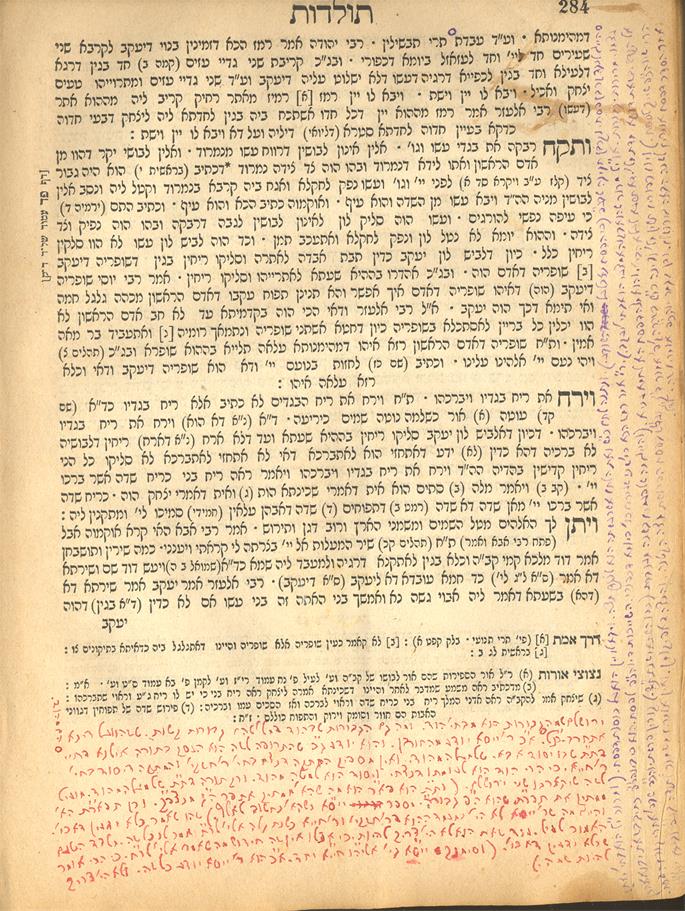
This Zohar belonged to the famed Kabbalist, Rabbi Levi Yitzchak Schneerson, of righteous memory. Exiled by the Soviets to a primitive town in Kazakhstan, he had neither ink nor paper. He wrote scholarly notes on the margins of his precious Zohar with “ink” his wife made from berries (credit: Library of Agudas Chassidei Chabad – Ohel Yosef Yitzchak Lubavitch).
The Zohar, which translates as “Splendor” or “Radiance,” is considered the fundamental work of Kabbalah. According to tradition, it was largely authored by the great 2nd-century Talmudic sage Rabbi Shimon bar Yochai, with sections (as attested to in the Zohar itself) written by various other Talmudic sages, notably Rabbi Shimon’s student, Rabbi Abba.
Widely unknown for many centuries, the Zohar was only revealed in the 13th century and was published by Rabbi Moshe de Leona, a leading Spanish Kabbalist (for more on this, as well as the debate on the authorship of the Zohar, see The Zohar’s Mysterious Origins).
Unlike Sefer Yetzirah and the Bahir, which are very short and cryptic, the Zohar was written very comprehensively and became the source for all later authoritative Kabbalistic teachings.
Sample Teaching:
Rabbi Chezkiah opened [his discourse] and said: “It is written: ‘As a rose among the thorns, so is my beloved amongst the daughters.’5 Who is the rose? This refers to ‘Knesset Yisrael’—the collective soul roots of Israel, [malchut]. (For there is one level of a rose and there is another level of a rose.) Just as a rose, which is found amidst the thorns, has within it the colors red and white, also Knesset Yisrael has within her both judgment and lovingkindness. Just as a rose has in it thirteen petals, so too Knesset Yisrael has within her thirteen paths of mercy which surround her from all her sides.”6
These opening words of the Zohar illustrate the loving relationship between G‑d and His people, and the 13 pathways of mercy that remain open even in the darkest of times. For a translation and commentary of this section, see The Rose Among the Thorns.
For some more selections from the Zohar with English commentary, see The Zohar.
Pardes Rimonim (“Orchard of Pomegranates”)
The handwritten title page to Pardes Rimonim (credit: Columbia.edu).
The Pardes Rimonim (“Orchard of Pomegranates”) was authored by the 16th-century Kabbalist Rabbi Moses Cordovero, widely known as the Ramak. Written when he was only 27, it is the first work to systematize and synthesize the entire spectrum of Kabbalistic thought, and it resolves many apparent contradictions and questions in Kabbalah in an orderly and relatively philosophical system.
In the last year of the Ramak’s life, the great Kabbalist Rabbi Yitzchak Luria (known by the acronym “Ari” or “Arizal“)came to Safed to study under the Ramak, whom he refers to as “our teacher.” According to one tradition, the Arizal actually arrived in Safed on the exact day of Rabbi Moshe Cordovero’s funeral in 1570. When he joined the funeral procession, he realized that no one but he saw a pillar of fire following the Ramak’s presence.
In many places in Kabbalistic text and the Zohar, we find that various colors parallel the sefirot. One must be very careful and not imagine that this is to be taken literally. Color is something physical, used to describe the physical world, and the sefirot, which are spiritual, should not be described with physical properties. If a person thinks that these are literally the colors of the sefirot, he destroys the entire system and oversteps the boundaries set by the ancients. One who delves into this should therefore be most careful not to assume that anything physical is implied.
Actually, these colors allude to the results that are transmitted from the highest roots. Thus, gevurah is responsible for victory in war. Since this involves bloodshed, where red blood is spilled, it is fitting to ascribe the color red to this sefirah. The color red likewise expresses hatred, anger and rage. This is obvious. We therefore ascribe the color red to the place of judgment. Furthermore, everything that is red is derived from the power of this root. . . .
Likewise, the color white indicates mercy and peace. This is because people with white hair are usually merciful. Thus, for example, the elders and aged do not usually fight in armies. Therefore, if you wish to depict peace and the sefirah of kindness and mercy, you depict it with the color white.
There is no question that things that are white emanate from the power of this root . . . this then is the proper interpretation of the relationship between the colors and the sefirot. The colors are used allegorically to allude to their functions and results.7
These opening words in the chapter Shaar Hagevanim (Gate of Colors) stress an extremely important rule to keep in mind whenever one learns Kabbalah: Never make the mistake of ascribing literal, physical properties to the spiritual. At the same time, all properties that are manifest in the physical are a reflection of spiritual roots.
For some more samples of Rabbi Moshe Cordevero’s work, see here.
Kitvei HaArizal (“Writings of the Arizal”)
The title page to Shaar Hagilgulim (“Gate of Reincarnation”) printed in Frankfurt (credit: Columbia.edu).
The Kitvei HaArizal (“Writings of the Arizal”), the teachings of Rabbi Yitzchak Luria, are considered by the Kabbalists to be the most authoritative texts of Kabbalah after the Zohar. Rabbi Luria himself wrote relatively little. All we have from his own hand are novellae on two Talmudic tractates (included in the Shitah Mekubetzet, written by his uncle and teacher, Rabbi Betzalel Ashkenazi). A few Kabbalistic teachings in Rabbi Chaim Vital’s Eitz Chaim are marked with the preface, “found written in manuscript,” indicating that they were written by the Arizal. He also left a commentary on a small section of the Zohar and a few hymns for the Shabbat meals.
The Arizal passed away in the year 1572 at the early age of 38, a little more than two years after arriving in Safed.
The bulk of his teachings were recorded in numerous works by his disciples, primarily Rabbi Chaim Vital. The main work of the Kitvei Arizal is the Etz Chaim (“Tree of Life”), which expounds the theoretical foundation of the Kabbalah. Some of the other works are Pri Etz Chaim (“Fruit of the Tree of Life”) and Shaar HaKavanot (“Gate of Meditations”).
Despite his passing at a young age, one cannot overestimate the Arizal’s great impact both on the revelation and development of Kabbalah, as well as on Jewish law, customs and liturgy. He introduced many important Kabbalistic concepts, including the tzimtzum and shevirat hakeilim (fallen sparks), and it is our job to elevate the world and these fallen sparks of holiness.
Sample Teaching:
It is stated in the Torah that [one of the punishments for national wrongdoing is that] “G‑d will return you to Egypt in ships . . . and you will be sold there to your enemies as slaves and handmaidens, and no one will buy.”8 Why is causing us to return to Egypt a punishment? The Torah does indeed tell us that “you shall see them [the Egyptians] no more.”9 [But is going against the Torah’s command a punishment?]
Also, why did G‑d say this about Egypt, but not about other exiles? Why is He against our returning to Egypt, but permits us to travel to Babylonia or Media?
. . . The four exiles correspond to the four letters of the name Havayah, and the exile of Egypt to the upper tip of the yud, which outweighs them all and is greater than them. It is therefore mentioned repeatedly [in the Torah] and is not listed together with the other [exiles], for it is in a class by itself.
Now, the purpose of exile is to elevate the fallen sparks of holiness that [were scattered all over the earth and] were mixed in with evil due to the sin of Adam. This is the meaning of the verse, “There is a time when a man overcomes another man to his detriment,”10 meaning that the “evil man” overcomes the “holy man” to his own detriment, for the fact that he oppresses Israel and rules them allows Israel to totally extract from him all the sparks of holiness within him.
And wherever they go, the Shechinah goes with them, in order to elevate her component parts.That is why we are commanded not to return to Egypt, but are not so prohibited with regard to other nations [that have oppressed us], for we have not yet elevated all [the divine sparks] within them.11
This teaching illustrates one of the great innovations found in Rabbi Luria’s teachings—that the purpose of exile is to elevate the fallen sparks of holiness that were scattered all over the earth and were mixed in with evil due to the sin of Adam.
To read the rest of this teaching with explanation, see The Jew and Egypt. For more on the concept of elevating the Divine sparks, see Scattered Sparks.
For more on the Arizal and his teachings, see the Holy Ari.
Csanád Szegedi, a la izquierda, en el documental Keep Quiet (2016). Imagen: AJH Films / Passion Pictures.
En el verano del 2012 Hungría se quedaba impactada al saber que Csanád Szegedi dimitía de su cargo como vicepresidente del partido de ultraderecha neofascista Jobbik. El número dos de la tercera fuerza política del país acababa de descubrir que era judío.
Esta es la historia de dos vidas en una, la de un depredador que se convirtió en presa solo cruzando el espejo.
Retrato de Csanád: Jobbik y la Guardia Húngara.
Csanád Szegedi nació el 22 de septiembre de 1982, él mismo explica en el documental sobre su vida Keep Quiet (2016) que su inclinación política ya estaba decidida desde que en el instituto empezó a leer el Hungarian Forum, un panfleto de propaganda antisemita que, por alguna razón, se distribuía en el ambiente escolar. Csanád mira a la cámara explicando esto con la naturalidad de quien dice que tuvo la mala suerte de estar en un mal momento en el lugar equivocado.
Fuese una epifanía o una mala casualidad, su carrera desde aquí es fulgurante. Durante su época universitaria será un miembro activo de las asociaciones de estudiantes de ultraderecha y por fin en 2003 miembro fundador y número dos del partido político Jobbik (abreviatura de Movimiento por una Hungría Mejor), que ha sido definido como un partido neofascista, neonazi, antisemita, antigitano y homófobo.
Entre 2003 y 2007 el partido se centra en alimentar y apoyar a todos los grupos que se opongan al Gobierno, aplicando la regla de «cuanto peor, mejor» y subiendo gradualmente el nivel de violencia, en una jugada maestra de juego sucio político, hasta que todo salta por los aires en los disturbios de Budapest de 2006. Durante septiembre y octubre Hungría vive un ambiente de guerra civil, disturbios callejeros, agresiones, enfrentamientos con la policía… esto abre a Jobbik la ventana de oportunidad para fundar en 2007 la Guardia Húngara.
Después de haber convocado las manifestaciones, de haber estado gritando en medio de las muchedumbres, de defender en debates políticos el derecho de los magiares (el grupo étnico de Europa del Este con quien se identifica a los húngaros) a autodeterminarse y a expulsar de su territorio a cualquier elemento que fuese contra esa idea idílica de patria perfecta, solo les faltaba un ejército. Un elemento marcial que les quitase ese aire de caos, pues necesitaban transmitir confianza mostrando que estaban dispuestos a defender a quienes habían confiado en ellos.
La Guardia Húngara, de carácter militar y fascista, tenía como intención ser el primer paso hacia una guardia nacional, al estilo de las SA de Hitler. Eso sí, en su web oficial define su propósito con un lenguaje administrativo digno de una calificación cum laude: «Reunir y, basándose en objetivos racionales, organizar a los grupos dispersos en defensa de la Patria».
Csanád, impávido, mira de frente y explica que la fundación de la Guardia significaba para Jobbik hacerse con un brazo armado. Crearon una estética atractiva, un uniforme que les hiciese sentir orgullosos y acogieron a todo tipo de grupos violentos, radicales, con antecedentes penales, ultras de fútbol… no había ningún tipo de control. Solo veinticuatro horas después de fundarse oficialmente, la Guardia Húngara ya tenía otros dos mil nuevos reclutamientos.
«Todo lo que los jóvenes querían era poder y fuerza, la Guardia les dio esa sensación de mandar en algo». No hay dolor en el tono sus palabras, ni siquiera pesar, pero sí un leve rencor de quien ha invitado a copas y ahora no tiene permiso de entrar en el bar.
La Guardia Húngara fue prohibida en el año 2009 por una sentencia del Tribunal de Estrasburgo, al considerarse que sus miembros contribuían a aumentar el clima de antisemitismo y racismo general. Esto no impidió que Csanád, elegido europarlamentario, asistiese a las sesiones en Bruselas con el uniforme de la Guardia.
Es fácil ser arrogante cuando te crees intocable y, visto desde fuera, es aún más fácil confundir arrogancia con valentía. En las elecciones generales de 2010 Jobbik consiguió el 14 % de los votos; nuestro protagonista tenía menos de treinta años y era vicepresidente de un partido de ultraderecha que contaba con casi cincuenta escaños en la Asamblea Nacional.
Era intocable, o casi.
El hombre que sabía demasiado
Zoltán Ambrus se movía en el ambiente de la ultraderecha húngara y había estado en la cárcel por posesión de armas y explosivos. No se sabe bien cómo, consiguió unos documentos, presumiblemente de los archivos de la policía secreta comunista húngara, que demostraban el origen judío de Csanád. Según él mismo confesó después, fue una maniobra de otro partido político contra el poder de Jobbik, él fue solo un ejecutor.
Un ejecutor que sonríe a cámara como una hiena sádica, parece un mal actor interpretando a un psicópata, lo peor es que no es un actor, es un tipo real tremendamente incómodo de mirar. Describe con alegría cruel cómo se citó con Csanád para informarle de lo que había averiguado, puso delante de él los papeles y grabó el momento en el cual le anunciaba que su abuela materna era una superviviente de Auschwitz.
Durante la conversación, que más tarde fue colgada en internet, Csanád parece realmente sorprendido, y le ofrece dinero o un puesto de asesor en Bruselas junto a él con tal de que no enseñe esos documentos en el partido.
Ambrus rechaza el soborno y saborea el momento de ver a aquel tipo completamente desesperado; es lógico pensar que ya estaría bien pagado por quien contrató sus servicios. No era nada personal, solo negocios. Inmediatamente después se va a las oficinas del partido y suelta la bomba.
En un giro digno de una película de Berlanga, el líder de Jobbik le quitó importancia al hecho, incluso se entusiasmó al saberlo: pensaba que así nadie les podría acusar de antisemitas, que tanto Csanád como su abuela, la superviviente, podrían ser un escudo humano perfecto para el partido. No se le pasó por la cabeza que negar el Holocausto y culpar a los judíos y su mentalidad cosmopolita del supuesto expolio al que estaba siendo sometida Hungría ya era suficiente razón para considerar que fomentaban el odio racial.
El resto de los miembros de su partido, más coherentes dentro de su locura, amenazaron a Szegedi con pegarle un tiro en la cabeza.
De repente, era judío.
En este punto del relato Csanád mira de frente a la cámara con la expresión de un gato a punto de ser atropellado, pierde el ritmo y la prestancia que había tenido hasta ese momento en todo el documental para decir que él no esperaba terminar su carrera política tan pronto. La frase es tan inocente y tan ligera que casi da pena, habla como si fuese un atleta extraordinario que se lesiona y no puede volver al deporte.
Después de ese encuentro devastador con Ambrus, de saber que tenía las puertas del partido cerradas y a todo su equipo en contra, va a ver a su abuela, a pedirle explicaciones. Aquel hombre que había defendido la supremacía húngara y negado las matanzas en los campos de concentración, vio por primera vez el número de Auschwitz tatuado en el brazo de aquella anciana. Ella le explicó por qué llevaba tantos años ocultándolo.
De catorce mil judíos en Miskolc, ciudad natal de Csanád, solo volvieron de la guerra ciento cinco; una de ellos era su abuela. Se casó con otro judío superviviente que había perdido a su mujer e hijos en los campos. Al principio todo fue bien, iban a la sinagoga y guardaban todas las costumbres de los judíos ortodoxos, pero en 1950, con el ascenso de los comunistas al poder, un nuevo brote de antisemitismo con ataques violentos se extendió por el país.
Fue en ese punto cuando la familia decidió que no sería nunca más judía, dejaron de ir a la sinagoga, de comer kosher… y el tema se convirtió en un tabú familiar. La madre de Csanád se casó con un húngaro cristiano, y siguió guardando el secreto incluso cuando vio a su hijo radicalizarse cada vez más. O quizá justamente por eso, nunca lo sabremos del todo.
La abuela, ya tan mayor y casi sorda del todo, mantiene el sentido de alerta de quien ha permanecido escondido. Está convencida de que lo que ella vivió volverá a suceder, por eso le dice al nieto, a modo de única explicación, que si eres judío en Hungría debes quedarte callado y quieto, porque todo el mundo los odia y solo espera el momento justo para volver a atacarlos. Los límites del absurdo saltan por los aires cuando el nieto, recién despertado de su dulce sueño fascista, la mira incrédulo y le dice: «¿Volver a suceder? Eso es imposible».
De Csanád a Dovid
Hoy en día la ultraderecha sigue ganando cada vez más terreno en Hungría. El actual primer ministro, Viktor Orbán, a pesar de contar con mayoría absoluta, considera la democracia un estorbo. Por eso ha tomado medidas para limitar la libertad de prensa y ha recortado el poder de la Asamblea Nacional.
Si todo hubiese seguido su curso natural, Csanád estaría orgulloso de formar parte de este giro cada vez más dictatorial del país. En lugar de eso, los días posteriores a la delación buscaba obsesivamente en internet ejemplos de personas a las que les hubiese pasado lo mismo que a él, necesitaba saber qué hacer, porque lo único que pensaba era en suicidarse. Entonces entendió que no le quedaba más remedio que afrontar lo que era, tenía que ser judío.
Cuando el rabino Köves, director de la Congregación Judía Unificada de Hungría, recibió un mensaje de Szegedi en el que este le pedía que lo llamase porque necesitaba hablar con él, pensó que era una trampa o una broma. Csanád tuvo que insistir unas cuantas veces hasta que finalmente se reunieron y hablaron. El rabí cuenta que se encontró con un hombre «en caída libre, que había perdido todos sus amigos y todas sus certezas», y que, aunque Csanád había hecho cosas horribles, sentía la obligación de ayudarlo. Después de discutir acerca de antisemitismo y fe judía, Köves le recomendó estudio y reflexión. Esto incluía no hacer ningún tipo de declaración a los medios, un aislamiento total.
Ahí nació Dovid, como la identidad secreta de un superhéroe.
Dovid estudia hebreo, se hizo circuncidar, guarda el sabbat, come kosher y va a la sinagoga todos los viernes. Viajó a Israel, visitó el monumento en memoria del Holocausto de Yad Vashem y el Muro de las Lamentaciones.
Csanád ha muerto, dice, y Dovid el devoto es su verdadera identidad.
Como quien da una vuelta al objetivo de una cámara a través del que ver el mundo, Csanád Szegedi pasó de mirar alrededor como un fascista húngaro a tener el punto de vista de un judío ortodoxo, pero siempre con el mismo encuadre, el de un fanático.
Él mismo cuenta que el racismo y la violencia se habían convertido para él en una especie de adicción. Comenzó señalando a los gitanos como causa de los males del país, siguió con los judíos, los homosexuales, la quema de banderas de Europa… pasando niveles como en un videojuego. La progresión de su nueva vida, ahora casi ascética, repite el mismo modelo, esta vez con el sentido de urgencia de quien estuvo en el lugar equivocado los últimos treinta años.
Después de esperar un permiso especial dados sus antecedentes, el director de Keep Quiet lleva al judío recién estrenado Dovid a visitar Auschwitz, porque, a pesar de su conversión, del estudio regular con su rabino y de los testimonios, continúa siendo escéptico acerca de la magnitud del Holocausto. En su visita va acompañado por una superviviente que lo lleva directamente a ver los hornos crematorios, y ahí, con una expresión un tanto estúpida, asiente torpemente y dice que sí, que era justo esto lo que necesitaba ver para darse cuenta de que todo era verdad. Por primera vez en la historia, el arrepentido es a la vez el maestro de ceremonias de su propio auto de fe.
¿Cuánto de lo que creemos de nosotros mismos somos de verdad nosotros? ¿Cuánto es fruto del ambiente o del adoctrinamiento? ¿Cuánto del tabú? Dovid quiere mudarse a Israel y entrar de nuevo en política; Csanád, el que se quedó a las puertas del éxito, estaría orgulloso de él. En el fondo, no estaban tan lejos uno del otro.
In rambling speech, PA president gives a ‘history lesson’ in which he tries to negate Jewish connection to Israel, accuses Zionists of cooperating with Hitler
By TOI staff
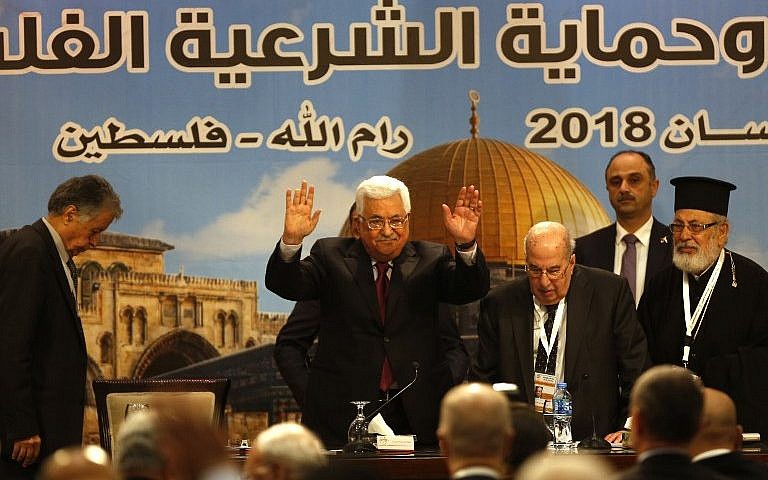
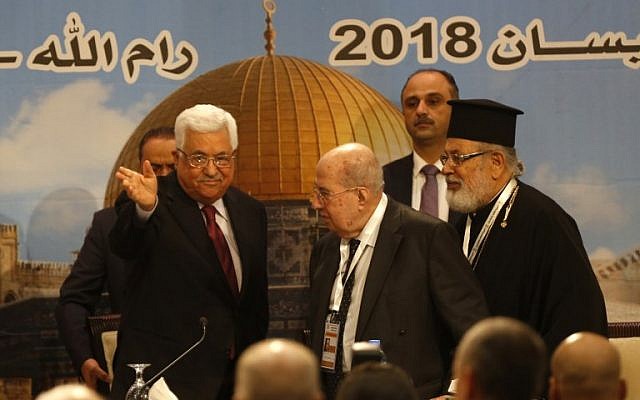
Palestinian Authority President Mahmoud Abbas gestures during the Palestinian National Council meeting in Ramallah on April 30, 2018. (AFP Photo/Abbas Momani)
Palestinian Authority President Mahmoud Abbas on Monday said that the Holocaust was not caused by anti-Semitism, but by the “social behavior” of the Jews, including money-lending.
In a long and rambling at speech in Ramallah at a rare session of the Palestinian National Council, Abbas touched on a number of anti-Semitic conspiracy theories during what he called a “history lesson,” as he sought to prove the 3,000 year-old Jewish connection to the Land of Israel is false.
Abbas said his narrative was backed by three points made by Jewish writers and historians, the first being the theory oft-criticized as anti-Semitic that Ashkenazi Jews are not the descendants of the ancient Israelites.
Pointing to Arthur Kessler’s book “The Thirteenth Tribe,” which asserts Ashkenazi Jews are descended from Khazars, Abbas said European Jews therefore had “no historical ties” to the Land of Israel.
He went on to claim that the Holocaust was not the result of anti-Semitism but rather of the Jews “social behavior, [charging] interest, and financial matters.”
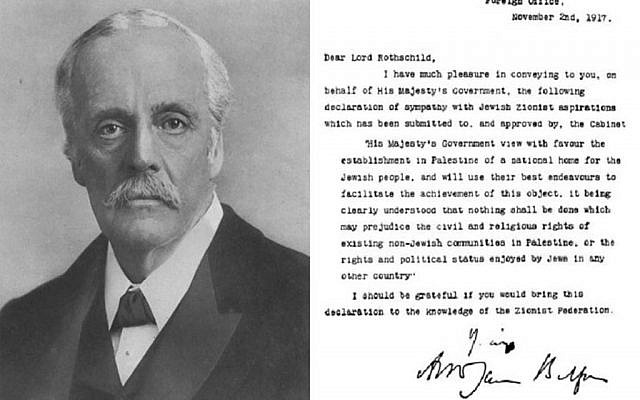
Abbas also claimed Israel was a European project from the start, saying that European leaders such as the United Kingdom’s Lord Arthur Balfour restricted the immigration of Jews to their countries while simultaneously promoting the immigration of Jews to the Land of Israel.
The 1917 Balfour Declaration endorsed the idea of a Jewish state in the Land of Israel.
The Balfour Declaration (Wikipedia)
“Those who sought a Jewish state weren’t Jews,” he said, repeating a claim he made in January when he said that the State of Israel was formed as “a colonial project that has nothing to do with Judaism” to safeguard European interests.
In that January speech, he said that European Jews during the Holocaust chose to undergo “murder and slaughter” over emigration to British-held Palestine.
However, on Monday, Abbas claimed that Adolf Hitler, whose Nazi regime was response for the murder of 6,000,000 Jews in the Holocaust, facilitated the immigration of Jews to Israel by reaching a deal with the Anglo-Palestine Bank (today Bank Leumi) under which Jews who moved to the British Mandate of Palestine could transfer all their assets there through the bank.
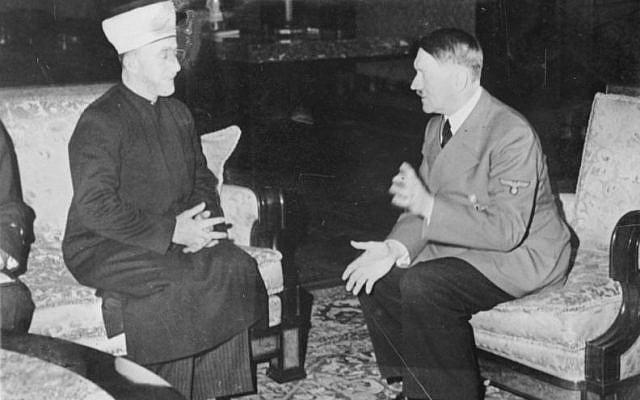
Hitler hosts Grand Mufti Haj Amin al-Husseini in 1941 in Germany. (Heinrich Hoffmann Collection/Wikipedia)
The Palestinian leader has a long history of Holocaust denial. His 1982 doctoral dissertation was titled “The Other Side: the Secret Relationship Between Nazism and Zionism,” and he has in the past been accused of denying the scope of the Holocaust. The dissertation reportedly claimed that the six million figure of Holocaust victims was hugely exaggerated and that Zionist leaders cooperated with the Nazis.
Abbas, in his Monday address, made no mention of the Jews’ historic presence and periods of sovereignty in the holy land. Israel is the only place where the Jews have ever been sovereign or sought sovereignty.
We will not accept the US
Abbas also spoke at length about the failed peace process, saying that the corruption investigation that felled former prime minister Ehud Olmert was meant to prevent him from reaching a peace deal. Olmert has made similar accusations.
Abbas previously said he rejected Olmert’s peace offer a decade ago. The Olmert proposal provided for a near-total Israeli withdrawal from the West Bank and the Arab neighborhoods of East Jerusalem, and would have placed the Old City — home to Jerusalem’s most sensitive holy sites — under international control.
Abbas also again preemptively rejected the peace plan that the Trump administration is working on, amid an ongoing and deep rift with the US.
Abbas told the PNC that he plans to take unspecified “tough steps” soon against Israel and the United States.
Abbas told the hundreds of delegates that he was sticking to his rejection of any US proposals for an Israeli-Palestinian peace deal following the Trump administration’s recognition in December of Jerusalem as Israel’s capital and a decision to move the US Embassy there in mid-May.
“This is completely unacceptable,” he said, during the opening of a four-day meeting in the West Bank. “We will not accept this deal, and we will not accept the US as the sole broker.”
Palestinian Authority President Mahmoud Abbas speaks while US President Donald Trump listens before a meeting at the Palace Hotel during the 72nd United Nations General Assembly on September 20, 2017, in New York. (AFP PHOTO / Brendan Smialowski)
Abbas did not refer to those reports specifically, but said he has been assured that Saudi Arabia remains supportive of the Palestinian positions. “We hear lots of rumors,” he told the delegates. “Don’t believe them.”
The 82-year-old Abbas warned that he might “take tough steps in the near future in our relationship with our neighbors (Israel) and the Americans.” He did not elaborate, but said they would be important and far-reaching.
Hamas and Gaza
The meeting of the Palestinian National Council comes at a time of deep divisions between Abbas and his domestic rival, the Hamas terror group that controls the Gaza Strip.
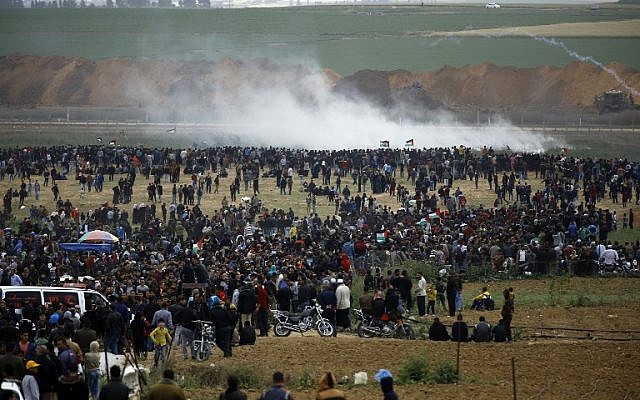
Hamas has raised its profile in recent weeks by organizing mass protests on the Gaza border with Israel. In the weekly marches, thousands of Palestinians gather near the border fence, with smaller groups approaching the barrier, throwing stones or firebombs and burning tires.
More than 40 protesters have been killed and more than 1,700 wounded by Israeli army fire over the past month, according to the Hamas-run health ministry in Gaza. Israel, which has come under mounting international criticism for the use of lethal force against the protesters, says it has the right to defend its border. It accuses Hamas of using the protests as cover for attacks and has shown groups trying to breach the fence. Hamas has acknowledged that five of those killed on the first Friday of the riots were its members, and has since been silent on whether fatalities were its members.
Israel says the 6,000 residents of nearby Israeli communities would be in mortal peril if the Hamas-led Palestinians breached the fence.
Palestinians take part in demonstrations near the border with Israel east of Jabalya in the northern Gaza strip on March 30, 2018. (AFP/Mohammed Abed)
Abbas praised the “brothers in Hamas” for belatedly adopting what he called peaceful resistance. “Thank God, they (Hamas) finally agreed and this is effective,” he said, while urging organizers to keep their children from protests along the border between Israel and Gaza, warning of a “handicapped” generation.
“Keep the young men from the border, move the children away, we do not want to become handicapped people,” he said.
Hamas leaders have declared that the protests aim to erase the border and liberate Palestine, and some have suggested there would be an eventual mass breach of the border.
Despite the rare praise for his rivals, Abbas posed tough conditions for ending the internal rift that broke open in 2007, when Hamas drove Abbas-loyal forces from Gaza a year after winning Palestinian parliament elections. Since the Hamas takeover, Israel and Egypt have enforced a border blockade on Gaza, aimed at stopping the inflow of rockets and weapons.
Masked gunmen from the Izzedine al-Qassam Brigades, a military wing of the Hamas terror group, march with their weapons, during a large-scale drill across the Gaza strip, March 25, 2018. (AP Photo/ Khalil Hamra)
Egyptian mediators have proposed that Abbas assume government responsibilities in Gaza as a way of ending the blockade. Abbas said Monday that he will do so only if Hamas hands over all authority — an unlikely prospect since the terror group refuses to give up control over its weapons.
“Either they give us everything or they take everything,” Abbas said of Hamas.
A new leadership
Later this week, the Palestinian National Council is to elect a new PLO Executive Committee, an 18-member leadership group that has served in recent years to rubberstamp any decisions by Abbas.
The elections, tightly controlled by Abbas, are expected to install a new group of loyalists in the committee.
Palestinian president Mahmud Abbas (L) gestures during the Palestinian National Council meeting in Ramallah on April 30, 2018. ( AFP PHO
Whatever is hateful to you, do not do to your fellow man.
by Rabbi Tzvi Nightingale
The Talmud tells the story of a gentile who came to Shammai requesting a quickie McConversion to Judaism. He asked to be taught the entire Torah while standing on one foot. Shammai had no patience for the ridiculous and disrespectful request and chased him out of the study hall.
Undaunted, the fellow then proceeded to visit Shammai’s colleague, Hillel with the same request. Hillel instructed him, “Whatever is hateful and distasteful to you, do not do to your fellow man. This is the entire Torah, the rest is commentary. Go learn.”
It seems a little bold of Hillel to claim to summarize the entire Torah in one sentence. And even if he could, what is it about this particular principle that defines all of Judaism? Would not, “I am the Lord your God…” the first of the Ten Commandments or “Shema Yisrael…” and the notion of One God been a more logical place to start?
It takes a genius to be able to distill something into its simplest and most basic component the way Hillel did. Hillel was instructing this gentile about the most crucial component that is the basis of all of Judaism. He was pointing out the most essential ingredient of Judaism before one can even begin to understand the myriad of responsibilities and mitzvot that are part and parcel of being a Jew.
All of Judaism depends on the ability to view another person as real as one views one self.
All of Judaism depends on the ability to view another person as real as one views one self. Understanding God’s word cannot begin without the realization that the person next to me is just as real as me; that another person travelling through life has the self-same experiences of love, pain, hurt and joy from the ups and downs and curveballs in life that I experience so intensely and seriously.
And as simple as this may sound, the fact of the matter is that it is a lifelong and difficult duty to try to accomplish on a daily basis.
This notion that Hillel is describing is expressed at the very beginning of Creation going back to Adam and Eve. After God created Adam and declared that, “It is not good for Man to be alone”, He made a helpmate for him. But before God put Adam into a deep sleep to create Eve from his side, He brought the animals to Adam for him to name. Only after this zoo-naming exercise did God finally provide Adam with his wife.
Why the interruption? Why have Adam name the entire animal kingdom before he met Eve? A prerequisite to the very first relationship in the history of mankind was the need for Adam to be able to practice and master the ability to relate to something outside of himself. He needed to realize that he was not the center of the universe. If he thought he was, his relationship with his soon-to-be wife would be doomed. Adam needed training in relating to something – anything, even an animal – before he’d be ready to begin a serious relationship with another.
While this lesson may be obvious, too often people cannot adjust to their new reality of putting another on equal or even higher footing than the self. It is not easy for a person to make the necessary and continuous effort to exercise heart and mind to look beyond oneself and see others as real beings with similar needs, fears, cares, goals and everyday concerns.
All of the Torah’s instructions for living rest on the ability to treat someone else as seriously as you would want another to treat you; to see another as a full human being created in God’s image just as you know with certainty that to be the case about yourself.
Once this becomes clear, the rest of the Torah is merely the commentary and details of how to carry it out.
The word “apocalypse” (literally translated as “an uncovering”) historically referred to revelations and prophecies related to the ultimate destiny of humanity, what some would call “the end of days” (eschatology).
However, the term is commonly used in reference to large-scale catastrophic events leading up to the doom of humanity and the end of the world as we know it.
So in answer to your question, if you’re referring to the original meaning, then yes, Judaism definitely believes in the apocalypse—as in the coming of Moshiach and the resurrection of the dead. (The details of what will happen vary significantly from the prophecies and traditions familiar to other religions. Learn more about it here.)
If, however, your question is about the apocalypse in the colloquial sense, then it is a bit more complicated.
Six Thousand Years—Then Destruction
Perhaps the best place to start is with the following statement in the Talmud:
Rav Ketina says: “Six thousand years is the world, and it is in ruins one [thousand], as it is stated: ‘The L‑rd alone shall be exalted on that day’1 (and the day of G‑d lasts one thousand years).” Abaye says: “It is in ruins for two thousand years, as it is stated: ‘After two days He will revive us; in the third day He will raise us up, and we shall live in His presence.’”2
. . . It has been taught in accordance with the opinion of Rav Ketina: Just as the Sabbatical year abrogates debts once in seven years, so too the world abrogates its typical existence for one thousand years in every seven thousand years, as it is stated: “The L‑rd alone shall be exalted on that day,” and it states: “A psalm, a song for the Shabbat day,” meaning a day—i.e., one thousand years—that is entirely Shabbat. And it says, “For a thousand years in Your eyes are but like yesterday when it is past . . .”3
What Does It Mean?
There is much discussion regarding the exact meaning of Rav Ketina’s statement.
Some commentators, like Rabbi Shlomoben Aderet (the Rashba)4 and Rabbi (Don) IsaacAbarbanel5 explain it in the literal sense, that the world will ultimately return to the state of nothingness from which it came. Others, like Rabbeinu Bechayei, while also interpreting it in the literal sense, explain that it refers to only part of the world.6 Maimonides, on the other hand, is of the opinion that the Talmudic statement is figurative.7
In this vein, Rabbi Menachem Meiri offers a number of possible explanations. One approach is that the millenium of destruction refers to a period of great persecution of the Jewish people. According to this explanation, the “year of destruction” is actually the sixth millennium, and Rav Ketina’s statement should be read as saying, “Six thousand years is the world, and it is in ruins one thousand—of those six. Afterwards, there will be the messianic era.”8
Alternatively, he explains that the “destruction” may actually refer to the destruction of the coarseness of the mundane world.9
The Thousand-Day Shabbat
The third Lubavitcher Rebbe, known as the Tzemach Tzedek, points out that on the one hand there are Torah sources that state that the reward for our Divine service will be in the seventh millennium,10 while on the other hand, Rav Ketina states that the world will be desolate in the seventh millennium. How can both be true?
He explains that when the Talmud compares those thousand years to Shabbat, it is explaining the nature of the “desolation.” The word “Shabbat” itself can mean either “rest” or “annulment”—and in this case it means both.
When the Talmud says the seventh millennium will be “desolate,” it means that there will be such a great spiritual revelation during that period that we will have no physical needs, like eating and drinking. Thus, all physical work that comes along with our physical needs, like plowing and planting, will be “annulled.” Instead, the souls will delight in the Divine glory.11
Nevertheless, the ultimate goal is the eighth millennium, when the physical itself will be refined to the point where the physical world and the great spiritual revelation will be integrated.12
May we merit the coming of Moshiach speedily in our days!
Footnotes
1.Isaiah 2:11.
2.Hosea 6:2.
3. Talmud, Sanhedrin 97a.
4. Teshuvot HaRashba 1:9.
5. Yeshuot Meshicho, Iyun 1:1.
6. Rabbeinu Bechayei, Numbers 10:35.
7. Guide for the Perplexed 2:29.
8. Meiri, preface to Pirkei Avot.
9. Ibid. See also Tzemach Tzedek, additional comments to Tehillim 9–10 (Sefer HaLikkutim, s.v. charuv, p. 943).
10. See, for example, Tanya, Likkutei Amarim, ch. 36.
11. Tzemach Tzedek, Tehillim, pp. 631–632; Sefer HaLikkutim, s.v. charuv, pp. 944–945.
12. Tzemach Tzedek, Shir HaShirim 14; Sefer HaLikkutim, s.v. charuv, p. 949.
Time management is more than management and larger than time. It is about life itself. God gives us one thing above all: life itself. And He gives it to us all on equal terms. However rich we are, there are still only 24 hours in a day, seven days in a week, and a span of years that, however long, is still all too short. Whoever we are, whatever we do, whatever gifts we have, the single most important fact about our life, on which all else depends, is how we spend our time.[1]
“The span of our life is 70 years, or if we are strong, 80 years,” says Psalm 90, and despite the massive reduction of premature deaths in the past century, the average life expectancy around the world, according to the most recent United Nations figures (2010-2015) is 71.5 years.[2] So, concludes the Psalm, “Teach us to number our days that we may get a heart of wisdom,” reminding us that time management is not simply a productivity tool. It is, in fact, a spiritual exercise.
Hence the following life-changing idea, which sounds simple, but isn’t. Do not rely exclusively on To Do lists. Use a diary. The most successful people schedule their most important tasks in their diary.[3] They know that if it isn’t in there, it won’t get done. To Do lists are useful, but not sufficient. They remind us of what we have to do but not when. They fail to distinguish between what is important and what is merely urgent. They clutter the mind with trivia and distract us when we ought to be focusing on the things that matter most in the long run. Only a diary connects what with when. And what applies to individuals applies to communities and cultures as a whole.
That is what the Jewish calendar is about. It is why chapter 23, in this week’s parsha, is so fundamental to the continued vitality of the Jewish people. It sets out a weekly, monthly and yearly schedule of sacred times. This is continued and extended in Parshat Behar to seven- and 50-year schedules. The Torah forces us to remember what contemporary culture regularly forgets: that our lives must have dedicated times when we focus on the things that give life a meaning. And because we are social animals, the most important times are the ones we share. The Jewish calendar is precisely that: a structure of shared time.
We all need an identity, and every identity comes with a story. So we need a time when we remind ourselves of the story of where we came from and why we are who we are. That happens on Pesach, when we re-enact the founding moment of our people as they began their long walk to freedom.
We need a moral code, an internalized satellite navigation system to guide us through the wilderness of time. That is what we celebrate on Shavuot when we relive the moment when our ancestors stood at Sinai, made their covenant with God, and heard Heaven declare the Ten Commandments.
We need a regular reminder of the brevity of life itself, and hence the need to use time wisely. That is what we do on Rosh Hashanah as we stand before God in judgment and pray to be written in the Book of Life.
We need a time when we confront our faults, apologize for the wrong we have done, make amends, resolve to change, and ask for forgiveness. That is the work of Yom Kippur.
We need to remind ourselves that we are on a journey, that we are “strangers and sojourners” on earth, and that where we live is only a temporary dwelling. That is what we experience on Sukkot.
And we need, from time to time, to step back from the ceaseless pressures of work and find the rest in which we can celebrate our blessings, renew our relationships, and recover the full vigor of body and mind. That is Shabbat.
Doubtless, most people — at least, most reflective people — know that these things are important. But knowing is not enough. These are elements of a life that become real when we live them, not just when we know them. That is why they have to be in the diary, not just on a To Do list.
As Alain de Botton points out in his Religion for Atheists, we all know that it is important to mend broken relationships. But without Yom Kippur, there are psychological pressures that can make us endlessly delay such mending.[4] If we are the offended party, we may not want to show other people our hurt. It makes us look fragile, vulnerable. And if we are the offending party, it can be hard to admit our guilt, not least because we feel so guilty. As he puts it: “We can be so sorry that we find ourselves incapable of saying sorry.” The fact that Yom Kippur exists means that there is a day in the diary on which we have to do the mending — and this is made easier by the knowledge that everyone else is doing so likewise. In his words:
It is the day itself that is making us sit here and talk about the peculiar incident six months ago when you lied and I blustered and you accused me of insincerity and I made you cry, an incident that neither of us can quite forget but that we can’t quite mention either and which has been slowly corroding the trust and love we once had for one another. It is the day that has given us the opportunity, indeed the responsibility, to stop talking of our usual business and to reopen a case we pretended to have put out of our minds. We are not satisfying ourselves, we are obeying the rules.[5]
Exactly so: we are obeying the rules. We are following the Jewish calendar, which takes many of the most important truths about our lives and, instead of putting them on a To Do list, writes them in the diary.
What happens when you do not have that kind of diary? Contemporary Western secular society is a case-study in the consequences. People no longer tell the story of the nation. Hence national identities, especially in Europe, are almost a thing of the past — one reason for the return of the Far Right in countries like Austria, Holland and France.
People no longer share a moral code, which is why students in universities seek to ban speakers with whose views they disagree. When there is no shared code, there can be no reasoned argument, only the use of force.
As for remembering the brevity of life, Roman Krznaric reminds us that modern society is “geared to distract us from death. Advertising creates a world where everyone is forever young. We shunt the elderly away in care homes, out of sight and mind.” Death has become “a topic as taboo as sex was during the Victorian era.”[6]
Atonement and forgiveness have been driven out of public life, to be replaced by public shaming, courtesy of the social media. As for Shabbat, almost everywhere in the West the day of rest has been replaced by the sacred day of shopping, and rest itself replaced by the relentless tyranny of smartphones.
Fifty years ago, the most widespread prediction was that by now almost everything would have been automated. The work week would be down to 20 hours and our biggest problem would be what to do with all our leisure. Instead, most people today find themselves working harder than ever with less and less time to pursue the things that make life meaningful. As Leon Kass recently put it, people “still hope to find meaning in their lives,” but they are increasingly confused about “what a worthy life might look like, and about how they might be able to live one.”[7]
Hence the life-changing magic of the Jewish calendar. Philosophy seeks timeless truths. Judaism, by contrast, takes truths and translates them into time in the form of sacred, shared moments when we experience the great truths by living them. So: whatever you want to achieve, write it in the diary or it will not happen. Andlive by the Jewish calendar if you want to experience, not just occasionally think about, the things that give life a meaning.
Shabbat Shalom.
_______
[1] For an excellent recent book about the way our behaviour is governed by time, see Daniel Pink, When: The Scientific Secrets of Perfect Timing, Riverhead Books, 2018.
[3] See Kevin Kruse, 15 Secrets Successful People Know about Time Management, 2017.
[4] Of course, Yom Kippur atones only for sins between us and God, not for those between us and our fellows. But it is a day when, traditionally, we seek to make amends for the latter also. Indeed most of the sins we confess in the long list, Al Cheit, are sins between humans and other humans.
[5] Alain De Botton, Religion for Atheists, Hamish Hamilton, 2012, 55 – 56.
[6] Roman Krznaric, Carpe Diem Regained, Unbound, 2017, 22.
[7] Leon Kass, Leading a Worthy Life: Finding Meaning in Modern Times, Encounter Books, 2018, 9.
El Libro de Rut nos enseña sobre el gran potencial del ser humano y sobre los catastróficos resultados de utilizarlo de manera incorrecta.
por Rav Dovid Rosenfeld
En Shavuot conmemoramos la revelación en el Sinaí, cuando Dios descendió sobre el Monte Sinaí y proclamó frente a la nación, “Yo soy Hashem, vuestro Dios”. En la sinagoga leemos el Libro de Rut, el cual relata la conmovedora historia de Rut la Moabita, quien dejó todo atrás para seguir a su suegra Naomi a la Tierra Santa, donde terminó convirtiéndose al judaísmo y transformándose en la bisabuela del Rey David.
La relevancia que tiene el libro de Rut para Shavuot es suficientemente clara. Tal como nosotros aceptamos la Torá y la misión judía en el Monte Sinaí, asimismo Rut ingresó voluntariamente al pacto para volverse parte de aquella gloriosa misión.
Pero hay una fascinante trama secundaria en la historia que tuvo grandes implicaciones en la historia judía.
El Libro de Rut comienza con el relato sobre la hambruna que hubo en Tierra Santa. Elimelej de Beitlejem deja el país para dirigirse a Moab, llevando con él a su esposa Naomi y a sus dos hijos. Elimelej muere en Moab y su esposa y sus hijos se quedan allí. A continuación sus hijos se casan con mujeres no judías: con las princesas moabitas Rut y Orfa. Los hijos también mueren y finalmente Naomi decide regresar a Israel, viuda, sin hijos y empobrecida.
Las nueras de Naomi, Rut y Orfa, la acompañan a lo largo del camino. Como se ve con claridad en el Talmud (Yevamot 47b), no lo hicieron como una mera cortesía, sino que ellas también querían entrar y residir en la tierra de Israel. A lo largo de sus años de matrimonio se apegaron al judaísmo. Querían convertirse por completo en judías, observar la fe y vivir en la tierra. Naomi intentó disuadirlas en tres ocasiones (versículos 1:8, 1:11 y 1:12;el Talmud deriva de aquí la cantidad de veces que debe ser disuadido un potencial converso). En dos ocasiones ellas se mantuvieron firmes; en la tercera, Orfa se debilitó y decidió regresar. Rut, sin embargo, se mantuvo fuerte. Continuó acompañando a su suegra rumbo hacia la Tierra Santa.
Naturalmente, el Libro de Rut continúa relatando la historia de Naomi y Rut: cómo regresaron empobrecidas a Beitlejem, cómo Rut atrajo la atención del ilustre pariente de Naomi, Boaz, y cómo ella le señaló de manera poco convencional que se casaran y preservaran el linaje de Elimelej.
Tan pronto como Orfa se apartó de la compañía de Naomi y Rut, se fue al extremo opuesto.
Orfa, por otro lado, desaparece de la historia y es olvidada. Luego de una breve aparición, sale del escenario y presumiblemente ya no vuelve a desempeñar ningún papel en ella. Había sido una de tantos “casi” a lo largo de la historia: gente que luchó por alcanzar la grandeza y la inmortalidad, pero que no resistieron y, en lugar de eso, se desvanecieron en el anonimato.
Pero nuestros sabios nos cuentan una fascinante secuela de la historia de Orfa: sus descendientes desempeñarían un importante papel en la historia judía… pero al otro lado de la calle.
Uno pensaría que Orfa no era un personaje tan malo. Era una seria candidata para la conversión, y se tomaba con seriedad la religión y la espiritualidad. Simplemente no alcanzó a llegar a una conversión total.
Pero el Talmud nos cuenta otra cosa. Tan pronto como Orfa se apartó de la compañía de Naomi y Rut, se fue al extremo opuesto. Naomi se refiere a ella como que “retornó a su gente y a sus dioses” (1:15). El Talmud (Sotá 42b) explica lo que ocurrió a continuación. Luego de dejar a Naomi, Orfa corrió hacia un batallón de 100 soldados y se sometió voluntariamente a todos ellos. De alguno de ellos quedó embarazada y dio a luz al gigante Goliat, con quien se enfrentaría posteriormente el joven David. (énfasis mío)
¿Cómo es posible que una mujer con tanto potencial para alcanzar la grandeza haya llegado a un extremo tan desenfrenado?
Hay un poderoso mensaje en esto. Orfa tenía el potencial para alcanzar la grandeza. Casi se desprendió de su pasado y de su tierra natal para unirse a una nueva religión. Estaba dispuesta a entregarse por completo por sus creencias, por seguir a Naomi a cualquier costo. Claramente tenía las semillas de grandeza en su interior.
Pero no lo hizo. Se echó atrás. Y tomo ese mismo fervor y autosacrificio, y lo llevó al extremo opuesto.
En lugar de transformarse en un gigante espiritual, se transformó en la madre de gigantes físicos.
Lo que le ocurrió a Orfa es lo mismo que le ha ocurrido a muchas personas a lo largo de la historia. Si una persona tiene el potencial para alcanzar la grandeza (como todos nosotros) y no lo aprovecha, entonces puede tomar esa misma energía y utilizarla para el mal. Orfa casi alcanzó la grandeza. Pero no pudo aguantar. Y, frustrada con la religión, tomó los mismos poderosos impulsos de lograr cosas y los dirigió hacia el plano físico. En lugar de transformarse en un gigante espiritual, se transformó en la madre de gigantes físicos. El libro de II Shmuel 21:18-22 describe cómo eventualmente dio a luz a cuatro gigantes, todos los cuales fueron posteriormente asesinados por el Rey David y sus hombres.
La némesis de Orfa era Rut, quien sí aguantó y quién sí transformó su potencial en una vida de grandeza. Rut se transformó en madre dentro del pueblo de Israel, bisabuela del gigante espiritual David. Y Goliat cayó ante David en batalla, en lo que era en esencia una batalla entre dos formas de ver el mundo, una batalla entre lo físico y lo espiritual. Como dice el Talmud (Sotá 42b): “El Santo, bendito sea, dijo: ‘Que los hijos de la besada (de Orfa, a quien Naomi besó como despedida) caigan en manos de los hijos de quien se aferró”.
La historia de Rut y Orfa es por lo tanto una historia sobre el tremendo potencial de la humanidad, y de lo mucho que está en juego dependiendo de cómo se utilice dicho potencial.
Esto también nos enseña una importante lección sobre la revelación en Sinaí, la cual celebramos en Shavuot. Los seres humanos tenemos un tremendo potencial para alcanzar la grandeza. Tenemos un impulso natural de transformarnos en personas importantes, de alcanzar la inmortalidad. Dios le dio la Torá a Israel para permitirnos dirigir dichos impulsos. Los mandamientos de la Torá no son simplemente actos que debemos realizar, o formas de ganarnos nuestra recompensa celestial, son medios para desarrollarnos a nosotros mismos, para dirigir nuestro impulso de lograr cosas hacia la espiritualidad y el perfeccionamiento del mundo.
En Sinaí nos encontramos cara a cara con Dios, un Dios al que anhelábamos acercarnos. Y se nos ordenó apegarnos a Él, tratar de cerrar la brecha que hay entre el mundo físico y lo divino. El encuentro del Sinaí despertó en nosotros un enorme impulso por alcanzar espiritualidad e inmortalidad. Y desde entonces, los judíos no han sido capaces de quedarse sin hacer nada. Tenemos un impulso por lograr cosas, por sentirnos realizados, y por volvernos semejantes a Dios y eternos.
Y con estas nobles metas frente nuestro, hay mucho que está en juego en la vida. Dios nos dio la Torá para que dirijamos nuestras energías hacia la divinidad y a lograr cosas significativas. Debemos tomar nuestros sentimientos y emociones más fuertes, y dirigirlos hacia Dios. Y si lo hacemos de forma apropiada, no habrá límite para lo que podemos lograr y para cuán significativa se volverá nuestra relación con Dios. Pero si no lo hacemos, sentiremos un impulso por cualquier otra causa imaginable: comunismo, anarquismo, liberalismo, capitalismo, lo-que-quieras-ismo. Luego de haber visto a Dios en el Monte Sinaí, nunca más podremos quedarnos sin hacer nada y mantenernos sin cambiar. Nos volvimos vivos, poseídos, y con un impulso por marcar una diferencia. Y la Torá nos enseñó cómo canalizar ese impulso.
Parte de las ideas escritas anteriormente se encuentran basadas en pensamientos de Rav Mattis Weinberg.










 Centro Estudios Judaicos del Sur de PR