RSS

Author Archives: yishmaelgunzhard

A Strange Drawing Found in Sinai Could Undermine Our Entire Idea of Judaism

Is that a 3,000-year-old picture of god, his penis and his wife depicted by early Jews at Kuntillet Ajrud?

More than four decades after its excavation wound down, a small hill in the Sinai Desert continues to bedevil archaeologists. The extraordinary discoveries made at Kuntillet Ajrud, an otherwise nondescript slope in the northern Sinai, seem to undermine one of the foundations of Judaism as we know it.

Then, it seems, “the Lord our God” wasn’t “one God.” He may have even had a wife, going by the completely unique “portrait” of the Jewish deity that archaeologists found at the site, which may well be the only existing depiction of YHWH.

Kuntillet Ajrud got its name, meaning “the isolated hill of the water sources,” from wells at the foot of the hill. It is a remote spot in the heart of the desert, far from any town or or trade route. But for a short time around 3,000 years ago, it served as a small way station.

Dozens of drawings and inscriptions, resembling nothing whatever found anywhere else in our region, survived from that period, which seems to have lasted no longer than two or three decades. Egypt gained the artifacts with the peace treaty with Israel 25 years ago, but the release of the report on the excavation six years ago and a book about the site two years ago have kept the argument over the exceptional findings from the hill in Sinai alive.

Kuntillet Ajrud

The hill lies 50 kilometers south of Kadesh Barnea and 15 kilometers west of the ancient Darb el-Ghazza route, which led from Gaza to the Read Sea’s Gulf of Eilat. Its unique qualities were first noticed in 1870 by the British explorer Edward Palmer who discovered a fragment of a clay jar, a pithos, marked with the Hebrew letter aleph.

Later, in 1902, a Czech orientalist and explorer, Alois Musil but was attacked by local Bedouins who claimed that he was defiling a holy site. Exploration would only resume in 1975, by the Tel Aviv University archaeologist Ze’ev Meshel, as a collaboration between the university and the Israel Exploration Society.

The excavation showed that Kuntillat Ajrud was what’s called a “single-layer site,” meaning, it had been occupied for just one period, which the excavators dated to the late ninth century or early eighth century B.C.E.

Meshel estimated that it had been occupied very briefy, 25 years at most. Structure-wise, the excavators only found two fairly simple, unimpressive structures. The wonder lay in the drawings and inscriptions.

Ancient Hebrew writing on the rim of a bowl found at Kuntillet Ajrud, dating to about 3,000 years ago

Clay from Jerusalem

At first the archaeologists thought that the place was a military fortress. Other fortresses from the First Temple period had been found in the Negev. But no evidence that there had been a military presence was found, and in the third excavation season, Meshel decided that the structures weren’t that sort.

Nor would Kuntillet Ajrud have been suitable as an inn for travelers: it was too small and was off the beaten track. Nor did it seem to match any of the criteria of a trade station.

The first hint at the true character of Kuntillet Ajrud was the discovery of pottery fragments inscribed with ancient Hebrew letters: quf, quf resh, aleph and yud.

Analysis of the clay from which the pithos (pottery jars) was intriguing. The pots were made of hawar motza, clay only found by Jerusalem. In other words, the jars had been made in area of Jerusalem, which was certainly far away.

Among the inscriptions were a blessing and religious texts. That and the origin of the clay suggested to Meshel that the residents were priests and Levites, who were supported by tithes collected in the Temple in Jerusalem.

In line with the spirit of this interpretation, he also interpreted the letters on the dishes: quf as standing for kodesh (holy), quf-resh as the first two letters in the word korban (sacrifice), and aleph for a korban asham (guilt offering).

The letter yud, Meshel suggests, may represent a vessel that had been used to continued tithes, though he himself casts doubt on that theory: “In First Temple times, they used Egyptian numbers,” he points out.

Another inscription found there argues that the hill had been peopled by a literate elite and even hints at the presence of a school. One vessel contains the Hebrew alphabet twice — one in the crisp, competent handwriting of a well-trained scribe and another in what researchers suspect was the hesitant handwriting of a student.

If all this is true, what was a small group of priests and Levites doing in the middle of the desert?

When King Yoash conquered Judah

Meshel thinks the people dwelling at the site were providing an essential service: writing blessings. But from who, for who? The story gets even more complicated when one examines the site through the lens of geopolitics.

At the time the hill was occupied, the kingdom of Israel existed in the north, ruled from Samaria. The kingdom of Judah existed in the south and had its capital in Jerusalem.

However, the names and inscriptions found at Kuntillat Ajrud seem to be Israelite, not Judahite. It seems to have been an Israelite site — far, far to the south of Israel and even south of the Judah border.

Reconstruction of what may be the image of King Yoash, possibly the only known contemporary portrait of a Judahite king. Found at Kuntillet Ajrud

Why would one kingdom maintain a religious site at the far end of another kingdom?

Meshel thinks the Israelite presence in or beyond the Judean kingdom, and the fact that Jerusalem (the capital of Judah) provisioned this way station of the rival kingdom, indicates that at the time the kingdom of Israel was, or was turning into, a regional power.

Judah was a vassal state subject to the more powerful northern kingdom, he thinks.

As for why Judahite Jerusalem would provision this Israelite-manned hilltop in the middle of nowhere, Meshel suspects it all comes down to Kuntillat Ajrud having been founded by none other than King Yoash of Israel.

“The bible says that war broke out between Amatzia, king of Judah, and Yoash, king of Israel,” he says. Thus the Israelite king Yoash gained control of Judah.

It would have been convenient for Yoash to provision Kuntillat Ajrud from the Temple in Judah. Why would he have sent up north to bring supplies for it from Israel, Meshel asks rhetorically.

If indeed Meshel is right and King Yoash founded the site, he may be the figure drawn on plaster at the entrance of the building.

The drawing, possibly of the king, was restored by Prof. Pirhiya Bar based on similar drawings from the ancient east, in which the royal figure holds a lotus flower. It is a reasonable possibility that the figure depicted at Kuntillet Ajrud was a ruler or king, and if so, then it is the only contemporary visual description we have of a king from biblical times.

“I told myself look at the luck I had, finding the only drawing of a king from the First Temple period,” says Meshel.

A picture of God, and is that his tail

Kuntillet Ajrud also brought images of animals, humans and what seems to be gods.

The one causing the controversy shows a man and a women, drawn naively, with crowned heads and holding hands. The man has either a tail or a large penis, and above him the blessing “Yahweh and his Asherah” is written.

Could the couple on the pithos be a rendering of God and his wife Asherah, the only one ever found?

Dr. Yigal Bin Nun, a researcher and author of “A Brief History of YHWH.” has no doubt. “If you want to step away from reality then you can say this or that, but if you look at it as it is you can’t ignore the truth,” he says.

Among the detractors are Prof. Tallay Ornan, who has studied the images at the site, and Prof. Shmuel Ahituv, an acclaimed ancient inscriptions researcher. Both contributed to a book on the topic together with Meshel and Esther Eshel, published last year.

They think these figures show the minor Egyptian deity Bes, not YHWH, the Jewish god.

“Bes is a dwarf who was the deity of witches,” Ahituv says, adding that in his view, the picture shown wouldn’t befit a major divinity.

Defending the picture as that of YHWH, Ben Nun an Israelite religious site on the border of Judah, under the political auspices of Assyria, would be unlikely to hail Bes, or any Egyptian god or symbol. Egypt was considered hostile. “The Bes explanation is completely illogical,” Ben Nun says.

Furthermore, it’s hard to make sense of the writing “YHWH and his Asherah” without suspecting that this god, at least according to the people on this hill, was married.

God of the south and god of the north

Other phrases found at the site also challenge the known pantheon of Israelite faith. “Yahweh of Teman and his Asherah” and “Yahweh of Samaria and his Asherah,” for example, were also found inscribed at the site.

These are doubly outrageous. If God is one, then how can there be god for the north (Shomron) and for the south (Yemen, still called Teman in Hebrew)?

To make matters worse, does the word “Asherah,” formulated as “his Asherah”, hint that the gods of Israel had a wife? If so, where has she gone?

For Meshel, the site’s main researcher, the issue remains unresolved.

He and Ben Nun suspect the site brings insight to the beliefs of the people living here 3,000 years ago. They did not worship a single al-powerful deity: they were devoted to a pantheon of gods.

It has also long been known that households with Jewish hallmarks, certainly in the First Temple era and later too, also had images of other gods, a.k.a, figurines.

If anything the discoveries at Kuntillet Ajrud indicate that in the late ninth century B.C.E. or the early eighth, the idea of a single deity had not yet consolidated, suggests Meshel. “In this religious reality YHWH is local, for the city, the village, for Shomron and for Teman (Yemen).”

Ashera the tree?

The sheer fact that Kuntillet Ajrud was so far-flung is what enabled it to survive, Meshel further claims – albeit not for long.

Come the seventh century B.C.E., Josiah King of Judah spearheaded a profound religious reformation, that included centralizing ritual sacrifice in Jerusalem and destroying competing sites.

By that time, Kuntillet Ajrud was long since abandoned. Meshel suspects the kingdom simply forgot about it.

Ahituv rejects this whole analysis and thinks that Ashera referred to a tree. Or maybe a thing or place. But not an independent female divinity.

“If you look at the Bible you can see that there is no sacrifice for Ashera – but rather the ashera is chopped down ahead of war,” he says. “It may be a tree but it was not an independent being.”

Regarding the varying names of Jehovah, Ahituv says these are different manifestations of the same god, “its like there are different manifestations of the Holy Mary in different places and everyone knows it’s the same Mary.”

Meshel does not agree: “If you read the phrase as is, clearly the meaning is that she is his partner.”

“The Bible reads: Ashera pesel (Ashera statue) — the statue had to represent someone. We can’t just say it was a log,” Ben Nun bolsters the point. Some also believe the early Jews worshipped trees.

This argument is bound to continue even though access to the actual findings is impossible. As part of the deal with Egypt, all archaeological findings were returned to Cairo in 1993. They have not been shown to the public since then. Meshel fears Kuntillet Ajrud will be forgotten again.

As taken from, https://www.haaretz.com/israel-news/.premium.MAGAZINE-a-strange-drawing-could-undermine-our-entire-idea-of-judaism-1.5973328

 
1 Comment

Posted by on April 7, 2018 in Uncategorized


NBC’s ‘Jesus Christ Superstar’: What were they thinking?

April 4, 2018, 8:21 am

A musical is just a musical and a biopic is just a biopic. Or are they? Popular culture, in an era when many do not study the Bible in the context of its time (or at all), continues to have an impact on the TV, theatre and movie-going public. Most people are well aware of the criticism of Mel Gibson’s film “The Passion of the Christ” as being virulently antisemitic. For instance, on February 25, 2004, in the Baltimore Sun, eminent Catholic theologian, Fr. John T. Pawlikowski wrote, “Mr. Gibson has continued to blame the Jewish leadership in defiance of this scholarly and ecclesial consensus….” Nearly 50 years ago, Jews, Protestants and Catholics raised alarm bells regarding the musical “Jesus Christ Superstar,” citing its depiction of Caiaphas’s role in Jesus’s death and the many historical inaccuracies. They feared the musical would mark a step backward for the real progress that had been made in Christian-Jewish dialog.

And so it was with tremendous disappointment that I viewed the April 1 concert presentation of the nearly 50-year-old Broadway musical Jesus Christ Superstar on NBC television. Like the original film version, the Temple High Priests are dressed in a manner clearly meant to convey evil, this time in hooded long black costumes. These costumes have nothing in common with the actual garb of the Temple High Priests, whose clothing consisted of various garments of white, blue and colorfully embroidered pieces. Pontius Pilate, on the other hand, wears costume of red and gold. In the musical presented Sunday night, once again, the Jews must convince Pilate to crucify Jesus and the crowd of Jews call for his death.

More than 50 years after Vatican II and with the ample contributions to scholarship of many respected Jewish and Christian theologians, one has to wonder why such a narrative would continue to be presented. After 50 years of fruitful interfaith Christian-Jewish dialogue, and the criticism that emerged after the first production nearly a half a century ago, one wonders why the production could not have have been updated.

The idea that any of the members of the various Jewish sects of the time  (as there were no monolithic  “Jews” per se in first century Judea) would have had such influence over their Roman occupiers simply makes no sense. Pilate, in particular, was a harsh and cruel ruler. He was eventually deposed and sent back to Rome because of the very degree of cruelty with which he suppressed a Samaritan uprising (another Jewish faction). Were the Jewish leaders of the time comfortable with Jesus’ emerging recognition as a messianic figure? Likely not, as this translated to sedition to Roman ears. But Jesus was also only one among at least 10 Jewish leaders who, according to historian Louis Feldman, were regarded as potential messiahs during this time period. Other historians believe the number to be even higher. However, they suggest that many tried to suppress the messianic ideals of these revolutionaries in order not to incur the wrath of the Romans who regarded a belief in a messianic ruler to be treasonous.

The Bible — and all sacred texts for that matter — must be read carefully with attention to context. “Give me a break, Belle! How about you just sit back and enjoy the musical for what it is….great songs sang by amazing voices.” Would we say this about “The Birth of A Nation”? Of course not. Are we now discussing how we portrayed indigenous people in Westerns and in animated films? Would we make films like that today? Of course not. And in Canada, this is an even more important discussion than in the US as we attempt to respond to the Calls to Action of the Truth and Reconciliation Commission.

As for the Bible? Well, many consumers of popular culture may never even crack open a Bible. Unless there is a willingness to update this musical that engages in the kind of accusations that once led to pogroms — perhaps we should decide it is as about as appropriate for today as a revival of Disney’s “Pocahontas” would be in an era of Reconciliation.

As taken from, http://blogs.timesofisrael.com/nbcs-jesus-christ-superstar-what-were-they-thinking/

 
Leave a comment

Posted by on April 7, 2018 in Uncategorized


¿Qué dice el judaísmo a propósito de la objeción de conciencia?

Related image

Génesis de la Objeción: el caso de Abraham

Por: Fishel Szlajen, Rabino y y Doctor en Filosofía

Objetar es poner alguna razón en contra de algo. La conciencia es el conocimiento del ser de su propia existencia, de la realidad de su entorno y del sentido y relevancia de sus actos y estados. Un individuo deviene en objetor cuando las exigencias derivadas de alguna norma legal enfrentan el mandato del tribunal de la propia conciencia. La objeción de conciencia relaciona los beneficios de la libertad con la dignidad, la identidad moral, la autonomía y la integridad individual del ser humano. Constituye la faz negativa de la libertad ideológica, ética o religiosa y es un bien jurídico básico, derecho subjetivo reconocido por la Constitución Nacional. Nadie puede ser obligado a actuar en contra de su creencia ni impedido para hacerlo conforme a ella. Un ejemplo extraído de la historia del judaísmo lo remarca.

Se reproduce con permiso un interesante aporte, publicado el 25 de agosto de 2017 en Infobae. (http://bit.ly/2DD6QUy)

La civilización sumeria fue la primera más esplendorosa por urbanización, escritura, ejército, comercio, leyes, medicina y matemática, más el primer sistema monárquico-religioso conocido, conformando el primer conjunto de ciudades Estado. Considerando la importancia de este centro político, comercial, industrial, científico y cultural, difícilmente pueda comprenderse la decisión de Abraham (s. XX-XIX a.e.c.), quien, septuagenario y educado en Ur-Casdim, una importante metrópoli de aquel orbe, emigró hacia tierras lejanas, inhóspitas y culturalmente intrascendentes.

Algunos investigadores describen a Abraham como un refugiado del opresivo y aterrorizante gobierno mantenido por las dos culturas entonces más importantes, la mesopotámica y la egipcia, que obtuvo la independencia política e ideológica mediante su vida nómade. Esta hipótesis es cuestionable, ya que el reino medio de Egipto fue una era generosa, época de reunificación, de grandes obras de irrigación, justicia social y mejor distribución de la riqueza. Y, si bien los antiguos babilonios centralizaron lo político bajo un único rey imperante sobre todas las ciudades Estado, unificándose religiosamente bajo un dios nacional (Marduk), endureciendo las penas y las cláusulas respecto de los anteriores códigos jurídicos, no hay registros sobre la vigencia de aquellos códigos. De hecho, el Código de Hammurabi homogeniza protegiendo la clase media y baja, jurídicamente comparable a la nobleza en cuanto hombres libres. Más aún, si bien en la mitología y la teodicea sumeria sus principales dioses son desenfrenadamente crueles, licenciosos, envidiosos y vengativos, gobernando el soberano análogamente por ser un dios encarnado, aquellos textos se refieren al mundo post mortem para el desvinculado con la divinidad local.

Similarmente, si bien la ideología estatal emulaba la cósmica, asemejando las ineludibles leyes astrales con la infalible palabra del soberano, justificando la demanda absoluta de obediencia de sus subalternos, el hombre común en la época de Abraham estaba alejado del contacto con las divinidades principales a quienes, como al Estado, contribuía casi únicamente con impuestos para mantenimiento de templos. De hecho, innumerables divinidades menores oficiaban de intercesores en las solicitudes personales frente a los dioses principales de cada ciudad Estado. Así, el hombre común íntimamente vinculado al dios famiInmanencia 2017;6(1):182-183
liar y al personal, basaba su religión particular en rituales familiares y consultas a vaticinadores o magos. Allí fue donde se produjo tal avance en astrología y mántica, exportándolo a egipcios y griegos, que Ur (fuego)-Casdim (de los Caldeos) fue asociado intrínsecamente a los sacerdotes, los astrólogos, los adoradores de astros o adivinos (casditas), como originarios de Caldea y por extensión babilonios, así observado en Reyes, Isaías, Jeremías, Ezequiel, Daniel y Crónicas, incluso 11 siglos después de Abraham. Existió una sinonimia entre el gentilicio “caldeo” y su actividad sacerdotal, patentizando el grado superlativo y la influencia de la idolatría mántica, oracular y hechicería imperante; así entendido también por RaShÍ e Ibn Ezra. Heródoto refiere a los caldeos como una casta sacerdotal; Cicerón describe la reinante sinonimia entre “caldeo” y “astrólogo” debido a la intensidad y la popularidad de esta disciplina entre aquellos, obligándose a explicar que “caldeo” no proviene de la actividad mántica sino del gentilicio. El matemático Gémino de Rodas asocia a los astrólogos babilonios con los caldeos y sus teorías zodiacales. Diodoro Sículo afirma la reputación de los caldeos como astrólogos y vaticinadores, y Flavio Arriano refiere a los caldeos como especializados en las artes mánticas y oraculares, sacerdotes de Baal.

Este contexto resignifica importantes homiléticos textos judíos (Génesis Rabbá y Seder Eliahu) que narran los antecedentes de la migración de Abraham, cuando Téraj, su idólatra padre y mercader de ídolos, lo deja a cargo de la tienda. Abraham reprueba a un cliente exclamándole: “¡Desgraciado el hombre sexagenario que adora algo que tiene sólo un día de antigüedad!”. Frente a una clienta que deseaba ofrendar harina a dichos ídolos, Abraham responde destruyéndolos, excepto al más grande, sobre cuya mano deja un madero. Téraj, de regreso y ante el desastre, cuestiona a Abraham, quien alega que, habiéndoles ofrendado la harina, la estatuilla mayor empuñando un palo destruyó al resto quienes se la disputaban. Téraj responde que es imposible por la absoluta carencia de poder de los ídolos, acusando a su hijo de objetar burlonamente las creencias paternas. Ante la réplica de Abraham: “¡Que tus oídos escuchen lo que tu boca está diciendo!”, Téraj lo envía con Nimrod, bíblico fundador de Babilonia, por ser contestatario a sus creencias. Nimrod intenta forzar a Abraham conminándolo a rendir culto al fuego, pero Abraham le responde que debería adorar al agua por apagarlo y dominarlo. Nimrod acuerda, demandándole dicho culto. Pero nuevamente Abraham propone prosternarse ante las nubes, portadoras del agua, y ante la anuencia de Nimrod, Abraham nuevamente impugna planteando adorar a los vientos por despejar las nubes, a lo que Nimrod presta consentimiento. Pero Abraham formula que en realidad debería adorarse al hombre, por poseer oquedades donde permanecen los hálitos. Nimrod, consciente que por los alegatos ad infinitum de Abraham, jamás se prosternaría, arroja a Abraham dentro de una gran caldera de llamas perpetuas para el culto al fuego, sugiriéndole que apele a Ds para su rescate. Así, la milagrosa supervivencia de Abraham deja sin sentido su emigración como refugiado ya que, ante semejante pena y prueba de superioridad, fácilmente pudo tomar el poder, ya que Nimrod y sus ministros finalizan prosternándose ante él. Pero Abraham, impidiendo que se lo idolatrara, les indica que deben prosternarse sólo ante Ds (Sefer HaIashar). Abraham emigra, entonces, porque así su padre lo indica, respetando la estructura política de su familia (Gén.11: 31).

En consecuencia, Abraham, decidiendo morir santificando el nombre de Ds, cumpliendo el precepto de dar su vida y no transgredir ante la idolatría, objeta al extremo un aspecto de su clan, del pater familias y por extensión a su sociedad, siendo aquel culto la base de su estructura política, legal e impositiva. Por ello Téraj lo envía al monarca para ser penalizado, quien enfurecido arroja a Abraham a la pira al momento en que este demuestra que toda idolatría es egolatría. De lo familiar a lo estatal, la objeción posee un denominador común, los ídolos, fomentando una sociedad básicamente corrupta, no por la teocracia estatal emulando un panteón divino, sino por la egolatría de toda idolatría, ejemplificada en dirigentes o instituciones como personificaciones o representantes de absolutos. Sin embargo, Abraham no procura el poder político, cambiar un régimen o gobierno determinado ni instaurar un nuevo orden jurídico, enmarcándose en insurrección, subversión o revolución. Tampoco hay una insubordinación al sistema jerárquico estatal ni familiar, él no desea suplir al rey ni al padre, ni subvertir roles. No es una protesta legal, ya que su accionar viola la ley vigente. Tampoco es desobediencia civil, porque su finalidad no es cambiar políticas públicas o alguna legislación, demandando legalidad a su actividad dentro del sistema.

Abraham permanece dentro de la estructura establecida manteniendo a su padre como líder del clan y a Nimrod como rey, pero objeta lo contrapuesto a sus principios axiológicos monoteístas que comandan su conducta, impidiéndole acatar ciertas leyes, sin importar su grado de empatía o beneplácito social. La objeción, registro de una difícil libertad, tan demandada cuando contenta como rechazada cuando contraría, resulta en inobediencia no violenta, resguardando la integridad axiológica (religiosa o moral) del objetor, sin incitación ni beneficio personal, ya que los valores siempre demandan y nunca satisfacen, sino como respuesta a circunstancias externas respetando el orden vigente.

Según tomado de, file:///C:/Users/yishm/AppData/Local/Temp/12629-45454575758436-1-PB.pdf


Leave a comment

Posted by on April 6, 2018 in Uncategorized


Si D-os es Omnisciente y sabe el futuro, ¿cómo podemos tener libre albedrío?

Related image

Dr. Gerald Schroeder

D-os ya sabe el final. D-os sabe el futuro pero no como un futuro. Habiendo creado el tiempo, D-os está fuera del tiempo. En tal dimensión, futuro, pasado y presente no tienen sentido, son todos simultáneos. El Nombre de D-os de cuatro letras: Iud, vav, he y vav, está compuesto de las letras, que quieren decir en hebreo “Yo fui, Yo soy y seré”. Los tres tiempos están incluidos dentro de un Eterno “ahora”.

Nosotros, sin embargo, vivimos en el tiempo. Entonces para nosotros, el futuro todavía no ha ocurrido.

La naturaleza nos da una pista de lo que significa estar fuera del tiempo. Las leyes de la relatividad nos han enseñado que a la velocidad de la luz, el tiempo se paraliza.

Para nuestra percepción, la luz viaja durante ocho minutos mientras se mueve del sol a la tierra. Pero si nos pudiéramos mover junto con la luz en su travesía, podríamos reportar que no pasó nada de tiempo durante la travesía del sol a la tierra.

Aquí en la tierra, estando dentro del tiempo, esos ocho minutos nos dan la oportunidad de escoger una variedad de actividades. Sin embargo, sus comienzos y finales aparecerían como si estuvieran ocurriendo simultáneamente desde la perspectiva de la luz.

De esta misma manera, aunque sea muy difícil de entender y esté totalmente fuera de la experiencia

Biografía del Autor

Dr. Gerald Schroeder recibió su PHD en Oceanografía y Física Nuclear de la universidad de MIT, y formó parte de su personal durante siete años. Hizo trabajos extensivos con la Comisión de Energía Atómica. Dr. Schroeder ahora vive con su familia en Jerusalem, Israel. Es el autor de Génesis and the Big Bang y The Science of God entre otros, que han sido traducidos a seis idiomas.

Según tomado de, http://www.tora.org.ar/preguntas-y-respuestas/

 
Leave a comment

Posted by on April 6, 2018 in Uncategorized


¿Cual es la óptica judía sobre el abuso sexual?

En los últimos días y semanas los medios han sido inundados con acusaciones, evidencia, juicios y sentencias que giran alrededor de varios actos de abuso. Tanto si el perpetrador es una figura religiosa, una estrella del rock u otra persona poderosa, en todos esos casos nos entristecemos y horrorizamos por las inocentes víctimas que han sido atacadas.

Dependiendo de la sociedad, cierto comportamiento, acciones y relaciones son considerados apropiados, mientras otros no. Una vez que una sociedad determina que algo es abusivo o degradante, entonces es considerado moral, y también legalmente, incorrecto. Sin embargo, correcto e incorrecto son reglas subjetivas, basadas únicamente en lo que otros consideran correcto o incorrecto en cualquier momento.

Históricamente, y continuando hasta el presente, es asombroso como las mismas acciones pueden fluctuar de un extremo del espectro donde son deseables, al otro, en el que son vistas como horribles y destructivas.

La mayoría de la gente está de acuerdo de que no se debe permitir que un hermano despose a su hermana. Puesto que nuestra sociedad ha considerado a tal relación perversa, no desafiamos el hecho de que no debe ser permitida. Pero, ¿qué pasa si nuestra sociedad no tiene problema con ello? ¿Qué pasa si es socialmente aceptable desposar a un pariente, como era el caso en el Egipto de los Faraones? ¿En ese caso repentinamente estaría bien?

En la época de los griegos no sólo era aceptable, sino que se animaba a los hombres mayores a que tuvieran relaciones con jóvenes muchachos pre púberes. No era visto como abuso. Era visto como una forma normal de ínter actuación entre hombres y niños.

Hasta hace poco cuando fueron creadas determinadas leyes para proteger a las mujeres, no había tal cosa como hombres declarados culpables de violar a la esposa. Puesto que los dos estaban legalmente casados, el gobierno asumía que era derecho del esposo tener relaciones con su esposa, aun si ella no estaba de acuerdo.

Sin embargo la Torá tiene una muy claramente definida descripción acerca de qué relaciones están permitidas, y cuáles están prohibidas. En algunos de esos casos puede ser difícil de comprender a primera vista. ¿Cómo puede ser que un acto sea un acto de amor mientras que otro es una abominación? Usualmente nuestro problema surge del hecho que estamos forzando nuestras opiniones y definiciones de correcto vs. incorrecto, moralidad vs. inmoralidad, en la Torá. No obstante la Torá no puede ser reducida a nuestras cambiantes ideas. Las definiciones de la Torá no cambian de acuerdo alo que es socialmente aceptable.

Por ejemplo, entre otras prohibiciones, la Torá nos enseña que un hombre no puede desposar a determinadas parientes próximas, las ex esposas de determinados parientes cercanos, una esposa que no ha sido divorciada en forma válida de su anterior marido, la hija o nieta de su ex esposa, o la hermana de su ex esposa durante la vida de ésta.

Esas relaciones no están prohibidas porque son consideradas antinaturales. En la sociedad actual, muchos suelen argumentar que si algo es natural, si es un deseo innato, entonces debe ser permitido. La Torá nunca niega que uno puede tener una tendencia o deseo hacia algo que está prohibido. En todo caso, es lo opuesto: el motivo por el que hay una prohibición es porque la Torá reconoce que algunas personas pueden tener un deseo natural por esa acción, pero debido a que está mal y es destructiva, hay una ley que la prohíbe.

La Torá es extremadamente sensible a todo contacto e interacción entre los sexos. Hay numerosas leyes que prohíben situaciones en las que un hombre y una mujer puedan estar solos juntos, y eso también se aplica a adultos con niños, cuando no se trata de un padre con su hijo. Además, no está permitido ningún contacto de ninguna clase entre un hombre soltero y una mujer o un hombre y una niña, o una mujer y un niño.

Para muchos esas leyes pueden parecer extremas, reaccionarias e innecesarias. ¿cómo puede ser que un niño no pueda abrazar al mejor amigo de su padre, o dos adultos compañeros de trabajo de diferente sexo no puedan trabajar solos en la oficina para terminar un proyecto importante?

Y sin embargo, cuando leemos las noticias de estos días, cuantas de las terribles tragedias no habrían ocurrido si alguien más hubiera estado en el lugar. Cuantos niños y niñas pequeñas habrían sido aterrorizaos por adultos abusadores en los que otros confiaban. Cuan a menudo oímos de “violaciones en citas” y otros ataques similares en los que una mujer estaba sola con alguien que conocía y al que no temía.

Esas leyes son dobles. Existen para protegernos de los demás y para protegernos de nosotros mismos. Existen porque la Torá sabe que el contacto, la fisicalidad y la proximidad están despiertos. La Torá sabe que la sexualidad es increíblemente poderosa. La Torá no ve esas verdades como negativas, sino como fuerzas intrínsecamente positivas. La Torá quiere que nos unamos y conectemos con otro íntimamente. Pero la Torá quiere que haya tanto un dador como un receptor activos. La Torá quiere estar segura que ambos compañeros están comprometidos en una relación matrimonial en la que su intimidad física es paralela a su vínculo espiritual y emocional, y que a través de su amor crearán una encarnación eterna de su amor y relación.

Nuestro primer mandamiento en la Torá es crecer y multiplicarnos. Nuestra primera mitzvá es tener relaciones físicas. . Y sin embargo, debido a que su capacidad es tan santa, también tiene la habilidad de ser el acto menos santo. La procreación es la manera más cercana en que un ser humano emula a nuestro Creador. Así como Él ha creado el mundo, así también cuando tenemos hijos, en un nivel microcósmico, también nosotros creamos.

Se nos ha enseñado que una de las características que diferencian a un humano de un animal es nuestra habilidad de tener dea vedibur, conocimiento y habla. Y la Torá se refiere a las relaciones maritales como “conocimiento” (“Y Adam conoció a su esposa Java” —Génesis 4:1). Se entiende por relaciones a la habilidad de tomar el más profundo y esencial aspecto de uno mismo, y transmitirlo a otro para crear una nueva realidad y una representación física del amor de la pareja. Se nos enseñó que en todo momento en que un hombre y una mujer tienen relaciones en el contexto de un matrimonio divinamente sancionado, se crean almas a través de su intimidad. A veces esas almas vienen a cuerpos físicos, otras veces permanecen espirituales, pero toda relación íntima crea almas.

A causa del poder de la sexualidad, aun dentro del contexto del matrimonio hay circunstancias en las que a la pareja le está prohibido estar juntos físicamente. En adición a la época en que la pareja está separada a causa de las leyes de pureza familiar, hay otros tres momentos en los que la ley de la Torá dice que la pareja no debe estar junta: 1) si uno de sus integrantes está ebrio, 2) si la pareja ha decidido divorciarse, 3) si una de las personas está pensando en otro. Esas tres restricciones nos muestran que para que una pareja tenga relaciones, mente, corazón, cuerpo y alma deben estar unidos y conectados uno con el otro. Si una de las partes, tanto física, mental o espiritualmente, no está en el lugar, entonces el contacto físico no ocurre.

El contacto físico está prohibido en esos casos porque para crear, ambas personas deben estar completamente concientes y deseosos de compartir su amor con el otro. Si el deseo físico brota de otra cosa y no de su meta, entonces es el animal interior que está buscando gratificación, y mientras los cuerpos se conectan, finalmente el acto provoca una pelea y una separación entre los dos.

Esta dualidad puede ser vista en la palabra hebrea jaia. Jaia significa tanto “vida” como “animal”. La forma en que vivimos y la forma en que creamos vida son a través del amor y el unirnos con otro ser humano. Pero cuando usamos nuestra fisicalidad no para crear sino para destruir, entonces ya no somos humanos, no vivimos. Es entonces cuando somos implemente un animal, algo que no piensa, no habla, sino simplemente actúa, para su propia gratificación, pacer y deseo.

Cuando se hace mal uso o abuso de la fisicalidad, los resultados son increíblemente poderosos en la más negativa de las formas. Tomar ventaja de otro ser humano, forzarse uno mismo cuando lo no deseado es la más grande e intrusiva violación. En esta clase de situación, hay una sola persona que es el dador y el receptor. El abusador da, pero lo hace para su propia satisfacción y goce, por lo tanto él o ella es también el único receptor. La persona de la que se toma ventaja no es un receptáculo, no es parte de esa relación, sino que ha sido transformada en un simple objeto. En todo momento en que ambos no están eligiendo y deseando concientemente esa intimidad, y en todo momento en que esa intimidad no es una expresión de amor dentro del contexto de una unión marital, la Torá nos enseña que las motivaciones son incorrectas y destructivas. Si la meta de la fisicalidad no es crear un vínculo eterno y la representación del amor que es compartido entre el hombre y la mujer, si no es amor expresado a través de la fisicalidad sino amor que está motivado por la fisicalidad, entonces es una degradación, más que el cumplimiento, de nuestro más Divino poder.

Las intrincadas leyes de la Torá con respecto a la sexualidad, el matrimonio y las relaciones, tienen por objetivo enseñarnos cuan poderosos y santos pueden ser nuestros cuerpos. Esas leyes son para recordarnos que somos humanos, y porque somos humanos, en todo lo que hacemos tenemos una elección. Y esa elección es para reducirnos a un animal de la jungla, o para elevarnos al Creador que nos ha dado vida. Cuando actuamos Divinamente, somos una nefesh jaia, un “alma viviente”; y cuando no lo hacemos, entonces sólo somos una jaia, una bestia.

Según tomado de, https://es.chabad.org/library/article_cdo/aid/930805/jewish/Humano-o-bestia.htm

 
Leave a comment

Posted by on April 6, 2018 in Uncategorized


¿Cuál es la creencia judía sobre el Mashíaj?

¿Qué es “el fin de los días”?

El concepto de “el fin de los días” proviene de Bamidbar 24:14. Esto siempre fue interpretado como una referencia a la era mesiánica. Aquí exploraremos –brevemente– la creencia judía sobre la llegada del Mashíaj.

¿Qué significa la palabra Mashíaj?

Mashíaj es la palabra hebrea para “mesías”. La palabra mesías significa salvador o “libertador esperado”. En hebreo, mashíaj en realidad significa “ungido”. En el hebreo bíblico, el título de mashíaj se confería a alguien que hubiera alcanzado una posición de nobleza y excelencia. Por ejemplo, al sumo sacerdote se lo llama el cohen hamashíaj.

En la bibliografía talmúdica, el título de Mashíaj o Mélej Hamashíaj (el rey Mesías), se reserva para el líder judío que redimirá a Israel en el fin de los días.

¿Cuál es la creencia en el Mashíaj?

Uno de los principios de la fe judía listado por el Rambam es que un día surgirá un dinámico líder judío, descendiente directo de la dinastía de David, que reconstruirá el Templo en Ierushaláim, reunirá a todos los judíos del mundo y los hará retornar a la tierra de Israel.

Todas las naciones del mundo reconocerán al Mashíaj como un líder mundial, y aceptarán su soberanía. En la era mesiánica habrá paz en el mundo, no habrá más guerras ni hambrunas y, por lo general, reinará una gran prosperidad.

Toda la humanidad adorará a un solo Di-s y vivirá una vida más espiritual y moral. El pueblo judío se dedicará a estudiar la Torá y a desentrañar sus secretos.

La llegada del Mashíaj completará los designios de Di-s para la creación: que el hombre construya una morada para Di-s en el mundo terrenal; o sea, que revele la espiritualidad inherente del mundo material.

¿No es este un sueño utópico?

¡No! El judaísmo cree fervientemente que con el liderazgo correcto, la humanidad puede cambiar y va a cambiar. La calidad del liderazgo del Mashíaj es tal que, a través de su personalidad dinámica y su ejemplo, combinados con su manifiesta humildad, inspirará a todos a luchar por el bien. Transformará un sueño aparentemente utópico en realidad. Será reconocido como un hombre de Di-s, con cualidades de liderazgo aún mayores que las de Moshé.

En la sociedad de hoy, mucha gente está muy disgustada por la ruptura de las normas éticas y morales. La vida tiene poco valor, el crimen está descontrolado, aumenta el abuso del alcohol y las drogas, los niños ya no respetan a sus mayores. Al mismo tiempo, la tecnología ha avanzado con saltos cuantitativos. No hay duda de que hoy el hombre cuenta con todos los recursos –si se usan correctamente– para ofrecer un buen nivel de vida a toda la humanidad. Sólo le falta la voluntad política y social. El Mashíaj inspirará a todos los hombres a concretar esa meta.

¿Por qué la creencia en un mesías humano?

Algunos creen que el mundo “evolucionará” por sí solo en una era mesiánica sin representación humana. El judaísmo rechaza esta idea. La historia de la humanidad ha estado dominada por constructores de imperios ávidos de poder.

Otros creen en un Armagedón, que el mundo se autodestruirá, ya sea por una guerra nuclear o por el terrorismo. Nuevamente, el judaísmo rechaza esta perspectiva.

Nuestros profetas hablan del advenimiento de un líder humano de una magnitud que el mundo aún no ha conocido. Su ejemplo y liderazgo singulares inspirarán a la humanidad para cambiar de dirección.

¿Dónde se menciona al Mashíaj en las Escrituras?

Las Escrituras están repletas de referencias mesiánicas. En Devarim 30:1, Moshé profetiza que, después de que los judíos se hayan dispersado por todos los confines de la Tierra, llegará un momento en que se arrepentirán y volverán a Israel, donde cumplirán todos los mandamientos de la Torá. El profeta no judío Balaam anunció que este retorno será guiado por el Mashíaj (ver Bamidbar 24:17-20). Iaacob se refiere al Mashíaj con el nombre de Shiloh (Bereshit 49:10).

Los profetas Ieshaiau, Irmiahu, Iejezkel, Amós, Ioel y Oshea hablan de la era mesiánica. (Para una lectura más completa, remitimos al lector al libro Mashíaj escrito por el rabino y Dr. J. I. Schochet.) Es interesante señalar que en una pared del edificio de las Naciones Unidas de Nueva York está inscripta la cita de Ieshaiau (11:6), “Y el lobo yacerá junto al cordero”. Es más, está claro en los escritos de los profetas, cuando se los estudia en el hebreo original, que el del Mashíaj es un concepto judío, y que su llegada implicará un regreso a la ley de la Torá, descartando firmemente cualquier “otra” creencia mesiánica.

¿Qué clase de líder será el Mashíaj?

El Mashíaj será un hombre con extraordinarias cualidades. Será un experto en las tradiciones orales y escritas de la Torá. Abogará incesantemente por que los judíos observen la Torá y por que los no judíos observen las siete leyes universales de Noaj. Será un observante escrupuloso y alentará los más altos principios en los demás. Defenderá los principios religiosos y reparará cualquier infracción. Por encima de todo, el Mashíaj será anunciado como un verdadero rey judío, una persona que indica el camino al servicio de Di-s, absolutamente humilde pero enormemente inspirador.

¿Cuándo vendrá el Mashíaj?

Los judíos anticipan la llegada del Mashíaj todos los días. Nuestros rezos están llenos de pedidos a Di-s para que dé inicio a la era mesiánica. Incluso a la entrada de las cámaras de gas, muchos judíos cantaban “Aní Maamín”: ¡Creo en la llegada del Mashíaj!

Sin embargo, el Talmud dice que hay un tiempo predestinado para el arribo del Mashíaj. Si lo merecemos, puede llegar aún antes de ese tiempo predestinado. Este “fin de los tiempos” sigue siendo un misterio, aunque el Talmud indica que será antes del año 6000 del calendario hebreo.

Esto no descarta la posibilidad de que el Mashíaj llegue hoy mismo, si así lo merecemos. Debemos notar que muchas autoridades en Torá opinan que estamos en la “época del Mashíaj”, y el Rebe de Lubavitch, Rabí Menajem Mendel Schneerson, de bendita memoria, declaró en numerosas ocasiones que la redención mesiánica es inminente.

¿El Mashíaj puede llegar en cualquier momento, en cualquier generación?

Sí. En toda generación existe una persona que potencialmente podría ser el Mashíaj. Cuando Di-s decida que el momento ha llegado, otorgará a este individuo los poderes necesarios para que precipite esa redención.

Todo potencial Mashíaj debe ser descendiente directo del rey David, como así también ser un erudito en Torá. Debemos notar que hoy hay mucha gente que puede remontar su linaje al rey David. A fines del siglo XVI, el rabino principal de Praga, el Rabí Iehuda Loew (el Maharal), tenía un árbol genealógico que llegaba a la dinastía del rey David. Por lo tanto, todo descendiente directo del Maharal es descendiente del rey David.

El Rambam, un gran filósofo y codificador judío del siglo XII, establece que si se identifica a un ser humano que posee las cualidades superiores atribuidas al Mashíaj, podemos asumir que es el potencial Mashíaj. Si este individuo tiene verdadero éxito en reconstruir el Templo y reunir a los exiliados, entonces será el Mashíaj.

¿Qué pasará exactamente cuando llegue el Mashíaj?

El Rambam escribe en su Mishné Torá –el compendio completo de la tradición halájica– que primero el Mashíaj reconstruirá el Templo y luego reunirá a los exiliados. Ierushaláim y el Templo serán el foco del culto divino, y “desde Tzion avanzará la Torá y desde Ierushaláim, la palabra de Di-s”.

El Sanedrín –la suprema corte judía con 71 sabios– será restablecido y decidirá en todo lo que concierne a la ley. En ese momento, todos los judíos volverán de lleno a observar y practicar la Torá. Observemos que en la era actual, de gran asimilación y emancipación, se ha producido un retorno sin precedentes de los judíos a los verdaderos valores de la Torá. Este fenómeno de “baal teshuvá” va en aumento y prepara el camino para el retorno completo en la era mesiánica.

¿Ocurrirán milagros?

El Talmud discute esta pregunta y nuevamente concluye que, si lo merecemos, la redención mesiánica estará acompañada de milagros. Sin embargo, la realización del sueño mesiánico, aún si ocurre naturalmente, será el milagro más extraordinario.

De acuerdo con algunas tradiciones, Di-s mismo reconstruirá el tercer Templo. De acuerdo con otras, será reconstruido por el Mashíaj; y aun otros sugieren una combinación de ambas opiniones. Algunos sugieren que habrá dos períodos diferentes en la era mesiánica: primero un período sin milagros, que conducirá a un segundo período, esta vez milagroso.

El Rambam escribe: “Ni el orden en que ocurran estos acontecimientos ni su detalle preciso están entre los principios fundamentales de la fe […] se debe esperar y creer en la concepción general de la cuestión”.

¿Qué será del mundo tal como lo conocemos?

Al principio, no habrá cambios en cómo funciona el mundo, salvo su disposición a aceptar el gobierno mesiánico. Todas las naciones del mundo se esforzarán por crear un nuevo orden mundial en el que no habrá más guerras ni conflictos. Los celos, el odio, la codicia y las luchas políticas (de índole negativa) desaparecerán, y todos los seres humanos buscarán sólo el bien, la bondad y la paz.

En la era mesiánica habrá grandes avances en tecnología, que permitirán un alto nivel de vida. La comida será abundante y barata.

Sin embargo, el foco de las aspiraciones humanas será la búsqueda del “conocimiento de Di-s”. La gente será menos materialista y más espiritual.

¿Cuáles son los “dolores de parto” por la llegada del Mashíaj?

El Talmud describe el período inmediatamente anterior a la llegada del Mashíaj como uno de gran esfuerzo y confusión. Habrá una recesión mundial, y los gobiernos serán controlados por déspotas. En este contexto turbulento llegará el Mashíaj.

Existe una tradición que dice que se producirá una gran guerra, llamada la guerra de Gog y Magog, y se especula mucho en cuanto al momento exacto en que esta guerra ocurra con respecto a la llegada del Mashíaj.

Existe una tradición que dice que el profeta Eliahu vendrá al mundo y anunciará la inminente llegada del Mashíaj. Sin embargo, de acuerdo a otras opiniones, el Mashíaj puede llegar sin aviso. En ese caso, Eliahu llegará para ayudar en el proceso de paz. Algunos sugieren que si el Mashíaj llega en el momento predestinado, entonces Eliahu anunciará su llegada; pero si el Mashíaj llega súbitamente, entonces Eliahu aparecerá después de la llegada del Mashíaj.

Como se mencionó anteriormente, no está claro cómo se desarrollarán estos acontecimientos. Sin embargo, esta incertidumbre no afecta la cuestión general sobre la llegada del Mashíaj.

¿Cómo ocurrirá la resurrección de los muertos?

Uno de los principios de la fe judía es la creencia en la resurrección de los muertos. De acuerdo con el Zóhar –un texto cabalístico temprano–la resurrección ocurrirá cuarenta años después de la llegada del Mashíaj. Sin embargo, algunos individuos rectos resucitarán con la llegada del Mashíaj. Todos los muertos resucitarán en la tierra de Israel.

Existe un pequeño hueso en el cuerpo humano llamado el hueso luz (algunos identifican este hueso con el coxis) a partir del cual se reconstruirá el cuerpo en el momento de la resurrección. Nuestros rezos diarios están repletos de pedidos por la resurrección, y hay muchas costumbres relacionadas con ella. (Ver el libro To Live and Live Again del autor de este artículo, publicado por S.I.E. Publications.)

¿Qué se puede hacer para traer al Mashíaj?

En general la humanidad debe esforzarse más por hacer actos de bondad y caridad. El judío tiene el mandato de aprender y ser consciente de la redención mesiánica, y de fortalecer su fe en la llegada definitiva e inminente del Mashíaj.

La caridad es un catalizador para la redención. Y en nuestros rezos diarios, rogamos muchas veces y con sinceridad por la reconstrucción de Ierushaláim, la reunión de los exiliados y el retorno al cumplimiento de la Torá bajo el liderazgo del Mashíaj. El Rebe de Lubavitch creó una campaña mundial para hacer crecer la conciencia sobre la inminente llegada de Mashíaj. El Rebe instó constantemente a cada judío a preparase a nivel personal, familiar y comunitario para la llegada del Mashíaj. La mejor manera de lograrlo es “viviendo con el Mashíaj” – es decir, aprendiendo sobre el Mashíaj y anhelando su llegada.

Resumen

En conclusión, el judío siempre fue y continúa siendo un eterno optimista. Aún en su horas más oscuras, conserva la esperanza y reza por un futuro más luminoso: un mundo de paz y espiritualidad.

Según tomado de, https://es.chabad.org/library/article_cdo/aid/3423766/jewish/El-Final-de-los-das.htm


Leave a comment

Posted by on April 6, 2018 in Uncategorized


Palestinian Christian Theologians against Israel

  • by Denis MacEoin
  • The purpose here is not to condemn the church for what it believes. These beliefs, however, make it difficult to understand how the leaders of a church can advocate such intimate relations with Muslims. Many of them seem to believe that much of what Christians believe is pure blasphemy.
  • In the Qur’an, Jesus is regarded, not as God or the Son of God, but as a prophet inferior to Muhammad. The Qur’an is emphatic in saying that Jesus was not crucified, but that someone else was substituted for him. Therefore, Christ did not die to save mankind; this salvation is reserved only for those who believe in the God of the prophet Muhammad.
  • No one is suggesting that Palestinian Christians should invite their own deaths by outrightly defying the Muslim majority. It seems inexplicable, however, why these Christians prefer to join with the Islamic resistance rather than to remain silent, accept their supposedly inferior status, and refrain from overt endorsements of what Muslims view as right.
  • On March 3, Britain’s most senior Catholic cleric, Cardinal Vincent Nichols, called for closer ties with Islam on the grounds that “the two religions have more in common than people think”. What on Earth does this prelate think Muslims believe? After some 1400 years of rivalry and war, some sort of naivety and fuzzy thinking is making Christians the agents of their own destruction.

It is sad but possibly to be expected that many Palestinian Christians – who are constantly under threat but have not been killed or expelled – identify closely with the cause of their Muslim fellows as they engage in often violent “resistance” to Israel and the limited Israeli “occupation” of the West Bank (Judaea and Samaria). Christians may have a long history in Syria and Palestine, but the earliest Christians, including Christ, were, of course, Jews. According to Christianity Today:

The Acts of the Apostles states that the first Christians in Jerusalem were Jews, and historians believe that even after the fall of Jerusalem in A.D. 70, Christianity in the Holy Land kept its Jewish flavor. But the Jewish revolt of Bar-Kokhba in 135 changed all this; Rome showed no mercy to the Jews and obliterated Jerusalem, renaming the city “Aelia Capitolina” and the country of Israel “Palestine.” With this blow, the Christian Jewish community effectively disappeared.

As non-Jewish Christians emerged, persecution continued throughout the Roman Empire until the emperor Constantine converted in 312 and later imposed Christianity as the sole religion.

Under the Roman and Byzantine empires, the Christians of Palestine enjoyed freedom to live and worship as they pleased. In 634, however, a mere two years after the death of the prophet Muhammad, Muslim Arab forces defeated the Byzantines and took possession of Syria, of which Palestine was the southern region. “Palestine,” although an ancient name, was imposed by the Roman Emperor Hadrian in an apparent attempt to sever the land even then from its Jewish roots in response to a revolt in 135 CE.

Palestine, however, was never a separate state or province, regardless of its rulers. From 1923-1948, it was the name of the area under the British mandate: during that time, everyone born there – Christian, Muslim and Jew – was officially a Palestinian, with “Palestine” stamped on all passports.

Then, in May of 1948, five Arab armies attacked Israel on the day of its birth, explicitly hoping to end the new country before it could start. The people now called Palestinians were those Arabs who fled during that war, after their leaders promised them they would be able to come back and reclaim their homes as soon as the Arab victory was complete.

That the Arabs might lose this war – which was what occurred– was never factored into this promise. When, after the war, the Arabs who had fled wished to come back, Israel reminded them that they had not exactly been allies, and declined to admit them.

During that war of 1947-48, Jordan illegally captured and later annexed much of Jerusalem. The Jews who had lived in those areas fled. Overnight, the Christians who had stayed in Gaza and the West Bank found themselves regarded as second-class, tolerated citizens, dhimmi people with few rights, who were forced to live as outnumbered “infidels” under Muslim rule. As such, they had no legal recourse and were under continual threat for their property and lives.

Until then, for centuries, Palestinian Christians had lived under a succession of Islamic empires and had little reason to love their overlords. With the slaughter and expulsion of the Armenians and Pontic Greeks by Muslim Turks from 1915-1923, Christians in the region had been reduced from being the citizens of the once-great Byzantine Empire, to a tiny minority in the land their ancestors once ruled.

The last of these empires was the vast Turkish Ottoman Empire, which the European allies displaced allies in 1918.

What today we regard as Palestinians, as the PLO leader Zuheir Mohsen explained in an interview in the Dutch newspaper Trouw in March 1977, are simply the Arabs who lost the war:

“The Palestinian people does not exist. The creation of a Palestinian state is only a means for continuing our struggle against the state of Israel for our Arab unity. In reality, today there is no difference between Jordanians, Palestinians, Syrians and Lebanese.”

Christians today represent a mere 1.3% of the Muslim Arabs (35,000 who live under the Palestinian Authority in the West Bank, and 3,000 under Hamas in the Gaza Strip). In Israel, the numbers are, not surprisingly, higher:

Christians constitute 2.1 percent of Israel’s total population. Some 83 percent of the Christians are Arab, representing a significant minority of 9.6 percent of the total Palestinian Arab minority in the state, which itself forms approximately 18 percent of the total population of Israel. The Christians in Israel thus form proportionally one of the largest Christian minorities within Arab populations in the Middle East.

The only Christian community in the Middle East to have grown since the end of the Ottoman Empire is the one inside Israel. Everywhere else, the numbers have been dropping due to emigration, a falling birth-rate, and persecution by Muslim majorities.

In Gaza and the West Bank, Christians have been routinely harassed, persecuted and even killed by their Muslim neighbors. There is no space here for a full account of the many indignities Christians have suffered under the Palestinian Authority, but David Raab has provided an overview:

The old Islamic disdain for Christians and other non-Muslims continues to infect modern Palestinian society. In a 2000 sermon from Gaza broadcast on PA television, Dr Ahmad Abu Halabiyya declared, amidst many calls for violence:

This is the truth, O Brothers in belief. From here, Allah the almighty has called upon us not to ally with the Jews or the Christians, not to like them, not to become their partners, not to support them, and not to sign agreements with them. And he who does that, is one of them, as Allah said: “O you who believe, do not take the Jews and the Christians as allies, for they are allies of one another. Who from among you takes them as allies will indeed be one of them…

…The Jews are the allies of the Christians, and the Christians are the allies of the Jews, despite the enmity that exists between them. The enmity between the Jews and the Christians is deep, but all of them are in agreement against the monotheists – against those who say, “There is no God but Allah and Muhammad is his messenger,” that is – they are against you, O Muslims.

An Israeli government report, “Palestinian Authority’s Treatment of Christians in the Autonomous Areas”, from as far back as 1997, lists a number of cases of PA harassment of Christians, especially those who converted from Islam to Christianity, and are therefore regarded as apostates, meriting the death sentence. Pastors and others have been arrested, imprisoned, and threatened as possible Israeli spies. Here is just a single example:

A Palestinian convert to Christianity living in a village near Nablus was recently arrested by the Palestinian police. A Muslim preacher was brought in by the police, and he attempted to convince the convert to return to Islam. When the convert refused, he was brought before a Palestinian court and sentenced to prison for insulting the religious leader. He is currently being held in a prison cell with more than 30 people, most serving life sentences for murder.

Nor is Muslim mistreatment restricted to individuals and families. According to Raab:

The PA has shown contempt for certain Christian holy sites, and there has been significant desecration as well. For example, without prior consent of the church, Yasser Arafat decided to turn the Greek Orthodox monastery near the Church of the Nativity in Bethlehem into his domicile during his visits to the city. On July 5, 1997, the PLO seized Abraham’s Oak Russian Holy Trinity Monastery in Hebron, violently evicting monks and nuns.

Among the most publicized incidents was the 2002 takeover of Bethlehem’s Church of the Nativity, when dozens of Palestinian terrorists held the sacred site of the birth of Jesus for five weeks, desecrating it, stealing anything valuable, and tearing up Bibles to use as toilet paper. The whole event was staged by the Palestine Authority itself, under Yasser Arafat.
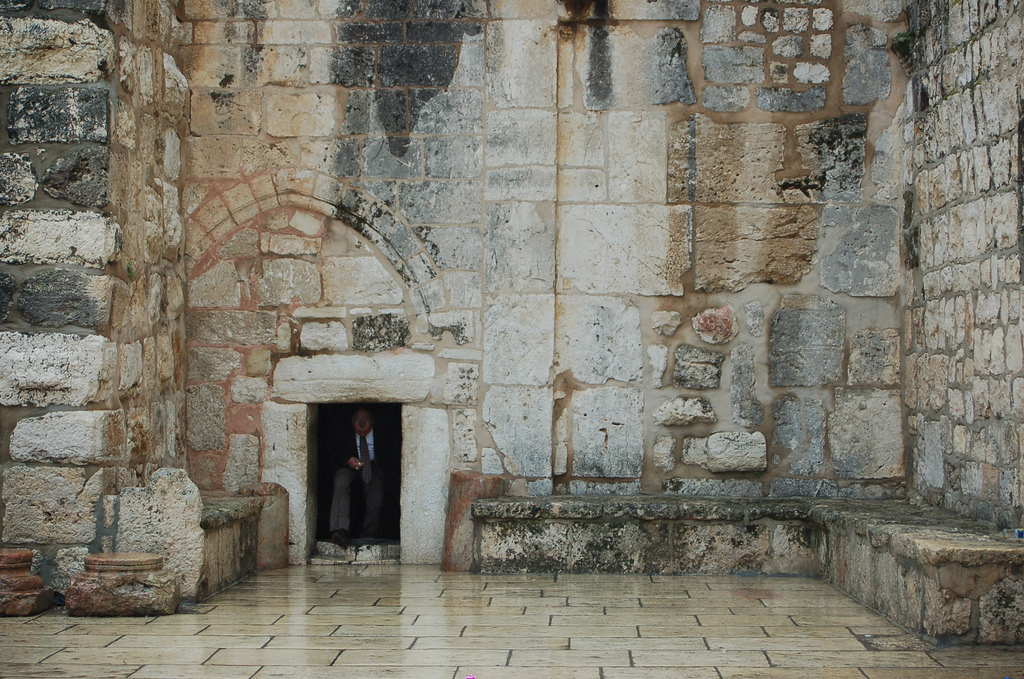
Pictured: The main access to the Church of the Nativity in Bethlehem, known as the

“Door of Humility”. (Image source: Dan/Flickr)

Given that they have been, and still are, so mistreated by the Muslim authorities, why do so many Palestinian Christians express their support for a “resistance” – a euphemism for armed struggle — to Israel by terrorist organizations, many inspired by jihadist ideals? This “resistance” takes its inspiration from the belief that any territory, once conquered for Islam (and, in this case, stolen from Christians), must remain under Islamic rule in perpetuity:

“Syrian Sheik Omar Bakri… said in an interview at the time that both Romania and Bulgaria were legitimate targets for attacks, because they are ‘Islamic land’ …

“Once Islam enters a land, that land becomes Islamic and the Muslims have the duty to liberate it some day. Spain, for example, is Islamic land, and so is Eastern Europe: Romania, Albania, Macedonia, Serbia, Kosovo and Bosnia.”

Surely that is very far indeed from Christian precepts?

Yet, anti-Israel activism among Palestinian Christians who contest the liberation of Jerusalem by Israel from its illegal capture and occupation by Jordan is not hard to find. Presumably there is a justifiable concern among Christians to protect their safety, and the safety of Christian properties, by allying themselves with the Muslims among whom they have to live. In June 2017, for example, a “Letter from Palestinian Christians to the World Council of Churches and the Ecumenical Movement” was signed by thirty Christian organizations, Catholic, Assyrian, Orthodox, and Protestant in Jerusalem, Bethlehem and Gaza. It begins:

As we meet this month in Bethlehem in occupied Palestine, we are still suffering from 100 years of injustice and oppression that were inflicted on the Palestinian people beginning with the unjust and unlawful Balfour declaration.

It continues in the same vein. The seventh of its nine demands on the WCC and the Ecumenical Movement reads:

That you defend our right and duty to resist the occupation creatively and non-violently. We ask that you speak in support of economic measures that pressure Israel to stop the occupation and that you support athletic, cultural, and academic measures against Israel until it complies with international law and UN resolutions urging the ending of its occupation, apartheid, and discrimination, and accepts refugees to return to their homeland. This is our last peaceful resort. [italics by the ed.]… In response to Israel’s war on BDS, we ask that you intensify that measure [“urging the ending of its occupation, apartheid, and discrimination, and accept[ing] refugees to return to their homeland.”].

As Palestinian “resistance” has always been extremely violent (just for example, here and here), one form of it has centred around protests over the al-Aqsa Mosque in Jerusalem. During a wave of these protests in July 2017, when Christians prayed with Muslims, one protester urged Christians to do more: “Bethlehem churches will close their doors tomorrow, Sunday, and urge Christians to head to the mosques… #Here_Is_Palestine.”

Indeed, “On Thursday, a delegation of the World Council of Churches joined Palestinian worshippers protesting near Al-Aqsa and stood in solidarity with the Muslim community.”

The anti-Israel Orthodox Archbishop of Sebastia, Theodosios (Atallah Hanna), expresses Christian solidarity with Muslims in stark terms:

I support Palestinians and share their cause and their issues….

We the Palestinian Christians suffer along with the rest of Palestinians from occupation and hardships of our economic situation. Muslims and Christians suffer equally, as there is no difference in suffering for any of us. We are all living in the same complicated circumstances, and overcoming the same difficulties.

Hanna was one of the authors of the anti-Semitic Palestinian Christian Kairos Document, about which I have written here before. Kairos Palestine was created in 2009 and signed by thirteen Christian leaders in Jerusalem, representing the Greek Orthodox, Latin, Armenian Orthodox, Coptic, Syrian Orthodox, Maronite, Ethiopian, Greek Catholic, Syrian Catholic, Lutheran, Anglican, and Armenian Catholic churches – all of which are traditionalist denominations. One of its first paragraphs reads:

In this historic document, we Palestinian Christians declare that the military occupation of our land is a sin against God and humanity, and that any theology that legitimizes the occupation is far from Christian teachings because true Christian theology is a theology of love and solidarity with the oppressed, a call to justice and equality among peoples.

This elevation of a political, legal and military concern into the realm of theology owes greatly to the style of Liberation Theology, a radical form of Christian belief and action that developed within the Catholic Church in Latin America, and based on concern for the poor and oppressed. Such concern is well within the bounds of the Christian tradition, but Kairos adopts a different form of replacement theology. It treats the Jews who have not embraced Jesus as their saviour, as no longer God’s people. This allows the writers of Kairos to show concern for the Palestinians, Christian and Muslim alike, yet show no such concern for Jews, faced by wars, terrorism, and international hatred — and without whose protection by Israel’s security services, as the Christians well know, they would be left to the same tender mercies of extremist Muslims as other Christians in the Middle East.

A genuinely ecumenical American center devoted to Christian-Jewish relations issued a document “Cautions to U.S. Churches Regarding the Kairos Palestine Document“, in which they found serious fault with its arguments:

A group, Christians for Fair Witness, apparently felt obliged to wrote a reply: “Cautions to U.S. Churches Regarding the Kairos Palestine Document.” It was endorsed by St. Paul University’s Institute for Jewish-Catholic Relations, and by Dialogika (as is made clear on the Christians for Fair Witness website). While treating the Kairos document with respect, the cautions expressed were far-ranging and crucial….

That Jewish natural right was not once raised…. Only Palestinian rights and demands were considered of relevance to Christians.

The Cautions document also states: “The Kairos Palestine document professes that ‘an end to Israeli occupation… will guarantee security and peace for all.'” (Sec. 7) … But is that true? There was no security or peace prior to the occupation. This analysis continues with a list of Arab violence against Jews, the PLO’s 1964 objective of liquidating Israel, and a clear statement that “There is no reason to believe that ending the occupation alone would bring security and peace to Israel and Palestine.”

Kairos, not surprisingly, has inspired a vast movement of anti-Israel activism in many countries. Kairos, and literature relating to it, may be found in Western churches, such as Sweden’s, during pro-Palestinian lectures and exhibitions. The Kairos document is so egregiously discriminatory that in 2010, the Central Conference of American Rabbis (CCAR) declared it “supersessionist” and “anti-Semitic.”

A leading figure among the authors of Kairos Palestine is Rev. Mitri Raheb, who has developed an international career as a self-proclaimed “Public Figure, Pastor and Theologian, Author and Social Entrepreneur”. Mitri’s CV is truly astonishing, from the awards he has received and the universities at which he has lectured to the institutions he has founded. He has had a broad media presence:

“The work of Dr. Raheb has received wide media attention from major international media outlets and networks including CNN, ABC, CBS, 60 Minutes, BBC, ARD, ZDF, DW, BR, Premiere, Raiuno, Stern, The Economist, Newsweek, Al-Jazeera, al-Mayadin, Vanity Fair, and others.”

How many clergymen of any variety feature in Vanity Fair magazine, aimed at the luxury market? These are achievements of which many other theologians and church leaders might well be envious.

Born in Bethlehem in 1962, Raheb studied at two German colleges: the Hermannsburg Mission Seminary (1980-19894) and Marburg University (1984-1988), where he obtained a PhD in theology. He went back to Bethlehem in 1988.

Raheb is an ordained minister in the Evangelical Lutheran Church in Jordan and the Holy Land, a version of Lutheranism established by German and English missionaries to Palestine in the mid-19th century. Based on a belief in the Trinity, the Evangelical Lutheran Church is fundamentalist in doctrine:

“The true way of salvation is revealed only through God’s Word, and any claims for revelation of the way of salvation through other means must be rejected. The main purpose of Holy Scripture is to reveal to us that Jesus Christ is our only Savior.”

It is immune to modern rationalist theology, and states, for example:

We confess that God created all things in six days by the power of His Word, exactly as is set forth in Genesis chapters 1 and 2 and elsewhere in Scripture. We therefore reject the theories of “evolution,” including “theistic evolution,” not only because they lack a sound basis in scientific evidence but especially because they contradict the divinely-inspired account of creation as given by Moses in the Old Testament and confirmed by Christ in the New.

The purpose here is not to condemn the church for what it believes. These beliefs, however, make it difficult to understand how the leaders of a church can advocate such intimate relations with Muslims. Many of them seem to believe that much of what Christians believe is pure blasphemy. What is even stranger, is that apparently the Christians do not even plan to convert these Muslims.

In the Qur’an, Christian belief in God as three persons is anathema, as God is only One. Similarly, Jesus is regarded, not as God or the Son of God, but as a prophet inferior to Muhammad. The Qur’an is emphatic in saying that Jesus was not crucified, but that someone else was substituted for him. Therefore, Christ did not die to save mankind; this salvation is reserved only for those who believe in the God of the prophet Muhammad…. [F]or Muslims, the Bible… was a corruption of Islam by Christian priests and monks, in a distortion known as tahrif.

Raheb and his supporters from different denominations are clearly willing to ignore this gross denial of their faith in all its aspects, a denial that renders non-existent the fundamental aspiration to life after death in heaven through the sacrifice of Jesus. It is normal for religious people to identify themselves as members of their faith above all other allegiances, to the extent that they are willing to suffer death rather than deny it. Baha’is in Iran have been offered their lives if only they converted to Islam, yet all have gone willingly to the hangman’s noose by refusing to do so. Christian martyrs, ancient and modern, are widely praised as ideal exponents of their faith. Many Christians have been killed by Muslims in Egypt and elsewhere, as in the Nag Hammadi massacre of 2010.

No one is suggesting that Palestinian Christians should invite their own deaths by outrightly defying the Muslim majority. It seems inexplicable, however, why these Christians prefer to join with the Islamic “resistance” rather than to remain silent, accept their supposedly inferior status, and refrain from overt endorsements of what Muslims view as right.

Raheb takes this so far that he cannot even bear to describe Jesus as a Jew. At a Christ at the Checkpoint conference in 2010, he stated that:

I’m sure if we were to do a DNA test between David, who was a Bethlehemite, and Jesus, born in Bethlehem, and Mitri, born just across the street from where Jesus was born, I’m sure the DNA will show that there is a trace. While, if you put King David, Jesus and Netanyahu, you will get nothing, because Netanyahu comes from an East European tribe who converted to Judaism in the Middle Ages.

The notion that Ashkenazi Jews are descended from an East European who converted has for many years been known, based on DNA testing, as a scientific fallacy. (In addition, see here.)

Raheb goes even further. He does not recoil from the violence, the genocidal threats, and the Islamic radicalism of Hamas. In an interview with the popular Egyptian daily al-Masri al-Yawm (Egypt Today) in March 2016, he praised the terror group (which is mainly responsible for the suffering of its own Palestinian people:

Hamas is a Palestinian political movement that has an important role. No one can deny this. The Church is in constant communication with Hamas in the West bank via many delegations from the Church. Some people in the church believe in the armed resistance, and we do not disagree. Once you have occupation, you will have resistance.

Here is a Christian leader celebrating a notoriously evil entity and announcing that “Some people in the church believe in the armed resistance, and we do not disagree”.

Moments later, Raheb tried to mitigate his support by addressing his private views: “However, on a personal level, I do not believe in the armed resistance. How would you fight an enemy with arms that were made by him and its allies? It is smarter not to invite your foe to a wrestling match if he was a wrestler, but to invite him to a chess match.”

Christian author Dexter Van Zile comments, “It’s bad enough that Raheb, a Christian pastor, would distance himself from Hamas’ jihadist violence not because it is wrong, but because it is ineffective.”

A fundamental aspect of much modern theology across the Christian churches is a belief in the central role of reconciliation and peace-making by believers, both clergy and lay. Even the World Council of Churches, to which Raheb and his followers are allied, emphasizes the role of Peace, Justice, and Reconciliation. Supporting Hamas and all the other forces within the Palestinian “Resistance” is a total contradiction of such Christian values. In few other places may one find such a level of hypocrisy and willful self-contradiction. Yet in churches almost everywhere, the literature, films, and spokespeople of that Christian deception may be found month after month and town after town.

Let me end with an item of recent news. On March 3, Britain’s most senior Catholic cleric, Cardinal Vincent Nichols called for closer ties with Islam on the grounds “That the two religions have more in common than people think”. What on Earth does this prelate think Muslims believe? After some 1400 years of rivalry and war, some sort of naivety and fuzzy thinking is making Christians the agents of their own destruction. Sadly, the Christians of the West Bank are at the heart of this growing need to bow down to people who, for the greater part, despise and persecute them.

Dr. Denis MacEoin has lectured in Islamic Studies in a university department of Religious Studies, including Christian theology, in the UK. He is a Distinguished Senior Fellow at the Gatestone Institute.

As taken from, https://www.gatestoneinstitute.org/12044/christian-theologians-israel

 
Leave a comment

Posted by on March 31, 2018 in Uncategorized


Jerusalén, la eterna encrucijada

Juan Carlos Sanz
Corresponsal en Oriente Próximo
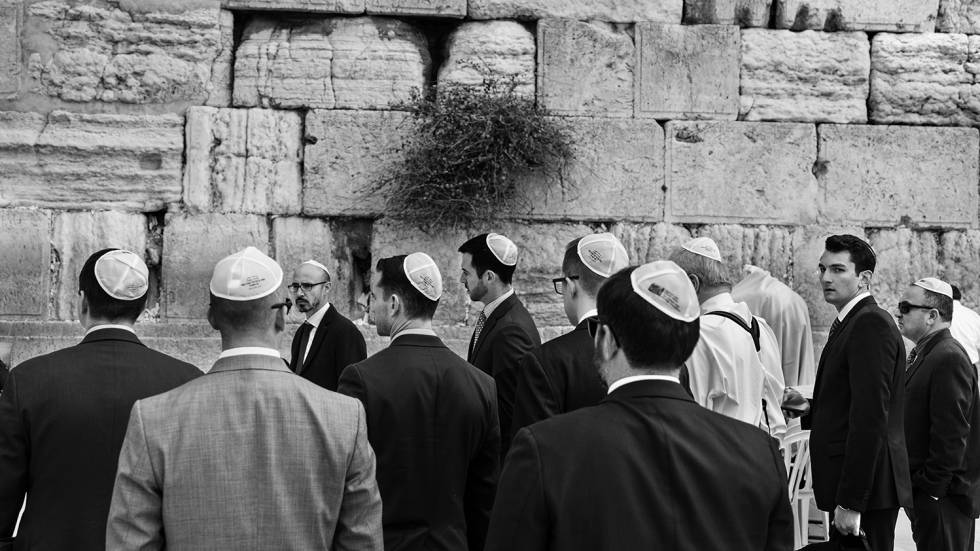
Visitantes junto al Muro de las Lamentaciones, uno de los grandes lugares sagrados del judaísmo. Ver fotogalería
Visitantes junto al Muro de las Lamentaciones, uno de los grandes lugares sagrados del judaísmo. Paolo Pellegrin

Judía laica, ultraortodoxa, árabe y cristiana, Jerusalén no es una sino sucesivas ciudades y, lo que es peor, enfrentadas. El fascinante curso de su historia y su cultura contrasta con su cruel devenir en manos de la política, la violencia y la desesperanza. La decisión de Donald Trump de reconocerla como capital de Israel no ha ayudado a apaciguar la vida en “la ciudad imposible”.


NO CREO QUE mi generación vaya a ver el fin del conflicto en Jerusalén, y menos aún tras la decisión de Donald Trump de reconocerla como capital de Israel”, asegura el historiador Meir Margalit mientras menea la cabeza en el Instituto Van Leer, un remanso de sosiego en el tráfago de la Ciudad Santa. “En Jerusalén existen tres narrativas superpuestas, pero hostiles, en un mismo espacio. Tres sistemas culturales que luchan por imponer su propia versión: el judío laico, el judío religioso y el árabe [palestino]”. Cada uno representa aproximadamente un tercio de sus cerca de 900.000 habitantes. La urbe se extiende hoy sobre 124 kilómetros cuadrados a ambos lados de la Línea Verde, una zona de separación sembrada de alambradas y barricadas que la dividió hace 70 años, cuando el recién fundado Estado de Israel se apoderó de la parte occidental, hasta 1967, en el vuelco histórico que supuso la guerra de los Seis Días. El Gobierno israelí sostiene que ha encarnado la capitalidad del pueblo judío durante 3.000 años y la del Estado hebreo desde 1948. Pero los palestinos reclaman la parte oriental de la urbe como capital de su futuro Estado.

Margalit (Buenos Aires, 1952) emigró a tiempo para combatir con 21 años en la guerra de Yom Kipur en el Sinaí antes de caerse del caballo de la derecha sionista que cabalgaba en Argentina y abrazar la fe de la izquierda pacifista israelí. Concejal durante 10 años en el Ayuntamiento de Jerusalén por el partido Meretz, es autor de Jerusalén, la ciudad imposible, una obra por la que acaba de recibir el premio de ensayo que concede la editorial española Catarata. “No es una, son varias ciudades. El término hebreo ‘Yerushalaim’ y el árabe ‘Urshalim’ son formaciones lingüísticas plurales, que deberían traducirse como los Jerusalenes”, explica, y pone como ejemplo los tres departamentos en que se divide el sistema escolar que pervive en la ciudad: el de educación normalizada (laica), el ultraortodoxo y el árabe. Cada uno tiene sus propios programas.

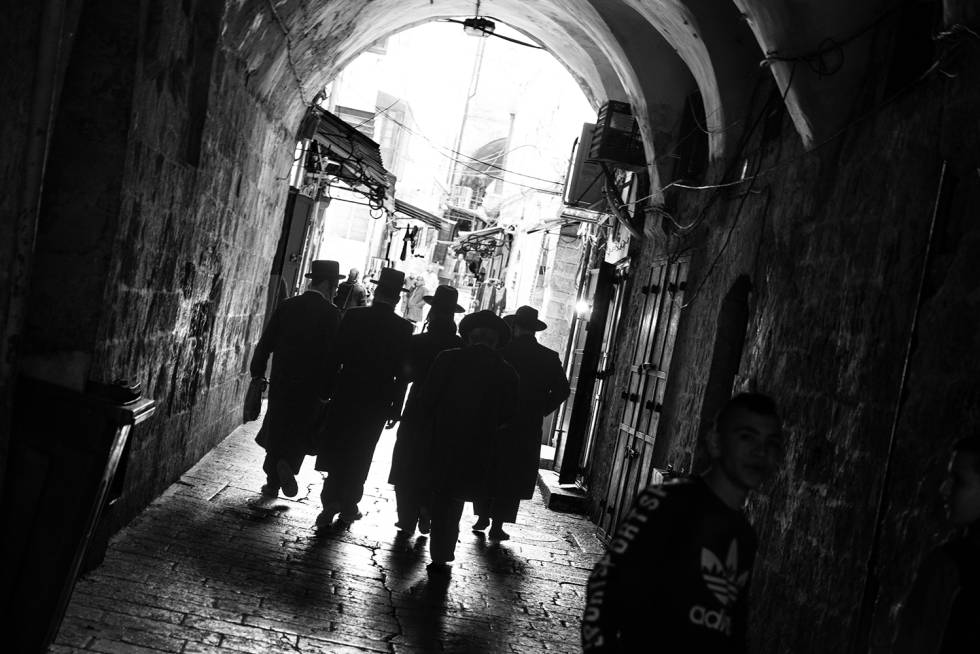
Judíos ortodoxos pasean por la Ciudad Vieja de Jerusalén. La urbe suma en torno a 900.000 habitantes. ver fotogalería
Judíos ortodoxos pasean por la Ciudad Vieja de Jerusalén. La urbe suma en torno a 900.000 habitantes. Paolo Pellegrin

Entre las callejuelas del barrio cristiano de la Ciudad Vieja, un portal que parece extraído de la era de los cruzados da paso al colegio del Pilar. En la azotea de la que hasta 1923 fue sede consular ondea la única bandera española izada dentro del recinto amurallado. Lo dirige la madre Marta Gallo (Burgos, 1944). “Jerusalén es un lugar agresivo”, avisa esta misionera de las Hijas del Calvario curtida en Zimbabue. “Durante los acuchillamientos de los últimos años he tenido que acompañar más de una vez a alguna niña pequeña hasta la puerta de Damasco; sus padres no podían franquear los retenes policiales”, relata casi como si se tratara de una anécdota.

La Asamblea General de Naciones Unidas aprobó en 1947 un plan de partición de la Palestina bajo mandato británico, recogido después en la resolución 181 del Consejo de Seguridad, que declaró Jerusalén corpus separatum bajo control internacional. Marta Gallo acude cada madrugada desde hace 16 años al rezo del cercano Santo Sepulcro. Luego abre las puertas del centro, en el que estudian dos centenares de alumnas cristianas y musulmanas de entre 4 y 18 años, casi todas con escasos recursos. “Aquí seguimos el programa oficial de la Autoridad Palestina, que nos facilita los libros de texto, pero también dependemos del Ministerio de Educación israelí, que nos ha obligado a instalar wifi en cada clase”, detalla.

Dos sistemas de transporte público discurren separados por las calles de cada sector urbano. A un tiro de piedra de la Ciudad Vieja y frente a la estación de autobuses del Este, la palestina cristiana Dolin Qaquish, de 22 años, llega jadeando a la cafetería del hotel Jerusalén. Viene desde una cárcel de la región del Negev, en el sur de Israel, donde ha visitado a su hermano mayor, que cumple 12 años de condena por herir a cuchilladas a dos israelíes ante la puerta de Damasco, el principal acceso al barrio histórico musulmán.

Desde que estalló la intifada de los cuchillos en 2015 han muerto unos 300 palestinos, 50 israelíes y 7 extranjeros.

Una lágrima discurre en paralelo al piercing que le perfora la aleta izquierda de la nariz mientras narra su visita a la prisión del Negev. “La Ciudad Vieja se ha convertido en una zona militar”, censura, aludiendo a la reciente construcción de puestos permanentes para la policía de fronteras (cuerpo militarizado) en Bab al Amud, como los palestinos denominan a la puerta de Damasco. “Me he criado en la Ciudad Vieja y seguiré viviendo aquí, pero no hay razones para el optimismo. Puede que haya que esperar 100 años a que cambien las cosas”. Antes de graduarse en Periodismo en Ramala, sede administrativa de la Autoridad Palestina situada 20 kilómetros al norte de Jerusalén, Dolin Qaqish estudió desde los 6 hasta los 12 años en el colegio del Pilar de Jerusalén.

Tras el estallido en octubre de 2015 de la llamada Intifada de los cuchillos, una ola de violencia se ha cobrado la vida de medio centenar de israelíes, siete extranjeros y más de 300 palestinos, dos tercios de los cuales fueron abatidos por las fuerzas de seguridad al ser considerados atacantes. En la Ciudad Vieja, el “choque religioso y de civilizaciones se escenifica aún con más virulencia”, subraya Margalit. Después de más de dos décadas de trabajo social en la ciudad y de un decenio de actividad en la gestión municipal, contempla Jerusalén como una metrópoli “fragmentada por barreras étnicas, religiosas, identitarias, psicológicas…”. En definitiva, una “no ciudad” que se dirige hacia una “reacción explosiva”. Los 300.000 palestinos que la habitan carecen de ciudadanía en su ciudad natal. Desde 1967, 14.000 de ellos han sido privados del permiso de residencia por las autoridades israelíes.

La guerra de los Seis Días que libró el Ejército hebreo hace 50 años contra una coalición de Estados árabes se saldó con la ocupación de Jerusalén Este, incluidos los santos lugares de la Ciudad Vieja. En 1980, la Kneset (Parlamento) aprobó la anexión del sector oriental y de poblaciones anejas de Cisjordania a la “capital eterna, unida y permanente de Israel”. La comunidad internacional ha venido condenando desde entonces la medida unilateral como contraria a la ley internacional.

Entrada a la Ciudad Vieja por la puerta de Damasco (Bab al Amud para los palestinos). Situada en el noroeste de la población, es el principal acceso al barrio musulmán. ver fotogalería
Entrada a la Ciudad Vieja por la puerta de Damasco (Bab al Amud para los palestinos). Situada en el noroeste de la población, es el principal acceso al barrio musulmán. Paolo Pellegrin

La barrera construida por Israel en Cisjordania a partir de 2002, después del estallido de la Segunda Intifada, se plasma en el término municipal de Jerusalén en altos muros de hormigón que han excluido de hecho de la ciudad algunos de los núcleos palestinos que fueron anexionados. Miembros del actual Gobierno de Benjamín Netanyahu, considerado por muchos de sus detractores como el más derechista en la historia de Israel, plantean ahora la segregación de esos distritos por razones de seguridad. “Quieren sacárselos de encima”, traduce Margalit, para postergar un sorpasso demográfico palestino en la Ciudad Santa. Entre la incuria patente del Este y el aparente orden del Oeste median “dos mundos”, destaca el antiguo edil. “No hay sociedad multicultural posible ante la asimetría entre la comunidad israelí, hegemónica, y la palestina, subordinada”. En Abu Dis, Shuafat, o Kfar Aqab —en la tierra de nadie situada al otro lado del muro de separación—, viven más de 100.000 palestinos. Al atravesar el paredón de hormigón se penetra en una dimensión de abandono de toda noción de ciudad. No es ni judía ni árabe.

Extramuros, Enash Jubran, tendera de 33 años, vive con su marido y sus cuatro hijos en Kfar Aqab, en un piso con vistas al muro gris donde alguien ha pintado una puerta con la inscripción en inglés “Exit” (salida). No está lejos del paso de Qalandia, frontera en la principal vía que lleva desde Jerusalén a Ramala. Las lluvias de invierno han generado un mar de barro en torno a los bloques de 12 alturas construidos sin licencia. La basura flota en el fango.

Hace un año que se mudó con su familia desde el campo de refugiados de Shuafat, donde se crio en el seno de un clan palestino desplazado por el nacimiento del Estado hebreo en 1948. Posee la tarjeta de la UNRWA, la agencia de la ONU para los refugiados palestinos, un carné de identidad israelí y paga las tasas locales del Ayuntamiento de Jerusalén aunque muchos creen que reside en Cisjordania. También le debe a un banco 250.000 sequels (unos 58.000 euros), algo más de la mitad de lo que cuesta su vivienda.

El conflicto se da entre proyectos antagónicos que niegan legitimidad al vecino por razones étnicas o religiosas

“El Ejército nos ha notificado la próxima demolición del edificio después de meses de pleitos. Volveremos a ser refugiados otra vez”, explica con más tristeza que rabia. “Aunque llevamos toda la vida de mudanza, ya estamos hartos de sentirnos exiliados en nuestra propia ciudad. Yo soy de Jerusalén…”. Frente a su balcón, los obreros siguen construyendo nuevos bloques sin permiso para familias con vidas divididas por el muro. “Por el paso de Qalandia, son 40 minutos en coche hasta el centro, pero siempre hay problemas: a menudo tenemos que cerrar las ventanillas por los gases lacrimógenos. Es como vivir en otro país”, describe Enash Jubran a propósito de su trayecto cotidiano.

En Jerusalén, la ciudad imposible, Margalit intenta sintetizar el drama de esta urbe, el conflicto entre “proyectos antagónicos que en nombre de la pureza étnica, nacional o religiosa niegan la legitimidad del vecino”. Los palestinos se suelen dejar ver —en especial mujeres y jóvenes— por la zona occidental de Jerusalén cuando desciende el nivel de violencia, pero como observa el exconcejal, “solo circulan puntualmente por centros de trabajo, oficinas públicas o centros médicos y comerciales, en una suerte de ‘movilidad restringida”. Puede haber roce, pero apenas hay contacto, solo desconfianza.

Nacido en Lisboa hace 75 años en una familia judía melillense, José Benarroch abandonó la Universidad Complutense en 1969 para concluir los estudios de Derecho en la Universidad Hebrea de Jerusalén. Revela que se lo recomendó el propio David Ben Gurión, fundador del Estado de Israel, cuando le invitó a la aliyá (inmigración). La Ley del Retorno israelí permite a un judío de cualquier parte del mundo establecerse en Israel y obtener automáticamente la ciudadanía. Lo recuerda en un concurrido restaurante del distrito de Baqa, cuyas elegantes casas, habitadas mayoritariamente por árabes hasta 1948, conforman ahora un vecindario de clase media judía.

“No cambio Jerusalén por ninguna otra ciudad del mundo”, asevera Benarroch, que pasó por el servicio diplomático israelí antes de dedicarse a la gestión universitaria. “Su espiritualidad única, su rico entorno intelectual… Aunque, desde luego, no viviría en Meah Shearim [el principal barrio ultraortodoxo], prefiero espacios más abiertos como este”, confiesa. “¿Para cuándo un Estado palestino?”, repite la pregunta que se le formula para poder meditar mejor una respuesta. “Existe un gran recelo entre la población israelí”, argumenta. “Tardará en llegar un futuro de armonía”.

Por lo general, resulta raro que un ciudadano judío atraviese la simbólica separación de la Línea Verde hacia los barrios palestinos, si bien más de 200.000 israelíes se han instalado en asentamientos en Jerusalén Este a partir de 1967. Colonos nacionalistas radicales viven ahora también en el barrio musulmán, e incluso en el cristiano, de la Ciudad Vieja, protegidos por guardaespaldas privados y por las fuerzas de seguridad, y en distritos históricos cercanos, como Silwán, una barriada al sur del recinto amurallado con aire de favela donde 450 colonos se han asentado entre 20.000 palestinos.

Panorámica de las murallas de la Ciudad Vieja de Jerusalén: una imagen emblemática para una urbe tan llena de historia y cultura como de problemas políticos. ver fotogalería
Panorámica de las murallas de la Ciudad Vieja de Jerusalén: una imagen emblemática para una urbe tan llena de historia y cultura como de problemas políticos. Paolo Pellegrin

Otro veterano conocedor de Jerusalén, el periodista y escritor barcelonés Eugenio García Gascón, afincado en la Ciudad Santa desde hace 27 años, coincide con el diagnóstico pesimista de Margalit. “Un espacio que se sustenta sobre las etnias, es decir, sobre la división de las comunidades, está condenado a no vivir en paz”, previene. Entre otras obras, es autor de dos dietarios sobre Jerusalén, el último publicado en 2017 bajo el título La derrota de Oriente (Libros del K.O.). “La existencia de cada grupo gira alrededor de sus creencias, sin mirar al bien común. Al contrario, miran más a lo que les separa como comunidades que a lo que les une”. Su respuesta llega tras un encuentro en la terraza del Café de París, situado frente a la sede de la residencia del primer ministro de Israel, en el distrito acomodado y mayoritariamente judío laico de Rehavia. En un gesto de reconciliación con la personalidad múltiple de una urbe en la que lleva media vida, García Gascón confiesa en su segundo dietario que ha regresado “sin resentimientos” al café del que desertó años atrás cuando se transformó en un local kosher, conforme al ritual judío.

Donald Trump ha anunciado el traslado de la Embajada de EE UU a Jerusalén coincidiendo con el 70º aniversario de la fundación del Estado de Israel, el próximo 14 de mayo. Hasta 13 países latinoamericanos llegaron a contar con representación diplomática en la parte occidental de la Ciudad Santa, pero todos acabaron trasladando sus legaciones a Tel Aviv después de la anexión de la zona oriental en 1980. Guatemala y otros Estados parecen dispuestos a seguir los pasos de Washington, en un cambio de paradigma que ha sido mayoritariamente condenado de nuevo en la ONU.

“La ciudad precisa una separación funcional, necesita ser dividida para poder estar unida algún día”, concluye Margalit mientras recoge sus papeles en una mesa de la biblioteca del Instituto Van Leer, por donde se asoma la línea vanguardista del edificio hacia un jardín próximo a la residencia del presidente del Estado. Cree que no vivirá para contarlo, pero el historiador predice que “la ocupación se acabará colapsando en una crisis política por la limitación que supone para la democracia de Israel y por la discriminación que impone a otro pueblo”.

Según tomado de, https://elpais.com/elpais/2018/03/23/eps/1521804664_359676.html

 
Leave a comment

Posted by on March 31, 2018 in Uncategorized


Pesach: The Mystery of Karpas

Image result for Nathan Lopes Cardozo

One of the most mysterious rituals on the Seder night is the eating of karpas[1] dipped in salt water at the very beginning of the evening. One reason for this ritual, we are told, is to encourage everyone, particularly the children, to ask many questions. After reciting the Kiddush we would no doubt expect a proper meal, as is customary on other festivals and on Friday nights. Instead, we receive a small piece of vegetable dipped in salty water and are then left hungry for a good part of the evening. This should certainly raise some eyebrows.

Without denying the importance of the above, we must understand why our Sages decided to introduce the need to ask questions through this particular ritual and not another. What is there in the ritual of karpas that would otherwise be lost on us, and why was this particular one chosen to be the first in the Haggada that would prompt our children to ask questions?

Rabbi Joshua Ibn Shuaib[2] and Rabbenu Manoach[3] give us a very unusual clue. The word karpas, they say, is etymologically difficult to place. Both of them mention that it means “fine woolen fabric,” and Rabbenu Manoach adds that it means “greens” or “a vegetable.” The latter definition is in line with the meaning in the Haggada, as we are told to partake of celery, parsley, potatoes, scallions, or other such vegetables.

The first definition reminds us of Rashi’s comment on the story concerning the hatred of the brothers toward Yosef.[4] As we know, this animosity was caused by Yaakov’s giving a ketonet passim (multicolored garment) to his son Yosef. Rashi there states that the word passim means material made of fine woolen fabric. This statement reveals to us a secret behind the ritual of dipping karpas into a liquid.

After Yosef had received this garment from his father, the brothers sold him to the Egyptians. This was the precursor of the exile and slavery in Egypt. Whatever the deeper meaning of this hatred, it was unjustified and led to much pain. Had Yaakov not given the garment to Yosef, the exile and servitude in Egypt would in all likelihood not have come about.

So this garment, made from karpas, was seemingly the primary cause of the Egyptian enslavement.

When the Rabbis fashioned the blueprint for the Haggada text, they looked for a way to draw attention to the fact that brotherly hate was what caused the Jews to end up in Egypt. Upon realizing that this infamous garment was made of karpas—fine woolen fabric—they decided to institute a ritual that would involve using a vegetable. On a deeper level, we realize that what identifies this ritual more specifically with the hatred of the brothers is the act of dipping the karpas in salt water. After all, the brothers took this “karpas garment” and dipped it into animal blood before they approached their father with the terrible news that Yosef had been killed.

Still, one may wonder why the Haggada only alludes to this in the form of a mysterious ritual. Apparently, the authors wanted to hide this information while simultaneously hoping that the readers would get the point. But, if the multicolored garment was indeed the principal cause of the entire Egyptian exile, why not actually bring a multicolored garment to the Seder table and mention it candidly, in order to ensure that no one will miss this crucial information? Is it not vital to know what caused the bondage in Egypt, before we tell the story of how and when the Israelites were freed?  What is the purpose of making the Seder participants aware of this only on a subconscious level, instead of bringing it to the surface?

I believe that this touches on the very core of Judaism’s interpretation of the Exodus. Its main point is to emphasize Divine providence; God’s miraculous interference in the lives of millions of Jews who were stranded and enslaved in Egypt. This story had to become the locus classicus of all Jewish history, and in fact of world history. Whatever happens is ultimately in God’s hands. This is the categorical lesson of the Pesach story. It is not the story of the human role in history, or to what extent man had a hand in shaping all of the events that took place. Of course, Jewish tradition constantly emphasizes that man has to take responsibility for the consequences of his deeds, but the Pesach story operates on a different level. It is the triumph of God as the Lord of History that is celebrated.

In fact, the interplay between Divine intervention and human action is one of the great philosophical problems, which all religious thinkers have grappled with. To what extent is man responsible, and to what extent is God responsible? This question remains basically unanswered and is part of the mystery of all human history.

This also touches on another and in no way more solvable problem. How can we ever know what is the cause that brings about a specific effect? More than that, when is something actually a cause and not the effect of an earlier incident? Speaking in terms of the Egyptian enslavement, are we indeed able to say for sure that it was just the hatred of the brothers for Yosef that brought about the Jews’ servitude, and if the brothers had not sold Yosef to Egypt, the Israelites would not have landed in Egypt? Wasn’t it promised to Avraham that his children would be enslaved in a land that was not theirs?[5] The Egyptian experience is seen in its own right as a sine qua non to prepare the Jews for receiving the Torah and shaping them into a spiritual people that will be a “light unto the nations.” So to what extent were the brothers really responsible for this exile, and how much free will did they actually exercise when they decided to sell their brother?

It is for this reason that the authors of the Haggada were not prepared to openly point their finger at the brothers. They could do nothing but allude to this fact, telling us that somewhere along the road to Egypt the “karpas garment” dipped in blood played a role. We may never know to what extent, but it is most telling that the karpas is eaten at the very beginning of the Haggada reading. It makes us immediately aware that the inside story of what really caused the exile in Egypt will remain forever a mystery. That is the all-encompassing, underlying message that this ritual wants to convey at the very beginning, before we continue to read the story. It will indeed provoke many questions. But however brilliant the answers, we will be left with the knowledge that on a higher plain, and beyond human understanding, it is the hand of God that holds the answers.

On a moral level, however, the story should be clear. It was hatred between brothers that sent us into exile. How revealing that what brought about the redemption was the love between two brothers, Moshe and Aaron, living in total harmony.


Notes:

[1] The Hebrew word for “greens” or “vegetable” comes from the Greek “karpos,” which means a fresh raw vegetable.

[2] Drashot, Parashat Tzav Ve-Shabbat HaGadol by Rabbi Joshua Ibn Shuaib (c. 1280-1340) who was a pupil of the famous Rabbi Shlomo ben Aderet (Rashba) and the teacher of Rabbenu Menachem Ibn Zerah, author of Tzeda LaDerech.

[3] Sefer HaMenucha, Hilchot Chametz U-Matza 8:2.

[4] Bereshit 37:3.

[5] Bereshit 15:13.

As taken from, https://www.cardozoacademy.org/thoughts-to-ponder/pesach-the-mystery-of-karpas/?utm_source=Subscribers&utm_campaign=4cfb259b42-Weekly_Thoughts_to_Ponder_campaign_TTP_548&utm_medium=email&utm_term=0_dd05790c6d-4cfb259b42-242341409

 
Leave a comment

Posted by on March 31, 2018 in Uncategorized


The Surprising Ancient Origins of Passover

An ancient agricutural village uncovered in Jerusalem’s Kiryat Hayovel neighborhood.Courtesy Israel Antiquities Authority


The holiday we know today began as two distinct ones, one for nomadic herders and one for farmers. Neither involved Egypt.

The Passover Seder is one of the most recognized and widely practiced of Jewish rituals, yet had our ancestors visited one of these modern-day celebrations, they would be baffled.

Not only does our modern Seder wildly diverge from the Passover of old: during antiquity itself the holiday underwent radical changes. Below we chart as best we can – considering the shortage of historical documentation – the origins of Passover, from the dawn of Israelite people to the destruction of the Second Temple in 70 CE, and the consequent establishment of the embryonic Passover Seder, which modern Jews would recognize.

windows
Lawrence Saint’s stained glass windows depicting Moses, at the Washington National Cathedral. Wikimedia Commons

As the centralized Israelite state took shape about 3,000 years ago, , the religion of the people varied from place to place and took variegated forms, hints of which we can see in the Bible, virtually the only historical narrative we have of this period. Among the different folk beliefs and frankly polytheistic practices these proto-Israelites practiced, the springtime rites seem to have had special status. Two of these rituals would later become subsumed by Passover: Pesach and Hag Hamatzot.

Pesach was a pastoral apotropaic ritual, that is: its purpose is to ward off evil. It was carried out by the semi-nomadic segment of Israelite society that subsisted on livestock. Spring was a critical time of the year for them, a time of lambing and a sign that soon they would have to migrate to find a summer pasture for their flock.

In order to protect their flocks, and families, from the dangers ahead, they would slaughter their flocks newest addition as an offering, either a lamb or a kid, in a bloody ritual followed by a family feast.

The origin of matza

Hag Hamatzot, on the other hand, was celebrated by the settled segment of Israelite society, who lived in villages and who drew their subsistence from farming. For them too spring was crucial, meaning the start of the harvest, of the cereals on which they depended.

Of the cereals grown by the ancient Israelites in this period, the first grain to be ready for harvest was barley. Although this made for inferior bread, it was highly prized: not rarely, by the spring harvest, the last years stores had been already depleted and hunger took grip of the land.

This new bread would have been unleavened, as the leavening used at the time was a portion of dough set aside from the last batch of bread. But this would have been unavailable due to the gap created by the empty stores. Add to this the fact that barley flour hardly rises anyway, and that the baking techniques of the time would have made even the superior bread made of wheat flour flat and hard, and youve got matza.

Still, when hungry even matza is a cause for celebration and one could imagine that the communal threshing grounds were filled with joy, cheer, and jubilation.

The holidays are merged

As the monarchy was established and a centralized religion took form, the two holidays began merging into one. The process was a gradual one, which culminated in both converging to the full moon in the middle of the spring month of Nisan.

The location of the celebrations was moved from the home and the community to the Temple in Jerusalem.

No doubt, an important milestone in this process took place in the reforms of the 16-year-old King Josiah in 622 BCE, as described in chapter 22 of the Second Book of Kings.

We are told that Josiah ordered the temple be renovated. and that During this process, as Hilkiah the high priest was clearing the Temples treasure room, The Book of the Law, – believed to be an early version of the Book of Deuteronomy – was found. This led to a series of reforms carried out by Josiah to bring the land into accord with the newly -discovered divine ordinances.

A major part of these reforms was the reform of Passover: And the king commanded all the people, saying, Keep the passover unto the Lord your God, as it is written in the book of this covenant. (23:21)

It was no longer supposed to be a family affair but a centralized national observance: the Book of Deuteronomy clearly stipulates that the Pesach sacrifice may not be made within any of thy gates but rather at the Temple. (16:5-6)

Pilgrimage to Jerusalem

Following Josiahs reforms, the holiday took the form of a mass pilgrimage to Jerusalem. The people would bring their paschal lamb (or kid) to be sacrificed at the Temple.

The feast of unleavened bread began the day after. All were commanded to avoid eating leavened bread for a week, though it seems that this wasnt accompanied by any special practices in the Temple; the Israelites would probably have followed this precept on their way home and at their homes themselves.

Not much more is known about the celebration at this time. This was apparently the time in which the story of the exodus from Egypt was introduced [link http://www.haaretz.com/archaeology/.premium-1.584911 . But this form of practice didnt last long. In 586, BCE the Babylonians sacked Jerusalem, the Temple was destroyed and the period in Jewish history called the Babylonian Captivity began.

Bondage in Babylon

It is during this time, when the elite of Judean society was in the relatively literate and cosmopolitan Babylonia and had they had no Jerusalem Temple on which to focus their religious fervor,, that the writing of many of the Biblical texts took place. This includes the Book of Exodus, the central tale of Passover. Among other things, the story would have united the people and appealed to its writers themselves, as they found themselves in bondage in a foreign land, hoping to be delivered by God and returned to their homeland.

They were indeed delivered, in 538 BCE, when Cyrus the Great, King of Persia, defeated the Babylonians, and proclaimed that the Jews could return to their homeland and rededicate their temple. Upon their return and the dedication of the new temple in 516 BCE, the holiday of Passover was reinstated. And the children of the captivity kept the passover upon the fourteenth day of the first month…and kept the feast of unleavened bread seven days with joy. (Ezra 6:19-22)

Following the rededication of the Temple, the Judeans would come to Jerusalem a few days before the holiday each year. They would prepare for the holiday by going through rigorous purity rituals. Entering the Temple compound in groups, the head of each household would hand their animal offering to the priests, who killed the animal, drew its blood and sprayed it on the altar. Then the carcass was returned to the family that had given it and they would roast it and eat it within the confines of the Temple.

The next day the people dispersed, though they would continue to eat unleavened bread for another week.

This form of Passover continued until the Maccabean Revolt erupted in 167 BCE. The celebration of Passover at the Temple had to stop, briefly, until Jerusalem was recaptured by the Maccabbees and the Temple was rededicated in 165 BCE. At this time Passover underwent further change.

The Hasmonean reform

Under the new Hasmonean regime, the sacrifice of the Pesach offering was done by the head of the household himself, not by the priests. On the other hand, during the week following Pesach, special sacrifices were given, and these were sacrificed by the temple staff – the priests and the Levites.

Another innovation that seems to have arisen under the Hasmonean Dynasty was the singing of songs praising God and the drinking of wine during the family meals, as well as some kind of public celebration at the end of the week of Hag Hamatzot.

The civil war that resulted from the murder of Julius Caesar in 44 BCE led to the demise of the Hasmonean Dynasty and the ascent of Herod the Great to the Judean crown in 37 BCE, as a puppet ruler of Rome. This had little effect on Passover, which continued pretty much as it was under Hasmonean rule. However, the vast numbers of Jews coming from throughout the Roman Empire forced change, as there was no longer room for everyone to have their paschal mean within the confines of the Temple. The rules were relaxed to the extent that the meal could be eaten anywhere within Jerusalem.

But this massive influx of Jews to Jerusalem made the Roman authorities uneasy. Several sources from this period report that the Jerusalem garrison was fortified during Passover to prepare for any unruliness.

The Passover meal in this form was the meal described in the New Testament as Jesus last supper.

In 66 CE, religious tensions between Greek and Jewish citizens, and protests over the heavy tax burden, boiled over into the Jewish rebellion against Rome. This rebellion was put down in 70 CE. Roman legions under Titus retook Jerusalem, destroying the Temple and much of the rest of the city. Passover was never to be celebrated as it had been again.

In Yavne, a rabbinical school lead by Rabbi Johanan ben Zakai and Rabban Gamaliel II, set out to forge a new Judaism adapted to a post-Temple world. Among their innovations, which were later redacted into the Mishnah, was the embryonic form of the Passover Seder we know and celebrate today.

This article was originally published on April 4, 2014

 
Leave a comment

Posted by on March 31, 2018 in Uncategorized