RSS

Author Archives: yishmaelgunzhard

Parshat Ki Teitzei: King Henry VIII and the Talmud

Remember that king with 6 wives? The Jews helped unravel his levirite obligation to his first marriage
Portrait of Henry VIII by Hans Holbein. (Public domain, Wikimedia Commons)

Portrait of Henry VIII by Hans Holbein. (Public domain, Wikimedia Commons)

Did you know that King Henry VIII purchased a copy of the newly printed Talmud when he wanted to escape his marriage to his first wife Catherine of Aragon? What makes this even more remarkable is that there were no Jews living in England at that time. But let’s not get ahead of ourselves.

Let’s begin at the Battle of Bosworth Field, the last time a king of England won his throne on the battlefield.

The 32-year War of the Roses, which wiped out the male heirs of the houses of York and Lancaster, ended on August 22 1485. King Richard III, the last king of the House of York, was killed and buried (his body was eventually discovered under a Leicester city council car park in 2012).

The 28-year-old Welsh-born Henry Tudor was now the king. But his claim to the throne was a tenuous one. His father, Edmond Tudor had been captured while fighting for Lancaster and died three months before Henry was born. Henry’s grandfather, Owen Tudor, had been a page boy in the court of Henry V. Later, he married the late king’s widow, though it took an act of parliament to declare that Edmond was in fact his legitimate heir.

It was his mother, Lady Margaret Beaufort, who was key in making Henry Tudor into Henry VII. Her great-grandfather was John of Gaunt, the third son of Edward III. But maternal claims to the crown of England were not really strong enough, so she improved her son’s standing by marrying him to Elizabeth of York, eldest daughter and heir to Edward IV (after the presumed death of Elizabeth’s brothers — the “princes in the tower”), thus uniting the warring houses of Lancaster and York.

Portrait of Henry VII by an unknown artist. (Public domain, Wikimedia Commons)

So, now that he was king, Henry had work to do to cement his claim and that of his children. Just four years after the Battle of Bosworth Field, Henry made plans to marry off his eldest son Arthur, who was only 3 at the time, to 4-year-old Catherine of Aragon, a daughter of the powerful Spanish royal family,

The couple were married in 1501, a few weeks after Arthur’s 15th birthday. But just six months later, the heir to the throne died. Catherine would later testify that the marriage was never consummated.

So now, what was Henry to do? Without the support of the Spanish, his monarchy was precarious. And to make matters worse, less than a year later, his wife, Elizabeth died too. Henry briefly entertained the idea of marrying Catherine himself, but eventually decided to marry her off to his second son, who would go on to become Henry VIII.

The problem was that marrying a brother’s widow is clearly forbidden by the Bible (Leviticus 18:16). Luckily, Henry VII was able to receive a papal dispensation from Pope Julius II to allow his son to marry and retain the alliance of Spain.

Fast forward 20 years. Henry VII is dead. Henry VIII is now king, and he is no longer interested in Catherine. For one thing, she failed to give him a male heir who survived infancy (though her daughter, Mary, did later become the first-ever female ruler of England). Also, Henry had fallen for Anne Boleyn, the sister of one of Catherine’s ladies-in-waiting. (Anne later became the mother of the future Queen Elizabeth).

But Henry had a problem. Catholic law did not allow for divorce. And even though, later on, Henry seemed quite happy to execute wives (including Anne Boleyn) when he lost interest in them, Catherine was the sister of the Spanish king, and far too important to behead.

Catherine of Aragon, attributed to Joannes Corvus. (Public domain, Wikimedia Commons)

So Henry’s advisers tried to invalidate the marriage to Catherine. As Henry’s brother’s widow, she was forbidden to him, they said. She had never actually been his wife in the eyes of the church (which therefore made Mary illegitimate). Furthermore they told Henry, the fact that his son from Catherine died in infancy was a sign that the marriage was not sanctioned.

However, Pope Clement VII, who was at the time effectively being held prisoner by the Holy Roman Emperor Charles V, who also happened to be Catherine’s nephew, refused to annul the marriage. Eventually, this led Henry to split from the Catholic Church and found the Church of England. But first his advisers and scholars had to defend their view to parliament.

The problem was a verse in this week’s Torah reading — if a man dies childless, his brother must marry his widow in a process called yibum (levirate marriage), in order to keep his brother’s name alive (Deuteronomy 25:5-6). This law supersedes the prohibition of marrying a brother’s widow, and applied in Henry’s case. If the brother-in-law chooses not to perform yibum, he must instead perform the Torah mandated “divorce” procedure called halitzah (Deuteronomy 25:7-10).

So now Henry really had a problem. Several of his advisers, however, found a loophole to this too, and consulted Jews for advice. There were no Jews living in England, since they had been expelled in 1290 by Edward I, but several Jewish converts to Christianity lived in the country, were close to the king, and maintained contacts with Jews in Europe.

“The Jews tell him that the law of Deuteronomy has never been kept since the fall of Jerusalem,” Henry’s former Greek tutor Richard Croke, who was advising him on what to do with Catherine, explained in a letter to the Bishop of London John Stokesley written in March 1531. “It is not intended to be kept, except where it is allowed by the Levitical law, and they do not consider it obligatory except where causes and circumstances expressly urge it, and not even then is it absolutely obligatory.”

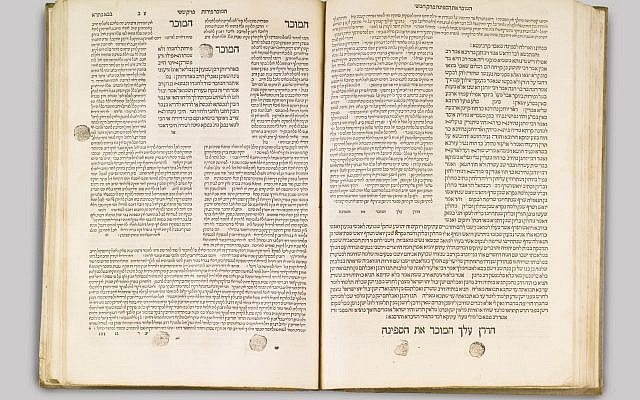
A page of the Babylonian Talmud, printed by Daniel Bomberg in 1522 in Venice. (Public domain, Wikimedia Commons)

He was basing his view on the words of the talmudic sage Abba Shaul, who banned the levirate marriage if it was done with the wrong intent.

“One who marries his sister-in-law for her beauty, or in order to gratify his sexual desires, or for any other [ulterior] motive it is as if he sinned with a forbidden relation, and it seems to me that the child would be almost illegitimate,” (Yevamot 39b).

The great mishnaic sage Rabbi Akiva also banned levirate marriage in even stronger terms.

As early as 1530, theologians tried this approach to free Henry from his marriage.

“The Levitical law remains in force, and that Deuteronomy was conditional, and is not kept either by Christians or Hebrews, as they themselves have determined in the Talmud,” wrote one of the theologians in Venice by the name of Franciscus Georgius.

In one of those historical coincidences that seems to occur nine times out of 10, a Christian scholar named Daniel Bomberg had printed the first complete set of the Talmud just a few years earlier. It was Bomburg who created the chapter and verse numbers that we all take for granted now, when he published his Mikra’ot Gedolot Bible a few years before that.

Henry ordered a copy of the nine-volume Talmud from Venice, hoping it would support his claim to have the marriage annulled. As it happened, Henry actually married Anne in 1532 before the nine volumes of Talmud arrived, so they were never used and remained in mint condition for hundreds of years.

And that is the (shortened version of the) story of Henry VIII and the Talmud.

By the way, the set of Talmud that Henry ordered was eventually discovered by Jack Lunzer in Westminster Abbey. After almost 25 years of failed attempts, Lunzer managed to purchase Henry VIII’s Talmud from the Abbey in 1980.

This same set of Talmud sold in 2015 for over $9 million. But that is another story.

As taken from, https://blogs.timesofisrael.com/parshat-ki-teitzei-king-henry-viii-and-the-talmud/


Leave a comment

Posted by on August 23, 2018 in Uncategorized


The Joy of Saying “I am Sorry”


Image result for nathan lopes cardozo

by Rabbi Nathan Lopes Cardozo

One of the most remarkable features of the Portuguese Spanish Selichot, besides the text, is the choice of melodies. The tunes are not like those of the Edot HaMizrach, the Eastern Sefardi communities. They are much nicer, with due respect, surely much more beautiful than those of our Ashkenazi brothers.

The Portuguese Spanish Selichot are different in that their tunes are very optimistic and joyful. They are a pleasure to hear.

Still, to sing about one’s transgressions in an optimistic tone, as if proud of them, is quite remarkable! It begs the question: How can a person feel pride about his transgressions? Would it not be more appropriate to chant them in a subdued voice, dramatically, to sad music?

Why ask a chazzan with a beautiful voice, accompanied by a grand choir, to lead these prayers? Shouldn’t the congregation get someone with an untrained voice who would sing the Selichot simply and humbly?

I believe there is a profound idea behind this phenomenon: To be given the opportunity to do teshuvah is an enormous privilege. It is a joy to be able to say I am sorry. In fact, it is one of the great gifts that Judaism has given mankind: the knowledge that man can change; that if he has not been successful the past year, he can turn over a new leaf and start again. This is the ultimate expression of religious optimism. Judaism teaches man that there is no karma that traps him, and no original sin that stands in his way. Man is free to re-engage with God and his fellow man. He can regret his deeds. Whatever obstacles there may be, all that is required is the will to change his ways and the effort to work hard at it.

Over the years, we have misunderstood the meaning of prayer and chazzanut. In most synagogues, services are heavy and often depressing. There is an absence of joy and spiritual outpouring.

True, it is not easy to speak to God. In fact, it is a major undertaking, and not without great risk. Who are we to speak to God? There is chutzpah involved. Even more outrageous is the fact that we dare to praise God. Johann Wolfgang Goethe once observed: Wer einem lobt stellt sich ihm gleich. He who praises someone places himself on the other’s level. Or, as Aristotle said: Everyone may criticize him, but who is permitted to praise him?

Indeed, the question is crucial. Logically, such boldness should not be permissible. The answer, however, is that God is prepared to compromise His greatness for the sake of man and come down to his level, or lift man to such greatness that he can touch His Throne.

This is the internal knowledge of the religious man. Through it he realizes the joy and the privilege to be allowed to praise God and ask His forgiveness, in spite of its impertinence.

Nothing expresses this joy better than singing the Selichot in an optimistic tone. Not only is man allowed to say the Selichot; he is commanded to do so. It is the celebration of man’s vulnerability as well as his grandeur. It is God’s great gift to man.

What, then, is the function of the chazzan and choir? Many seem to believe it is to give a musical performance; to provide a “charming service” for the congregants. But such an observation is a tragedy. It’s a violation of the very goal it wants to achieve. More than that, it’s a kind of idolatry entering our synagogues.

Abraham Joshua Heschel once said, “The Cantor has to pierce the armor of indifference”. Chazzanut is not simply a skill, or a technical performance. It is a protest against apathy; a nearly impossible battle to rescue the words of the prayer book from spiritual oblivion. The chazzan’s task is to lift the printed words from the very page on which they appear and turn them into a prophecy through which man will look in the mirror and realize that he must run for his life. He has to disengage himself from the all-too-familiar prayers, which have become stagnant and deadening. Chazzanut is the art of putting wings on the words, elevating them to a world that many of us no longer recognize. The goal is to unbind the words from their own restrictions until, in an explosive burst, they scatter into new meanings and carry us to a newfound world of spirituality.

The chazzan and the choir must lift each word out of its confined meaning and turn it into something that the word on its own is unable to convey. To sing is “to know how to stand still and to dwell upon a word” (Heschel).

The Talmud tells us (Sanhedrin 94a)) that God wanted to appoint King Chizkiyahu as the Mashiach. After all, he was a great tzaddik, a righteous man who even turned Jewish education on its head by ensuring that “no boy or girl, man or woman was found who was not thoroughly versed in the laws of purity and impurity” (Ibid 94b). Never, says the Talmud, was there such advanced Torah learning in all of Israel. And yet, Chizkiyahu’s son Menashe was utterly wicked. The Talmud asks, in astonishment, how that could have been. Such a righteous father; and such an evil son! Surprisingly, the Talmud responds that the reasons why King Chizkiyahu did not become the Mashiach and why he had such a wicked son are one and the same: He didn’t sing! That showed that he lacked understanding of the value and profundity of singing. He didn’t realize that just as music sets the soul on fire and draws us nearer to the infinite, so does singing. “It takes us out of the actual and whispers to us dim secrets that startle our wonder as to who we are, and for what, whence, and whereto” (Ralph Waldo Emerson). Menashe never heard his father singing. He was probably a very serious and somber man. As a result, he couldn’t purify his heart and mind. He was left with stagnated words that couldn’t move him and ultimately led to his wickedness.

We must never forget that because Chizkiyahu didn’t sing, he could not be the Mashiach. And all of us lost out.

No song – no Mashiach

As taken from, https://mailchi.mp/cardozoacademy/ttp-1352689?e=ea5f46c325

 
Leave a comment

Posted by on August 23, 2018 in Uncategorized


Repentance for Christians Involves Rejecting Replacement Theology

It is not because you are the most numerous of peoples that Hashem set His heart on you and chose you—indeed, you are the smallest of peoples. Deuteronomy 7:7 (The Israel Bible™)

Rabbi Tuly Weisz, director of Israel365 and the publisher of The Israel Bible and Breaking Israel News believes that the rejection of replacement theology by contemporary Christians is a “prerequisite for all of the other stages of geula (redemption).” He told Breaking Israel News, “As a Jewish rabbi, I’m not comfortable telling non-Jews what they should believe and do. However, I do feel strongly that the time for the rejection of replacement theology is now, to bring about the continued stages of redemption.”

What exactly is replacement theology? Bob O’Dell, co-founder of Root-Source, a Christian portal for dialogue between Christians and Jews, believes that replacement theology exists on a continuum. O’Dell said, “This replacement could be as minimal as ‘the church is God’s preferred institution’ to the most aggressive form of replacement theology which transfers the entire calling and purpose of the Jewish people over to the church, while relegating the Jewish people to a place of hell on earth – without hope, without promise, and devoid of anything good, [without] any hope of redemption.”

Robbie Coleman of Zion’s Bridge Ministry used even stronger language to define replacement theology. “It is more than errant doctrine, which began late first century. It is a devised plan by God’s enemy to deceive His creation, to keep them from His protective covenantal blessings — the blessing through Israel to the nations.”

In advance of this past 9th of Av, a date in the Hebrew calendar that marks the destruction of the Holy Temples in Jerusalem and other tragedies in Jewish history, O’Dell and Ray Montgomery, a Root Source subscriber from New Zealand, put together a list of anti-semitic actions throughout Christian history.

O’Dell noted, “A careful examination of the list that we put together for the 9th of Av project makes it quite clear that certain key leaders within the Christian faith, from about 100 to about 400 CE, put forth an argument that the church had replaced Israel in certain ways.”

Coleman admitted that it’s difficult for many churches to face the consequences of centuries of replacement theology. “Today, many of the mainline denominations are not open to the discussion of replacement theology. I have found two reasons: ignorance or prejudice.

“The first group is somewhat naïve people that have accepted what has — and has not been — taught them. This has, at times, been expressed in the teaching of supersession theology [another name for replacement theology], which says that the new covenant supersedes the original covenant.

“The prejudiced group is generally pro-Palestinian and against the Jewish people. They take up causes that require the Jewish people to leave the land promised to them by God. They develop theology based on propaganda and lies, rather than a pure study of the Scripture. If people had read and understood the Bible, I don’t think such deception would have been established as doctrine,” Coleman asserted.

Tommy Waller, founder of HaYovel, an organization that brings Christian volunteers to Israel to serve Jewish farmers, also spoke to Breaking Israel News about the difficulty Christians may have facing the damage done by replacement theology. “It is difficult, anytime we’re admitting that we have done something wrong. Until we can take a position of humility, we’re not going to be able to tackle this situation and understand the harsh realities, having to face that the Holocaust was a reality, and even before that, the Spanish Inquisition and the pogroms and the Crusades and all these other horrific things done to Jews were a reality.

“These things have to be presented to us over and over again in order for us to overcome it. The first time I went to Yad Vashem (Israel’s Holocaust museum) in Jerusalem, that was a wake up. I walked out of there literally undone, in tears. It was a horrific reality to understand. There are a lot of historical facts that incriminate Christianity. It’s not talked about. It’s not something that the pastor gets up and speaks about every Sunday, the need to repent. So it’s hard.”Waller acknowledged a second reason why replacement theology is challenging for the church to fully grapple with. “There’s still anti-semitism in the church. There’s a hatred for Judaism, a hatred for Jews. It’s a sad statement, but there’s still an undercurrent of anti-semitism,” he said.

The church’s relationship to Israel and to Jerusalem poses yet a third difficulty. “Replacement theology has extracted everything about Jerusalem, about Israel, from our Bibles. Somehow that got taken away early on in Christianity and we just haven’t been able to come back to it,” Waller said.

Although much damage has been done in the name of replacement theology, Christian leaders Waller, Coleman and O’Dell agree that, at least in some circles, things are, in fact, changing for the better.

Waller elaborated on the specific way his organization is helping to heal the damage done by replacement theology. “The only way we can turn this around is first to admit that we were wrong and then for me, and for HaYovel particularly, putting our feet where our heart is, where our true intentions are to repent, has been very helpful to us and also helpful to the Jewish people that we’re serious about this repentance. It’s not just verbiage. We physically want to walk it out. The atrocities done to the Jewish people were done in a physical way, and obviously the reconciliation, the repair, the teshuva (repentance) also needs to be a physical reality.

“We have to introduce and encourage more congregations to come to Israel, meet the people that have been affected by this. Just coming here to Israel and just working in the fields, it’s part of teshuva – putting ourselves in a place of servitude and doing something good and not being resistant to God’s choosing the Land of Israel and the Jewish people.”

Coleman told Breaking Israel News, “An increasing number of ministries are arising to shed light on the truth of the issue.” He highlighted Christians United for Israel as “one that has continued to make a huge impact, with over one million adherents.” Coleman also noted the work of Christian Friends of Magen David Adom, Bridges for Peace, the International Christian Embassy in Jerusalem and the Christian Friends of Israel, founded by Ray and Sharon Sanders whom he applauded for working for 30 years, “undoing the harm that has been done to the Jewish people in the name of Christianity.”

His own ministry, Zion’s Bridge, teaches, “the necessity of embracing our Hebraic roots and repenting for the error in our prejudices against the Jewish people, as well as God’s promises toward, and revival of, the Jewish nation, Israel. We travel to churches, exposing the fallacy of replacement theology and showing its errant foundation that was established with the founders of the Christian doctrine.

“By renouncing replacement theology, the church first of all must acknowledge that we’ve been wrong about Israel and the chosen people. We’ve been wrong and committed atrocities by thinking that God wanted to replace Israel with the church. Repentance is returning to God and His Word. We must ask why it could be that we have treated the ‘chosen ones’ with disrespect? If God has not rejected His people then, we are not allowed to either.”

O’Dell concluded on an optimistic note, “This thing is going to happen. It may be delayed. It may be resisted. It may be fought, but I firmly believe that God is saying to the churches that they must begin moving in the direction of actively renouncing replacement theology. Or else [they] risk missing out on the next big revival God desires to pour out onto the Christian world.”

As taken from, https://www.breakingisraelnews.com/112719/renouncing-replacement-theology/?utm_source=Breaking+Israel+News&utm_campaign=552e1e8411-BIN_morning_8_18&utm_medium=email&utm_term=0_b6d3627f72-552e1e8411-86605125

 
Leave a comment

Posted by on August 23, 2018 in Uncategorized


Social Capital and Fallen Donkeys

by Rabbi Jonathan Sacks

Many years ago, Elaine and I were being driven to the Catskills, a long-time favourite summer getaway for Jews in New York, and our driver told us the following story: One Friday afternoon, he was making his way to join his family in the Catskills for Shabbat when he saw a man wearing a yarmulke, bending over his car at the side of the road. One of the tires was flat, and he was about to change the wheel.

Our driver told us that he pulled over to the roadside, went over to the man, helped him change the wheel, and wished him “Good Shabbos.” The man thanked him, took his yarmulke off and put it in his pocket. Our driver must have given him a quizzical look, because the man turned and explained: “Oh, I’m not Jewish. It’s just that I know that if I’m wearing one of these” – he gestured to the yarmulke – “someone Jewish will stop and come to help me.”

I mention this story because of its obvious relevance to the command in today’s parsha: “Do not see your kinsman’s donkey or his ox fallen on the road and ignore it. Help him lift it up” (Deut. 22:4). On the face of it, this is one tiny detail in a parsha full of commands. But its real significance lies in telling us what a covenant society should look like. It is a place where people are good neighbours, and are willing to help even a stranger in distress. Its citizens care about the welfare of others. When they see someone in need of help, they don’t walk on by.

The sages debated the precise logic of the command. Some held that it is motivated by concern for the welfare of the animal involved, the ox or the donkey, and that accordingly tsa’ar ba’alei hayyim, prevention of suffering to animals, is a biblical command.[1] Others, notably the Rambam, held that it had to do with the welfare of the animal’s owner, who might be so distressed that he came to stay with the animal at a risk to his own safety[2] – the keyword here being “on the road.” The roadside in ancient times was a place of danger.

Equally the sages discussed the precise relationship between this command and the similar but different one in Exodus (23:5): “If you see your enemy’s donkey fallen under its load, do not pass by. Help him load it.” They said that, all other things being equal, if there is a choice between helping an enemy and helping a friend, helping an enemy takes precedence since it may “overcome the inclination”, that is, it may help end the animosity and turn an enemy into a friend.[3]  This, the ethic of “help your enemy” is a principle that works, unlike the ethic of “love your enemy” which has never worked and has led to some truly tragic histories of hate.

In general, as the Rambam states, one should do for someone you find in distress what you would do for yourself in a similar situation. Better still, one should put aside all considerations of honour and go “beyond the limit of the law.” Even a prince, he says, should help the lowliest commoner, even if the circumstances do not accord with the dignity of his office or his personal standing.[4]

All of this is part of what sociologists nowadays call social capital: the wealth that has nothing to do with money and everything to do with the level of trust within a society – the knowledge that you are surrounded by people who have your welfare at heart, who will return your lost property (see the lines immediately prior to the fallen donkey: Deut. 22:1-3), who will raise the alarm if someone is breaking into your house or car, who will keep an eye on the safety of your children, and who generally contribute to a “good neighbourhood,” itself an essential component of a good society.

The man who has done more than anyone else to chart the fate of social capital in modern times is Harvard sociologist Robert Putnam. In a famous article, ‘Bowling Alone’ and subsequent book of the same title,[5] he drew attention to the sharp loss of social capital in modern times. It was symbolised by the fact that more people than ever were going ten-pin bowling, but fewer than ever were joining bowling teams: hence ‘bowling alone,’ which seemed to epitomise the individualism of contemporary society and its corollary: loneliness.

Ten years later, in an equally fascinating study, American Grace,[6]  he argued that in fact social capital was alive and well in the United States, but in specific locations, namely religious communities: places of worship that still bring people together in shared belonging and mutual responsibility.

His extensive research, carried out throughout the United States between 2004 and 2006, showed that frequent church- or synagogue-goers are more likely to give money to charity, regardless of whether the charity is religious or secular. They are also more likely to do voluntary work for a charity, give money to a homeless person, give excess change back to a shop assistant, donate blood, help a neighbour with housework, spend time with someone who is feeling depressed, allow another driver to cut in front of them, offer a seat to a stranger, or help someone find a job. Religious Americans are measurably more likely than their secular counterparts to give of their time and money to others, not only within but also beyond their own communities.

Regular attendance at a house of worship turns out to be the best predictor of altruism and empathy: better than education, age, income, gender or race. Religion creates community, community creates altruism, and altruism turns us away from self and toward the common good. Putnam goes so far as to speculate that an atheist who went regularly to church (perhaps because of a spouse) would be more likely to volunteer in a soup kitchen than a believer who prays alone. There is something about the tenor of relationships within a religious community that makes it an ongoing tutorial in citizenship and good neighbourliness.

At the same time one has to make sure that ‘religiosity’ does not get in the way. One of the cruelest of all social science experiments was the “Good Samaritan” test organised, in the early 1970s, by two Princeton social psychologists, John Darley and Daniel Batson.[7]  The well known parable tells the story of how a priest and a Levite failed to stop and help a traveler by the roadside who had been attacked and robbed, while a Samaritan did so. Wanting to get to the reality behind the story, the psychologists recruited students from Princeton Theological Seminary and told them they were to prepare a talk about being a minister. Half were given no more instructions than that. The other half were told to construct the talk around the Good Samaritan parable.

They were then told to go and deliver the talk in a nearby building where an audience was waiting. Some were told that they were late, others that if they left now they would be on time, and a third group that there was no need to hurry. Unbeknown to the students, the researchers had positioned, directly on the students’ route, an actor playing the part of a victim slumped in a doorway, moaning and coughing – replicating the situation in the Good Samaritan parable.

You can probably guess the rest: preparing a talk on the Good Samaritan had no influence whatever on whether the student actually stopped to help the victim. What made the difference was whether the student had been told he was late, or that there was no hurry. On several occasions, a student about to deliver a talk on the Good Samaritan, “literally stepped over the victim as he hurried on his way.”

The point is not that some fail to practice what they preach.[8]  The researchers themselves simply concluded that the parable should not be taken to suggest that Samaritans are better human beings than priests or Levites, but rather, it all depends on time and conflicting duties. The rushed seminary students may well have wanted to stop and help, but were reluctant to keep a whole crowd waiting. They may have felt that their duty to the many overrode their duty to the one.

The Princeton experiment does, though, help us understand the precise phrasing of the command in our parsha: “Do not see … and ignore.” Essentially it is telling us to slow down when you see someone in need. Whatever the time pressure, don’t walk on by.

Think of a moment when you needed help and a friend or stranger came to your assistance. Can you remember such occasions? Of course. They linger in the mind forever, and whenever you think of them, you feel a warm glow, as if to say, the world is not such a bad place after all. That is the life-changing idea: Never be in too much of a rush to stop and come to the aid of someone in need of help. Rarely if ever will you better invest your time. It may take a moment but its effect may last a lifetime. Or as William Wordsworth put it: “The best portion of a good man’s life: his little, nameless, unremembered acts of kindness and of love.”[9]

Shabbat shalom.

NOTES

[1] See Baba Metzia 31a.
[2] Mishneh Torah, Hilkhot Rotze’ach, 13:2, 14.
[3] Baba Metzia 32b; see also Tosafot, Pesachim 113b.
[4] Hilkhot Rotzeach 13:4.
[5] Robert Putnam, Bowling Alone: the Collapse and Revival of American Community. New York: Simon & Schuster, 2000.
[6] Robert Putnam, David E. Campbell, and Shaylyn Romney Garrett, American Grace: How Religion Divides and Unites Us. New York, NY: Simon & Schuster, 2010.
[7] Darley, J. M., & Batson, C. D. (1973). ‘From Jerusalem to Jericho: A study of situational and dispositional variables in helping behavior,’ Journal of Personality and Social Psychology, 27(1), 100-108.
[8] Tosefta Yevamot 8:7; Bavli, Yevamot 63b.
[9] Wordsworth, ‘Lines written a few miles above Tintern Abbey.’

As taken from, http://rabbisacks.org/social-capital-fallen-donkeys-ki-teitse-5778/

 
Leave a comment

Posted by on August 22, 2018 in Uncategorized


The Unstoppable Yehudit Abrams

The Unstoppable Yehudit Abrams


The hi-tech maverick who recently won $360,000 for her early detection breast cancer device is also a convert to Judaism. This is her amazing story.


Standing before a crowd of 5,000 at the We Work Creator Awards this summer in Jerusalem, Yehudit Abrams had reason to be nervous. This moment represented the culmination of many dramatic twists and turns: childhood in a devout Quaker home; Orthodox Jewish conversion; researching ultrasound to support the Mars mission at NASA; mingling with tech elite in Silicon Valley; and conducting a medical relief missions around the world.

Standing there under the spotlights, with WeWork’s legendary founder Adam Neumann looking on, Yehudit took a deep breath and focused on how breast cancer claims another life every 74 seconds.

Yehudit said a prayer and launched into the pitch for MonitHer, the first at-home, hand-held monitor for early detection of breast cancer. With a combination of engineering and medical expertise, fierce entrepreneurial spirit, and unstoppable energy and passion, Yehudit described her vision to revolutionize one of modern medicine’s most perplexing challenges.

Minutes later, Yehudit was awarded first prize of $360,000.

Idaho and TM

Born Holley Abrams in Boise, Idaho, the road to here has been complex, dramatic, and deeply inspiring.

“I grew up in a family of cowboys and ranchers, raised as a devout Quaker,” Yehudit tells Aish.com near her office in downtown Jerusalem. “My mom is very spiritual, and talking to God is something instilled in me from an early age. If an ambulance drives by, we’d say, ‘Please God, take care of this person and let them not suffer’.”

A precocious and razor-sharp child, Yehudit was encouraged to explore the worlds of music, science and adventure. Yet when it came to religion, she was taught “not to question.”

I was born questioning.

“The problem is, I was born questioning,” Yehudit says. “As a Christian, it didn’t make sense to me that man could be God. It also didn’t make sense that because someone died, I’d go to heaven. Nor did it make sense that God is divided into three entities, since by definition a First Cause can’t have a split beginning.”

By age 10, Yehudit began studying other religions like Daoism and Buddhism. She eventually settled on Transcendental Meditation – connecting with a local instructor and meditating diligently throughout junior high and high school.

From a young age, Yehudit was self-reliant. Her parents divorced, leaving a father uninvolved, a mother working two jobs, and a brother off with his friends. “I cooked for myself and grew up fast,” she says.

As age 13, Yehudit randomly raised her hand when the school music instructor asked if anyone wanted to play cello. That night she took the instrument home and an unbreakable lifelong bond was formed. She excelled at cello, going on to win statewide solo completions.

Her cello teacher gave her the sheet music for “Kol Nidrei,” the solemn prayer that begins Yom Kippur services. “Even before I played it, I sensed something special,” Yehudit says. “I stared at the music and it was like the notes were popping off the page. When I played it, every hair on my body stood up straight. I couldn’t explain it and I needed to find out its origins.”

Yehudit opened the Boise yellow pages and called the local synagogue for the schedule of services. That Friday evening, she dropped in at Boise’s legendary synagogue built in 1865, the oldest synagogue building in continuous use west of the Mississippi. Though a tiny congregation with no rabbi, Yehudit was welcomed by a middle-aged lay leader named George, a convert to Judaism and the son of a KKK Wizard in West Virginia. George agreed to answer all of Yehudit’s questions and gave her the book, Judaism & Christianity: The Differences.

“I fell in love with the services, the community, and the study” she says. “It felt like home.”

Yehudit continued meditating and pursuing a Jewish education. At age 15, she wondered if any Kohanim, descendents of the Jewish priests, lived in Idaho. She flipped open the phone book and found one “Cohen.” Reuben Cohen, who happened to live directly across the street.

“It was late in the evening and I went outside, laid down and looked up at the stars,” Yehudit says. “I thought about the blessing given to Abraham, and asked God to send someone to teach me more about Judaism.”

At that moment, a short, stocky, 78-year-old man emerged to throw out the garbage. “I ran across the street and asked him, ‘Are you a kohen?’ Reuben stiffened with pride and said, ‘Yes, I am a kohen. What else would you like to know?'”

The two stood outside talking till 3 a.m. It was a match made in heaven. Reuben’s wife passed away 10 years earlier, leaving him all alone. “He became my best friend and my surrogate father,” Yehudit says. “Every day after school, I’d go straight to his house. He was a walking encyclopedia. Every night we’d talk history and politics, and he’d cook me dinner.”

Though Reuben had not been to synagogue for 50 years, Yehudit’s enthusiasm caught on and they began attending services regularly together.

Conversion and Medical School

In high school, Yehudit decided to become a Jew. Wanting to experience Judaism in the “optimal way, in Israel,” she noticed a flyer at the synagogue for Sar-el, the program to volunteer at an army base or hospital. In 1993, one week after high school graduation, 80-year-old Reuben and 17-year-old Yehudit set off together to Israel.

After six weeks, Reuben went home to Idaho and Yehudit stayed, lodging at the Heritage House while looking for a conversion program. “I cried on every rabbi’s desk and they politely turned me away,” she says. “That was God’s way of saying: ‘How badly do you want to become a Jew?'”

That year, on Yom Kippur, Yehudit attended services overlooking the Western Wall. She had since discovered she was born on Yom Kippur, and memories came rushing back of the “Kol Nidrei” sheet music that started this whole journey.

“That day I surrendered everything to God. I asked, with every fiber of my soul: ‘I will do your will for the rest of my life. Just help me become a Jew.'”

Life as a Jew felt brighter and more potent. That special feeling has never gone away.

The next day, Rabbi Asher Wade, himself a former Christian pastor, gave Yehudit the phone number of Sharei Bina, a women’s seminary in Tzfat. The director, Tova Weingot, warmly accepted Yehudit and pledged to shepherd her through the conversion process. “I studied morning till night, drinking in Torah,” she says with an enormous smile.

One year later, Yehudit completed her conversion under Rabbi Avraham Auerbach of Tiberias. “I emerged from the mikveh into a different reality,” she says. “Life as a Jew felt brighter and more potent. That special feeling has never gone away.”

With one big goal checked off, Yehudit’s next priority was pursuing her dream of eventually becoming a doctor. After 6 months of ulpan, her Hebrew was still not at university level, so she moved back to the U.S. and studied mechanical engineering at Oregon State. “There were virtually no women in engineering back then,” she says, relishing the role of a maverick. “The entire department had one small women’s bathroom – a converted janitor’s closet. I saw this as an opportunity to break some norms.”

Yehudit solidified her engineering bona fides with internships at HP and Intel, then chose to attend medical school at Charles University in Prague, the oldest university in Central Europe, founded 1348. Every summer during medical school, she joined different medical teams – in Guyana, the Czech Republic, the Appalachian Smoky Mountains, rural Idaho, and at Tel Hashomer in Israel.

Her conclusion from these experiences was disheartening. “Treatments were mostly superficial, prescribing a pill but not diagnosing the problem due to the lack of diagnostics,” she says. “That’s when I began thinking of how to apply engineering to medicine, to create point-of-care diagnostics.”

In the NASA “Sandbox”

On a whim during her senior year of medical school, Yehudit applied to Singularity University, an elite technology think tank and business incubator. The 10-week program, held on the NASA campus in California, exposes creative leaders to cutting-edge, exponential technologies, with the goal of creating companies whose target is to impact a billion lives.

Yehudit was accepted to Singularity and awarded a $25,000 scholarship from Google. “It was an incredible summer,” she says. “We learned the business side of start-ups, which sparked my entrepreneurial streak. After hanging out with Elon Musk, Larry Page, astronauts and Nobel laureates, my take-away was that we all have greatness within. I can do big things, too. That was an empowering realization.”

After hanging out with Elon Musk, Larry Page, astronauts and Nobel laureates, my take-away was that we all have greatness within.

At Singularity, Yehudit became friendly with NASA’s chief medical officer. She was hired and “thrown into the sandbox,” the building where young engineers collaborate on innovative NASA projects.

Yehudit was put on a NASA team working on medical devices to support astronaut health during space missions. “Because Mars is such a long-duration mission,” she says, “you need to identify, diagnose, and treat with the same device. That’s the beauty of working at NASA – they set impossible standards and expect you to achieve huge things.”

In 2010, following the devastating earthquake in Haiti that killed a quarter-million people, Yehudit went to assist the medical relief teams. She surveyed hospitals and saw patients day and night. Seeing that one of Haiti’s main hospitals, servicing 400,000 people, had only one X-ray machine, she began thinking of how to make ultrasound affordable, portable, and easy to use.”

Yehudit returned to NASA where she helped develop a futuristic wearable “ultrasound patch,” she calls a “body window” that sticks to the body and performs continuous imaging and medical diagnosis – all with low-energy requirements and no physical side effects.

With Yehudit’s background in mechanical engineering and medicine, hi-tech connections, and out-of-the-box thinking, the pieces were falling into place for a creative breakthrough in portable ultrasound.

Meanwhile, she still had unfinished business with her medical career and turned her focus to getting a residency. Little did she know of the detour life would take. She had met her husband at NASA, had a baby boy, and soon after divorced. Suddenly, Yehudit was a single mom and her medical career stalled. “I spent the next five years applying for different medical residencies, and every time something else interfered with my plans. I was frustrated at the delay in my plans.”

It would, of course, prove a blessing in disguise.

Puzzle Pieces

During her time at NASA, Yehudit’s cousin – a breast cancer survivor who had discovered the disease through self-exam – was killed in a car accident. That’s when Yehudit decided to focus her attention on the early-detection of breast cancer. Being at home with her son, she had time to digest all she had learned over the years, and to begin drafting ideas for monitoring breast health.

Breast cancer can metastasize rapidly, making it critical to detect it at an early stage. “Once the cancer metastasizes, the five-year survival rate can drop from 95% to 23%,” she says. Of the 250,000 cases of invasive breast cancer diagnosed each year, she says only 60,000 are stage 0 cancers that can be easily cured. “Breast cancer can metastasize in a few months, yet we’re screening every one-to-two years. The numbers prove that mammography alone is not detecting it early enough.”

Yehudit blames the problem on the limitations of current screening methods. Mammography, she explains, delivers a high rate of false-positives – as many as one in three. “Mammography is not finding aggressive breast cancers early enough, cannot alone reliably image dense breasts, or be used to monitor high-risk women, and cannot differentiate some cancers that may not need treatment from those that do. This causes over-diagnosis and unnecessary biopsies. In the U.S. alone, 20,000 women proactively remove their healthy breasts to avoid living with anxiety and fear. We want to eliminate such unnecessary intervention.”

Fortuitously, Yehudit was hired by an ultrasound start up for the next 4.5 years, where she honed her knowledge of ultrasound, skills as a scientist and investigator, and formed scientific relationships that would later be critical to her own start-up. She also learned from the company’s mistakes after they went bankrupt due to poor management.

By this time, Reuben, her surrogate father, had died at age 102. Yehudit’s son was of school age, and she felt it was time to move to Israel.

Yehudit wanted to find breast cancer in its earliest state, keeping survival rates above 95%.

In the meantime, Yehudit wrote out her own ideas for a completely novel approach to screening for breast cancer. Instead of screening for cancer, she wanted to monitor health, in order to find breast cancer in its earliest state keeping survival rates above 95%.

She filed a patent for the MonitHer breast health monitoring system in which monthly whole breast ultrasounds are performed in the home in order to detect any breast changes. In the event of any suspicious change, the user sends historical images of the area of the breast in question via secure link to a physician for review. This removes the guessing game for physicians whether or not to perform a biopsy. MonitHer utilizes an FDA-approved software developed by one of her collaborators.

Grand Prize

With a bright future in the Holy Land, and after five years at home raising her son, Yehudit saw the move as a perfect opportunity to get her medical career back on track and complete her training in radiology. She applied to a residency lottery in Israel, not knowing which hospital she would get. “My first choice was Shaare Zedek in Jerusalem. It’s run according to Jewish law and was my dream hospital from when I was a teenager living in Israel,” she says.

Yehudit began 2018 with Aliyah, along with her son and mother, settling in Jerusalem’s urban hip neighborhood of Nachla’ot. Incredibly, she was accepted at Shaare Zedek, slated to start her residency in July 2018. In the meantime, she applied to MassChallenge, a prestigious startup accelerator focusing on high-impact, early-stage entrepreneurs. The Israeli branch received over 500 applications from 40 countries, and Yehudit was selected to participate. “This gave me access to advisors, classes, and a space to work out of,” she says.

In April 2018, after seeing a notice for the WeWork Awards, Yehudit quickly submitted a “pitch video.” Based on the criteria of social impact, ability to scale, and commercial potential, MonitHer was accepted to compete.

The competition pitted MonitHer against endeavors as diverse as organic farming and solar-powered water desalination.

” Moments before going onstage, it all came together. The years of engineering, the inability to return to residency which led to many years of ultrasound research. Nothing had gone my way. But that was not my deal with Hashem. I gave my life to do His will, and now perhaps this was Hashem’s will for me.” Yehudit says. “I looked out at the crowd and realized that of those thousands of people, one in eight women would be diagnosed with breast cancer in their lifetime. I knew what I had to do and wasn’t nervous anymore. I understood that it’s not about me. And I made a commitment: Whatever God wants from me, I’ll do. Just show me the way.”

The grand finale of the night was the announcement of WeWork’s $360,000 first prize. (Adam Neumann the Shabbat-observant Israeli founder of WeWork, is partial to prize money in multiples of 18, Chai.)

As “MonitHer” was announced the winner and as confetti rained down, Yehudit was momentarily stunned. “I sensed my entire life coming together,” she says pensively. “God and Torah is the undercurrent of my entire path, how I got to this point today. Those five years of frustration at not getting a residency was God’s way of enabling me to stay home and spend lots of quality time with my son.”

Beyond this, Yehudit found those years at home allowed her entrepreneurial side to flourish. “Caring for an infant is a wonderful time for creativity,” she says. “I had the luxury of developing my ideas, conducting ultrasound research, and making connections with scientists around the world who now support the work I’m doing. Raising a child is a time to be creative, to explore oneself and let God guide you in a direction.”

How does Yehudit handle being an anomaly, an Orthodox woman in hi-tech, particularly while wearing a traditional Jewish head-covering?

“Observant women approach me all the time, saying that I am an inspiration. Just as I thrived as a mechanical engineer in a department comprised almost entirely of men, so too, I carry with pride the crown I wear on my head. Covering my hair is an obvious statement to me, that I have my priorities where they belong. I think it conveys the message that I’m a proud Jew, serving God through the technical background He granted me.”

Into the Future

After the awards ceremony, Yehudit didn’t stick around basking in accolades. She headed straight to the airport for a pre-planned visit of Jewish historical centers in eastern Europe. It was in Uman, at the grave of Rebbe Nachman of Breslov, that she confronted an enormous quandary:

“My end-goal all these years was to finish my residency. I was scheduled to start residency at my dream hospital the following week. Yet with MonitHer looking so promising, I needed to decide: Should I throw myself 100% into running the company, or should I bring in someone else?”

In Uman, Yehudit got her answer. “I meditated and listened for a still, clear voice. The voice said: ‘Go and don’t look back.’ I had been focused on my medical career, but God had other ideas.”

Yehudit flew back to Israel and told the folks at Shaare Zedek she would have to cancel. They were upset, but understanding of her decision.

The WeWork prize money has been earmarked to build a hardware prototype of the actual home breast monitoring device. Experience shows that any medical hardware product requires lots of money and manpower – years of research, plus rigorous clinical studies to obtain FDA approval. Projections are that the product will be available to consumers in three to four years.

In order to focus more on the engineering and medical aspects of development, Yehudit is on the verge of announcing a co-founder, what she describes as “a powerhouse businesswoman who was CEO of a highly successful medical device company.”

MonitHer is just getting started, and it appears as if Yehudit is hurtling toward her destiny. In July, MassChallenge Israel selected MonitHer as a top startup of 2018, earning a spot at their prestigious innovation symposium in November. And she is currently competing to get to the WeWork Global Finals at Madison Square Garden in January 2019.

The challenging times are God’s way of leading us to something greater.

After years of adventures, including 8 universities on 3 continents, Yehudit is back where she belongs, thankful for the long and winding road. “When you raise yourself alone at age 8, it’s obviously very challenging, but it forces you to take charge of who you want to become,” she says. “The challenging times are God’s way of leading us to something greater.”

“We are democratizing early detection by bringing clinical grade diagnostics into the home, enabling the earliest most accurate detection of breast cancer possible.

“This is not about me,” Yehudit says with fire in her eyes. “This is saving lives – pikuach nefesh. Every minute, another life can be saved.”

As taken from, http://www.aish.com/sp/so/The-Unstoppable-Yehudit-Abrams.html?s=sh1

 
Leave a comment

Posted by on August 22, 2018 in Uncategorized


Crimen y castigo

Ki Tetzé(Deuteronomio 21:10-25:19)

Rav Paul Seiger, excapellán de una prisión estadounidense, cuenta la historia trágica pero real de un homicidio que pudo ser evitado. Aparentemente la víctima había recibido una llamada telefónica de un hostigador, que le informó que habían fijado precio a su cabeza. Sin dudar sobre la seriedad de la amenaza, el hombre fue a la policía, pero allí le dijeron que no podían brindarle protección. Exactamente una semana después fue asesinado.

Hasta la promulgación de las leyes contra el acoso, había muy poco que hacer para protegerse de esta clase de amenazas. Pero incluso en la actualidad, las leyes siguen teniendo muchas limitaciones. La ley civil no contempla castigos preventivos. De hecho, al convertir al acoso en un crimen, los legisladores sostuvieron el principio de que no se puede castigar a una persona antes de que haya cometido un crimen. Lo único que hicieron fue definir al acoso como un “crimen”.

Pero imaginemos que fuera posible saber anticipadamente que alguien va a cometer un crimen. ¿Sería correcto poner a esa persona tras las rejas?

Esta pregunta es el eje del hijo rebelde, un tema importante de esta parashá. El hijo rebelde es un niño que, a pesar de la disciplina que recibe de sus padres, elige seguir el camino del mal. Él abandona toda semblanza de rectitud moral e incluso llega robarles a sus padres para satisfacer su codicia. Las acciones del pasado llevaron a que sea castigado por la corte… Pero de todas maneras se rehúsa a cambiar.

Al perder toda esperanza de que su hijo se rehabilite, los padres van a la corte para declarar que su hijo es un “ben sorer umoré”, un hijo rebelde. Si después de la investigación, la corte encuentra que el niño es un hijo rebelde, emiten la pena de muerte.

Los comentaristas de la Torá se refieren a la aparente dureza de este castigo. Para comenzar, debemos aclarar que el caso del hijo rebelde es solamente teórico. El Talmud dice que nunca se mató ni se matará” a un niño por esta ley. De hecho, hay tantas especificaciones para la implementación de esta ley que la existencia de un hijo rebelde es virtualmente imposible.

Si es así, ¿por qué la Torá dedica una sección entera a este tema? Los comentaristas explican que es para brindarnos muchas enseñanzas importantes.

En un nivel básico, la Torá enfatiza la profunda responsabilidad que tienen los padres al criar a sus hijos. La Torá advierte que si un niño no es disciplinado como se debe, eventualmente puede caer en actividades criminales. Aunque obviamente hay una multitud de factores, la verdad es que un hijo que se desvía probablemente sufrió de una carencia fundamental durante su infancia.

Rashi, cita al Talmud y explica este tema de manera más profunda: el duro castigo no es por crímenes ya cometidos, sino para evitar en el futuro actos criminales más severos. Si continúa por su camino del mal, el hijo rebelde se convertirá eventualmente en un delincuente, asaltará y robará. En lugar de esperar a que muera siendo mayor, con las manos manchadas por la sangre de sus víctimas, la Torá determina que debe morir antes de convertir a otros en sus víctimas y causar un mal terrible a su propia alma.

En un nivel práctico, los seres humanos no tienen la capacidad para saber si una persona cometerá o no un crimen en el futuro. Para nosotros, los castigos preventivos son inapropiados. Sin embargo, el Zóhar dice que para Dios es diferente, ya que Él lo sabe todo. A menudo, Dios trae dificultades sobre una persona no como castigo de un crimen pasado, sino como una medida preventiva en contra de un error futuro. Ante Dios están revelados tanto nuestro pasado como nuestro futuro potencial.

Al aproximarse las Altas Fiestas, esta es una enseñanza importante para tener presente.

Según tomado de, http://www.aishlatino.com/tp/s/la-parasha-de-appel/Crimen-y-castigo.html?s=nb

 
Leave a comment

Posted by on August 22, 2018 in Uncategorized


El síndrome de deficiencia espiritual y qué puedes hacer al respecto

El síndrome de deficiencia espiritual y qué puedes hacer al respecto

Antes de Rosh Hashaná efectúa este importante chequeo espiritual anual.

por Sara Debbie Gutfreund

¿Sufres de lo que el Rav Dr. Abraham Twersky llama “síndrome de deficiencia espiritual”?

En su libro Happiness and the Human Spirit: The Spirituality of Becoming the Best You Can Be, él escribe:

Reconoce que tienes un cuerpo y un espíritu. Si a tu cuerpo le falta algo, por ejemplo hierro, desarrollas una anemia. Vas al médico y él te prescribe suplementos. Si él te da más vitamina A o niacina, eso no te ayudará. Tiene que ser hierro. Lo mismo ocurre con el síndrome de deficiencia espiritual. Si tratas de curarlo adquiriendo más riquezas, viajando en un crucero o bebiendo otro trago más, te sentirás bien por un rato. Pero no serás feliz.

Una de las cosas bellas de ser un ser humano es que podemos darnos cuenta de que cometimos un error. Una vez que entendemos que estuvimos socavando nuestra propia espiritualidad, entendemos que tratamos de llenar el vacío con las cosas equivocadas.

¿Cuáles son los signos del síndrome de deficiencia espiritual y cómo podemos tratarlo?

1. Aburrimiento. Pascal dijo: “Todos los problemas de la humanidad surgen de la incapacidad del hombre de permanecer en una habitación sentado quieto y a solas”. Sentirse aburrido no es sólo el resultado de no tener nada que hacer; tememos enfrentar el silencio tanto interno como en el mundo. El silencio nos obliga a enfrentarnos a nosotros mismos y las preguntas difíciles que presenta la vida. En vez de luchar con las respuestas nos dedicamos a Netflix o a nuestros ubicuos teléfonos celulares y llenamos el silencio con ruido y distracción.

Para ayudarnos a superar este bloqueo espiritual, toma algunos momentos y escribe tus respuestas a las siguientes preguntas:

Si no tuviera miedo, lo que haría es…

¿Para ser quién fui creado?

2. Falta de empatía. Un signo significativo del síndrome de deficiencia espiritual es estar envuelto en tus propios problemas al grado en que no puedes ver ni sentir el dolor de los demás. Esto significa que no nos relacionamos con la luz infinita que reside dentro de cada persona. Ser capaz de dar y escuchar a los demás no sólo nos hace más espirituales, en definitiva nos hace humanos. No hay mayor ejercicio espiritual que salir de uno mismo y dar a los demás.

A veces nuestros desafíos diarios pueden dificultarnos ver toda la imagen, pero pensar sobre estas preguntas puede ayudarnos a ganar más perspectiva:

¿Conozco a alguien que pueda estar sufriendo de soledad, dolor o pena? ¿Cómo puedo ayudar a esa persona?

¿De qué tres formas podría ayudar hoy a que el mundo sea un lugar mejor si tuviera recursos ilimitados?

3. Preocupación por lo material. A menudo intentamos llenar nuestro vacío espiritual con más cosas que en verdad no necesitamos, lo cual en definitiva profundiza el vacío que sentimos. Podemos tratar de aliviar el vacío comiendo de más, navegando por Internet o con atracones de películas, pero el alivio temporal siempre es seguido de la desilusión, porque no estamos alimentando a nuestras almas con lo que realmente necesitan.

El síndrome de deficiencia espiritual en cierta manera es un regalo. Es nuestra alma avisándonos que tiene hambre y necesita ser alimentada, no con calorías vacías, sino con genuino significado y propósito que llene nuestra esencia interior.

Rosh Hashaná es el momento para obtener claridad sobre lo que realmente nos importa. Cuando comienza un nuevo año, tenemos la oportunidad de examinar quiénes somos realmente y quiénes queremos llegar a ser.

Piensa en esto: ¿Cuál es el legado que espero dejar en este mundo? Si muero hoy, ¿qué lamentaría no haber dicho o no haber hecho?

Cada uno tiene una esencia infinita repleta de luz que anhela derramar al mundo que nos rodea. Cuando ignoramos esa luz, sentimos el vacío y tratamos de llenarlo con desesperación. Este año llena tu alma con lo que realmente necesita: propósito, conexión y significado.

Según tomado de, http://www.aishlatino.com/h/rhyik/ryc/El-sindrome-de-deficiencia-espiritual-y-que-puedes-hacer-al-respecto.html?s=fab


Leave a comment

Posted by on August 22, 2018 in Uncategorized


¿Puedo realmente cambiar?

¿Puedo realmente cambiar?

Cómo aprovechar el poder transformativo del mes judío de Elul.

por Rav Heshy Kleinman

Ya sea tu primer o tu sexagésimo primer encuentro con el mes judío de elul —que culmina en las Altas Fiestas—, es posible que comiences esta temporada de introspección y crecimiento personal un tanto mortificado. Y no serías el único. Todos tenemos una larga lista de batallas personales luchadas y perdidas.

“Voy a dejar de engullir y comenzaré a comer como un ser humano”. “Voy a dejar mi smartphone y viviré una vida real”. “Es la última vez que le digo algo denigrante a mi pareja”. “Voy a aprovechar mejor mi tiempo”. Y luego ignoramos nuestras buenas intenciones.

Para muchos, la batalla es con temas más profundos, como la fe en Dios. Buscamos entender el mensaje que nos transmite Dios, o nos quejamos diciendo: “¿Por qué yo? ¿Qué hice yo?”. ¿Aceptamos los traspiés y aprendemos de ellos, o gritamos frustrados “¡Alguien va a pagar por esto!?

¿Cómo podemos tomar conciencia y levantarnos a nosotros mismos?

Haciendo bien las cosas pequeñas

La respuesta es replantear lo que tratamos de lograr cuando nos embarcamos en el camino del crecimiento personal. La teshuvá, el proceso de ‘retorno’ a Dios y a nuestra esencia más elevada, abarca todos los desafíos recién descritos. Es ser un mejor cónyuge, padre y hermano. Es volverse más honesto con nosotros mismos y los demás. Es autodisciplina, autoestima y dignidad. Pero no es alcanzar la perfección.

La clave es meterse de lleno en la batalla y permanecer allí.

Muchos héroes espirituales del mundo judío también trataban y fallaban mientras intentaban escalar. Rav Itzjak Hutner, Rosh Ieshivá de la Ieshivá Jaim Berlín en la década del 70, habla sobre “las batallas, los obstáculos, las caídas y las regresiones” sufridos por gente como el Jafetz Jaim, uno de los más grandiosos rabinos de principios del siglo XX, y otros. “Pierde batallas, pero gana guerras”, dice. “Te prometo… que emergerás victorioso”.

El Rey Salomón declaró famosamente: “El recto cae siete veces y se levanta…”. Caer no hace que la persona pierda su título de “recto”. De hecho, se espera que caiga. Como un luchador espiritual, sólo pierde el título si se queda tirado en el piso.

Un pequeño paso puede cambiar tu realidad

Si bien de niños aprendimos que “El viaje de mil kilómetros comienza con un pequeño paso”, a menudo dudamos realmente que un pequeño paso tenga algún valor. ¿Qué cambia? ¿Y qué hay de toda la distancia que queda? Digamos que hoy te abstuviste de comprar algo online cuando se suponía que estabas trabajando. Pero, ¿qué logras con un solo episodio de abstención?

La respuesta es: cambió tu realidad.

Dejaste de remar en una dirección y comenzaste a remar en la otra. Si alguna vez remaste en un bote, sabes que esas primeras remadas en la dirección opuesta sólo logran detenerte. Luego comienzas a avanzar firmemente.

Para Dios, tu primer pequeño paso es prueba de que deseas seriamente tu objetivo. Convierte pensamientos efímeros en hechos concretos.

Una buena comparación es un depósito para un auto. Un vendedor está dispuesto a reservarte un auto de $30.000 dólares con un depósito de sólo $1.000 dólares. Esa pequeña fracción del precio total evita que se lo venda a otro comprador, que llega una hora después, con el bolsillo lleno de dinero. Cambia la realidad porque, una vez que le diste los $1.000, probaste que “He decidido que esto es lo que quiero”.

Lo mismo aplica a tu pequeño paso. Al darlo, pruebas que “He decidido que esto es lo que quiero”. Y avanzas un milímetro en dirección a Dios.

Practica, practica, practica

La pieza final del rompecabezas es el poder de la repetición. Cuando nuestro yo impulsivo está a cargo, enfrentamos una decisión y pensamos: “Una sola vez no hará ninguna diferencia”. Actuar en base a ese impulso fortalece el músculo equivocado. Mientras más veces tome una persona una galleta de más, más difícil le resultará ignorar la bolsa de galletas. Cuantas más veces se proteja con una mentira, más difícil le resultará decir la verdad.

Afortunadamente, lo opuesto también es cierto. Toda elección positiva que hacemos fortalece el músculo adecuado. El autocontrol cultiva la autoestima, la cual a su vez cultiva un mayor autocontrol.

Por esta razón, Maimónides aconseja que “Todo depende de la abundancia de acciones”. Esto significa que quien da $1.000 a caridad en una ocasión no sufrirá un cambio interno tan grande como quien da $10 cien veces. Cada vez que la persona se acerca a alguien con su donación, refuerza su imagen de sí mismo como “dador”.

Conquista el mes

Con estas herramientas, podemos aprovechar al máximo el mes de elul, un tiempo de particular favor para el pueblo judío. Este es el mes en que el oído de Dios se inclina hacia nosotros, escuchando nuestras plegarias y recibiendo nuestros esfuerzos para vivir una vida más sagrada.

Es la temporada judía de cambio, esperanza y renovación. Nunca hay un motivo para renunciar a nosotros mismos. Cuando Dios nos levanta vivos y sanos cada mañana, tenemos una innegable señal de que Él no ha renunciado a nosotros.

Según tomado de, http://www.aishlatino.com/h/rhyik/e/Puedo-realmente-cambiar.html?s=mm

 
Leave a comment

Posted by on August 22, 2018 in Uncategorized


Abraham – the First Jew

Image result for abraham

Why is Abraham considered the first Jew?

The Aish Rabbi Replies:

When he was three years old, Abraham looked around at the world of nature with all its perfection, beauty, symmetry, precision, timing, balance, integration, coordination, unity – and he concluded that for the world to be designed so perfectly, there obviously must be an intelligent designer. It was then that Abraham discovered God.

Noah also knew about God, and his descendants Shem and Ever even had a yeshiva! If so, in what way was Abraham different that he is chosen to start the Jewish people?

What makes Abraham unique is not just that he recognized God, but that he understood the need to go out and share this with others. The Midrash likens spiritual knowledge to a bottle of perfume. If you leave the bottle of perfume corked and sitting in a corner, what good is it? Shem and Ever were like a closed bottle of perfume, off studying in a corner somewhere.

But Abraham went out and taught people about monotheism. He pitched his tent, which was open on all four sides, in the middle of an inter-city highway. He authored a 400-chapter book refuting idolatry. And he endured all types of mockery and persecution for holding beliefs that were, to say the least, politically incorrect. In fact, the Torah calls him “Avraham Ha-Ivri” – Abraham the Hebrew. HA-IVRI translates literally as “the one who stands on the other side.” The entire world stood on one side, with Abraham standing firm on the other.

Abraham distinguished himself as being a lover of all humanity. When God sought to destroy the corrupt city of Sodom, Abraham was willing to stand up against God and argue that they should be spared. He cared about everyone and viewed himself not as an individual trying to perfect himself, but as the progenitor of a movement to bring God’s existence into perfect clarity.

That is the Jewish legacy – serving as an inspiration and a role model for all humanity.

As taken from, http://www.aish.com/atr/Abraham_First_Jew.html?s=dfh

 
Leave a comment

Posted by on August 21, 2018 in Uncategorized


¿Cuál es la Opinión Judía Sobre el Karma?

La Providencia Divina (“hashgaja”) significa que podemos llegar más allá del sistema

Karma es una idea que permea muchas culturas. En egipcio antiguo era llamado “maat”, en griego “heimarmene” o “fate” y en germánico “wyrd”. Básicamente todo está dentro del sistema (en griego: cosmos) y así todo rebota eventualmente. Ustedes pueden jugar con el sistema y hasta manipularlo, pero no pueden escapar de él.

La Providencia Divina (“hashgaja”) significa que podemos llegar más allá del sistema. Podemos rogar al Creador del sistema, o hacer teshuvá y transformarnos, hasta cambiar nuestro pasado. Podemos quebrar la prisión de nuestro Egipto personal y llegar a la Luz Infinita pre-cósmica, sin ataduras y libres.

Por ejemplo, el karma de Abraham y Sara era tal que no podían tener hijos. La Torá dice que Di-s elevó a Abraham por encima de las estrellas y Sara dio a luz a Isaac. Similarmente, el karma de su descendencia fue ser esclavizados por Faraón. Nuevamente la intervención Divina anuló ese karma y fueron liberados milagrosamente.

Si, el karma nos envuelve y a todo lo que existe. Pero hay una puerta de escape, por medio de la teshuvá, por medio de la Torá y por medio de los buenos actos.

Según tomado de, https://es.chabad.org/library/article_cdo/aid/604702/jewish/Cul-es-la-Opinin-Juda-Sobre-el-Karma.htm

 
Leave a comment

Posted by on August 21, 2018 in Uncategorized