RSS

Monthly Archives: December 2020

La historia de los regalos de Janucá: ¿Es esta costumbre realmente judía?

Hanukkah events this week in Naples, Fort Myers

Por Rabbi Jill Crimmings

Hace un par de años, un estudiante de mi clase de Introducción al judaísmo me preguntó porqué los judíos hacen regalos durante la fiesta de Janucá. Le indiqué que no tenía idea, pero supongo que la costumbre se tomó principalmente de la Navidad. Le dije que investigaría y me pondría en contacto con ella.

Cuando comencé a investigar, descubrí que no había una respuesta directa a su pregunta. Me quedé impactada. Todos los rituales judíos tienen una historia, o dicho con más precisión, muchas historias. ¿Cómo puede ser que la entrega de regalos durante Janucá, un ritual muy extendido, simplemente se haya tomado prestado de la Navidad?

Cuando me dispuse a descubrir, para mi tesis rabínica, el trasfondo judío detrás de la entrega de obsequios descubrí que mi hipótesis inicial es en gran parte correcta. La costumbre contemporánea de regalar juguetes, ropa y joyas surgió junto con la Navidad. Dicho esto, también debemos mencionar que muchos aspectos del ritual de entrega de regalos tienen raíces claramente judías, cada uno de los cuales ha ayudado a sentar las bases para el desarrollo del ritual en lo que es hoy.

La primera forma como podemos comprender el dar regalos como una costumbre judía es la conexión que existe entre dar regalos y ofrecer sacrificios en el templo. La historia original de Janucá, tal como la podemos leer en el primer y segundo libro de Macabeos, se centra completamente en el sacrificio. Los griegos en este tiempo reemplazaron el culto sacrificial con el culto pagano, acción que luego llevó a la rebelión y la guerra. Cuando los judíos derrotaron inesperadamente a un ejército griego más fuerte y más grande, se dispusieron a restaurar el templo y el altar que éstos habían destruído. Establecieron la fiesta de Janucá como una forma de celebrar la rededicación (Janucá, en hebreo) del altar que les permitió ofrecer nuevamente sacrificios a Dios (I Macabeos 4: 42-56).

Si, eso es correcto. La historia original de Janucá tiene que ver totalmente con el sacrificio. No se trata de la victoria milagrosa de los judíos sobre los griegos, y tampoco se trata acerca del aceite milagroso. Estamos ante  una celebración por el regreso a la práctica del sacrificio.

Aunque el texto del libro de los Macabeos no detalla cómo fue la nueva dedicación del altar, podemos postular que se parecía a las ceremonias de dedicación descritas en la Biblia, particularmente la dedicación del Tabernáculo en Números 7. En este capítulo, aprendemos que los jefes de Israel trajeron varios presentes al Tabernáculo. Entre los regalos que trajeron hubo artículos físicos que se usaban para facilitar el sacrificio, como palanganas, palanganas y cucharones de plata (Números 7: 1-8: 3). Un regalo de Janucá es, por tanto, un regalo que nos permite adorar a Dios, y así es precisamente como los judíos celebraban la fiesta de Janucá en los años posteriores a su victoria sobre los griegos.

Todo cambió después de la destrucción del Templo en el 70 EC.

Carentes de templo, el sacrificio ya no podia realizarse, por lo tanto la comprensión en cuanto al cómo adorar a Dios pasó del sacrificio al estudio y la oración. Por esta razón, el festival de Janucá pudo haberse transformado en una fiesta de regalos. En lugar de dar regalos para facilitar el sacrificio, uno haría regalos para incentivar los actos de estudio y oración. En lugar de dar una palangana de plata, se podía regalar un talit o un jumash. Sin embargo, como sabemos, los rabinos decidieron llevar la celebración de Janucá por una senda diferente. Como parte de su argumentación, introdujeron y/o integraron el milagro del aceite y se centraron en las leyes que regulan el encendido de la menorá.

La segunda forma en la que podemos entender la entrega de regalos como una costumbre judía es con la introducción de Janucá gelt (dinero) en Europa durante el siglo XVIII.

Muchos creen que esta costumbre se desarrolló debido a la conexión etimológica que existe entre las palabras Janucá y la educación. Chinuch (educación) comparte la misma raíz hebrea (Chet ﬣ / nun נ / chaf ﬤ ) que Janucá (dedicación). Por esta razón, la educación, y específicamente el estudio de la Torá, se convirtió en una práctica central durante Janucá. El historiador Eliezer Segal sugiere que las familias comenzaron a usar estas sesiones de estudio de Torá durante Janucá como una oportunidad para dar pequeñas cantidades de dinero a los maestros, quienes de otra manera tenían prohibido aceptar dinero por enseñar Torá. Los padres daban dinero a los niños para que se lo dieran a sus maestros y, finalmente, sugiere Segal, los niños comenzaron a esperar también les diera a ellos. Esto, dice él, pudo haber sido el origen de la práctica de dar Gelt durante Janucá.

Sin embargo, hay algunos que fechan la práctica a una época o momento anterior. En, The Original Janukah Gelt, Marvin Tameanko sostiene que esta costumbre se remonta al primer festival de Janucá celebrado por los Macabeos. Señala a la entonces común práctica de tomar el botín de guerra: cuando los judíos destruyeron los ejércitos griegos, tomaron armas, armaduras, caballos y monedas (I Macabeos 3:41). Estas monedas se distribuyeron a soldados victoriosos, viudas y huérfanos de los muertos, así como a la población en general, incluyendo a los niños. Tameanko sugiere que este pudo haber sido el origen de Janucá gelt.

La tercera forma de entender la entrega de regalos como una costumbre judía es reinterpretar Janucá como una festividad que siempre ha celebrado la interacción entre el judaísmo y la cultura dominante de la época. En su libro The Jewish Way: Living the Holidays, Irvin Greenberg dice que “Janucá es el paradigma (ejemplo o modelo) de la relación entre aculturación y asimilación en el que cada generación ha interpretado Janucá a su propia imagen, conforme a sus propias necesidades”. Discute cómo comenzó la historia de Janucá debido a la mezcla de las culturas griega y oriental. El helenismo atrajo a la élite judía y, de hecho, hubo algunos judíos que favorecieron una asimilación agresiva. La entrega de regalos es el mejor ejemplo de una costumbre que fue, y sigue siendo, tomada prestada de la cultura dominante.

A lo ya dicho debemos mantener presente que los judíos utilizaban monedas extranjeras como Janucá gelt. Para la época del libro de los Macabeos la entrega de regalos era una práctica común entre los griegos. Hay tres ejemplos en los libros de los Macabeos que describen a los griegos comprometidos con la práctica de hacer regalos.

En el primer ejemplo, los oficiales del rey Antíoco le dicen a Matatías que le darán oro, plata y regalos si hace un sacrificio pagano (I Macabeos 2: 15-28). En el segundo, el rey Antíoco se da cuenta que su riqueza disminuyó durante la guerra, y lamenta que ya no podrá dar regalos como solía hacerlo (I Macabeos 3:30). En el tercer ejemplo, el Rey de Persia convierte un lugar sagrado en un santuario y usa el dinero que gana con él para hacer regalos a sus amigos (II Macabeos 1: 34-35).

Cada uno de estos ejemplos habla del hecho donde hacer regalos era una práctica predominante en la cultura griega durante la época de la historia de Janucá. Así se prepara el escenario para una discusión sobre cómo los judíos toman prestado y se involucran con la cultura dominante de su tiempo. Si Janucá viene a ser un momento para pensar en lo que significa ser un pueblo libre que simultáneamente vive y participa en una sociedad más amplia, tornándose entonces, en una perfecta oportunidad para pensar en lo qué significa compartir prácticas con otros, y si aún se puede considerar judío a lo que es un ritual prestado.

Durante esta próxima fiesta de Janucá, dedica tiempo a reflexionar sobre la historia judía detrás de tus propios rituales de entrega de regalos. ¿Da usted como una forma de ayudar a otros a adorar o servir a Dios? ¿Da usted como una forma de celebrar la victoria de los judíos sobre los griegos? ¿Da como una forma de participar y ser parte de una sociedad más amplia? No importa lo que haga, le insto a que piense en estas preguntas y discuta cómo se relaciona la entrega de regalos con su comprensión de la festividad.

¡Feliz Janucá y feliz entrega de regalos!

Según tomado y traducido con modificaciones que permiten un mejor y mayor grado de comprensión en español. https://reformjudaism.org/history-hanukkah-gifts-custom-really-jewish-one?utm_source=TMT-Thursday&utm_campaign=Feature&utm_medium=email&utm_content=2020_12_3

drigs (CEJSPR)
 
Leave a comment

Posted by on December 3, 2020 in Uncategorized


The History of Hanukkah Gifts: Is This Custom Really a Jewish One?

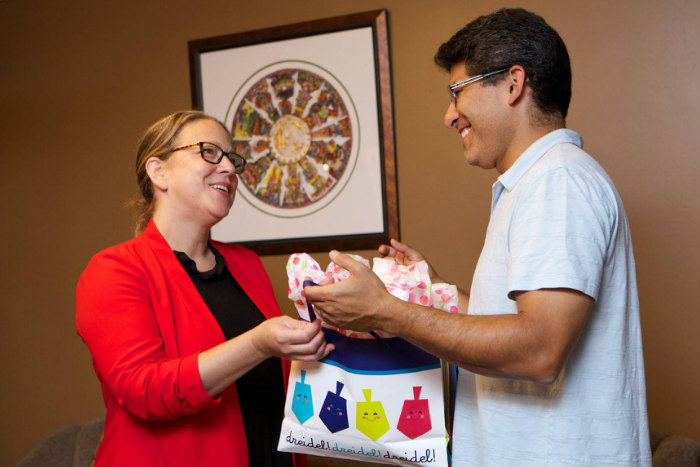
A man and woman exchanging a Hanukkah gift in a bag patterned with colorful dreidels
by Rabbi Jill Crimmings

A couple of years ago, a student in my Introduction to Judaism class asked me why Jews gave gifts for Hanukkah. I told her I had no idea but my guess is that the custom is primarily borrowed from Christmas. I told her I would investigate and get back to her.

As I started to research, I discovered that there was not a direct answer to her question. I was shocked. All Jewish rituals have a story, or more accurately, many stories. How could it be that Hanukkah gift-giving, a widespread ritual, is simply borrowed from Christmas?

As I set out to uncover the Jewish background behind gift-giving for my rabbinic thesis, I discovered that my initial hypothesis is actually mostly correct; the contemporary custom of wrapping presents of toys, clothes, and jewelry arose in conjunction with Christmas. That said, many aspects of the gift-giving ritual have distinctly Jewish roots, each of which has helped set the stage for the development of the ritual into what it is today.

The first way we can understand gift-giving as a Jewish custom is in the connection between giving gifts and offering sacrifices at the Temple. The original story of Hanukkah, as told in the first and second books of Maccabees, is entirely centered on sacrifice. The Greeks in this time replaced sacrificial worship with pagan worship, which then led to rebellion and war. When the Jews unexpectedly defeated the stronger and bigger Greek army, they set out to restore the Temple and altar that the Greeks destroyed. They established the festival of Hanukkah as a way to celebrate the rededication (Hanukkah in Hebrew) of the altar that enabled them to once again offer sacrifices to God (I Maccabees 4:42-56).

Yes, that is correct. The original story of Hanukkah is all about sacrifice. It’s not all about the miraculous victory of the Jews over the Greeks, it’s not all about the miraculous oil. It’s just a celebration for the return to sacrifice.

Though the text in the book of Maccabees does not detail what the rededication of the altar looked like, we can postulate that it resembled the dedication ceremonies described in the bible, particularly the dedication of the Tabernacle in Numbers 7. In this chapter, we learn that the chieftains of Israel brought various presents to the Tabernacle. Among the presents they brought were physical items used in facilitating sacrifice, including silver basins, bowls, and ladles (Numbers 7:1-8:3). A Hanukkah gift is, therefore, a gift that enables us to worship God, and this is precisely how the Jews celebrated the festival of Hanukkah in the years following their victory over the Greeks.

Everything changed after the destruction of the Temple in 70 CE.

Sacrifice was no longer possible and the understanding of how to worship God shifted from sacrifice to study and prayer. For this reason, the festival of Hanukkah could have transformed into a gift-giving holiday. Instead of giving gifts to facilitate sacrifice, one would give gifts to facilitate acts of study or prayer. Instead of giving a silver basin, one might give a tallit or a chumash. As we know, however, the rabbis took the celebration of Hanukkah in a different direction. They introduced the miracle of the oil and focused on the laws surrounding the lighting of the menorah.

The second way we can understand gift-giving as a Jewish custom is with the introduction of Hanukkah gelt in Europe during the 18th century.

Many believe this custom developed because of the etymological connection between Hanukkah and education. Chinuch (education) shares the same Hebrew root (Chet/nun/chaf) as Chanukah (dedication). For this reason, education and specifically Torah study became a central practice during Hanukkah. Historian Eliezer Segal suggests that families began to use these Torah study sessions during Hanukkah as an opportunity to give small amounts of money to teachers, who were otherwise prohibited from accepting money for teaching Torah. Parents would give children money to give to their teachers, and eventually, Segal suggests, the children began to expect it themselves. This, he says, might be the origin of the practice of giving Gelt during Hanukkah.

There are some, however, who date the practice much earlier. In The Original Chanukah Gelt, Marvin Tameanko argues that this custom dates back to the very first Hanukkah festival celebrated by the Maccabees. He points to the then common practice of taking war booty: when the Jews destroyed the Greek armies, they took weapons, armor, horses, and coins (I Maccabees 3:41). These coins were distributed to victorious soldiers, widows, and orphans of the dead, as well as the general population, including children. Tameanko suggests that this could be the origin of Hanukkah gelt.

The third way to understand gift-giving as a Jewish custom is by reinterpreting Hanukkah as a holiday that has always celebrated the interplay between Judaism and the dominant culture of the time. In his book The Jewish Way: Living the Holidays, Irvin Greenberg says that “Hanukkah is the paradigm of the relationship between acculturation and assimilation where each generation has interpreted Hanukkah in its own image, speaking to its own needs.” He discusses how the story of Hanukkah began because of the blending of Greek and Eastern cultures. Hellenism attracted the Jewish elite, and in fact, there were some Jews who favored aggressive assimilation. Gift giving is the prime example of a custom that was, and still is, borrowed from the dominant culture.

In addition to Jews using foreign coins as Hanukkah gelt, gift-giving was generally practiced in Greek culture during the time of the book of Maccabees. There are three examples in the books of Maccabees that describe Greeks engaging in the practice of gift-giving.

In the first example, King Anthiochus’ officers tell Mattathias they will give him gold, silver, and gifts if he makes a pagan sacrifice (I Maccabees 2:15-28). In the second, King Antiochus realizes that his wealth diminished during the war, and he laments that he will no longer be able to give gifts the way he used to (I Maccabees 3:30). In the third example, the King of Persia turns a holy site into a shrine and uses the money he makes from it to give gifts to his friends (II Maccabees 1:34-35).

Each of these examples speaks to the fact that gift-giving was a prevalent practice in Greek culture during the time of the story of Hanukkah. It sets the stage for a discussion about how Jews borrow from and engage with the dominant culture of their time. If Hanukkah is a time for thinking about what it means to be a free people who also live and participate in greater society, it is a perfect opportunity to think about what it means to share practices with others and whether a borrowed ritual can still be considered Jewish.

This Hanukkah, reflect on the Jewish story behind your own gift-giving rituals. Do you give as a way to help others worship or serve God? Do you give as a way to celebrate the victory of the Jews over the Greeks? Do you give as a way to engage with and be part of a larger society? No matter what you do, I urge you to think about these questions and discuss how gift-giving relates to your understanding of the holiday.

Happy Hanukkah and happy gift-giving!

As taken from, The History of Hanukkah Gifts: Is This Custom Really a Jewish One? | Reform Judaism

 
Leave a comment

Posted by on December 3, 2020 in Uncategorized


What Is A Ba’al Teshuvah?

Once a name for sinners who repented, ba’al teshuvah now describes a Jew who returns to Orthodoxy — or becomes Orthodox for the first time.

BY MJL

The term ba’al teshuva (plural is ba’alei teshuvah) literally means “master of the return” and in talmudic times, it was used to describe repentant sinners. According to a famous passage in the Talmud, in a place where penitents stand, even the completely righteous cannot stand.

In the modern context, ba’al teshuvah typically refers to a Jew who has embraced some form of traditional Judaism. Such individuals are sometimes seekers who individually seek out spiritual fulfillment in Orthodoxy, while others are the targets of outreach efforts by rabbis or Orthodox groups. While Judaism traditionally eschews proselytizing to non-Jews, drawing secular Jews closer to religious practice — an effort known as kiruv, from the Hebrew word for “drawing near” — is considered a meritorious practice among the Orthodox, if not an outright divine imperative. The actress Mayim Bialik and the acclaimed scholar Rabbi Adin Steinsaltz are both ba’alei teshuvah.

Beginning in the second half of the 20th century, the ranks of newly observant Orthodox Jews seemed to swell, giving rise to the idea of a ba’al teshuvah movement, which was the subject of numerous magazine and newspaper stories and garnered an approving mention from President Ronald Reagan in his 1984 speech to a B’nai B’rith gathering.  To some, Israel’s Six-Day War and the outpouring of Jewish pride it engendered is sometimes credited with inspiring the growth of this movement in the 1970s and ‘80s. But the phenomenon was also the work of a handful of pioneering Orthodox outreach groups. This effort has since blossomed into a diverse collection of kiruv organizations aimed at exposing non-religious Jews to the joys of Jewish life.

The Jewish group most identified with cultivating ba’alei teshuvah is the Chabad-Lubavitch Hasidic group, whose emissaries have been setting up outreach operations across the world since the 1950s. But such efforts now exist across the Orthodox spectrum and include other large international groups like Aish Hatorah and Ohr Somayach, both headquartered in Jerusalem and operating branches around the world. Other groups are active on college campuses, in public schools and among young professionals. The Association for Jewish Outreach Programs (formerly the Association of Jewish Outreach Professionals) is a Baltimore-based group that supports various Orthodox outreach efforts.

This effort has attracted significant philanthropic support as well as a cadre of Jewish activists who have made kiruv the focus of their careers, but it has also engendered controversy. The movement has been criticized as fundamentalist and creating distance between the newly religious and their non-observant families. Others have charged that kiruv groups employ deceptive practices that prey on the weak-minded. Some have also contended that the children of ba’alei teshuvah are treated unfairly by Orthodox communities.

The phenomenon has inspired a number of scholarly works. Among them, Becoming Frum, an ethnographic look at how the newly religious learn the language and customs of their new Orthodox communities by Sarah Bunin Benor, a professor at Hebrew Union College-Jewish Institute of Religion. In 1989, sociologist M. Herbert Danzger published Returning to Tradition, about the embrace of Orthodoxy by secular Jews. And Lynn Davidson, a sociologist at Brown University, has published books both on those who embrace Orthodoxy and those who leave it.

Hard data on ba’alei teshuvah is difficult to come by. According to a 2015 Pew survey of American Orthodox Jews, fully 30 percent of Orthodox Jews were not raised as such, which would place the total population of American ba’alei teshuvah at around 150,000. However an earlier survey by Pew that looked at the entirety of the American Jewish community suggests that most denominational switching occurs in the direction of less traditional Judaism. Pew noted, however, that this may owe largely to a so-called “period effect,” in which great numbers of Jews who came of age in the middle part of the 20th century wound up leaving Orthodoxy.

In recent years ba’alei teshuvah’s opposites — Jews leaving the Orthodox, particularly the ultra-Orthodox, community — have drawn significant attention, with a number of formerly Orthodox Jews such as Shulem Deen and Leah Lax, publishing memoirs and a 2017 Netflix documentary, One of Us, highlighting the challenges many face when they leave the community. In 2003, a formerly Hasidic woman founded Footsteps, a New York-based organization that helps Jews leaving ultra-Orthodoxy to adjust to their new lives. However, current Orthodox retention rates among the young remain quite high, which could mean that the net movement between liberal and Orthodox Judaism is today in favor of Orthodoxy.

As taken from, What Is A Ba’al Teshuvah? | My Jewish Learning

 
Leave a comment

Posted by on December 2, 2020 in Uncategorized


Obama’s Promised Land

Former US President Barack Obama. Photo: Wikimedia Commons.

A Promised Land, Barack Obama’s newly-published 768-page memoir that tops The New York Times Best Seller List, borrows its title from the Biblical recounting of God’s promise to Abraham and his descendants. Millennia later that promised land was understood by Zionists to be the Land of Israel, where their ancient homeland would be restored. Curiously, the American president least friendly to the State of Israel since its birth in 1948 recasts the promised land of Jews to highlight the narrative of his own presidency.

Obama’s recounting of his relationship with Israel (in fewer than five pages) begins with the Balfour Declaration, noting that the promise of “a national home for the Jewish people” ignored the reality of “a region overwhelmingly populated by Arabs.” Following World War II, when the United Nations approved a plan to partition Palestine between Arabs and Jews, “Zionist leaders embraced the plan but Arab Palestinians … strenuously objected” and “the two sides fell into war.” They hardly “fell” into war. Arabs — as yet there were no self-defined “Palestinians” — waged war to exterminate the fledgling Jewish state. In Obama’s cursory narrative, “Israel would engage in a succession of conflicts with its Arab neighbors” — which, he fails to note, those “neighbors” provoked.

As president, Obama writes, “the Israeli-Palestinian conflict … weighed on me personally.” He claims to have believed that “there was an essential bond between the Black and the Jewish experiences” that made him “fiercely protective of the right of the Jewish people to have a state of their own” — an absurdly inflated claim. Obama “thought it was reasonable to ask the stronger party to take a bigger first step” toward peace. But “the noise orchestrated by Netanyahu” — his favorite villain — “had the intended effect of gobbling up our time, putting us on the defensive, and reminding me that normal policy differences with an Israeli prime minister … exacted a domestic political cost that simply did not exist” when he dealt with “any of our other closest allies.” In translation, he was no match for Netanyahu.

Obama’s narrative conceals far more than it reveals about his impatience with, and eventual hostility toward, Israel. In his 2013 Jerusalem speech to “the people of Israel” he made clear his belief that “the only way for Israel to endure and thrive as a Jewish and democratic state is through the realization of an independent and viable Palestine” — “two states for two peoples.” In translation, all that was required was for Israel to relinquish its Biblical homeland in Judea and Samaria.

The final blow to the relationship, and to Obama’s fantasy of presiding over peace, came when Israel announced permits for the construction of new housing units in East Jerusalem while Vice President Joe Biden was visiting. As “the window for any peace deal had closed,” he realized that “the children of despair” (Palestinians) would inevitably revolt against the “old order in the Middle East” and “those [Israelis] who maintained it.” In other words, Palestinian terrorism was predictable and forgivable.

Even before he arrived in the White House, Obama had pledged that he would create “daylight” between the United States and Israel. It may have been his singular foreign policy achievement, topped only by the Joint Comprehensive Plan of Action (2015), his nuclear deal that provided Iran with a clear path toward atomic weapons — that is, until Israeli attacks (as recently as last week) killed Iran’s top nuclear scientists.

It is hardly surprising that A Promised Land would receive a fawning front-page review in the Sunday Times Book Review (November 29). Five pages long, comprising one-third of the Review, it was written by novelist Chimamanda Ngozi Adichi, who deserves a prize for hero worship. In her ludicrous opening she writes that Obama’s pedestrian prose is “gorgeous in places, the detail granular and vivid.” More revealing is a Jewish Journal poll, taken just after Obama’s presidency ended, asking, “Which US President was the worst for Israel over the last 30 years?” Not surprisingly, in a landslide, Obama ranked highest at 63%. (His nearest challenger was Jimmy Carter at 16%.) A Promised Land reveals why.

In the final days of his presidency, Obama abstained from UN Resolution 2334 maligning Israeli settlements as a “flagrant violation of international law.” But for eight years he had made quite clear his discomfort with Jews living in their Biblical homeland. Yet, the title of his book — A Promised Land — is a biblical reference to God’s promise of the land to the Jewish people. Does he know that?

Ironically, the president most hostile to Israel was followed by the president who has done more for the Jewish state than any of his predecessors since Harry S. Truman recognized it moments after its declaration of independence.

Jerold S. Auerbach is the author of Print to Fit: The New York Times, Zionism and Israel 1896-2016, chosen for Mosaic by Ruth Wisse and Martin Kramer as a Best Book for 2019.

As taken from, Obama’s Promised Land | Jewish & Israel News Algemeiner.com

 
Leave a comment

Posted by on December 2, 2020 in Uncategorized


¿La fuente de la juventud eterna? No, gracias

(iStock)
por Michael Laitman

La gente envejece; sucede de forma natural. La pregunta es si nosotros, como sociedad, entendemos cuánto necesitamos a las personas mayores.

A lo largo de los siglos, se han creado innumerables métodos y tratamientos que pretenden detener o desacelerar el proceso de envejecimiento, ya que las personas experimentan profundos cambios fisiológicos, psicológicos y sociales asociados con el envejecimiento.

Científicos israelíes afirman haber encontrado el secreto para lucir y mantenerse joven para siempre. Incluso si esto resultara posible, poco significado tendría si no  exploraramos el tema desde un nivel más profundo; uno que responda a la pregunta más importante de todas, “¿Para qué vivo?”

La investigación científica de la Universidad de Tel Aviv en conjunto con el Centro Médico Shamir en Israel colocó a un grupo de personas de 64 años en buen estado de salud en cámaras hiperbáricas en las que les proporcionó sesiones de altos niveles de oxígeno durante tres meses. Los científicos responsables del experimento afirman que la terapia retrasó el proceso de envejecimiento, lo “revirtió” y transformó el rendimiento de esos individuos a niveles similares a los de personas 25 años más jóvenes.

El envejecimiento asusta y preocupa a la mayoría de la humanidad. Dado que el proceso del envejecimiento natural, implacablemente acerca a cada personal al final de la vida,  y a lo desconocido, también puede implicar angustia. La vejez y la muerte no son necesariamente algo placentero, pero todo lo que sucede de forma natural tiene un propósito y un beneficio del cual quizá no nos percatamos. Por lo tanto, no es un buen consejo salir corriendo hacia cualquier posibilidad que altere o cambiar el estado natural de las cosas.

Resulta mucho más sabio para nosotros ir de la mano con el proceso natural de envejecimiento y aprender a adaptarnos cómodamente a nuestra situación, en lugar de luchar artificialmente contra el fenómeno natural del envejecimiento. La gente envejece; y esto sucede de forma natural. La pregunta es si nosotros, como sociedad, nos comportamos correctamente con las personas durante todo el proceso del ciclo de vida. Debemos escudriñar: “¿Están ocupados los ancianos y sienten que la sociedad los necesita?” De hecho, ¡una sociedad sana debería considerar las contribuciones de este grupo como importantes!

Si no tuviera mi horario de enseñanza diario, saldría felizmente y limpiaría la calle. Reuniría a amigos que viven en mi vecindario y les ofrecería que vengan conmigo a limpiar los edificios que están a nuestro alrededor. ¿Por qué no? Es saludable salir, respirar aire puro, hacer un esfuerzo físico y en el proceso estar en compañía de otros. Al terminar esta actividad conjunta me sentaría con mis amigos en la plaza pública del barrio y tomaríamos  café. Cualquier líder comunitario que se precie puede ofrecer tal empresa social, y muchas otras, a sus residentes de edad avanzada. Nuestros adultos mayores tienen toda una vida de experiencia y sabiduría para compartir como mentores y ayudar a quienes recién comienzan su camino.

Y si el ejemplo de la limpieza no le parece digno a alguien, entonces debemos admitir que el problema está dentro de quien asi piensa. Es importante capacitar a todos los miembros de la sociedad para cuidar el medio ambiente y servir a la comunidad. A partir de este principio, queda más claro que la sociedad debe estar debidamente educada para inspirar respeto y aprecio la vejez, haciendo un espacio para pensar en estas cosas. La actitud correcta de la sociedad debería ser descubrir cuánto necesita a sus ciudadanos mayores. Pregunte a los niños, ellos entienden esto bien porque esta premisa está naturalmente construida en ellos.

Los abuelos, padres e hijos deben mantener vínculos de conexión que fluyan de una generación a la siguiente, generándose un espíritu de juventud dentro de los ancianos de cada familia. Los ancianos ya comprenden que hay que aceptar la vida como viene y han aprendido a esforzarse para estar por encima de todas las preocupaciones y proyectar esas actitudes a los nietos. Los más pequeños reciben invaluables enseñanzas de los abuelos, siendo estos un ejemplo de amor incondicional y ternura incalculable.

En pocas palabras, el envejecimiento no debe convertirse ser algo aterrador. En lugar de pensar que no tenemos nada más que aportar, los años dorados deberían abrir una plétora de oportunidades para nuevos logros cuando nos demos cuenta de que el aspecto más importante de una vida rica y significativa se encuentra en la conexión humana. Precisamente las preguntas: “¿Cuál es el sentido de la vida?” Y “por qué vivo” son las puertas de entrada a un mundo infinitamente mejor.

Con el conocimiento que las respuestas a estas preguntas se pueden encontrar en nuestras relaciones humanas, en nuestra conexión y en acciones que tienen un beneficio duradero para los demás, trascendemos nuestra vida corporal. Entendemos que existe un colossal mecanismo que rodea nuestra vida y nuestro mundo que supera la existencia en nuestro cuerpo físico temporal. Este ajuste de cuentas nos prepara para entrar en un mundo amplio y eterno, a un nivel superior de existencia que está más allá de los límites del tiempo y el espacio.

Según tomado de, https://blogs.timesofisrael.com/the-fountain-of-eternal-youth/

Traducido por drigs, CEJSPR

 
Leave a comment

Posted by on December 2, 2020 in Uncategorized


The fountain of eternal youth? No thanks

People age; it happens naturally. The question is whether we as a society understand how much we need senior citizens

(iStock)
by Michael Laitman

Throughout centuries, countless methods and treatments have been created that claim to stop or diminish the aging process, as people experience deep physiological, psychological, and social changes associated with growing older. Israeli scientists claim to have found the secret to looking and staying younger forever. Even if that turns out to be possible, it means nothing without exploring the subject from a deeper level, one that answers the most important question of all, “What do I live for?”

Scientific research from Tel Aviv University and Shamir Medical Center in Israel placed a group of healthy 64-year-old people in hyperbaric chambers and supplied them with sessions of high levels of oxygen for three months. Scientists responsible for the experiment claim that the therapy delayed the aging process, “reversed” it, and transformed those individuals’ performance to levels similar to people 25 years younger.

Aging scares and troubles most of humanity. Since the natural aging process relentlessly brings a person closer and closer to the end of life and to the unknown, it can also involve anguish. Old age and death are not necessarily a pleasant thing, but everything that happens in nature has a definite purpose and benefit that we may not realize. So it would be ill-advised to run to tamper with or change any natural state.

It is far wiser for us to go hand in hand with the natural aging process and learn to adjust comfortably to our situation, instead of artificially fighting the natural phenomenon of getting older. People age; it happens naturally. The question is whether we as a society behave properly with people throughout the entire lifecycle process. We must scrutinize, “Are the elderly busy and feel that society needs them?” Indeed, a healthy society should consider their contributions as important!

If I did not have my daily teaching schedule, I would happily go out and clean the street. I would gather friends who live in my neighborhood and offer them to clean with me around the buildings. Why not? It’s healthy to move outside, breathe fresh air, make a physical effort and in the process be in the company of others. Upon finishing this joint activity I would sit down together with my friends on the neighborhood bench and drink coffee. Any self-respecting community leader can offer such a social enterprise and many others to its elderly residents. Our senior citizens have a lifetime of experience and wisdom to share as mentors and help those just beginning their path.

And if the example of cleaning seems to someone as not worthy or dignifying, the problem is within the person himself. It is important to train all members of society to take care of the environment and serve the community. From this principle, it is clearer that society must be properly educated in order to respect and appreciate old age, to give it a place, to devote thought to it. Society’s right attitude should be to discover how much it needs its senior citizens. Ask the children, they understand this well because this premise is naturally built in them.

Grandparents, parents, and children should maintain bonds of connection that flow from generation to generation, giving birth to a spirit of youth within the elderly among the family. The elderly already understand that one should accept life as it comes and have learned how to strive to be above all worries and project such attitudes to grandchildren. The youngest ones receive so many invaluable gifts from grandparents, an example of love that is unconditional, simple warmth without calculations.

In a nutshell, aging should not be a scary prospect. Instead of thinking that we have nothing else to contribute, the golden years should open a plethora of opportunities for new attainment when we realize that the most important aspect of a rich and meaningful life is found in human connection. Precisely the questions: “What is the meaning of life” and “Why do I live” are the gateways to a boundlessly better world.

With the knowledge that the answers to those questions can be found in our human relations, in our connection, and in actions that have lasting benefit to others, we transcend our corporeal life. We understand that there is a colossal mechanism surrounding our life and our world that surpasses existence in our temporary physical body. This reckoning prepares us in great depth to enter the wide, eternal world, a higher level of existence beyond the limits of time and space.

As taken from, The fountain of eternal youth? No thanks | Michael Laitman | The Blogs (timesofisrael.com)

 
Leave a comment

Posted by on December 2, 2020 in Uncategorized


Haciendo de Janucá una fiesta para dar en lugar de recibir

Quiero que mis hijos estén agradecidos por poder dar por sentado el privilegio de sus vidas, así que este año esto es lo que estamos haciendo.

Mis hijos son mocosos mimados. Por supuesto, lo sucedido en el  2020 les ha enseñado  a “prescindir” de cosas que de otro modo podrían haberse dado por hechas. No hubo campamentos, ni viajes de verano a Estados Unidos. Lo sé, estás llorando por ellos mientras lees esto (espero que mi sarcasmo sea escuchado).

Estoy segura que no estoy sola en mis sentimientos, los que van desde estar extremadamente agradecida por los privilegios que tienen mis hijos, hasta preocuparme de que estén creciendo en una burbuja, completamente inconscientes en cuanto a cómo es verdaderamente el mundo y lo que significa tener problemas “reales” que no involucran el wi-fi que a veces no funciona y de los videojuegos que se congelan. Por un lado, mi instinto maternal quiere que un wi-fi poco confiable sea lo peor que le suceda a cualquiera de mis hijos. Por otro lado, quiero que comprendan lo afortunados que son a pesar de las fallas en la conección.

Y no me refiero a ser afortunados porque se van a unas divertidas vacaciones de vez en cuando, o cuando se gastan unos cuantos dólares en zapatillas caras. Lo que quiero decir es, que entiendan que el privilegio que tienen es mucho más profundo. Tienen un techo sobre su cabeza. Tienen comida en la mesa. Tienen libros escolares. Tienen ropa que les queda bien. Tienen zapatos sin agujeros. Estas son las cosas que quiero que sepan pueden dar por sentado, pero también quiero que estén profundamente agradecidos por el mero hecho de que pueden darlas por hechas. Y, más que eso, quiero que sepan que simplemente tener esa seguridad significa que absolutamente DEBEN ayudar a otros que no tienen tanta suerte.

Me gustaría pensar que los estamos criando en un hogar donde el valor de la tzedaká” es evidente. Sé que están creciendo en una comunidad donde “jesed” y las donaciones son abundantes, continuas (así que, en caso de que estemos fallando como padres, ¡espero que todavía estén recibiendo el mensaje desde alguna parte!). Creo que dar caritativamente, y ayudar a los necesitados, es algo que debe hacerse todo el tiempo, en todas las formas posibles (no importa cuán grande o pequeña sea), y no solo concentrada en una época del año. Pero, hay ciertas festividades en las que surgen oportunidades y es una buena forma de compartir con los demás, y simultáneamente  educar a mis hijos.

Mis recuerdos favoritos de Janucá cuando era niña son aquellos donde encendeíamos la menorá en el estudio de mi padre. Todos nos amontonábamos en la habitación, encendíamos las velas, cantábamos MUY fuera de tono y luego pasábamos a la parte divertida: los regalos, al menos uno por cada noche. A medida que mi hermana y yo crecimos, los regalos se volvieron menos interesantes (piense en medias y otras necesidades similares), pero todavía había algo divertido cada noche cuando  abríamos un regalo. Esta es una tradición que quería continuar con mis propios hijos cuando eran pequeños, dándoles la emoción de 8 noches de pequeños obsequios y tesoros. A medida crecieron, se dieron cuenta que Janucá no es solamente un asunto de recibir pequeños obsequios cada noche; sino, por ejemplo con hacer un viaje para ver los  abuelos y primos, ¡lo que representa un beneficio aún mayor!

Este año, al igual que con todas las demás festividades, Janucá se experimentará de forma diferente. No lo pasaremos con nuestros abuelos u otros familiares extendidos. (Sin embargo, cantaremos fuera de tono cuando se enciendan las velas, eso es un hecho). Si bien estoy tentada a darle a cada niño 8 increíbles regalos para compensar los meses difíciles que todos hemos estado experimentando, no lo haré. En cambio, cada uno recibirá una tarjeta de Myisrael, explicándoles que se ha comprado un regalo a su nombre para alguien que lo necesita.

Este es realmente el mejor regalo que puedo darles para Janucá; mostrándoles cómo podemos difundir un poco de luz en este tiempo de oscuridad, recordándoles que tenemos mucho que agradecer ayudando a los necesitados. Es una iniciativa brillante por parte de Myisrael porque mis hijos todavía tendrán algo que abrir, y también algunos niños (o adultos) que de otra manera no tendrían mucho que celebrar este año.

Si está buscando hacer que su fiesta de Janucá sea un poco más significativa este año, en lugar de esperar un regalo, regale.

Escrito por: Emily Kirschenbaum

Según tomado de, https://blogs.timesofisrael.com/making-hanukkah-about-giving-not-getting/

Traducido, con algunas modificaciones, por drigs (CEJSPR)

 
Leave a comment

Posted by on December 2, 2020 in Uncategorized


Making Hanukkah about giving, not getting

I want my kids to be grateful they can take the privilege in their lives for granted, so this year here’s what we’re doing

by Emily Kirschenbaum

My children are spoiled brats. Sure, 2020 has taught them about “going without” things that they otherwise may have taken for granted. There was no camp, no summer trip to America. I know – you are crying for them as you read this (I hope my sarcasm is coming across).

I am sure I’m not alone in my feelings that vary between being extremely grateful for the privileges that my children have and worrying that they are growing up in a bubble, completely unaware of what the real world is like and what it means to have “actual” problems that don’t involve the wifi sometimes not working and video games freezing. On the one hand, my maternal instinct wants unreliable wifi to be the absolute worst thing that ever happens to any of my children. On the other hand, I want them to understand how lucky they are.

And I don’t mean lucky because they get to go on fun vacations or occasionally splurge on expensive sneakers. I mean that I want them to understand that the privilege they have goes way deeper. They have a roof over their head. They have food on the table. They have school books. They have clothes that fit. They have shoes without holes. These are the things that I want them to know they can always take for granted, but I also want them to be deeply grateful for the mere fact that they can take them for granted. And, more than that, I want them to know that simply having that security means they absolutely MUST help others who are not as lucky.

I’d like to think that we are raising them in a home where the value of “tzedakah” is clear. I know that they are growing up in a community where “chesed” and giving abounds (so in case we are failing as parents, hopefully they are still getting the message from somewhere!). I believe that giving to charity and helping those in need is something that needs to be done all the time, in whatever way possible (no matter how big or how small) and not just concentrated at one time of year. But, there are certain holidays where opportunities arise and it’s a good way to give to others and educate my children at the same time.

My favorite Hanukkah memories as a kid are of lighting the menorah in my dad’s study. We would all pile into the room, light the candles, sing VERY off-key, and then get to the fun part – the presents, at least one for every night. As my sister and I got older, the presents got less interesting (think socks and other necessities), but there was still something fun about opening a wrapped gift each night. This is a tradition I wanted to continue with my own children when they were small – giving them the excitement of 8 nights of little treats and treasures. As they’ve gotten older, they’ve been lucky enough to start associating Chanukah less with an assortment of small gifts and more with a trip spent with grandparents and cousins – an even greater benefit!

This year, as with all the other holidays, Hanukkah will look different. We will not be spending it with grandparents or other extended family. (We will be singing off-key when we light the candles though, that’s just a given). While I am tempted to get each kid 8 amazing presents to make up for the tough months we have all been experiencing, I will not be doing that. Instead, they will each receive a card from Myisrael, explaining to them that a gift has been purchased in their name for someone in need.

This is truly the best Hanukkah gift I can give them – showing them how we can spread some light in this time of darkness, reminding them that we have much to be grateful for, and helping those in need. It’s a brilliant initiative on the part of Myisrael because my kids will still get something to open and so will some kids (or adults) who otherwise may not have had much to celebrate at all this year. 

If you are looking to make your Hanukkah a bit more meaningful this year, check it out.

As taken from, Making Hanukkah about giving, not getting | Emily Kirschenbaum | The Blogs (timesofisrael.com)

 
Leave a comment

Posted by on December 1, 2020 in Uncategorized


La oportunidad de Janucá: Un análisis en profundidad de la fiesta de las luces

por Rav Asher Resnick

La oportunidad de Janucá: Un análisis en profundidad de la fiesta de las luces

La batalla de Janucá, en términos del enfrentamiento entre los valores griegos y judíos, es tan relevante hoy como lo fue hace 2.000 años atrás.


La primera pregunta sobre Janucá es: ¿Qué fue lo que ocurrió?

La versión breve de la historia es que los griegos junto con los judíos asimilados y helenizados trataron de destruir al judaísmo imponiendo los valores griegos al resto de los judíos. Un pequeño grupo de judíos (los macabeos) vencieron en la batalla y lograron mantener los valores judíos tradicionales.

¿Qué tiene que ver esto con nosotros?

Debido a la naturaleza cíclica del tiempo, sabemos que la misma dinámica ocurre cada año en esta época. El mundo occidental sigue constituyendo un desafío para el judaísmo a través de los valores occidentales que cada judío confronta a lo largo del año, pero en particular durante esta época. Además, lamentablemente sigue siendo sólo un grupo pequeño de judíos los que intentan luchar para mantener nuestros valores judíos tradicionales.

Por lo tanto, nuestros objetivos respecto a Janucá son entender:

¿Cuáles son exactamente esos valores griegos/occidentales que son tan destructivos?

¿En qué se diferencian de los valores tradicionales de la Torá?

¿Cómo nos ayuda Janucá a luchar contra ellos?

La parashá Lej Lejá

La parashá Lej lejá toca algunos de estos temas. El primer versículo (Bereshit 12:1) menciona tres cosas que le ordenaron a Abram que debía abandonar:

“Y Dios le dijo a Abram: ‘Vete por ti de tu tierra, de tu lugar de nacimiento, y de la casa de tu padre, a la tierra que Yo te mostraré”

Estas tres cosas, la tierra, el lugar de nacimiento (es decir la región dentro del país en la que vive) y la casa de su padre (la casa misma en la que vive), parecieran no estar en orden. Cuando uno deja su país, necesariamente tiene que salir de su lugar de nacimiento; y cuando uno deja su lugar de nacimiento, necesariamente deja la casa de su padre. Basado en el orden del mandamiento que recibió Abram para partir, entendemos que lej lejá (que significa “vete por ti”) no fue una travesía física, sino también un viaje espiritual. De esta forma, se puede entender el orden del mandamiento (como explicaremos a continuación). Esto puede explicar por qué el final del versículo (“a la tierra que Yo te mostraré”) no especifica el destino de esta travesía. La naturaleza de cada travesía espiritual es que nunca sabemos por anticipado y de forma definitiva cuál será nuestro destino.

¿En qué consistió la travesía espiritual de Abram? Las tres primeras cosas fueron dejar su tierra, su lugar de nacimiento y la casa de su padre.

La tierra” corresponde a la nacionalidad y el patriotismo, nuestra primera identidad y lealtad.

Por supuesto que esto es completamente relevante para nosotros en la actualidad. Los judíos que nacen y crecen en Argentina, por ejemplo, ¿son primordialmente argentinos judíos o judíos argentinos?

El lugar de nacimiento” corresponde a la comunidad, la fuente de los valores sociales de la persona. En cada sociedad, necesitamos preguntarnos a nosotros mismos: ¿Cómo sabemos que nuestros valores son correctos?

La casa de tu padre” corresponde a nuestros valores más personales, así como nuestra identidad.

Sin embargo, después la Torá nos dice que Abram debió ceder a su conexión con muchas otras cosas:

La tierra de Israel (temporariamente, debido a la hambruna)

Su esposa Sará (también temporariamente, con el faraón)

Su sobrino Lot (de forma permanente)

Arriesgar su propia vida (en la Guerra con los Reyes)

Su conexión cercana con el resto de la humanidad (con el brit, la circuncisión)

El placer espiritual de la profecía (cuando se fue a atender a los tres visitantes)

Su esposa Sará por segunda vez (también temporariamente, pero esta vez con Avimélej)

Su segunda esposa (Hagar)

Su hijo mayor (Ishmael)

Su hijo más amado, su lógica y toda su misión en la vida (con el mandamiento de ofrendar a Itzjak en el altar)

¿Por qué Abram tenía que separarse de todas estas cosas obviamente valiosas? Para entenderlo, veamos una mishná en Pirkei Avot.

Valorar la belleza del mundo

Rabí Iaakov dice: Aquél que estudia mientras va por el camino e interrumpe su estudio para decir: “¡Qué bello ese árbol! ¡Qué bello ese campo sembrado!”, las Escrituras consideran que compromete su existencia. (Pirkei Avot 3:9)

Es muy difícil entender esta mishná. Imagina que esta persona desea disfrutar la belleza del árbol o del campo. Pero como es serio en su estudio, se asegura de continuar estudiando Torá cuando camina hacia esos lugares, y sólo se detiene cuando llega a ellos para valorar su belleza. Si incluso este comportamiento es criticado, y con dureza, entonces pareciera que no hay ninguna forma en que la persona pueda disfrutar las bellezas del mundo. ¿Acaso esta mishná nos está diciendo que Dios creó un mundo bello simplemente como una distracción o una tentación, quizás para poner a prueba nuestra dedicación al estudio de la Torá? Además, ¿tiene sentido que la persona a la que la mishná le reprocha hubiera hecho mejor si no estudiaba en absoluto mientras caminaba hacia el árbol o el campo, para no tener que “interrumpir el estudio” antes de admirarlos?

Sin embargo, si analizamos cuidadosamente la mishná, encontraremos la clave para entender correctamente su mensaje. ¿Cuál es el punto crítico que revela el verdadero significado de esta mishná?

Antes de que esta persona pronunciara las palabras: ““¡Qué bello ese árbol! ¡Qué bello ese campo sembrado!”, la Mishná nos dice que él interrumpió su estudio. ¿Qué significa esto? Para entenderlo, consideremos esta disertación sobre Janucá.

¿Sería exacto decir que comenzamos hablando de Janucá y luego interrumpimos nuestro estudio para hablar sobre la parashat Lej lejá? ¿Y que después de eso volvimos a interrumpir nuestro estudio para analizar una Mishná en Pirkei Avot? ¿Y a continuación otra vez interrumpimos nuestro estudio para retomar nuestra presentación sobre Janucá? ¡Por supuesto que no! Lo que realmente ocurrió fue que hablamos de Janucá y luego continuamos nuestro estudio hablando de la parashat Lej lejá. Después continuamos estudiando analizando una mishná en Pirkei Avot y luego continuamos estudiando al retomar lo que dijimos sobre Janucá. Durante todo el tiempo, nunca dejamos de estudiar, simplemente cambiamos lo que estudiábamos de un texto a otro.

Con esto en mente, regresemos a nuestra mishná y a la persona que desea disfrutar la belleza del árbol y del campo sembrado. La pregunta clave es por qué desea hacerlo. ¿Quería valorar la belleza del mundo que Dios creó o simplemente le interesaba entretenerse? Al decirnos que “interrumpió el estudio” antes de comentar sobre la belleza del árbol y del campo, queda claro que no estaba interesado en una experiencia de aprendizaje. El mensaje de la mishná es que es terrible que alguien trate la belleza del mundo que Dios creó como un mero entretenimiento.

Lo que es particularmente fascinante es la inferencia que podemos sacar de esta mishná: ¿cuál hubiera sido la situación de esta persona si no hubiera “interrumpido su estudio” antes de prestar atención a la belleza del árbol y del campo sembrado? El Rambam da una bella descripción de cómo se hubiera visto eso. En el segundo capítulo de Hiljot Iesodei HaTorá (Las leyes de las bases de la Torá) 2:2, él analiza cómo se puede llegar a amar y a temer a Dios.

Cuando uno contempla los actos de Dios, junto con Sus grandiosas e increíbles creaciones, y ve la sabiduría ilimitada de Dios en ellas, necesariamente ama, alaba, glorifica y tiene un enorme deseo de conocer el gran Nombre de Dios…

Cuando uno piensa [con mayor profundidad] sobre estas cosas, necesariamente se estremece de miedo. Entiende que es una criatura pequeña, oscura y baja, presentándose con su mente pequeña y endeble frente a Aquél que tiene un conocimiento completo…

Vemos un tremendo contraste entre las diferentes maneras que una persona puede apreciar la belleza del mundo. Como un mero estímulo y entretenimiento, uno se provoca un terrible daño espiritual a sí mismo. Sin embargo, si lo usamos como un vehículo para conectarnos con Dios, entonces será el catalizador para llevarnos a amar y a temer a Dios, dos de los objetivos más elevados del judaísmo. Todo depende si nos relacionamos con la belleza del mundo como un medio y no como un fin.

Si examinamos todavía más la mishná, veremos que este principio se aplica todavía con mayor amplitud. La persona que iba caminando e interrumpió su estudio no comentó sólo sobre la belleza de un árbol, sino que también apreció la belleza del campo sembrado. ¿Por qué la Mishná brinda dos casos que aparentemente ilustran el mismo punto? Si lo pensamos, entenderemos que en verdad los dos casos no son iguales, tienen una diferencia muy significativa. Un árbol es un ejemplo de una belleza natural hecha por Dios, mientras que un campo sembrado es una expresión de belleza hecha por el hombre. Al presentar ambos casos, la mishná nos dice que la importancia de conectarse con la realidad de Dios es importante incluso con la belleza creada por el hombre; por ejemplo con toda clase de artes.

Ahora apliquemos este punto a la dificultad que teníamos en la parashat Lej lejá, donde se le pidió a Abraham ceder a su conexión con tantas cosas valiosas.

Uno y Único

Monoteísmo (creencia en un único Dios) significa que hay una y sólo una realidad verdadera. Tan importante como son la tierra de Israel, la esposa de Abraham, sus parientes, su propia vida, etc., estos nunca pueden ser valores absolutos. El único valor absoluto es la realidad de Dios. Por lo tanto, todo en el mundo es valioso sólo en el grado que se define por la realidad de Dios y que es un medio para conectarse con esa realidad. El proceso de Abram (después Abraham) de separarse de todo lo que le era valioso demostró la centralidad de Dios en cada aspecto de su vida y el mundo.

El concepto esencial y el mensaje de Janucá

Si debemos relacionarnos con la belleza como un medio o como un fin es una de las áreas principales de conflicto entre la materialidad/superficialidad de los valores griegos y la espiritualidad/profundidad de los valores de la Torá. Mientras que tanto los griegos como los judíos apreciaban el mundo físico, este valor surgía de dos perspectivas diferentes. La pregunta era si lo físico era un fin en sí mismo, como creían los griegos, o si era un medio para un fin superior, como creían los judíos.

El milagro de la menorá

El Rav Hirsch, en su comentario sobre la Torá, parashat Terumá, explica que la menorá, el vehículo para el milagro de Janucá, expresa de forma muy bella esta perspectiva de Torá. Para valorar sus palabras, primero tenemos que entender los simbolismos de los números seis, siete y ocho:

a. Seis (como en los seis días de la creación) expresa la idea de lo físico exclusivamente en pos de lo físico, es decir como un fin en sí mismo.

b. Siete (como en Shabat, el séptimo día de la semana) expresa el concepto de lo físico en pos de aquello que está más allá de lo físico, es decir como un medio para conectarse con Dios y con el reino espiritual.

c. Ocho (como en la circuncisión, que idealmente se realiza al octavo día) expresa la noción del reino y la realidad espiritual, es decir, completamente por encima de lo físico.

Rav Hirsch escribió que la menorá tenía siete brazos acomodados en una configuración de seis más uno (Es decir, un brazo central, como el tronco de un árbol, con tres ramas que salían de cada lado). Las seis velas externas tenían la llama hacia el interior, hacia la séptima, que se dirigía hacia el kodesh hakodashim (el santo sanctorum) en el Templo. Esto expresaba el concepto judío del número siete: lo físico en pos de aquello que está más allá de lo físico.

Si bien el Rav Hirsch no dice esto, podemos sugerir que si los griegos hubiesen tenido una menorá, esta hubiera tenido sólo seis brazos y seis velas; expresando su filosofía de seis: lo físico exclusivamente por lo físico.

A través del milagro del aceite que duró (específicamente) ocho días, la menorá “resolvió la disputa” con los griegos de una forma simbólica muy bella. Una vez que este milagro nos demostró que lo metafísico era real, fue obvio que Dios y la espiritualidad deben ser el punto final de todos nuestros esfuerzos en el mundo físico.

Consagración y educación

Uno de los temas centrales de Janucá es cómo una comunidad puede mantener su identidad y sus valores mientras vive en medio de una sociedad más amplia. ¿Qué es lo que le permitirá no sólo sobrevivir sino florecer como una cultura diferente? La respuesta a ambos cuestionamientos queda aludida en el nombre de la festividad:

a. Janucáliteralmente significa “consagración”. Como escuché del Rav Matis Weinberg, el concepto de consagración es cuando algo que tiene diversos usos posibles se separa para usarlo sólo para uno de esos propósitos. Este no es un concepto religioso. Uno puede consagrar una línea telefónica, por ejemplo, para ser usada exclusivamente por una máquina de fax o por una computadora. La consagración adecuada es la esencia de una vida judía. Comenzando con su travesía inicial de su tierra, su lugar de nacimiento y la casa de su padre, y continuando con las diversas separaciones que debió realizar luego, Abraham consagró a Dios absolutamente todo lo que tenía en su vida. La mishná en Pirkei Avot nos dice que también nosotros tenemos que imitar esto al dedicar todo el mundo físico y su belleza a Dios.

b. La palabra Janucá también se relaciona con el término jinuj (por lo general traducido como “educación”). Para que el judaísmo sobreviva, es crítico que haya un sistema educativo confiable que transmita los valores judíos de una generación a la siguiente. Una traducción más literal de jinuj es el proceso de “formarse y transformarse” a uno mismo. Dentro del contexto de Janucá esto puede significar comprometerse a convertirse en un macabeo, es decir a luchar por el pueblo y por los valores judíos.

Ocho días de Janucá

Una de las preguntas más frecuentes respecto a Janucá es por qué celebramos ocho días. Al fin de cuentas, cuando los judíos recapturaron el Templo encontraron una vasija de aceite puro que era suficiente para que durara la primera noche. Esto implicaría que el milagro de que el aceite continuara ardiendo duró sólo siete días. Una de las muchas respuestas a esta pregunta es que el milagro que celebramos en la primera noche de Janucá es el hecho mismo de haber encontrado el aceite puro. Esta vasija pura en medio de la profanación griega del Templo es simbólica del pintele id, la chispa judía que arde en lo más profundo de cada judío, sin importar cuán lejos se encuentre del judaísmo. Una vez que somos capaces de encender ese judaísmo dormido, continuará irradiando luz.

Janucá es el momento en que tenemos que recordarnos a nosotros mismos que si bien el mundo físico es insignificante como un fin en sí mismo, es increíblemente significativo como un medio para conectarnos con Dios y con el reino espiritual. La batalla de Janucá, en términos del enfrentamiento entre los valores griegos y judíos, es tan relevante hoy como lo fue hace 2.000 años atrás. Por cierto no es coincidencia que Janucá tenga lugar cada año exactamente cuando los valores físicos del mundo occidental nos rodean con mayor prominencia. Tal como el pueblo judío resultó victorioso tanto física como espiritualmente en el momento del milagro original de Janucá, esperemos que Dios nos ayude a continuar ganando en la actualidad las batallas espirituales para mantener la conexión con nuestra herencia y con los valores judíos, y a poder transmitirlos a las futuras generaciones.

Según tomado de, La oportunidad de Janucá: Un análisis en profundidad de la fiesta de las luces (aishlatino.com)

 
Leave a comment

Posted by on December 1, 2020 in Uncategorized