RSS

Author Archives: yishmaelgunzhard

The Enduring Preciousness of the Secular Jew

The Enduring Preciousness
of the Secular Jew

Image result for Nathan Lopes Cardozo

By Rabbi Jonathan Lopes Cardozo

We live in an age of unabashed irreverence. Debunking has become the norm, and at every turn we experience a need to expose the clay feet of even the greatest. Human dignity, a phrase often mentioned, has become a farce in real life. Instead of deliberately looking for opportunities to love our fellow humans, as required by our holy Torah, many have rewritten this golden rule to read: “Distrust your fellow humans as you distrust yourself.” People’s lack of belief in themselves has spilled over into their relationships with others. Fearing their own deeds and mediocrity has led them to believe that moral and spiritual greatness has left us and that we are a generation of spiritual orphans.

This condition has slowly entered the subconscious of segments in the religious community as well, although in a more subtle form. Influenced by materialistic philosophies, many religious people who once revered their fellow humans have unknowingly become part of the problem. Instead of sending a message of unconditional love and respect for fellow Jews, whatever their background or beliefs, many within the religious Jewish community have fallen victim to debunking others, which has led to a most worrisome situation in and outside of the Land of Israel.

When observing even those who are fully committed to helping fellow Jews find their way back to Judaism, we see an attitude that is foreign to religious life and thought. We cannot escape the impression that some people, without denying their love for their fellow Jews, tend to talk down to secular Jews. This has become the norm. Constant emphasis is placed on the need to fix the secular person’s mistaken lifestyle. No doubt such an attitude is born out of love, but it lays the foundation for infinite trouble. It is built on arrogance.

While religious Jews are seen as the ideal, they turn secular Jews into second-class members of the Jewish people. It is they who need to repent for their mistaken ways. Such an attitude is built on notions of disparity and lack of affinity. The secular Jew will always feel inferior. As such, the point of departure from which one reaches out to bring fellow Jews closer to Judaism is its undoing. The suggestion that “one should throw oneself into a burning furnace rather than insult another person publicly” (Berachot 43b) may very well apply, since it is the community of secular Jews that is being disparaged and treated as inferior.

For people to bring their fellow Jews back to Judaism there is a need to celebrate the mitzvot that secular Jews have been observing all or part of their lives, not to condemn their failure to observe some others. Only on the basis of sharing mitzvot will an authentic way be found to bring Jews back home.

The foundation should be humility, not arrogance. There is little doubt that secular Jews, consciously or unconsciously, keep a large number of commandments. Many of them may not be in the form of rituals, but there is massive evidence pointing to secular Jews’ commitment to keeping interpersonal mitzvot. Beneath the divisiveness of traditional commitment lie underpinnings of religion such as compassion, humility, awe, and even faith. Different are the pledges, but equal are the devotions. It may quite well be that the meeting of minds is lacking between religious and non-religious Jews, but their spirits touch. Who will deny that secular Jews have a sense of mystery, forgiveness, beauty, and gentleness? How many of them do not have inner faith that God cares? And how many will not show great contempt for fraud or double standards? Each of these is the deepest of religious values.

This not only calls for a celebration but may well become an inspiration for religious Jews – not just by honoring secular Jews for keeping these mitzvot, but by renewing these and other good deeds themselves. There is a need to make the non-observant Jews aware of the fact that they are much more religious than they may know. To have them realize that God’s light often shines on their faces just as much if not more than on the faces of religious Jews.

Just as non-religious Jews need to prove that they are worthy of being friends with religious Jews, so too must religious Jews be worthy of the friendship of their secular fellow Jews. It would be a most welcome undertaking if the religious would call on their secular fellow Jews for guidance in mitzvot that demand their own greater commitment.

There is a significant need for calling Jews back to their roots by showing them that they never left. Once religious Jews learn that secular Jews are their equals, not their inferiors, a return to Judaism on equal terms will come about.

One of the tragic failures of the ancient Jews was their indifference to the Ten Tribes of Israel that were carried away by Assyria after the Northern Kingdom was destroyed. Overlooked, and not taken seriously by their fellow Jews, they were consigned to oblivion and ultimately vanished.

This is a nightmare that, at this moment in Jewish history, should terrify each and every religious Jew: the unawareness of our being involved in a new failure, in a tragic dereliction of duty.

As taken from, https://www.cardozoacademy.org/

 
Leave a comment

Posted by on February 8, 2018 in Uncategorized


El Poder de la Empatía

Image result for rabbi jonathan sacks
Mishpatim 5778
William Ury, el fundador del Programa de Negociación de Harvard, cuenta
una historia maravillosa en uno de sus libros. (1) Un joven norteamericano que fue a
vivir a Japón para estudiar aikido, estaba viajando una tarde en un tren en los
suburbios de Tokio. El vagón estaba semivacío. Había algunas madres con sus hijos y
gente mayor que había ido de compras.
Súbitamente, en una de las estaciones se abrieron las puertas y entró
tambaleando un hombre a los gritos, borracho, sucio y agresivo. Comenzó a insultar
a los pasajeros y se abalanzó sobre una mujer que sostenía un bebé en brazos. De un
empujón la arrojó sobre la falda de una pareja de ancianos que huyó hacia el otro
extremo del vagón. Esto enfureció al hombre, que los persiguió tratando de sacar un
caño metálico de su sostén. Era una situación peligrosa, y el joven se preparó para la
pelea.
Pero antes de lograrlo, un pequeño anciano setentón le gritó Eh! al borracho
en forma amistosa. “Ven para acá que quiero hablarte.” El hombre se acercó, como
en trance. “Y por qué tendría yo que hablarte?” El anciano le contestó “Qué has
estado bebiendo?” “Sake” le respondió, “y no tiene nada que ver contigo.”
“Ah! Que bueno” dijo el anciano “Sabes, yo también adoro el sake. Cada noche
mi mujer y yo (tiene 76 años, sabes) calentamos una botellita de sake, la llevamos al
jardín y nos sentamos en un viejo banco de madera. Miramos el atardecer y vemos
como crece el árbol de caqui que plantó mi bisabuelo…”
A medida que continuó hablando la cara del borracho se ablandó y sus puños
se aflojaron. “Sí” dijo “Yo también amo los caquis.” “Y estoy seguro” comentó el
anciano, “que también tienes una mujer maravillosa.”
“No,” le contestó el hombre “mi mujer falleció.” Lentamente comenzó a
sollozar. “Yo no tener mujer. No tener hogar. No tener trabajo. Estoy tan
avergonzado de mí mismo.” Mientras le caían las lágrimas por las mejillas.
Al llegar a su estación y descender del tren, el estudiante escuchó al anciano
suspirar con simpatía: “Caramba, está sí que es una situación difícil. Siéntate aquí y
cuéntame de qué se trata.” La última imagen que tuvo fue la del hombre con la
cabeza sobre la falda del anciano, mientras éste le acariciaba suavemente el cabello.
Lo que iba a intentar con el músculo, el anciano lo logró con palabras
bondadosas.
Una historia como esta ilustra el poder de la empatía, de ver el mundo con ojos
ajenos, meterse en sus sentimientos y actuar de manera de hacerle saber al otro que
es comprendido, que está siendo escuchado, que a uno le importa.(2)
Si hay un precepto que sobre todos los demás habla del poder de la empatía,
está en una frase de la parashá de hoy: No oprimirás al extranjero,
pues tú conoces el corazón del extranjeroporque fuiste extranjero en la tierra de Egipto” (Ex. 23: 9).
A qué se debe este precepto? La necesidad de empatía ciertamente se extiende
más allá de los extranjeros. Se aplica a la pareja en el matrimonio, a los padres, hijos,
vecinos, colegas laborales y otros. La empatía es esencial a la interacción humana en
general. Por qué invocarla específicamente para los extranjeros?
La respuesta es que la “la empatía es más fuerte en los grupos que se
identifican mutuamente: familia, amigos, clubes, barras, religiones o razas.” (3) El
corolario de todo esto es que cuanto más sólido es el vínculo del grupo, más aguda es
la sospecha o el temor a los que están afuera del mismo. Es fácil decir “ama al
extranjero como a ti mismo.” Es muy difícil en realidad amar o aún tener empatía
por un desconocido. Como lo planteó el primatólogo Frans de Waal:
Hemos evolucionado hacia odiar a nuestros enemigos, ignorar a personas
que apenas conocemos y desconfiar de cualquiera que no se nos parezca. Aún
siendo colaboradores dentro de nuestra comunidad, nos transformamos casi
como en animales distintos en el trato con extranjeros. (4)
El temor a los-que-no-son-como-uno es capaz de anular la respuesta
empática. Es por eso que este precepto específico es capaz de cambiar la vida. No
solo nos dice que hay que tener empatía con el extranjero porque sabemos cómo se
siente estar en su lugar. Casi da a entender que
este fue uno de los motivos del exilio
de los israelitas de Egipto.
Es como si Dios hubiera dicho: tus sufrimientos te han
enseñado algo de extraordinaria importancia. Has sido oprimido; por lo tanto acude
en defensa de los oprimidos, sean quienes sean. Has sufrido; por eso serás el pueblo
que está dispuesto a ofrecer ayuda a los demás cuando sufren.
Y efectivamente así fue. Había judíos entre los que ayudaron a Ghandi en su
lucha por la independencia india; con Martin Luther King en su esfuerzo por los
derechos civiles de los afroamericanos; con Nelson Mandela en su campaña contra el
apartheid en Sudáfrica. Hoy en día, los equipos de salvataje médico de los israelíes
suelen ser los primeros en asistir cuando se produce un desastre natural. La
respuesta religiosa al sufrimiento ajeno es poder colocarse en el lugar del que sufre.
Es por eso que vi con frecuencia que los sobrevivientes del Holocausto en nuestras
comunidades son los que se identificaron más intensamente con las víctimas de las
guerras de Bosnia, Ruanda, Kosovo y Darfur.
He argumentado en mi libro Not in God’s Name que la empatía está
estructurada en la forma en que la Torá cuenta ciertas historias – la de Hagar e
Ismael cuando fueron arrojados al desierto, la de Esav, cuando se presenta ante el
padre para recibir su bendición y se encuentra con que Yaakov la ha tomado, y la de
los sentimientos de Lea, cuando se da cuenta de que Yaakov ama más a Raquel qué a
ella. Estas historias nos obligan a reconocer la humanidad del otro, los
aparentemente malqueridos, no elegidos, rechazados.
En efecto, puede que sea principalmente este el motivo por el cual la Torá
relata estas historias. La Torá es esencialmente un libro sobre la Ley. Por qué
entonces hay narrativa? Porque la ley sin empatía es como la justicia sin compasión.
Rashi nos dice que “Originariamente Dios pensó en crear al mundo a través del
atributo de la justicia, pero vio que no podía sobrevivir sólo con esa base. Por ese
motivo puso como necesario el atributo de la compasión junto con el de la justicia.”
(5) Es así como actúa Dios y como desea que actuemos nosotros. La narrativa es la
manera más efectiva mediante la cual podemos ingresar imaginativamente en el
mundo de otras personas.
La empatía no es un agregado superficial, adicional, liviano, de la vida moral.
Es un factor esencial para la resolución de conflictos. Personas que han sufrido
dolor, frecuentemente responden infligiendo dolor a otros. El resultado conduce a la
violencia, a veces emocional, otras veces física, dirigida contra individuos e incluso
contra grupos enteros. La única alternativa genuina, no violenta, es poder ingresar
en el dolor de la otra persona, de tal manera de que sepa que ha sido comprendida,
su humanidad reconocida y su dignidad afirmada.
No todos pueden hacer lo que hizo el anciano japonés y desde ya que no cualquiera
puede intentar desarmar a una persona potencialmente peligrosa de esa forma. Pero
la empatía activa cambia la vida, no solo para uno sino también para la gente con la
que uno interactúa. En lugar de responder con enojo a la ira de otra persona, es
necesario intentar conocer el motivo del enojo. En general,
si la intención es la de tratar de cambiar el comportamiento de alguien, es necesario
ubicarse en su mente, ver el mundo a través de sus ojos y tratar de sentir lo que siente esa
persona, y luego decir la palabra o actuar de tal forma que apele a sus emociones,
no de las de uno mismo. Muy poca gente lo logra. Los que sí pueden hacerlo, cambian el mundo.
NOTAS
(1) Adaptado de William Ury, The Power of Positive No,
(2) Dos libros recientes sobre el tema son los de Roman Krznaric, Peter Bazalgette, The Empathy Instinct,
Simon Baron-Cohen, The Essential Difference, mujeres tienden a ser mejores que los hombres.
(3) Bazalgette, 7.
(4) Frans de Waal, ‘The evolution of empathy’, Keltner, Marsh and Smith. Instinct: the science of human goodness
(5) Rashi a Gen. 1: 1.
 
Leave a comment

Posted by on February 7, 2018 in Uncategorized


What Is the Meaning of the ‘Evil Eye’?

In Judaism, the “evil eye,” ayin hara in Hebrew, is the harmful negative energy that is created when one looks at something with envy or ill feeling.

The idea of an ayin hara is found in many places in the Talmud and Jewish law. For example, we are told not to gaze at a fellow’s field of standing grain, lest we damage it with an evil eye,1 and the custom is not to call two brothers (or father and son) up to the Torah consecutively because of the ayin hara that may come from drawing too much attention to a single family.2 The evil eye is also the reason why we don’t “count” people.3

However, before we start fearing every possible ayin hara, it’s important to know how, why and when the evil eye works.

Which Eye Is the Evil Eye?

The concept of an ayin hara is related to the prohibition “Do not covet” in the 10 Commandments.4

Some medieval sages explain that an ayin hara is a sort of physical phenomenon in which negative energy emanates from the person’s eyes when he gazes upon something or someone with ill feeling or envy.5

However, the second Chabad Rebbe, Rabbi Dover Schneuri, explains that you cannot say that the “eye” referenced here is the physical eye, for what power does such an organ—which has no intelligence—have to cause good or evil? Rather, the “evil eye” refers to a spiritual vision of the intellect, “the eye of the mind.”6

Why the Evil Eye Works

Many have questioned how it is possible that one person’s negative gaze (and thoughts) can cause harm to another. The key is that it is not the evil eye on its own that causes the negative effects.

Here’s how it works:

G‑d is the epitome of kindness. As such, Heaven does not generally judge a person in the strictest possible manner. But when one negatively gazes at another’s good fortune with ill feelings or envy, he is essentially asking, “How come that person has XYZ?” This arouses the latent harsh judgment Above, and the person is judged strictly according to what he deserves. So if there is already some sort of existing sin, the evil eyecan amplify it and cause the person to be judged in a strict and unfavorable fashion.7

To put it differently, when the Heavenly Court weighs the sins and merits of a person, both good and bad judgments result. When we note and speak of the good, we channel the good. And when someone views the other negatively, he channels the negative.

Based on this, we can understand why the sages tell us that an ayin harah also negatively affects the person who gazes with an evil eye, since the harsh judgment and scrutiny is visited upon both of them.8

Warding Off the Evil Eye

When you praise a person, his family or belongings, you can avoid giving the evil eye by indicating that you bear no jealousy toward them, and even bless them that an evil eye should have no power over them.9

In Hebrew, this is commonly done by inserting the phrase bli ayin hara, which means “without evil eye.” In Yiddish, this is said as kein ayin hara, which is often contracted to sound like kenainahora or kinnahora.

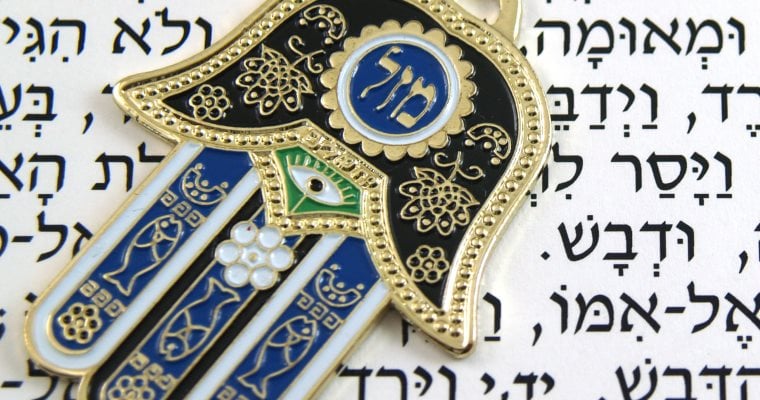
Additionally, some use various amulets and remedies as a way to ward off the evil eye (but that deserves an article of its own).

However, since the evil eye is generated by people gazing enviously and with ill feeling, it is best avoided by acting in a modest manner, not flaunting wealth or other gifts. As the sages tell us, “Blessing only rests on that which is hidden from the eye.”10

Why You Need Not Worry About the Evil Eye

Although the Talmud does lend a measure of credence to the evil eye, it also tells us that “one who is not troubled by it, will not be troubled by it.”11 Don’t be bothered by it, and it will not bother you.

As Rabbi Dovber, the Maggid of Mezritch, taught: In truth, everything is considered as naught before G‑d, and there is no true independent existence outside of G‑d. Thus, when you look at something in a positive way, you are also seeing and recognizing how it comes from G‑d, and since G‑d is the source of all blessing, by doing so, you bring forth even more blessing. . However, when you gaze upon something with an evil eye—even when you praise it but don’t truly recognize that all is from G‑d—you are essentially presenting it as if it is an entity of its own, separating it from its Divine source and the spiritual vitality within it and therefore causing a loss of blessing.12

Of course, the reverse is also true. If one can have a negative impact just by gazing at something with ill feelings, imagine what one can accomplish by making an effort to always regard things with positivity. Let’s make sure to view our blessings and the blessings of others with a kind and grateful eye.

Footnotes
1. See Talmud, Bava Metzia 107a; Bava Batra 2b.
2. Shulchan Aruch, Orech Chaim 141:6.
3. Talmud, Yoma 22b.
4. Rabbi Yaakov Tzikili (14th century), Torat Haminchah, Mishpatim 25.
5. Rabeinu Yonah, Avot 2:15; Abrabanel, Exodus 30:12; Sefer Chareidim.
6. Torat Chaim, Breishit 114b.
7. See Likkutei Sichot vol. 5 pgs 44-45; Likkutei Sichot, vol. 32, p. 151; R. DovBer of Lubavitch (Mitteler Rebbe) Sefer Maamarei Kuntreisim p. 332-333; Tzemach Tzedek in Ohr Hatorah, Nosso p. 1831-2; Rabbi Shmuel of Lubavitch in Torat Shmuel, Sefer Maamarim 5638 p. 84.
8. Avot d’Rabbi Nosson 16:1; Avodat Hakodesh, Tziporen Shamir 11:172.
9. Rabbi Chaim Yosef Dovid Azulai, Chida, Avodat Hakodesh, Tziporen Shamir 11:172
10. Talmud, Taanit 8b; Zohar 1:64b.
11. Talmud, Pesachim 110b and commentaries ad loc.
 
Leave a comment

Posted by on February 7, 2018 in Uncategorized


¿Tiene Di-s un lado femenino?

Siempre que nos referimos a Di-s, lo hacemos en género masculino.Sin embargo, él está por encima de todo límite


¿Por qué Di-s siempre es referido en sexo masculino? Lo llamamos Nuestro Padre, nuestro Rey, y siempre es “Él”.

Obviamente Di-s no es un hombre. ¿Por qué el judaísmo perpetúa esta dominancia masculina patriarca?

De hecho, Di-s trasciende todo género. Siendo la fuente de toda vida, Di-s alberga tanto género masculino

como femenino. Esto está reflejado en nuestras plegarias. A veces llamamos a Di-s en aspecto femenino,

y a veces en su aspecto masculino. Depende del contexto.

De hecho, nos referimos a Di-s en femenino en una de las plegarias más populares: “Lejá Dodi”. Cada

viernes a la noche, recibimos a la “Novia Shabat”, y a la “Reina Shabat”. ¿Quién es esta novia real? Es

la Shejiná, la Divina Presencia, femenina que desciende en este día de descanso. ¿Por qué Di-s es

femenino en esta plegaria, mientras que en la mayoría de las plegarias es masculino?

Para responder a esto, analicemos una básica referencia entre masculino y femenino. Conozcamos

a Brenda y Mike.

Mike llega a casa luego de un estresante día de trabajo. Brenda percibe su mal humor.

Brenda: ¿Qué sucede Mike? ¿Está todo bien?

Mike: ¿Eh?

Brenda: ¿Qué te está molestando?

Mike: Nada

Brenda (ofendida): ¿A qué te refieres con nada? Yo veo que hay algo malo. ¿No te importo

lo suficiente como para compartir tus sentimientos?

Mike: ?????

Brenda se ha olvidado que los hombres sólo comparten sus problemas cuando piensan

que puedes ayudarlo a encontrar una solución. De lo contrario, ¿Para qué cargar a otro

con sus problemas? Siendo que Mike siente que sus temas en el trabajo no le conciernen a

Brenda, se los guarda para él mismo. Ella no le puede aconsejar, así que él intenta

solucionarlo por sus propios medios. Mientras tanto, ella se siente abandonada y no

involucrada, porque las mujeres comparten sus problemas no para encontrar una

solución, sino sólo para compartirlos y sentirse acogidas y amadas. Ella no planeaba

aconsejarle nada, sólo quería estar allí para él. Pero los hombres no entienden eso.

Ahora, demos vuelta las cartas. Otro día, Brenda llega a casa del trabajo, y antes de

que Mike le diga algo ella le dice:

Brenda: He tenido un día tan estresante. Mi jefe es un animal. No puede parar de

presionarme sin importarle lo que hago. Y no puedo soportar su condescendiente actitud.

Mike: Te he dicho un millón de veces que debes dejar el trabajo. ¿Por qué sigues yendo?

Brenda (frustrada): No te he pedido un consejo sobre mi carrera, te estoy contando

sobre mi día. Estoy muy contenta con mi trabajo.

Mike: ?????

Lo que Mike no entiende es que las mujeres lidian con sus problemas de forma diferente

a los hombres. Brenda no buscaba un consejo, ella buscaba comprensión. Todo lo que Mike

tenía que hacer era escucharla con mirada comprensiva y emitir el tan tranquilizante

sonido de “mmmmm”. Esta es la manera femenina de lidiar con un problema: compartirlo

con alguien que le importe, y ellos al escuchar, harán que ella no se sienta mal. A los

hombres les gusta aconsejar, pero las mujeres solo quieren compartir sus frustraciones

para luego sentirse mejor, incluso si no cambia nada. Esto es por supuesto una generalización.

Pero es muy cierto. Para un hombre, un problema precisa una solución. Para una mujer,

un problema precisa ser compartido. Los hombres intentan cambiar los hechos.

Las mujeres intentan cambiar los sentimientos. Los hombres intentan mejorar la situación.

Las mujeres intentan sentirse mejor con las cosas de la manera que son.

Ahora veamos a Di-s. Di-s tiene modos de expresión femenina y masculina, porque

Di-s es la fuente de ambos. Di-s puede ser el solucionador masculino de los problemas,

o el tranquilizador femenino de las almas turbadas. En la plegaria, nos dirigimoa ambos.

Depende de la circunstancia. A veces queremos una respuesta masculina de Di-s,

y a veces precisamos un acercamiento femenino.

Generalmente rezamos porque hay un problema que tiene que solucionarse.

Alguien está enfermo y precisa una curación, alguien está deprimido y precisa que se lo

“levante”, hay gente hambrienta que precisa que se la alimente, y el mundo está lleno de

dolor y oscuridad y precisa cambiarse. Sería desubicado dirigirse al lado femenino de Di-s

con estos pedidos. No queremos sentirnos mejor sobre la pobreza, queremos acabarla.

No queremos llegar a un trato con la enfermedad; queremos una cura. Así que le rezamos

a “Nuestro Padre, nuestro Rey”, el aspecto masculino de la Divinidad. “Di-s, ¡soluciona el problema!”

Pero hay veces que no buscamos un cambio en el mundo, sino una apreciación del mismo

en un nivel más profundo. En Shabat, no queremos arreglar cosas. Desistimos de la agresiva

misión de mejorar al mundo a través del trabajo y la creatividad, y disfrutamos de los placeres

naturales que el mundo ya tiene: amistad, familia, espiritualidad. Más que cambiar la realidad,

buscamos nutrir su belleza innata.

Así que en la noche del viernes, recibimos a la Divina Presencia en la forma de “La Reina Shabat”,

o la “Novia Shabat”. Es el aspecto femenino de la Divinidad que desciende en Shabat, no para

resolver los problemas del mundo, sino para adentrarnos en la conciencia de que el mundo

en el que vivimos ya es bello.

Según tomado de, http://es.chabad.org/library/article_cdo/aid/1738510/jewish/Tiene-Di-s-un-lado-femenino.htm

 
Leave a comment

Posted by on February 5, 2018 in Uncategorized


Why Do Torah and Haftarah Have Different Trope?

Trope (trop in Yiddish) is the tune used when Torah reading and other texts, based on a cantillation marks.

Most communities use six different kinds of trope throughout the year:

  • The common trope used on Shabbat, holiday, and weekday Torah readings1
  • The High Holiday melodies
  • Haftarah
  • Megillat Esther
  • Meggilat Eicha (Lamantations)
  • The three Megillahs of Shir Hashirim (Song of Songs), Ruth, and Kohelet (Ecclesiastes)

Are They Really Different?

Besides for telling us how to sing, the cantillation marks are considered part of the Oral Torah

since they give syntax and structure to the verses and actually affect the meaning of the verses read.2

The mystics add that there are many secrets and layers of meaning in the Torah that can only

be understood through the cantillations.3

Although these six tropes all sound different, the cantillation marks all serve the same

function as far as syntax and meaning is concerned. They only differ with regard to the

clef and tempo they are sung in.

The Differences Matter

A page of a Tikkun printed in Berditchev, which displays the text with cantellation marks alongside the same text with no markings at all, used as an aide to Torah readers (from the private collection of Menachem Posner).
A page of a Tikkun printed in Berditchev, which displays the text with cantellation
marks alongside
the same text with no markings at all, used as an aide to Torah readers
(from the private collection of Menachem Posner).

So why are they different? Rabbi Moshe Sofer (known as the Chatam Sofer) writes: “Clefs that the

cantillations are sung in are dependent upon the nature or occasion of the reading. Thus, for the

reading of Eicha the text is read in a more sorrowful pitch, while Megillat Esther is more joyful.”4

But there is more than just mood. Rabbi Judah the Pious (1150-1217) writes that there is an ancient

tradition that the Torah, Nevi’im (Prophets) and Ketuvim (Writings) are each sung in their own

unique pitch, and one may not read Torah in the tune of the Prophets or vice versa.5

Some are of the opinion that the general differences of tune and pitch are in fact remnants of the

tunes that the Levites sung in the Holy Temple, which they composed based on the sounds of the

cantillations.6

In fact, the cantillations were held in such reverence that the Talmud says that one should not

dirty the right hand in the privy because the right hand is used to show the cantillation notes

of the Torah.7

The Books of Emet

A detail from an edition of the Book of Job, printed in Warsaw in 1861, which displays the text with the cantillation marks unique to the Books of Emet (from the private collection of Menachem Posner).
A detail from an edition of the Book of Job, printed in Warsaw in 1861, which displays the text with the
cantillation marks unique to the Books of Emet
(from the private collection of Menachem Posner).

Although for the most part the cantillations only vary by tempo and pitch, there are three (out of the 24)

books of Scripture that do indeed have an almost entirely different cantillation system with separate rules.

These are the books of Iyov (Job),8 Mishlei (Proverbs) and Tehillim (Psalms). In Hebrew, their names

form the acronym of “EMeT,” which means “truth,” and they are collectively known as Sifrei Emet,

“Books of Truth.”

Why do they have their own system?

  • Tosafot attributes it to the fact that these books are written in a poetic style with short verses.9
  • Tosafot Hashalem explains that these three books contain the “secret of creation” and therefore
  • share their own unique tune.10
  • Rabbi Judah the Pious explains that the authors of these three books were unique in that each
  • of them experienced great upheavals in their lives. The Book of Job describes how Job was catapulted
  • from extreme privilege to the depths of suffering, and was then restored to his former glory.
  • Kings David and Solomon (authors of Psalms and Proverbs respectively) both experienced
  • periods when their rule was temporarily taken from them.11

Understanding the Cantillations

As we mentioned, there are deep secrets hidden in the names and sounds of the cantillations, rooted

in the songs of the Holy Temple. Let us hope and pray for the day when the Temple will be rebuilt

and the meanings of these songs will be fully understood.12

Footnotes
1. There are parts of the Torah that are read with different tunes such as the song of the sea, as well as
the Ten Commandments, which have two sets of cantillations (ta’am eliyon and ta’am tachton). For
the purpose of this article, they are all included in the general Torah reading.
2. See Zohar 2:205a; Zohar Chadash, Shir Hashirim 73b.
3. See, for example, Rabbi Moshe Cordovero—Ramak, Shiur Komah 8.
4. See repsonsum Chatam Sofer, 6:86.
5. Sefer Chassidim 302; he refers to their unique tunes as well as the prohibition of not
switching tunes as “tradition from Sinai.” See, however, the Chida in his commentary
Brit Olam ad loc., where he explains that it does not necessarily mean that the tunes
of the Prophets and Writings were literally from Sinai.
6.Rabbi Shimon ben R’ Tzemach Duran; Rashbatz, in Magen Avot 3, “Hameyuchad
L’Techiyat Hameisim,” ch. 4 (p. 384 in Haktav edition).
7. Talmud, Berachot 62a and Rashi ad loc.
8. While most of the book of Job has unique cantillation, ch. 1-2 and the end of Job
have the regular cantillation.
9. Tosafot, Talmud Bava Batra 14b; see also Mesechet Sofrim 12:11-12.
10. Tosafot Hashalem on Genesis 1:1 no. 74; see there where it explains that the last
letters of the first three words of the Torah are an acronym for these three
books בראשית ברא אלוקים is an acronym for תהילים איוב משלי
11. Rabbi Yehuda Hachassid in Sodei Chumash, Likutim, Sodei Iyov (p. 111).
12. See Shiltei Hagiborim, Rabbi Avraham Harofeh, Ma’mer Haloshon (p. 602 in Machon Yerushalayim edition).
 
Leave a comment

Posted by on February 1, 2018 in Uncategorized


The Challenge of Yitro. Would you Convert?

Would You Convert?


TTP: 578

Read this essay on the Cardozo Academy Website, For a printable pdf, click here.

In memory of Toby Willig,
Noble Lover of the People and the State of Israel

As we are daily confronted with a steady increase in the number of Jews who have not only left the fold but are actively involved in anti-Jewish activity inside and outside Israel, it would perhaps be meaningful to study an episode in the life of a biblical non-Jew who decided to join the Jewish people at all costs.

Reading the story of Yitro (Shemot 18)—Moshe’s father-in-law and one of the earliest converts to Judaism—presents a challenge, not only to many anti-Jewish Jews but also to those who are actively living a Jewish religious life but lack the intensity and passion for Judaism and its message. For sensitive souls, Yitro’s story is not just a significant narrative but also a painful confrontation with one’s own Jewishness.

After many years of separation, Moshe and Yitro meet again. Moshe had married Yitro’s daughter Tzipora many years earlier but had then left his father-in-law’s home and gone back to Egypt to redeem his people. Subsequently, he took the Jews out of Egypt and miraculously led them through the Red Sea. Once the exodus had been realized, Yitro, Tzipora and her children were able to meet him again. The text tells us that this meeting took place in the wilderness:

Yitro, Moshe’s father-in-law, came with [Moshe’s] sons and wife to the desert, where Moshe was staying… (Ibid. 18:5)

What, asks Rashi, is the importance of knowing that they met in the desert? Rashi answers that this points to the tremendous sacrifice Yitro made when he decided to become a Jew:

The verse speaks in praise of Yitro. He lived in a world of glory, yet his heart prompted him to go out to the desert wasteland to hear the words of the Torah. (Ibid ad loc.)

Indeed, tradition teaches us that Yitro was a man of great wealth. He had held the prestigious post of high priest in Midyan, comparable to the position of pope in Rome today. He was surrounded by servants and basked in glory and abundance. The verse now informs us that he gave up all of this to go to a “desert”, a place where he would no longer have any of these honors. He had decided to convert. In many ways, this was a catastrophic decision. All the glory and prestige would be gone. Instead of holding the post of high priest and playing a crucial role in world affairs, he would now be an ordinary Jew, sliding into oblivion. He would become one among many, no longer a leader in his own right, just “the father-in-law of Moshe”.

In fact, our tradition continues to provide us with remarkable information about this sweeping decision. Yitro had become an outcast among his own people. After having rejected all forms of religion and philosophy known in his day, he was banned and abandoned by the societies in which he lived. He had turned into a “lonely man of faith”, as Rabbi Soloveitchik would say. Once he heard about the exodus from Egypt, the splitting of the Red Sea, and the soon-to-come revelation of the Divine Teaching at Sinai, everything else seemed of secondary importance. Only this moved him: to be part of the Jewish people and participate in their Torah experience. The price was indeed enormous.

Yitro confronts us for the first time with a new phenomenon: to be a Jew by choice. By doing so, he presents all Jews with a major challenge: how to become a Jew by choice even when one has been born into the fold; how to feel the fire needed to live the life of an authentic Jew, as Yitro did. Such an undertaking is possible only if one is able to re-enact and experience Yitro’s journey to Judaism.

It must have been a long and difficult road, a heart-rending challenge, with many ups and downs before finally arriving at the top. Along the way, Yitro must have had countless fiery conflicts with his former friends and colleagues, and he surely felt terribly lonely. He was plagued by doubts and inner conflicts before he was able to become a Jew. Like a baby taking its first steps, he most likely tried to engage the world of Torah and its spirit, undergoing its hardships before experiencing its joy. How many times must he have nearly thrown in the towel in despair, only to continue his struggle until he overcame all obstacles and took the final, crucial and radical step: to be a Jew and nothing but a Jew; to experience the incredible joy that accompanies it.

For many of us who were born into the fold, Yitro’s desire to become a Jew is a major problem. It hits us in the face. It’s a challenge to all those among us who left the fold, opting for a comfortable secular lifestyle. We must ask ourselves why a non-Jew would be prepared to give up everything to become Jewish. What is there in Judaism that makes a non-Jew conclude that it surpasses everything else? These questions should plague each one of us.

But also for those of us who are religiously observant, Yitro’s engagement with Judaism is a big challenge, posing questions such as: Am I in love with Judaism as much as Yitro was? Am I prepared to give up everything, including wealth, honor and social standing? Would I have been prepared to exchange my prestigious position in the world for a life in the desert, ridiculed by old friends and colleagues?

Yitro forces each one of us to ask ourselves whether we would have opted for Judaism had we not been born Jewish. And if yes, would this not mean that we would have had to start all over again, discovering it on our own so as to comprehend what it is really all about? If Yitro traveled his road to Judaism step by step in order to fully grasp its beauty and truth, we may have to re-engage ourselves with every mitzvah as if we have never done it before, as real beginners. Only that way can we become “Jews by choice”, real Jews. Perhaps we should begin a process by which we take hold of every mitzvah that we have been observing for years and transform it into something radically new.

It is told that the great Jewish philosopher and ba’al teshuva Franz Rosenzweig (1886-1929), in his earlier days when he was still on his way to becoming a real Jew, was once asked whether he put on tefillin. “Not yet”, was his answer.

Although he may not have felt ready at the time to take on this great mitzvah, he made it clear that he looked forward to the day when wearing tefillin would become a truly religious experience. Surely this does not mean that we should wait until we are fully ready. After all, it was Rosenzweig himself who taught that it is in the deed that one hears the mitzvah. Only when one actually does a mitzvah can one hear and feel its profundity. But it does mean that when a person just goes through the motions of putting on tefillin, they have not yet authentically performed the mitzvah. Only when one approaches it as a novice, as did Yitro, can one experience its full power. Not out of tradition or habit, but from a genuine desire to fulfill the word of God.

This is the road that Yitro took, which led him to realize the enormous religious profundity of Judaism, of each and every mitzvah, for which he was prepared to give up everything. And therefore he poses a challenge to each of us.

The famous non-Jewish, British literary historian A.L. Rowse (1903-1997) gave added meaning to Yitro’s decision when he wrote at the end of his memoirs: “If there is any honour in all the world that I should like, it would be to be an honorary Jewish citizen.” (A.L.Rowse, Historians I Have Known, London: Duckworth, 1955, p.204) For him, it remained an unfulfilled dream.

For many Jews, it is a reality never dreamed about and consequently unappreciated.

 
Leave a comment

Posted by on February 1, 2018 in Uncategorized


Why Did Adolf Hitler Hate the Jews?

Although much of Adolf Hitler’s political manifesto, ‘Mein Kampf,’ was devoted to explaining that hatred, researchers have looked for a more personal explanation.

Adolf Hitler
Adolf Hitler

One cant consider the Holocaust without wondering about the source of Adolf Hitlers hatred for the Jews. Although much of his political manifesto, Mein Kampf, was devoted to explaining that hatred, which was clearly shared by an enthusiastic German nation, the actions taken against Europes Jews were so monstrous in both nature and scale that it was inevitable that researchers would look for a more personal explanation. Its natural that scholars and others would scrutinize every piece of available evidence for proof of some deeply personal psychological injury that will explain Hitler.

Illegitimate father

Even before Hitler came to power, there were rumors that he was of Jewish descent, a detail of personal history that would be highly damaging, even humiliating to him, and which he went to lengths to quash. The idea derived from the fact – not a secret – that his father, Alois Hitler, was illegitimate. Although Hitlers paternal grandmother, Maria Anna Schicklgruber, eventually married Johann Georg Hiedler and took his surname, Alois was already aged five when she did so, and she never did reveal, if indeed she knew, who his father was.

Naturally, there was much speculation about the identity of Hitlers grandfather – most of it centered on Johann Georg Hiedler himself and his brother, Johann Nepomuk Hiedler, who was the stepfather of Alois, and who left him part of his estate when he died.

The Jewish angle to the speculation, however, concerned a third candidate, a Jew named Leopold Frankenberg, who according to Hitlers personal lawyer, Hans Frank, was the young-adult son of a couple who employed Maria Schicklgruber as a cook at the time she became pregnant with Alois. According to testimony given by Hans Frank at the Nuremberg Trials, in 1945-46, he had heard from Hitler himself in 1930 about this Jewish ancestry. Nevertheless, no evidence has ever been found to support this claim, nor is there any proof that Leopold Frankenberger even existed.

In any event, the connection between having an embarrassing ancestor in ones family tree to possessing a pathological hatred of that ancestors ethnic group is far from obvious.

The physician

Another well-known theory concerns the Jewish physician, Eduard Bloch, who cared for Hitlers beloved mother, Klara Hitler, before her death from breast cancer, in 1907, at age 47. By the time Klaras condition was diagnosed, it was incurable, but Dr. Bloch, at her sons insistence, treated her for more than a month with a quasi-experimental medication called iodoform. The medication caused her excruciating pain, but did not extend her life.

Could the Holocaust have been Hitlers revenge on Dr. Bloch for his inability to save Klaras life?

Certainly at the conscious level, Hitler did not hold Bloch responsible for his mothers suffering. After her death, he actually wrote to Dr. Bloch thanking him for his devoted care. Three decades later, in post-Anschluss Austria in 1938, when Bloch wrote to the chancellor asking for help, Hitler arranged for him to be spared the harsh measures being taken against Jews until he could make arrangements to emigrate to the United States, where he died in 1945.

Mufti’s idea?

Last fall, Israels prime minister suggested that Hitler got the idea for the Holocaust from the Palestinian political and religious leader Amin al-Husseini, who was the grand mufti of Jerusalem from 1921 to 1937. According to Benjamin Netanyahu, Hitler would have sufficed with expelling the Jews from Germany, but Husseini complained that if he did that, they would just come to Palestine. When Hitler asked Husseini what he recommended, said Netanyahu, the Arab counseled him to burn them.

Netanyahus theory was not widely embraced, to put it mildly, and he himself soon backtracked on it, conceding that, responsibility of Hitler and the Nazis for the extermination of 6 million Jews is clear to fair-minded people.

Truth be told

In Mein Kampf, published in two volumes, in 1925 and 1926, Hitler himself explains that he had no special feelings about Jews before he moved to Vienna, in 1908, and that even then, initially, he thought favorably of them. He saw the light only after Germanys loss in World War I, for which he held the Jews responsible.

Adolf Hitler's 'Mein Kampf.'
Adolf Hitler’s ‘Mein Kampf.’AP

During the second half of the 19th century, as the Jews emancipation throughout most of Europe led to their increasing integration into society and into the modern economy, it elicited a backlash. Anti-Semitism, some of it murderous, rose across the continent, including in Germany. When the Jews were kept apart in the ghetto, and limited to certain professions, it was possible to accuse them of clannishness, and resent the interest they charged on loans. But when they emerged from the ghetto, and became captains of industry and finance, and socially and intellectually prominent, there was a whole new set of reasons to hate them. The success of the emancipated Jews was perhaps even more galling than the poverty and degradation of disenfranchised Jews – and it gave rise to racial theories that posited an essential biological difference in them.

When imperial Germany went down to defeat in 1918, and Kaiser Wilhelm, the German emperor, was forced to abdicate, a popular theory that Germany had been stabbed in the back by the Jews took hold. Jews role, on the one hand, in the socialist and Communist movements that led revolutions in both Germany and Russia, and their prominence in international finance, on the other, led to dark theories about Jews lack of national loyalty, their treachery, and their degeneracy.

In Hitlers mind, all the groups that he saw as foiling Germany – Bolsheviks, socialists, social democrats – became identified with Jews, because indeed, Jews were so prominently represented among each of them. His political theories blended with increasingly technical racial theories that imagined the Jews, along with other groups like Slavs and Gypsies, as biologically inferior to Aryans, the white northern European race that pure Germans were presumed to belong to.

However perverted his thinking and outrageous his theories, though, and whatever personal experiences he did have that may have turned him against Jews, Hitler was supported at every level of German society by people who were ready to see their country return to the greatness they felt had been denied it, and to believe that it was the Jews who were responsible for that fall from grace.

As taken from, https://www.haaretz.com/jewish/holocaust-remembrance-day/why-did-adolf-hitler-hate-the-jews-1.5088390


1 Comment

Posted by on February 1, 2018 in Uncategorized


Jews and Poles Don’t Have to Be Enemies

avatar by Jonathan S. Tobin / JNS.org

The entrance to Auschwitz-Birkenau. Photo: Wikimedia Commons.


JNS.org – Jews and Poles spent most of the first half of the 20th century at each other’s throats. Must

they continue on the same destructive path as we head further into the 21st century?

If you’ve been following the pointless controversy engendered by a foolish new law about the Holocaus

t that was recently passed by the Polish parliament, your answer to that question is probably in the

affirmative. The legislation makes it a criminal offense for anyone to suggest that the Polish people

are in any way responsible for the Holocaust. Jews see this as an attempt to deny history and have

responded with the outrage that is always engendered when the Holocaust becomes part of any

contemporary debate.

But what is missing from many of the comments from either side is any awareness of how wrong it

would be if this debate is allowed to become a bitter addendum to the tragic history of Jewish-Polish

relations, which will drive the two peoples further apart after all they’ve both suffered.

The controversial law is rooted in Polish resentment when Auschwitz and other Nazi death factories

are referred to as “Polish death camps.” If, as is likely, the Polish Senate approves the bill, doing

so will be illegal. But the text of the bill goes beyond that. It says, “Whoever accuses, publicly and

against the facts, the Polish nation, or the Polish state, of being responsible or complicit in the

Nazi crimes committed by the Third German Reich…shall be subject to a fine or a penalty of

imprisonment of up to three years.”

Phrased in that way, this is an attempt to deny the long history of Polish antisemitism, the fact

that some Poles helped the Germans kill Jews as well as the hostile and sometimes violent

reception Jewish survivors got when they tried to return to their homes after the war.

Why is the Polish government going down this road?

Domestic politics is a big part of the answer. The current nationalist government thinks

that whipping up anger about perceived slights to Polish honor is in its interests. At a

time when many on the continent are understandably resentful about the impact of

globalization and the outsized influence of the European Union, of which Poland is a

member, anger about the actions of Germans (past and present) or critics of Poland

is a political winner. This is shortsighted and does nothing to help Poles resist Russian

President Vladimir Putin’s attempt to reassemble the old Soviet empire that once counted

Poland as a captive satellite.

But as wrongheaded as this bill is, this is a moment for Jews to stop and think about the

meaning of history and its implications for our lives today rather than merely venting

knee-jerk anger over the Poles’ chutzpah.

Jewish attitudes toward Poles are still more the product of historical memories than t

he generally good relations that exist today between Israel and Poland. Jew-hatred was

widespread in the independent Polish republic that was destroyed by a German invasion

in 1939. It was also officially sanctioned by the government and rooted in centuries of

religious prejudice whipped up by many in the Catholic Church. Israeli Prime Minister

Yitzhak Shamir, who had grown up in Poland, spoke for many when he said in 1989

that Poles sucked antisemitism with “their mother’s milk.”

But even as they voice dismay at the new law, Jews would do well to remember the

extent of the Polish suffering at the hands of the Germans.

As Prime Minister Benjamin Netanyahu has noted, talk of “Polish death camps” is

inaccurate. The phrase shifts blame from the Nazis who perpetrated the Holocaust

to the invaded nation where the bulk of the murders took place. The Holocaust was

the fault of its German perpetrators and their collaborators, not the Poles. The fact

that the death camps were located in Poland was a function of logistics, not a belief

that that Poles would help the Nazis kill Jews. Germans, not Poles, staffed the camps

where many of the 3 million Polish Jews who were killed in the Holocaust died.

The plight of the Poles under German occupation was not as dire as that of the Jews,

all of whom were marked for death. But Poles were victimized more than any other

occupied nation. At least 1.5 million Poles were deported to Germany for forced labor.

Hundreds of thousands were imprisoned in concentration camps, and at least 1.9

million Polish civilians were killed during the war, including many who were

murdered by Soviet Communist occupiers.

The extent of Polish resistance to the Nazis must also be remembered. The Poles fought

bravely against impossible odds both at the outset of the war and in 1944 when they

rose against the Germans. That revolt was brutally crushed in a defeat that was enabled

by the cynical refusal of the advancing Soviets to help and resulted in the deaths of more

than 200,000 Poles.

Though some Poles helped the Germans, many thousands also risked their lives to save

Jews. Among them was Jan Karski, the Polish officer who brought word of the death

camps to the West and was ignored by President Franklin D. Roosevelt.

That doesn’t excuse the massacre of Jews at Kielce or at Jedwabne in 1941. But Jews

who are quick to lump the Poles in with the Germans need to understand there is a

reason why Poles consider themselves to be victims, not perpetrators. Moreover,

Poland’s victimization didn’t begin in 1939, but stretched back centuries as the

great powers treated it as a pawn in their wars and alliances.

A willingness to dive back into conflict with Poland over the Holocaust ignores the

enormous progress that was made to bridge the gap between the two nations in the

postwar era. The heroic efforts of the late Pope John Paul II to combat endemic

antisemitism both in his own nation and among Catholics everywhere deserve to be

remembered with honor. The post-Cold War government of Poland also should be

given credit for maintaining strong and friendly relations with Israel, something

confirmed by its recent refusal to support the United Nations resolution condemning

President Donald Trump’s stand on Jerusalem. Support for and interest in Jewish

culture among Poles also testifies to the way Poland is changing.

Jews and Poles don’t need to be enemies anymore. To the contrary, given Poland’s

delicate strategic situation and the ongoing attacks on Israel, they have much in common.

So rather than engage in mutual condemnations, Jewish critics of the new law should

speak with the same understanding and compassion for Polish suffering and sensibilities

that they demand for their history.

The Polish Holocaust law is a foolish mistake. Like other nations, including Israel,

they’d do better to avoid bills infringing even on hateful speech. But more than that,

it would be a pity if arguments about history were to undo the progress that has been

made to heal the historic rift between Jews and Poles.

Jonathan S. Tobin is the editor-in-chief of JNS. Follow him on Twitter at: @jonathans_tobin.

As taken from, https://www.algemeiner.com/2018/01/31/jews-and-poles-dont-have-to-be-enemies/


Leave a comment

Posted by on January 31, 2018 in Uncategorized


El sentido de la vida

El sentido de la vida

Mientras no sepas por qué estarías dispuesto a morir, aún no has comenzado a vivir.

por Rav Noaj Weinberg zt”l

Durante los últimos dos mil años, los judíos de la diáspora han tenido muchas oportunidades para expresar su coraje y defender sus creencias judías. Fíjate por ejemplo en Natan Sharansky, un prisionero político que estuvo dispuesto a atravesar muchos años de tortura física y psicológica por el hecho de ser judío.

Las páginas de la historia judía están llenas de miles de Sharanskys. Ya sea durante la inquisición, las cruzadas, los pogromos u otras persecuciones y expulsiones, los judíos siempre han dado sus vidas por el judaísmo.

Para la mentalidad occidental, “sacrificar la vida por una creencia” suena como una acción demasiado drástica. ¿Tiene lógica alguna lo que nuestros antepasados hicieron? ¿De dónde sacaron la fuerza para dar sus vidas antes de aceptar otra religión?

Rabí Akiva y el Shemá

Una de las historias más inspiradoras del judaísmo es la de Rabí Akiva.

¿De dónde sacaron la fuerza para dar sus vidas antes de aceptar otra religión?

A pesar de que Rabí Akiva comenzó a estudiar el alef-bet (abecedario) a los cuarenta años de edad, fue tal su aplicación en el estudio que se convirtió en el sabio más grande de los tiempos del Talmud.

Durante el siglo I, los romanos trataron de eliminar el judaísmo y decretaron leyes que prohibían el estudio de la Torá. Pero Rabí Akiva reunió desafiantemente a todos sus discípulos y continúo enseñándoles Torá.

Entonces, los romanos arrestaron a Rabí Akiva y lo ejecutaron brutalmente arrancándole la piel con peines de acero.

Mientras lo torturaban, Rabí Akiva alegremente recitó el Shemá: “Escucha Israel, Hashem es nuestro Dios, Hashem es Uno”.

Sus estudiantes exclamaron: “Rabí, ¿no sólo debemos dar nuestra vida por el honor de Dios sino que también debemos hacerlo con alegría?”.

Rabí Akiva contestó: “Toda mi vida luché por tener el nivel de dedicación necesario para santificar el Nombre de Dios incluso con mi propia vida. Ahora que tengo la oportunidad, ¡lo hago con alegría!”.

¿Acaso Rabí Akiva era un superhombre? ¿Cómo puede ser que esta “oportunidad” le diera tanto placer que oscureciera por completo la agonía de su muerte?

Conoce qué es lo que da placer

Un fundamento básico del judaísmo es que no hay nada que un ser humano pueda hacer por Dios. Dios no tiene necesidades. Pero al mismo tiempo Él nos ha dado todo: agua, aire, comida, sol. Y nos dio la Torá, las instrucciones para obtener el máximo placer en este mundo.

En el Shemá Israel —el juramento de fidelidad judío— se nos ordena amar a Dios “bejol nafshejá”, con toda nuestra alma. Tienes que estar dispuesto a sacrificar tu vida antes de negar a Dios.

Si las mitzvot son para nuestro beneficio, ¿cómo puede ser placentero esto para nosotros?

Este es el placer de la claridad y el compromiso. Si puedes percibir que algo es tan importante que estarías dispuesto a sacrificar tu propia vida por ello, entonces tu vida tiene peso, propósito y dirección. Porque mientras no sepas por qué estarías dispuesto a morir, aún no habrás comenzado a vivir.

Los placeres materiales son necesarios y agradables, pero no se pueden comparar con placeres mayores como lo son el amor y tener una vida con sentido. Imagina que te ofrecen 10 millones de dólares por uno de tus hijos. Después de rechazar la oferta, ¡estarías impresionado por el inmenso valor de ese niño! Puede que siempre hayas conocido su valor en un plano intelectual, pero ahora se convirtió en algo real para ti.

Cuando vives por una causa lo haces con una fuerza y un placer desmesurado.

Similarmente, una vez que encuentras una causa tan elevada que estarías dispuesto a dar tu propia vida por ella, cuando realmente vives por ella lo haces con una fuerza y un placer desmesurado.

Este es el secreto del heroísmo judío. Esta es la razón por la cual tantos judíos a lo largo de la historia han sacrificado sus vidas por sus creencias: porque morir por Dios es un placer mayor… que vivir sin Él.

Vive por lo que estarías dispuesto a morir

Una vez conocí a un hombre que vivía en base a este principio.

“Zev” vivió en Israel cuando los británicos tenían el poder, y era miembro de un movimiento clandestino judío que tenía como objetivo derrotar a los británicos por la fuerza.

Durante los cuatro años que Zev estuvo en la clandestinidad cortó completamente la conexión con sus amigos y familia, viéndose forzado a trabajar como un trabajador itinerante, sin un lugar fijo al cual llamar hogar. Todos los días caminaba por las calles muy alerta, porque los ingleses detenían constantemente a los transeúntes y los registraban. Cualquier judío que fuera descubierto portando un arma era culpable de un delito capital.

Un día, los británicos hicieron un barrido sorpresa y Zev fue arrestado. Los británicos se dieron cuenta que él era parte de la resistencia judía y lo torturaron para obtener información. Zev perdió una pierna como consecuencia del maltrato.

Luego en 1948, cuando los británicos se retiraron, él fue puesto en libertad. Entonces Zev procedió a casarse, estableció un negocio y formó una gran familia.

Él dice:

“Mirando hacia atrás en mi vida, la mejor época fue sin duda cuando era miembro de la resistencia judía. Es cierto, gran parte de ello fue una existencia miserable. Pero en todo momento yo estaba completamente vivo. Estaba viviendo por algo por lo cual estaba dispuesto a morir”.

La vida se trata de placer, no de comodidad

La comodidad es muy agradable, pero no es significativa.

Un idiota es más que capaz de tener una vida cómoda. No sufre mucho, le gusta el helado, los insultos vuelan sobre su cabeza, siempre tiene una sonrisa… la vida es ma-ra-vi-llo-sa.

Pero no experimenta nada que vaya más allá de su helado. No tiene la capacidad de apreciar placeres elevados que están más allá de lo físico como las relaciones, el significado y la espiritualidad.

Vivir solamente por el placer material y la comodidad no es vivir realmente. También tenemos que entender el significado más profundo y existencial de la vida. Tarde o temprano, todo ser humano se enfrenta a la dura y fría realidad: “¿Cuál es el objetivo de mi vida?”.

El “objetivo” de la vida judía

Una infinidad de grupos a lo largo del mundo estarían dispuestos a dar sus vidas por diferentes causas. Los iraníes, los iraquíes, los kurdos… la lista no tiene fin. Entonces, ¿qué tiene de especial el pueblo judío?

Tarde o temprano, todo ser humano se enfrenta a la dura y fría realidad: “¿Cuál es el objetivo de mi vida?”.

A lo largo de la historia, el destino y la misión del pueblo judío ha sido enseñar monoteísmo. Los judíos no mueren sólo por su propio honor, sino que lo hacen por el honor de toda la humanidad. Al transmitir el mensaje del monoteísmo y amor al prójimo, continuamos siendo una “luz para las naciones” y preservamos por lo tanto la esperanza de una paz mundial.

Este concepto era una realidad tan evidente, que le daba a los judíos un placer más grande que cualquier placer material en la Tierra. Rabí Akiva entendió esto. Cuando tuvo que dar su vida por Dios, entendió la idea tan claramente que incluso experimentó alegría al hacerlo. Sabía que estaba conectándose con algo más preciado que su propia vida.

A pesar de las horribles persecuciones, los judíos siempre hemos apreciado la vida porque siempre hemos entendido el poder que tenemos para transformar el mundo. Sin embargo, cuando nos hemos enfrentado a la conversión forzada o a la muerte, hemos sabido luchar o morir para dejar vivo el mensaje judío.

Sin esa terquedad y adherencia a nuestra fe, el pueblo judío nunca habría podido hacer un impacto tan grande en las ideas y los valores de la civilización.

Nuestros abuelos entendían esto y por eso hasta el día de hoy somos judíos.

Por eso le enseñamos a nuestros hijos a decir el Shemá: “Escucha Israel, Hashem es Nuestro Dios, Hashem es Uno”.

Si quieres vivir, sé sincero. Descubre por qué estarías dispuesto a morir y después de eso estarás genuinamente vivo.

Shakespeare dijo: “Los cobardes mueren muchas veces antes de su verdadera muerte; los valientes prueban la muerte una sola vez”. Todos vamos a morir. La pregunta es: ¿Quieres vivir?

Según tomado de, http://www.aishlatino.com/e/bj/48420252.html?s=feat

 
Leave a comment

Posted by on January 29, 2018 in Uncategorized


9 Incredible Muslims that Support Israel

Sheikh al-Adwan was born in 1952 and raised in Amman, Jordan and studied Islamic Sharia at the College for Islamic studies in Amman. In Muslim circles he’s considered incredibly controversial as he not only supports Israel, which is rare for a Jordanian, but believes it is a religious duty for all Muslims to support the Jewish State.

Sheikh al-Adwan was born in 1952 and raised in Amman, Jordan

and studied Islamic Sharia at the College for Islamic studies in

Amman. In Muslim circles he’s considered incredibly controversial

as he not only supports Israel, which is rare for a Jordanian,

but believes it is a religious duty for all Muslims to support

the Jewish State.

Sheikh Ahmad al-Adwan

  • He believes Islam commands Muslims and Jews to be friends
  • He believes the Quran bequeaths Israel to the Jews
  • He believes antisemitism can be defeated through correct interpretation of Islam
  • He believes according to the Quran, Palestine should not exist as a country
  • He believes Israel is a peaceful nation and the Jews a peaceful people

On Jewish and Muslim friendship

The Jews are our cousins and therefore we must pray for them and visit them,

live alongside them, grant them respect and cooperate with them at the highest

levels of esteem and appreciation. This, because we are not more God-fearing,

smarter, or better than the Prophet Muhammad may he rest in peace,

who lived alongside them and behaved honorably, mercifully and

amicably with them. Let us state that it was permitted for Muslims to marry them.

On the Jewish State of Israel

Indeed, I recognize their sovereignty over their land. I believe in the Holy Quran,

and this fact is stated many times in the book. For instance ‘O my people!

Enter the holy land which Allah hath assigned unto you,’ [Quran 5:21],

‘We made the Children of Israel inheritors of such things.’ [Quran 26:59]

and additional verses in the Holy Book.

And there are additional reasons: this people (Israel) is peaceful and

peace-loving, is not hostile or aggressive; [they are] a people that defends

itself only when necessary, while trying to minimally harm its enemies,”

he said. “In addition, I recognize the fact that God may He be praised

gave preference to these people over humans and demons until the end of days.

God does not give preference for nothing but grants all that which they deserve.

God may He be praised never turned to any [other] people by name and

grant them this honor, aside from the People of Israel, who are named

for their ancestor Israel (Jacob), may he rest in peace, as it says in the

Quran ‘O Children of Israel.’ In contrast, in approaching others it is

said ‘O Believers’ or ‘O people,’ which is a more general greeting.

On antisemitism

In my opinion the way to end anti-Semitism is to concentrate efforts and

call for peace, spreading knowledge and forthrightly educate people of the

values of justice and truth in accordance with what appears in the books

of God – the Torah, Tehillim, the Ingil [the Gospel] and the Quran, which

admired the Israelites, clarified their rights, gave preference to them and

bequeathed to them the Holy Land and their direction of prayer – to Jerusalem.

The books testify that this is a peace-loving and peace-calling nation,

and it is the first people for whom the Creator designated a role in

order to serve as its messenger on this earth until the Day of Resurrection.

In the Quran, it is written ‘Those who have faith and do righteous deeds,

they are the best of creatures.’ [Quran 98:7]. The intent in the word best

is ‘the best among people,’ but regarding the Umma of the Quran – that

is the Arabs and those who preach Islam – they have no recourse but to

return to the straight and true voice as appears in the Quran that many

of its scholars interpreted in a mistaken and deviant manner. They

distorted the true will of God may He be praised, as it is expressed

in the verses, in a false and fallacious manner to say that murder of

Jews is part of the commandment of Jihad for Allah and that this

land is not the Land of [the People of] Israel.

They continue to hold this villainous interpretation towards others,

and there will be no true peace but with the return of the Ummah of

the Quran to the book of the Quran, as God bequeathed to his adherents.

My religious education allowed me to strengthen what I say, and I

have merited much honor in succeeding in interpreting verses which

scholars did not properly interpret. These are verses which spell out

the obligations and rights of people and that which is required so

that peoples not be hostile to one another.

On Palestine

Allah may He be praised wrote in the Torah that this is the land of the

sons of Israel, he bequeathed the Holy Land to the sons of Israel and

called the land by this name (the Land of Israel) and so it is stated by

the Holy Quran: ‘O my people! Enter the holy land which Allah hath

assigned unto you, and turn not back ignominiously, for then will ye

be overthrown, to your own ruin.’ [Quran 5:21]. This holy verse is a

‘Kushan’ (deed) which confirms that this land is granted to the Jews.

It is also said ‘We made the Children of Israel inheritors of such things.’

[Quran 26:59], and in the following verse, ‘And We said thereafter to

the Children of Israel, ‘Dwell securely in the land (of promise)”

[Quran 17:104] and there are many additional holy verses which

prove and confirm this.

So in an answer to your question, how can they (the Palestinians)

have the right to establish a State on the Jewish Land of Israel,

which Allah granted and bequeathed to the Jews? More than that,

even if all the inhabitants of the land forgot their right, or went

crazy and collaborated with those who call themselves ‘Palestinians’

to establish a state for the latter, they won’t succeed, and Allah

will not allow this until the Day of Judgment, this because Allah

Himself willed and specifically wrote in His book that this land

will be the land of the People of Israel under Israeli sovereignty

so that no-one would later dispute it.


Dr. Qanta A. Ahmed

Dr. Qanta A. Ahemd is a British-born Pakistani Muslim who today lives in

New York. She is a staunch defender of Israel, who has been accused by her

critics of being a “Zionist in a Muslim guise”. She is firmly opposed to the

boycott against Israel, saying that the movement attempts to vilify Israel

in almost every argument. While opposing the continued occupation of

the Palestinian Territories, Ahmed admits that she doesn’t know how

Israel can currently relinquish control over a region hosting “a virulent

Jihadist ideology” and leaders calling for her own destruction.

  • She believes Israel is required as a place of refuge for Jews fleeing antisemitism
  • She believes Muslims have an disproportionate interest in the Israel/Palestine conflict above all conflicts
  • She believes that Hamas are a fascist regime with no regard for life
  • She affords huge respect to Jews and Judaism
  • She will side with Israel and Islam, over Hamas and injustice

On Israel being a refuge from antisemitism

Call me an Accidental Zionist, if you must, but Eretz Yisrael is a vital shelter,

an only shelter, from lethal, genocidal anti-Semitism.

If we care for wider humanity at all, we must all be ‘accidental’ Zionists

and want for the Jews, for the Israelis, what each Muslim already has for

themselves: a future, a nation and a faith, secured.

On the hypocrisy of the Muslim interest in

condemning Israel

Israel’s eight-day operation “Pillar of Defense” sought to dismantle the Hamas

apparatus from within Gaza. The predictably seamless alignment of the Muslim

world against Israel was even more breathtaking than usual in the face of Syria’s

22 months of systematic genocide, one which has consistently failed to trigger

unanimous Muslim protest. What does this say about us as Muslims?

We are hypocrites.

On Hamas

To Hamas, a Palestinian life is worth more when “martyred,” a dead child more

of a blessing than one living. “The children of the kindergarten are the shaheeds

[martyrs] of tomorrow,” reads a sign displayed at a Hamas-run kindergarten.

The martyrdom mantra is their anthem.

Coloring their [Hamas] fascism with Islam, Hamas claims religious legitimacy

to openly seek destruction of the Jewish state and eradication of the Jewish

people. By grafting themselves onto Into Islamic ideals – the vertebral column

of that which is most sacred to Muslims – they render Islam itself heinous,

representing their true ruthlessness: theirs is a willingness to sacrifice

anything –including Islam – to portray Israel as evil.

This ethos was captured in a single unprecedented obscenity: Hamas’ morbid

motorcade. Cocksure thugs, defiantly cruising on motorcycles trailed exposed

cadavers of Palestinians – Muslim men – trousers pooled at dead ankles. To

chants of ‘Allah-hu-Akbar’ as dozens of Palestinian onlookers silently watched,

Hamas took its ghoulish victory lap explicitly to show Gazans how they execute

‘suspected informers to Israel’. This is the Islam of Hamas.

This is why Hamas does not represent me, or other believing Muslims. This

is why Israel’s battle is mine. This is why Israel’s struggle – Israel’s jihad – is mine.

These are the ‘Muslims’ that Israelis must confront and these are the “Muslims”

who intimidate innocent Palestinians into subjugation to their monstrous

political Islamism.

On siding with justice

During Operation Pillar of Defense, Jewish friends said “this must be such

a difficult time for you, but I am glad of our friendship” implying that because

I am Muslim, my loyalty must surely be to Gaza, my enmity automatically

aligned with Israel.

Not so. As a Muslim, I am clear: my loyalty is with Islam, and therefore

explicitly with justice, justice for all humanity, a humanity that must include

Jews. Hamas is obscenely unjust, so how can my loyalty be with them? To

be loyal to Hamas is no less than to abandon Islam. To be loyal to Hamas

is the ultimate blasphemy.

On respecting Judaism

Followers of Judaism embody the oldest form of monotheist, Abrahamic faith.

Jewish scriptures, commandments, traditions and rituals are inextricably woven

into the fabric of faiths which would follow in Judaism’s wake. Muslims,

particularly so, are immersed in this fused engraftment. When I bend at the

hip during supplication and pause in ruku, I move according to a legacy of

Judaic prayer. When Muslim women enforce their Islamic rights to an

independent inheritance, they do so just as the Daughters of Zelophelad once

claimed of behalf of their brethren. While we would be guaranteed our

inheritance through Mohammed, these six Jewish sisters were guaranteed

theirs through Moses, millennia earlier.

Abdurrahman Wahid

Abdurrahman Wahid was a devout Muslim and the third president of Indonesia.

He was born Abdurrahman Addakhil in 1940. He was the long-time president

of the Nahdlatul Ulama and the founder of the National Awakening Party (PKB).

He was a famed moderate and peacemaker that was able to see beyond the

artificial divides between men of faith.

All religions insist on peace. From this we might think that the religious struggle

for peace is simple … but it is not. The deep problem is that people use religion

wrongly in pursuit of victory and triumph. This sad fact then leads to conflict

with people who have different beliefs

He saw absolutely no reason why Israel and Indonesia could not forge a strong

diplomatic relationship and this lead him, the leader of a devout Muslim country,

to visit Israel six times.

Israel believes in God. While we have a diplomatic relationship and recognizing

diplomatically China and Russia, which are atheist states, then it’s strange that

we don’t acknowledge Israel. This is the thing that we have to correct within Islam.

I think there is a wrong perception that Islam is in disagreement with Israel.

This is caused by Arab propaganda. We have to distinguish between Arabs and

Islam. Some people in Indonesia claimed that I was a stooge for the West, but

the fact that I am gaining in popularity all the time dispels this idea, and shows

that this is the view of only a small minority of the elite. I always say that China

and the Soviet Union have or had atheism as part of their constitution, but we

have long-term relationships with both these countries. So then Israel has a

reputation as a nation with a high regard for God and religion — there is then

no reason we have to be against Israel.

kasim-hafeez-cover


Kasim Hafeez

Kasim, a British born Pakistani-Muslim in his early thirties, could have easily

turned into a jihadist terrorist. He grew up in a community and a household

awash with anti-Jewish and anti-Israel ideas. His father had anti-Semitic

sentiments and revered Hitler as a hero (although he criticised the genocidal

dictator for not kill enough Jews). The negativity didn’t end at home, both in

the community and on campus, Kasim was exposed to a barrage of anti-Israel

and often anti-Semitic propaganda and within a short space of time Kasim

was well on his way to radical Islam.

Kasim got more and more involved in the politics of the Middle East, increasing

his anti-Israel activism and saving money to attend a jihadi training camp in

Pakistani. But instead of booking a flight to Islamabad he booked a flight to Tel Aviv

to see for his own eyes just how bad Israel was. This trip changed his life converting

him for an extreme doctrine of radical Islam, to supporting the Jewish State,

self-identifying as a Zionist and de-radicalising his beliefs and submitting to a

traditionally more authentic and moderate Islam.

Today he tours all over the world presenting his talk, “The Day I Stopped Hating

Israel – Confessions of an ex-Radical” to diverse audiences. Motivated by his

strong conviction which he summarised with the following words:

It’s not about being pro-Israel or pro-truth, I just want the facts to be heard.

Israel is a democratic state. Muslims in Israel have more rights than possibly

most Muslims in the Arab world and then there is the reality of the actual conflict.

In the UK, most of us can’t impact what will happen in Israel, we can’t stop

rockets falling from Gaza or forge a peace process, but we can tackle the

delegitimisation and demonisation of Israel


salim-mansur-cover

 Salim Mansur

Salim is a formidable force in the movement to promote moderate Islam,

his strong criticism of more radical streams within the Muslim world has

resulted in extremists issuing two fatwas calling for his death.

Originally born in Calcutta Salim moved to Canada, where he’s currently

an Associate Professor of Political Science at the University of Western Ontario.

In addition to promoting moderate islam, he has also been a vocal friend of

Israel and has publically bestowed praise on the young Jewish nation.

An objective consideration of the huge disparity in size and population between

the Arab world and Israel should dispel the drivel the world has been fed that

Arabs are the “underdog” in a colonial struggle against Jews as a colonizing people.

The reverse disparity between Israelis and Arabs is the tremendous human

achievement of the former as free people, and the contrast when measured

against the sullen reality of the Arab world just about at the bottom of the

UN human development index despite the resources available.

But here, too, Arabs, Muslims and their apologists in the West will fault Israelis

for the collective failure of the Arab world.

It is as if the plight of Palestinian “occupation” by Israelis explains the Sudanese

civil wars and genocide in Darfur, or the savage killings inside Algeria, or the

long list of atrocities, gender oppression, humiliation of religious minorities,

wars, military dictatorships, and with no end in sight of violence and murder

in the name of Islam across the Arab world.

It is sheer absurdity to hold Israelis responsible for the utterly dysfunctional

nature of the Arab world.

Palestinians are an integral part of this dysfunctional world, and their politics reflect,

in a heightened sense, the problems the rest of the world seeks to avoid discussing

for fear of being denounced as politically incorrect.

Israel is a very small country packed with immensely talented people.

Mudar Zahran

Mudar Zahran is a Jordanian pro-democracy politician of Palestinian heritage.

He is the secretary general of the Jordanian Opposition Coalition and a vocal

advocate for peace with Israel. Zahran now lives in the United Kingdom, where

he was granted political asylum after being indicted by a Jordanian military

court for four separate charges against him. He is well-heard and followed in

Jordan, for example when he called for Jordanians not to protest against the

Israeli Embassy in Amman, less than 200 people showed up for the

government-backed anti-Israel protest.

When talking about Israel he often refers to the Faisal Wiesel Agreement.

Which was an agreement between the one time King of Syria and Iraq and

the Zionists to create an Arab homeland out of 78 percent of Mandatory

Palestine (today known as Jordan) and for the Jews to create their homeland

out of what was left (Israel, the West Bank and Gaza). His endorsement

of this agreement has lead him to support Israeli settlements and annexing

the West Bank.

  • He believes the West Bank should be annexed by Israel
  • He believes the Palestinians have received more help from Israel than any other country

I came to Ariel to state clearly that the settlements are legitimate. The more

Israelis delegitimize the settlements, the more they’ll complicate the situation

and harm more Palestinians. You, the Israelis, need to wake up and realize

that most of the Palestinians in east Jerusalem, for example, want you to stay.

I know polls that show that 70 percent of the residents want that. I felt it was my

duty as a Palestinian to speak the truth, to present the Palestinians and to represent

them. I hope I’ll succeed in changing the situation.

The only assistance that we [the Palestinians] have ever received from any country

was from the ‘Zionist enemy.’ We really have no other options. It’s not that I’m a

Zionist. I care about Israel for selfish reasons, but how long are we going to fight

against the only nation that helps us?

The current situation is a mistake that must be corrected, and Israel must annex

all of Judea and Samaria [the West Bank]. The Palestinian Authority has no good

health-care system or policing system in all of Judea and Samaria. The whole idea

of establishing a Palestinian state here is not realistic at all. It cannot sustain itself,

and many of the Palestinian residents would like to leave the area. Their lives are

terrible. There’s a lot of corruption here.

m-zuhdi-jasser-cover

M. Zuhdi Jasser

M. Zuhdi Jasser, M.D. is the Founder and President of the American Islamic Forum

for Democracy (AIFD). A devout Muslim and former Lieutenant Commander in the

United States Navy. Dr. Jasser founded AIFD in the wake of the 9/11 attacks on the

United States as an effort to provide an American Muslim voice advocating for liberty

and freedom, and the separation of mosque and state. Dr. Jasser is a first generation

American Muslim whose parents fled the oppressive Baath regime of Syria in the

mid-1960’s for American freedom. He is leading the fight to shake the hold that

the Muslim Brotherhood and their network of American Islamist organizations

and mosques have on organized Islam in America.

Jasser has said that Muslims need to recognize Israel as a state, to stand against

radical Islamist groups by name, not by theory, tactic, or condemning terrorism,

but by name—Hamas, Al Qaeda and other groups. Jasser calls political Islamism

“the root cause of Islamist terrorism” and a matter on which it is “time to take sides.”

An outspoken supporter of Israel, Jasser warned against what he sees as the

increasing threats of Radical Islam to the West.

  • He considers the religious ideology of radical Islam to be the root of the Israel / Palestine conflict
  • He considers Israel to be on the frontline of combating radical Islam

Israel has always been a canary in the coal mine, dealing with the threat of

radical Islam. Now each country is going to have to deal with it.

I don’t believe Israel is a religious issue for Muslims … Hamas and other radical

Islamic groups have propagandized the issues for decades and the latest conflict

demonstrates that. It is constant warmongering. Hamas creates, starts these wars,

commits acts of terror, and then uses the war as a platform to say all its grievances

are Israel’s fault.

About Hamas and their corrupt ideology … You can compare it to drug addiction,

which leads to violence… Well, if you say the problem is the violence and you stop

the violence, it won’t work. It is the drug addiction that leads to the violence. We

believe the gateway drug here is political Islam.

Khaleel Mohammed

Khaleel Mohammed is a Guyanese-born Canadian professor of Religion at San Diego

State University. In 2004, he was one of the founders of the Center for Islamic Pluralism,

but left it believing it had become a front for anti-Muslim sentiment. He is an outspoken

friend of Israel and uses the Quran to justify his support for the Jewish National Home.

  • He believes the Quran bequeaths Israel to the Jews
  • He believes the medieval Islamic scholars agreed with his interpretation
  • He believes Muslims distorted Islam to justify their conquest of Israel

On Israel belonging to the Jews

It’s in the Muslim consciousness that the land first belonged to the Jews. It doesn’t

matter if the Jews were exiled 500 years or 2000 years, the Holy Land, as mentioned

in Quran belongs to Moses and his people, the Jews.

The Qur’an in Chapter 5: 20-21 states quite clearly: Moses said to his people:

O my people! Remember the bounty of God upon you when He bestowed prophets

upon you , and made you kings and gave you that which had not been given to anyone

before you amongst the nations. O my people! Enter the Holy Land which God has

written for you, and do not turn tail, otherwise you will be losers.”

The Quran goes on to say why the Israelites were not allowed to enter the land for

forty years…but the thrust of my analysis is where Moses says that the Holy Land is

that which God has “written” for the Israelites. In both Jewish and Islamic understandings

of the term “written”, there is the meaning of finality, decisiveness and immutability.

And so we have the Written Torah (unchangeable) and the Oral Torah

(which represents change to suit times). And in the Qur’an we have

“Written upon you is the fast”–to show that this is something that is decreed,

and which none can change. So the simple fact is then, from a faith-based point of view:

If God has “written” Israel for the people of Moses, who can change this?
The Qur’an refers to the exiles, but leaves it open for return…saying to the Jews that

if they keep their promise to God, then God will keep the divine promise to them.

WE may argue that the present state of Israel was not created in the most peaceful

means, and that many were displaced–for me, this is not the issue. The issue is that

when the Muslims entered that land in the seventh century, they were well aware of

its rightful owners, and when they failed to act according to divine mandate

(at least as perceived by followers of all Abrahamic faiths), they aided and abetted in a

crime. And the present situation shows the fruits of that action–wherein innocent

Palestinians and Israelis are being killed on a daily basis.

On the medieval Islamic understanding of Israel

I also draw your attention to the fact that the medieval exegetes of Qur’an–without

any exception known to me–recognized Israel as belonging to the Jews, their birthright

given to them. Indeed, two of Islam’s most famous exegetes explained “written” from Quran 5:21 thus:

Ibn Kathir (d. 774/1373) said: “That which God has written for you” i.e.

That which God has promised to you by the words of your father Israel that

it is the inheritance of those among you who believe” . Muhammad al-Shawkani (d. 1250/1834)

interprets Kataba to mean “that which God has allotted and predestined for you in

His primordial knowledge, deeming it as a place of residence for you” (1992, 2:41).

The idea that Israel does not belong to the Jews is a modern one, probably based on

the Mideast rejection of European colonialism etc, but certainly not having anything

to do with the Qur’an. The unfortunate fact is that most Muslims do NOT read the

Qur’an and interpret it on the basis of its own words; rather they let imams and preachers

do that for them.

On Muslim sovereignty over Israel

When Abdul Malik built the [al-Aqsa] mosque there [on the Temple Mount],

and had false traditions ascribed to Muhammad wherein the Prophet is supposed

to have said that a man should set out for a journey only for three mosques,

the ones in Mecca, Medina and Jerusalem. Now how could the prophet have

said this when ALL Muslims agree that when the Qur’an states “this day

I have completed for you your religion” (Q5:3), that Jerusalem was not

within Muslim geography? The completion means just that…with the

Arabic Qur’an for the Arab peoples, and the aspect of conquest of foreign

territory NOT an injunction of Qur’anic Islam.

When the Muslims conquered Jerusalem, it should have been left open

for the rightful owners to return. It is possible that Jewish beliefs of the

time only allowed such return under a Messiah–but that should not have

influenced Muslim action. And in contrast to the report of Sophronius

above, there are also reports showing that Umar in fact opened the city

to the Jews. If this be the case, then the later Muslim occupation and

building a mosque on the site of the Temple was something that was

not sanctioned by The Qur’an. How honest is contemporary Islam

with this? Given the situation in the Middle East, politiking etc stands

in the way of honesty.

tawfik-hamid-cover

Tawfik Hamid

Dr. Tawfik Hamid, is an Islamic thinker and reformer, who was at one time

an Islamic extremist from Egypt. He was a member of the notorious Islamic

terror group al-Gama’a al-Islamiyya alongside Dr. Ayman Al-Zawaherri who

went on to become leader of Al-Qaeda. Long before the attacks on the Twin

Towers, Madrid and London (which Tawfik foresaw) he had recognised the

threat of Radical Islam and the need for a reformation based upon modern

peaceful interpretations of the Quran.

His reformation didn’t end with Islam, he also called for better relations

between Muslims and Israel. He justified his support for the Jewish State

on his interpretation of the core Islamic texts, while simultaneously attributing

the vociferous and violent opposition to Israel in Muslim world to erroneous

interpretations by radical clerics of those same core texts.

  • He believes land for peace will not work
  • He believes the Quran bequeaths Israel to the Jews
  • He believes antisemitism is at the heart of the conflict
  • He considers himself a Muslim by faith and a Jew by heart
  • He loves the Jewish people and their faith
  • He considers Israel the flower of the Middle East

On the root of the Israel/Palestine conflict

Approaching the Arab-Israeli conflict from the perspective that it is about land,

so that giving more land to the Palestinians will solve the problem, is a failed endeavor.

Israel has already given Egypt the whole of the Sinai, and got nothing in return

except a cold peace and rising anti-Semitism in the country. Similarly the

disengagement from Gaza did not magically lead to a decline in the wave

of anti-Semitism in the Muslim world.

Pro-Palestinian Muslim demonstrators across the world repeatedly use the

chant “Khyber Khyber Ya Yahood… Gaish Muhammad Sawfa Yaood,” which

reminds the Jews that the army of Muhammad is coming back for a repeat of

what was done to the Jewish Khyber tribe. According to authentic Islamic

history books, the Islamic army, led by Muhammad, annihilated the Jewish

tribe of Khyber, raping its women and killing all its men.

The Hamas charter also calls for the destruction of Israel. This violent principle

has its roots in the traditional Islamic teaching, based on Hadith books,

that encourages the killing of all Jews before the end of days.

Until US envoys to the Middle East realize that the problem in the eyes of

the Palestinians and their supporters is not the borders of Israel but the very

existence of the country, all future missions will similarly fail. Solving the Arab-Israeli

conflict must be done initially at the theological rather than the political level,

as the former is impeding the latter.

It is unfair to ask Israel to trust those who shamefully advocate the killing of Jews,

and claim that Islamic annihilation of the Jews by an Islamic army is a model

that must be emulated today.
The problem is not only in the existence of violent teachings in historical Islamic texts,

but also in the dangerous desire of many Islamists and violent Islamic scholars to

revive such violence in modern times. Violent texts exist in other religions as well,

but we do not generally see such destructive desire to use the texts to justify killing

others, and we rarely hear about modern scholars of other faiths who advocate

using such texts literally.
The problem is that this disastrous anti-Semitic religious dimension is not limited

to verses in books, but is also propagated by a powerful media machine that utilizes

vicious, Nazi-style propaganda across the Muslim world. Publishing dehumanizing

cartoons in the mainstream media, and blaming Jews for nearly every problem in

the world has become much too common in the leading Arab media over the past

few decades.

How he was taught to think of Jews

I am a typical Arab Egyptian with a Muslim background.
As any Arab, I was brought up on hating Israel and the Jews. When I was four

years old, the dehumanisation of the Jews everywhere around me led me to imagine them as green ugly people, full of evil.

The views he came to hold on Jews

I am a Muslim by faith… Christian by the Spirit… a Jew by heart

I loved the meaning [of the word Jews], because the word Jews in Arabic language is

“Yahood”. Even though most Arabs hate this word, for me it was the opposite, for the

following reason. The word ‘Yahood” in pure literal Arabic language is derived from

the word “Hado and Hudna” which means “returned back”. This word, according

to the Quran, was given as a gift from God to the Israelites when they “returned back” to him.

I used to ask people around me why do you hate the Jews while this beautiful

word represents those who “returned back” to God. Sadly, I had no answer as

the hatred for the Jews among Arabs and Muslims made them blind to any logic

The view he came to hold on Israel

I also loved the concept of gathering such a wonderful nation from around the earth

into their homeland again. For me, according to the Quran, this represented the

power of God who saved the Jews from the evil of pharaoh (28:4 Truly Pharaoh

elated himself in the land and broke up its people into sections, depressing a small

group among them (children of Israel): their sons he slew, but he kept alive their

females to rape them: for he was indeed a maker of mischief 28:5 And We wished

to be Gracious to those who were being depressed in the land,

to make them guiding lights and leaders (in Faith) and make them heirs) Furthermore,

and again according to the Quran itself, God gave the Israelites the land as their

promised land (17:104 And We said thereafter to the Children of Israel, “Dwell

securely in the land of promise”: The Quran went even further to consider the

Promised Land as the permanent inheritance for the Israelites (26:59 Thus it was,

but we made the Children of Israel inheritors of such things (the Promised Land)

In addition, the Quran considered that God wrote the Promised Land to the

Israelites as a final contract (5:21 “O my people (the Jews)! Enter the holy land,

which God hath assigned unto you).

In addition to the above discussion and according to some other unambiguous

Quranic verses God will gather the Israelites again into their promised land before

the end of the world (Quran [17:104] And we said to the Children of Israel

afterwards, “ scatter and live all over the world…and when the end of the world

is near we will gather you again into the Promised Land”).

This last verse proves that the Quran is declaring that it is the will of God

himself to gather the children of Israel again into their promised land before

the end days. Accordingly, No Muslim has the right to interfere with the gathering

of the Jews in Israel, as this is the will of God himself.

I will never forget Israel the country, Israel the civilisation, Israel the great meaning

that put its sons and daughters at risk to find the terrorists who hide amongst civilians

to only target them. Israel the democracy that allows different religions to exist on its

land (compare this to Saudi Arabia which prevents other people but Muslims from

practicing their own religions, does not allow Non-Muslims to build their temples

for use in prayer, or to be able to have their religious books).

For these reasons I will never forget Israel… the “Flower” of the Middle East.

As taken from, https://israelseen.com/2015/08/27/9-incredible-muslims-that-support-israel/

 
2 Comments

Posted by on January 29, 2018 in Uncategorized