RSS

Category Archives: Uncategorized

Una cuestión del corazón

por Rabino Pinchas Wilson

El Pri Tzaddik señala que la mitzvá de recordar lo que Amalek le hizo al pueblo judío en su camino al Monte Sinaí es realmente una mitzvá para recordar lo que hizo el pueblo judío para provocar su ataque. Es solo que Chazal no quería expresar la mitzvá utilizando como base el pecado que se cometió, por lo que se centró más en el ataque de Amalek. Se supone que debemos entender esto ,y recordar la parte más importante.

No es dificil. Rashi, en relación al asunto, menciona el error que produjo el ataque de Amalek. Cuando se acabó el agua, el pueblo judío se quejó y preguntó: “¿Está Dios entre nosotros o no?” Eso es todo, sólo cinco palabras hebreas, y lo siguiente que supieron fue que estaban siendo atacados por una tribu nómada del sur de Eretz Canaan solo para mutilarlos y matarlos.

Es importante saber que el pueblo israelita no había preguntado si Dios estaba con ellos o no, aunque eso es lo que parecen decir las palabras. ¿Cómo pudieron haber hecho tal pregunta después de que el maná había comenzado a caer del cielo y las nubes de gloria los rodearon? Y si esta no es la manera como debemos interpretar la pregunta, entonces, ¿qué fue lo que pidieron como para que Amalek los atacara?

La respuesta involucra un poco de cábala. Aunque la palabra “ayin” se puede traducir como “o no”, aquí significa algo mucho más profundo. “Ayin” es también un Nombre de Dios, uno de los más sublimes; lo que hace que la pregunta que hicieron también sea más sublime: ¿Está Dios entre nosotros o Ayin?

Pero, si Ayin es otro nombre para referirnos a Dios, ¿qué significa esto? Significa que el pueblo no estaba preguntando si Dios estaba entre ellos, sino a qué nivel de Dios se estaba realizando esta manifestación. ¿Era el nivel del Shem Hovayah (יהוﬣ), el Nombre escrito en los sidurim? ¿O al nivel de Ayin, cuya revelación es demasiado sublime como para siquiera entenderlo?

¿Cual es la diferencia? El Leshem explica:

Todas las redenciones son el resultado de una revelación de Arich Anpin. Él (Moshé) le explicó al pueblo que el Santo, Bendito sea, estaba tratando con ellos al nivel de la luz de Arich Anpin llamada “Ayin”, la cual funciona por encima de cualquier medida. En otras palabras, no depende del mérito ni del demérito. (Drushei Olam HaTohu, Chelek 2, Drush 5, Anaf 4, Siman 3)

Por lo tanto, el Leshem dice que la pregunta NO fue: “¿Está Dios entre nosotros, o no?” sino:

¿Está Dios entre nosotros a nivel de Hovayah, lo que significa que nuestros pecados pueden afectar el resultado de una situación, o está a nivel de Ayin, lo que implica que no se ve afectado ni por lo bueno o por lo malo que hagamos?

Considerando el hecho de que el pueblo acababa de salir de la esclavitud egipcia y recién iniciado en esta mitzvá, la pregunta parece tener validez. Si fue asi, ¿por qué la respuesta a esta pregunta fue este feroz ataque de Amalek?

Día de Shabat

Entre un castigo y una consecuencia, hay una gran diferencia; aunque debemos estar conscientes que un castigo es una consecuencia y que hay ocasiones cuando una consecuencia puede tener el efecto de un castigo. Un castigo suele ser una respuesta evaluada y deliberada a un acto ilícito, mientras que una consecuencia no tiene porqué serlo. Es la forma como este mundo funciona; digamos que si una persona se golpea el codo, le va a doler y tal vez incluso le dejará un moretón. Los pecadores/as son castigados; sin embargo una persona justa puede sufrir consecuencias negativas como las sufre cualquier otra persona. Lo que resulta muy importante es: aprender a hacer la distinción entre una y otra.

La pregunta acerca de la Pregunta es, ¿pecó el pueblo israelita y fue castigado por el ataque de Ama-lek, o hicieron algo que, dada la naturaleza del mundo, resultó ser una consecuencia llamada “Amalek”? Quizá usted se esté preguntando si en realidad vale la pena establecer la diferencia. ¡Qué importa!, si al final el impacto fue el mismo.  Pero, ¡sí hay una gran diferencia, especialmente a nivel nacional!

El asunto tiene que ver con la naturaleza de la percepción, algo que evidentemente no debe darse por sentado. Digamos que, una persona puede entrar a una entrevista luciendo perfecta para el puesto, pero al hacerse una verificación de antecedentes todo cambia. Por otro lado, algo que puede parecer delicioso tiene el potencial de estar envenenado. En ambos casos, una rápida acción nos permitiría la información necesaria para decidir la senda a tomar.

Muchas son las personas que alguna vez creyeron en Dios y luego perdieron su fe. Asimismo, hay personas que alguna vez se proclamaron ateas o agnósticas, y ahora creen de todo corazón. En el primer caso, la transformación pudo deberse a la falta de información. En este último, fue la adición de información lo que cambió su mente y percepción.

Desde el principio, aprendemos el impacto de la percepción en el pecado:

              “Y la mujer vio que el árbol era bueno para comer y que era un deleite para los ojos, y que el árbol era deseable para hacer sabio, así que tomó de su fruto y comió…” (Bereshis 3: 6)

El Talmud pregunta: “¿Dónde se alude a Amán en la Torá?” y responde, cuando Dios le preguntó a Adán: “¿Has comido del árbol ( הֲמִן־הָעֵץ) del cual te mandé que no comieras?” (Bereshis 3:11) La palabra hebrea para la pregunta  “del árbol” se deletrea de la misma manera que “Amán”. Entonces, el impacto de la serpiente sobre la percepción de Chava, la llevó a comer del árbol, dándose origen a la realidad de Amalek. Fue la consecuencia implícita de ella haber permitido que su percepción reposara en una verdad limitada.

En mi segundo año en la Yeshivá, estaba aprendiendo las leyes de Shabat en la Mishnah Berurah con mi compañero de estudio. Cuando llegamos a las leyes de cómo actuar si se desata un incendio en Shabat, mi chavrusa y yo decidimos pasar por alto la sección para ir halachos más “prácticos”, prometiéndonos regresar a la sección más tarde. Razonamos, ¿con qué frecuencia estallan los incendios en Shabat?

Sin la menor sospecha, poco después, se produjo un incendio en nuestro apartamento. Aproximadamente cinco de nosotros corrimos de un lado a otro frenéticamente mirando a través de diferentes seforim halajá para aprender cómo lidiar con el fuego sin quebrantar el Shabat. Sin éxito, y preocupados de que el edificio se incendiara y pusiera en peligro vidas, finalmente apagamos el fuego. Al día siguiente, nos sentamos y comenzamos a aprender las leyes de los incendios en Shabat.

Dios no espera que sepas lo que no pudiste, pero no te librará del castigo por lo que supiste y olvidaste, ni por lo que pudiste haber aprendido y no aprendiste. Esto genera percepciones defectuosas que podrían hacer que una persona sea un peligro para sí misma, la sociedad y la Creación.

Seudas Shlishis

EL TALMUD dice que una persona sabia es aquella que ve lo que está “naciendo”. La tal, presta mucha atención a sus decisiones al proyectar su impacto en el futuro. Es muy agradable vivir en el aquí y ahora, y debemos hacerlo. Pero esto no significa ignorar el hecho de que lo que hacemos aquí y ahora afectará algún día al allá y entonces.

La gente entiende esto cuando se trata de asuntos de carácter materialista. Hay personas que no compran todo lo que quieren hoy para poder ahorrar algo de dinero para mañana. No hacen todo lo que quieren hacer ahora para poder protegerse en el futuro. El meollo es simple: no aplican también la misma perspicacia a su vida espiritual.

Una posible razón es porque el mundo físico funciona de acuerdo a leyes conocidas cuyos efectos se pueden ver en la vida diaria. Hay ecuaciones y algoritmos que se han elaborado, los cuales podemos usar para hacer cálculos hoy, para nuestro bienestar en el futuro.

Pero cuando hablamos del mundo espiritual hacemos bien al mantener presente que en éste no se siguen las mismas reglas. Aquí el asunto se torna un tanto más místico. Hay menos garantías de que sus acciones lograrán los resultados deseados y, a veces, pueden producir lo contrario a lo que una persona deseaba. El mundo físico da la impresión de poderse depender en gran medida del éxito estadístico. El mundo espiritual deja en claro que se basa “en el alma” en la voluntad de Dios, y algunas personas tienen dificultades con esto. Los hace sentir incómodos, vulnerables y carentes de control.

Pero esto es sólo una percepción, más bien, una percepción errónea. Si algo ha demostrado la historia, es que cuanto más control intenta el ser humano quitarle a Dios, acaba teniendo menos control. Si algo está claro en la Torá, es que cuanto más control dejes en las manos de Dios, más control tendrás sobre tu vida.

Esta fue una consecuencia que el pueblo israelita aprendió a través del ataque de Amalek. Cuando preguntaron: “¿Está Dios entre nosotros, o está Ayin?” fue porque percibieron menos control del que deseaban tener sobre la situación que enfrentaban. Esto los dejó en un nivel de espiritualidad inferior; un mundo en el que a Amalek se le permite hacer daño. Esto le enseñó a la nación que estaban mejor en un nivel espiritual más alto, uno que es el resultado o el producto de confiar más en Dios, de confiar en Su Providencia y permanecer ferozmente leales al estilo de vida que Dios establece.

Melave Malkah

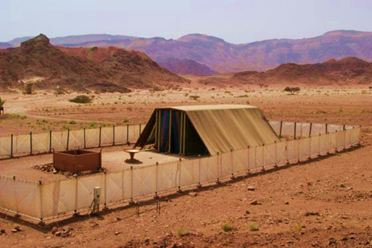
La parashá de esta semana inicia con un llamado a los dones del corazón, nedavos haleiv, para construir el Mishkán, la morada de la Presencia Divina en este mundo. Es asombroso cuan liberales podemos ser con las traducciones y lo que perdemos por causa de las mismas. Sí, es una ofrenda que nace de nuestro “libre albedrío”, pero literalmente, es un regalo del corazón… DEL corazón.

En realidad se trata de LEALTAD, porque de eso es que trata el corazón. Es por eso que un perro, conocido como el mejor amigo del hombre, debido a su lealtad, es “kelev” en hebreo … deletreado k’leiv, que significa “como corazón”. Y es por eso que uno de los dos leales espías se llamaba “Kaleiv”, escrito de la misma manera.

Sin duda, la dudas surgirán en tu vida. Estas son un resultado inevitable del Aitz HaDa’as Tov v’Ra, el árbol del conocimiento del bien y del mal.  No es sin razón o motivo que también se le conozca como  el “Elana d’Sfeika — Árbol de la duda.” Por eso es que también es la fuente de Amán, un descendiente de Amalek cuya gematria es igual  a “suffek — duda”.

Hey, la duda no es el problema. Desde el momento en que se comió lo prohibido, la cuestión no ha sido si una persona tiene o no tiene dudas sobre Dios. El asunto es cómo la persona lidia con su duda, ya sea porque cuestiona el nivel de participación divino en su vida, o con lealtad inquebrantable, nacida de un corazón devoto.

No se puede construir un Mishkan, con materiales de construcción, ni aun con usted mismo, si su corazón está incompleto. Dios no reposará en una persona con doble lealtad. Él comprende que tenemos dudas y es posible que incluso El mismo haya intervenido para provocarlas; hace esto para ver cómo respondemos, ayudándonos así a desarrollar la autoconsciencia.

Si respondemos con lealtad, entonces Dios morará en nosotros/as  y despejará nuestras dudas, hacienda de un momento difícil, un sentimiento asombroso. Pero, si respondemos adversamente, entonces debemos saber que abrimos la puerta a un ataque de Amalek. Y, cuando estos llegan, recuerda: no siempre salimos bien de los mismos.

Según tomado de, A Question of Heart • Torah.org

Traducción por drigs, CEJSPR

 
Leave a comment

Posted by on February 21, 2021 in Uncategorized


The Truth About Self-Interest

Image result for self interest

by Pini Dunner

The celebrated American novelist Veronica Roth, whose Divergent trilogy was successfully adapted into a series of blockbuster sci-fi movies, deliberately infused her best-known work with important moral lessons.

In particular, the protagonist and narrator of Divergent, sixteen-year-old Beatrice “Tris” Prior, begins her roller-coaster journey in the belief that selflessness is a debilitating weakness which one needs to overcome. But early on she is disabused of this notion; deuteragonist Tobias Eaton, better known as “Four”, informs Tris that it is only “when you’re acting selflessly that you are at your bravest.”

It is a powerful lesson, and it foretells the dramatic climax of the trilogy, when Tris gives up her own life to save her brother.

One of the great challenges of the human condition is the ever-present tension between self-interest and selflessness. Curiously, countless studies have shown that focusing on self-interest to the exclusion of the needs of others does not guarantee happiness.

No matter how much one has managed to accumulate in terms of material possessions, or to what extent one has managed to isolate oneself from the outside world — happiness and contentment may well continue to be elusive. In fact, a 2015 study carried out by two economics professors at Emory University empirically demonstrated that great wealth often decreases one’s happiness.

Every human being on the planet is driven by selfish needs and desires, and yet the evidence is that being successful does not guarantee the happiness we all constantly seek. If so, how is it possible to find happiness? The answer appears to be — both for those who have accumulated wealth, as well as for those without it — to engage in acts of compassion.

At the most basic level, this is because doing whatever you can for others stimulates the brain’s pleasure pathways and makes you feel good. It might sound crazy, but brain-imaging research has revealed that performing a kind act — for example, donating money to charity or putting yourself out for others — actually activates the brain’s pleasure centers in the same way as eating a sweet dessert or buying new clothes.

But the difference is, when we divert our focus away from self-interest, and particularly if we focus on the needs of others, we will be less preoccupied with our own anxieties. Specifically, the positive feeling that accompanies a compassionate act will enable you to face the issues which are a downer in your life with fresh energy and a constructive attitude.

Concerning yourself for others can also have a positive impact on your physical health. In 2007, the Washington DC based Corporation for National and Community Service reported that those who volunteer for 100 hours each year or more are 33% less likely “to report bad health” in comparison to those who never volunteer — and the evidence shows that these same people will have reduced their risk of hypertension, and even premature death.

Other studies have shown that those who engage in regular acts of charity and compassion have a better chance of avoiding dementia in old age.

The Torah records countless acts of charity and compassion, and it is clear that altruism is a value embedded at the heart of Judaism. But it is not until Parshat Terumah that this vital characteristic of our faith finds its first mandated act, when God requests that the recently redeemed nation parts with their newly acquired material possessions in order to build a sanctuary in His honor.

Among the items listed for contribution were the twelve jewels designated to decorate the High Priest’s breastplate. Central to the interpretation of Torah is the idea that no descriptive words are ever used by chance — which means that the fact the breastplate gems are referred to as avnei millu’im (“filling stones”) is no accident.

Rashi explains that each gem was intended to fill a cavity in the solid gold plate, but Ramban is puzzled by this explanation: why would the Torah define an object by what was going to be done with it once it was received for use?

More surprisingly, the stones seem to be defined by a negative — they would fill an empty space — rather than a positive, namely their sparkling beauty and arresting splendor. And, as we know, these stones were intended to represent the twelve tribes of Israel, all of whom had unique qualities; surely they should all have been defined by their unique qualities rather than by the fact that they would be used to fill a hole?

Rabbi Yochanan Zweig suggests a satisfying explanation for this anomaly, which dovetails beautifully with the idea that focusing on doing good for others is far more beneficial than being totally absorbed by self-interest. People often find themselves torn between remaining in a place which requires their talents or relocating to another location which may be more conducive to perceived personal growth. By referring to the breastplate gems as avnei millu’im, the Torah offers a solution to this dilemma, prescribing that it is preferable to remain in a place where one is needed — filling a hole — rather than relocating to somewhere better suited to one’s own personal development.

The simple explanation is that a community needs each and every individual to contribute their unique qualities to the larger group, and if you choose the community’s needs over your own, you are filling a gap that would be an ugly void if you weren’t there.

But truthfully, the Torah is offering an even greater insight, one that is reflected in the sociological studies I’ve already mentioned. In the final analysis, the choice to remain where you are most needed and where you are engaged in helping others is, as it turns out, what is most beneficial for you. Your personal growth is best served by serving others, not by focusing exclusively on yourself.

Or, to put it slightly differently: it is not a jewel’s beauty that makes it beautiful, but the fact that it fills a hole and thus enhances everything around it.The opinions presented by Algemeiner bloggers are solely theirs and do not represent those of The Algemeiner, its publishers or editors. If you would like to share your views with a blog post on The Algemeiner, please be in touch through our Contact page.

As taken from, The Truth About Self-Interest | Jewish & Israel News Algemeiner.com

 
Leave a comment

Posted by on February 19, 2021 in Uncategorized


Christian Leaders Remain Silent as the Church Recycles Its Oldest Hatred

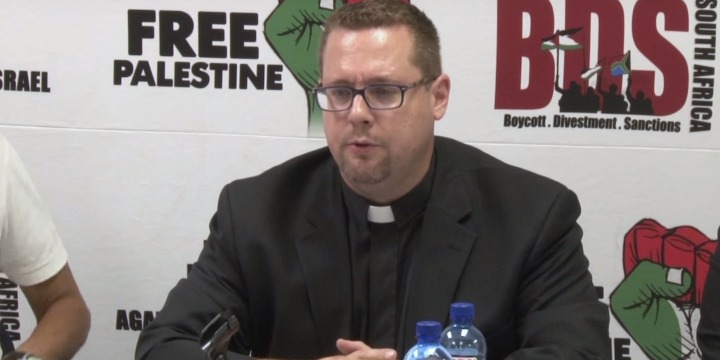
Rev Robert Smith, Jerusalem representative of the World Council of Churches, addresses a BDS rally in South Africa. Photo: Screenshot

The World Council of Churches has gone full theological incitement against the State of Israel.

In a recent Zoom webinar with more than 300 Christian activists to promote a film about the pro-Palestinian activism of Michel Sabbah — the former Latin Patriarch of Jerusalem — Rev. Frank Chikane, the moderator of the WCC’s Commission of the Churches on International Affairs, went much further than the usual falsehoods about Israel’s “brutality” towards the Palestinians. “We need to begin to say to those who support Israel to brutalize Palestinians that the blood of the people of Palestine will be sought from them because they collaborate by allowing this system to continue,” he said.

Chikane’s apparent incitement to violence clearly channeled Matthew’s infamous curse in the New Testament: “His blood be upon us and on our children!”

This curse, calling for retribution in perpetuity against the Jewish people for the crucifixion of Jesus, resulted in the slaughter of hundreds of thousands of Jews through the centuries.

Since Jesus was held to be the son of God, the charge of deicide justified the slaughter of the Jews on theological grounds and turned them into devils.

Indeed, Chikane, a South African priest, openly suggested that Israeli Jews were demonic. He said the Palestinians were “dealing with the same demons we dealt with in South Africa, except that in their case, the demons have invited many other demons to make their struggle much more difficult.”

So Chikane’s choice of words targeted Israel’s Jews with the same genocidal incitement.

This shocking conflation of inflammatory falsehoods about Israeli crimes against humanity with the infinitely more incendiary charge of deicide is by no means new in the Christian church. It is part of what’s called “supersessionism,” also known as “replacement theology.”

This is an ancient Christian calumny against the Jews which, over the past few decades, has been revived and adapted to the Palestinian cause.

The doctrine holds that the Jews were stripped of God’s favor because they denied the divinity of Jesus. Christians, therefore, inherited God’s promises and became the “new Israel” while the Jews were damned.

This murderous doctrine was driven underground for a time by the Holocaust, but was given new life by the emergence of Palestinian Christian liberation theology. This fused the falsehood that the Palestinian Arabs were the original possessors of the land of Israel with theological, anti-Jewish supersessionism.

Such fusion gave the Palestinian Arab claim to the land of Israel the status of supposedly holy writ, turning the State of Israel into an ungodly interloper and its defenders into the enemies of God.

Giving rise to the patently ludicrous claim that “Jesus was a Palestinian” — whereas he was, of course, a Jew from ancient Judea — it has fueled grotesque Palestinian propaganda that presents the Palestinians as being “crucified” by the Israelis. This image provokes a visceral revulsion against Israel among some Western Christians, whose ignorance of Judaism and Middle East history turns them into the useful idiots of murderous incitement against Israel and the Jews.

The hybrid of Christian theological and Palestinian political demonization of Israel and the Jews has been pumped out for years by the Sabeel Ecumenical Liberation Theology Center in Jerusalem. The Zoom webinar was organized by Sabeel and other venomously anti-Israel Christian groups and activists.

This Palestinian “liberation theology” has been adopted wholesale by the World Council of Churches.

For decades, the WCC has promoted anti-Israel and anti-Zionist rhetoric and activism. Through its “liberation theology” propaganda, it has infused liberal churches with neo-Marxist, anti-capitalist, anti-West attitudes — thus placing a virtual halo over the anti-Semitism and anti-Zionism of the left.

As the Christian historian Paul Merkley has chronicled, the WCC played a key role in bringing about the anti-Zionist hate-fest in Durban, South Africa, a few days before 9/11, when representatives attending the U.N. Conference on Racism, Racial Discrimination, Xenophobia and Related Intolerance demanded that the United Nations denounce Israel for “systematic perpetration of racist crimes, including war crimes, acts of genocide and ethnic cleansing.”

The Simon Wiesenthal Center has noted that, while the WCC has doubled down on Israel, it has made little or no criticism of the brutal regimes in places such as Cuba, North Korea, Venezuela, China and Iran.

When Islamic extremists kept blowing up Coptic churches in Egypt, traumatized Copts said that the WCC was apparently too preoccupied with Israel to give them support.

Indeed, its flagship project, the Ecumenical Accompaniment Programme in Palestine and Israel (EAPPI), has sent at least 1,800 volunteers to serve as observers in Jerusalem and the “West Bank” over the past couple of decades.

The International Holocaust Remembrance Alliance states that “drawing comparisons of contemporary Israeli policy to that of the Nazis” is an example of anti-Semitism. The WCC says it “does not countenance equating Israel to Nazi Germany, neither in the training of participants in the EAPPI nor otherwise.”

Yet in 2019, the pro-Israel watchdog NGO Monitor reported that WCC leadership and EAPPI volunteers had repeatedly made comparisons of Israeli actions to those of Nazi Germany in their advocacy sessions.

In 2012, Vivian Wineman, president of the U.K.’s Board of Deputies, said members of Jewish communities across the country had “suffered harassment and abuse at EAPPI meetings,” and that the EAPPI “helped to create a climate of hostility towards Israel within the Church of England.”

The WCC’s Zoom event was reported last week in the Algemeiner by Dexter Van Zile, the specialist in Christian affairs for the Committee for Accuracy in Middle East Reporting (CAMERA) and who has long charted the conflation of Christian anti-Semitism with anti-Israel incitement.

In a subsequent article this week, Van Zile reports that the WCC has now tried to distance itself from Chikane’s remarks by claiming that he was from the African National Congress and therefore wasn’t speaking on behalf of the WCC when he made his comments.

He wrote that theologian Gerald McDermott expressed strong disagreement with Chikane’s statements and declared that he was “out of touch with the situation on the ground.”

In such circumstances, that would seem to be a considerable understatement. The situation on the church’s ground is that influential Christian organizations continue to pump out inflammatory falsehoods about Israel and Zionism which don’t just demonize and delegitimize Israel but draw upon the church’s own theology to demonize the Jewish people.

The most shocking aspect of this is that with just a handful of exceptions, the churches remain mute about it.

Church leaders usually flatly deny that Christian supersessionism has any contemporary resonance. Yet you don’t have to scratch very hard below the surface of the anti-Israel utterances by Western church leaders to pick up the supersessionist allusions.

It’s true that some of the most passionately pro-Israel people in the world today are Christians, in America and elsewhere. But these tend to be the biblically faithful. The obsessive animus against Israel and Zionism, along with its supersessionist underpinning, is mainly to be found among liberal Christians.

And their influence — through Christian NGOs and a wide range of other public and cultural institutions — is immense.

It’s not just that they influence other Christians. Even in relatively godless places like today’s Britain, the assumption that Christians stand for truth, justice and compassion means that even secular people tend to believe what they say. The pernicious falsehoods that such Christians pump out about Israel are therefore regarded as unchallengeably true.

Extreme as it was, Chikane’s diatribe on Zoom illustrated an even more unpalatable state of affairs — the silent acquiescence of church leaders in the contemporary mutation of Christianity’s own murderous history, and its virulent spread into the cultural arteries of the West.

Melanie Phillips, a British journalist, broadcaster and author, writes a weekly column for JNS. Currently a columnist for “The Times of London,” her personal and political memoir, “Guardian Angel,” has been published by Bombardier, which also published her first novel, “The Legacy.” Go to melaniephillips.substack.com to access her work.

As taken from, Christian Leaders Remain Silent as the Church Recycles Its Oldest Hatred | Jewish & Israel News Algemeiner.com

 
Leave a comment

Posted by on February 19, 2021 in Uncategorized


El Di-s Solitario

por Rabino Simon Jacobson

¿Alguna vez te has sentido solo/a? ¿Completamente solo/a? ¿Sin nadie a quien acudir y nadie capaz de entenderte? Únete al club. Imagina un alma solitaria vagando sin cesar, sin dónde descansar la cabeza. Finalmente llega el día y encuentra un lugar al que puede llamar hogar. Te animo a continuar la lectura y descubrir la sorprendente compañía con quien compartes la soledad. Y lo que puedes hacer para encontrar consuelo en un mundo desolado.

Se han postulado muchas, muchas teorías sobre Di-s. Algunas están presentes a través de preguntas como las que leerás a continuación: ¿Le importa o no le importa la humanidad y los asuntos terrenales? ¿Cómo un Dios totalmente bueno permite cosas malas? ¿Está presente en nuestros momentos de dolor y sufrimiento? ¿Se trata de un él o de una ella; de ninguno, o de ambos? ¿Existe Di-s y, de ser así, porqué no lo vemos? ¿Existe Di-s tal como nosotros existimos o, en otra forma?

¿Qué tipo de personalidad tiene Di-s? ¿Está enojado, es amable, desligado e indiferente?

Luego, están las preguntas acerca de cómo Dios dirige o no el universo. ¿Está Di-s presente e involucrado en cada detalle, o ha puesto la máquina en movimiento, revisándola de vez en cuando? ¿Gobierna la Divina Providencia cada detalle de nuestras vidas?

Y, por supuesto, abundan las discusiones sobre el propósito de la existencia. ¿Por qué y para qué Dios creó el universo? ¿Cuál es nuestro papel en “la película”? ¿”Obtiene” Di-s algo en virtud de nuestra existencia?

Se puede decir que todo lo anterior es cierto. Di-s se manifiesta de muchas formas y diferentes expresiones, incluso contrarias o paradójicas. De hecho, los místicos explican que todo posible “estado de ánimo” y “estado mental” humano se originan en una fuente Divina. Entonces, aunque Di-s en Su esencia trasciende todas las definiciones y características antropomórficas, al mismo tiempo es capaz de generar todo tipo de experiencia posible.

Considerando todas estas nociones acerca de Di-s y Su todopoderosa “personalidad”, tuve esta semana una profunda epifanía sobre una dimensión inesperada de Di-s, una del tipo “vulnerable” de la cual creo que podemos obtener un gran consuelo.

Mientras leía la porción de la Torá para esta semana, en la que Di-s le ordena a Moisés “constrúyeme un santuario y descansaré entre ellos.” En ese instante me asaltó un triste pensamiento: Di-s, ¿se sentía solo sin nosotros? Hasta el momento cuando se construyó el santuario, Di-s, en efecto, estaba “sin hogar”, sin un lugar para descansar.” ¿Cómo se sentiría vagar para siempre en el pasado infinito, sin un lugar al que llamar hogar? De hecho, no es hasta que se pronuncia el contenido de este versículo, que hubiéramos pensado que Di-s necesitaría un lugar para “descansar”. Después de todo, el descanso es solo para los débiles mortales. ¿Cómo y por qué un Di-s omnipotente necesitaría “descansar”? Pero, la realidad es que después que Di-s le dice a Moisés “constrúyeme un santuario y yo descansaré entre ellos”, que queda claro que hasta ese momento Di-s no tenía un lugar para descansar …

A vuelo de pájaro, podemos estar inclinados a explicar que el Templo no fue construido para para albergar a presencia Divina, sino para crear un espacio para nosotros los humanos. Se trata deun lugar donde los simples mortales podemos experimentar lo Divino. Toda nuestra vida estamos involucrados en nuestra lucha mundanal por la supervivencia; el santo Santuario nos proporciona un ambiente separado donde Di-s descansa entre nosotros, ofreciéndonos precisamente eso: santuario y protección para nuestras vidas de caminantes; un lugar donde podemos encontrar descanso y consuelo celestial para nuestras agotadas almas.

Pero cuando leemos cuidadosamente, “constrúyeme un santuario y descansaré entre ellos”, es muy obvio que el santuario no es solo un lugar para que nos encontremos con Di-s, sino también un lugar para que Di-s “descanse” Su presencia.

Este punto se hace evidente cuando Di-s le dice a Salomón (el constructor del primer templo en Jerusalén): “Los cielos y los cielos de los cielos no pueden contenerme; sólo esta casa puede ” (cf. 2 Crónicas 6:18)Sea como sea que se explique, Dios claramente no se sentía “en casa” en el cosmos infinito, a pesar de toda su grandiosa y magnífica gloria. Hasta ese momento cuando se construyó el templo en el planeta Tierra, Di-s no tenía un lugar para “descansar.”

“Di-s realizó un viaje de 500 años para adquirir un nombre”, afirma un Midrash críptico (Kohelet Rabba 7: 2). La soledad, al parecer, no es simplemente una preocupación entre los mortales. El Todopoderoso mismo, está en busca de “compañía.”

Sin lugar a dudas estamos ante un concepto inquietante y reconfortante. A veces, todos experimentamos momentos de soledad existencial. Independientemente de todos nuestros seres queridos, de todos nuestros logros y elogios, en lo profundo (o no tan profundo) de nosotros mismos hay una parte que siempre permanece muy sola. Podemos distraernos, divertirnos, dejarnos llevar por todo tipo de estimulación y entretenimiento; pero al final del día, ese centro aislado y silencioso nos llama desde nuestra profundidad interior.

De hecho, cuanto más te adentras en tus recovecos más íntimos, menos puede entrar alguien en ese espacio, más difícil es expresarte, más solo estás. En tu núcleo más íntimo, está completamente solo.

Un solitario versículo en el triste libro de Kohelet captura el sentimiento: “Un hombre está solo, sin sucesor, sin hijo ni hermano…” (Eclesiastés 4: 8).

Entonces, ¿qué tiene de reconfortante esta soledad? Es reconfortante saber que no estamos solos en nuestra soledad. En la cima donde Di-s habita está muy solo; siendo que en Su núcleo y esencia El es único e incomparable.

Esta soledad se deriva de la fuerza, no de la debilidad, del hecho que Di-s es absolutamente único, “Él es uno, y no hay otro como Él”. Lo mismo ocurre con nuestro núcleo: nuestro lugar más solitario, nuestra esencia, es un reflejo de nuestra profunda individualidad e inimitabilidad. En ese lugar íntimo estás solo, no porque seas un paria o porque te odien; estás solo en tu centro porque eres absolutamente único, de una manera que nadie más puede realmente “atraparte.”

Tu esencia puede que no sea un lugar muy dramático. No tiene el alboroto y los fuegos artificiales que acompañan a todas las ajetreadas maquinaciones de nuestras vidas; no tiene el elemento de “fiesta” que acompaña nuestras interacciones sociales. Cuando estamos involucrados con niveles externos y superficiales, podemos celebrar y experimentar estos momentos con otros. Pero tu esencia, aunque no es muy colorida, es tu centro único y, como tal, lo experimentas solo.

Sin embargo, por muy especial que sea la Esencia Divina, Di-s realizó un viaje para encontrar “compañía”, para encontrar un hogar en el que Él pueda descansar. La revelación divina se manifiesta en los “cielos y los cielos de los cielos”; la belleza de la naturaleza captura la majestuosidad del Divino Diseñador. Pero, Di-s en Su solitaria Esencia, descansa y se siente como en casa solo en el Santuario construido en la Tierra.

Lo mismo con nosotros: al igual que Di-s, no estamos satisfechos con vivir “dentro”, aislados y separados de los demás. Necesitamos construir un espacio al cual podamos llamar hogar; un santuario donde encontramos un respiro; un entorno donde finalmente nuestras almas solitarias puedan descansar. Una cosa es encontrar consuelo en la familia y los amigos; otra muy distinta es encontrar un hogar cómodo para el núcleo solitario de nuestras almas.

[Los místicos explican que “El que está solo” es el nivel de la Luz Divina Infinita que no se manifiesta en las relaciones (“No tiene ni hijo ni hermano”). El concepto de las relaciones está solo en la forma en que lo Divino se manifiesta en lo finito: en la estructura de las diez esferas, los diez bloques de construcción de la existencia (Ohr HaTorah en Kohelet, p. 1115). Sin embargo, el propósito final es unir lo infinito con lo finito, el “que está solo” con nuestras relaciones].

Así que, la próxima vez que te sientas solo/a, recuerda dos cosas: no estás solo; tu soledad es compartida por cada alma y por Di-s mismo. Cada esencia está fundamentalmente sola.

Segundo: Construye un santuario a partir de tu vida material, santifica el dinero y las pertenencias con las que fuiste y eres bendecido–eso proporcionará a tu solitaria esencia, y a la Esencia de Di-s– un cálido hogar en el que descansarás cómodamente.

Según fue tomado de y traducido, The Lonely G-d – The Meaningful Life Center

Traducción por drigs, CEJSPR

 
Leave a comment

Posted by on February 19, 2021 in Uncategorized


En relación al tabernáculo, el silencio y la oración

por Rabino Dr. Nathan Lopes Cardozo

“Y que me hagan un santuario para que yo habite entre ellos. Exactamente como les muestro – el modelo del Tabernáculo y el modelo de todos sus muebles – así lo harán.” Shemot 25: 8

Algunos de nuestros más grandes comentaristas han luchado con la conexión entre el mandato de construir el Mishkán (la Tienda de Reunión o Tabernáculo) y el pecado del Becerro de Oro. En el verso “Y lo harás” (Shemot 25: 9), relacionado con la construcción de la Tienda de Reunión, el famoso comentarista italiano Ovadia Sforno (siglo XVI) hizo la siguiente declaración notable:

              Para que yo habite entre ustedes, para hablar con ustedes y aceptar las oraciones y el  servicio de Israel. Esto no es como era antes del pecado del Becerro de Oro, donde se dijo: “En cualquier lugar donde se mencione Mi nombre, vendré a ti y te bendeciré”. (énfasis agregado) (Shemot 25: 9.)

Y un poco después:

              Porque al final de los primeros cuarenta días, Dios dio las tablas hechas por él mismo para santificar a todos como sacerdotes y como nación santa, como había prometido. Pero ellos se rebelaron y se corrompieron, y cayeron de este alto nivel espiritual.  (itálica agregada)

La Tienda del Encuentro (y por lo tanto el Templo), dice Sforno, son el resultado de la decisión de Israel de hacer el mal: optar por el Becerro de Oro. En otras palabras, si el incidente del Becerro de Oro nunca hubiera tenido lugar, nunca se habría dado la directiva para construir una Tienda de Reunión.

Lo que resulta sumamente claro es que el templo real, como lugar del servicio divino, no se limita al mundo finito. Su legítimo lugar es el universo entero, y lo que está más allá del universo: “En cualquier lugar donde se me mencione Mi Nombre, vendré a ti.” Claramente, la grandeza de Dios está más allá de todas las limitaciones físicas y abarca el universo y los “mundos” más allá del universo.     

Si ésta es la idea central de la intención original de Dios, entonces ¿cuál es la necesidad de un lugar físico que simbolice la morada de Dios en este mundo? ¿Qué propósito tienen los muchos objetos rituales como el Altar, la Menorah y el Arca en el Lugar Santísimo? Sforno sugiere que la necesidad de estos “accesorios” es el resultado directo del pecado del becerro de oro.

El pecado del becerro de oro

¿Cuál fue la esencia de este pecado? ¿Qué construcción mental se reflejó en esta transgresión, en la que estuvieron involucrados tantos judíos?

El pecado en sí, obviamente, no pudo haber sido una forma regular de adoración de ídolos: solo un poco antes, el pueblo judío había experimentado una revelación divina de una intensidad sin precedentes. La palabra hablada de Dios les llegó en un encuentro abierto y fue de una veracidad incuestionable. Con una sola voz, todo el pueblo manifestó su compromiso: “Na’ase ve-Nishma”. (“Haremos y escucharemos”) (Shemot, 24: 7). De una vez y por todas, se había establecido la existencia de Dios y Su relación con este mundo. Y aún asi, la pregunta clama por una respuesta: después de todo esto, ¿cómo pudo haber ocurrido el pecado del Becerro de Oro? Debemos concluir que la creación del becerro de oro debe verse como un intento de lidiar con esta abrumadora experiencia.

Después de todo, lidiar con una experiencia de semejante magnitud requiere vastos recursos espirituales. Exige un nivel espiritual de alturas sin precedentes y, sobre todo, la abolición de cualquier símbolo físico de la Divinidad. En resumen, esto es monoteísmo, que es la realización de la naturaleza unitaria y única de Dios en su forma más avanzada. Incluso, lo que fluye de la unidad de Dios no puede ser captada completamente desde una plataforma mundana. En su estado ideal, el judaísmo no debería haber necesitado para nada el simbolismo. Al hombre sólo se le permitiría contemplar asuntos del mundo monoteísta.

Esto, sin embargo, era inalcanzable para la generación del Éxodo, que sólo poco antes había estado inmersa en un mundo de adoración de ídolos. Aferrarse a la experiencia sin precedentes del Sinaí solo era posible, por lo que creían, a través de un medio tangible y, por lo tanto, más realista; de otra forma, estaba en peligro de escaparse, disiparse en un vacío espiritual sin implicación real, y mucho menos con validez eterna.

Este es, sin duda, el leitmotiv del episodio del becerro de oro. Se percibió la necesidad de garantizar que la experiencia reveladora del Sinaí siga siendo una de carácter continuo. La forma de un becerro, simbólico de la divinidad en el medio cultural egipcio, lugar del cual el pueblo había emergido tan recientemente (y también, más tarde, visto por la tradición cabalística como un símbolo de inmenso poder espiritual), fue entendido como la forma más apropiada de lograr este objetivo. Sin embargo, estaba claro para todos los involucrados que esto no estaba destinado a ser, ni fue percibido como, la divinidad monoteísta en sí. Era simplemente un símbolo del Creador y Motor del Universo en términos mundanos.

Entonces, esta fue la razón detrás de la creación del Becerro de Oro. Sin embargo, la creación de esta imagen dio lugar a una situación completamente diferente. El nivel de monoteísmo de Sforno aún no estaba al alcance del pueblo israelita. La elaboración del becerro de oro mostró que la gente todavía no podía relacionarse con Dios sin recurrir al simbolismo. El mundo del monoteísmo supremo sin símbolos tenía, forzosamente, que acceder a un monoteísmo lleno de símbolos.

Los peligros del simbolismo

Sin embargo, el uso de la representación simbólica no está exento de peligros. Esto es exactamente lo que demuestra el incidente del becerro de oro. Debido a su gran poder emotivo en el mundo de la imaginación humana, se puede llegar a conclusiones erróneas acerca de un símbolo fuera de lugar. A menudo, está más allá de nuestras capacidades crear nosotros mismos las representaciones adecuadas. La realidad es que posiblemente nunca seamos capaces de captar el mundo metafísico hasta tal punto que podamos reflejarlo dentro de nuestra plataforma de lo mundano. Por lo tanto, símbolos de este tipo sólo se pueden recibir, no construirse. Éstos no pueden ser deducidos por la mente humana, y sus ya conocidas  limitaciones.

Lo que los creadores del becerro de oro no entendieron fue, que ningún símbolo podría abarcar la esencia de El Eterno. Incluso, cuando un símbolo pudiera ser necesario, solo la forma de Dios de tratar en este mundo puede reflejarse en un símbolo, no Su esencia. Solo Dios mismo puede evocar y ordenar adecuadamente un símbolo apropiado, y aun así continua siendo una aproximación.

Por lo tanto, el mandato divino de construir el Mishkán fue una forma más humana, más cercana a nuestro mundo y, por lo tanto, una forma más simbólica para transmitir los grandes valores del monoteísmo, sin dejar de recordarnos, sin embargo, un monoteísmo sin símbolos. Como sugirió Sforno, el llamado al Mishkán solo puede verse como una concesión a la debilidad humana.

La insolencia de la oración

Otro recordatorio sobre lo que es el verdadero monoteísmo proviene del Sidur (libro de oraciones). Allí, el jazán (lector comunitario) recibe instrucciones al abrir el cuerpo principal de oraciones con: “Baruj et Ha-Shem Ha-Mevorach” (Alabado sea el Señor, que en última instancia es alabado). Sin embargo, se pide a la congregación que diga simultáneamente: “Su nombre es exaltado por encima de todas las alabanzas y bendiciones”. Esto se entona en silencio, luego de lo cual la comunidad responde en voz alta con: “Baruch Ha-Shem Ha-Mevorach Ie-olam va-ed” (Bendito es el Nombre de su majestad gloriosa por siempre jamás.)

Esto es, por decir lo mínimo, una paradoja: primero, hay un llamado a alabar a Dios, uno que simultáneamente es desmentido por una declaración posterior donde Su nombre se eleva más allá de todas las alabanzas y bendiciones. En otras palabras, alabar a Dios es imposible: ¡está más allá de las capacidades del hombre! Pasan unos minutos y la comunidad continúa alabando a Dios, como queriendo decir que a pesar de tenemos el poder de alabar a Dios.

La misma paradoja se puede encontrar en la oración del Kadish: “Que el gran Nombre [de Dios] sea exaltado y santificado en el mundo que ha creado…. Él es … honrado, exaltado, glorificado, adorado [etc.]” Repentinamente, se le pide al adorador que realice un radical cambio de dirección: “[Dios] está más allá del poder de todas las bendiciones, himnos, alabanzas y consuelos que son dichas en este mundo, y ahora digan: Amén”.

Esta paradoja se refleja en una singular historia relatada en el Talmud: el rabino Janina una vez observó a un adorador en el acto de alabar a Dios con numerosos elogios adicionales: Dios no solo era “grande”, “poderoso” y “sublime”, sino también “majestuoso”. “ Asombroso ”,“fuerte”, “intrépido ”,“seguro ”, “honrado”, etc. (Berajot 33b.)

Rabí Janina esperó a que el devoto terminara y luego le preguntó si realmente pensaba que había alabado a Dios lo suficiente. El Talmud nos dice que uno solo debe alabar a Dios con las tres palabras que usó Moshé y dejarlo ahí. El hombre puede comenzar a alabar a Dios, pero nunca podrá hacerlo lo suficiente; por lo tanto, cualquier intento solo revela cuán limitantes son nuestras palabras, esto sin importar cuán desbordantes las consideremos. Cuantas más alabanzas uno acumule, más limites imponemos a los atributos de Dios. Esto, simplemente es una blasfemia.

El mensaje de esta historia es que, en realidad, ante Dios, el hombre debería quedarse mudo. Captar la grandeza de Dios debería dejarlo en silencio. No hay palabras que sean suficientes para ensalzar la maravilla de esta experiencia. Por tanto, el silencio es la máxima expresión de la oración.

Entonces, ¿por qué no nos paramos en una oración de contemplación silenciosa? ¿Por qué pronunciar palabras si ninguna palabra es suficiente? La respuesta ahora es clara para nosotros: la “oración de palabras” es (una vez más) una concesión a la debilidad humana. Simplemente somos incapaces de permanecer en silencio contemplativo; incluso en un silencio significativo no podemos captar la inmensa grandeza de Dios. Nuestras mentes no pueden captar lo que sabe nuestro corazón.

En medio de semejante silencio, nuestra mente divagaba y, paradójicamente, el foco de nuestra atención se alejaba de nuestro Creador. En este estado de debilidad humana, comenzamos a buscar otras formas de concentrar nuestras mentes en nuestro Hacedor. Esta, entonces, es la función de la oración verbal. Es más realista, más tangible y, por lo tanto, más apropiada para la condición del ser humano. Ese es el secreto de la oración.

Por lo tanto, la institución de la oración formal hablada fue una continuación directa de la construcción del Mishkán, una forma de concretar nuestra experiencia religiosa, al tiempo que allana el camino hacia el verdadero monoteísmo. Así como el verdadero Mishkán es la totalidad del universo, la verdadera oración solo puede ser el silencio ante una abrumadora maravilla.

Según tomado de, Según tomado de, https://www.cardozoacademy.org/thoughtstoponder/parashat-terumah-on-the-tabernacle-silence-and-prayer/?utm_source=Subscribers&utm_campaign=b8373f57b5-RSS_EMAIL_CAMPAIGN&utm_medium=email&utm_term=0_dd05790c6d-b8373f57b5-242341409

Traducido por, drigs (CEJSPR)

 
Leave a comment

Posted by on February 18, 2021 in Uncategorized


On the Tabernacle, Silence, and Prayer

by Rabbi Dr. Nathan Lopes Cardozo

“And let them make Me a sanctuary that I may dwell among them. Exactly as I show you — the pattern of the Tabernacle and the pattern of all its furnishings — so shall you make it. “ Shemot 25:8

Some of our greatest commentators have wrestled with the connection between the command to build the Mishkan (the Tent of Meeting or Tabernacle) and the sin of the Golden Calf. On the verse “And you shall make it” (Shemot 25:9), relating to the construction of the Tent of Meeting, the famous Italian commentator Ovadia Sforno (sixteenth century) made the following remarkable statement:

In order that I shall dwell between you, to speak with you and to accept the prayers and the service of Israel. This is not as it was before the sin of the Golden Calf, where it was said: “In any place where I shall have My name mentioned, I shall come to you and bless you.” (emphasis added) (Shemot 25:9.)

And a little later:

For at the end of the first forty days God gave the tablets made by Himself to sanctify all as priests and a Holy nation, as He had promised. But they rebelled and became corrupt, and fell from this high spiritual level. (italics added)

The Tent of Meeting (and therefore the Temple), says Sforno, are the result of Israel’s choice to do evil — to opt for the Golden Calf. In other words, had the Golden Calf incident never taken place, the directive to build a Tent of Meeting would never have been given.

What becomes exceedingly clear is that the real Temple, as the site of divine service, is not limited to the finite world. Its rightful place is the whole universe and that which is beyond the universe: “In any place where I shall have My Name mentioned I shall come to you.” Clearly, God’s greatness is beyond all physical limitations and encompasses the universe and the “worlds” beyond the universe.

If this is the thrust of God’s original intention, then what is the need for a physical place to symbolize God’s dwelling in this world? What purpose is served by the many ritual objects like the Altar, the Menorah, and the Ark in the Holy of Holies? Sforno suggests that the need for these “props” is the direct outcome of the sin of the Golden Calf.

The sin of the golden calf

What was the essence of this sin? What mental construct was reflected in this transgression, in which so many of the Jews were involved?

The sin itself could obviously not have been a regular form of idol worship: Only a short while earlier, the Jewish People had experienced a divine revelation of unprecedented intensity. The spoken word of God reached them in an open encounter and was of unquestionable veracity. In one voice the entire people avowed their commitment—“Na’ase ve-Nishma.” (“We shall do and we shall hear”) (Shemot, 24:7). Once and for all, the existence of God and His relationship to this world had been established. And still the question cries out to be answered—after all this, how could the sin of the Golden Calf have come about? We must conclude that the creation of the Golden Calf has to be seen as an attempt to deal with this overwhelming experience.

After all, to deal with an experience like this requires vast spiritual resources. It demands a spiritual level of unprecedented heights, and above all, the abolition of any physical symbol of the Divinity. In short, this is monotheism, which is the realization of the unitary and unique nature of God in its most advanced form. And even that which flows forth from God’s unity cannot fully be captured in the mundane. In its ideal state, Judaism should have had no need for symbolism altogether. Man would only be permitted to contemplate matters of the monotheistic world.

This, however, was unattainable for the generation of the Exodus, which only shortly before had been steeped in a world of idol worship. To hold on to the unprecedented Sinai experience was only possible, so they believed, through a tangible and, therefore, more down-to-earth medium— otherwise it was in danger of slipping away, dissipating into a spiritual nothingness with no real implication, nor indeed eternal validity.

This is undoubtedly the leitmotiv behind the episode of the Golden Calf. There was a perceived need to ensure that the revelatory experience of Sinai remain an ongoing experience. The form of a calf, symbolic of the godhead in the cultural milieu of Egypt, from which the people had so recently emerged (and also, later, seen by kabbalistic tradition as a symbol of immense spiritual power), was understood to be the most appropriate way to accomplish this goal. It was, however, clear to all involved that this was not meant to be, nor was it perceived as, the monotheistic godhead itself. It was merely a symbol of the Creator and Mover of the Universe in mundane terms.

This, then, was the reason behind the fashioning of the Golden Calf. However, the creation of this image brought into being a completely different situation. Sforno’s level of monotheism was not yet within the reach of the Israelite people. The fashioning of the Golden Calf showed that the people still could not relate to God without resorting to symbolism. The symbol-less world of ultimate monotheism had, perforce, to accede to a symbol-full monotheism.

The dangers of symbolism

The use of symbolic representation is, however, not without its dangers. This is exactly what the incident of the Golden Calf demonstrates. Because of their great, emotive power in the world of human imagination, wrong conclusions may be drawn from a misplaced symbol. It is often beyond our capabilities to create appropriate representations ourselves. We may never grasp the metaphysical world to such an extent that we can reflect it within the mundane. Therefore, symbols of this kind can only be received. They cannot be deduced by the limited human mind.

What the makers of the Golden Calf did not understand was that no symbol could ever encompass the essence of God Himself. Even when a symbol might otherwise be called for, only God’s way of dealing in and with this world may be reflected in a symbol — not His essence. Only God Himself can adequately conjure up and command an appropriate, yet still approximate, symbol.

Hence, the divine command to build the Mishkan was a more human, more mundane, and therefore more symbolic way of getting across the great values of monotheism, while still reminding us, however, of its ultimate symbol-less monotheism. As suggested by Sforno, the call for the Mishkan can only be seen as a concession to human weakness.

The impudence of prayer

Yet another reminder of what true monotheism is all about comes from the Siddur (prayer book). There, the chazan (communal reader) is instructed to open the main body of prayers with: “Barchu et Ha-Shem Ha-Mevorach” (Praise You the Lord, Who is ultimately praised). The congregation, however, is requested to simultaneously say: “His name is elevated above all praises and blessings.” This is intoned in silence, after which the community responds in a loud voice with: “Baruch Ha-Shem Ha-Mevorach Ie-olam va-ed” (Praised is the Lord, who is ultimately praised).

This is, to say the least, something of a paradox: First there is a call to praise God, which is simultaneously belied by a statement that His name is elevated beyond all praises and blessings. In other words, praising God is an impossibility—it is beyond man’s capabilities! After this, the community continues to praise God, as if to say that it is within the power of man to praise God after all.

The same paradox may be found in the Kaddish prayer: “May [God’s] great Name be exalted and hallowed in the world of His creation…. He is…honored, exalted, glorified, adored [etc.].” Suddenly, the worshiper is asked to radically change direction: “[God] is beyond the power of all blessings, hymns, praise, and consolation that are said in this world and now say: Amen.”

This paradox is reflected in a unique story related in the Talmud: Rabbi Chanina once observed a worshiper in the act of praising God with numerous additional laudations: not only was God “great,” “mighty,” and “powerful” but also “majestic,” “awesome,” “strong,” “fearless,” “sure,” honored,” and so forth. (Berachot 33b.)

Rabbi Chanina waited for the worshiper to conclude and then asked him if he really thought he had praised God sufficiently! The Talmud tells us that one should only praise God by the three words that Moshe used and leave it at that. Man may begin praising God, but he can never do so sufficiently; therefore, any attempt only succeeds in limiting, however fulsome it may be. The more praises one heaps on, the more one ultimately confines God’s attributes. This is nothing short of blasphemy.

The message of this story is that in reality, man should be speechless before God. To grasp the greatness of God should render him silent. No words can ever suffice to extol the awesomeness of this experience. Silence is therefore the highest expression of prayer.

So why do we not stand in a prayer of silent contemplation? Why utter words if no words can ever suffice? The answer is now clear to us: the “prayer of words” is (once more) a concession to human weakness. We simply are unable to stand in contemplative silence; even in meaningful silence we cannot grasp the immense greatness of God. Our minds cannot grasp what our heart knows.

In the midst of such a silence, our mind would wander, and paradoxically, the focus of our attention would shift away from our Creator. In this state of human weakness, we start to look for other ways to concentrate our minds on our Maker. This, then, is the function of the verbal prayer. It is more down-to-earth, more tangible, and therefore, more appropriate to man’s condition. Such is the secret of prayer.

Thus, the institution of formal spoken prayer was a direct continuation of the building of the Mishkan — a way to concretize our religious experience, while paving the way to true monotheism. Just as the true Mishkan is the entire universe, so true prayer can only be the silence of overwhelming wonder.

Thought to Ponder: Parashat Terumah: On the Tabernacle, Silence, and Prayer (campaign-archive.com)

 
Leave a comment

Posted by on February 18, 2021 in Uncategorized


Creating the Jewish Canon

choosing a book

The 24 books that make up with the Jewish Bible evolved over time in a process that reveals what the ancient rabbis considered authoritative — and what they didn’t.

BY AJ BERKOVITZ

For most modern Jews, the biblical canon consists of 24 books, beginning with the Five Books of Moses and continuing through the Prophets (Nevi’im) and Writings (Ketuvim). This particular list is quite old, going back at least to the ninth century. But this collection did not descend from heaven prefabricated. Rather it developed slowly, with each of its parts gaining authority over time.

We can catch glimpses of this process by tracing the way certain works were cited by the literature that followed it. If asked to prove that the earth was round, we would not recreate the math, but would point instead to authoritative sources. Similarly, in the ancient world, proving a religious truth required one to cite an authoritative text. To cite a text as proof is to rely on its authority.

In the Book of Kings, for example, we are told that Hilkhia, the High Priest, finds a “Book of Law.” He has it read before Josiah, the Judean king, who in turn tears his clothing and proclaims: “Our ancestors did not obey the words of this book, to do according to all that is written concerning us.” The shock of failing to live up to these authoritative words prompts Josiah to ignite a religious revolution. That Josiah succeeded, and that Deuteronomy became an authoritative source, is evident from the Book of Kings, which tells us that King Amatzia, in seeking to secure his throne, put to death the men who killed his father but not their children. Why? Because it “is written in the book of the law of Moses, where the Lord commanded, ‘The parents shall not be put to death for the children, or the children be put to death for the parents; but all shall be put to death for their own sins.’” The citation is Deuteronomy 24:16.

The Pentateuch, as a complete unit of five books, was viewed as canonical by the start of the Second Temple period. Numerous religious activities mentioned in the book of Ezra-Nehemiah, which recounts the building of the Second Temple, are authorized by citing “that which is written in the law of Moses.”

But the books that now constitute the Ketuvim underwent significant development during this period, slowly rising in authority and status. The Book of Psalms contained sometimes more and sometimes less than the 150 psalms it includes today. Fragments of the book of Esther have not been found at Qumran, suggesting that the community there did not treat it as canonical. Even texts from the Ketuvim that do appear, such as Ezra-Nehemiah, do so in such a small quantity relative to other biblical texts as to imply their decreased status.

This historical process did not inevitably lead to the 24-book rabbinic canon. Rather, ancient Jews competed with each other over the meaning of Jewish identity by forming canons of their own.

The Jews at Qumran, for example, consider the Books of Enoch and the Book of Jubilees authoritative, both of which cohered with their deterministic worldview and their solar-based Jewish calendar. Meanwhile, the Greek-speaking Jews of Egypt crafted an extended canon that included works such as Ben Sira and 1-4 Maccabees. While their canon contains all the 24 books in our canon, it does so in a different order, favoring historical sequence over other forms of division. Early Jewish followers of Jesus supplemented the Greek canon with works of their own, texts that eventually became the New Testament canon. Samaritan Jews, by contrast, considered only the Pentateuch as authoritative.

Even the ancient rabbis themselves offer a vision of the canon that differs slightly from the version we know today. According to one rabbinic tradition, the Book of Isaiah follows Jeremiah and Ezekiel. In short, our 24-book rabbinic canon is but one of many possible canons.

Why did the rabbis make the choices they did? At least four selection criteria are evident.

  • Old over new: The rabbis equated authority with antiquity. Only authors who wrote in the distant past deserved the respect of biblical authority. Thus, the books of wisdom perceived to have been penned by Solomon are accepted as canonical while the equally wise work of the more contemporary Ben Sira was not. History as told in Samuel and Kings is sacred; not so that of 1-2 Maccabees.
  • Hebrew over Greek: The rabbis bind authority to the language they considered holy. Only works in Hebrew (and to some degree Aramaic) are considered canonical. Greek works – even when ascribed to ancient authors – deserve no place in the canon. Thus, the Wisdom of Solomon, although attributed to an ancient author, is excluded.
  • Tradition over Heresy: The rabbis imagine a society based on tradition and ancestral practices. This leaves no room for works that offer a vision of Judaism that substantially differs from their own. Books like Enoch and Jubilees, which demand Judaism adhere to a solar calendar, fundamentally clash with the rabbinic vision of a Judaism based on a joint lunar-solar calendar.
  • Interpretation over Text: In a similar vein, even books that were already considered canonical by the rabbis could have their circulation questioned. The rabbis sought to remove Ecclesiastes from the biblical roster because they found its words self-contradictory. They decided against doing so since the book begins and ends with words of Torah. Likewise, the talmudic sage Hanania ben Hizkiya is praised for resolving numerous contradictions between Ezekiel and the Pentateuch, thus saving Ezekiel from the dustbin of history.

The formation of the biblical canon is a long historical process of grappling with ancient texts, but it’s of greater value than just winning arguments. To create a canon is ultimately to craft a community. Ancient Jews, with their varying collections of authoritative texts, were saddled with irreconcilable differences, ultimately leading to division and dissolution.

By sharing the 24-book rabbinic canon, modern Jews share a fundamental Jewish identity. We still argue — but about their interpretation, not about what is considered authoritative.

Abraham Berkovitz is a historian of Judaism and an assistant professor of liturgy at Hebrew Union College — Jewish Institute of Religion. 

As taken from, Creating the Jewish Canon – My Jewish Learning

 
Leave a comment

Posted by on February 15, 2021 in Uncategorized


Visual Moment | A Biblical Family Torn Asunder

BY FRANCES BRENT

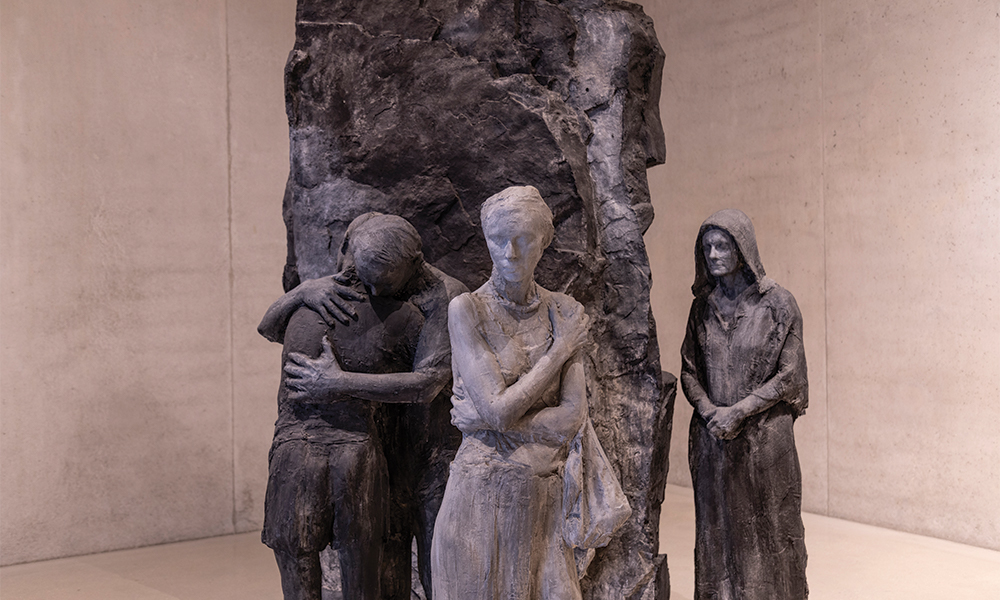
George Segal. Abraham’s Farewell to Ishmael, 1987.

Some works of art are perfect receptacles for the stresses and troubles of their times while they are graced with a wisdom that is fundamental and ongoing, making them perpetually relevant. When I was in Miami in February 2020, just before COVID-19 caused the Pérez Art Museum to close down for eight months, I was lucky enough to see one such work—the new installation of sculptor George Segal’s 1987 “Abraham’s Farewell to Ishmael.” Segal died in 2000, and his heart-wrenching “Farewell” was being shown for the first time since the Pérez’s conservation department restored it.

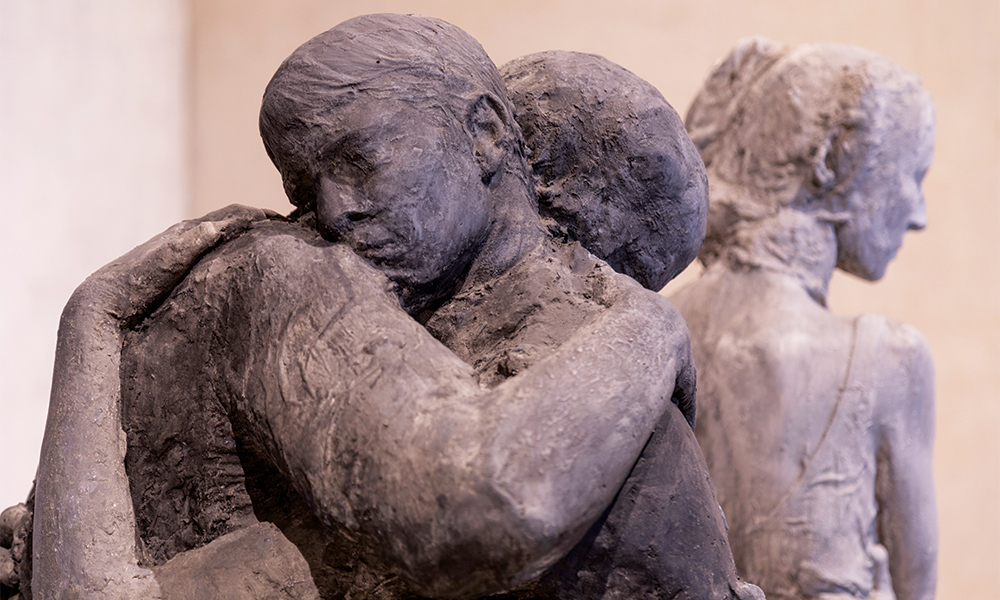
Composed of life-size, free-standing, almost dreamlike figures, Segal’s sculptural tableau presents plaster casts of Abraham, Ishmael, Hagar and Sarah arranged on the bare floor of the museum against the background of a looming rock formation. The scene is a reenactment of the traumatic moment just before Abraham sends his son Ishmael and Ishmael’s mother, Hagar, into the desert: a grieving father cleaves to his firstborn child while his wife and concubine are positioned nearby. Together they create the configuration of an about-to-be-torn-apart family suspended in time. The biblical text is succinct, offering only essential facts about the expulsion, provoked because Abraham’s wife Sarah insisted that Ishmael should not share her son Isaac’s inheritance. But Segal’s sculpture throws attention onto an excruciating moment of ordinary suffering. By refocusing the narrative, he exposes an emotional essence at the basis of the ancient story.

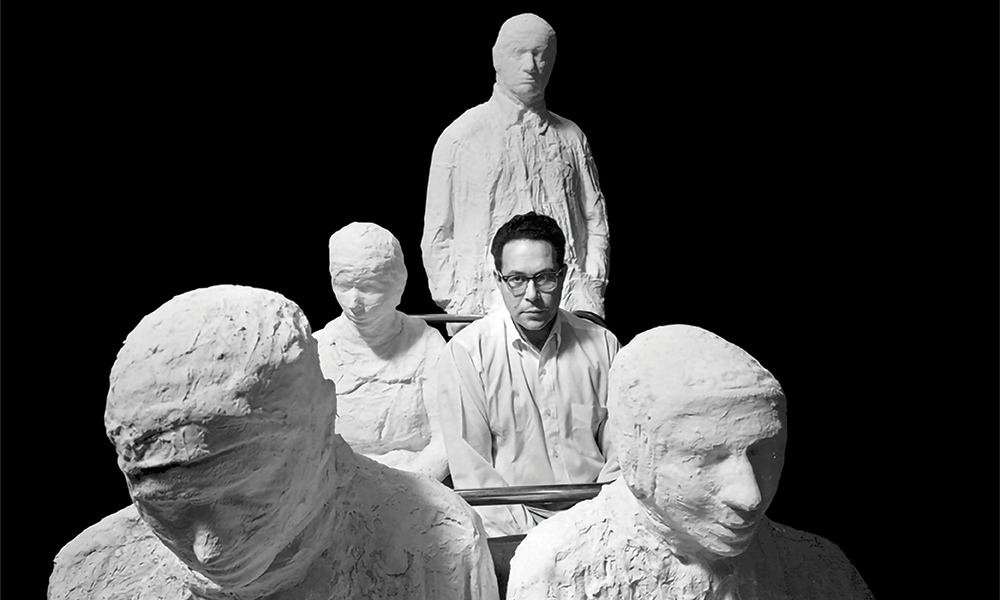
Artist George Segal takes a seat among his iconic, early, stark-white plaster figures in 1963. (Photo credit: Britannica)

The new repair has strengthened and joined together two portions of the roughly nine-foot-tall unwieldy and massive rock. Thirty-two years ago, the rock, which is made of gypsum cement and acrylic paint, had to be cut in half to get it out of the artist’s studio. The refortified and stabilized formation, braced by timber and chicken wire on the inside, functions as an austere emblem of the wilderness of Beersheba, as sculptural stage scenery, as a mysterious prop as impenetrable as the frozen figures that surround it.

“I suppose,” Segal once noted, “I’m in the business of fleshing things out.”

George Segal was born in 1924 in the Bronx. As a restless young man, he studied at The Cooper Union, Pratt Institute, NYU and Rutgers, idolizing the Abstract Expressionists before becoming a member of the avant-garde cooperative Hansa Gallery in New York City. In 1958, after grappling to find his calling as a painter, Segal turned to sculpture, developing a distinctive technique based on the ancient process of lifecasting (creating a three-dimensional copy of a living human body through the use of molding and casting techniques). In his case, however, he wrapped his models—mostly family members or friends dressed in their own contemporary clothes—in plaster-dipped bandages made from a then newly-manufactured material. In the bare setting of his studio, he had his figures pose in scenes from ordinary life. When the plaster set (and this occurred very rapidly), he broke the molds from their bodies, reworking the surfaces so they were covered with his fingerprints and tool marks as he chipped and polished the exterior finish. Then he put the pieces together, arranging the molds to suit his purposes, creating an art form that merged features of classical portraiture with aspects of Living Theater or “happenings” (the term “happening”—a performance art event—was, in fact, coined by painter and Rutgers professor Allan Kaprow in 1957 during a picnic at Segal’s farm in South Brunswick, New Jersey).George Segal. Abraham’s Farewell to Ishmael, 1987.

George Segal. Abraham’s Farewell to Ishmael, 1987. (Photo credit: Pérez Art Museum Miami / Lazaro Llanes)

Segal understood that there was a certain amount of chance connected with the completion of his projects, and he thought of his work as collaborative, counting on his subjects to imaginatively participate in his ideas, demonstrating their own emotions through the smallest tensions of muscle, gestures of extended fingers or angled jaw. As he noted, “models never lie,” since their feelings are imprinted into the material. His mysterious, roughened, perhaps even hulking, plaster-cast figures reflected the layers of complication and trauma in the second part of the 20th century, and many of his early pieces, such as “Couple on a Bed” from 1965, now at the Art Institute of Chicago, are iconic representations of an existential isolation that was felt at that time. While his tableaux—anomic passengers riding a bus, forbearing pedestrians crossing a street—have been described as hyper-realistic, they also provide a compassionate glimpse into what he viewed as the enormous pain and loneliness of the human condition. In the later part of his career he worked on several public monuments, most notably his 1991 “Depression Bread Line,” commissioned for the Franklin Delano Roosevelt Memorial in Washington, DC, and “The Holocaust,” installed at the California Palace of the Legion of Honor in San Francisco’s Lincoln Park in 1984.Segal’s 1991 “Depression Bread Line,” made of plaster, wood and metal and cast in bronze, was commissioned for the FDR Memorial in Washington, DC. Figures include a life-cast of Segal himself.

Segal’s 1991 “Depression Bread Line,” made of plaster, wood and metal and cast in bronze, was commissioned for the FDR Memorial in Washington, DC. Figures include a life-cast of Segal himself. (Photo credit: Wikiart)

The son of Polish Jewish immigrants—kosher butchers in the Bronx who later became chicken farmers in New Jersey—Segal was profoundly interested in the open-endedness of biblical texts. He noted, in a 1979 documentary, how remarkable it is that when reading the Bible “the fleshing out is completely up to each reader,” adding, “I suppose I’m in the business of fleshing things out.” Between 1978 and 1987 he embarked on a series of four pieces based on the Genesis narrative, restaging complex and perplexing moments that were essential metaphors for fundamental human dilemmas. “Abraham’s Farewell to Ishmael,” the final piece in the series, depicts the deep grief of leave-taking. Segal set his characters in motion, having them act out the cruel domestic tragedy from the Bible, where ruptured family relationships reveal the tension and balance between compassion and anguish. In Segal’s choreography, Abraham grasps hold of his firstborn, lowering his head onto Ishmael’s shoulder in grief; the boy’s face reflecting trust and acceptance as he hugs his father for the last time. Hagar, fortifying herself, touches one hand to her waist, raising the other against her chest like a brace. The dark, hooded figure of Sarah, a fury or ghost (after all, according to the Bible, she would have been 90 years old), seems to float in the theatrical roundabout.

Painted in shades of gray, “Abraham’s Farewell,” reflects the somber and mournful nature of the biblical narrative, while the color also references the humanistic cast sculptures of the late-19th and early-20th centuries. You can see something of the clay lumps of Degas’ sculptured textures on Segal’s plaster surfaces, but because of his figures’ contemporary clothes—for instance, Hagar’s loose skirt, bulky shoulder bag and the strung beads so popular in the 1980s—you also recognize the modernness of the work. In this way, the piece wobbles in its own time warp.

Segal was remarkable as an artist because he recorded the most particular details while simultaneously showing how they are part of what is universal. Drawing attention to Abraham’s grief, he demonstrated how the shock of family separation is an age-old part of the human condition. Sarah and Hagar are incarnations of the entanglements and passions that are often below the surface but set every exile into motion.

When I moved around the life-size characters in the gallery, I noticed that each figure took a turn dominating the narrative. Abraham and Ishmael’s arms were almost braided together in Segal’s tableau, and it was clear their separation would be an agony. It was impossible not to think about the legacy of the expulsion and how Isaac and Ishmael would themselves become forefathers of two separate peoples so painfully intertwined today. Ishmael and his mother were literally refugees when they entered the desert, and their suffering is a reminder of today’s refugees and ruptures in our national family. Segal was wise to choose the dignified young woman as his model for Hagar. Seemingly planted like a pillar, a caryatid, or a mourning figure from the Renaissance, she looks compliantly out and into the unfolding calamity, an embodiment of human suffering, and I couldn’t help but hope that she’d survive.

Visual Moment | A Biblical Family Torn Asunder (momentmag.com)

 
Leave a comment

Posted by on February 11, 2021 in Uncategorized


Reflexiones sobre el Holocausto

por Bernardo Kliksberg

Post thumbnail
Judíos de la Ruthenia de los Cárpatos arriban a Auschwitz- Foto: Wikipedia – Dominio Público

El 27 de enero de 1945 fue liberado Auschwitz. Sus gestores se ufanaban de que sobresalía entre los campos de muerte, porque desarrolló tecnologías que permitían eliminar en pocos minutos a los recién llegados. “Era un verdadera fábrica” dice uno de ellos entrevistado por Lanzmann en su excepcional documental Shoá. Más de un millón de judíos fueron asesinados en el campo. Cuando llegaron los aliados, solo encontraron 7.000 sobrevivientes famélicos, y muy enfermos. Unos días antes 37.000 habían sido enviados a una marcha de la muerte. Tenía un gran cartel de entrada que decía “el trabajo libera” para engañar a las víctimas. Allí Mengele hizo sus experimentos con mujeres y las cámaras de gas y los hornos crematorios funcionaban sin cesar. Su principal problema era como deshacerse de los cadáveres.

Los nazis se proponían conquistar el orbe. La canción nazi decía “Hoy Alemania es nuestra, mañana el mundo entero”. ¿Por qué el Holocausto es único?. Según el gran historiador Yehuda Bauer, porque Hitler quería masacrar a los 17 millones de judíos por un solo crimen, tener sangre judía. Racionalizó la matanza, inventando con ayuda de la ciencia alemana que eran una sub-raza, y que estaban conspirando. También se propuso suprimir los gitanos, los discapacitados, y los homosexuales. La maquinaria de muerte que montó tenía como pilar a los campos de concentración. Allí las víctimas eran totalmente humilladas y convertidas en números para deshumanizarlas. Sin embargo, los deshumanizados fueron los nazis mismos resalta Bauer. Relata una historia real. Un SS dice a una madre judía, tengo un ojo de vidrio, adivina cual es y te dejo ir, sino te mato. Lo identifica de inmediato. ¿Cómo hiciste?. Me di cuenta porque luce más humano que el otro.

¿Por qué lo hizo?. Los judíos no eran ningún peligro militar. Otro gran historiador Léon Poliakov, dice que en enero de 1942, percibió que la guerra podía ser prolongada. Necesitaba que los alemanes no desertaran. Concibió “la solución final” un crimen único, la matanza de todo un pueblo, un genocidio, en el que todos se ensuciaran con sangre, y no pudieran retroceder.

De los 6 millones de civiles judíos asesinados, un millón y medio fueron niños. Les dio prioridad en el aniquilamiento porque mañana podían ser testigos.

El día de la liberación de Auschwitz fue convertido por la ONU en Día Universal de recordación del Holocausto. El Papa Francisco, advirtió “Tenemos que practicar una vigilancia extrema porque esto puede volver a pasar”.

Hoy, en una humanidad azotada por la pandemia, la pobreza, las grandes desigualdades, con multitudes desesperadas, las ultraderechas están inspirándose en el nazismo. Están diseminando la xenofobia, el racismo, el antisemitismo, el odio al inmigrante, para ganar a las masas. Entre sus armas favoritas está la negación misma del Holocausto, la evocación de héroes nazis, la reivindicación de sus ideologías.

Se suceden las expresiones de este tipo. Partidos o fuerzas políticas neonazis crecen en diversos países como Hungría, Grecia, la misma Alemania, Inglaterra, Francia, Italia, Rusia y otros. Según un informe gubernamental alemán “los neonazis están bien conectados, se visitan, se encuentran, celebran juntos”. The New York Times habla de una trasnacional neonazi. En el 2020 hubo 25 millones de mensajes antisemitas en internet. Cunden las patrañas de conspiraciones judías. La pandemia habría sido creada por poderes judíos para dominar el mundo, usando rayos láser Rothschild provocó los incendios en California, el dictador húngaro Orbán empapeló el país con carteles “stop Soros”. Un legislador lituano dijo que los judíos comparten la culpa del Holocausto, un académico ruso que no hubo Holocausto, en Polonia se publicó una edición de lujo de “Mi Lucha”, un líder de ultraderecha austriaco plantea que se quiere “reemplazar a los blancos puros”. Más del 40% de los polacos y los húngaros afirman en las encuestas “que los judíos controlan las finanzas y las empresas”. En USA hubo en los últimos dos años la mayor cifras de incidentes antisemitas en 40 años. En la invasión al Congreso, algunos carteles decían “6 millones no fueron suficientes”.

A 76 años de Auschwitz, se necesita como pide el Papa Francisco, no subestimar las nuevas formas del nazismo, combatirlas frontalmente, dar la pelea para erradicarlas de los espacios virtuales y educar intensivamente para la tolerancia, la diversidad, y un mundo fraterno.

Según tomado de, Reflexiones sobre el Holocausto | Aurora (aurora-israel.co.il)

 
Leave a comment

Posted by on February 9, 2021 in Uncategorized


A Letter in a Torah Scroll

The Indispensable Letter

he Torah scroll is a tangible embodiment of our connection to G‑d, our most precious treasure and our guide to life. “And now,” Moses says, “write for yourselves this song” (Deuteronomy 31:19). Meaning that every Jew should write a Torah scroll.

But writing a Torah is a laborious process. Each one of its 304,805 letters must be written by hand, with ink and quill on parchment, in special calligraphy, by a trained scribe.

If you’re not a trained scribe, you could always commission one to write a Torah for you. But if you can’t afford that, there is another way to fulfill the mitzvah: Purchase just one letter in a Torah—meaning, have just one letter written specifically for you.

Jewish Unity

Every individual—big or small, scholar or unlearned—is one letter

Which is the most important letter in the Torah? The first? The last? The letters in the Ten Commandments? Actually, if any letter is missing or incomplete, the whole scroll is invalid for use.

The Jewish nation is one Torah scroll. Every individual—big or small, scholar or unlearned—is one letter. We are all one, interdependent and equally important.

The Lubavitcher Rebbe, Rabbi Menachem Mendel Schneerson, of righteous memory proposed that all Jews join together by purchasing a letter in a “collective” Torah scroll, expressing our inherent unity. One nation, one Torah, one G‑d.

Moreover, a letter in the Torah places its owner in “G‑d’s book.” “At that time,” the prophet Daniel says, “your people will be delivered, everyone who is found inscribed in the book . . .”

Click here to purchase a letter in the Jewish Unity Torah.

Children’s Torah

The Rebbe also encouraged the writing of special Torahs to unite children. Pure, unblemished by sin, theirs is a perfect unity. Every Jewish boy or girl under the age of bar or bat mitzvah can acquire a letter in the Children’s Torah Scroll. Five Children’s Torahs have been completed. The sixth one is currently being written in the Old City of Jerusalem—where all these Torahs are housed.

As taken from, MITZVAH MINUTE: A Letter in a Torah Scroll (chabad.org)

 
Leave a comment

Posted by on February 8, 2021 in Uncategorized